Author: GPS World Staff

  • USAF GPS Expert Benshoof to Lead Locata Initiatives

    Locata Corporation has announced that U.S. Air Force (USAF) veteran Paul Benshoof, formerly chief of strategic development at the 746th Test Squadron at Holloman Air Force Base, New Mexico, has joined the company as global business development manager for military and government applications in the U.S. and abroad.

    This team expansion primes the company to meet growing global demand for GPS backup for critical government, civilian, and commercial infrastructure, Locata said. Benshoof, who witnessed the success of Locata’s precision positioning in GPS-denied environments during USAF LocataNet development at White Sands Missile Range, will set and execute the company’s worldwide defense sales initiatives.

    Near universal reliance on GPS for a broad range of critical positioning and navigation requirements in military, civilian government, and commercial applications — despite the fact that GPS signals are frequently blocked, jammed, spoofed or unavailable — is driving increasing demand for an alternative positioning solution. Locata’s terrestrial technology is the first and only system to locally replicate GPS precise positioning — on the ground. Locata is therefore the only real “backup to GPS” across any area where satellite-based signals aren’t reliable. Many modern applications (such as machine automation, military operations in GPS jammed areas, and all manner of positioning across campuses, ports, downtown “urban canyons,” open-cut mines, warehouses, malls and more) have far outstripped the original design parameters of the GPS satellite constellation. The ability to provide a backup to GPS is therefore now recognized as an essential national requirement for future mobile, industrial, transportation, homeland security and other critical infrastructure applications, as clearly laid out in the 2010 Federal Radionavigation Plan and the U.S. President’s National Space Policy of the USA.

    On September 7, the USAF granted Locata a multi-year contract to install a LocataNet over a vast 2,500 square mile (6,500 sq km) area of the famed White Sands Missile Range. The LocataNet has been described in a current USAF technical report as the key component for the realization of the USAF’s new “gold standard” military-grade reference system required to test and evaluate future navigation and guidance systems for the U.S. Department of Defense when GPS signals are jammed or unavailable. Locata has been proven by independent USAF testing to be fully autonomous from GPS, delivering the same or better positioning, navigation and time (PNT) as the GPS satellite constellation. Locata has invented a large portfolio of new technologies to create this new capability. Locata currently has 94 granted patents and over one hundred more in process to protect their innovations.

    “It’s an honor to have Mr. Benshoof join our team,” said Nunzio Gambale, CEO and co-founder of Locata. “Paul’s caliber of GPS expertise and firsthand experience with military and government positioning requirements will be instrumental in helping grow our business in this sector. He will help military and government organizations meet next-generation positioning needs using Locata’s world-first backup to GPS. I’ve known and worked with him and his USAF team since 2005, so he’s seen Locata’s groundbreaking technology in action. The fact he has now chosen to join our company is a tribute to the importance of our emerging technology. It also tells you all you need to know about how well our ‘impossible technology’ actually works!”

    Benshoof began his 22 years in GPS as the Project Manager responsible for the development and procurement of the PLGR — the DoD’s first secure handheld GPS receiver, manufactured by Rockwell Collins. He then devoted his technical prowess to developing navigation warfare (NAVWAR) test assets to support advanced technology demonstrations in GPS-denied environments, as well as supervising international test programs for NATO and allied forces. As GPS testing became increasingly important, he formed and directed the GPS Test Center of Expertise, a consortium of U.S. test agencies dedicated to GPS test and evaluation, while also chairing an international working group that helped standardize GPS test practices among 11 participating countries. Ultimately, he was selected to implement and lead the 746th Test Squadron’s Strategic Development activity that worked with commercial and military GPS industry to project guidance, navigation and NAVWAR testing shortfalls, and then managed developmental programs to fill technical capability gaps.

    “I’m excited to join a company that has done what no one thought was possible,” said Benshoof. “While other companies have attempted to replicate GPS without satellites, Locata is the first to succeed. Just as the early days of GPS were sparked by groundbreaking military applications, Locata has followed this same evolutionary path, yet much more rapidly. I’m honored to be a part of the team bringing essential GPS backup to the countless nations, organizations and partners that need it.”

  • China Satellite Navigation Conference (CSNC 2013)

    The fourth China Satellite Navigation Conference (CSNC 2013) has issued a call for papers for the May 15–17, 2013, event in Wuhan, China.

    The theme of CSNC 2013 is “BeiDou Application — Opportunities and Challenges.” The event will include an academic exchange and a commercial exhibition and technical forum.

    The deadline for submitting abstracts is October 31, 2012. Full papers are due December 20. Authors whose papers have been accepted will be notified by the end of February 2013. A template for the papers and additional information on the event are available on the  CSNC conference website.

  • In-Location Alliance to Promote Location-Based Indoor Solutions

    The In-Location Alliance was launched August 23 by 22 companies across location industries to drive innovation and market adoption of high-accuracy indoor positioning and related services.

    Accurate indoor positioning opens up plenty of possibilities for new mobile services. For a consumer this could mean, for example, receiving directions to the right products and personalized product promotions in nearby shops; using real-time navigation inside a building; finding the precise location of assets and people; and even increasing security in emergency situations. For facility owners and local service providers this could enable, for example, increased local customer identification; enhanced product placement; and better customer satisfaction by deploying resources when and where needed.

    The alliance will focus on creating solutions offering high accuracy, low power consumption, mobility, implementability, and usability. It will create an ecosystem that stimulates innovation, enhances service delivery, and accelerates the adoption of solutions and technologies that optimize the mobile experience, the companies said.

    Founding members include: Broadcom, CSR, Dialog Semiconductor, Eptisa, Geomobile, Genasys, Indra, Insiteo, Nokia, Nomadic Solutions, Nordic Semiconductor, Nordic Technology Group, NowOn, Primax Electronics, Qualcomm, RapidBlue Solutions, Samsung Electronics, Seolane Innovation, Sony Mobile Communications, TamperSeal AB, Team Action Zone and Visioglobe.

    Alliance members will pilot the most promising services and use cases from a business and solution point of view. The other important task for the Alliance is to ensure a multivendor environment by promoting open interfaces and a standard-based approach.

    Alliance members are encouraged to execute their own pilots and present their data to the Alliance. The primary solutions will be based on enhanced Bluetooth 4.0 low-energy technology and Wi-Fi standards using relevant existing or coming features of those technologies. These technologies are commonly used in mobile handsets and are thus a natural starting point for the Alliance’s efforts.

    Pre-commercial pilots and business model verifications will start in 2012, while 2013 is expected to bring mobile handset-based implementation enabling the first consumer applications in the indoor mobile environment.

    The Alliance says: “The aim of the In-Location Alliance is to act as a pioneer opening up new business streams for indoor environments. Indoor positioning is the next frontier of mobile services, offering great opportunities to enhance consumer experiences. For the benefit of enterprises, the Alliance will drive a world-wide indoor positioning system for use in major venues. Our pilots, along with technical evaluations, are paramount for driving rapid market adoption.”

    Patrick Connolly from ABI Research says: “The indoor location market sits on the cusp of a wave, with the market set to reach a significant number of installations in 2015-2017. With a huge number of proprietary technologies vying for position, the establishment of the In-Location Alliance can encourage innovation, lower costs and, ultimately, widespread adoption of standard based technologies and solutions.”

  • Altus Positioning Systems Receives Large Order for GNSS Survey Receivers In Norway

    Altus Positioning Systems has been selected by the National Courts Administration of Norway, Land Consolidation Court Division, to provide APS-3G series GNSS survey receivers to modernize its fleet of about 80 receivers.

    NavSys AS, Altus’ sales representative in Norway, won the tender in a highly competitive bid.

    “The Land Consolidation Court’s rigorous tests for the selection process were completed in demanding environments, including under heavy tree canopies,” said Arnt Tore Sund, managing director of NavSys. “The price-performance relation and the quality of the Altus APS-3G receivers, together with the comprehensive customer support, detailed product knowledge and deep technical understanding of the NavSys team, strongly contributed to this successful outcome.”

    The Land Consolidation Court’s 34 district offices will use the Altus APS-3G systems for geodetic, cadastre and land consolidation applications and for supporting the resolution of legal disputes.

    The Altus 136-channel APS-3G is a compact, lightweight, portable GNSS RTK receiver. It is based on the high-precision Septentrio multi-frequency, multi-constellation AsteRx3 engine. The unit is completely configurable from the data collector via Bluetooth for either base or rover operation with the internal UHF radio or for network rover operation with the internal quad-band GSM/GPRS modem. Its removable 2-GB SD card enables plug-and-play of raw data transfer for post processing.

    The APS-3GX model, which also is being delivered, optionally provides a port to a remote lightweight antenna that can be mounted on a five-meter pole to improve reception of the GNSS signals by raising the phase center when under dense vegetation.

    Neil Vancans, president and CEO of Altus Positioning Systems, commented, “This substantial order, obtained through the efforts of our valued sales partner in Norway, is an important validation of our APS-3 technology, which offers significant competitive benefits and advantages over other higher-priced GNSS survey receivers on the market today.”

    The Land Consolidation Court of Norway is a special court established under the Land Consolidation Act to adjudicate boundary disputes among property owners and freeholders in land consolidation cases. Mapping and other technical work is done by staff from the court so that decisions made are documented for the future. The technical staff has competency to do all the technical work in each case handled by the court.

  • Munich Navigation Satellite Summit

    The Munich Navigation Satellite Summit will be held June 18–20, 2013, in the Residenz München, Munich, Germany. It has been established as a top European and International conference with global impact, featuring invited high-ranking worldwide speakers from industry, science and governments dealing with the directions of satellite navigation now and in the future.

    The Summit starts on June 18 with the Exhibition Opening and Champagne Reception at 16.30 hrs. The technical programme of the conference starts with the Opening Plenary Panel discussing the topic “GNSS – New Challenges” at 17.15 hrs. Afterwards the Bavarian State Reception in the famous ”Residenz München” is giving opportunities for networking.

    The technical program of the Munich Satellite Navigation Summit includes plenary discussions among invited speakers and presents a concise update on the main activities in worldwide satellite navigation systems, in particular on

    • Implementation of the European satellite navigation system Galileo
    • Modernization of the US Global Positioning System (GPS IIF, GPS III)
    • Status and modernization of the Russian Global Satellite Navigation System
      GLONASS
    • Developments of new global and regional systems like the Chinese COMPASS, the Japanese QZSS and the Indian IRNSS
    • Space Based Augmentation systems (SBAS)
    • Legal issues of privacy devises and GNSS re-transmitters
    • Getting the centimeter on global scale (Precise Point Positioning)
    • Design of future navigation systems: Will autonomous sensors come to the fore
    • GNSS monitoring of the system earth and natural disasters
    • Integrated applications of GNSS and Earth Observation

    The Munich Satellite Navigation Summit will further highlight the creation of new applications and services in

    • satellite navigation, in combination with
    • telecommunication and
    • information technology, in particular geo-information technology

    Various sessions will feature discussions among invited panellists talking about perspectives and critical issues in various rapidly growing application scenes of satellite navigation, in particular with Galileo. Brief presentations and statements of the panellists are initiating each session. An interactive question and answer period with the auditorium is closing the topic.


  • Trimble Dimensions 2012

    Trimble’s conference will provide insight into how information technology can transform the way surveying, engineering, construction, mapping, GIS, geospatial, utilities and field service management professionals work. It will be held November 5–7, 2012, in Las Vegas, Nevada.

  • NAVITEC 2012

    The Radio Navigation Systems & Techniques Section of the Directorate of Technical and Quality Management announces the Sixth Workshop on Satellite Navigation Technology, NAVITEC 2012, December 5-7, at the European Space Research and Technology Centre (ESTEC) in Noordwijk, The Netherlands.
    NAVITEC 2012 will also include the “GNSS Signals and Signal Processing Workshop,” in coordination with CNES, DLR, and UFAF.

  • 9th European Conference on Precision Agriculture

    The 9th European Conference on Precision Agriculture will be held in Lleida, Catalonia, Spain, July 7-11, 2013. The conference started on 1997 and takes place every two years in different locations around Europe. The proceedings of the conference are strictly edited to ensure the scientific quality of the event. The event is being held under the auspices of the International Society of Precision Agriculture (ISPA) and the Universitat de Lleida (UdL).


  • JAVAD Asserts Filters Protect GPS L1, L2, L5; GLONASS L1, L2; Galileo L1, L5

    Javad Ashjaee, founder and CEO of JAVAD GNSS, has filed a letter with the U.S. Federal Communications Commission (FCC) concerning his company’s development of technical possibilities in GNSS filter designs and components. He states “I hope this will be helpful in establishing realistic guidelines for the characteristics of high-precision GNSS receivers that will be used in critical applications.”

    Below is the full text of the letter.


    September 7, 2012

    The Honorable Julius Genachowski
    Chairman
    Federal Communications Commission
    445 12th Street, S.W.
    Washington, D.C. 20554

    The Honorable Lawrence E. Strickling
    Assistant Secretary for Communications and Information
    National Telecommunications & Information Administration
    United States Department of Commerce
    1401 Constitution Avenue, N.W.
    Washington, D.C. 20230

    Dear Chairman Genachowski and Assistant Secretary Strickling:

    In this communication I want to inform you of the current status of technical possibilities in GNSS filter designs and components. I hope this will be helpful in establishing realistic guidelines for the characteristics of high precision GNSS receivers that will be used in critical applications.

    We have improved our previous L1 filter and have extended the design to include all commercial GNSS bands.

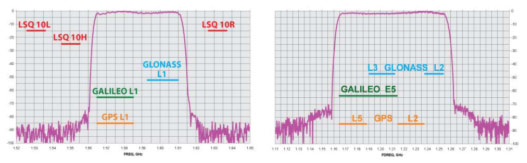
    Javad's FCC filing

    Figure left above is our filter that protects GPS L1, Galileo L1 and GLONASS L1 bands. It brings in all the useful signals intact and rejects out of band signals with the slope of about 12 dB/Mhz. Similarly, Figure right above is our filter that protects GPS L2, GPS L5, GLONASS L2 and Galileo L5 and has slope of about 9 dB/Mhz.

    These filters have been extensively tested with five different innovative tests and prove that the filters also improve the performance of GNSS receivers. These extensive innovative tests are embedded in the receivers that we mass-produce today and every user can test their receivers in all environments. These tests are much more extensive than those previously employed by PNT and other organizations. These embedded tests are not only much more extensive, but it takes only a few minutes to perform these by any novice user by clicking some receiver buttons. Compare that to the limited tests by PNT and others that took weeks to perform and needed experts with very expensive equipment in some laboratories to perform.

    Attached is our 8-page commercial advertisement that has more details on filters and embedded test features.

    These filters not only protect GNSS signals against all LightSquared signals (10L, 10H and 10R handsets) but also from all similar signals that may appear near all commercial GNSS bands in the future. We are proud that our filters help allow better usage of these precious bands, in particular for broadband wireless communication that our country desperately needs.

    These filters apply to wideband high precision GNSS receivers and the cost is even less than earlier conventional filters. The case of narrow-band low precision receivers (e.g. Garmin) is much simpler, as has been demonstrated by GPS receivers in more than 300 million cell phones and mobile devices which are not affected by LightSquared signals. The low precision receivers (L1 C/A code only) require filter slopes 10 times less steep than those presented here and do not necessitate additional costs.

    In summary, the technology exists today of improved filter design and better performing GNSS receivers and can actually be done at a cost lower than current conventional GNSS receiver filter designs. I trust that the information that I have presented can be used in establishing the performance guidelines and requirements for all GNSS receivers used in critical applications.

    I also would like to invite your representatives to ION-2012 GNSS conference where we present details and answer questions at 2:00 PM on September 20.

    Regards,
    Javad Ashjaee, Ph.D.
    Javad Ashjaee, Ph.D.
    CEO, Javad GNSS
    San Jose, California
    USA

  • GreenRoad to Offer Advanced Fleet Tracking from GPS Insight

    GreenRoad, a driver performance management company, and GPS Insight, a fleet GPS tracking provider, have announced that GreenRoad will offer advanced fleet tracking capability, provided by GPS Insight, as part of its GreenRoad driver performance management service. GreenRoad will integrate the GPS Insight solution and offer it to customers as GreenRoad Advanced Tracking.

    “GreenRoad delivers the best drivers on the road — safe, fuel-efficient and green,” said Jim Heeger, chief executive of GreenRoad. “As we’ve collected feedback about what more we can offer, we’ve consistently heard requests for integrated, advanced GPS tracking. The comprehensiveness, flexibility, and effectiveness of the GPS Insight service are truly impressive. Now, with the GPS Insight partnership, we can offer the tools to also create the most efficient fleets on the road. It is a powerful combination.”

    “GPS tracking is a natural complement to the GreenRoad driver performance management offering,” said Robert Donat, CEO of GPS Insight. “With the combination of these two capabilities, fleet operators will have all they need to optimize fleet efficiencies and maximize driver productivity.”

    The integrated solution, GreenRoad Advanced Tracking, will be available in the U.S. UK and Canada by the end of the year.

  • Hemisphere GPS Introduces Outback MAX with ConnX


    Hemisphere GPS has introduced Outback MAX with Outback ConnX — what it calls its “next-generation Outback Guidance system that redefines simplicity in precision farming.” Working seamlessly with Outback eDriveX with eTurns, the Outback MAX integrated display terminal provides a full array of features including section and variable rate control, Eclipse L1/L2 GPS and GLONASS guidance, and video support for up to four monitoring cameras, the company said.

    Outback MAX also provides wireless connectivity via the Outback ConnX data management system to deliver real-time data access and management that is imperative for modern farmers. ConnX provides seamless data transfer between the Outback MAX terminal, office, and service providers ensuring efficient, accurate decision making and farming operations. ConnX can automatically import and export data, engage customer service with remote control capability, and simplify connection to RTK correctors. ConnX is compatible with popular data platforms including AgJunction, AgVerdict, NutriScription HD, OptiGro, and Precision.Ag.

    “Hemisphere GPS has established a new level of innovation with Outback MAX that will substantially improve the accessibility and effectiveness of automated guidance and application control,” said Kip Pendleton, senior vice president and general manager of Agriculture at Hemisphere GPS. “The highly functional yet simple design of Outback MAX combined with the seamless connectivity between the field, office, and service providers greatly enhance the value that farmers can realize from precision farming techniques.”

    Building on the functionality of company’s successful, the feature-rich Outback S3, the Outback MAX adds a host of new features: simplicity in design and operation, a powerful mapping engine, excellent screen clarity, seamless connectivity, and a rugged design that can operate in rough environments — features that are critical to achieving the benefits of precision farming. Outback MAX incorporates the ability to create shortcuts and favorites for the most commonly used tasks, facilitating a short learning curve with simple access to important features, getting farmers up and running quickly, Hemisphere GPS said.


  • Safe Software at the ESRI International Users Conference 2012

    GPS World magazine interviews at the ESRI show, talking with Dale Lutz of Safe Software – FME.