Author: GPS World Staff

  • Leica Geosystems Promotes Revamped Online Store with Laser Discount

    To promote the relaunch of its online store, Leica Geosystems is offering a promotion for the Rugby 50 and 55 construction lasers. The redesigned B2C online store offers enhanced functionality, navigation features, and content to enable consumers to more easily and quickly find the tools and product information they need to make informed purchasing decisions. The enhanced customer-checkout functionality allows consumers to pay for products with the free payment service PayPal. Customers can also pay using Visa, Mastercard, American Express, or Discover cards. Users can purchase construction survey products directly from Leica Geosystems through the online store.

    “The re-launch of Leica Geosystems’ B2C online store is all part of our commitment to continually improve our customers’ experience and to develop innovative ways to increase brand awareness of our construction survey product lines,” said Reynolds Boyd, Leica Geosystems’ product marketing manager and principal manager of the online store.

    In line with this commitment is Leica Geosystems’ promotion of the latest additions to its construction laser family: the Leica Rugby 50 and Leica Rugby 55 interior and general construction rotating lasers. Customers have the opportunity to purchase these two construction lasers online at a reduced price. Until April 30, 2007, customers will receive $100 off Leica Rugby 50 packages and $125 off Leica Rugby 55 packages. These packages also include free second-day shipping.

  • Trimble Offers Training for Its Engineering and Construction Solutions

    Trimble has expanded its portfolio of training products with a suite of modules for the engineering and construction industry. Facilitated through an Internet-based enterprise learning management system, the training modules will be available to distribution partners and customers.

    Utilizing virtual reality technology, the interactive training modules provide simulations of how to use Trimble solutions. The simulation modules may be used as standalone training tools or as an integral part of a blended training program that encompasses e-learning and instructor-led training. Customers can access the simulation modules online and learn through hands-on training in the office or their home. An individual’s training history is recorded in the enterprise learning management system, providing a way of managing and tracking each person’s professional development.

    “The introduction of the Trimble Knowledge Network is an important element in our overall strategy within the Engineering and Construction segment,” said Chris Gibson, general manager for Trimble’s Global Services Division of the Engineering and Construction segment. “Providing a highly innovative, cost-effective and comprehensive training program enables our customers and partners to refine their training activities to optimize productivity and maximize their return-on-investment through the use of Trimble solutions.”

  • GPS Transmitter Frequencies

    Why are the two GPS Transmitter frequencies (1575.42 and 1227.6 MHz) coherently selected integer multiples of 10.23 MHz master clock?

    Question posted on CANSPACE on October 30, 2006, by Sivaraman Ranganathan.

    The document defining the GPS signal, IS-GPS-200, states that “The carrier frequencies for the L1 and L2 signals shall be coherently derived from a common frequency source within the SV.” This makes the L1 and L2 multiples of the common frequency source 10.23MHz. (Section 3.3.1.1). Why is this? I believe this is done for simplicity of system design and operation. All components of the signal (code, carrier, and navigation data) are derived from the atomic frequency standards on board the satellite. If this were not done and separate frequency sources were used, then biases between the different components would occur, which would have to be calculated and removed.

    IS-GPS-200 furthermore states in Section 3.3.1.8 that the C/A and P(Y) digital codes are as well derived from the same frequency standard. “All transmitted signals for a particular SV shall be coherently derived from the same on-board frequency standard; all digital signals shall be clocked in coincidence with the PRN transitions for the P-signal and occur at the P-signal transition speed. On the L1 channel the data transitions of the two modulating signals (i.e., that containing the P(Y)-code and that containing the C/A-code), L1 P(Y) and L1 C/A, shall be such that the average time difference between the transitions does not exceed 10 nanoseconds (two sigma)”.

    Despite the coherence of the two carriers, it is understood there is a difference between the radiated L1 and L2 signals due in part to the different paths the signals take within the on-board electronics. This is called the differential group delay and an estimate of this difference is broadcast to users in the navigation message. The difference between L1 P(Y) and L2 P(Y) is designated Tgd (reference paragraph 20.3.3.3.3.2). The difference between L1 P(Y) and L2C is called the Inter-Signal Correction (ISC) (reference paragraph 30.3.3.3.1.1).

    For further technical discussion of this topic, see the book Global Positioning System, Signals Measurements, and Performance by Pratap Misra and Per Enge (section 2.3.1).

    John Lavrakas, President

    Advanced Research Corp.

  • Why are GLONASS satellites launched on Christmas Day?

    Why are GLONASS satellites launched on Christmas Day? Question posted on CANSPACE on December 10, 2006, by Kerry Matthews

    The latest triple-satellite GLONASS launch occurred on December 25th at 23:18 Moscow Time. This launch is the sixth GLONASS December launch in a row. In fact, all 9 launches since December 1995 have occurred in the last month of the year with the exception of the launch on October 13th, 2000 (see a list of GLONASS launches going back to 1990).

    Including this month’s launch, three of the recent launches have occurred on December 25th and one originally scheduled for the 25th, occurred on the 26th. Why the preponderance of December launches and launches on Christmas Day in particular?

    First of all, we should realize that for most people in the Russian Federation, there is nothing special about December 25th. Most Christians in Russia belong to the Russian Orthodox Church which celebrates Christmas according to the Julian calendar — on January 7th. And in modern Russia, January 7th is a state-wide holiday. So, GLONASS launches don’t occur around December 25th because it’s a special day on the Russian calendar. So why do they occur then?

    I posed this question to Col. (ret.) Nikolai Shienok, the former chief of the Information Department of the Coordination and Scientific Information Center of the Russian Ministry of Defense. After conferring with officials from Roscosmos (the Russian space agency) responsible for the GLONASS program, Col. Shienok confirmed that it is only for financial or organizational reasons that there is a preponderance of launches in December. “It is the last month of the year and it is impossible to postpone a planned launch further” Col. Shienok said.

    Nevertheless, there may be some operational calendar constraints on GLONASS satellite launches as there are for launches of other satellites. Satellite operators typically try to avoid launching satellites when the Sun-orbit-plane or beta angle for the intended orbit is unfavorable. The beta angle is the angle between the geocentric position vector to the Sun and the satellite’s orbital plane. This angle determines if and for how long a satellite will be in the Earth’s shadow during its orbit. For a given orbit (altitude, inclination, and initial right ascension of the ascending node), the beta angle will vary over the year. Operators try to avoid a launch date when the satellite would be in eclipse for a significant fraction of its orbit so that during the crucial satellite deployment and commissioning phase, the satellite’s solar panels receive as much sunlight as possible to keep the satellite’s batteries fully charged. The recent GLONASS launch put the satellites into Plane 2 which is actually in one of its eclipse seasons right now. However, the satellites will be out of eclipse by early January.

    Prof. Richard B. Langley

    Dept. Geodesy and Geomatics Engineering

    University of New Brunswick

  • Innovation: The International GNSS Service: Any Questions? (PDF)

    Innovation: The International GNSS Service: Any Questions? (PDF)

    By Angelyn W. Moore

    Published: January 2007 GPS World

    In this month’s column, Angelyn Moore, the IGS Central Bureau’s deputy director, overviews the organization’s service, history, and future, demonstrating that the IGS is a model of scientific collaboration of which not just the GNSS community but the whole world should be proud.—Richard Langley

  • Seen + Heard: GPS Adventure Game Out the Window

    Seen + Heard: GPS Adventure Game Out the Window

    GPS DATA maintains a 3D model that keeps a car correctly positioned while passengers hunt down werewolves.
    GPS DATA maintains a 3D model that keeps a car correctly positioned while passengers hunt down werewolves.

    Looking out the window during a long car trip becomes an interactive adventure with a new GPS-based game developed by The Interactive Institute in Stockholm, Sweden. The Backseat Playground uses GPS to turn passing sights such as forests, buildings, and rivers into locations for in-game characters and events, reports New Scientist magazine. Backseat Playground consists of a GPS receiver, a handheld computer, and headphones connected to a laptop in the trunk of the car.

    A geographical database extending over an area of 35 square kilometers in Stockholm matches events in the game to suitable locations. Game characters and events are all generated dynamically during the car trip. As the car travels its route, the player receives phone calls and messages from in-game characters. The team has received positive initial feedback and hopes to add voice recognition to the set-up. “Being able to talk directly to the characters would be great,” said co-creator John Paul Bichard.

    GPS tagging will help determine the size of protected area the snow leopard needs.

    In the Know Over Snow Leopards

    In the first study of its kind, a female snow leopard received a GPS collar that will provide researchers with precise data on the endangered animal’s movements and habitat use, reports BBC News.

    The 78-pound snow leopard was captured November 17 in Chitral Gol National Park in northern Pakistan.

    Their solitary nature, the steep, rocky terrain they inhabit, and typical twilight activity make snow leopards extremely difficult to study, say researchers. The project, carried out jointly by the Snow Leopard Trust, the Northwest Frontier Province Wildlife Department, and WWF-Pakistan, seeks to collar as many as five of the rare, elusive cats with GPS over the next several months.

    Geotagging: Giving Photos Context

    The New York Times highlighted the value of geotagging in a lengthy November 2 feature story, “Pictures, With Map and Pushpin Included.” Geotagging enables users to plot where they have taken their pictures.

    “It’s kind of a geek obsession,” said Kathleen Bennett, a software engineer and amateur photographer. “But it’s also a combination of the geek aspect, the community aspect, and the love of good old-fashioned travel photography.”

    Stewart Butterfield, co-founder of the photo-sharing website Flickr, says linking pictures to maps lends a new dimension to photography, helping people make sense of the mounds of photos accumulating on their hard drives.

    “The value may not be immediately apparent,” Butterfield said. “But 10 years from now, nobody who’s geotagging their photos is going to regret it. Most people have just one or two or three iconic photos of their grandparents. Now people are going to have tens of thousands of photos, and when that happens, every little bit of context helps.”

  • The Business — January 2007

    » AVIONICS & TRANSPORTATION

    Pay As You Drive Insurance Gets Brit Road Test

    Under a plan offered by British insurer Norwich Union, GPS helps determine how much drivers pay for their auto insurance.

    The company’s Pay As You Drive plan uses GPS to calculate monthly insurance premiums based on how often, when, and where a person drives, basing the premium on the individual’s driving habits — rather than everyone else’s — and potentially saving the customer some money.

    A black-box GPS unit provided by Trafficmaster is installed in the trunk or under the dashboard so it cannot be disturbed or tampered with. Once the unit is fitted on the car, the insured motorist’s journeys are monitored to see what types of road they drive on, and whether they drive at peak or off-peak times. This generates a price per mile that is totaled on their monthly bill.

    The objective is to help drivers control insurance costs by making informed choices about when to use the car. Examples of pricing might be 1 penny per mile for off-peak motorway driving for 24 to 65 year olds, and as much as £1 per mile for an under 24-year-old driver at night.

    Norwich Union has been piloting the project since 2004, with 5,000 customers recording data on 100 million miles from more than 10 million trips.

    The program especially targets young motorists. “We tested young drivers because they have an issue with high insurance charges so we wanted to find ways to help them,” said Norwich Union’s product development manager Sue Rowland. “On average, they saved 30 percent on their premium.”

    The Pay As You Drive bill looks similar to a mobile phone bill, with premiums for each journey calculated and totaled. According to Iain Napier, director of Pay As You Drive insurance, this transparent approach to motor insurance will help customers control insurance costs.

    “We’re confident that Pay As You Drive insurance is simply a fairer way of calculating premiums and gives customers greater control, flexibility, and choice,” Napier said. “That is why we expect this unique UK proposition to be a huge success with motorists.”

    The Association of British Drivers (ABD) is not fond of the plan. “Aside from the obvious implications for privacy and civil liberties, the ABD warns drivers that this information can also be used for the government’s planned road charging scheme.” In that proposal, aimed at cutting congestion, “pay-as-you-go” road charges would replace road and gas taxes. Every vehicle would be equipped with a GPS black box to track its journey. Costs would range from as little as 2 cents per mile in rural areas to £1.34 per mile for peak time in city areas.

    An ABD spokesman who participated in the initial 5,000-vehicle trial said, “Insurance premiums are already based on a driver’s accident/ conviction history, age, the number of miles traveled annually, and the vehicle’s insurance group. Why do we need to attempt a micro-managed premium calculation? We don’t. The government’s own research shows that they are not trusted with an individual’s personal journey details by the majority of the British public. The use of service providers, such as insurance companies, is seen as a way around the problem.”

    Norwich Union is the UK’s largest general insurer with a market share of around 14 percent, and a focus on insurance for individuals and small businesses.


    » LOCATION-BASED SERVICES

    Philips Exits PND Market Before Entry

    Philips Electronics, the Netherlands-based electronics giant that is Europe’s largest consumer electronics company, said in June, 2006, that it would enter the personal navigation device (PND) market in the fall, to compete with Garmin, TomTom, Magellan, and other PND makers. But it abruptly pulled the plug on that effort in early December, stating that it was no longer interested. A spokesperson confided that the company had watched the market closely and decided it was too crowded.

    This marks the second time Philips has retreated in this sector. Although its Carin system was an early dedicated in-vehicle nav system (circa 1990), and the company was an early investor in NavTeq, it later abandoned that market.

    The booming European PND market, which analysts say could double to about 5 million units, has attracted Japanese consumer-electronics giants as well as many smaller Taiwanese manufacturers. Hardly a day goes by without a trumpeting of a new PND, often from a company heretofore unheard of in GPS and nav circles.

    “It’s a very competitive market and it puts a lot of pressure on profit margins,” stated the Philips spokeperson. “We decided we need some focus, and navigation devices like these don’t fit within this focus.”

    The company remains interested in GPS in general, but not for stand-alone products. “We don’t want to go further with GPS as a single device, but it’s an interesting technology to implement in other products,” she added. Mobile phones or digital music players remain as possible candidates for GPS capabilities.


    » TRANSPORTATION & AVIONICS

    Trimble Acquires @Road, Spacient

    Trimble will acquire @Road, Inc. of Fremont, California for $496 million. This expands Trimble’s role in mobile resource management (MRM), formerly known as fleet tracking. Trimble acquired Spacient Technologies, an MRM software supplier, in November.

    An early sector pioneer, @Road has a scalable software infrastructure, relationships with telecom carrier partners, system integrators, and a strong field presence in transportation, distribution, telecommunications, utilities, facilities management, and public works. This complements Trimble Mobile Solutions division’s business in construction supply, store delivery, and public safety.

    Frost and Sullivan forecasts MRM growth to $2.6 billion by 2010, from $1.2 billion in 2006.


    Carnegie Mellon’s Sandstorm racer, veteran of both Mojave and
    Grand Challenges

    » MILITARY & GOVERNMENT

    Driving for Dollars: Urban Challenge Purse Put at $3.5 Million

    The Defense Advanced Research Projects Agency (DARPA) will award $2 million, $1 million and $500,000 awards to the top three robotic finishers who complete its new Urban Challenge course in November 2007.

    Under Secretary of Defense for Acquisition, Technology and Logistics Kenneth J. Krieg approved the cash prizes, evidencing the Department’s interest in making one-third of all combat vehicles — principally supply vehicles — driver-less by 2015.

    DARPA has staged two desert Grand Challenges, in 2004 and 2005 in the Mojave, with significant difficulties posed by geography and terrain. The 2007 Urban Challenge will feature fully autonomous ground vehicles conducting simulated military supply missions in a mock urban area. The race will take place on November 3, 2007, at a location to be announced later, in the western United States.

    Robotic vehicles will attempt to complete a 60-mile course through traffic in less than six hours, operating under their own computer-based control. Vehicles must obey traffic laws while merging into moving traffic, navigating traffic circles, negotiating busy intersections, and avoiding obstacles.

    Learning Curve. Participants in past Grand Challenges have truly risen to the occasion, learning and innovating as they go. The number of sensors and software applications integrated into most of the experimental vehicles increased dramatically between the first and second races. Inertial sensors proliferated, with cost, size, and power consumption going down, while performance went up. Inertial systems, along with various camera/vision apparati, function as the workhorses covering the ground in most of the vehicles. GPS generally teams with a central processing unit (CPU) to act as the brain guiding the process.

    William “Red” Whittaker of Carnegie Mellon University’s Robotics Institute and Louis Nastro of Applanix Corporation co-authored a detailed technical article in September 2006 GPS World on their experience with the students of Carnegie Mellon’s Red Team Racing effort, designing and outfitting two vehicles that competed and placed in the 2005 race.

    To qualify for the race or simply watch, see the Grand Challenge website for additional information and rules for the Urban Challenge.


    » AGRICULTURE & NATURAL RESOURCES

    Accuracy on the Move

    The American Society of Agricultural and Biological Engineers (ASABE) announced an effort to develop a standard on the dynamic accuracy of GPS equipment used in precision agriculture. In unveiling Project X587, Assessment and Reporting of GPS Receiver Dynamic Accuracy, in its October 2006 newsletter, the Society states: “GPS receivers are used in many agricultural field operations. There are standards in place to guide assessment of the static accuracy of GPS receivers, but static performance is not always indicative of the performance when the receiver is used dynamically.”

    The ASABE seeks to develop such dynamic accuracy standards to enable evaluation of moving GPS units. Farmers spend thousands of dollars on mobile, high-precision GPS units that are components of tractor guidance systems, variable-rate application equipment, and crop- yield monitoring equipment. The proposed standards will provide prospective purchasers with a benchmark to compare the specifications of units for accuracy.

    Current specifications assume that GPS units that monitor satellite signals five times per second deliver greater positional accuracy than units that monitor the signals one time per second. The proposed ASABE standards will provide a more definitive measurement on the way GPS units must function on moving vehicles.


    » LOCATION-BASED SERVICES

    Cingular TeleNavs Mobiles

    Cingular Wireless has launched its first generally available, location-based service with TeleNav Inc’s GPS Navigator. Cingular business and government customers can get turn-by-turn voice and onscreen GPS directions, while driving or walking, on Cingular business devices including the HP iPAQ hw6920 and hw6500 Mobile Communicators, the Cingular 8125 Pocket PC, and the Palm Treo 650. The latter two devices require a Bluetooth GPS receiver. A GPS receiver is built into the Mobile Communicators. Features include:

    • full-color moving maps
    • a “Biz Finder” for locating nearby businesses such as cash machines, restaurants, hotels, and gas stations
    • a spot marker for locating a parked car
    • a fuel finder for finding low gas prices
    • pedestrian mode.

    Pricing is $5.99 per month for up to 10 trips, or $9.99 per month for unlimited trips.

    “Location-based services on wireless phones have disrupted the navigation market and created a more versatile solution for both businesses and consumers,” said Ken Hyers, principal mobile wireless analyst at ABI Research, of the launch of TeleNav GPS Navigator.


  • The System — January 2007

    And Not Fade Away

    Old Block IIA Sat Reactivated for Tests

    SVN23, the first Block IIA satellite to be launched (as PRN23), has been reactivated as PRN32. This satellite was launched on November 26, 1990, and initially decommissioned on February 13, 2004, after more than 13 years of service. SVN23/PRN32 is in slot E5 and is operating on its Rb2 clock.

    PRN32 was last used by SVN32. It used that code until January 28, 1993, when its code was switched to PRN01.

    It is believed that SVN23 was initially reactivated with a non- standard code that cannot be tracked by standard GPS receivers. However, on December 2, it started to transmit the standard PRN32 code. Nevertheless, the satellite was set unhealthy as it reportedly had been reactivated only for test purposes.

    Richard Langley provided this information in a footnote to his Navstar GPS Constellation Status report of November 4, 2006, posted to users of the CANSPACE list service (contact [email protected] to subscribe). As reported by Stephan Schaer of the Center for Orbit Determination in Europe, some “all-in-view” stations of the IGS tracking network (which can track both healthy and unhealthy satellites) began receiving SVN23/ PRN32 signals on December 2. However, it seems that some manufacturers’ receivers were unable to track a satellite with a PRN number of 32.

    On December 7, the GPS Operations Center at Air Force 2nd Space Operations (2SOPs) issued this Notice Advisory to Navstar users (NANU): “An initial assessment period for SVN 23 utilizing PRN 32 was accomplished 1 December to 6 December 2006; SVN 23 is no longer transmitting L-band.

    “During this assessment period SVN 23 was broadcasting L-band and set unhealthy. SVN 23 was not included in the operational constellation almanac.

    “Any users that experienced unusual performance from GPS user equipment during this period should contact the GPS Operations Center.

    “Approximately 10 January 2007, SVN 23 utilizing PRN 32 will be turned on; transmitting L-band and kept unhealthy. SVN 23 will still not be included in the operational constellation almanac. The GPS Operations Center will transmit a General NANU reminding users of this activity.”

    Testing, Testing. As reported in the November, 2006 issue of this magazine, the Air Force issued an earlier memorandum stating that the November 17 launch of SVN58/PRN12 would set a new mark of 31 operational satellites, and that operational control could go beyond 32 satellites. As most current civil receivers are set at 31, this has important ramifications that manufacturers should consider.

    The GPS Operations Center continues to seek feedback on potential impacts the largest-ever GPS constellation may have on users and equipment. “Although future versions of our interface spec, IS-GPS-200, will accommodate a larger constellation for the next-generation GPS, the most pressing concern is with potential impacts to existing fielded GPS receivers that may not properly account for up to 32 operational PRNs.”

    The early December and January L-band broadcasts by SVN 23 may represent tests to assess various aspects of that future eventuality.

    This One’s for Real. Meanwhile, the new GPS IIR-M satellite SVN58/ PRN12 was declared operational on December 13.


    Galileo Guess Who

    EU States Vie to Host Supervisory Authority

    No fewer than eleven European Union (EU) member states have their hands in the ring to grab hosting of the Galileo Supervisory Authority, tasked to take over from the Galileo Joint Undertaking on January 1, 2007, and manage the EU satellite navigation program. Ministerial meetings among the candidate states could not resolve the matter, nor could the EU leaders’ summit, December 11-12, make the politically charged decision.

    Deliberations were postponed until the incoming German presidency in January and the next Transport Council meeting in February. Discussion focused on whether the decision should respect an agreement reached in 2003 providing for the new member states to be given priority in hosting new agencies.

    Race Card. Eleven countries have ponied up their candidate sites: Belgium (Brussels), the Czech Republic (Prague), France (Strasbourg), the Netherlands (Noordwijk), Italy (Rome), Malta (Valetta), Germany (Munich), Greece (Athens), Slovenia (Ljubljana), the United Kingdom (Cardiff), and Spain (Barcelona).

    According to the EU protocol, new “decentralized” agencies should go to new member states, that is, predominantly those in Eastern Europe. Only Poland currently hosts one of these, and all the founding 15 states already have an agency. So, presumably, Malta, Slovenia, and the Czech Republic would appear to have pole position. They are truly dark horses, however, as national contributions to the Galileo budget run much higher in the industrialized, space-age West, and these commitments come with significant quid pro quo.

    Security. Concern has surfaced from some old member states about the security of the site, since the agency will oversee highly sensitive information. The Czech Republic is making a particularly strong push for host designation, witha Czech spokesperson later stating “Prague has fulfilled the security conditions.” Angered by the debate — which may or may not represent a stalking horse for more real economic motives — the Czechs could block a move to host in an old member state city, with the UK’s Cardiff seen a strong candidate. Germany and France have already landed plum Galileo sites, and Italy and Spain have secured backup/secondary hostings. Only the UK, of the Galileo Big Five, remains out in the cold.

    Agency hosting brings jobs, direct economic benefits, and enhanced prestige. It also entails correlative conference hosting attracting international participation — and closer contact for national industry that could lead to further contracts.

    Governments compete by offering the best buildings with desirable, largely metropolitan locations, and requiring only token rent. The model was set in this regard a few decades ago, when a farsighted mayor of Noordwijk, the Netherlands, offered a substantial plot of ground virtually free to the nascent European Space Agency (ESA).

    Whether the EU will stick to its principles or opt pragmatically remains to be seen. Meanwhile, some observers recall Italian prime minister Silvio Berlusconi’s pouting when the EU food agency appeared headed for Helsinki: “They don’t know prosciutto” — or words to that effect.

    The agency ended up in Parma.

    GPS III Faucet Opened

    $50M Design Contracts Awarded

    Co-competitors Lockheed Martin Space Systems Corp. and Boeing Co. each received a $49,999,000 cost-plus-fixed fee contract modification to accomplish a GPS III system design review (SDR) in March 2007, towards a key decision point B in June, 2007: the award of a multi-billion dollar development contract for building GPS III. Headquarters Global Positioning Systems Wing, Los Angeles Air Force Base, California, is the contracting entity. Lockheed Martin leads a team that includes ITT and General Dynamics.

    The next-generation GPS Block III “will address the challenging military transformational and civil needs across the globe, including advanced anti-jam capabilities and improved system security, accuracy, and reliability.”

    In early 2005, the GPS III program was restructured from an FY12 first launch to no later than an FY13 first launch.

    In September, 2006, the U.S. Air Force announced plans to offer a “healthy incentive” to the prime GPS III contractor for launching the first III satellite in 2011, instead of the current projected 2013 date. Lieutenant General Michael Hamel, Commander, Space and Missile Systems Center, stated “We believe speed-to-market is a key element of our future success.”

    GPS III contract incentive fees will shift from qualitative to a quantitative basis, structured around cost, schedule, and technical performance.

    Co-competitors Lockheed Martin Space Systems Corp. and Boeing Co. each received a $49,999,000 cost-plus-fixed fee contract modification to accomplish a GPS III system design review (SDR) in March 2007, towards a key decision point B in June, 2007: the award of a multi-billion dollar development contract for building GPS III. Headquarters Global Positioning Systems Wing, Los Angeles Air Force Base, California, is the contracting entity. Lockheed Martin leads a team that includes ITT and General Dynamics.

    The next-generation GPS Block III “will address the challenging military transformational and civil needs across the globe, including advanced anti-jam capabilities and improved system security, accuracy, and reliability.”

    In early 2005, the GPS III program was restructured from an FY12 first launch to no later than an FY13 first launch.

    In September, 2006, the U.S. Air Force announced plans to offer a “healthy incentive” to the prime GPS III contractor for launching the first III satellite in 2011, instead of the current projected 2013 date. Lieutenant General Michael Hamel, Commander, Space and Missile Systems Center, stated “We believe speed-to-market is a key element of our future success.”

    GPS III contract incentive fees will shift from qualitative to a quantitative basis, structured around cost, schedule, and technical performance.


    Modern Space Receiver

    ITT Corporation and General Dynamics each received a contract from the GPS Wing to develop a modernized space receiver (MSR) to operate in space on low-earth orbit satellites and capable of receivng new, modernized GPS signals. Each will prepare a proposal for full-scale development of the MSR, to be presented to the GPS Wing in mid-2007, and one will be chosen to complete the project.

  • Business Outlook: Critical GNSS: Safety, Financial, and Legal

    Business Outlook: Critical GNSS: Safety, Financial, and Legal

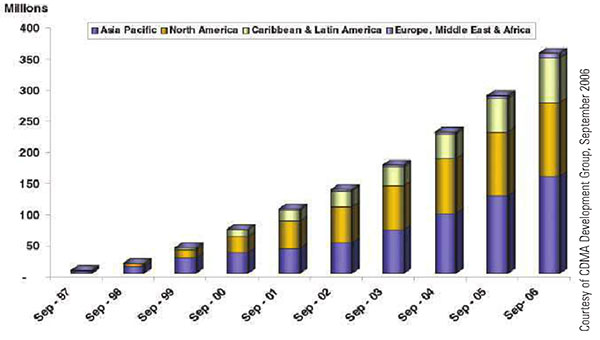
    Figure 1. Global CDMA subscribers. CDMA cellular infrastructure uses GPS for synchronization and optimal performance. Location-based billing will require GNSS integrity.
    Figure 1. Global CDMA subscribers. CDMA cellular infrastructure uses GPS for synchronization and optimal performance. Location-based billing will require GNSS integrity.

    By Vidal Ashkenazi

    The use of satellite navigation in civil aviation and other safety-critical navigation applications drove the development of satellite-based augmentation systems and differential networks to track and augment GPS, providing the prerequisite levels of accuracy, integrity, coverage, and availability. Deployment and operation of Galileo — independent, compatible, and interoperable with GPS — will significantly add to the levels of accuracy, coverage, and system integrity.
    Meanwhile, safety-critical transportation is no longer the only critical application considered for satellite navigation and positioning. New and developing financial-critical, business-critical, security-critical, legal-critical and government- policy-critical applications demand levels of coverage, integrity, and availability matching those of safety-critical transportation.

    Consider road user charging (RUC) proposed by the British government to replace the current fixed annual road tax, which only depends on a vehicle’s size and pollution rating. RUC is based on taxing a car owner who drives only on country roads less than another driver who uses city centers and motorways, often during rush hours, contributing to traffic jams and pollution. It would be fairer if road taxing were based on when, where, and how you drive. The same principles also apply to car insurance and city-center congestion charging.

    So far, all seems straightforward. But consider that with direct telematic links to individual bank accounts, these charges could be debited automatically, or invoiced and debited like monthly utility bills. Once money is involved, the operation becomes financially-critical. There is a need to demonstrate that such charges not only have high accuracy and integrity, but that they are “correct, beyond all reasonable doubt”.

    As a scientist and an engineer, I have always used the terms “statistical levels of accuracy and integrity.” This is the first time in my scientific life that I have to use that statistically meaningless, unspeakable term “correct”, which implies 100 percent of certainty. GNSS, this is your challenge!

    The same is true of the timing of stock exchange transactions and location-based billing via mobile phones. As the levels of accuracy, coverage and integrity of GNSS improve, so will the credibility of satellite positioning as a highly accurate, reliable tool for economically-critical applications.

    It is difficult to distinguish between security-critical and legal-critical navigation and positioning applications. Both types will require very high levels of accuracy, coverage, and integrity, but most applications that start as security-critical may end up in a court of law and become legal-critical. Examples include tracking precious or hazardous cargos, tracking suspected individuals or criminals released on parole, the location of suspect mobile phone calls, and the positioning of fishing vessels inside territorial waters.

    Lastly, many government/policy-critical navigation applications connected with police, fire and ambulance services, national security, and emergencies will require secure/encrypted GNSS signals. In the United States, where GPS is directed by the PNT Executive Committee, co-chaired by the DoD and the DoT, this should not present a problem, because the system is considered a fully dual military-civilian navigation tool. This is not the case in Europe, which has yet to define the framework for governance and use of the Public Regulated Service within EU member states, and the status of non-EU states proposing to collaborate on Galileo.


    VIDAL ASHKENAZI is CEO of Nottingham Scientific Ltd., a UK-based company involved in Galileo since its earliest phase. He is a charter member of GPS World’s Editorial Advisory Board since 1990. This article is excerpted from his keynote address at IAIN World Congress 2006 held in Korea.

  • GPS Adventure Game Out the Window

    GPS Adventure Game Out the Window

    GPS DATA maintains a 3D model that keeps a car correctly positioned while passengers hunt down werewolves.
    GPS DATA maintains a 3D model that keeps a car correctly positioned while passengers hunt down werewolves.

    Look out the window — is a werewolf hiding behind that tree?

    Looking out the window while on a long car trip can be an adventure with a new GPS-based game being developed by The Interactive Institute in Stockholm, Sweden. The Backseat Playground uses GPS to turn passing sights like forests, buildings, and rivers into locations for in-game characters and events, reports New Scientist magazine. Backseat Playground consists of a GPS receiver, a handheld computer, and headphones — all connected to a laptop in the trunk of the car. A database of geographical information is used to match events in the game to suitable locations. Game characters and events are all generated dynamically during the car trip.

    The game begins with a radio newsflash, relayed by the handheld computer, which places a passenger at the start of a murder mystery or a werewolf thriller. As the car travels along its route, the player receives further phone calls and messages from in-game characters.

    Players interact mostly by listening; minimal graphics are involved, according to the designers. “It’s like a novel,” said John Bichard, who created Backseat Playground with colleagues Liselott Brunnberg and Oskar Juhlin. “We are trying to suggest spaces and places and events and have the user fill in the gaps to build a narrative.”

    For now, a prototype now being evaluated only works over an area of 35 square kilometers in Stockholm. Initial feedback has been positive, and the team hopes to add voice recognition to the set-up. “Being able to talk directly to the characters would be great,” Bichard said.

    We’ve always wondered what those werewolves had to say.

  • Philips Exits PND Market Before Entry

    Philips Electronics, the Netherlands-based electronics giant that is Europe’s largest consumer electronics company, said in June 2006 that it would enter the personal navigation device (PND) market in the fall, to compete with Garmin, TomTom, Magellan, and other PND makers. But it abruptly pulled the plug on that effort in early December, stating that it was no longer interested. A spokesperson confided that the company had watched the market closely and decided it was too crowded.

    This marks the second time Philips has retreated in this sector. Although its Carin system was an early dedicated in-vehicle nav system (circa 1990), and the company was an early investor in NavTeq, it later abandoned that market.

    The booming European PND market, which analysts say could double to about 5 million units, has attracted Japanese consumer-electronics giants as well as many smaller Taiwanese manufacturers. Hardly a day goes by without a trumpeting of a new PND, often from a company heretofore unheard of in GPS and nav circles.

    “It’s a very competitive market and it puts a lot of pressure on profit margins,” stated the Philips spokeperson. “We decided we need some focus, and navigation devices like these don’t fit within this focus.”

    The company remains interested in GPS in general, but not for stand-alone products. “We don’t want to go further with GPS as a single device, but it’s an interesting technology to implement in other products,” she added. Mobile phones or digital music players remain as possible candidates for GPS capabilities.

  • Cingular Launches LBS with TeleNav

    Cingular Wireless has launched its first generally available, location-based service with TeleNav Inc’s GPS Navigator. Cingular business and government customers can get turn-by-turn voice and onscreen GPS directions, while driving or walking, on Cingular business devices including the HP iPAQ hw6920 and hw6500 Mobile Communicators, the Cingular 8125 Pocket PC, and the Palm Treo 650. The latter two devices require a Bluetooth GPS receiver. A GPS receiver is built into the Mobile Communicators. Features include:

    • full-color moving maps
    • a “Biz Finder” for locating nearby businesses such as cash machines, restaurants, hotels, and gas stations
    • a spot marker for locating a parked car
    • a fuel finder for finding low gas prices
    • pedestrian mode.

    Pricing is $5.99 per month for up to 10 trips, or $9.99 per month for unlimited trips.

    “Location-based services on wireless phones have disrupted the navigation market and created a more versatile solution for both businesses and consumers,” said Ken Hyers, principal mobile wireless analyst at ABI Research, of the launch of TeleNav GPS Navigator.