Category: Timing

  • Facebook chooses u‑blox timing to speed up data centers

    Facebook chooses u‑blox timing to speed up data centers

    Facebook has open-sourced the design of its time card, which features the ultra-precise u‑blox ZED-F9T timing module, providing easy access to nanosecond-level timing

    Photo: u-blox
    Photo: u-blox

    Facebook has chosen the u‑blox ZED-F9T GNSS receiver module for timekeeping, according to u-blox. By improving the synchronization of networked computers, Facebook’s time card can significantly speed up the performance of its data centers and distributed databases.

    By open-sourcing their designs, Facebook has bolstered the adoption of highly accurate timing solutions based on u‑blox technology. These solutions can be adopted by other industries requiring nanosecond-level timing, such as 5G cellular networks or smart power grids.

    Facebook set out to create a precise timing solution that reduces the computational overhead required when synchronizing the timing between different computers in a network, u-blox said. The social media company used a u‑blox ZED-F9T multi-band GNSS receiver to sync up its solution with the highly accurate GNSS atomic clocks. To bridge possible gaps in GNSS coverage and keep clock drift to a minimum, the time card contains a backup timing source: a miniaturized atomic clock continuously synchronized with GNSS time.

    To maximize the impact of the solution, Facebook decided to open-source the design of its time card, which fits onto a PCIe form factor. Anyone with experience working with microelectronics can turn any PC built on an x86 architecture and featuring a network interface controller into a nanosecond-level-accurate timing and synchronization solution, u-blox said.

    Easy access to nanosecond-level timing accuracy — based on the u‑blox RCB-F9T timing board, which hosts the u‑blox ZED-F9T GNSS receiver — opens new avenues in industry segments that rely on highly synchronized signals, such as 5G network base stations that require tighter synchronization than those of previous generations, u-blox said.

    As power-distribution networks become more complex to accommodate a growing share of decentralized renewable energy, they are becoming more reliant on reliable and accurate timing solutions. Data centers and computer networks will be able to modernize infrastructure management to speed up performance and reduce latencies.

    Facebook has shared the GitHub repository including the specs, the schematics, the mechanics, the bill of material, and the source code in partnership with the Open Compute Project (OCP) under the Time Appliance Project (TAP).


  • ADVA responds to government concerns with assured PNT services

    ADVA responds to government concerns with assured PNT services

    Company responds to calls for stronger national resilience against GNSS vulnerabilities and cyber threats to PNT services

    Photo: ADVA
    Photo: ADVA

    ADVA has responded to calls from the U.S. Department of Homeland Security (DHS) and the National Institute of Standards and Technology (NIST) to protect critical infrastructure from the growing danger of GNSS vulnerabilities and cyber threats to positioning, navigation and timing (PNT) services with the launch of its aPNT+ platform.

    The scalable aPNT+ platform meets all the latest guidelines for resilient PNT, the company said. It provides end-to-end control and timing network visibility for robust protection against the catastrophic risks that PNT disruption poses to national security and essential assets such as power grids.

    “Cyber threats are at an all-time high. At the same time, the infrastructure that our economies and lives depend on has never been more reliant on weak and highly vulnerable satellite signals. That’s why the U.S .DHS and NIST are driving for PNT services to be more resilient and for network operators to implement strategies to counteract the vulnerabilities of GPS and other GNSS systems, including in-network PTP timing feeds. Our trusted aPNT+ platform is the definitive response,” the company said.

    Governments worldwide have issued guidelines to protect businesses and society from disruption to PNT services, including US Executive Order 13905, which was followed by the DHS Resilient PNT Conformance Framework and NIST Cybersecurity Framework for PNT Profile. The government guidelines urge operators to swiftly implement technologies and measures to safeguard vital infrastructure.

    Based on these guidelines, ADVA integrated an intelligent and scalable aPNT platform into its product portfolio. Even without GPS or GNSS timing, the solution provides an intelligent, end-to-end self-recovery system designed around a three-fold framework. Integrating sophisticated multi-layer detection, multi-source backup and multi-level fault-tolerant mitigation, it delivers high levels of resilience, robustness and cybersecurity. It integrates the DHS framework’s four levels of PNT resilience while also providing enhanced level-four resilience, the highest level for trusted PNT services assurance.

    “For industries and governments, timing is now a critical service in need of urgent protection,” said Gil Biran, general manager, Oscilloquartz, ADVA. “Being open and scalable, it offers an end-to-end range of cost-effective solutions… for augmented resilience, robustness and cybersecurity.”

  • NextNav, Satelles collaborate on Bay Area alternative PNT testbed

    NextNav, Satelles collaborate on Bay Area alternative PNT testbed

    Technology evaluation capabilities inaugurated in demonstration for U.S. Department of Homeland Seurity

    NextNav and Satelles Inc. have partnered on an alternative positioning, navigation and timing (PNT) testbed in the San Francisco Bay area.

    Designed and managed by NextNav with a timing source from Satelles, the testbed creates scenarios and conditions to rigorously test the precision and resilience of alternative PNT solutions, allowing technologies to be evaluated in the absence of signals from GPS and other GNSS.

    NextNav used the testbed to demonstrate the precision and resilience of the company’s TerraPoiNT network in a GPS-denied environment using STL from Satelles as its absolute timing source. This demonstration for the U.S. Department of Homeland Security (DHS) showcased the timing accuracy and resilience of TerraPoiNT, which delivered timing synchronization better than 50 nanoseconds in urban and semi-urban settings.

    As a source of GPS/GNSS-independent time that the U.S. National Institute of Standards and Technology (NIST) determined is highly consistent with Coordinated Universal Time (UTC) — including in deep indoor environments — STL provided the timing signal for the demo instead of GPS.

    The advent of the alternative PNT testbed is timely given the recent publication of “Understanding Vulnerabilities of Positioning, Navigation, and Timing” by the Cybersecurity and Infrastructure Security Agency (part of DHS). This important CISA publication urges owners and operators of critical infrastructure to adopt the responsible use of PNT as defined in Executive Order 13905. The new testbed will be used to demonstrate applications for emergency services, telecommunications, financial markets, the electrical grid, and other critical infrastructure sectors.

    “Demonstrating the accuracy and resilience of alternative PNT solutions is integral in validating the capabilities of alternative PNT solutions and, ultimately, increasing adoption across use cases and applications,” said Ashu Pande, TerraPoiNT VP at NextNav. “With the development of this testbed, we can emulate real world deployment scenarios and can more effectively instill confidence across the PNT industry in the viability of alternate PNT solutions.”

    “The development of this testbed will enable the rigorous, transparent, and replicable testing of alternative PNT solutions,” said Christina Riley, VP of Commercial PNT at Satelles. “We’re excited to be integrated as the GNSS-independent timing reference for this alternative PNT testbed and are looking forward to continuing our collaborative work to build stronger PNT solutions to augment GPS globally.”

    The U.S. Department of Transportation categorized TerraPoiNT from NextNav and STL from Satelles as the top-ranked PNT systems in its technology demonstration report released in January. The testbed collaboration between these complementary alternative PNT service providers underscores the companies’ commitment to promoting the adoption of multiple technologies that complement and augment GPS/GNSS to protect the operations of critical infrastructure.

    Image: imaginima/iStock / Getty Images Plus
    Image: imaginima/iStock/Getty Images Plus/Getty Images
  • PGE selects assured PNT clocks for smart-grid infrastructure

    PGE selects assured PNT clocks for smart-grid infrastructure

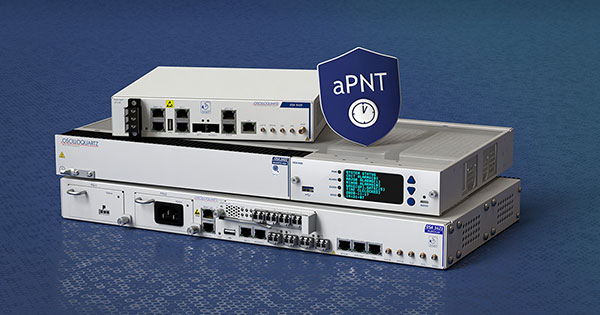
    ADVA’s aPNT platform is key for the development of PGE’s critical network infrastructure (Photo: Business Wire)
    ADVA’s aPNT platform is key for the development of PGE’s critical network infrastructure (Photo: Business Wire)

    Portland General Electric (PGE) is deploying Oscilloquartz PTP grandmaster clock technology as it upgrades to packet-based synchronization and protects its network against GNSS vulnerabilities and cyberattacks. The upgrades also conform to PNT Executive Order 13905.

    PGE, one of the largest power utilities in the Western United States, is using the ADVA scalable timing solution to enable a smooth transition from legacy synchronization and ensure new levels of accuracy, reliability and resiliency. The new system will  timestamp data and control grid substations at the edge.

    With multi-band GNSS receivers and artificial-intelligence (AI) threat detection, ADVA’s assured PNT (A-PNT) platform helps maintain resilient timing, even in challenging circumstances such as deliberate jamming and spoofing attacks. It also provides multi-source backup, including PTP network timing and in-device holdover oscillators for when GNSS signals are unavailable or disrupted.

    The solution is built on the OSA 5410 and OSA OSA 5420 series of edgeSync+ grandmaster clocks. It features multi-band, multi-constellation GNSS receivers and supports multiple PTP profiles, including substation power and core telecom backup sync, while also allowing conversion between them and supporting legacy interfaces.

    The products are part of ADVA’s new aPNT platform, integrating threat detection, multi-source backup and ADVA’s intelligent Ensemble Sync Director.