Category: Defense

  • DoD certifies GPS OCX program to Congress

    DoD certifies GPS OCX program to Congress

    By Karen Parrish, DoD News, Defense Media Activity

    An Air Force program that will provide a vital new command system for the global positioning system satellite constellation in the shortest time possible will continue despite cost growth, Defense Department officials have confirmed.

    Frank Kendall, undersecretary of defense for acquisition, technology and logistics, announced Oct. 12 the continuation of an over-cost program supporting the global positioning system. Here, Kendall is briefed by Jose Romero-Mariona on cybersecurity science and technology during Kendall’s visit to Space and Naval Warfare Systems Center Pacific in San Diego, Aug. 24. (Navy photo by Aaron Lebsack)
    Frank Kendall, undersecretary of defense for acquisition, technology and logistics, announced Oct. 12 the continuation of an over-cost program supporting the global positioning system. Here, Kendall is briefed by Jose Romero-Mariona on cybersecurity science and technology during Kendall’s visit to Space and Naval Warfare Systems Center Pacific in San Diego, Aug. 24. (Navy photo by Aaron Lebsack)

    The next-generation operational control system, known as OCX, reached what is called a Nunn-McCurdy breach on June 30. The Nunn-McCurdy provision applies to weapons programs and requires the military services to notify Congress if a program’s cost per unit increases 25 percent or more over the current baseline estimate.

    But well before June 30, defense acquisition experts began working with Raytheon, the contractor for OCX, to resolve program issues. In December 2015, Undersecretary of Defense for Acquisition, Technology and Logistics Frank Kendall directed in-depth quarterly reviews, including a series of “deep dives” overseen by him. Certification activities began in July 2016, and culminated with Kendall certifying the program to Congress yesterday, thus allowing the program to continue.

    Next-Generation GPS

    James MacStravic, acting assistant secretary of defense for acquisition, discussed OCX and its importance with DoD News.

    “This is what the controllers on the ground are going to use to make sure that all the satellites are talking to each other, that they’re exchanging the same information [and] that they’re where they’re supposed to be,” he said.

    The OCX system will command all modernized and legacy GPS satellites, manage all civil and military navigation signals and provide improved cybersecurity and resilience for the next generation of GPS operations.

    The OCX program includes the following phases: Block 0, to perform launch and checkout of GPS-III satellites; Block 1, to command all navigation signals, including the modernized military signal; and Block 2, for additional enhancements to signal assurance and navigation warfare capabilities. The ground segment capability not only supports military forces, but also civil, commercial and scientific uses. The current total program cost estimate for OCX is $5.46 billion.

    OCX will consist of:

    • A master control station and alternate master control station;
    • Dedicated monitor stations;
    • Ground antennas;
    • GPS system simulator; and
    • Standardized space trainer

    Turning the Program Around

    Defense officials said factors in the OCX cost growth included late recognition of the magnitude of information assurance work that was required, concurrent systems engineering that drove significant rework, inconsistent configuration management of the program baselines, immature software and a lack of automation across the program. These issues drove schedule slips, which in turn increased the cost of the program, leading to the breach.

    MacStravic described the efforts defense officials and Raytheon have made to turn the program around. He emphasized the work has included the personal involvement of Kendall, Air Force Secretary Deborah Lee James and Raytheon’s chief executive officer.

    “What we spent the summer doing was making sure … does this program have the right management resources, the right financial resources and an appropriate schedule to succeed?” MacStravic said.

    Officials report that after three on-site quarterly reviews, Kendall’s assessment is that Raytheon is making substantial progress on the program, but that some additional schedule increase has occurred and that there is risk of more schedule increases.

    Progress has been sufficient to support certification under the Nunn-McCurdy process, officials said. Kendall’s office will continue the OCX quarterly reviews begun in March 2016, which to date have included the secretary and principal deputy acquisition chief of the Air Force, the program executive officer and Raytheon’s chief executive officer.

    The alternatives to certifying the program included several options, including program termination, but this was deemed simply unworkable, due to the extended time it would require to design and field a new ground system for the vital GPS III network.

    According to officials, the future of the OCX program will depend upon Raytheon’s ability to demonstrate that it can deliver the needed capability to the Air Force at acceptable cost and within an acceptable time.

  • Largest unmanned naval exercise weighs anchor

    Largest unmanned naval exercise weighs anchor

    In the exercise, the Thales Watchkeeper looks seaward, spotting passing ships and feeding data to headquarters vessel MV Northern River in the Irish Sea. (Photo: Royal Navy)
    In the exercise, the Thales Watchkeeper looks seaward, spotting passing ships and feeding data to headquarters vessel MV Northern River in the Irish Sea. (Photo: Royal Navy)

    Unmanned Warrior 2016, the largest exercise for marine unmanned vehicles, is underway in the North Atlantic, off the coast of Scotland. The U.K. Navy hosts the event, and the U.S. Navy’s Office of Naval Research is a key participant.

    The exercise will test many teamed technologies, including ONR’s lidar package for SeaHunter unmanned aerial vehicle. Researchers will evaluate the ability of different systems to communicate and operate as a unified force.

    “These systems can help protect our Sailors and Marines from some of the Navy’s dull, dirty and dangerous missions, like mine countermeasures . . . Additionally, these systems can increase our capabilities at a more affordable cost of the conventional systems we currently employ,” said Chief of Naval Research Rear Adm. Mat Winter. “Autonomy will enable our naval forces to stay longer, see farther, understand more, decide faster, do more, adapt more quickly and when necessary be more lethal.”

    Mine-hunting robots will be deployed on a test range set up by U.K defense contractor QinetiQ in one set of exercises, to compare their performance with those of crewed U.K. Navy minehunters. Remotely piloted submarines are already routinely employed in manned mine-hunting, but the exercise seeks to find if matters can be taken a stage further.

    Unmanned vehicles are supplied by Thales, Seebyte and BAE will participate.

    Unmanned Warrior is part of Joint Warrior, a twice-yearly NATO naval exercise. Nearly 6,000 personnel, more than 30 warships and 70 aircraft will participate in joint maneuvers off Scotland during the drill.


  • How to dissolve funding logjams in Congress

    [Editor’s note: This is the Signals Leadership Award acceptance speech given by Clark Cohen at GPS World’s 2016 Leadership Dinner in September. The Award was recognized the development of alternates to GPS based on communication satellites: a method for adding high-accuracy ranging capability to Iridium by modifying the transmitted signal structure of an already flying, programmable constellation. ]

    Thank you GPS World, industry sponsors, and colleagues who engaged in the selection process. I appreciate the honor.

    The Advanced Waveform was the second and most ambitious broadcast that we developed for the DoD-sponsored iGPS program. It is a wide-bandwidth (10 MHz maximum spectrum allocation), near-white, high-power broadcast with independently resolvable code and carrier capable of illuminating regions of the world at any time. Yet Iridium was never designed for navigation.

    I am grateful to the Naval Research Lab, the Office of the Secretary of Defense, Boeing, and Iridium for their support. Also, many capable people comprised our team. Completeness is impossible, but I’ll highlight the efforts of Dick Cervisi, Kamran Ghassemi, Ann Stevens, Robert Scholl, Tom Guffey, Bernie McCormick and Mark Psiaki.

    The commercial Iridium constellation is built on billions of dollars of private capital. Meanwhile, the iGPS overlay required Congressional appropriation. But if the technical part weren’t challenging enough, the politics were, in my view, a bit too hard.

    My topic is the future of public-private partnerships. Such partnerships include the GPS space and ground segments and most other government projects. Our broken, inflexible Congress is not helping. My answer here for the family dinner table is not political — it’s structural, non-partisan, systems engineering.

    We can do better than handicapped innovation, winner-take-all procurements, Nunn-McCurdy triggers, continuing resolutions, debt-limit brinksmanship and government shut-downs. This is not to judge people. Good people are operating under imperfect rules.

    House elections now resemble a stuck, one-bit, analog-to-digital converter. Hundreds of individual races, cumulate the equivalent of input noise and bias, rendering the House largely unresponsive to voters. Consent of the governed demands a healthy, moderating feedback loop from people to representatives to laws and back. Cutting this loop spells trouble.

    A major root cause of dysfunction is winner-take-all, single-member districts. Geographical voting made sense in the 18th century. But in an increasingly complex, connected world, where you live is no longer a stand-in for what you think.

    We need to start dissolving district boundaries themselves. An elegant approach is aggregating adjacent single-member districts into larger multi-winner “super districts” with three to five members each. A refinement called Ranked Choice Voting eliminates spoiler hazard and incentivizes positive campaigns. No change to the Constitution is needed — only passing a law.

    We should reset our expectations. Congress should be able to pass the nation’s budget on time every time. We don’t need drama around GPS modernization, backup terrestrial navigation, and spectrum protection. And America should boldly pioneer aspirational, cathedral-and-moonshot-scale, public-private initiatives.

    Working hard and playing by the rules implies a value-added, positive-sum relationship with society. But to the extent that the rules are imperfect, don’t vestiges of zero-sum exchange imply collateral damage somewhere in society? Voters are rebelling by the millions. We should pay attention. America’s defining Revolutionary War was fought over taxation without representation.

    Whether applied to sword or plowshare, precision feedback from GPS provides guidance to help minimize collateral damage. Updated voting rules will do the same for the nation. Everyone benefits from more efficient and effective execution. Yet perhaps our greatest harvest — should we choose to claim it for ourselves and our children — will follow from sowing new seeds of discovery and innovation through public-private partnerships on a vast and visionary scale.


  • L-3 completes GPS military code security certification

    L-3 Communications has announced that its next-generation military code (M-code) GPS user equipment has successfully completed the final step in a government security certification process.

    L-3’s M-code GPS features advanced user equipment technology, increasing soldiers’ ability to resist enemy jamming and spoofing and performing significantly better in contested environments. The development and certification of this technology was performed under the Air Force Military GPS User Equipment (MGUE) program led by the GPS Directorate within the Space and Missile Systems Center (SMC) at Los Angeles Air Force Base.

    The certification review was performed by an independent government review team, with a focus on the security design of the L-3 GPS user equipment. The goal of these new security standards is to further protect the integrity of the navigation and timing solutions and provide required safeguards for critical information inside GPS user equipment. Work on this project will be done by L-3 Interstate Electronics Corporation (L-3 IEC), which is part of the Precision Engagement & Training sector within L-3’s Electronic Systems business segment.

    “We are pleased to be the first DoD contractor to complete security certification for our new M-code GPS user equipment,” said Michael T. Strianese, L-3’s chairman and chief executive officer. “L-3 is ahead of the technology curve, and we are delivering critical innovations that have significant applications inside DoD markets and on several U.S. Army initiatives. Timely delivery of these advancements to the warfighter is essential as they respond to current and emerging threats on the battlefield.”

    Based in Anaheim, California, L-3 IEC is provider of positioning, navigation and timing products and solutions and long-term supplier of critical navigation, test instrumentation and missile tracking systems for the U.S. Navy’s Fleet Ballistic Missile (FBM) weapon systems, including the Trident submarine.

  • Raytheon, US Air Force complete GPS OCX test milestone

    Raytheon, US Air Force complete GPS OCX test milestone

    Raytheon has reached another milestone in its development of the U.S. Air Force’s Global Positioning System Next Generation Operational Control System, known as GPS OCX. This new system offers significant improvements to the GPS on which the U.S. military and millions of civilians rely, including enhanced availability, accuracy and security.

    OCX’s development is delivered in “blocks,” with Block 0 comprising the Launch and Checkout System to take GPS III satellites into early orbit. Block 1 is built on Block 0 and delivers the full OCX capability, which allows the Air Force to transition from its current GPS ground controls to the modernized and secure GPS OCX master control station.

    Testing demonstrates end-to-end functional checkout, integration of Block 1 capabilities.(Image: Raytheon)
    Testing demonstrates end-to-end functional checkout, integration of Block 1 capabilities.(Image: Raytheon)

    Raytheon recently completed a series of Risk Reduction functional checkouts of OCX Block 1 capabilities, with a focus on OCX software. This latest development activity integrated iteration 1.5 of the OCX Block 1 Master Control Station with the GPS System Simulator and ran operational scenarios, representing the first end-to-end integration of available Block 1 capabilities. The testing included GPS constellation management and sustainment, demonstrating OCX’s abilities for precision navigation and timing capabilities in a fully cyber-hardened environment.

    The test included running Kalman filters and generating GPS satellite navigation uploads. The completion of the Risk Reduction functional checkout informs and benefits future OCX development efforts. Future development will add to the existing capability and expand capability to include both the civil and military modernized signals.

    The U.S. Air Force-led GPS Modernization Program will yield new positioning, navigation and timing capabilities for both the U.S. military and civilian users across the globe. GPS OCX is being developed by Raytheon under contract to the U.S. Air Force Space and Missile Systems Center, which is replacing the current GPS operational control system.

    GPS OCX provides a number of significant modernized capabilities for GPS users, including robust cybersecurity and deployment of jam-resistant, operational military code, or M-code. The OCX Launch and Checkout System provides an early delivery of much of the overall block 1 OCX capability, and will support the GPS III satellite launches.

  • US Naval Observatory chooses NovAtel GPS anti-jam technology

    US Naval Observatory chooses NovAtel GPS anti-jam technology

    The GAJT by NovAtel.
    The GAJT by NovAtel.

    The United States Naval Observatory (USNO) has selected NovAtel’s GPS Anti-Jam Technology (GAJT) to satisfy a requirement for a controlled reception pattern antenna capability at sites throughout the Department of Defense Information Network (DoDIN).

    The DoDIN is the core global enterprise network of the United States military and is depended upon for secure and sensitive voice, data, video and bandwidth services. This latest order brings the number of NovAtel GAJT antennas ordered by the U.S. Navy to more than 600.

    GAJT protects GPS-based navigation and precise timing receivers from intentional jamming and accidental interference. It is a null-forming antenna system that ensures satellite signals necessary to compute position and time are always available.

    The commercial off-the-shelf product comes in versions suitable for land, sea, fixed installations and smaller platforms such as UAVs. Military vehicles and platforms, networks and timing infrastructure also benefit from the protection that GAJT provides. There is no need to replace GPS receivers already installed, as GAJT works with civil and military receivers, and is ready for M-code, according to NovAtel.

    NovAtel’s manufacturing techniques and quality processes mean that that the company can ramp up quickly to meet volume requirements, the company said.

    “This order underlines our ability to deliver GAJT in volume and on time,” said Michael Ritter, president and CEO of the Canada-based NovAtel. “GAJT has now been shipped and is in use operationally by 12 allied nations around the globe. We are grateful for the rigorous technology selection process conducted by USNO which led to this latest order.”

    The U.S. Naval Observatory is located in Washington, D.C.
    The U.S. Naval Observatory is located in Washington, D.C.

    Located in Washington, D.C., the USNO is one of the oldest scientific agencies in the United States, with a primary mission to produce Positioning, Navigation and Timing for the United States Navy and the United States Department of Defense.

  • Register by Tuesday for Friday’s adjacent band compatibility workshop

    The U.S. Department of Transportation will host its fifth workshop on the GPS Adjacent Band Compatibility Assessment effort on Oct. 14 in Washington, D.C. The workshop is open to the general public by registration only. Those who would like to attend the workshop are asked to register by Tuesday, Oct. 11.

    Read the Federal Register Notice here.

    The purpose of this workshop is to discuss the results from testing of various categories of GPS/GNSS receivers to include aviation (non-certified), cellular, general location/navigation, high precision and networks, timing, and space-based receivers. The workshop also will include a discussion on the development of use-case scenarios for these categories.

    Register at Global Positioning System Adjacent Band Compatibility Assessment Workshop V.

    DATE/TIME: Oct. 14  / 10 a.m. – 4 p.m. (Eastern Daylight Time).

    LOCATION: RTCA, Inc., 1150 18th St. NW, Suite 910, Washington, D.C.  20036.

  • GPS III 9 and 10 procured, targeting 2022 launch

    GPS III 9 and 10 procured, targeting 2022 launch

    The first eight GPS III satellites are under contract and in production at Lockheed Martin’s GPS III Processing Facility outside of Denver.
    The first eight GPS III satellites are under contract and in production at Lockheed Martin’s GPS III Processing Facility outside of Denver.

    The U.S. Air Force Space and Missile Systems Center awarded a contract option to Lockheed Martin Space Systems Company to procure two additional GPS III satellites, space vehicles nine and 10 of the next generation. The contract option procures long lead and production hardware.

    “The GPS III SV 9 and 10 satellites are expected to be ready for launch in 2022, thus sustaining the GPS constellation and the global utility the world has come to expect,” said Lt. Gen. Samuel Greaves, the Space and Missile Systems Center’s commander and Air Force program executive officer for space.

    The Lockheed Martin team is finishing up final testing and integration activities on the first GPS III satellite, GPS III SV01, and is preparing to deliver it to the Air Force later this year. The second satellite, GPS III SV02, is poised to have its major functional systems fully integrated into one space vehicle prior to starting its own environmental testing. GPS III SV03 also is beginning to take form in the company’s production clean room as its major subcomponents are being assembled.   \All eight of the first set of GPS III satellites are in various stages of production at Lockheed Martin’s GPS III Processing Facility outside of Denver.

    190921-f-zz999-108The government expects to compete future purchases of GPS III satellites, beginning with GPS III SV 11. This competition will maintain the current technical baseline of GPS III and will add additional hosted payloads to increase system accuracy, search and rescue capability, and universal S-band compatibility.

  • Harris delivers first OCX receiver

    Harris delivers first OCX receiver

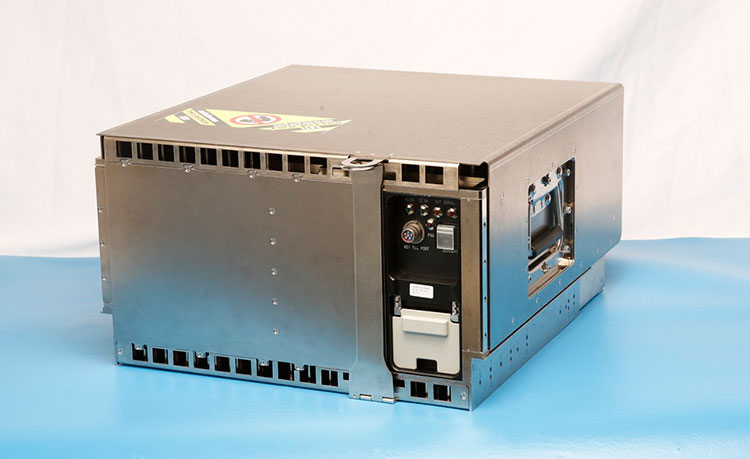
    Photo: Harris
    Photo: Harris

    Harris Corporation delivered the first of 34 modernized receivers to support the GPS Next-Generation Operational Control System (OCX). They will receive the signals sent by the current GPS satellite constellation plus the new signals sent by the next generation GPS III — 13 military and civilian signals in all.

    The receiver was shipped to the prime contractor, Raytheon Company, in Aurora, Colorado, after it passed a critical electromagnetic interference test, the first of many stringent qualification requirements. Though the receivers will be placed throughout the world, this first production unit will be installed in Aurora as OCX software development and integration continues.

    OCX will replace the existing ground control system that receives signals from the 31 operational GPS satellites already orbiting Earth. Only OCX will be able to receive and decrypt all GPS III military and civil signals, however.

    In addition to receivers, Harris has delivered 14 ground encryptors that will help protect the GPS signal. Harris also is providing critical software elements, which provide the fundamental navigation data to the GPS satellites and enable U.S. Air Force operators to better know and monitor the exact position and timing of the GPS constellation.

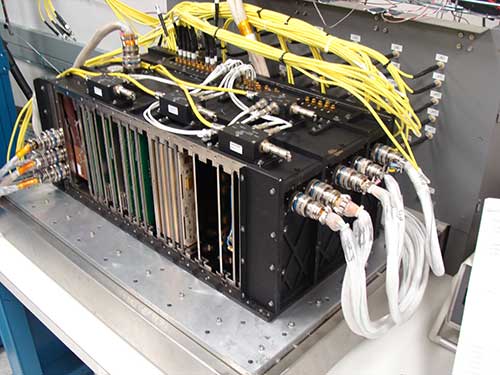
    Pictured here is the advanced MDU on navigation payloads being delivered for GPS III Space Vehicles 1-10. (Photo: Harris)
    Pictured here is the advanced MDU on navigation payloads being delivered for GPS III Space Vehicles 1-10. (Photo: Harris)


  • DARPA floats aerial surveillance Dragnet by UAV

    DARPA floats aerial surveillance Dragnet by UAV

    As off-the-shelf unmanned autonomous systems (UAS) become less expensive, easier to fly, and more adaptable for terrorist or military purposes, U.S. forces will increasingly be challenged by the need to quickly detect and identify such craft, especially in urban areas, where sight lines are limited and many objects may be moving at similar speeds.

    To map small UAS in urban terrain, the U.S. Defense Advanced Research Projects Agency (DARPA) seeks innovative technologies to provide persistent, wide-area surveillance of all UAS operating below 1,000 feet in a large city. While the newAerial Dragnet program focuses on protecting military troops operating in urban settings overseas, the system could ultimately find civilian application to help protect U.S. metropolitan areas from UAS-enabled terrorist threats.

    “Commercial websites currently exist that display in real time the tracks of relatively high and fast aircraft—from small general aviation planes to large airliners—all overlaid on geographical maps as they fly around the country and the world,” said Jeff Krolik, DARPA program manager. “We want a similar capability for identifying and tracking slower, low-flying unmanned aerial systems, particularly in urban environments.”

    Although several systems are being developed for tracking small UAS by extending surveillance methods used in open areas where large line-of-sight buffers mitigate the threat, these systems are impractical for operation in urban terrain. Aerial Dragnet seeks to leapfrog these approaches by developing systems adapted to the fundamental physics of small UAS in urban environments that could enable non-line-of-sight (NLOS) tracking and identification of a wide range of slow, low-flying threats.

    The program envisions a network of surveillance nodes, each providing coverage of a neighborhood-sized urban area, perhaps mounted on tethered or long-endurance UAS. Using sensor technologies that can look over and between buildings, the surveillance nodes would maintain UAS tracks even when the craft disappear from sight around corners or behind objects.

    Low Cost Sensors, SDR. The output of the Aerial Dragnet would be a continually updated common operational picture of the airspace at altitudes below where current aircraft surveillance systems can monitor, disseminated electronically to authorized users via secure data links. Because of the large market for inexpensive small UAS, the program will focus on combining low-cost sensor hardware with software-defined signal processing hosted on existing UAS platforms. The resulting surveillance systems would thus be cost-effectively scalable for larger coverage areas and rapidly upgradeable as new, more capable and economical versions of component technologies become available.

    The Aerial Dragnet program seeks teams with expertise in sensors, signal processing, and networked autonomy to achieve its goal. A solicitation detailing the goals and technical details of the program was posted here. A Proposers Day took place in late September.


    Inertial, Gyroscope Take to Space


    The concept image above shows the NEA Scout CubeSat with its solar sail deployed as it characterizes a near-Earth asteroid. (NASA)

    Sensonor AS of Norway has partnered with the U.S. National Aeronautics and Space Administration (NASA) to supply current and future low- and near-Earth orbit space missions with inertial and gyroscope modules.

    The Norway-based company first began supplying its standard inertial measurement unit (IMU) and gyroscope modules for low Earth orbit (LEO) space applications in 2012, Sensonor’s STIM300 and STIM210 inertial products now fly aboard several NASA spacecraft. Current projects using STIM inertial systems include the Raven technology demonstration and Near Earth Asteroid (NEA) Scout.

    Raven, which launched to the International Space Station in September, will test key elements of an autonomous relative navigation system. Its technologies may one day help future robotic spacecraft autonomously and seamlessly rendezvous with other objects in motion, such as a satellite in need of fuel or a tumbling asteroid.

    The NEA Scout is a robotic reconnaissance mission that will be deployed to fly by and return data from an asteroid representative of NEAs.

    The STIM gyroscope modules are often used in combination with GPS or a Star Tracker and Kalman filter to orient and stabilize the satellite, as well as to provide feedback on satellite motion induced by its reaction wheels. In some applications, the gyroscopes are used to stabilize satellite-to-satellite communications.


    Lighting Up Indoors for Retail Position

    A new indoor positioning system uses LED lighting to pinpoint location for use in the retail industry. Researchers from the University of South Australia have developed an indoor positioning system that tracks movement with greater accuracy than contemporary RFID and Wi-Fi based systems.

    Developer Siu Wai Ho said other methods of indoor positioning such as Wi-Fi were only accurate to within 1–2 metres and were easily hampered by radio frequencies from nearby devices, power sources or other wireless electronics. “Our system is more accurate with an error margin of 10cm and unlike some positioning systems our algorithm can calculate the orientation at the same time.”

    LiPo uses LED lights as transmitters and photodetectors as receivers because they are both common items in modern societies. Photodetectors are a key component for capturing light and are also commonly found in smart phone cameras. The system uses a specially designed receiver to measure light intensity that is able to calculate position and orientation. Although it currently requires a unique receiver, developers hope to integrate the technology with the photodectors in mobile phones. This would reportedly enable supermarkets to provide customers with relevant information about items nearby.

    “If you are in a supermarket you want to see some information for a product in front of you. One or two metres of error is still too big because it maybe gives you a product you are not in front of.”
    Other applications could include the identification of objects or machinery in factories, movement aid tools for the elderly and trackers for museums to provide relevant information to tourists as they passed by exhibits.

    Munich SatNav Summit Stresses GNSS Back-Up

    “Is it Time for GNSS Back-Up?” has been announced as the the theme of the 2017 Munich Satellite Navigation Summit, to take place March 14–16.International experts gather to discuss recent position, navigation and timing develeopment and the necessity for GNSS backup solutions.

    Among the topics, in addition to system updates on all major GNSS, we find listed: From Iridium to e-Loran — GNSS in need for a Backup; Galileo after the Brexit; Civil use of the Galileo Public Regulated Service (PRS); and Network-based solutions for GNSS Backup. Go to to www.munich-satellite-navigation-summit.org for registration information.


    Xsens Offers Knowledge BASEd Inertial Motion Tracking

    Xsens has launched BASE, an online technology platform with a community forum and a knowledge base on 3D motion tracking technology and products. BASE.xsens.com, contains inside information about micro-electro-mechanical system (MEMS) sensors, inertial measurement units (IMU), sensor fusion algorithms, body-motion tracking and motion capture.

    It also provides best practices, tips and tricks for the use of Xsens’ MTi series, the MTw and the MVN wearable motion capture solutions. A second section of BASE is the community forum with direct access to Xsens’ engineers and other Xsens users.

    There is no need to register for BASE to access the community forum and the knowledge base. To ask questions or comment on articles, registration is possible via SSO or email.

  • Galileo Initial Services looming

    With Galileo Initial Services at last on the horizon and a quadruple satellite launch scheduled for November, here’s hoping that Europe’s GNSS constellation will be delivering limited, but reliable, global PNT services before the year is out.

    The four Galileo satellites for Arianespace’s first Ariane 5 mission for the constellation are being prepared at ESA’s launch facility in French Guiana. The flight is scheduled for 17 November. However neither these four new satellites, nor the two orbited in May, are required to deliver Galileo Initial Services, which should be launched officially some time in November. Fingers crossed.

    The European GNSS Agency (GSA) is gearing up to assume its operational role for Galileo in early 2017. During the summer the GSA formally accepted their Loyola de Palacio facility in Madrid, Spain that houses the European GNSS Service Centre (GSC). This is a significant milestone in the development of the programme and its service provision as Galileo’s “door to the GNSS world” as GSA Executive Director Carlo des Dorides described the facility at the handover ceremony.

    GSA already oversees the operation and service provision for the European Geostationary Navigation Overlay Service (EGNOS) (since 2015) along with managing the security accreditation and general security provision for both programmes.

    The GSC offers over 1,100 square metres of space and currently employs over 40 people. Since 2013, the core team at GSC has been providing limited services and working as a precursor to GSC v1. Its key work includes supporting the lead up to Galileo Initial Services provision, along with operating the GSC Helpdesk, disseminating orbital products to the Search and Rescue (SAR) community, supporting GNSS-related research and industrial activity and monitoring user satisfaction. Once operational, GSC v1 will be connected to the Galileo core system, thus enabling the long anticipated Commercial Service. This service is expected to enter operations by mid-2017.

    Once the Galileo Operations Contract is awarded and Initial Services officially declared, the GSC is expected to see a significant increase in staff.

    Also in the summer CNES President and France’s inter-ministerial coordinator for European satellite navigation programmes Jean-Yves Le Gall was elected as the new chair of the GSA Administrative Board with Mark Bacon, representing the United Kingdom, elected as deputy chair.

    “I am honoured to have been elected chair of the GSA Administrative Board, with Galileo now poised to enter its operational phase,” said Le Gall. “This election confirms the desire of Member States to join forces on the cusp of a prolific period for European space as we move Galileo towards full operational capability.”

    Brexit blues?

    Mark Bacon added “I am very pleased to have been elected to work with the Board and I look forward to helping the GSA deliver on the Galileo and EGNOS programmes over the coming years.”  However the UK’s decision to leave the EU (Brexit) must make his position rather uncomfortable – and temporary – to say the least.

    The GSA Administrative Board is composed of representatives from each EU Member State, the European Commission, and the EU parliament. The Board meets three times per year to ensure that the Agency performs its tasks correctly. As things stand if the UK is no longer an EU Member State it must lose its representative(s) on the advisory board.

    However, the relationship between the UK and EU space programmes is, of course, subject to the Brexit negotiations. The UK will almost certainly remain a member of the European Space Agency (ESA) as this is a pan-European body not an EU agency, however when it leaves the EU the country will have to renegotiate terms if it wants to continue to participate in the key EU programmes such as Galileo GNSS and Copernicus Earth Observation system.

    The ESA is autonomous from the EU and should not be directly affected by Brexit confirmed Jean Bruston, head of ESA’s EU policy office at a media briefing in mid-September. But “As soon as it [Britain] is leaving the EU it is not participating in these programmes [Galileo / Copernicus] any longer,” he observed.

    In addition, UK-based companies hold contracts worth tens of millions of euros from ESA to supply hardware for the Copernicus and Galileo GNSS. “If nothing changes [and Brexit goes ahead], we would have to stop these contracts,” said Bruston bluntly.

    Of course, Britain could still contribute to Galileo and Copernicus if it negotiated a third-party agreement with the EU, as Norway and Switzerland (both non EU members) have done. The down side is that this may take some time to initiate, let alone complete, and if Britain sticks to its guns on issues such as free movement of people then the likelihood of a successful outcome for the UK is not high.

    In an interview with French media ESA director-general Jan Woerner reinforced Bruston’s views saying that “the UK will remain a member state of ESA, this is very clear” but also continuing “As we are also dealing with European programmes like Copernicus and Galileo, and also the question of UK citizens working on the continent and all these legal issues, we have to take this into account.”

    EU opportunity

    Many in ‘continental Europe’, as we Brits so often condescend to describe our fellow Europeans, will be more than happy to see the U.K. no longer participating in deciding key aspects of EU space and other policy areas.

    It is no coincidence that the European Commission has become much more vocal on plans for a European defence force since the Brits announced their departure. The U.K. has long been opposed to the concept of an ‘EU Army.’ However planning and military cooperation between Member States outside normal NATO channels has been increasing over many years. The small and discreet (so discreet that I didn’t realise the exact location of its HQ in Brussels until the recent terrorist incidents meant burly Belgian paratroopers were stationed outside and I asked them what they were guarding. Has to be said they were not discreet!) has seen its budget frozen for the last five years, but this may now change.

    The interface of EU space and defence policy – in particular ‘dual use’ issues – will also become simpler without the U.K.’s protests. A leaked draft of the upcoming EU Space Policy communication talked directly of dual-use synergies to reinforce security from space, in particular to reduce costs and improve efficiency, and that the next generation of EU GNSS and Copernicus programmes should be designed from the start to be more relevant for security purposes. Defence-related research is also slated for future Horizon 2020 calls.

    The draft policy document also underlines that with EU space programmes becoming fully operational, building stability, trust and confidence in users is a key objective. Current services must be fully deployed and their long-term continuity and evolution assured. This continuity should be driven by user needs and take into consideration the mid-term (hardly mid-term for Galileo!) evaluation of the programmes that should happen in 2017. For Galileo and EGNOS, the document looks to improvements in the current services, including greater robustness and performance, and provision of additional services, such as regional or timing services.

    California dreaming

    So with Brexit what is the U.K.’s GNSS – and space-related – industry and research community to do? Of course many of the UK industrial players are multi-national companies and internal transfer of people and/ or projects will overcome many issues. And bi-lateral collaborative agreements on exchange of talent and ideas between partners can also achieve the same results for smaller companies and research groups. However not having a seat in the policy process and the development of programmes will put ‘UK plc’ at a distinct disadvantage in my opinion.

    But U.K. leaders say that Brexit is an opportunity to be seized and that the U.K. should be looking to sell  goods and services in other global markets than the EU. Which is something most U.K. industry has been doing since trade/ time began. And in my experience U.K. business leaders have always been much more eager to go jump on a plane to the States or Australia than go visit their European neighbours – something to do with our renowned national language skills perhaps?

    Space is no exception – and one that has been shown to be a success in recent times. A helping hand is provided by InnovateUK, the U.K.’s government innovation agency, that is organising its third ‘Space Mission UK’ to the US in November. These are trade and investment missions specifically designed to support U.K. start-up companies to build world-leading space and satellite application businesses.

    Space Mission 1 visited Utah, LA and Silicon Valley in August 2015 and Space Mission 2 landed in Houston in November 2015. Space Mission 3 will visit San Francisco and LA from 5-11 November this year.

    Mission programmes are varied but typically include visits to companies working at the forefront of the sector, networking opportunities with investors and corporate venture people interested in space, visits to incubators, accelerators and technology hubs, and masterclasses on pitch development, business culture and market entry.

    The previous two Space Missions have had immediate impact for the companies involved, including securing over £1 million in investment, and initiating collaborations with major organisations such as NASA and (ironically) ESA, and winning contracts with the UK Ministry of Defence at home.

    GNSS-related companies in previous missions include Arralis who build high-end semiconductor chips but have also been funded to develop novel GNSS antennas, and an exciting data fusion start-up – Gyana – that takes complex inputs from multiple data sources, including satellite, to build simple to understand 3D situational images. The founder of the business, engineering graduate Joyeeta Das, has raised US $1.1m since the mission.

    You can find a complete list of companies who have participated on the previous missions here.

    The selection for Space Mission 3 has closed and I am told there is at least one GNSS applications company that has been chosen to be on the plane in November. Good luck to them all!

    Google emergency LBS upgrade

    E112 is a location-based version of the 112 universal European emergency number, where the telecommunication operator transmits location information to the emergency centre in parallel to the call itself. With more than 70 percent of calls to emergency services coming from mobile phones, getting help fast and efficiently to the caller can be challenging if they don’t know where they are. Now, in a major step forward for implementation, Google has created and rolled out in two European countries (U.K. and Estonia) its Emergency Location Service on Android, with other regions to follow. The feature, when supported by the caller’s network, sends the phone’s location to emergency services when the 112 (or equivalent) emergency number is dialed.

    Emergency Location Service is supported by more than 99 percent of existing Android devices (version 2.3 and above) through Google Play services. The service activates when supported by the mobile network operator or emergency infrastructure provider.

    The new geographical location system claims to identify the source of a mobile phone emergency call to typically within 0.003 square kilometres (less than half the size of a football field) instead of a current average of around 12 square kilometres.

    When an emergency call is made with an enabled Android smartphone, the phone automatically activates its location service and sends its position by text message to the 112 service. This usually takes less than 20 seconds. This text message is not visible on the handset and is not charged for.

    And the first European Galileo-ready smartphone has been launched with the Aquaris X5 Plus smartphone, produced by the Spanish technology company BQ, and based on the Galileo-supported Qualcomm Snapdragon 652 processor with Galileo capability accessible via a software update to be released in Quarter 4 2016.

    U.S.-based Qualcomm announced in June that it was adding support for Galileo across its Snapdragon processor and modern portfolios for smartphone, computing, automotive and IoT applications.

    As well as Galileo capability, the Aquaris X5 Plus is powered by the latest Google Android OS and has all the usual features of a top end smart phone including 16 mega pixel ‘back’ camera and support for 4k video recording with a stabiliser and fingerprint recognition for added security.

    If you want to take the pulse of the GNSS user technology industry and keep up with the latest trends then you’ll need to get your hands on the GSA’s GNSS User Technology Report due out at the beginning of October.

    The 2016 report will be launched on 4 October as part of the Horizon 2020 Space Information Days in Prague. This two-day GSA-hosted event will introduce the third call for GSA-funded Horizon 2020 research and innovation proposals for Galileo and EGNOS.

    The document will take an in-depth look at the latest state-of-the-art GNSS receiver technology, along with providing expert analysis on the various trends that are defining the future global GNSS technology landscape. The report will focus on three key areas: mass market solutions; transport safety and liability-critical solutions; and high precision, timing and asset management solutions.

    Pulsar GNSS for deep space

    The use of pulsars, highly magnetized, rotating neutron star that emits a beam of electromagnetic radiation with a very precise period, have been potential candidates for a deep space navigation system for many years. Now a paper from the U.K.’s National Physical Laboratory (NPL) and the University of Leicester shows that pulsars can be used to obtain position along a particular direction in space to an accuracy of two kilometres in the direction of the pulsar. Furthermore such a technology could operate autonomously and greatly increase the number and capabilities of space missions, the paper claims.

    To calculate their position a space craft would need to carry a small X-ray telescope. The method uses X-rays emitted from pulsars, which can be used to work out the position of a craft in space in 3 dimensions to an accuracy of 30 km at the distance of Neptune. Certain types of pulsar, called ‘millisecond pulsars’, emit pulses of radiation with the regularity and precision of an atomic clock and therefore could be used much like GNSNS in space.

    The paper, published in Experimental Astronomy[1], details simulations undertaken using data, such as the pulsar positions and a craft’s distance from the Sun, for an ESA feasibility study of the concept. The simulations took these data and tested the concept of triangulation by pulsars with current X-ray telescope technology and state-of-the art position, velocity and timing analysis. This generated a list of usable pulsars and measurements of how accurately a small telescope can lock onto these pulsars and calculate a location.

    The key finding was that at a distance of 30 astronomical units – the approximate distance of Neptune from the Earth – an accuracy of 2km or 5km can be calculated in the direction of a particular pulsar (PSR B1937+21) by locking onto the pulsar for ten or one hours respectively and that by locking onto three pulsars, a 3D location with an accuracy of 30km can be calculated.

    This is an improvement on the current navigation methods of the ground-based Deep Space Network (DSN) and European Space Tracking (ESTRACK) network as it could be autonomous with no need for Earth contact for months or years, if an advanced atomic clock is also on the craft. Also ESTRACK and DSN can only track a small number of spacecraft at any one time. It is also possible that the pulsar technique could be quicker.

    Dr Setnam Shemar from NPL commented: “How these [space]craft navigate will in future become a limiting factor to our ambitions. The cost of maintaining current large ground-based communications systems based on radio waves is high and they can only communicate with a small number of craft at a time. Using pulsars as location beacons in space, together with a space atomic clock, allows for autonomy and greater capability in the outer solar system.”

    This simulation uses real-world technology and proves its capabilities for this navigation task. The X-ray telescope can be launched into space due to its low weight and size and it will be flown on a mission to Mercury in 2018. Could we be seeing the emergence of a navigation technology that can enable a new era of space exploration?

    And with that look into the future it is time to say “adios” to this column. From now on my EAGER dispatches will be sprinkled through other GPS World imprints and platforms. I’ll be at the global geospatial fun-fest that is Intergeo in Hamburg in October and sniffing around the first Galileo ‘hackathon’ in Berlin in early November, so I hope to see many of you at those and subsequent Euro-GNSS events in the future.

    A bientot as they say in these parts.

    [1] Towards practical autonomous deep-space navigation using X-Ray pulsar timing’ Shemar, S., Fraser, G., Heil, L. et al. Exp Astron (2016). doi:10.1007/s10686-016-9496-z

  • Launchpad: Time and frequency server accurate in all conditions

    Launchpad: Time and frequency server accurate in all conditions

    The VersaSync is a new generation time and frequency server from Spectracom. The high-performance GNSS master clock and network time server delivers accurate, software-configurable time and frequency signals in all circumstances, including GNSS-denied environments.

    versasync-spectracom-wIt is based on a platform-approach to maximize versatility without restricting performance, which maintains or improves high-performance standards from larger form factors while reducing the footprint. The result is a rugged and compact design suitable for air, land or sea applications.

    Standard VersaSync configurations are designed in accordance to VITA 75, which was developed for easy integration of subsystems in mobile platforms. The overall volume is under 1 liter, the weight is less than 1 kilogram, and its power consumption is approximately 10 watts.

    The list of design features for harsh environmental conditions include mil-performance circular connectors, a sealed enclosure (IP65), and an efficient heat transfer via the conduction-cooled based plate. Spectracom is currently confirming its extensive reliability and compatibility modeling to military specifications.

    Versatility is also the theme for the VersaSync’s internal time-base, compatibility with external time and frequency reference sources, and time and frequency signal generation. It is available with a choice of a very low-phase noise ovenized crystal oscillator (OCXO) or chip-scale atomic clocks (CSAC), and can accommodate other high-precision internal time references. Similarly, it is available with various GNSS receivers including multi-constellation receivers and SAASM encrypted GPS with an upgrade path to M-code.

    Software-defined digital timing I/Os offer mission-to-mission configurability of virtually any timing signal. Network synchronization and management also offers a high degree of flexibility. Two gigabit Ethernet interfaces are available for network synchronization protocols (NTP and PTP) as well as for configuration, status, logging and upgradability.

    Applications

    • UAVs
    • flight test
    • telemetry
    • mobile communication systems
    • C4ISR (command, control, communications, computers, intelligence, surveillance and reconnaissance)

    Spectracom, spectracom.com