Category: Mapping

  • Hurricane barrels toward Texas, maps show impact

    Hurricane Harvey is hitting Texas with wind speeds of at least 111 mph. Widespread flooding is a risk for Texas and neighboring states as public safety groups and communities prepare.

    Esri has created a new Hurricanes and Tropical Cyclones Story Map that identifies the potential impact of the storm through a variety maps, including:

    • Public Information Map — identifies the current and recent location of Harvey as well as forecast positions and probable track; additionally, the shaded area is called the “cone of uncertainty,” the likely path of the center of Harvey.
    • Impact Summary Map — shows the storm surge by identifying locations most at risk for life-threatening inundation from storm surge; accordingly, to Esri’s data, the total population at risk is 248k people, 99k households, and 10k businesses.
    • Forecast Precipitation Map — forecasts the amount of rain expected within the next 72-hour period.

    Click here to view the story map.

    Hurricane-Harvey-Esri-storymap

  • Nearmap expert joins Aug. 31 mapping and UAV webinar

    Tony Agresta of Nearmap has joined the panel of speakers on the Aug. 31 webinar, “Integrated Technologies for Industrial Positioning.”

    Tony Agresta, Nearmap

    The webinar is free (register here) and focuses on applications in the electric utility/telecom sector, such as site inspections, drones and geographic information systems (GIS) mapping in general. Participants will learn how to maximize reach and capabilities using various sensors and technologies integrated with GPS aboard unmanned autonomous vehicle (UAV) platforms.

    Agresta leads the U.S. marketing effort including customer use cases for Nearmap across industries.

    Nearmap provides instant access to high resolution aerial imagery including ortho, oblique and now 3D — at scale. Today, this imagery is used for site locate analysis, planning and tracking change over time. The webinar presentation will review the different forms of imagery, how they are captured, managed and delivered in the cloud and used inside ESRI and AutoDesk.

    Nearmap provides cloud-based subscription access to up-to-date 2-D orthomosaic aerial imagery. Using its patented HyperCamera2 technology, Nearmap is applying the same access model to the oblique aerial imagery market.

    Screen capture from a Nearmap 3D fly-through of Austin, Texas, rendered from Nearmap oblique Imagery.

    Because this new camera system provides a high degree of overlap from different angles, Nearmap can reconstruct the real world in stunning detail, producing not only high-resolution orthomosaic and oblique imagery, but also surface and terrain models, natural-color point clouds and textured 3-D meshes.

    Other Speakers on the Panel

    Jeff Fagerman, Lidar USA

    Jeff Fagerman. Fagerman, a professional surveyor and certified photogrammetrist, is founder and owner of Lidar USA. He holds a master’s degree in photogrammetry from Purdue University. During his tenure with Intergraph from 1985 to 1999, he worked as a photogrammetric software developer on that company’s innovative photogrammetric workstations. In 1999, he started Fagerman Technologies, now known as Lidar USA. In 2010, the main corporate focus became mobile lidar aboard UAVs.

    Lidar USA provides solutions for GIS, surveying, civil engineering, agriculture, forensics, BIM, heritage mapping — all things 3D and beyond. In addition to UAV-based mapping and surveying, the company has developed ground—based lidar, building an economical mobile mapping system called ScanLook, incorporating scanning, imaging, and navigation. The company has provided client services in survey/mapping, agriculture, law enforcement, military, archaeology, and education.

    Chris Lund, Honeywell

    Chris Lund, Honeywell Corporation. Lund will focus on inertial sensors as the centerpiece of any robust industrial positioning solution. Given they can’t be interfered with, inertial sensors are the glue that binds the information from all the other sensors together to reveal the desired insights and maximize operator uptime/efficiency.

    Lund is a senior director of product marketing for Honeywell’s Navigation and Sensor business. He has experience running product lines for inertial measurement units as well as for surface and marine navigators. Previously, he had engineering roles as a researcher, project lead and technical manager. Lund has an M.S. in the management of technology. He has been working on navigation-related technologies since the late 90s, holds multiple patents, and has co-authored several conference papers and presentations.

    Derrick Reish, LTI

    Derrick Reish, Laser Technology Inc. (LTI). (LTI) started working with the U.S. government more than 30 years ago by designing lasers that measured distances between two planes in-flight for a de-icing exercise. The company then won a contract with NASA to build a custom laser that could measure both distances and speeds for space docking missions. Its first professional measurement device was a hand-held reflector-less total station launched the GPS laser offset sector.

    LTI addresses real world needs and applications, including forestry, mining, utilities and surveying, among others. The company focuses on facilitating data collection and GPS/GNSS mapping for professionals, with innovative solutions aboard Android and UAV platforms.

    Register here for the free Aug. 31 webinar.

  • Wyzelink IoT workflow app now on Geotab Marketplace

    Wyzelink Systems’ IoT workflow-automation application, WyzeTask, is now available in the Geotab Marketplace. WyzeTask is the newest application in the marketplace and is a complement to the MyGeotab platform, which serves more than 14,000 Geotab customers.

    WyzeTask maximizes employee productivity by automating task tracking and job completion processes, freeing workers from paperwork and manual data entry. Automation also maximizes record accuracy by avoiding the errors that come with manual entry.

    The WyzeTask solution includes the WyzeBeacon, a wearable device that uses Bluetooth Low Energy (BLE) to transmit data to a nearby BLE scanner, which can be a Geotab IOX-BT hub or a smartphone/tablet running the WyzeTask application. Employees simply click a button on their WyzeBeacon to have it log and share information such as their task status, time and GPS location.

    Designed for field workers in public works, construction and manufacturing, WyzeTask leverages Geotab’s IOX-BT hub to reliably transmit data even when they’re away from their smartphone or IOX-BT-enabled vehicle.

    WyzeTask includes an easy-to-navigate Geotab webAdd-in with an interactive map that allows administrators to view task progress and other key information. A mobile app also lets supervisors assign and change worker’s tasks from the job site or remotely.

    “Wyzelink creates intelligent solutions for workforces outside of a typical office building with wireless IoT technology, smart sensors and wireless applications,” said Brian Barry, Wyzelink Systems CEO. “By closely tracking workforce tasks, businesses can cut through the tedious paperwork process and focus on core responsibilities while improving efficiency, productivity and workplace safety.”

    “The addition of Wyzelink provides increased IoT capability as we continue to create an impressively connected ecosystem for Geotab’s Marketplace customers,” said Joey Marlow, Geotab executive vice president of U.S. operations. “Through Geotab’s IOX Bluetooth hub, telematics tracking and data collected from WyzeTask, management now has the ability to collect and analyze workforce data to deliver business intelligence.”

    The Geotab Marketplace provides an extensive ecosystem of valuable business focused applications and Add-Ons, helping customers add value to their Geotab fleet management solution. Launched in 2015 as a complement to the MyGeotab platform, the marketplace is used by more than 14,000 Geotab customers.

  • Lidar/UAV and inertial experts join panel on free webinar: Integrated tech

    Jeff Fagerman, Lidar USA

    Jeff Fagerman, a professional surveyor and certified photogrammetrist, has joined the panel of speakers on the Aug. 31 webinar, “Integrated Technologies for Industrial Positioning.” The webinar is free (register here) and focuses on applications in the electric utility/telecom sector, such as site inspections, drones and geographic information systems (GIS) mapping in general. Participants will learn how to maximize reach and capabilities using various sensors and technologies integrated with GPS aboard unmanned autonomous vehicle (UAV) platforms.

    Also joining the panel for the Aug. 31 webinar is Chris Lund from Honeywell Corporation. He will focus on inertial sensors as the centerpiece of any robust industrial positioning solution.  Given they can’t be interfered with, inertial sensors are the glue that binds the information from all the other sensors together to reveal the desired insights and maximize operator uptime/efficiency.

    The two new speakers join Derrick Reish of Laser Technology, Inc., for the webinar.

    Fagerman is founder and owner of Lidar USA. He holds a Master’s degree in photogrammetry from Purdue University. During his tenure with Intergraph from 1985 to 1999, he worked as a photogrammetric software developer on that company’s innovative photogrammetric workstations. In 1999, he started Fagerman Technologies, now known as Lidar USA. In 2010, the main corporate focus became mobile lidar aboard UAVs.

    Chris Lund, Honeywell

    Chris Lund is a senior director of product marketing for Honeywell’s Navigation and Sensor business. He has experience running product lines for inertial measurement units as well as for surface and marine navigators. Previously, he had engineering roles as a researcher, project lead and technical manager. Lund has an M.S. in the management of technology. He has been working on navigation-related technologies since the late 90s, holds multiple patents, and has co-authored several conference papers and presentations.

    Lidar USA provides solutions for GIS, surveying, civil engineering, agriculture, forensics, BIM, heritage mapping — all things 3D and beyond. In addition to UAV-based mapping and surveying, the company has developed ground—based lidar, building an economical mobile mapping system called ScanLook, incorporating scanning, imaging, and navigation. The company has provided client services in survey/mapping, agriculture, law enforcement, military, archaeology, and education.

    Derrick Reish, Laser Technology, Inc.

    Laser Technology Inc. (LTI) started working with the US government more than 30 years ago by designing lasers that measured distances between two planes in-flight for a de-icing exercise. The company then won a contract with NASA to build a custom laser that could measure both distances and speeds for space docking missions. Its first professional measurement device was a hand-held reflector-less total station launched the GPS laser offset sector.  

LTI addresses real world needs and applications, including forestry, mining, utilities and surveying, among others. The company focuses on facilitating data collection and GPS/GNSS mapping for professionals, with innovative solutions aboard Android and UAV platforms.

    Register here for the free August 31 webinar.  A final speaker expert in aerial photography  will be announced soon.


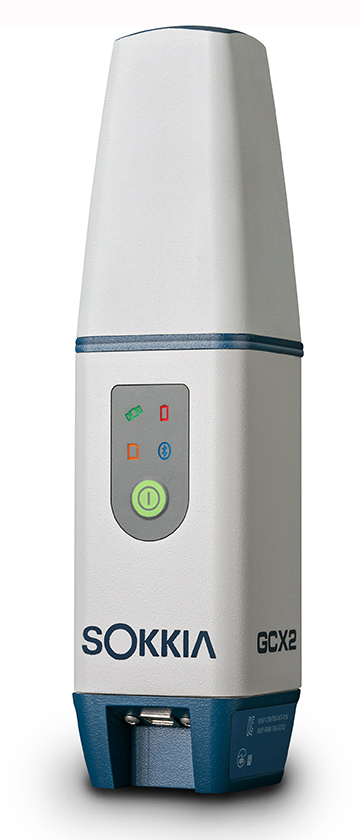
  • Sokkia GNSS receivers now integrated with TerraGo Magic

    Sokkia GNSS receivers now integrated with TerraGo Magic

    GCX3

    TerraGo Magic now offers advanced integration and support for the Sokkia line of GNSS receivers, including the new GCX3.

    TerraGo Magic is a zero-code platform-as-a-service that enables customers to build their own custom mobile apps without writing any code by choosing from a menu of available, field-tested features.

    Featuring advanced constellation tracking and longer range base to rover communication, the GCX3 offers lightweight, compact and ergonomic benefits — along with centimeter-accurate positioning — now with expanded satellite tracking capabilities.

    “The GCX3 features the new second generation POST2 integrated antenna – adding BeiDou, Galileo, SBAS, QZSS, and GAGAN satellite tracking in addition to GPS and GLONASS to provide users with the best positioning availability,” said Jason Tuck, branch manager at Topcon Solutions. “With TerraGo Magic, users can build their fully customized apps, tailored for their specific industry requirements and capture high-precision data in real-time from the receiver.”

    “TerraGo Magic custom apps combined with the Sokkia GCX3 receiver is a superior solution for our partners and customers in utility, energy and other industries that require high-accuracy data collection,” said John Timar, vice president of worldwide sales at TerraGo. “Our integration makes it possible to capture the full fidelity and GPS data record with a user experience and modern mobile features unmatched by legacy GPS data collectors.”

  • TerraGo adds advanced features to Magic apps

    TerraGo adds advanced features to Magic apps

    New features are now available for TerraGo Magic, including laser-rangefinder integration, offset data capture, Apple and Google turn-by-turn navigation, and proximity alerts. Also new is extended waypoint guidance for finding off-road assets and infrastructure.

    TerraGo Magic is a zero-code platform-as-a-service that enables customers to build their own custom mobile apps without writing any code by choosing from a menu of available, field-tested features.

    TerraGo Magic is also the underlying platform used to build TerraGo Edge, which includes these latest features in version 4.1, available for download from the iTunes App Store and Google Play.

    “With the addition of laser positioning and offsets for remote data collection, TerraGo helps us rapidly capture high-accuracy data for more assets and infrastructure, even those in difficult to reach locations,” said Fernando Mutia, IS supervisor for San Jose Water Company.

    Partnership with Laser Technology

    TerraGo is now partnering with Laser Technology Inc. (LTI) to enable all custom apps built by TerraGo Magic to seamlessly utilize LTI’s professional-grade laser rangefinders.

    TerraGo Magic partners and customers can now add TruPulse rangefinder support to their custom iOS and Android apps with the click of a button using the TerraGo Magic zero-code app platform.

    Also, Seiler Instrument – Geospatial, a partner of both LTI and TerraGo, will now add TruPulse support to its new Field2GIS app, which was built using TerraGo Magic and is now available from iTunes and Google Play.

    “We’re very happy to launch this partnership that we feel responds directly to our customers’ goals and the industry’s demand for improving the quality and productivity of their field data collection work,” said Derrick Reish, senior product manager at LTI. “By leveraging laser precision and cloud-based mobility, we can help our joint customers collect the accurate data they need at a level of efficiency that wasn’t possible just a few years ago.”

    “With TerraGo Magic, we totally change the traditional way of thinking about how custom mobile app versions get built, released and upgraded,” said Dave Basil, vice president of product development at TerraGo. “When we publish a new feature in Magic, it’s immediately available to all customer apps but doesn’t force it on all customers or require an upgrade beyond their control.”

    “With TerraGo Magic’s platform-as-a-service, customers can evaluate and include features based on their priorities, timeline, business requirements and users’ needs, giving them the flexibility and control of a custom solution  without the cost of custom app development,” Basil said.

    Webinars

    TerraGo is hosting a webinar on Aug. 15 at 12 p.m. ET with a live demonstration of the latest features in TerraGo Magic Apps and TerraGo Edge.

    To learn more about the technical details and operational benefits, join TerraGo and LTI in the webinar Advanced Mobile Data Collection Finds the Range with Laser-Precision, on Aug. 22 at 12 p.m. ET.

  • Launchpad: OEM, survey and mapping, transportation, UAVs

    Launchpad: OEM, survey and mapping, transportation, UAVs

    OEM

    Narrowband cellular chipset

    With integrated GNSS

    The ALT1250 narrowband CAT-M1 and NB1 (NB-IoT) chipset includes GNSS functionality. Its extreme level of integration eliminates the need for most external components required to design a cellular Internet of Things (IoT) module. Less than 100 x 100 square millimeters, the ALT1250 module features support for both Release 13 standards — CAT-M1 and NB1. It includes a wideband RF front end supporting unlimited combinations of LTE bands within a single hardware design; a multi-layered and hardware-based security framework; an internal application MCU subsystem; and packaging that enables standard, low-cost printed circuit board (PCB) manufacturing.

    Altair Semiconductor, www.altair-semi.com

    Grandmaster clock

    Carrier-grade, packet-based timing and synchronization

    Hardware on the TimeProvider 5000 IEEE 1588 Precision Time Protocol (PTP) grandmaster clock has been updated to support Internet Protocol version 6 (IPv6) and multi-GNSS constellations to ensure better reception and higher security in a wide variety of telecommunications network applications. Looking forward to mobile infrastructure with LTE-Advanced (LTE-A) and 5G services, support for IPv6 and alternate GNSS constellations is rising in importance for deploying a robust, secure and future-proof synchronization network. The device offers multiple constellations in accordance with the directives in certain countries to remove sole dependency on GPS. Support for GLONASS and Galileo also makes systems more robust and secure to certain GNSS vulnerabilities. The TimeProvider 5000 provides redundant hardware, user-configurable PTP profiles and Synchronous Ethernet (SyncE) support with optical small form-factor pluggable (SFP) modules.

    Microsemi Corporation, www.microsemi.com

    Post-processing board

    Designed for effective data collection, management

    The Precis-BX316R is a GNSS Post-Processing Kinematic (PPK) board for accurate positioning. It supports raw measurement output from two antennas: GPS L1/L2, GLONASS G1/G2 and BeiDou B1/B2 from the primary antenna and GPS L1/L2 from the second antenna. The SD card on board (up to 32 GB) makes it convenient for users to collect data for post processing. Working with GNSS antennas, it can output stable measurement in challenging conditions. Integrated with versatile interfaces and connectors, Precis-BX316R aims to facilitate applications such as precision navigation, precision agriculture, surveying and UAV, and enforcing effective GNSS data management.

    Tersus GNSS, www.tersus-gnss.com

    GNSS module

    Integrated module eases embedded designs

    The u-blox SAM-M8Q GNSS receiver with integrated antenna is housed in a 15.5 x 15.5 x 6.3 millimeter package. It can be embedded in small devices that require location information, such as asset tracking and telematics systems, and generic automotive after-market applications. The module offers simultaneous reception of GPS, GLONASS and Galileo. The combination of an integrated wide-band antenna along with the module’s SAW filter and low-noise amplifier (LNA) architecture ensures that the SAM-M8Q receiver delivers robust performance in the presence of high-frequency signals from other electronic equipment that can cause interference, such as cellular modems.

    u-blox, www.u-blox.com

    Dual-band antenna

    Tight pre-filter protects against high-level cell signals

    The TW3892 is a through-hole mount dual-band plus L-band GNSS antenna. It employs Tallysman’s Accutenna technology and is capable of receiving GPS L1/L2, GLONASS G1/G2, BeiDou B1, Galileo E1 plus L-band correction services (1213MHz to 1261MHz + 1525MHz to 1610MHz). The TW3892 is a precisely tuned antenna with a tight pre-filter to protect against intermodulation and saturation caused by high-level cellular 700 MHz and other signals.

    Tallysman, www.tallysman.com

    Multi-constellation board

    Protection against jamming interference

    The credit-card sized AsteRx-m2 offers all-in-view multi-frequency, multi-constellation tracking and centimeter-level real-time kinematic (RTK) position accuracy for low power. It can receive TerraStar satellite-based correction signals for precise point positioning (PPP). The board features Septentrio’s AIM+ interference mitigation system that can suppress a wide variety of interferers, from simple continuous narrowband signals to complex wideband and pulsed jammers. The RF spectrum can be viewed in real time in both time and frequency domains.

    Septentrio, www.septentrio.com

    Test suite

    For in-vehicle and V2V connectivity

    Spirent’s TTsuite-WAVE-DSRC (Wireless Access in Vehicular Environments – Dedicated Short-Range Communications) conformance test solution includes a set of tests required for U.S. Department of Transportation (USDOT) certification. TTsuite-WAVE-DSRC consists of four different protocol conformance test suites as per the USDOT Certification Operating Council (COC) conformance test specifications. It enables full test automation, includes frameworks for individual adaptation, and it is extensible with many plug-ins to meet constantly changing development requirements. TTsuite-WAVE-DSRC is targeted at companies supplying or testing WAVE-DSRC ITS technology.

    Spirent Communications, www.spirent.com

    Survey & Mapping

    GNSS receiver

    Multi-frequency, multi-application and multi-use

    The SP90m GNSS receiver is a powerful, highly versatile, ultra-rugged and reliable GNSS positioning solution for a wide variety of real-time and post-processing applications. Integrated communications options include Bluetooth, Wi-Fi, UHF radio and cellular modem as well as two MSS L-band channels to receive Trimble RTX correction services. The SP90m can be used as a base station, campaign receiver, continuously operating reference station (CORS), real-time kinematic (RTK) or Trimble RTX rover, or be integrated on-board a machine. The receiver uses all available GNSS signals to deliver fast and reliable positions in real time, and allows the connection of two GNSS antennas for precise heading or relative positioning determination without a secondary GNSS receiver. It features an internal removable battery, internal memory and optional accessory kits for specific applications.

    Spectra Precision, www.spectraprecision.com

    Field-to-office software

    For total stations, robotics and GNSS rover systems

    GeoPro Field provides a graphical user interface designed to collect field measurements for land surveying and construction activities. GeoPro Field is a tool to collect and import measurement data into design and drafting software, increasing productivity with CAD functionality in the field. It is compatible with various software workflows, and point files are easily exported to third-party software. Sokkia GeoPro Office is the office-processing complement to the field software — designed to clean, process, and analyze field data into its easiest-to-use form. The office software can also be expanded with an optional 3D and road design module, for further versatility to design roads with the processed field measurements.

    Sokkia, www.sokkia.com

    RTK base and rover

    Ready for highway and site construction

    Hemisphere GNSS’ C321 GNSS Smart Antenna is designed for heavy highway and site construction. When paired with SiteMetrix Site Management software, the multi-frequency, multi-GNSS C321 antenna can be used as an all-in-one construction base and rover site controller. The C321 combines the Athena GNSS engine and Atlas L-band correction technologies. The ruggedized antenna is designed for the most challenging environments and meets IP67-standard requirements. Powered by Athena GNSS engine, the C321 provides best-in-class, centimeter-level RTK. Athena excels in virtually every environment where high-accuracy GNSS receivers can be used. Tested and proven, Athena performs with long baselines in open-sky environments, under heavy canopy, and in geographic locations experiencing significant scintillation. The C321 ships pre-configured to test-drive corrections from Hemisphere’s Atlas L-band corrections service. C321 also uses Hemisphere’s aRTK technology, powered by Atlas. This feature allows the receiver to operate with RTK accuracies when RTK corrections fail. If the C321 is Atlas-subscribed, it will continue to operate at the subscribed service level until RTK is restored.

    Hemisphere GNSS, www.hemispheregnss.com

    RTK GNSS tablet

    Centimeter-level positioning

    Toughpad is Panasonic’s newest professional-grade notebook, specifically designed for precision agriculture, machine control and robotic guidance applications in harsh environments and conditions. Embedded in the tablet is a u-blox NEO-M8 GNSS receiver module delivering high integrity and precision in demanding applications worldwide. First tested for collecting snow in Hokkaido, Japan, the Toughpad tablet uses Panasonic’s own satellite positioning technology combining a satellite radio receiver module, wireless WAN, and a single-band real-time kinematic (RTK) GNSS receiver connected to an external antenna. The system enables high-precision positioning down to centimeter level in open-sky conditions.

    Panasonic, www.panasonic.com
    u-blox, www.u-blox.com

    Mobile app

    Aids in understanding the oceans

    Esri has released an Ecological Marine Units (EMU) app for mobile devices. The app provides a new way to measure marine environments on a 3D interactive map for more cost-effective fishery planning and informed conservation. It is a resource for scientists, educators, governments and industries seeking accessible information and imagery about the ocean’s long-term physical and nutrient properties. The EMU app puts data such as temperature, salinity and dissolved oxygen from 52 million locations throughout the world’s oceans at any user’s fingertips. This data informs how livable marine environments are for ocean-dwelling species as well as the overall health of the ecosystem. The app is free from the App Store and Google Play.

    Esri, www.esri.com

    Post-processing software

    Delivers CAD drawings from ground-penetrating radar data

    DX Office Vision is a utility post-processing software for mapping ground-penetrating radar (GPR) data from the field into a CAD drawing. It allows even non-experienced users to obtain professional 3D CAD drawings and visualize the detected underground utilities in a simple way. The intuitive interface enables users to filter, select, identify and make annotations of the located targets. With DX Office Vision, post-processing for all ground-penetrating data requires no add-on or third-party software.

    Leica Geosystems, www.leica-geosystems.com

    Transportation

    Infotainment testing

    For the connected-car market

    Averna has entered a strategic partnership with M3 Systems to distribute their StellaNGC GNSS Simulator on VST NI platforms for the infotainment segment of the automotive market. M3 Systems’ GNSS simulator, based on National Instruments’ Vector Signal Transceiver (NI VST), will now be available as part of Averna’s AST-1000 platform, extending its capability to navigation and GNSS testing. Launched in July 2016, the AST-1000 is an RF solution designed for radio, navigation, video and connectivity testing. Also based on the NI VST, the software-defined AST-1000 supports infotainment RF signals, including AM/FM, DAB, RDS, HD Radio and Sirius/XM as well as GNSS navigation. The combination provides a comprehensive solution and enables applications for testing infotainment systems.

    Averna, www.averna.com

    LTE automotive-grade module

    Optimized for connected cars

    The LE940A9 automotive-grade module is designed to support LTE Advanced Category 9 (Cat 9) networks. The series offers three multi-band, multi-mode variants — including voice-over-LTE (VoLTE) — and is optimized for automobile manufacturers to deploy next-generation connected-car technology in world markets. The LE940A9 delivers 450 Mbps download and 50 Mbps upload speeds with extremely low latency and advanced security. The xE940A9 40×40 mm LGA form factor nests with the 34x40mm Telit xE920 automotive module family, offering flexibility for the OEM or tier-one integrator. It powers the entire connected-car platform, supporting current needs while including advanced features that enable future integration of upcoming services. The module can run in-vehicle applications inside a secure processing environment from the built-in application processor, storage and memory. Automotive application programs can run entirely and securely on the module itself, protected by advanced cyber-security capabilities.

    Telit, www.telit.com

    Reference design

    Nine antennas including four LTE, two Wi-Fi, GNSS, SDARS and DSRC

    The Axiom is a reference design for a low-profile, compact multiple-antenna solution for the next generation of connected cars. The Axiom reference design helps automobile manufacturers more quickly advance antenna configurations that work for their particular make and model. As many as 18 antennas are needed to power the next-generation connected car, including multiple cellular antennas for network connectivity; Wi-Fi for hotspot connectivity; GNSS for navigation, emergency call systems and other location-based technologies; satellite radio (SDARS); AM/FM antennas; radar antennas for object detection; Bluetooth antennas for smartphones and other devices, and dedicated short-range communications (DSRC) antennas for vehicle-to-vehicle/infrastructure applications.

    Taoglas, www.taoglas.com

    Ground robotics

    Ruggedized module based on military design principles

    The Duro is a ruggedized version of Swift Navigation’s Piksi Multi dual-frequency RTK GNSS receiver. Built for outdoor operations, Duro combines a rugged enclosure with centimeter-accurate positioning. Leveraging design principles typically used in military hardware, the GNSS sensor is protected against weather, moisture, vibration, dust, water immersion and unexpected circumstances that can occur in outdoor long-term deployments. It is ready to connect out of the box. Primary industries for this product include robotics, precision agriculture, mapping, military, outdoor industrial and maritime.

    Swift Navigation, www.swiftnav.com
    Carnegie Robotics, www.carnegierobotics.com

    UAV

    GPS-INS for drones

    Now in beta mode for summer release

    The μINS is a precision miniature GPS-aided inertial navigation system (GPS-INS) designed to provide high-quality direction, position and velocity data for drones and robotic applications. It uses a u-blox L1 GPS receiver. Advanced algorithms fuse output from micro-electro-mechanical system (MEMS) inertial sensors, magnetometers, barometric pressure, and a high-sensitivity GPS (GNSS) receiver to deliver fast, accurate and reliable attitude, velocity and position even in the most dynamic environments. Sensor calibration, standard on all units, minimizes undesirable effects of manufactured variation and maximizes sensor performance. Features include GPS UTC time synchronization; an inertial measurement unit with comprehensive calibration for bias, scale factor and cross-axis alignment; –40°C to 85°C temperature compensation; a measurement of 15.6 x 12.5 x 6.3 millimeters; and a weight of 2 grams.

    Inertial Sense, www.inertialsense.com

    UAV helicopter

    Designed for high-altitude flight

    The Scout B-330 UAV helicopter is built with a payload capacity of up to 50 kg. (110 pounds), flight endurance of at least three hours, and the capability of flying at high altitudes (up to 3,000 meters above sea level) in a typical mission scenario. This includes a full autonomous take-off sequence, a mission flight at variable speed, and a landing sequence. The Scout B-330 is specifically designed for lidar-based powerline mapping missions. It pairs with Riegl airborne and unmanned lidar sensors such as the Riegl VP-1 Helicopter Pod, the Riegl VUX-1UAV lightweight UAV laser scanner, and the Riegl VUX-1LR lightweight, long-range airborne laser scanner.

    Aeroscout, www.aeroscout.ch

    Situational awareness

    Certifiable application for unmanned traffic management

    The IRIS UAS Airspace Situational Awareness application meets the requirements of the DO-278A Assurance standard for Air Traffic Management systems, providing a certifiable option to monitor drones and airspace. By anticipating the regulatory requirements for airspace visualization with Unmanned Traffic Management or UTM, the IRIS display will be a regulatory-approved component increasing the safety of commercial drone flight operations — especially when operating beyond visual line of sight (BVLOS). The application had its genesis in supporting military UAV flight operations and was developed to help operators safely pilot UAVs in BVLOS operations. It was also used by regional airspace UTM managers to monitor the operations of multiple drones simultaneously. The DO-278A standard is used by certification authorities such as FAA, EASA and Transport Canada.

    Kongsberg Geospatial, www.kongsberggeospatial.com

    Precision pointing gimbal

    Better than 0.3-degree accuracy, plug-and-play

    The miniature Epsilon series of gyro-stabilized gimbals now have a precision geo-pointing feature. The feature, Precision Geo-Lock, combines a GPS-aided inertial navigation system (GPS/INS) with dedicated software algorithms and payload operator software. Precision Geo-Lock provides the user with highly accurate target geo-location, range-to-target, as well as Geo-Lock functionality and moving map user interface. It incorporates VectorNav’s VN-200, which offers a high-level of performance in a form factor small enough to be integrated directly into the optical bench of the gimbal. Precision Geo-Lock provides better than 0.3-degree accuracy and is plug-and-play, so the customer can install the Epsilon gimbal and get accurate results on any platform and in a high-vibration environment.

    Octopus ISR Systems, www.octopus.uavfactory.com
    VectorNav Technologies, www.vectornav.com

  • Trimble Penmap for Android designed for field surveying

    Trimble has introduced Penmap for Android, a cloud-connected application for field surveying and high-accuracy geographic information system (GIS) data collection that works on mobile handhelds, smartphones and tablets.

    Trimble Penmap for Android focuses on core survey and mapping tasks such as cadastral and boundary surveys, as well as establishing local control, stake-outs, quality checks and asset management for utilities. It provides both professional surveyors and field workers with an intuitive, easy-to-use map-based interface to manage features and attributes for high-accuracy GIS and complete survey documentation.

    The application is also ideal for use in the energy distribution industry for locating infrastructure and recording critical information on encroachments, clearways and existing monuments, the company said.

    The application runs on a variety of Android devices, including the rugged Trimble TDC100 handheld, and supports full-featured Trimble GNSS receivers such as the Trimble R10, R8s and R2 receivers.

    Trimble Penmap for Android is optimized to integrate with the new Trimble Catalyst service, a software-defined GNSS receiver that connects to the small, inexpensive plug-and-play DA1 antenna, and allows surveyors to choose an accuracy level from meter to centimeters to suit their application needs.

    Together, Penmap and Trimble Catalyst — both purchased through a fixed monthly subscription — offer an on-demand, lightweight and low-cost professional surveying system that provides value, convenience and flexibility, the company added.

    “The addition of Penmap expands our portfolio to address the needs of organizations that require a value-packed, flexible survey system,” said Matt Delano, general manager of Trimble’s Land Administration solutions. “Surveyors using the Penmap application with Trimble Catalyst can easily manage seasonal shifts in survey activity by scaling up or down without a capital investment. Survey managers will find it an efficient way to carry out field checks without tying up expensive equipment used by their field crews. They can simply use a phone, the Penmap application, a Catalyst subscription and the DA1 antenna.”

    Trimble Penmap for Android includes the Penmap Project Manager, which is used to set up projects, create templates and add team members.

    Penmap Project Manager works with the Trimble Connect platform for storing and transferring data between the field and office.

    Trimble Connect, which is also included in the Penmap subscription, is a collaborative cloud-based platform that enables organizations to set up and deploy projects to their field users. Information collected in the field is synced back to the office in real-time where it is stored, managed and communicated to team members.

    Data can also be exported from Penmap Project Manager into back-office systems in a variety of file formats for viewing and sharing.

  • GIS users come from every field

    I just returned from the 38th Annual Esri International User Conference (Esri UC), which is the largest gathering of GIS (geographic information systems) professionals in the U.S. No GIS event in the U.S. is close to its scale.

    Every year for the past 38 years (I presume, as I’ve only attended the last 11), Esri President Jack Dangermond begins by spending time during the kick-off plenary session painting his GIS vision. I appreciate that he doesn’t just dive into Esri-product-specific information. Granted, I know he’s setting the stage for that, but why wouldn’t he? He has a vision, and the products Esri develops will naturally follow that vision. Every year during his plenary presentation, I look for striking statements he makes. This year, a statement that struck me was:

    “GIS users come from nearly every field of human endeavor.”

    Remember this slide from the Esri UC Plenary in 2015?

    Plenary-Dangermond-Esri

    The concept was that historically, geospatial technology has been a technology for scientists, but as geospatial awareness builds with business consumers and then mainstream consumers, the users of geospatial technology will count in the millions and, eventually, billions of users. One could argue that location-based services (LBS) have already reached more than one billion as consumers use geospatial technology in their mobile phones for navigating.

    Without geospatial technology, the mobile phone would just display latitude/longitude, offering no situational awareness. That’s not what the above slide is referring to. Geospatial awareness for the business consumer (and mainstream consumer) is becoming more about analytics. A communication tool, a decision-making tool. … not only for the scientist, but for a much wider audience.

    Of course, some will say I’m just “drinking the Esri Kool-Aid.” I would agree, except for one point: It’s actually happening. Think about it.

    Clearly, geospatial technology has reached thousands of users. (Reference the above slide.) Also, it’s clear that geospatial technology has already reached hundreds of thousands of users. We know this from market research, and even Esri has stated in the past it has about 350,000 customers of its enterprise, desktop and mobile products.

    How about millions of users? Check out the following slide Mr. Dangermond presented at this year’s plenary session…

    Esri-plenary-2017-W

    4.4 million!

    That’s more people that live in the State of Oregon (where I live). That’s more than one percent of the entire U.S. population. That’s the number of ArcGIS Online users.

    If you’re still not convinced about the direction of the trend, then consider the number to the right of 4.4 million on the slide above: “+30%.” That means a 30 percent increase in ArcGIS Online users (presumably from this time last year). If you look closely at the slide, you’ll see that 30 percent is the lowest number. Map tiles served increased 95 percent to 3 billion. Open data downloads were more than 40 million, an increase of 200 percent.

    Esri is a fascinating business case. With any other business model, it would be very difficult to accomplish what Esri has. Three points stand out to me:

    1. Esri has remained a privately held company. In other words, they didn’t “go public” and risk polluting its culture. Also, being a privately held company held means Esri can make major strategic decisions (such as shifting to web GIS) very quickly without having to worry about Wall Street or the next quarter’s financial report. This is very rare, and makes it very difficult for other companies to compete with Esri. Esri says it spends 28 percent of its revenue on R&D (research and development). In comparison, Microsoft spends 13 percent.
    2. The key management team has stayed intact. Senior management turnover is a killer in the technology world. Every time a key strategic manager changes, a company, or portion of it, is paralyzed until the next senior manager gears up. Six to 12 months can be lost during this transition. That’s an eternity in tech.
    3. Focus. This is a function of leadership and a stable management team. Esri isn’t perfect, but they’ve done a solid job for being a billion-dollar organization.

    Ok, enough of my armchair quarterbacking. Following are some quick observations.

    Mobile GIS is king

     
    The Collector and Survey123 user base is expanding, fueled by the rapid adoption of iOS and Android devices as field data-collection tools. Add to that the growth of high-accuracy GNSS receivers for the GIS professional.

    This is a perfect storm of technology convergence that’s resulting in a paradigm shift in high-accuracy GIS data collection. In other words, there’s a ton of demand for iOS/Android mobile devices running hardware-agnostic data collection software (such as Collector or Survey123) connected to a high-accuracy Bluetooth GNSS receiver.

    UAVs

     
    The UAV technical sessions were jammed with people. If you’ve kept up with my GSS Monthly newsletter the past couple of years, you can see why. You can use an inexpensive UAV (~$1,500) to generate centimeter-level orthophotos, 3D models, volume calculations and elevation contours.

    UAVs are another tool in the box, and one that I think most GIS users will eventually have access to. UAVs will continue to get cheaper and better. The challenge will continue to be how to consume UAV data efficiently into your GIS workflow.

    Structure from motion

     
    I see this technique being implemented with many technologies like UAVs and other devices. If you haven’t looked at the GeoSLAM device, the Zeb Revo, it looks incredible. With it, the GeoSLAM team scanned the San Diego Convention Center in 2 hours at 1.5-centimeter resolution.

    GeoSLAM-Esri-W
    The handheld Zeb Revo by GeoSLAM.
    GeoSLAM-art-scan-W
    Using the Zeb Revo, the GeoSLAM team scanned the San Diego Convention Center to 1.5-centimeter resolution in two hours.

    The user simply walks around with it as it scans an area. No tripods, no setups. Just walk. It’s expensive, but so were GPS, UAVs and 3D scanners when they first entered the market. The beauty of the GeoSLAM product is its simplicity. Check out this three-minute YouTube video:

    BYOD GNSS receivers

    The transformation is here. Trimble is finally on board with the Catalyst, in a big way. No more proprietary GNSS handhelds. You pick the device you want to use (an Android smartphone or tablet) and the software you want to use, then select the BYOD GNSS receiver (submeter, decimeter, centimeter) you want to use. This is the way it is supposed to be. If you think about it, it was backwards for so many years!

    Oh, and I forgot to mention. At nearly 18,000 attendees (that’s the high number I heard), this was the largest Esri UC in history. As someone who has attended the past 11 Esri UCs, this was the best one yet because I could feel the technology (hardware and software) really starting to come together to form practical solutions that can be deployed in a large scale.

    Thanks, and see you next time.
    Follow me on Twitter.

  • LizardTech optimizes Portfolio 2017 for geospatial data

    LizardTech optimizes Portfolio 2017 for geospatial data

    Image: LizardTech

    LizardTech and Extensis have launched Portfolio 2017, a digital asset management (DAM) solution now optimized for geospatial data. Portfolio 2017 enables users to organize, access and share geospatial datasets – including compressed MrSID files – along with associated graphics and documents.

    Divisions of Celartem Inc., LizardTech and Extensis collaborated in adding geospatial data management capabilities to the new version. The DAM solution indexes and catalogs photographs, videos, maps, audio files, Adobe Creative Cloud applications and Microsoft Office documents.

    “In laying out the vision for Portfolio 2017, we saw a unique opportunity to marry the value of LizardTech and Extensis products and extend the value of DAM to new industries, particularly geospatial,” said Toby Martin, vice president of development and strategy at Extensis and LizardTech. “For geospatial users, having a centralized repository for managing digital files will significantly reduce the time spent looking for datasets and essentially eliminate costly replacement of files that have been misplaced.”

    Portfolio 2017 gives users instant access to imagery, lidar and video data captured by satellite, aircraft and unamanned aerial vehile (UAV) platforms. Geospatial files that have been compressed and saved in MrSID formats with the LizardTech GeoExpress solution can be loaded and viewed into Portfolio without any further data conversion, the companies said.

    The new version extracts embedded metadata from compressed imagery and lidar files saved in MrSID formats – as well as GeoTIFF, JPEG 2000, NITF and LAS. Geospatial data can be indexed and stored alongside associated non-geospatial photographs and documents.

    “Portfolio multiplies the value of geospatial assets by making them easier to share with many end users throughout the organization as well as external partners,” Martin said in a news release.

    Data can be retrieved by geographic coordinates or the metadata tag, such as a name, acquisition date or sensor platform. Users can also search by defining an area of interest on a map interface.

  • SXblue introduces Platinum survey-grade GNSS receiver

    SXblue introduces Platinum survey-grade GNSS receiver

    Geneq has introduced the SXblue Platinum, the latest model in the SXblue series. This high-accuracy GNSS receiver is compatible with iOS, Windows and Android Bluetooth, and provides real-time professional-grade positioning information.

    Powered by 394 channels, the SXblue Platinum uses all constellations (GPS, GLONASS, Galileo, BeiDou and QZSS) with triple frequency, and provides the ability to use global or local coverage for corrections (SBAS, L-band and RTK).

    With the scalable SXblue Platinum Basic, users can activate any frequency or constellation at anytime following initial purchase. The receiver is also field-upgradable, which means that these options can be remotely activated when convenient.

    The Platinum was developed on the success of the proven SXblue receivers that were designed to optimize SBAS performances under tree canopy and in rugged terrain. In addition to location performances when working in a restricted environment, the SXblue Platinum is introducing an L-band signal correction via the Atlas service. This worldwide satellite-based correction system can deliver up to sub-decimeter accuracy. Thanks to its new Tracer technology, the receiver can sustain its level of accuracy when the Atlas signal is interrupted. The Atlas service can also stream data over the internet (NTRIP) while ensuring the best available vertical and horizontal accuracy.

    Another innovative feature integrated on the Platinum model is the aRTK technology. This feature will allow RTK corrections to be received via the Atlas service, when RTK corrections have not been received for a period of time. For an Atlas-subscribed user device, a high accuracy will still be available at the subscribed service level until RTK is restored.

    The new receiver is the same compact, lightweight, palm-sized unit as the SXblue series, which is completely dustproof and ruggedized. The internal, rechargeable, field-replaceable Li-Ion battery has on-board LEDs for easy access to battery life information.

    The SXblue Platinum is targeted at GPS/GIS mapping and survey professionals in industries such as forestry, utilities, agriculture, environmental and other natural resource industries in addition to local, state and federal government users.

    With a wide variety of compatible software and mobile devices, the support team can help users choose the perfect solution for their applications. A free iOS application for NTRIP/DIP configuration, named iSXblue RTN, is available from the App Store.

  • Boundless partners with Mapbox on mapping platform

    Boundless, an open source geographic information systems (GIS) company, has announced a new partnership with Mapbox, a real-time location and mapping platform for developers.

    The partnership enables developers to build applications that help people move through cities and understand their world better by giving Boundless users access to premium basemap content from Mapbox using Boundless Connect subscription service.

    Additionally, Boundless has released a new version of its Desktop GIS software, which — along with Boundless Connect — was first introduced in November 2016. Boundless Desktop 1.1 includes increased support for PKI authentication, new options for styling, new image discovery and terrain analysis toolbars, in addition to Mapbox basemaps. Users can quickly search through an image library and discover image scenes based on location, cloud cover, acquisition date and more.

    New Partnership

    “This announcement signifies the massive growth and capabilities of Boundless Connect and accelerates the movement towards open GIS software and developer tools by expanding access to important content like Mapbox’s datasets and gorgeous maps,” said Andy Dearing, CEO of Boundless. “Partnering with Mapbox has been phenomenal and will only add value to our users. Making this data and content easily accessible through the Boundless ecosystem allows for significant productivity gains and unparalleled flexibility to our customers.”

    Today, Boundless Desktop users can easily access this content through the Boundless Connect plugin. Mapbox content is also accessible through Boundless Suite and Exchange subscriptions. These basemaps include:

    • Mapbox Streets: A comprehensive, general-purpose basemap used for styling transit networks
    • Mapbox Outdoors: A basemap with curated tilesets and specialized styling tailored for adventurous use cases such as hiking or biking
    • Mapbox Light & Dark: A subtle, full-featured basemap that provides geographic context while highlighting data
    • Mapbox SatelliteA full global basemap, perfect as a blank canvas or overlay
    • Mapbox Satellite StreetsCombines Mapbox Satellite with vector data from Mapbox Streets, providing a comprehensive set of road, label and POI information; bringing greater clarity and context to the crisp detail in high-resolution satellite imagery
    • Additional premium services for routing, geocoding and more will be available in the near future.

    “This partnership just makes sense. Mapbox and Boundless share a mission: helping developers build amazing applications that change the way people move and understand their world,” said Matt Irwin, head of strategic partnerships at Mapbox. “Boundless’s open, flexible platform pairs perfectly with Mapbox’s live-updating, customizable maps. The Boundless community now has tools and content, all in one place. We’re excited to see what they build!”

    Boundless Desktop 1.1 Release

    The Boundless Desktop 1.1. update includes increased support for PKI authentication, new options for styling, new image discovery and terrain analysis toolbars, and access to Mapbox basemaps.

    Boundless Desktop is a cross-platform desktop GIS built upon proven open source software. Its ecosystem consists of more than 600 plugins that make working with geospatial data simpler.

    The release of Boundless Desktop 1.1 signifies the company’s ongoing commitment to creating the world’s premier open GIS ecosystem. Boundless aims to continually provide customers with improvements and updates that make open GIS a viable and preferred alternative to proprietary GIS software.

    Key features include:

    • Access to premium basemap content from Mapbox made possible through a new partnership with Mapbox.
    • Improved support for terrain analysis through a new toolbar that exposes common analysis techniques in a single location.
    • Increased support for imagery with a new image discovery plugin. This feature enables users to conduct a quick search through image libraries and discover image scenes based on location, cloud cover, acquisition date and more.

    “Boundless continues to evolve its ecosystem of open GIS software with each release,” said Anthony Calamito, VP of product at Boundless. “Boundless Desktop 1.1 includes enhancements designed to make working with Desktop GIS easier for all. Access to premium basemaps, increased image capabilities and easy access to analysis tools were added in direct response to customer feedback. We encourage customers to submit their feedback to our Ideas Portal, so that we can continue to deliver software that meets the needs of our user base.”

    Boundless offers a complete open GIS solution through a unique combination of technology, products and experts, to give enterprises deeper intelligence and insights into their location-based data. The Boundless platform is built upon open-source technology and open APIs that generate actionable location intelligence across third-party apps, content services and plugins for enterprise applications.