Esri has announced that Geoloqi, a platform for next-generation location-based services (LBS), will merge its staff and product capabilities into Esri’s existing geospatial platform and launch a new Esri Research and Development (R&D) Center in Portland, Oregon, where Geoloqi is headquartered. Terms of the agreement were not disclosed.
“We are excited to have the team at Geoloqi and its technology become part of the Esri family,” said Jack Dangermond, president of Esri. “Geoloqi’s capabilities and relationships with the developer community will build on Esri’s already impressive suite of ArcGIS products to create more dynamic mobile and web applications.”
Geoloqi’s platform enables rapid development of cross-platform, geography-based applications using a single API in any development language. Geoloqi provides specialized algorithms that help preserve battery life while location runs in the background or at stated intervals.
“It’s the perfect fit,” said Amber Case, CEO of Geoloqi. “Our tools and platforms are very complementary. We’ve seen a lot of other companies and start-ups try to work on only one piece of the location equation, but location doesn’t work with just one element. The entire system has to work together to add value, and Esri has just that.”
Geoloqi’s service for existing developers will not be interrupted. The Esri R&D Center in Portland will be focused on developing new tools and functionality to create improved, integrated products that accentuate the strength of a combined platform.
ByteLight, a provider of LED (light-emitting diode) based indoor positioning technology, announced that it has received $1.25 million in funding from individual and institutional investors, led by VantagePoint Capital Partners. ByteLight will use the funding to build its team, deploy at pilot locations, and expand its ecosystem of lighting partners.
Using ByteLight’s LED lighting-based indoor positioning solution, commercial and enterprise building owners, public safety officials, retail outlets and public spaces such as airports, museums and convention centers can target customized information, special offers and other data directly to users based on their precise location inside a building.
GTX Corp has announced today that its patented GPS tracking smart shoe will be commercially available in the U.K and Ireland this month. The Aetrex Navistar GPS shoes will be made under license by comfort footwear maker Aetrex Worldwide, Inc., and will be distributed by Tipp Toes, an Aetrex Worldwide distributor located in Ireland.
The Alzheimer’s Society in the U.K estimates there are 800,000 people in the UK and Ireland afflicted with Alzheimer’s and Dementia who are prone to wandering. Statistics show that if not found within the first 24 hours, more than half may be found seriously harmed. The GPS technology embedded inside comfortable walking shoes designed for seniors were first introduced in the U.S. and Australia. EE, the UK digital communications company, will be the wireless SIM provider for the GPS shoes after having recently signed a global contract with GTX Corp that will enable the shoes to work in more than 50 countries across the globe which utilize the GSM network.
The shoe wearer can be monitored remotely, thereby helping to ensure their safety, providing peace of mind to their caregivers and reducing the cost of remote oversight. The shoes are embedded with a miniaturized proprietary module that contains the locator’s integrated GPS/cellular chipset and the SIM card unique to each wearer. The GPS shoes communicate via EE’s cellular network and sends location coordinates via a wireless data connection, similar to sending SMS messages on a cell phone. If the wearer wanders outside of a pre-set location determined by the caregiver, an SMS or email message will alert the caregiver instantly.
The GPS shoes have been heralded by healthcare and technology authorities around the world and is featured in the “100 Most Important Inventions of Mankind” Exhibit in the National Museum of Science and Technology in Sweden.
The uproar caused by glitches in turn-by-turn and other features from Apple’s new Maps feature has forced CEO Tim Cook to make a public apology. It also has made some in the industry wonder why Apple decided to drop Google Maps in the first place — though many say it was the smart thing to do in the long run. In the meantime, indoor positioning technology and markets seem to be shaping, if not slowly, for serious commercial success in the near future. Some still have concerns about indoor positioning’s technical limitations, privacy concerns and consumer acceptance.
Apple recently told its customers to try competing map services while it improves its new mapping program. A recent uproar by iPhone users, who found that Apple’s new mobile maps gave them wrong directions right after the release of iPhone 5, has been dubbed “mapplegate” by some bloggers.
In a letter to customers, Tim Cook, Apple’s chief executive officer, said that iPhone customers try mapping services from Bing, MapQuest, Google and Waze through its apps store.
Cook, in his letter, apologized for the frustration caused by its mapping platform. He said that more than 100 million iOS devices use the new Apple Maps.
“We launched Maps initially with the first version of iOS. As time progressed, we wanted to provide our customers with even better Maps, including features such as turn-by-turn directions, voice integration, Flyover and vector-based maps. In order to do this, we had to create a new version of Maps from the ground up,” Cook said. “Everything we do at Apple is aimed at making our products the best in the world. We know that you expect that from us, and we will keep working non-stop until Maps lives up to the same incredibly high standard.”
TomTom, which provides the map data for the new application, has been tight-lipped about the fiasco. In addition, the move to TomTom has some questioning Apple’s move away from Google Maps.
One thing is for sure in this whole mess: the importance of location and mapping to consumers, something pundits have downplayed in recent years. A recent New York Times article said the Maps outcry “shows how map services, which Apple treated as an afterthought when it built the first iPhone, have become critical tools for millions of people.”
The Times article goes as far as saying that Apple executives were surprised by the popularity of the map function, but began to concern the brass there about how much iPhone behavior data was flowing back to Google.
Between this recent glitch and its decision not to join standards consortiums for indoor positioning, one wonders if Apple, or Google for that matter, really believes in the power and promise of location technology.
Aisle411 Says It Has 10,000 Indoor Maps
The mainstream media is touting indoor location as the next big thing for consumers. One company, aisle411, now with 10,000 indoor maps, says the future is now. The “so what” for consumers is the ability to easily search for products, says Kris Kolodziej, new aisle411 vice president of location services.
“Consumers want less stress when shopping; they want to be informed, and also have fun [and] be engaged,” said Kolodziej, who most recently was associate director at Verizon Wireless.
Aisle411’s product enables product search, indoor/store map, indoor location (around 5 meter/aisle level) and product recommendation through an ad engine. “Users can search for products. We then display the products on a store map, down to the aisle level,” Kolodziej said. “We also recommend products based on search and indoor location by displaying coupons and offers.”
Kolodziej says, as part of its 10,000 indoor maps, all 8,000 Walgreens stores are mapped. “You can find these maps inside the Walgreens app and inside the aisle411 app. Even Google does not have this,” he said.
Like all new technology, including GPS, standardization of maps and technology help to grow new markets. Some believe it is the Wild West for indoor positioning, which Kolodziej contends may be overblown. “Aisle411 figured out the technical issues related to scaling indoor maps and indoor location. Aisle411 generates the indoor maps and offers them in an XML format via our SDK and APIs,” he said. “Developers can access the product data and store maps via our SDK and APIs.
Big box retailers and other chains are showing big interest in indoor positioning, but the concern is will privacy and other issues slow it? “This Walgreens deployment is helping to educate the market, and other retailers, that this technology is what consumers want. Specific to indoor location, consumers are more open to sharing their location with their store/retailer vs. Google or anyone else,” Kolodziej said. “Since the store already knows you are there to shop, users are not afraid to share their location inside the store.”
Aisle411 recently purchased WiLocate’s technology assets — and a few patents pending as part of the deal. WiLocate’s positioning product, which allows access to mobile devices, leverages existing Wi-Fi infrastructure and sensor information, along with gyroscope and compass.
Google continues to be a dominant player in indoor mapping. It recently said that Galeries Lafeyette and supermarket chain Carrefour in Paris are now mapped. This includes information about ATMs, escalators, restrooms, what products are in different aisles, and walking directions.
Google has been mapping airports, museums and malls for some time. In addition to France, the company brought indoor maps to the United Kingdom and Switzerland last summer. In the United States, Google has mapped such places as Atlanta Hartsfield — Jackson International Airport; San Francisco International Airport; Mall of America, Bloomington, Minnesota; Caesars Entertainment, Bally’s Las Vegas; MGM Resorts, Monte Carlo Resort & Casino, Las Vegas; and Vallco Shopping Mall in Cupertino, California.
Google has also mapped such big-box stores as Home Depot, IKEA, Macy’s and Bloomingdale’s — though it remains to be seen when a Wal-Mart or Target will be included.
Analysts contend that the big indoor positioning players are Google, Microsoft, Research in Motion, Nokia and Qualcomm.
Rand McNally unveiled its HD 100 device — which provides electronic Hours of Service (HOS) recording, text- and dispatch-integrated messaging plus driver performance monitoring capabilities — at the American Trucking Association Management Conference and Exhibition.
The HD 100 will be commercially available in April 2013 for use with Android tablets and the Rand McNally IntelliRoute TND 720 truck GPS device. Later in the year, the HD 100 will integrate with other platforms including Android smart phones and iOS tablets and smart phones.
Designed to work seamlessly with a variety of mobile devices, the HD 100’s Hours of Service recorder qualifies as a compliant electronic driver log. The HD 100 plugs into a truck’s on-board diagnostics port and records the truck’s GPS position along with critical vehicle-specific information such as engine diagnostics and driving behavior. The device — 3 ½ inches by 5 inches — can be installed in less than 10 minutes.
Drivers interact with the HD 100’s HOS and messaging functions through an application that they download and run on their mobile device or Rand McNally’s IntelliRoute TND 720.
“With the HD 100, Rand McNally now provides a wide range of options for compliance, communication, and electronic Hours of Service. Our product line offers large fleets and smaller operators unparalleled flexibility with features and pricing options,” said Dave Muscatel, CEO of Rand McNally. “Our goal is to be hardware agnostic in order to provide a cost-effective EOBR (electronic on-board recording) solution for owner operators who already own a smart phone, tablet, or one of our GPS devices and the HD 100 accomplishes this objective. The HD 100 will help fleets and drivers alike with meeting the upcoming EOBR implementation mandated by MAP 21.”
Just as with the company’s premier enterprise solution, TPC 7600, and the robust cost-effective single-box device, the TND 760, the HD 100 allows data integration with more than 20 third-party dispatch and fuel tax applications via Rand McNally Connect software.
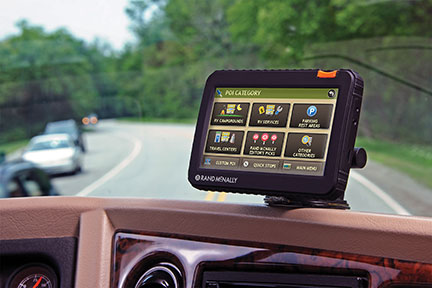
Rand McNally today introduced the RVND 7720, a 7-inch RV GPS device with Wi-Fi connectivity allowing for real-time weather information and display, and new hardware with rugged casing, video input, and brighter screen.
The new device — shipping now to stores, online retailers, and RV dealers and distributors — joins Rand McNally’s line of RVND GPS devices for RVers. Rand McNally pioneered RV-specific navigation by launching the first GPS device designed specifically for RVers and campers, the company said.
RV-specific navigation is necessary to route large vehicles and towables around road restrictions, low bridges and other physical hazards. However, like all Rand McNally RV GPS devices, the RVND 7720 can be used as a car GPS by changing a simple setting.
One of the key new features of the RVND 7720 is Wi-Fi connectivity, which enables the transmission and display of weather as well as other real-time information. With updated weather information, RVers will be able to anticipate delays and make plans by viewing current and predicted conditions displayed on the map and along the route, the company said. Besides weather, other RV-specific connected services will be coming soon for this device.
The RVND 7720 has a new hardware platform as well, with a rugged design with ridged casing for added protection, a brighter screen that adjusts for low and strong light, and video input compatible with a range of back-up and rear-view cameras, Rand McNally said.
The base maps and overlaying content, such as campgrounds, parks, RV service and other RV points of interest, also have been updated for the RVND 7720.
The new device ships with Lifetime Maps, so owners will be able to update their devices at no additional cost.
The RVND 7720 GPS includes the following additional new features:
Fully updated road data, including RV-specific information such as speed limits, legal and physical restrictions, and all Rand McNally proprietary RV data
Fully updated points of interest necessary for safe and convenient routing, including travel centers and RV parking information at rest stops, exits, and other locations
Fuel logs, which are accessible from the Virtual Dashboard or via RV Tools; the feature enables drivers to record fuel purchases for a trip
Additional routing options such as “Avoid State or Province” and “Avoid Smaller Roads”
Address book icon enhancement, which enables unique icons to be created by group and shown on the map for imported locations; address book items can be sorted by name, distance from current location or date added
Text-to-speech alert details for user-imported custom points of interest, such as red light cameras, to reduce driver distraction
The RVND 7720 also has these features: Virtual Dashboard; junction view with lane assist; free downloads of Rand McNally’s proprietary construction information and software updates; Exits Quick View, which shows RV parking and amenities at exits; RV Tools, RV amenities and locations such as campgrounds, RV services, and dumps; Woodall’s Campground information with searchable amenities; Rand McNally exclusive pre-planned trips with photos and video; and routing for 11 types of RVs as well as for cars.
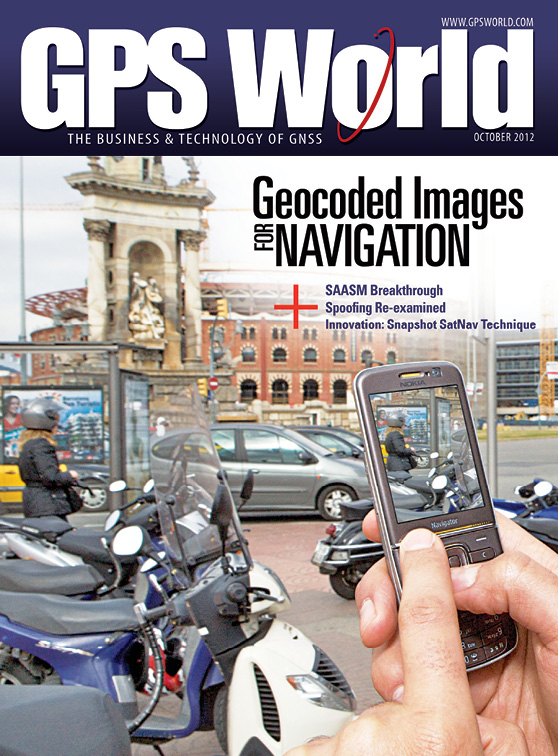
By Ruizhi Chen, Yiwu Wang, Ling Pei, Yuwei Chen, and Kirsi Virrantaus.
A simple and flexible smartphone-based 3D navigation solution uses geocoded images that require neither 3D modeling nor real-time rendering of 3D scenes, making it energy-efficient and cost-effective. Real-world images can be also replaced with screen snapshots of the 3D scenes rendered from existing 3D models. Field tests demonstrate energy efficiency, consuming roughly half the power of a model-based solution with real-time rendering of 3D scenes.
After the September 12 launch of the Apple iPhone 5, which comes equipped with Apple’s own Maps application, users soon found their efforts to navigate thwarted by mislabeled cities, misplaced landmarks, lack of’ transit directions, and strange satellite imagery.
Today, Apple Inc. Chief Executive Tim Cook apologized to customers for the flaws in the Maps app in a letter posted on Apple’s website. The Maps app replaced Google Maps as the standard iPhone mapping application, but Cook is now suggesting customers use the online Google Maps or download other mapping applications while Apple works to fix its application. Google Maps was standard on previous versions of the iPhone. Apple’s newest mobile operating system, iOS 6 doesn’t support Google Maps, so users would have to use that application through the Internet.
Here is the text of Cook’s letter:
To our customers,
At Apple, we strive to make world-class products that deliver the best experience possible to our customers. With the launch of our new Maps last week, we fell short on this commitment. We are extremely sorry for the frustration this has caused our customers and we are doing everything we can to make Maps better.
We launched Maps initially with the first version of iOS. As time progressed, we wanted to provide our customers with even better Maps including features such as turn-by-turn directions, voice integration, Flyover and vector-based maps. In order to do this, we had to create a new version of Maps from the ground up.
There are already more than 100 million iOS devices using the new Apple Maps, with more and more joining us every day. In just over a week, iOS users with the new Maps have already searched for nearly half a billion locations. The more our customers use our Maps the better it will get and we greatly appreciate all of the feedback we have received from you.
While we’re improving Maps, you can try alternatives by downloading map apps from the App Store like Bing, MapQuest and Waze, or use Google or Nokia maps by going to their websites and creating an icon on your home screen to their web app.
Everything we do at Apple is aimed at making our products the best in the world. We know that you expect that from us, and we will keep working non-stop until Maps lives up to the same incredibly high standard.
Open a Nestlé candy bar in the United Kingdom — one of six with a GPS tracking device — and you could win a big cash prize. The candy company’s latest marketing campaign involves putting GPS trackers on half-a-dozen bars such as Kit Kat, Aero, and Yorkie.
A 30-second commercial video shows, in Bond-like fashion, how the bar will activate when opened, with instant response by a “crack team” that will arrive via helicopter to award the lucky customer £10,000.
The marketing campaign, developed by creative agency JWT London, is part of a promotion involving ads on TV and radio, as well as online, costing Nestlé £4 million ($6.5 million).
We are making history. The rate of iOS and Android device adoption has surpassed adoption rates for any other consumer technology in recent history, reports analytics firm Flurry. Android and iOS devices are being adopted at a rate 10 times faster than the rate of PC adoption during the 1980s. Smart device adoption is growing twice as fast as Internet adoption during the 1990s, and three times faster than that of recent social network adoption. Flurry estimates there were more than 640 million Android and iOS devices in use as of July 2012. The U.S., followed by China, has the most active iOS and Android devices. However, China had the fastest growth of active devices last year and its active user base will soon overtake the U.S. Other news this month includes security concerns with LBS offerings, developments in the indoor location market, voice navigation for bikes, and unusual election activities.
With cause, people are concerned about the security of location-based applications. In a poll focused on LBS security, a quarter of 1,000 Americans surveyed indicated both concerns about third-party use of personal information for marketing purposes and strangers knowing too much about personal activities. Surprisingly, about 20 percent indicated a concern for their actual personal safety. The poll was conducted by the non-profit security group, ISACA. Nearly one-third of consumers in ISACA’s survey use location-based apps more than they did a year ago.
It isn’t just LBS that carries security risks. Smartphones themselves are inherently vulnerable. “Every smartphone subscriber end-point is a potential threat to the mobile network and creates hundreds of millions of points of network vulnerability,” says Jeff Orr of ABI Research. Currently, protection is focused on hardware and end-user application security. To more ably face threats, defensive security measures will grow more sophisticated and encompass contextual information about usage, location, and user. Perversely, this is the same information sought by mobile advertisers. Today, carriers are focused on 4G roll-out and delivering the hottest handset, but they need to be just as concerned about security.
A Whiff of Hyperbole in the Indoors. The indoors location market is going to be big, but I think that ABI Research’s forecast of indoor maps and services reaching more than $2.5 billion by 2017 is overstated. I agree with their assertion that business models are changing with the most significant indoor mapping companies increasing their scope to include more revenue enhancing activities. These still focus on indoor location, but include application development, location technologies, analytics, and advertising.
Indoor Location Club. The In-Location Alliance has been formed by 22 companies, including Nokia, Qualcomm, and Samsung, to pursue high-accuracy indoor positioning and related services. One of their goals is to ensure a multi-vendor environment by promoting open interfaces and a standard-based approach. Members are encouraged to execute their own pilots and present their data to the Alliance. The primary solutions will be based on enhanced Bluetooth 4.0 low-energy technology and Wi-Fi standards using relevant existing or upcoming features of those technologies. Pre-commercial pilots and business model verifications will start in 2012, while 2013 is expected to bring mobile handset-based implementation, enabling the first consumer applications in the indoor mobile environment.
Enterprise GPS Doing Well Approximately 5.5 million GPS/wireless devices are used to manage fleet vehicles, trailers, construction equipment, and mobile workers, estimates C.J. Driscoll & Associates. By 2015, this market will expand to more than nine million units and annual hardware and service revenues will grow to over $3.0 billion, predicts Driscoll. Growth is expected to be strongest in the local GPS fleet tracking market, which is expanding at a rate of 15-20 percent per year.
Listen to Your Bike. Google has added turn-by-turn voice-guided navigation for bike riders in 10 Nordic and European bike loving countries. Bikers can either listen to the voice or view the route on a phone. In the U.S. and Canada, a beta version will be available. Google maps contain more than 330,000 miles of biking lines. These are color classified as either dedicated bike trails with no motor vehicles, streets with bike lanes, or other streets recommended for biking. Users can use Map Maker to add bike routes.
Election Coverage. You may have heard that a group called Crossroads GPS spent $5.3 million to run ads to defend Governor Romney’s proposed tax plan. Crossroads GPS is not a new faction of the LBS industry. Crossroads GPS (Grassroots Policy Strategies) is a conservative organization with an unlikely acronym.
Save the Date. I’ll be moderating a panel debate, “Opening up the Indoors for Location Services,” at MforMobile’s Location Business Summit 2012, being held in San Jose October 16-17. TheWhereBusiness and NFC Insight are now MforMobile.
Placed Analytics is a new service that will provide perspective on the places that people were physically nearby when interacting with specific content. Placed Analytics expands the platforms it supports beyond Android and iOS to include the mobile web.
“We chose mobile web as our next platform because mobile site owners have been requesting the same level of insights as app developers. Additionally, the early adopters of Placed Analytics are also the same developers embracing HTML5 as an alternative to native app development,” said David Shim of Placed. “Placed has measured over 1 billion locations since launching our beta to the public back in June. This rate of adoption has surpassed all of our internal goals, and the addition of mobile web measurement should only accelerate growth.”
Dentsu has released a social app for location-based food search for iOS devices. FoodKing enables searching for a particular food item of interest, such as an omelet or pasta, based on the user’s location. Users can also “like” and “comment” on reviews and gather points to become a King of an individual food ranking.
This app was released globally enabling users to communicate internationally through food reviews. Dentsu says it will be adding new food categories every month. Currently the app supports English and Japanese in the interface, and reviews in all languages. More languages are planned.