Category: Transportation

  • NovAtel releases 2 triple-frequency marine GNSS antennas

    NovAtel releases 2 triple-frequency marine GNSS antennas

    NovAtel-ATEX-antennaNovAtel Inc. has introduced the GPS-713-GGG-N and GPS-713-GGGL-N ATEX-qualified triple-frequency GNSS antennas with an Inmarsat rejection filter.

    Based on the company’s pinwheel technology, the antennas offer multi-constellation reception of L1, L2 and L5 GPS; L1, L2 and L3 GLONASS; B1 and B2 BeiDou; as well as E1 and E5 a/b Galileo frequencies.

    The GPS-713-GGGL-N also supports L-Band from 1525 to 1560 megahertz. The same antenna can be used for GPS-only, dual or triple constellation applications, resulting in increased flexibility and reduced equipment costs, the company said in a news release.

    The phase center of the antennas remain constant as the azimuth and elevation angle of the satellites change. Signal reception is unaffected by the rotation of the antenna or satellite elevation, according to NovAtel. With the phase center in the same location for the GNSS signals, and with minimal phase center variation between antennas, the antenna is suitable for baselines of any length.

    The rugged antenna is enclosed in a durable, waterproof housing and meets MIL-STD-810G for vibration, corrosive environment and salt fog, NovAtel says. The GPS-713-GGG-N and GPS-713-GGGL-N are similar in form factor to our other high performance GPS-700 series antennas, and bth antennas meet IEC60945 specifications.

    The two antennas deliver choke-ring level antenna performance, but without the size and weight, NovAtel said. Both antennas provide enhanced Inmarsat interference rejection, which allows tracking of GNSS signals in the presence of high-powered Inmarsat transmitters that are typically found on marine vessels.

  • Clarion adopts Furuno GNSS receiver for car nav system

    Furuno's GV-86.
    Furuno’s GV-86.

    Clarion has adopted Furuno’s GV-86 in the NXR16 for in-car navigation and positioning. Clarion is a Japanese manufacturer of in-vehicle infotainment head units, including car navigation systems and car audio systems.

    Clarion thoroughly evaluated the Furuno receiver for its robustness in heavy-use environments and the company’s long-term supply-chain capability.

    The NXR16, which debuted in June, is designed to fill the needs of professional-use customers in the auto-leasing and rent-a-car industry. It supports multi-language and multi-display features that satisfy the increasing number of foreign tourists using rental-cars.

    Clarion's NXR16 car navigation system.
    Clarion’s NXR16 car navigation system.

    Furuno’s GV-86 is a dead-reckoning-enabled GNSS receiver that concurrently receives GPS, SBAS and QZSS satellite signals. Its dead-reckoning function enables it to provide high-accuracy positioning in environments where no GNSS signals can be received, such as tunnels, underground car parking and deep urban canyons.

    The dead-reckoning function is realized by integrating the information from a gyro sensor and a velocity sensor.


  • Pointer Telocation to support Rio Olympics with fleet management

    Pointer Telocation Ltd. – a developer, manufacturer and operator of Mobile Resource Management (MRM) — signed a contract July 18 with CET RIO (the Rio de Janeiro Transit Authority) to provide technology and integration services during the 2016 Olympic Games, managing the vehicles and personnel responsible for transit control, emergency and contingencies.

    More than 200 vehicles will be monitored in real time which will be managing, controlling and supporting the traffic management systems starting Aug. 5 and throughout the games.

    The system will use Pointer’s Web Fleet Software Platform and will be integrated into the CET Control Center as well as the COR (the city’s Operation Center), providing a unified view of traffic information throughout Rio.

    “We are very pleased to be playing an important role in the smooth running of the Olympic Games this summer,” said David Mahlab, chief executive officer of Pointer. “Our selection by Rio’s Transit Authority for this very high profile event and mission critical task, demonstrates a strong level of trust in our solution. We look forward to successfully delivering on this contract, and we believe this will provide us with very strong references for further work in the region.”

  • Verizon to acquire fleet management company Fleetmatics

    Verizon to acquire fleet management company Fleetmatics

    Transaction to accelerate Verizon’s position as a provider of fleet and mobile workforce management solutions, companies say

    Verizon Communications Inc. and Fleetmatics Group PLC have entered into a definitive agreement under which Verizon will acquire Fleetmatics, a global provider of fleet and mobile workforce management solutions, for $60 per share in cash — representing a value of approximately $2.4 billion.

    In June, Verizon Telematics announced the acquisition of Telogis Inc., a global, cloud-based mobile enterprise management software company based in Aliso Viejo, California. That transaction closed on July 29.

    With approximately 1,200 employees, Fleetmatics is headquartered in Dublin, Ireland, with North American headquarters inWaltham, Massachusetts. The company’s web-based solutions provide fleet operators with visibility into vehicle location, fuel usage, speed and mileage, and other insights into their mobile workforce, helping them to reduce operating costs, as well as increase revenue.

    Verizon Telematics, a subsidiary of Verizon Communications, operates in more than 40 markets worldwide and offers comprehensive wireless, software and hardware solutions to consumers, enterprises, automakers and dealers to power connected-vehicle products around the world.

    “Fleetmatics is a market leader in North America — and increasingly internationally — and they’ve developed a wide-range of compelling SaaS (software as a service)-based products and solutions for small- and medium-sized businesses,” said Andrés Irlando, CEO of Verizon Telematics.

    “The powerful combination of products and services, software platforms, robust customer bases, domain expertise and experience, and talented and passionate teams among Fleetmatics, the recently-acquired Telogis, and Verizon Telematics will position the combined companies to become a leading provider of fleet and mobile workforce management solutions globally,” Irlando added.

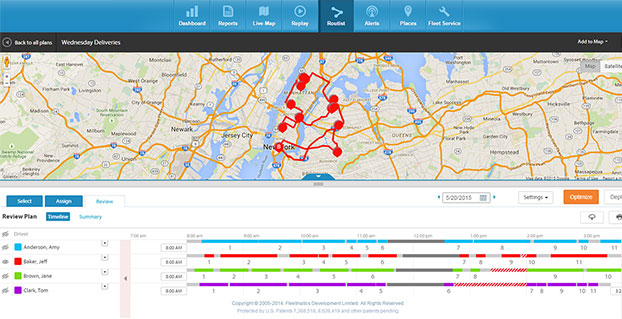
    Fleetmatics Routist is an intelligent routing optimization tool for fleet management.
    Fleetmatics Routist is an intelligent routing optimization tool for fleet management.

    “Verizon and Fleetmatics share a vision that the SaaS-based fleet management solution market is extraordinarily large, lightly penetrated, global and fragmented which can best be attacked together with a world class product offering and the largest distribution channel in the industry,” said Jim Travers, Chairman and CEO of Fleetmatics.

    “Fleetmatics brings over 37,000 customers, approximately 737,000 subscribers, a broad portfolio of industry leading products, and a team of 1,200 professionals focused on solving the critical challenges of businesses that deploy mobile workforces. We are excited to partner with Verizon in fulfilling the mission of becoming the largest mobile workforce management company in the world,” Travers added.


    The acquisition is subject to customary regulatory approvals and closing conditions, including the approval of Fleetmatics’ shareholders and the sanction of the Irish scheme of arrangement by which Verizon will acquire Fleetmatics by the Irish High Court, and is expected to close in the fourth quarter of 2016.

    PJT Partners and Wells Fargo Securities, LLC are acting as financial advisors to Verizon. Cleary Gottlieb Steen & Hamilton LLP, A&L Goodbody and Macfarlanes LLP are acting as legal advisors to Verizon. Morgan Stanley is acting as financial advisor to Fleetmatics. Goodwin Procter LLP and Maples and Calder are acting as legal advisors to Fleetmatics.

  • PNT Roundup: Remote and autonomous ships coming to high seas

    PNT Roundup: Remote and autonomous ships coming to high seas

    Remote and Autonomous Ships

    Coming Soon to the High Seas Near You

    Image courtesy of Rolls-Royce.

    The Advanced Autonomous Waterborne Applications Initiative (AAWA) published a white paper in June as part of presentations at the Autonomous Ship Technology Symposium 2016 in Amsterdam. The white paper outlines the Project’s vision of how remote and autonomous shipping will become a reality.

    Oskar Levander, Rolls-Royce vice president of Innovation – Marine, said, “This is happening. It’s not if, it’s when. The technologies needed to make remote and autonomous ships a reality exist. The AAWA project is testing sensor arrays in a range of operating and climatic conditions in Finland and has created a simulated autonomous ship control system which allows the behaviour of the complete communication system to be explored. We will see a remote controlled ship in commercial use by the end of the decade.”

    The AAWA white paper explores the research carried out to date on the business case for autonomous applications, the safety and security implications of designing and operating remotely operated ships, the legal and regulatory dimensions and the existence and readiness of a supplier network to deliver commercially applicable products in the short to medium term.

    Positioning Technologies. The proposed system draws on a range of sensors (see Figure 1) including GPS, inertial, lidar, cameras, short-range radars, and electronic charts. “When combined witha global or local positioning reference such as GNSS, and with wind sensors and inertial measurement units, the ship is able to keep its position even in rough weather conditions,” states the report. “The main question is therefore not whether the implementation of autonomous ship navigation is technically possible, but what is the combination of technologies and methods that provides the level of performance and reliability that is required for practical operation of large vessels, and at a reasonable cost.”

    The white paper draws on a wide range of expertise from academic researchers at some of Finland’s leading universities. Industry input has been provided by leading members of the maritime cluster including Rolls-Royce, Brighthouse NAPA, Deltamarin, DNV GL and Inmarsat.

    The project also has the support of shipowners and operators. The tests of sensor arrays are being carried out aboard Finferries 65-metrer double ended ferry, the Stella, which operates between Korpo and Houtskär. ESL Shipping Ltd is helping explore the implications of remote and autonomous ships for the short sea cargo sector.


    Iran Reiterates Loran Effort

    Researchers at Iran’s Malek-Ashtar University have developed a 1-megawatt transmitter with half-cycle technology for a national project announced as a replacement for GPS, which is currently employed for all positioning, navigation and timing services across the country. Given the lack of control on the GPS’s accuracy and quality and a possible outage of the system in critical conditions, the country’s defense ministry has set out to develop a local positioning system (LPS) for positioning and timing.

    Experts at the U.S.-based Resilient PNT Foundation say the description of the system make it appear to be a variant of Loran, probably similar to those operated in Russia and China. If it is such a Loran variant and if it complies with international standards, it should complement Saudi Arabia’s Loran signals in the Persian Gulf, they said.

    Iran will establish five stations with powerful transmitters in appropriate locations to provide navigation, positioning and timing services in compliance with international standards, according to the country’s defense minister.

    Iran made a similar announcement about a land-based navigation system in December 2013. The country’s military experts and technicians have reportedly logged significant progress in manufacturing a broad range of indigenous equipment.


    U.S. eLoran August demonstration

    The Wildwood, New Jersey, eLoran transmitter will continuously broadcast from July 29 through 12 p.m. Eastern time on Aug.15. Wildwood will broadcast as 8970 Master and Secondary most of the time but occasionally may operate at other rates.

  • Launchpad: OEM, UAV and survey/mapping products

    OEM

    Geodetic Antennas

    For RTK, PPP, and other precision applications

    TW6000 rendered[1]

    The VP6300 is a triple-band antenna for reception of GPS L1/L2/L5, GLONASS G1/G2/G3, BeiDou B1/B2 and Galileo E1/E5a+b (1165MHz to 1254MHz + 1560MHz to 1610MHz). The VP6200 is a dual-band antenna for reception of GPS L1/L2, GLONASS G1/G2, BeiDou B1/B2, Galileo E1 and the L-Band correction services (1195 MHz to 1254 MHz + 1525 MHz to 1610 MHz). Both antennas have been calibrated by the U.S. National Geodetic Survey and are designed for high-precision applications such as real-time kinematic, precise point positioning and other applications where precision matters. The antennas feature an available, uncommitted printed circuit board for integration of custom electronics such as precision GNSS receivers. Both antennas feature the VeraPhase technology used in the VP6000 all-band reference antenna.

    Tallysman, www.tallysman.com


    ‘Future Proof’ RTK

    For rover or base station

    Image_Altus_APS3G_external_use

    The Altus APS3G is a real-time kinematic (RTK) receiver that brings technology from scientific receivers into the field for professional surveyors. The new multi-constellation APS3G addresses major concerns about compatibility with new satellite constellations, as well as interference and jamming. Built on Septentrio’s AsteRx4 engine, the APS3G tracks all-in-view GPS, GLONASS, BeiDou, IRNSS, SBAS, Galileo and QZSS, including E6/L6 and all other signals known to be available in the medium term. The APS3G incorporates Septentrio’s AIM technology with three notch filters for in-band jamming and chirp jammer resistance, ensuring the highest possible levels of accuracy and resilience under all conditions. It provides optimum GSM signal reception, as well as a built-in advanced UHF receiver for reliable performance on longer baselines, yielding real-time 25-Hz RTK.

    Septentrio, www.septentrio.com


    GNSS Receiver

    Offshore surveys, machine control, crustal deformation

    N72_Hi-res

    CHC’s N72 GNSS series offers high-end receivers for GNSS applications including offshore surveys and machine control, national geodetic networks, crustal deformation monitoring and bathymetry. It was designed to provide all the necessary technical features required for geodetic surveying and demanding applications such as Continuously Operating Reference Stations (CORS), on-board machine control and disaster monitoring. Embedded battery supports 15 working hours without external power supply; 32-GB internal memory integrated and 1TB+ external memory supported; Eight threads of logging with circulating storage and FTP push functions; Wi-Fi, LAN, Bluetooth and serial ports for data communications; and LCD display and function buttons for direct configuration.

    CHC, www.chcnav.com


    Anti-Jam Antenna

    Suitable for airborne platforms

    GAJT-AE 34 view

    The GAJT-AE-N anti-jam antenna is designed for size- and weight-constrained applications such as small airborne and ground unmanned platforms where it is preferable to mount the antenna electronics inside the vehicle. Users can select from a variety of four-element Controlled Reception Pattern Antennas (CRPA) and cabling lengths to meet the form factor requirements of their installation. Interference mitigation is achieved by applying proprietary digital beamforming algorithms to the signals, creating dynamic nulls to give protection against narrowband and broadband interference sources. GAJT-AE-N comes in variants that protect L1 and L2 signals in wide or narrow band. The wide bandwidth version ensures future compatibility with M-code GPS.

    NovAtel, www.novatel.com


    Transportation

    GNSS Modules

    Automotive-grade positioning modules

    UB052(Fig1)

    The NEO-M8Q-01A and the NEO-M8L-01A positioning modules provide concurrent reception of GPS, GLONASS, Beidou and Galileo. The NEO-M8L-01A is suited to providing 100 percent dead-reckoning positioning coverage even in areas of weak signal such as in tunnels or multi-story car parks or those experiencing poor signal quality such as caused by multipath reflections. This module is qualified to operate in the -40 to +85 degrees temperature range. The NEO-M8Q-01 GNSS module is the first GNSS module able to operate across the extended automotive temperature range from -40 to + 105 degrees Celsius.

    u-blox, www.u-blox.com


    Connected Car Reference Platform

    Simplifies integration of advanced connectivity technologies into new vehicles

    2016-06-06-ch-qualcomm-cc-reference-platform

    The Qualcomm Connected Car Reference Platform is aimed at accelerating the adoption of advanced and complex connectivity into the next-generation of connected cars. The product is designed to maintain pace with an ever-increasing set of automotive use cases facilitated by the latest advances in 4G LTE, Wi-Fi, Bluetooth and vehicle-to-everything (V2X) communications. The platform is also designed to solve for challenges such as wireless coexistence, future-proofing and support for a large number of in-car hardware architectures. The Connected Car Reference Platform is built upon Qualcomm Technologies’ broad automotive product and technology portfolio, including quad-constellation GNSS, Snapdragon X12 and X5 LTE modems, and 2D/3D dead-reckoning location solutions, Qualcomm VIVE Wi-Fi technology, Dedicated Short Range Communications (DSRC) for V2X, Bluetooth, Bluetooth Low Energy and broadcast capabilities such as analog and digital tuner support using software-defined radio via Qualcomm tuneX chips. In addition, the platform features in-vehicle networking technologies such as Gigabit (OABR) Ethernet with Automotive Audio Bus (A2B) and Controller Area Network (CAN) interfaces.

    Qualcomm Technologies, www.qualcomm.com


    SURVEY & MAPPING

    TotalStationSurveyTotal Station App

    Connects Android device to information gathered 

    Total Station Survey helps land surveyors and civil engineers view and inspect on any Android device the information gathered by the total station. It connects to the total station using Bluetooth or a USB-serial adapter/converter cable. It can measure horizontal and vertical angle, slope and horizontal distance, and set the horizontal angle on the total station. The app is available free on Google Play.

    Systranova Software, play.google.com


    Laser and Android App

    Collect survey-grade accuracy with an Android device 

    TP300_QM3D_Cedar_TriPod_CloseUp_001

    The TruPoint 300 is a lightweight, compact point-and-shoot laser with survey-grade accuracy. It measures the distance between two remote points and has onboard solutions for volume, heights and 2D and 3D areas. Users can collect 3D measurements from a single location using a personal smart device and capture a photo of every shot taken, using LTI’s MapSmart on Android software. MapSmart combines sophisticated technology typically required to collect field data and puts it into a straightforward app for smart devices. It simplifies the mapping process by allowing users to establish an origin quickly and begin mapping in just minutes. Users can integrate location data using the GPS from a smart device or improve accuracy with an external antenna.
    Laser Technology, www.lasertech.com

    Laser Technology, www.lasertech.com


    Smartphone App

    Quick land measurements 

    GPS Fields Area

    GPS Fields Area Measure Pro is easy, intuitive, app to manage area, distance, perimeter. It enables fast area/distance marking, and ha a Smart Marker Mode for accurate pin placement. Its GPS tracking enables auto measurement while walking or driving around a boundary. Users can share an auto-generated link with boundary/selected area/ direction/route. GPS Field Area Measure useful as map measurement tool for outdoor activities, sports, range finder applications, bike tour planning, or run tour planning, explore golf area, land survey, golf distance meter, field pasture area measure, garden and farm work and planning, area records, construction, agricultural fencing, solar panel installation – roof area estimation, trip planning.

    Studio Noframe, play.google.com


    Dedicated 3D Tablet

    Capture and review 3D images in the field  

    3DTablet

    The EyesMap tablet is a versatile instrument for modeling 3D scenes indoors and outdoors. It provides results while working in the field with real-time measurements. The tablet has a stereocamera, depth sensor scanner, GPS and inertial measureent unit. It also supports external cameras and other topographic instruments. Applications include crime scene investigation, archaeology and architecture documentation, as-built measurements and inspections, industrial and civil maintenance.

    eCapture, www.ecapture.es


    Handheld Collector

    Entry-level GNSS device for GIS 

    TDC100_FrontThe TDC100 handheld data collector is an entry-level GNSS device for a variety of geographic information system (GIS) applications. It combines both smartphone and ruggedized data collection capabilities in a single, mobile device. The Android-based TDC100 can run commercially available or in-house developed applications on a professional, IP-67 ruggedized platform with a sunlight readable display and user replaceable batteries. The built-in GNSS receiver also provides real-time accuracy. It supports GPS, GLONASS and BeiDou, as well as satellite-based augmentation system (SBAS) capabilities.

    Trimble, www.trimble.com


    UAV

    RedHen-UAVreconnaissanceReconnaissance Kit

    Situational awareness for disaster relief

    The Digital Mapping Reconnaissance Toolkit (DMRT) provides real-time reconnaissance for disaster relief and other time-sensitive situations. . It is a custom configuration of cameras, laser rangefinder, GPS unit and software all linked through the Red Hen VMS-333 multiplexing system. Users can create up-to-date orthomosaic maps and 3D models, as well as geotag reference points in impacted areas without a time lag. Users can create search patterns and map with situational awareness. Both modular aerial and land-based solutions are available

    Red Hen Systems, www.redhensystems.com


    UAV Backpack

    Intelligent Obstacle Navigation

    Yuneec Typhoon H with Intel RealSense Technology (PRNewsFoto/Yuneec International)

    The Typhoon H UAV with Intel RealSense Technology comes with a factory installed Intel RealSense R200 Camera and quadcore Intel Atom processor, an ST16 controller with a Wizard controller for dual operator mode, two batteries and extra propellers, all packed in a custom designed backpack. RealSense Technology enables Typhoon H to fly autonomously, intelligently navigating around objects. The Intel RealSense R200 Camera and the Atom processor work seamlessly with the flight-control firmware to add intelligent obstacle navigation. With a combination of specialized cameras and sensors, this Intel system maps and learns its environment in 3D, recognizing each obstacle, planning an alternative route, and safely navigating around it — an advancement over ultrasonic collision prevention, which automatically stops short of obstacles but cannot model the environment or intelligently reroute around obstacles. The module also adds downward facing sensors to improve stability, enabling flight indoors or outdoors close to the ground, even with poor GPS reception.

     Yuneec International, www.yuneec.com


    Intelligence Platform

    Insight for complex missions

    Advanced alerting

    Mission Insight provides UAS operators in deployed situations with a common operating picture in a customized graphical interface. The commercial off-the-shelf application processes and analyzes large streams of data from disparate sources in real-time. It ensures real-time, in-depth data access for mission-critical events even in remote environments or low-bandwidth situations. Complex data filtering, advanced processing and timing techniques enable Mission Insight to prioritize data and allow transmission as low as 2400 baud. The complete information management solution —including archival and replay capabilities in addition to the correlation, fusion and analytical tools — aid in training, post-operation analysis, incident investigation and review of operational effectiveness.

    Simulyze, www.simulyze.com


    Multi-Spectral Camera

    Situational awareness for disaster relief

    Sensefly_Camera_2

    Sequoia is a small, light multispectral UAS sensor that captures images of crops across four highly defined, visible and non-visible spectral bands, plus RGB imagery. Sequoia is fully compatible with the eBee Ag and other eBee platforms via senseFly’s proprietary Integration Kit. It has four 1.2 megapixel sensors (near-infrared, red-edge, red and green) plus one 16 megapixel RGB sensor, providing multispectral and RGB imagery from a single flight. An upward-facing Sunshine Sensor automatically calibrates Sequoia’s multispectral sensors for accurate imagery, whatever the light conditions. The camera unit can be configured over Wi-Fi and has 64-GB of built-in storage; the Sunshine Sensor has GPS, an IMU, a magnetometer and SD card slot

    senseFly, www.sensefly.com


  • Rohde & Schwarz offers ADAS testing

    Rohde & Schwarz offers ADAS testing

    Rohde-ADAS-spectrum-analyzer-W

    Rohde & Schwarz’s FSW85 high-end signal and spectrum analyzer, including an analysis option for FMCW chirp signals, is suitable for testing advanced driver assistance systems (ADAS). It analyzes automotive radar sensors designed for designated frequency bands around 24 gigahertz and 79 gigahertz.

    It can cover the frequency range from 2 gigahertz to 85 gigahertz in a single sweep. Its optional analysis bandwidth of up to 2 gigahertz makes it possible to demodulate and thoroughly analyze even extremely broadband signals.

    R&S also offers an eCall test system consisting of the R&S CMW500 and the GNSS-capable R&S SMBV100A vector signal generator, a hardware-in-the-loop solution for standard-compliant end-to-end tests for wireless communications and GNSS-capable components in in-vehicle systems.

  • Connected car considerations: Industry viewpoints on standardization, safety and more

    Connected car considerations: Industry viewpoints on standardization, safety and more

    This article presents short segments from each of the four speakers on GPS World’s June Connected Car webinar, sponsored by u-blox. The one-hour webinar with presentation slides is now available on demand.

    Chaminda Basnayake, Principal Engineer, V2X Systems, Renesas Electronics

    In the basic V2X concept of operation, everybody will be talking to each other, will be aware of each other. Any car will be broadcasting BSMs, pedestrian or personal devices will be broadcasting an equivalent message, called personal safety messages (PSM), and then all the control devices like traffic control will broadcast signal-based timing information, SPAT messages, intersection maps and GPS correction data.

    The expectation in the system design is that all vehicles will provide position information and location accuracy, and the vehicle should be able to get this from itself and from others.
    The idea is that every vehicle should be able to relatively position everyone else, and then with the onboard device, the vehicle should be able to position itself with respect to the roadway.

    A lot of applications are out there. A good source of further information on these is put together by the Connected Vehicle Reference Implementation Architecture, a U.S. Department of Transportation initiative.

    Connected Car Gateway for applications such as emergency calling, telematics, infotainment data distribution and usage-based insurance. (Image: u-blox)
    Connected Car Gateway for applications such as emergency calling, telematics, infotainment data distribution and usage-based insurance. (Image: u-blox)

    John Kenney, Director and Principal Researcher, Network Division, Toyota InfoTechnology Center

    A couple of issues are hot today with regard to spectrum and how we’re going to use it: what kinds of technology to use to support V2X, in the United States and around the world, and also whether that spectrum can be shared by other technologies for other purposes.

    V2X is an inherently ad hoc network, and that makes evolution across generations a much more challenging task than we are used to seeing in the cellular environment.

    Dedicated Short-Range Communication (DSRC) technology is now mature, and it’s entering the deployment phase. The cellular V2X technology that’s in the initial standardization is interesting; it offers benefits by complementing DSRC, but we don’t want to see it positioned as a competitor. The auto industry wants to remove uncertainty (regarding spectrum sharing) but only in a way that does not threaten DSRC’s safety-of-life mission.

    Nikolaos Papadopoulos, President, u-blox America

    The adjacent figure shows an in-vehicle module for emergency calling, other positioning applications and infotainment. The blue boxes show the components that we supply: the GNSS with three-dimensional dead reckoning, and in the future with lane-level accuracy, the TOBY 4000 with the customer application, as well as Wi-Fi, Bluetooth and near-field communications.

    I have shown examples in this webinar where we can clearly identify lane changes with a combination of GNSS technologies.

    We very much encourage both Tier Ones and OEMs to keep the cellular technology, the short-range communication technology, and the GNSS positioning technology separate. The advances in GNSS and positioning for autonomous vehicles are truly extraordinary, and can only be done in the separate GNSS technology.

    How to Put the Car on a Map? Positioning technology options. (Image: Renesas Electronics)
    How to put the car on a nap? Positioning technology options. (Image: Renesas Electronics)

    Roger Berg, Vice President, Wireless Technologies, DENSO North American R&D Laboratories

    The video example that I showed here, of advance warning of a braking car hidden from your line of sight ahead of you, used a Toyota vehicle, a u-blox positional element, and a Renesas V2V component.

    We’ve learned through experience that one company can’t do it all. This is an ecosystem that requires connectivity and cooperation. No longer is a vehicle its own entity; it does not operate separate from infrastructure and other road users. And finally, we can’t necessarily predict how connected and automated drivers interact with so-called regular vehicles, those controlled by human drivers. It’s going to take a lot of collaboration between industry, academia and government to be effective.

  • Launchpad: OEM, transportation and survey/mapping products

    OEM

    Grandmaster Clock

    All-in-one time-and-frequency master time and clock server

    Spectracom's VelaSync time server and grandmaster clock.
    Spectracom’s VelaSync time server and grandmaster clock.

    When the VelaSync time server platform was introduced in 2014, it met the needs of financial trading networks’ move to 10 gigabit-per-second networking. Now available with 40-GbE network interfaces, it offers high-performance synchronization for time-sensitive networks. Matching network speeds between timing and data on a single low-latency high-throughput network enhances synchronization accuracy and eliminates queuing delays and hidden time errors caused by slower connections. The availability of a network timing appliance with 40-GbE interfaces benefits any deployment of critical network infrastructure at high data rates.

    Spectracom, www.spectracom.com


    Multi-Band Antenna

    Triple band plus L-Band correction services

    TW3000 flat grey trans

    The TW3970 / TW3965 antennas have superior cross polarization rejection to enhance multi path signal rejection, tight phase center variation and an excellent axial ratio. The TW3970 is a pole mount or through-hole mount antenna; the TW3965 is an embeddable form. Bothemploy Tallysman’s Accutenna technology and are capable of receiving GPS L1/L2/L5, GLONASS G1/G2/G5, BeiDou B1/B2, Galileo E1/E5a+b plus L-band correction services (1164 MHz to 1254 MHz + 1525MHz to 1606 MHz). The antennas are designed for precision agriculture, autonomous vehicles and other precision applications. The ability of the antennas to access L-band correction services extends its utility to a wider range of applications.

    Tallysman, www.Tallysman.com


    Inertial Navigation

    Systems for a variety of unmanned applications

    VectorNav's new Tactical Series
    VectorNav’s new Tactical Series

    The Tactical Series of inertial navigation systems (INS) is a next-generation family for high performance. Built on a common tactical-grade proprietary micro-electro-mechanical (MEMS) inertial sensing core, the Tactical Series includes the VN-110 inertial measurement unit and attitude heading reference system (IMU/AHRS), the VN-210 GPS-aided INS (GPS/INS), and the VN-310 dual-antenna GPS/INS. The Tactical Series offers the same functionality and features as the Industrial Series for integrators of SWaP-C (size, weight, power and cost) constrained manned and unmanned systems. The Tactical Series takes advantage of the latest developments in solid-state MEMS technology to incorporate a three-axis gyro with <1°/hour in-run bias stability, leading to an attitude accuracy of 1 to 2 milliradian. In addition to the improved IMU core, the Tactical Series enclosure is designed to DO-160G airborne standards and rated IP68 for deployment in harsh and extreme environments.

    VectorNav Technologies, www.vectornav.com


    Autopilot Sensors

    Plug n’ fly control system for UAV, UAS, USV and UGV systems

    VelaSync by Spectracom

    Veronte Autopilot is a miniaturized fail-safe avionics system with an embedded suite of sensors and processors for advanced control of unmanned systems. The OEM version weighs 90 grams, and the version with an aluminum enclosure weighs 200 grams. Both versions include a datalink radio. The control system is fully configurable — payload, platform layout, control phases, control channels and the user interface layout can be user defined, making it cost effective for a wide range of professional applications. The embedded GPS module offers RTK-like positioning with centimeter precision. It meets DO-178C / ED-12, DO-254 and DO-160G aircract regulations.

    Embention, www.embention.com


    Transportation

    Digital Maps

    Critical coverage for autonomous driving development

    HX-DU1603-ROVER-RADIO

    TomTom’s HD (high-definition) Map and RoadDNA are highly accurate digital map products helping automated vehicles precisely locate themselves on the road and plan maneuvers, even when traveling at high speeds. These technologies are being rolled out in strategic geographies and are the subject of key partnerships with other automotive suppliers. TomTom now offers more than 122,000 kilometers of HD Map coverage globally, including Interstates in Connecticut, Delaware, District of Columbia, Georgia, Idaho, Kansas, Louisiana, New Hampshire, New Mexico, North Carolina, Ohio, Pennsylvania, Rhode Island, South Dakota, Tennessee, Texas, and Vermont; Interstates and highways in California, Michigan and Nevada; and the Autobahn network in Germany.

    TomTom, www.TomTom.com


    V2X GNSS Antenna

    Applications range from infrastructure to infotainment

    3D-Model-of-small-object-with-eyesMap3D-O

    Smart Antennas by Laird Technologies combine antenna elements and radio receivers in the same robust package. Compared to traditional architectures, the Smart Antenna provides signifcant performance improvement and system-wide cost savings. Custom solutions are available, including 4G LTE cellular, GNSS, Wi-Fi and Bluetooth, as well as the emerging dedicated short-range communications (DSRC) technology with a 1,000-meter range for V2X. Applications include navigation systems, vehicle-to-vehicle communication,vehicle to infrastructure communication and infotainment. Operating temperature range is –40 C to 85° C.

    Laird Technologies, www.lairdtech.com


    SURVEY & MAPPING

    USV Echo Sounder

    Single-beam system for shallow water surveys 

    HX-DU1603-ROVER-RADIO

    The CEESCOPE-USV is a waterproof one-box echo sounder, GNSS and broadband radio telemetry package that can be installed on practically any remotely operated unmanned surface vehicle (USV). The self-contained unit requires no interface with the USV, eliminating challenges of instrument data integration on the vehicle. Using real-time broadband radio telemetry, detailed 20-Hz dual-frequency soundings, up to 20-Hz RTK GNSS and a 3200-sample-per-ping digital echogram are available to the USV operator on shore via the CEE-LINK radio base station. Data from the CEESCOPE-USV telemetry link allows the operator to steer the USV along the survey line like in any manned boat survey. The CEESCOPE-USV offers users a range to their vehicle of more than 1,000 meters.

    Cee HydroSystems, www.ceehydrosystems.com


    Airborne Sensor

    Expanded functionality

    3D-Model-of-small-object-with-eyesMap3D-O

    The new ALS80-UP airborne sensor enables even more flexible data acquisition with extended range measurement capability. It takes advantage of the dual-output optical system pioneered in the ALS70 and enhanced in the originl ALS80. The AL80-UP has higher Multiple Pulse in Air (MPiA) operation settings, enabling data collection in extreme terrains with minimal variation in swath width due to terrain elevation variations. The ALS80-UP works perfectly in a wide variety of scenarios, including wide-area mapping, detail mapping from high-flying heights and detail mapping over mountainous terrain. With its expanded maximum range, the system has demonstrated good results at up to 6,000 meters above terrain and with terrain relief of up to 2,300 meters.

    Leica Geosystems, www.leica-geosystems.com


    Repeater

    Receive RTK corrections via radio 

    3D-Model-of-small-object-with-eyesMap3D-O

    The Settop Repeater allows rover-RTK network users in areas of low or no GSM coverage to receive differential corrections via radio. It can connect to any external radio model on the market for precision agriculture systems or machine control. Repeater field application versatility is managed by an intuitive software controlled using a touchscreen. It can also be used for land surveying and marine work. It reduces the need for an RTK base station and offers flexible field configuration.

    Setup Survey, www.settopsurvey.com


    Graphics-Based Data Collection

    Expanded toolsets and capabilities for speed and accuracy 

    3D-Model-of-small-object-with-eyesMap3D-O

    FieldGenius 8 software takes advantage of the high-power processors, high-definition displays and larger memory in modern Windows Mobile powered data collectors and Windows 7 powered tablets. It provides tight control through expanded toolsets. Features include easy GNSS local transformation with the ability to export and import localization files; enhanced DXF support; advanced point averaging, which allows users to take multiple GNSS measurements and calculate an averaged position; support for integrated inertial sensors; native unicode support;and simplified GIS mapping. FieldGenius 8 also has improved road alignments, an onboard basic measurement mode, dynamic screen rotation and expanded ASCII export options. Supported coordinate systems, geoids, instruments and data collectors have been expanded, making it easier to integrate into existing survey operations.

    MicroSurvey Software, www.microsurvey.com


    UAV

    Imaging Camera

    Thermal and radiometric functionality

    VelaSync by Spectracom

    The FLIR Vue Pro R adds radiometric functionality to the Vue Pro camera, giving drone operators the ability to save pictures for post-flight image analysis and accurately measure the temperatures of individual image pixels. Calibrated radiometric imaging allows it to capture the temperature data of every pixel in an image. When saved in Radiometric JPEG format, still images can be imported into FLIR Tools software for detailed analysis and reporting. FLIR Tools, a free download on FLIR.com, lets drone operators adjust settings including object emissivity, background temperature, target distance, relative humidity and thermal sensitivity, as well as assigning various color palettes for each image. The Vue Pro R records digital thermal video, along with radiometric thermal still images, to an on-board micro-SD card. For applications such as electrical inspection, infrastructure assessment and precision mapping, the onboard recording allows operators to capture high-quality thermal data for post processing and analysis.

    Flir Systems, www.flir.com


    Real-Time Reconnaissance

    Reconnaissance for disaster relief, time sensitive situations 

    3D-Model-of-small-object-with-eyesMap3D-O

    The Digital Mapping Reconnaissance Toolkit (DMRT) creates up-to-date orthomosaic maps and 3D models. Users can fly a drone to survey the landscape for real-time solutions, and geotag reference points in impacted areas without a time lag. Seeing what the drone sees, pilots can create search patterns and map with situational awareness. Modular aerial and land-based solutions are available.

     Red Hen Systems, www.redhensystems.com

  • U-blox produces automotive-grade positioning modules

    U-blox has added automotive qualified product variants to its range of positioning and cellular wireless connectivity modules: the NEO-M8Q-01ANEO-M8L-01ASARA-G350-02A  and LISA-U201-03A.

    Manufactured according to the ISO/TS 16949 automotive supply-chain quality management standard, the modules are thoroughly tested with an extended qualification process aimed at achieving the lowest level of failure rates, u-blox said.

    Leveraging the early production experience of tens of millions of professional grade modules, u-blox automotive-grade modules consistently reach excellent quality levels. With long product life-cycle characteristics, u-blox manufacturing management includes industry-recognized processes such as automotive PCN, PPAP and 8D failure reporting.

    The NEO-M8Q-01A and the NEO-M8L-01A positioning modules provide concurrent reception of GPS, GLONASS, Beidou and Galileo. The NEO-M8L-01A is suited to providing 100 percent dead-reckoning positioning coverage even in areas of weak signal such as in tunnels or multi-story car parks or those experiencing poor signal quality such as caused by multipath reflections. This module is qualified to operate in the -40 to +85 degrees temperature range, and the NEO-M8Q-01 GNSS module is the first GNSS module able to operate across the extended automotive temperature range from -40 to + 105 degrees Celsius.

    The SARA-G350-02A is a quad-band GSM/GPRS data and voice connectivity module that is certified for provisioning global connectivity. The LISA-U201-03A also provides global connectivity with 5 HSPA bands, with data rates up to 7.2 Mbps. Both these modules accommodate the automotive operating temperature range of -40 to + 85 degrees Celsius, have a compact footprint and consume very little power.

    With these product additions, u-blox is able to supply a complete range of automotive grade connectivity and positioning modules for use in navigation systems, telematics, e-Call, road tolling and advanced driver assistance system (ADAS) applications. The recently announced V2X and Wi-Fi modules THEO, EMMY and ELLA complete this portfolio.

    Samples are available in August and full production will commence in September 2016, the company says.

  • FAA awards NextGen contract to Lockheed Martin

    The Federal Aviation Administration (FAA) has awarded a contract to Lockheed Martin worth $344 million to develop and implement a new NextGen technology that will improve the efficiency of departures and arrivals, as well as the movement of aircraft on the ground.

    The new technology is expected save time for the flying public and lessen the impact on the environment by reducing emissions and noise.

    Terminal Flight Data Manager (TFDM) will replace the paper flight strips that air traffic controllers currently use at most airports to share flight plans with electronic flight strips that will enable faster and more informed tactical decisions. The electronic strips will improve work efficiency, making it easier for controllers to accommodate traffic volume changes, bad weather and other evolving situations.

    With TFDM, the digital flight plans used to estimate arrivals, gate push-backs, routings, departures and overall airport demand will be shared in real time among air traffic controllers, aircraft operators and airports to improve the handling of more than 40,000 flights each day.

    The shared awareness of aircraft on the ground and in the air will enable arrivals, departures and surface flow to be managed more efficiently, providing accurate, predictive modeling tools to improve flight efficiency from gate to gate.

    Other benefits include improved aircraft traffic flow on the ground, which maximizes airport efficiency, reduced taxi-time delays, and enhanced safety through an increase in controllers’ heads-up time.

  • NDGPS to remain operational, fewer sites face decommissioning

    NDGPS to remain operational, fewer sites face decommissioning

    The United States Coast Guard, Department of Transportation and Army Corps of Engineers have issued a notice that reduces the number of Nationwide Differential Global Positioning System (NDGPS) sites that will be decommissioned.

    The agencies published a notice on Aug. 18, 2015, seeking public comments on the proposed shutdown and decommissioning of 62 the then-existing 84 NDGPS sites.

    “After a review of the comments received, we have reduced to 37 the number of NDGPS sites to be shut down, nine of which are USCG Maritime sites and 28 of which are DOT inland sites,” the notice reads. “As a result of this action, the NDGPS system will remain operational with a total of 46 USCG and USACE sites available to users in the maritime and coastal regions.”

    Over time, a number of factors have contributed to the declining public use of the NDGPS, including lack of a carriage requirement, technological advances in GPS and limited availability of consumer-grade DGPS receivers.

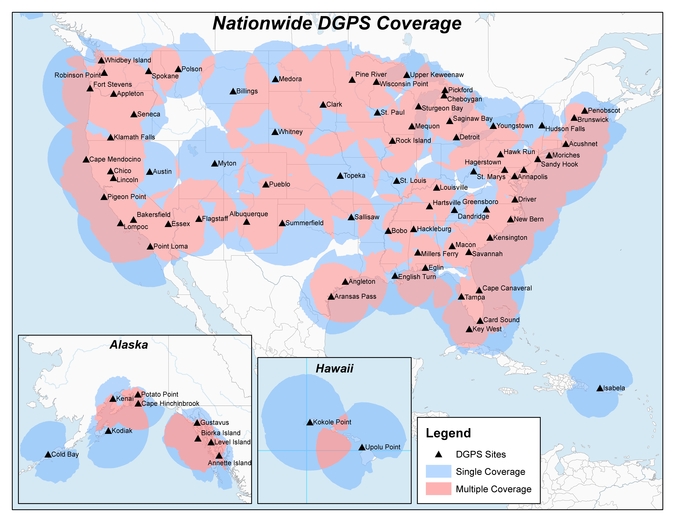
    The Federal Register Notice reduces the number of Differential GPS sites throughout the country, while maintaining coverage in major maritime ports and waterways.

    Read the full notice at the Federal Register website, including a list of sites to be decommissioned. Termination of the broadcast signal is scheduled to occur within the next 30 days.

    Graphic depicting NDGPS after site reductions. (U.S. Coast Guard)
    Graphic depicting NDGPS after site reductions. (U.S. Coast Guard)
    Graphic depicting NDGPS coverage after site reductions. (U.S. Coast Guard)
    Graphic depicting NDGPS coverage after site reductions. (U.S. Coast Guard)
    Original NDGPS coverage.
    Original NDGPS coverage.