Summit CE Group, in its partnership with Hearst Brand Development, has announced in a news release it will launch a new line of Car and Driver-branded dash cams at the Consumer Electronics Show, which will be held Jan. 6–9 in Las Vegas, in booth No. 14617.
The new line of dash cams, created with the automotive magazine Car and Driver, features 1080p recording, loop recording, accident/motion detection, auto on/off, parking mode, night vision to Wide Dynamic Range, GPS logger, lane departure warning, speed alerts, WiFi, 3G and Android-powered touch screen models.
“The Car and Driver Dash Cams allow drivers to hit the road with confidence, knowing that every mile and minute will be recorded in HD video,” said Glen Ellen Brown, vice president, Hearst Brand Development. “Our partner Summit CE Group has developed a high-quality line of dash cams with innovative features that consumers expect from the leading automotive media brand.”
Summit CE Group has more than 50 years of experience in the designing and manufacturing of consumer electronics. The Car and Driver dash cams will be available at leading consumer electronic stores, auto care and online retailers in spring 2016.
Swiss startup WayRay has introduced an augmented reality navigation system that projects holographic GPS imagery and driver notifications onto the windshield of a car.
Navion, billed as the “first-ever holographic navigation system for cars,” is placed on a car’s dashboard and projects a virtual route into the regular focal range of the driver. The driver sees the navigation signs laid out directly on the road ahead of the moving vehicle, while the driver’s eyes are safely focused on the road at all times. “We call this concept natural navigation, and we believe it will change the way we drive,” WayRay said in a press release.
In contrast to other augmented reality devices currently on the market, no additional eyewear or headgear is needed to see the image. Navion’s interface provides the driver with clear route indicators even in bright sunlight, the company said.
Navion responds to simple hand gestures and voice control. Certain features are available for use only when the car is stopped or moving at a very low speed.
WayRay is a Swiss-based innovator working with augmented reality technology to develop holographic navigation systems and advance the connected car. The WayRay story goes back to 2012, when Founder and CEO Vitaly Ponomarev had an unexpected experience.
“I was living in Moscow at the time, and I was driving at a low speed while also trying to adjust my brand-new GPS,” Ponomarev said. “My attention got distracted just for an instant and I had my first-ever car accident. The accident had a profound effect on me and I began to think about how the windshield is the perfect place to start when it comes to improving car safety. That began this remarkable journey and inspired the creation of WayRay.”
In its two years of development, the company has emerged as a premier developer in connected cars by applying aerospace technology to land navigation — the principles behind its two key products.
The company first developed the WayRay Element, a smart car tracker that collects data from the car and transforms it into statistics about the driver. Element works in conjunction with the WayRay Navion. Both products are to be released in 2016.
“I think WayRay is the step between where we are now and the future self-driving car that is connected to a city’s infrastructure,” Ponomarev said.
WayRay is headquartered in Switzerland with offices in Moscow and San Francisco.
Magellan has expanded its lineup of MiVue DashCam devices to be displayed at the Consumer Electronics Show, which will take place Jan. 6–9 in Las Vegas. The four new models include the MiVue 320, MiVue 420, MiVue 430 and MiVue 450D.
“Magellan is excited to expand its award-winning line of MiVue DashCam models. Our four new models are designed with superior image quality, large storage capacity and extended battery life,” said Stig Pedersen, Magellan associate vice president of product management, in a news release. “Plus, select new models have new features such as lane departure and collision avoidance warnings, dual cameras and wide angle lenses that increase driver peace of mind and safety.”
All MiVue DashCams include the MiVue Manager to record and manage videos that can be shared on social media. A parking mode for the MiVue DashCams allows an event to be recorded in case there is no impact. The impact sensor records the impact force and has a night view enhancement. A camera mode collects photos for evidence immediately, and it can be taken off out of the car for close-up photos. There also is a rotating mount design with a built-in GPS receiver that records location and time for playback of videos.
Magellan to debut new RoadMate DashCams
\Magellan is set to introduce its new family of three DashCam Navigators at CES 2016, according to a news release from the company. The flagship model for the family, the RoadMate 7670T-LM — project name: Hybrid 360Vue — is a CES 2016 Innovation Awards Honoree in the Vehicle Intelligence category.
Magellan’s DashCam Navigator family is designed for safety-conscious drivers who want to record traffic incidents, as well as scenic and unusual events., the company says. It also includes a host of advanced navigation features and location-based content.
“Our new DashCam Navigators give users flexibility, peace of mind and the confidence gained from using dependable Magellan engineering,” Pedersen said. “Plus, each model comes with well-known Magellan navigation features such as landmark guidance, junction view, parking mode and red light and speed camera warnings from PhantomALERT for improved driver safety.”
The RoadMate 6630T-LM and RoadMate 7630T-LM devices include a fully integrated DVR and a software interface for recording, viewing and deleting videos and photos. The Lane Departure feature is an audio alert and icon that appears when departing to the left or right of the current lane. There also is an alert and icon that appears when a traffic-facing camera detects that the driver is getting too close to the car ahead.
The devices will be displayed at in the Magellan booth in LVCC South Hall MP25441.
Excelfore, a provider of cloud solutions for intelligent transportation, will launch its comprehensive suite of secure cloud and connectivity solutions at CES 2016, the Consumer Electronics Show that will be held in Las Vegas this week.
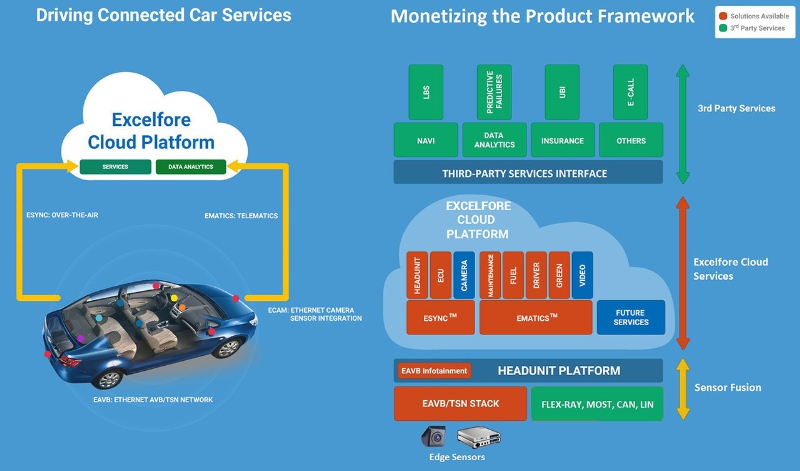
Excelfore provides an end-to-end intelligent transportation framework to the automotive industry using a cloud solutions platform along with in-vehicle connectivity technologies.
Excelfore will demonstrate solutions during CES 2016 in two locations: at the Excelfore Suite (MGM Grand, Las Vegas, Nevada (Jan. 6-8), and at GenIVI Showcase at Trump International (Jan. 6-7).
ESync enables full vehicle over-the-air update of all vehicle components for the Headunit, multiple Electronic Control Units (ECU) and Telematics units. ESync updates the firmware components (FOTA), and software components (SOTA), including OS, kernel, kernel, drivers and applications.
Excelfore provides a cloud-based solution for connected car services. (Image: Excelfore)
Excelfore leverages its patented machine-to-machine (M2M) distributed architecture to support cloud-to-vehicle connectivity and multiple in-vehicle networks including LIN, CAN, FlexRay and Ethernet. New advanced security features include enhanced Hash functions, multiple-levels of encryptions, content-delivery network (CDN) integration and end-to-end security from the cloud to the vehicle-components.
“Connected cars are revolutionizing the automotive industry,” said Erich Geiger, former CEO of Harman/Becker Automotive Systems. “Excelfore’s EMatics and ESync platform with their advanced security and scalability will help accelerate adoption of innovative solutions for the automotive industry.”
“By continuing to deliver to the automotive industry over the last several years, our cloud platform has architecture has evolved into a sophisticated offering with advanced security and scalability,” said Shrinath Acharya, CEO of Excelfore. “Within our product framework, we also offer data analytics and monetization by integrating with third-party services. Our platform enables fast and cost-effective deployment solutions for OEMs and Tier-1s.”
The Excelfore team has delivered OEM programs (US, European, and Japanese Tier-1s and OEMs) and aftermarket automotive solutions to millions of vehicles.
Highlights of ESync
Tailored for automotive headunit and electronic control units (ECUs)
Updates headunits, ECUs, telematics units (TU), and IoT edge devices, including cameras
Updates using any communication link (over the air, other networks)
Ease of implementation of the cloud platform for SOTA/FOTA deployment
Key features of the OTA updater
Full campaign management capability
Secure administration
Creation and delivery of packages for faster transmission and updates
Complete, differential and incremental software updates
Patented adaptive compression and M2M technology
Highlights of EMatics
Fleet Monitoring: Access a fleet from anywhere in the world at anytime. Quickly access vehicle information including location, driver, fuel and battery voltage. Monitor vehicles closely when needed using high frequency tracking.
Automated Service Scheduling: Automatically get timely reminders on upcoming services, and schedule vehicle servicing by notifying preferred vendors.
Fuel Management: Get detailed fuel data for an entire fleet including usage, consumption and mileage trends.
Driver Rating: See who the most fuel-efficient drivers are. Get insights on how to improve driving behavior to reduce fuel usage and costs.
Vehicle Travel History: Get detailed trip information including distance, duration, idling time along with date and time of trips. Easily differentiate personal versus business trips and automate reporting.
Vehicle Safety: Set geo-boundaries and curfew periods. Get notified instantly when any vehicle violates curfews.
PCTEL Inc. has launched a new antenna for high-speed rail, fleet and other transportation modes. The new SkyCompass Dual multiple input, multiple output (MIMO) Long Term Evolution (LTE) antenna is designed for high data-rate applications such as direct video feeds and broadband connectivity for commuters.
The SkyCompass series comprises six new configurable antenna platforms, including single-band and multiband GNSS options that address the majority of rail and fleet management installation needs. The antenna features new ultra-ruggedized design and housing, outstanding electrical efficiency performance, high isolation between elements and pattern consistency.
In addition, as wireless routers adopt MIMO, the antenna’s inherent MIMO capabilities protect a network’s investment in cellular and — more specifically — LTE installations.
“MIMO and efficiency with optimized patterns enable high throughput in performance critical mobile applications for public safety, fleet and rail markets,” said Rishi Bharadwaj, vice president and general manager of PCTEL’s Connected Solutions. “PCTEL’s innovations continue to deliver high performance antennas in robust, easy-to-install housings.”
The series is currently available to select OEM customers and will be generally available at the end of January 2016.
Penton announced at CES 2016 that it has acquired TU-Automotive, an event and digital information company serving the connected vehicle segment of the automotive tech market, from FC Business Intelligence. This acquisition positions Penton at the center of the industry’s most innovative and fast-growing segments: connected vehicles, mobility and autonomous driving.
The single biggest opportunity facing the automotive industry is the shift of vehicles to connected mobility for communication, diagnostics and dataflow, autonomy and other intelligent systems. This shift is already gaining significant ground in the trucking industry with connected devices changing fuel efficiency, optimizing speed and brake usage. Gartner predicts that by 2020, more than 250 million vehicles will be connected globally, with the number of installed connectivity units in vehicles worldwide increasing by 67 percent and consumer spend on in-vehicle connectivity fully doubling.
TU-Automotive delivers premiere events, networking, content and analysis on the current topics of connected vehicles, mobility, autonomous driving and the downstream implications to related industries. The company’s key assets include: 13 events including the world’s largest connected car and mobility event, TU-Automotive Detroit, plus flagship events TU-Automotive Europe, TU-Automotive Japan and The Consumer Telematics Show.
In addition, TU-Automotive provides digital content, analysis, education and business intelligence through TU-Automotive’s communications hub. TU-Automotive plays a critical convening role for key players in this complex and fast moving segment, including Ford, General Motors, FCA, BMW, Mercedes-Benz, Facebook, IBM and Microsoft.
TU-Automotive will become a part of the Penton Ground Transportation group, led by Vice President Sue Boehlke. The TU-Automotive assets are complementary with Penton’s existing transportation portfolio, which includes WardsAuto, FleetSeek, FleetOwner, Trailer Body Builders and American Trucker. Boehlke commented, “TU-Automotive offers the most respected, high profile platforms to expand Penton Ground Transportation’s reach beyond the United States into Europe, South America and Asia, with a core hub of operations in London. We look forward to TU-Automotive becoming part of the Penton family.”
The acquisition also strengthens Penton’s planned launches around the Internet of Things (IoT) in 2016 across Penton. “IoT and connected devices are a major theme across Penton, impacting many of our industry sectors including ground transportation, aviation, agriculture, technology and electronics. Companies and factories that are connected are more productive and the implications for innovation through IoT are tremendous,” said David Kieselstein, Penton CEO. “In 2016 we are launching a major IoT initiative to help companies break down the complexity. From sensors and platforms to data and security issues, we’ll cover best practices to help businesses grappling with policy, strategy and implementation in the application of this new wave of technology.”
Volvo Cars has chosen HERE to power connected navigation for the next-generation in-car control system for new and future Volvo models as part of a multi-year agreement between the two companies.
Volvo’s in-car system, Sensus, offers customers a fully connected experience and incorporates advanced maps and services enabled by the HERE location cloud to provide drivers with smart guidance in and out of the car.
The first model featuring the new Sensus system is the XC90, Volvo’s luxury SUV that started shipping earlier this year.
GPS-guided cruise control is now in production for new models of Kenworth long-haul trucks that have the Paccar MX-13 engine.
By anticipating the terrain ahead using GPS, Kenworth Predictive Cruise Control delivers optimal fuel economy by ensuring the engine and transmission are in the most efficient operating mode.
The system is available as a factory-installed option.
The new flyGarmin app for Windows simplifies avionics database updates such as navigation, charts and more, while also accommodating the distribution of Jeppesen charts, Garmin said.
The flyGarmin app is intended to give pilots a streamlined experience that makes database updates easier, requiring less time at their computers. Jeppesen charts are available for ChartView-enabled devices, plus subscribers can download Jeppesen charts alongside other databases purchased from Garmin.
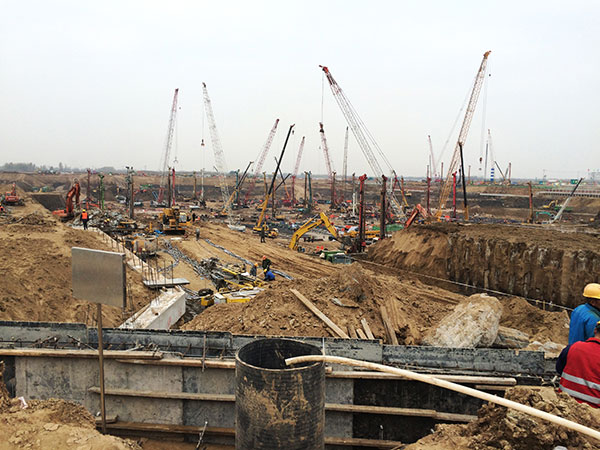
Trimble has received a contract extension for Beijing’s new airport project. In April, Trimble won the initial bid to supply the project with a construction information management system. Based on the success of the solution to date, the contract has been extended to include additional machine control systems for soil stabilization.
Beijing’s new airport is projected to handle 72 million travelers, 2 million tons of shipping and 620,000 flights by the year 2025. It is a massive construction project with an unprecedented amount of civil aviation investment by the Chinese government. In order to construct the airport in a safer, more efficient manner, achieve transparent management, and maximize construction quality, the Beijing new airport project is using construction technology from Trimble to integrate construction and operations.
Artist’s depiction of the inside of the new Beijing Airport terminal. (image: Zaha Hadid Architects)
Trimble was chosen to implement a browser-based, locally hosted digital construction information management system for tracking and monitoring construction operations in real time. The Trimble solution allows users to create 3D constructible models, perform soil stabilization, automate construction processes and effectively manage information. Based on the successful soil stabilization results using Trimble machine control over the past four months, another 15 systems have been ordered.
“The research results for dynamic compaction have been extremely promising,” said Li Qiang, chief engineer of the Beijing New Airport Construction Office. “As a result, the project is pushing forward with a larger scale deployment to further the research into creating new methods and standards for airfield construction.”
“The Beijing new airport project is a significant win for Trimble, and we are very excited about the success of the project,” said Steve Berglund, president and CEO of Trimble. “The contract extension validates Trimble’s ability to provide innovative solutions that transform work processes by maximizing management capability, ensuring construction quality and improving productivity.”
Trimble’s machine control solutions leverage a variety of technologies, including GPS, construction lasers, total stations, wireless data communications, the Internet and application software. As part of the Trimble Connected Site strategy, these solutions provide a high level of process and workflow integration from the design phase through to the finished project, delivering significant improvements in productivity throughout the construction lifecycle, the company said.
Terminal construction: The technology used allows creation of 3D constructible models and automated construction processes. (Photo: Trimble)
Fugro has been awarded a three-year contract by PGS for the provision of precise satellite positioning systems for its seismic vessel fleet. PGS is a leading global provider of marine seismic and electromagnetic services, data acquisition, imaging, reservoir services and multi-client library data.
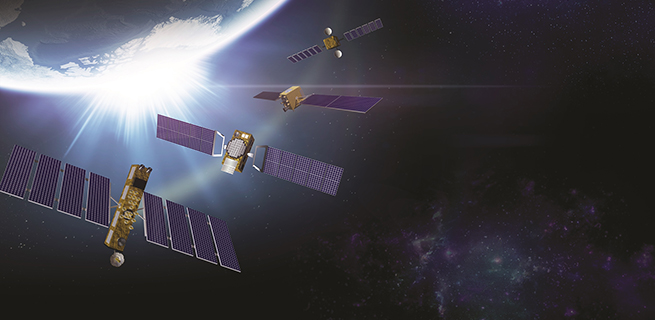
Fugro, provider of precise satellite positioning to the offshore oil and gas industry, will supply PGS vessels with a number of independent GNSS. These systems include Fugro’s recently launched Starfix.G4 — a commercial GNSS service to utilize all available GNSS systems (GPS, GLONASS, Galileo and BeiDou), giving sub-decimeter accuracy — and Starfix.G2+, a global service offering centimeter accuracy in both position and height.
In addition to precise vessel positioning, PGS will benefit from a new generation of positioning technology for their seismic sources and tailbuoys. Meeting the high demand for robustness and quality in the offshore industry, this proactive technology provides independent decimeter and centimeter positions and heights for remote (seismic source and tailbuoy) operations.
Cerys James, vice president technical at PGS, remarked, ”Reliable, precise positioning technology is essential for modern seismic operations. The solution supplied by Fugro will ensure our entire fleet has highly accurate vessel positioning, along with precise source and streamer positioning.”
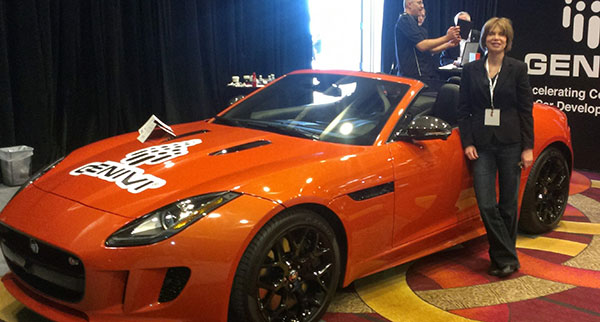
Janice Partyka at the LA Auto Show with a car representing the GENIVI Alliance, a non-profit automotive industry alliance committed to driving the broad adoption of an in-vehicle Infotainment open-source development platform. (Photo: courtesy of Janice Partyka)
LOS ANGELES — The Los Angeles Auto Show’s Connected Car Expo, held Nov. 18-19, puts LA at the intersection of Detroit and Silicon Valley. Cybersecurity garnered attention, as did the impact of the sharing economy on connected features. Caution was urged that these new technologies be carefully vetted for safety and reliability, as failures will impede market acceptance. And research shows safety to be one of consumers’ highest valued attributes that connected vehicles can offer.
Call to action on automotive cybersecurity. Safeguarding the vehicle with its hugely complex supply chain is an enormous challenge. Sensors can be spoofed, wireless sensors and radar can be forged, and cameras can be blocked, warned Andre Wiemerskirch of the University of Michigan Transportation Research Institute. A greater following distance between cars would allow other systems to kick in, should some sensors be hacked. Wiemerskirch appealed for a delay on all connected vehicle features that make a vehicle too vulnerable to hacking until there are better cyber security solutions. He proposed confidence levels for determining the integrity of information coming back from sensors. And he called for a resilient architecture to be created with mature security solutions, such as those used in iPhone security.
A dependable car hacker? Faith in vehicle reliability is one thing; faith that the vehicle won’t be hacked is another. I was looking forward to Chris Valasek’s appearance once again at the Connected Vehicle Show. He is a skilled automotive hacker, who has helped the industry become more secure. You may have read the account by Andy Greenberg in Wired magazine of how Valesek and a cohort hacked Greenberg’s Jeep (with permission) while he was traveling on a freeway. This included disabling its brakes, accelerator and other core functionality. Valasek didn’t show up for his scheduled talk, which, perhaps, can’t be seen as unexpected.
How well do they perform? Connected vehicles struggle with performance in certain environments, warned Thomas Form of Volkswagen. More testing and work are needed for automated cars to handle bad weather, particularly conditions in which visibility is obscured, like fog or sandstorms. Unusual objects, such as tumbleweed skittering across the highway, can cause an automated vehicle to make an emergency stop. What would happen when a traffic light is red, but a police officer points to a driver to go, or indicates she needs to stop at a green light? Form exhorted attendees to test all scenarios, even the unlikely ones.
Will driver skills erode? One attendee asked panelists if with automation, drivers’ skills will become rusty from disuse and be less able to handle manual driving, pointing to the airplane disasters of Asiana in San Francisco and Aeroflot in China. Both flights crashed due to pilots’ confusion with autopilot. The U.S. Federal Aviation Administration (FAA) claims two thirds of pilots make mistakes because of their reliance on technology. A common error is not recognizing that the autopilot has been disconnected. A report from the FAA reads, “pilots sometimes rely too much on automated systems and may be reluctant to intervene.”
Industry worried about sharing. The exponential growth in the sharing economy and declining interest among young people in owning a vehicle was one theme of the conference. If this becomes a massive disruptive trend in mobility, do we know its influence on the uptake of connective technology? The young are most ready to embrace new technology, yet teenage driver license rates peaked in 1982 and have fallen ever since.
New mobility options. Millennials, those born after 1980, are showing less enthusiasm for car ownership and driving than their predecessors. Less than 70 percent of those aged 16-24 have a driver’s license. John Zimmer of Lyft reported that 60 percent of their rides in San Francisco and 50 percent of those in New York City are with Lyft Line, a service in which strangers heading in the same direction share Lyft rides. Not only are riders accepting an unknown person to drive them in a personal car, they don’t mind sitting shoulder-to-shoulder with strangers in the intimate confines of a vehicle. Zimmer reported that Lyft is now looking to offer themed cars, such as those showing sports or other types of entertainment on video screens to create new market “verticals.”
Transforming a personal car into rental vehicle. Cars are vastly under-utilized with the average U.S. household using its cars just four percent of the time with only 1.7 seats occupied on average. This has been duly noted by some car owners, who have created an economy of renting out their vehicles with the help of services like RelayRides. Automakers are taking stock of how Airbnb sliced into the hotel market and are looking at ways to own shared mobility. Ford is one of the OEMs experimenting in the sharing market. Alicia Agius of Ford described Go!Drive, which offers access to a fleet of cars for flexible and affordable one-way journeys throughout London. It also serves to introduce drivers to the Ford brand and build a loyal base among those who become car buyers.
How are we doing? The intersection of tech and automotive is going remarkably well, and the OEMs are proud of how they have cut long development cycles and become more open to new ways of thinking. Tech has prided itself as the innovators, but a speaker from Google humbly remarked, “The automotive industry has been thinking about the future longer than those of us living in Silicon Valley and working at Google.” A nice tip of the hat.