Tag: Altair Semiconductor

  • Polte and Altair embed location services on cellular IoT chipset

    Polte and Altair embed location services on cellular IoT chipset

    Altair Semiconductor integrates Polte’s Cloud Location over Cellular (C-LoC) technology with Altair’s ALT1250 dual-mode CAT-M& NB-IoT chipset.

    Photo: Altair
    Photo: Altair

    Polte Corp. and Altair Semiconductor have collaborated to integrate Polte’s cellular-based location technology with Altair’s ALT1250 cellular Internet of Things (IoT) chipset.

    The ALT1250 is Altair’s dual-mode CAT-M & NB-IoT solution, a small, highly integrated cellular IoT chipset with ultra-low power consumption, GNSS location positioning, a hardware-based security framework and an RF front-end supporting all commercial LTE bands.

    Enabling miniature module sizes of less than 100 square millimeters, the ALT1250 is suitable for a range of industrial and commercial IoT applications.

    Polte’s patented location-as-a-service (LaaS) solution leverages ubiquitous 4G and 5G cellular networks and cloud computing to enable highly accurate location data indoors and outdoors.

    Business processes, customer self-service automation, and better decision making insights enable consumer, commercial and industrial businesses to capitalize on location.

    “With the explosive demand for smaller and low powered IoT devices, Polte’s C-LoC technology is a great complement to the integrated GPS and GNSS capabilities of our dual-mode ALT1250 chipset,” said Oded Melamed, CEO of Altair Semiconductor.

    “Location is a key function in numerous IoT applications, such as smart meters, telematics and trackers, where low power and small form factor are crucial,” Melamed said. “We look forward to the opportunity of working with Polte to offer our customers the best solutions to meet their needs.”

    “Polte is poised to disrupt the location services market. As more and more IoT use cases demand indoor, outdoor and everywhere in between location, Polte’s software-only solution embedded on Altair’s dual mode ALT1250 chipset delivers location services — at lower cost, using less battery, more securely,” said Polte CEO Ed Chao. “We are excited about the opportunity to bring the power of Polte’s location services platform to Altair’s leading Cellular IoT chipset.”

  • HERE, Altair Semiconductor partner on IoT tracking

    HERE, Altair Semiconductor partner on IoT tracking

    Photo: Altair
    Photo: Altair

    HERE Technologies and Altair Semiconductor are partnering to integrate HERE tracking and positioning software into Altair’s ALT1250 dual-mode LTE Cat-M1/NB-IoT chipset. This will enable HERE customers, system integrators and tracking device manufacturers to significantly reduce device time to market and provide hardware-based security.

    The two companies plan to reduce overall power consumption of an end-to-end tracker application by optimizing the way the device communicates with the cloud.

    The ALT1250 includes a GNSS receiver, an RF front-end supporting all commercial LTE bands within a single hardware design, a hardware-based security framework and an internal application MCU subsystem.

    The integration of HERE tracking and positioning software means the chipset will be able to locate itself using the strength of cellular signals, even when it is not possible to obtain a GNSS fix.

    The chipset can take advantage of the ability of HERE to provide online and offline positioning based on its database of cellular towers.

  • Altair selects Rohde & Schwarz for testing new IoT chipsets

    Modules featuring Altair’s ALT1250 CAT-M1/NB1 chipset will be demonstrated at Mobile World Congress.

    Altair Semiconductor, a provider of LTE chipsets, has selected Rohde & Schwarz as its partner for test equipment for its dual-mode CAT-M1/NB1 internet of things (IoT) ALT1250 chipset, as well as its next-generation IoT chipsets.

    The ALT1250 is a highly integrated dual-mode CAT-M1/NB-IoT chipset with GNSS. Modules with ALT1250 inside are the world’s smallest, and may be as small as 100 millimeters square in area.

    The ALT1250 includes GNSS location positioning, a wideband RF front-end supporting all commercial LTE bands within a single hardware design, a multi-layered and hardware-based security framework, an internal application subsystem and packaging that enables standard, low-cost PCB manufacturing.

    The Rohde & Schwarz R&S CMW500 test platform offers the most validated CAT-M1/NB-IoT protocol conformance tests. It allows manufacturers and test houses to use a single instrument to verify that chipsets, modules and devices comply with GCF and PTCRB standards, and specific network operator requirements.

    The test equipment will be used for protocol testing as well as RF, RRM performance and carrier tests.

    Rohde & Schwarz is a global manufacturer of wireless communications and EMC test and measurement equipment and plans to develop new testing protocols for Altair’s next generations of cellular IoT chipsets.

    “Our ALT1250 chipset is already forming the foundation for multiple current and emerging IoT applications,” said Ilan Reingold, VP of business development and marketing for Altair. “The choice of Rohde & Schwarz is part of our commitment to the highest quality of advanced validation and performance testing for our game-changing products.”

    “This announcement confirms the commitment of Rohde & Schwarz to the wireless industry to provide innovative test tools and solutions that allow the testing and certification of cellular IoT devices,” said Anton Messmer, vice president, mobile radio testers, for Rohde & Schwarz. “We are pleased to have been selected by Altair and are looking forward to supporting them in the development of highly integrated chipsets in conformance with 3GPP Release-13 standards for CAT-M1 and NB-IoT, and beyond.”

    Altair will be demonstrating partner modules based on ALT1250 at Mobile World Congress (MWC) in Barcelona, Spain, Feb. 26 to March 1 at Altair meeting rooms in Hall 2, Stands 2B2Ex and 2B4Ex.

    Rohde & Schwarz will showcase CAT-M1/NB-IoT test solutions with the R&S CMW500 at MWC in hall 6, booth 6C40.

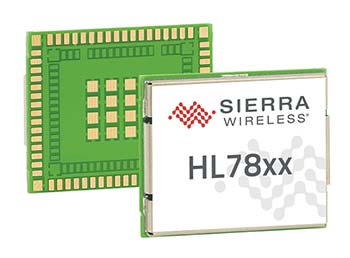
  • Sierra Wireless integrates GNSS, SIM, security into multi-mode LPWA modules

    Sierra Wireless, a provider of fully integrated device-to-cloud solutions for the Internet of Things (IoT), has introduced multi-mode, low-power wide-area (LPWA) cellular modules.

    The modules are targeted at rapidly growing markets in asset tracking and connected industrial equipment, smart cities, healthcare, agriculture and wearables.

    AirPrime HL78 modules, featuring Altair Semiconductor’s integrated ALT1250 chipset, deliver power performance that extends the life of battery-operated devices by 5-10X compared to older LTE-M/NB-IoT modules.

    The new level of power saving modes was designed for power-constrained IoT applications, and includes improved wake-up and sleep-mode responsiveness, as well as ultra-low sleep-mode power.

    The modules also integrate GNSS tracking capability, security and an embedded SIM in a new compact CF3 size (18  x 15 millimeters) that is pin-to-pin compatible with other HL Series modules.

    Customers have the flexibility to deploy the same device on global LTE-M (Cat-M1/eMTC) and NB-IoT (Cat-NB1) networks, with support for more than 20 LTE frequency bands in addition to optional 2G fallback.

    Built-in security, including HTTPS, secure socket, secure boot and free unlimited firmware over-the-air (FOTA) updates from the AirVantage device management IoT Platform, helps customers ensure HL78 deployments are future proof and secure.

    LTE-M and NB-IoT LPWA networks deliver a new class of wireless technology specifically designed for low-power IoT applications. LPWA technologies combine lower cost, broader coverage and better battery life with globally available and secure cellular networks ready to connect hundreds of millions more things to the internet.

    “With the HL78 modules, OEMs and system integrators have the most scalable, lowest power module platform to build their global IoT applications on,” said Dan Schieler, senior vice president and general manager, OEM solutions, Sierra Wireless. “And to make it even simpler for our customers, we’ve integrated the SIM and cloud, as well as GNSS and security features, to drive down the size of LPWA connected devices while enhancing tamper resistance and security.”

    “More than 690 million LTE-M and NB-IoT connected devices are expected by 2022, and the market needs a low-power, compact embedded module to connect their industrial, smart city, smart home and simpler static sensor applications,” said Dan Shey, managing director and vice president at ABI Research. “With the addition of the HL78 product line, Sierra Wireless has amassed a broad portfolio of low power devices to drive the billions of advanced IoT connections we expect in the next decade.”

    “The ability to switch seamlessly between any commercially deployed LTE-M or NB-IoT frequency band gives HL78 customers the flexibility to choose which network they want to deploy their low bandwidth application on. And for those regions where LPWAN coverage is not as widely available, optional 2G fallback ensures their devices stay online,” said Ilan Reingold, vice president, business development and marketing at Altair Semiconductor (a Sony Group company). “Incorporating Altair’s advanced IoT chipset, HL78 devices will also enjoy an extended life of up to 15 years on a single battery.”

    The AirPrime HL78 modules are fully compliant with the 3GPP Release 13 standard and are Release-14-ready to support NB2 features in the future.

    Sierra Wireless AirPrime HL and WP Series modules are interchangeable across 2G, 3G, 4G and LPWA technologies. They use the CF3 form factor, which is footprint compatible across product lines, providing customers with the option to develop smarter by building their connected IoT product or service on a single module.

    HL7800 and HL7802 modules are sampling with lead customers now, with general availability in the third quarter of this year.

  • Altair markets narrowband cellular chipset with integrated GNSS

    Altair markets narrowband cellular chipset with integrated GNSS

    LTE chipset maker Altair Semiconductor has demonstrated GNSS functionality integrated in its new ALT1250 narrowband CAT-M1 and NB1 (NB-IoT) chipset.

    In addition to GNSS functionality, the ALT1250’s extreme level of integration eliminates the need for most external components required to design a cellular Internet of Things (IoT) module.

    Its GNSS capability was demonstrated June 13  at the Sierra Wireless Innovation Summit being held at the Paris Novotel Tour Eiffel in Paris, France.

    Approximately the size of a shirt button and less than 100 mm2 in size, an ALT1250 module features support for both Release 13 standards — CAT-M1 and NB1, and includes a wideband RF front-end supporting unlimited combinations of LTE bands within a single hardware design, a multi-layered and hardware-based security framework, an internal application MCU subsystem and packaging that enables standard, low-cost PCB manufacturing.

    “Location determination is essential in many IoT applications — including asset tracking, vehicle monitoring and wearable devices. Satellite positioning is the most accurate method for doing that,” said Eran Eshed, co-founder and vice president of marketing for Altair. “Integrating GNSS functionality in the ALT1250 significantly reduces the overall cost of IoT solutions while offering state-of-the-art, low-power satellite positioning capabilities in a miniature package. The market is responding well to it.

    “We called the ALT1250 a game-changer when we announced it several months ago — integrated GNSS is one of a large set of groundbreaking innovations offered by this chip.”