Tag: ArcGIS

  • Esri ArcGIS Hub helps government agencies meet open data law requirements

    Logo: Esri ArcGIS HubEsri’s ArcGIS Hub is helping government agencies more easily and efficiently comply with new policies outlined in the Open, Public, Electronic and Necessary (OPEN) Government Data Act, Esri said.

    The OPEN Government Data Act sets a presumption that all government information should be open data by default — machine readable and freely reusable.

    According to Esri, federal agencies using the ArcGIS Hub can share data in open formats with only a few clicks and feed those data catalogs directly to data.gov, the government-wide website supported in the bill. In addition, apps and dashboards can help responders identify vulnerable populations areas, locate resources like shelters and hospitals, and visualize where and when routes to these resources are accessible in real time.

    The ArcGIS Hub online portals also enable government agencies to direct their open data to deepen citizen engagement with apps, data, events and collaboration focused on specific civic initiatives. According to Esri, ArcGIS Hub lets citizens, businesses, academic institutions and nongovernmental organizations take advantage of their governments’ spatial analytics capabilities to collaborate and turn data-driven goals into policy.

    “When authoritative data is unencumbered and interoperable, it enables effective and efficient government programs that save lives and money,” said Jill Saligoe-Simmel, Esri product manager for spatial data infrastructure. “Esri supports the OPEN Government Data Act — combined with the recently passed Geospatial Data Act — as an essential component to modern spatial data infrastructures.”


  • Esri Living Atlas updates to shed light on global change

    Esri is updating the ArcGIS Living Atlas of the World, a vast collection of geographic information from around the globe. The updates include new data and capabilities for users to gain insight for helping in decision making, as well as a more complete and dynamic picture of the world.

    The new features were introduced at this year’s Esri User Conference, held July 9–13 in San Diego, California.

    The new Earth Systems Monitor app, powered by Living Atlas data, showing Sea Surface Temperature. (Image: Esri)
    The new Earth Systems Monitor app, powered by Living Atlas data, showing Sea Surface Temperature. (Image: Esri)

    Earth Systems Monitor. This new app (currently in beta) is powered by Living Atlas data. It allows users to see — on a 2D map or a 3D globe — historical, forecasting and real-time data for depicting land, the oceans and even the human footprint.

    Users can see where events or phenomena such as marine temperature shifts are occurring at any time on the planet, or even model global population growth and its effects, the company said.

    The configurable app will be released later this year. The app can be used with Living Atlas data layers or with other layers from an organization’s own data or ArcGIS Online.

    Wayback Imagery. This digital archive of the World Imagery basemap enables users to access more than 80 different versions of world imagery captured over the past five years.

    Each record in the archive represents a version of world imagery as it existed on the date it was published. Users can move back and forth in time and choose the imagery they want to use.

    OpenStreetMap Vector Basemap. Moving to a local scale, OpenStreetMap (OSM) is an open, collaborative project to create a free editable map of the world, built by a community of mappers who contribute and maintain data about roads, trails, buildings, restaurants and more.

    Until now, OSM was only available as a raster basemap in ArcGIS Online. The new vector basemap, introduced in beta, will be available for free to all ArcGIS users and developers.

    “The Living Atlas shows how our community of users continues to contribute to the innovations that power our technology,” said Jack Dangermond, Esri founder and president. “The beauty of these new features is that they transform the data that users are supplying into valuable online services like Earth Systems Monitor.”

    Living Atlas can be used to create indexes displaying properties such as vegetation health or soil moisture and quantifying the changes over time, enabling better understanding of the environment.

    Earth Systems Monitor, OSM Vector Basemap and Wayback Imagery are all examples of how online GIS technology is transforming traditional mapping organizations into web service providers, Esri said. These innovations are just the latest steps in creating a living digital twin of the systems and processes that help run organizations, cities and even nations.

    By fostering the adoption of apps, web maps, and collaborative efforts, Living Atlas is supporting end users who face increasing geospatial data demands, enabling them to be self-sufficient with the application of location intelligence across their organizations.

    Wayback Imagery is currently accessible, while both OSM Vector Basemap and Earth Systems Monitor will be available soon in ArcGIS Online.

  • Eos, Laser Technology and Esri Introduce Laser Mapping Workflow for Esri’s Collector for ArcGIS

    Eos, Laser Technology and Esri Introduce Laser Mapping Workflow for Esri’s Collector for ArcGIS

    From left: Esri Program Manager Doug Morgenthaler, Laser Technology Sr. Product Manger Derrick Reish and Eos CTO Jean-Yves Lauture.(Photo: Eos Positioning)
    From left: Esri Program Manager Doug Morgenthaler, Laser Technology Sr. Product Manger Derrick Reish and Eos CTO Jean-Yves Lauture. (Photo: Eos Positioning)

    The three-way partnership will enable field crews to collect centimeter-accurate 3D data in GNSS-impaired environments.

    GNSS receiver maker Eos Positioning Systems has released a laser offset solution within the Esri Collector for ArcGIS workflow.

    When combined with Laser Technology Inc.’s (LTI’s) laser rangefinders, the solution will allow field crews to capture centimeter-accurate 3D locations of hard-to-reach assets and in GNSS-impaired environments.

    “By combining the high-accuracy of the Eos Arrow Series GNSS receivers and the laser capabilities of LTI, we can empower field crews to capture highly accurate XYZ coordinates from a safe distance,” LTI Senior Product Manager Derrick Reish said. “This eliminates the need for physically occupying every point. It also provides more accurate location data, with a more affordable mobile asset-management workflows.”

    The Arrow Gold. (Photo: Eos Positioning)
    The Arrow Gold. (Photo: Eos Positioning)

    The solution has been in the works for months, as demand has grown for hard-to-reach, high-accuracy mapping within the Collector workflow.

    “Eos is extremely grateful to be a part of this initial release in high-accuracy asset location data with LTI’s laser rangefinders and Esri’s Collector mobile app,” Eos CTO Jean-Yves Lauture said. “Enabling this kind of accuracy means even the most budget-conscious field crews will be able to access the location of their hard-to-reach assets.”

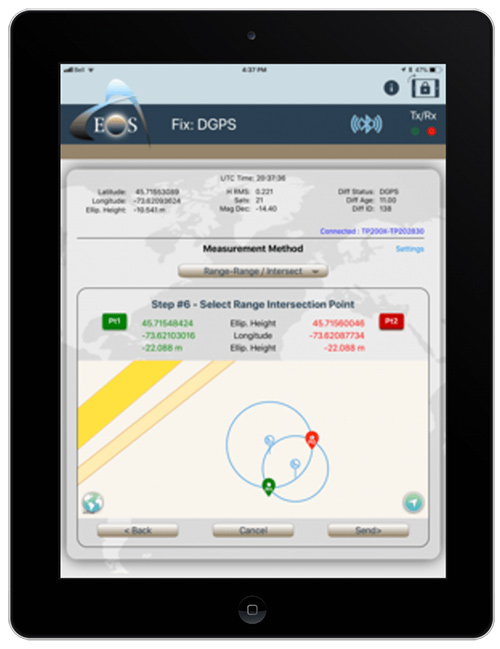
    All three teams have been working closely to ensure a seamless integration with Collector and ArcGIS Online. When using an LTI laser rangefinder and an Eos Arrow Series receiver with Collector, a field worker can easily shoot, capture and share high-accuracy 3D location data that is streamed into ArcGIS Online in real-time.

    Image: Eos Positioning
    Image: Eos Positioning

    The solution is expected to be particularly useful in urban corridors, highway settings, forested (or wetlands) areas, and other areas where assets are hard or dangerous to occupy. This will both increase accuracy and efficiency, as well as decrease safety liabilities in dangerous situations, the companies said.

    “Esri is extremely pleased that Collector can now support the capture of high-accuracy asset locations from afar, leveraging our unique partnership with both Eos and LTI,” Esri Product Manager Jeff Shaner said. “This is a game changer for asset management.”

    Prior to this release, field crews challenged with capturing high-accuracy 3D locations for hard-to-reach assets would need to use a total station with a different software workflow and then mesh the data back in the office, a clumsy and inefficient workflow requiring lots of additional training and expertise. With the new workflow, field crews can operate in GNSS-impaired environments at a high-accuracy level without leaving the Collector/AGOL environment, creating a highly efficient workflow.

    The solution has been designed to provide several offset-mapping methods.

    “The implementation of several measurement methods gives users the freedom of choice, so they can pick the right laser option which meets their accuracy needs,” Reish said.

    Eos will unveil its offset measurement solution for Collector at the upcoming Esri User Conference in San Diego. For a field demonstration of how the solution works, attendees can visit Eos at booth #1019 during the conference, and attend the session “LaserGIS for Everyone: How to Combat Costly and Tedious Data Collection Workflows” at 10 a.m. on Wednesday.

  • Esri releases Sentinel-2 Image Services through Living Atlas

    Esri is releasing Sentinel-2 Image Services to all Esri users for no additional cost.

    According to the company, Sentinel-2 is an Earth Observation Satellite that provides multi-spectral imagery for any location in the world at 10-meter resolution. Currently in beta, the service is updated daily with new imagery for all ground locations every five to seven days.

    The Sentinel-2 Image Services provide temporal, multi-spectral imagery of the entire globe for improved monitoring of agricultural and forest conditions, monitoring of land cover changes, and to assist with natural disaster management.

    Sentinel-2 is part of Copernicus, the world’s largest single Earth observation program directed by the European Commission in partnership with the European Space Agency.

    Esri makes the multi-spectral data quickly accessible using ArcGIS Image Server and publishes an image service through the ArcGIS Living Atlas of the World, hosted on the Amazon Web Services Infrastructure.

    The service includes all Sentinel-2 imagery going back 14 months, enabling change to be easily reviewed. Image analysis can be run directly on the service to create indexes displaying properties such as vegetation health or soil moisture as well as quantifying the changes over time, for better understanding of the environment.

    “We are committed to helping our users discover, explore, and better understand our changing planet,” said Jack Dangermond, Esri founder and president. “Pairing Sentinel-2 imagery with our ArcGIS Image Server provides a powerful platform for in-depth analysis which can inform meaningful action.”

    Sentinel-2 multi-spectral imagery can provide better visualization and understanding of catastrophic events such as Hawaii’s Kilauea volcano, the company said. The ability to use imagery of the volcano along with other spatial data, such as digital elevation models, provides an unprecedented opportunity to help predict lava flow direction and provide advanced notice to those who may be in danger.

    Sentinel-2 can also help provide understanding of the conditions that lead to fires such as this past winter’s Thomas Fire, which is California’s largest wildfire on record. The Thomas Fire burned more than 280,000 acres and triggered massive mudslides. Visualizing factors, such as periods of increased moisture contributing to more lush vegetation followed by hot and dry weather, can help predict future wildfires and mitigate their effects in the future.

    The Sentinel-2 imagery is available through the Living Atlas, the foremost collection of geographic information from around the globe. The Living Atlas is included with all ArcGIS online subscriptions. It is comprised of maps, apps, and data layers that support the work of thousands of Esri users around the world. Full service access, including a rolling 14-month archive of the Sentinel-2 data, is now available to all Esri ArcGIS users.

  • Hangar joins Esri Startup Program to add aerial insights to ArcGIS

    Hangar Technology Inc., a robotics-as-a-system technology company providing scalable 4D visual insights, has been selected to join the Esri Startup Program.

    The three-year program helps emerging business partners bring new and innovative products to Esri customers.

    The initial partnership between Hangar and Esri will enable ArcGIS customers to request and receive autonomous, precision-captured drone data on demand from within ArcGIS, enabling industries to gain real-time awareness and insight about locations and features.
    The GIS community has grown accustomed to ambiguous and infrequent imagery. While emerging robotic enablers like drones provide a high-resolution, low-cost alternative to satellite and manned aircraft imagery, there hasn’t been a feasible way for GIS professionals to repeatedly gather precision location insight at scale, from potentially thousands of features within Esri maps, Hangar said in a statement.

    Hangar not only makes aerial data possible at this scale, but also available on request from within ArcGIS. Using a system of systems, Hangar streamlines and automates the 4D data supply chain, enabling task-and-receive reality capture. In the near future, ArcGIS users will be able to request aerial insights at any feature, and have imagery delivered back in 24 to 48 hours or less.

    “The pain we see in the GIS community is an inability to quickly and efficiently pair 2D data with the 3D reality,” said Jeff DeCoux, CEO and founder of Hangar. “We’re excited to work with Esri to deliver on-demand, precision 4D insight to ArcGIS users. Hangar will enable businesses to take full advantage of robotics as instruments of data collection, and provide the industry much needed repeatability and scale.”

    ArcGIS Online users will have the capability to request and receive aerial imagery at variable frequencies or volumes. Requests can be made manually, on an as-needed basis, or automatically, based on contextual triggers or volume requirements. Data is autonomously captured, automatically processed, then delivered back to the customer via a high-speed delivery engine.

    The digital missions behind requests are saved indefinitely, and can be performed repetitively with absolute precision and accuracy, preserving data integrity over time. ArcGIS users will be able to view captures within 24 to 48 hours from the initial request, across a variety of data types.

    “Hangar empowers Esri users to explore any of the thousands of features within ArcGIS maps, observing ground truth at each pin in incredible detail, today and over time,” said Francis Kelly, Esri, global partner programs manager. “Hangar adds valuable data validity and scalability to the budding drone industry. We’re excited to work with them to give Esri users the ability to analyze and consume physical world content in a new and meaningful way.”

    As big-data levels of precision spatial data are collected over time, Hangar will work with Esri to intelligently apply change detection and pattern recognition to enable a new era GIS that includes artificial intelligence and machine learning.

    Hangar will be attending the Esri User Conference, July 9-13 in San Diego, at booth Z19 to demonstrate its technology and showcase the partnership with Esri.

  • Esri to demonstrate Land Administration Software at FIG Congress 2018

    Location intelligence system introduced for nations in need of modernized land governance

    Esri will join this year’s FIG Congress, hosted by the International Federation of Surveyors, taking place May 6–11 in Istanbul, Turkey.

    At the annual event, Esri will showcase its new program for modernizing land administration systems tailored to the needs of developing countries and island nations.

    Good land governance requires effective policies, efficient processes and institutions that can determine, record and disseminate information about the tenure, value and use of land. The new Land Administration Modernization Program allows land administration organizations in developing nations to meet these challenges and lay the foundation for economic success.

    Esri’s program delivers an inexpensive, scalable platform that allows simple field capture, management and publication of parcel data in the cloud, or that can be implemented as an enterprise system meeting the needs of any modern land administration office.

    The software is donated to eligible countries for four years from date of order, and includes maintenance updates and support from Esri.

    At FIG Congress, Brent Jones, land records/cadastre industry manager at Esri, will host the workshop, “Modernize Land Administration Systems: Off-the-Shelf GIS Technology for Modern Cadastral Operations,” May 9, 11 a.m.–12:30 p.m., at Hamidiye Hall, Istanbul Congress Center.

    The workshop will demonstrate how Esri’s ArcGIS platform is a complete, interoperable, open, and purpose-built system for cadastral operations to improve efficiency, manage data integrity, and share data across organizations and with the public. ArcGIS delivers necessary capabilities ranging from fit-for-purpose to enterprise cadastral systems, whether the aim is improve data quality, increase throughput, or enhance spatial accuracy.

    Photo: Esri

  • Esri acquires ClearTerra location data extraction technology

    Esri acquires ClearTerra location data extraction technology

    Spatial analytics company Esri has acquired technology from ClearTerra, a company that offers geospatial and activity-based intelligence tools.

    The acquisition will provide ArcGIS platform users the ability to easily discover and extract geographic coordinates from unstructured textual data like emails, briefings and reports, instantly generating intelligent map-based information.

    This capability will make mapping this elusive information easier across many industries. Defense, intelligence and public safety organizations tend to have massive volumes of unstructured data, as do other fields, such as petroleum, utilities and maritime, where locating information on the Earth is not as easy as searching for a street address.

    Esri’s acquisition of ClearTerra technology brings workflow-enhancing software technologies into the ArcGIS platform.

    “We have been close partners with Esri for a number of years,” said Jeff Wilson, former vice president of sales for ClearTerra, now an executive for defense and intelligence with Esri. “Esri has the platform and resources to provide a solid path going forward for our technology, allowing us to expand this capability to the global market.”

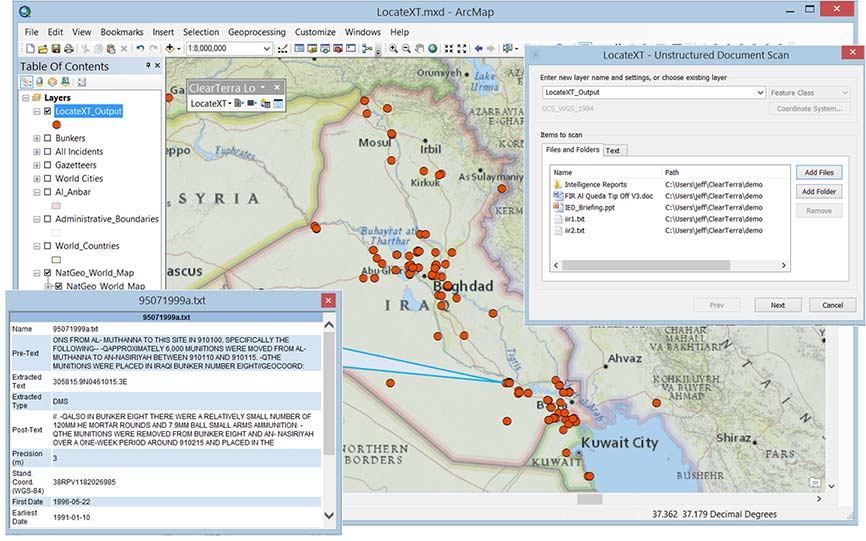
    ClearTerra LocateXT technology allows analysts to rapidly scan through documents without having to spend hours reading, copying, pasting and running spreadsheet formulas, placing the results instantly into geospatial features.

    Additionally, ClearTerra FindFZ technology provides enhanced search capabilities for the ArcGIS platform, incorporating the powerful techniques found in internet search engines, including a tolerance for misspelled words, as well as wildcard and Boolean logic searches.

    The LocateXT extension for ArcMap is used to extract locations from unstructured data (messages, reports, briefings) into a geodatabase feature class. (Image: ClearTerra)
    The LocateXT extension for ArcMap is used to extract locations from unstructured data (messages, reports, briefings) into a geodatabase feature class. (Image: ClearTerra)

    “We are excited to bring ClearTerra technology into the Esri family,” said Jeff Peters, Esri director of national government. “The unstructured data tools are powerful not only for those who have made use of this technology for a number of years, such as in the military, but it also has useful applications for so many more Esri users.”

    ClearTerra has been an active member of the Esri partner program, providing their software to ArcGIS users via desktop, server, and the cloud. Support and maintenance for the software will continue via Esri with no interruption of service, and is readily available for licensing.

    ClearTerra specializes in geospatial and activity based intelligence software products, custom solutions, technical services, consulting and training. ClearTerra is a business unit of ClearShark.

  • Esri releases Operations Dashboard for ArcGIS to manage events in real time

    Esri has released a new web browser application, allowing users to create reporting dashboards that use charts, gauges, maps and other visual elements to reflect the status and performance of people, services, assets and events in real time.

    Using dynamic dashboards through Operations Dashboard for ArcGIS, organizations of all types — from emergency operations centers to public utilities — can view crucial activities and key performance indicators that are vital to meeting their objectives.

    “The Chicago Office of Emergency Management and Communication [OEMC] GIS team has been using Operations Dashboard to support various events with access to real-time information,” said Joe Kezon, GIS manager for the Chicago OEMC. “We are looking forward to the enhancements that will further increase our ability to ensure the safety and security of the City of Chicago.”

    With an easily accessible web app, executives can monitor their organizations’ activities to assess what is working well and what needs attention.

    Esri-Operations-Dashboard-ArcGIS-W

    “The Emergency Management division of the Chicago Office of Emergency Management and Communications works very closely with our public safety partners and the city’s infrastructure departments in our comprehensive approach to event and incident management,” said Thomas Sivak, deputy director, Emergency Management, Chicago OEMC. “The Operation Dashboard allows us to effectively coordinate among agencies and adjust resources to make Chicago a safe place to live, work, and play.”

    Having this type of authoritative data allows decision-makers to reduce the risk of costly errors due to inaccurate or outdated information, better control the allocation of resources, maintain real-time awareness of where assets and human resources are located, monitor conditions live such as weather and traffic, and achieve real-time insight to respond to changing conditions.

    “The new Operations Dashboard web app enables, at a glance, decision-making better than ever,” said Jeff Shaner, Esri product manager. “Not only can dashboards be authored online — anywhere, at any time — but the common platform allows greater collaboration among personnel.”

    Operations Dashboard also provides a common interface to monitor progress and identify vulnerabilities that could compromise the success of an organization’s mission. Dashboards can be authored completely in a web browser. There is no need to download and install an app anymore.

    Users can launch Operations Dashboard by using their ArcGIS organizational account. They can also browse and manage dashboards within their ArcGIS organizational content or on the dashboard home page.

    Photo: Esri

  • Esri tech to help power UN’s new global data hub

    Esri and the United Nations Statistics Division (UNSD) are working with a number of member states to utilize a data hub that will allow countries to measure, monitor and report on sustainable development goals (SDGs) in a geographic context.

    This new hub, called the Federated System for the SDGs, is based on Esri’s ArcGIS platform and will use location intelligence to make it easier for countries to collect, analyze, and share the data required to monitor progress toward the SDGs.

    The SDGs are a set of global goals that include such objectives as poverty eradication, access to safe water, clean oceans, eliminating hunger, gender equality, climate action, peace and justice, education and other important areas on the U.N. agenda.

    The Federated System explores new pathways for facilitating dataflows and action through data hubs. It then supports and informs data-driven decision-making by making the data open, usable, interoperable and visual.

    Based on the early success, UNSD and Esri are working to advance the initial research exercise to support broader adoption by other member states and organizations in 2018.

    “The Federated System for the SDGs leverages enabling technologies and capabilities to strengthen the ability of the national and global statistical systems to manage and share data and good practices for the SDGs,” said Gregg Scott, inter-regional advisor, UNSD Global Geospatial Information Management. “This has already provided the opportunity for National Statistical Offices to condition and structure data so that it can be portrayed in a geographic context and provide more insights and enable us to look at dependencies and interdependencies across SDG indicators.”

    First introduced as a research project, participation was by invitation only and consisted of six countries: Ireland, Mexico, the Philippines, Qatar, South Africa and Senegal. These countries helped define the requirements and deployment of a web mapping and data management platform that would eventually become the hub.

    The Federated System was announced in Mexico City, Mexico, by Esri founder and president Jack Dangermond.

    “The key challenge to collaboration between nations is a common digital context,” said Dangermond. “Data hubs provide this context with location intelligence and use organizations’ core data to engage stakeholders, communicate policy, inform the public, and measure progress.”

    Participants of the UN forum in Mexico City issued a declaration on the importance of geospatial technology’s role in implementing the SDGs. Using Esri’s capabilities to enable access, collaboration, analyticsand powerful maps provides visualization and awareness that supplies the critical information needed to ensure each country meets its commitment to these goals.

    Most importantly, the Federated System allows collaboration across countries and makes it possible to measure the success of global SDG initiatives for the first time.

    For more information on how Esri supports the UN and SDG requirements, visit go.esri.com/Sustain_Dev.

  • Esri joins with Airbus on global intelligence enterprise agreement

    Esri has entered into an enterprise agreement with the intelligence program line of Airbus Defence and Space. With this new agreement in place, the core GIS will be expanded to meet Airbus’s pivotal mission of using creativity and innovation to address the massive economic, social, and environmental challenges our planet faces.

    The enterprise agreement is global in nature and includes all Airbus Defence and Space intelligence affiliates. The agreement also includes several addendums to cover the complete use of Esri’s ArcGIS platform by Airbus Defence and Space.

    Airbus Defence and Space has used Esri technology as part of its GIS for 26 years.

    “The potential of this agreement can be expected to reach far beyond today’s use of the Airbus Defence and Space core geographic information systems,” says Greg Buckman, head of Airbus Defence and Space’s intelligence business activities in North America. “Enterprise-wide access to the ArcGIS platform will provide new and faster spatial analytical functionality through web services to support key Airbus initiatives. This bears the potential for significant cost savings and speed to market while enhancing crucial cross-domain functionality on a global basis.”

    “Esri shares in this vision and looks forward to supporting Airbus Defence and Space through the deployment of ArcGIS Enterprise,” said Lawrie Jordan, Esri’s director of imagery and remote sensing. “Having a complete GIS platform is vital to organizations such as Airbus Defence and Space that operate on a global scale and for whom geographic awareness is crucial.”

    To learn more about how Esri helps the intelligence community make the most of location data with The Science of Where, visit go.esri.com/arcgis-intel.

  • ArcGIS Pro 2.0 offers innovations, streamlined workflows

    ArcGIS Pro 2.0, Esri’s next-generation desktop geographic information system (GIS), is now available. This latest version provides more highly requested workflows and features new innovations.

    It is also more tightly integrated with the rest of the ArcGIS platform, so that users can complete more of their workflows solely in ArcGIS Pro.

    Jack Dangermond, Esri president, introduced major features of the upgrade at the Esri User Conference plenary July 10. The Esri User Conference takes place in San Diego July 10-14. Several focused sessions at the conference will explore the updates to ArGIS Pro.

    Highlights of ArcGIS Pro 2.0 include the following.

    Workflows

    The user’s favorite workflows are now easier and more powerful in ArcGIS Pro 2.0. Users can perform more complete workflows solely in ArcGIS Pro, such as map creation and data management.

    • Create more effective and meaningful maps with annotation and grids.
    • Getting started with new ArcGIS Pro projects has vastly improved with Favorites.
    • Modify topology properties directly in ArcGIS Pro.
    • Enhanced traverse tool improves COGO workflows.
    • Highly requested context menu options for importing and exporting data included in the Catalog pane.
    Users of ArcGIS Pro can now create map notes in 3D in a scene.
    Users of ArcGIS Pro can now create map notes in 3D in a scene.

    Innovations

    ArcGIS Pro 2.0 features the following innovations.

    • Explore 3D landscapes with new 3D navigation controls, and sync the views of 3D and 2D maps.
    • Layouts are more useful and powerful with embeddable dynamic interactive charts.
    • Improvements to 3D drawing including feature drawing by camera distance and enhanced lighting of 3D objects make 3D visualizations even better.
    • Analytics improvements with fill-missing-values tools and enhanced spacetime cubes.
    • Get more done with new geoprocessing tools.

    ArcGIS Platform Integration

    ArcGIS Pro 2.0 works better with the rest of the ArcGIS platform, including ArcGIS Online, ArcGIS Enterprise and Esri’s library of ready-to-use apps. Cross-platform workflows are now easier and more powerful than ever.

    • Enhancements for editing and interacting with the geodatabase in the ArcGIS Pro 2.0 SDK.
    • Consume native OGC Web Feature Service (WFS) Services directly in ArcGIS Pro.
    • Sync with feature layers that reference data registered in Portal for ArcGIS 10.5.1.
    • Vertical coordinate systems are included when sharing web scenes and web scene layers.
    • Continue to work in ArcGIS Pro while packaging operations complete in the background.

    Get the full details on what’s new in ArcGIS Pro 2.0.

  • Avineon launches portal to highlight Esri’s Utility Network in ArcGIS

    Avineon Inc. has launched a new portion of the Avineon Innovation Lab dedicated to articles, white papers and videos highlighting the impact of Esri’s Network Management System in the ArcGIS Platform. Avineon is a provider of geospatial, information technology and engineering support services.

    The new section focuses on Avineon’s contributions, expertise and partnership with Esri on the next evolution of GIS Network Management: the Utility Network.

    Part of the ArcGIS platform, the Utility Network is available on any device.
    Part of the ArcGIS platform, the Utility Network is available on any device.

    GIS services and solutions have been a part of Avineon’s success for the last 25 years, which is keeping pace with evolving technology and the impact GIS has on companies in the utility and telecommunications industries.

    The Utility Network lets users create, manage, and share electric, water, wastewater, gas, district heating, and telecommunications asset data. The beta release of the Utility Network comes with base data models for electric, gas and water networks.

    The technology is capable of supporting other networks — such as district heating, telecommunication and wastewater — but, for now, users need to build their own data models or rely on partners. Esri will provide base data models in some of these areas in later releases.

    “Avineon has been a valuable partner and contributor to Esri’s Utility Network throughout the early adopter program, providing valuable feedback to our product teams,” commented Bill Meehan, Director of Utility Solutions for Esri. “The resulting Network Management System in the ArcGIS Platform will support utility and telecommunication companies as they execute their business plans for innovation, digital transition and transformation, sustainability, and smart ecosystems (smart grid, smart buildings, smart transportation, smart cities, etc.). We believe Avineon’s partnership with Esri and offerings like Avineon’s Head Start program, as well as observations into the practical applications of the Utility Network, through their Innovation Lab, will help industries understand the strategic and tactical pathway to maximize the value of their GIS now and into the future.”

    Joel Campbell, Avineon’s vice president of Commercial Systems, added, “As an Esri business partner, it is exciting to support our customers and contribute to Esri’s vision of the ArcGIS Platform. These new capabilities serve as the foundation for delivering a new generation of business applications leveraging web and services patterns as well as evolved network management capabilities. We at Avineon look forward to utilizing our Innovation Lab as an outlet to share the lessons learned, best practices, and case studies around the newest evolution of GIS and its impact on the utility and telecommunication industries.”