Esri launched the beta version of its AppStudio for ArcGIS and is requesting submissions for its App Challenge by May 1.
With AppStudio for ArcGIS, users can build their own ArcGIS native apps that will automatically run on Android, iOS, Windows, OS X and Linux platforms. Existing ArcGIS can be made into consumer-friendly apps for the Google Play and Apple app stores. There also are app templates to create map galleries and crowd-sourcing apps.
To enter the contest, email the video to Esri with a short write-up, company name and signed official rules. The builder of the best app will be announced by Esri on Twitter, Facebook and Instagram, and may be featured on the Esri website.
Since AppStudio for ArcGIS leverages the power of the ArcGIS Runtime, users can build their own native apps featuring advanced GIS capabilities such as offline visualization, editing, querying and analysis. It also includes a utility called AppStudio Player that will enables users to easily share their own apps within their organizations or companies.
AppStudio for ArcGIS Beta was introduced at Esri’s 2015 Developer Summit, held March 10-13 in Palm Springs, Calif.
PenBay Solutions, a developer of GIS-based facility management and public safety software, is introducing InVision 2.0 at the 2015 Esri Federal GIS Conference, held Feb. 9-10 in Washington, D.C.
Built on the Esri ArcGIS platform, PenBay Solutions has developed the InVision software suite to cohesively address a full range of facility management needs, from strategic portfolio planning and management, to day-to-day operations, maintenance, and safety and security. InVision helps users solve both tactical and strategic challenges throughout the facility lifecycle driving measurable results in portfolio performance, facility management and risk mitigation, according to the company.
InVision 2.0 focuses on new and expanded capabilities for mobile viewing and editing workflows, analysis and reporting, and data authoring and interoperability.
The new InVision Mobile Viewer is an HTML5/JavaScript viewer that is designed to work with most mobile devices. Users can leverage the InVision Mobile Viewer to securely deliver a variety of facilities data to other InVision users via smart phones and tablets. The viewer allows users to search across the portfolio, moving between the indoors and outdoors, displaying different views of information that may be linked to or related to features of interest on the map. Some common uses of the InVision Mobile Viewer include:
helping a campus community find points of interest, buildings, spaces, etc. across the portfolio;
securely viewing space assignments to better understand the allocation of spaces to individuals and departments;
managing the location of assets and access information linked to those assets in the field; and
securely sharing emergency plans out in the field.
The InVision Mobile Inspector — also an HTML /JavaScript web application — is designed to help users inventory and inspect assets throughout the facility portfolio. InVision Mobile Inspector allows users to go out in the field and inventory all manner of items, create inspection records associated to those items, capture photos to attach to the items and upload files to attach to the items.
InVision 2.0 also features InVision CADs, Data Interoperability Workbenches, InVision Home and FISDM Support.
“Collectively, InVision 2.0’s new capabilities deliver more value so our customers can better manage their most critical facilities-related business challenges,” said Stu Rich, CTO for PenBay Solutions. “2.0 is also setting the table for another round of incredible new features and solutions that we plan to release later this year.”
The new technology will be featured in the company’s booth, #325, and at the facility management conference track in room 102B at the Walter E. Washington Convention Center on Feb. 10.
PenBay Solutions, a developer of GIS-based facility management and public safety software, is introducing InVision 2.0 at the 2015 Esri Federal GIS Conference, held Feb. 9-10 in Washington, D.C.
Built on the Esri ArcGIS platform, PenBay Solutions has developed the InVision software suite to cohesively address a full range of facility management needs, from strategic portfolio planning and management, to day-to-day operations, maintenance, and safety and security. InVision helps users solve both tactical and strategic challenges throughout the facility lifecycle driving measurable results in portfolio performance, facility management and risk mitigation, according to the company.
InVision 2.0 focuses on new and expanded capabilities for mobile viewing and editing workflows, analysis and reporting, and data authoring and interoperability.
The new InVision Mobile Viewer is an HTML5/JavaScript viewer that is designed to work with most mobile devices. Users can leverage the InVision Mobile Viewer to securely deliver a variety of facilities data to other InVision users via smart phones and tablets. The viewer allows users to search across the portfolio, moving between the indoors and outdoors, displaying different views of information that may be linked to or related to features of interest on the map. Some common uses of the InVision Mobile Viewer include:
helping a campus community find points of interest, buildings, spaces, etc. across the portfolio;
securely viewing space assignments to better understand the allocation of spaces to individuals and departments;
managing the location of assets and access information linked to those assets in the field; and
securely sharing emergency plans out in the field.
The InVision Mobile Inspector — also an HTML /JavaScript web application — is designed to help users inventory and inspect assets throughout the facility portfolio. InVision Mobile Inspector allows users to go out in the field and inventory all manner of items, create inspection records associated to those items, capture photos to attach to the items and upload files to attach to the items.
InVision 2.0 also features InVision CADs, Data Interoperability Workbenches, InVision Home and FISDM Support.
“Collectively, InVision 2.0’s new capabilities deliver more value so our customers can better manage their most critical facilities-related business challenges,” said Stu Rich, CTO for PenBay Solutions. “2.0 is also setting the table for another round of incredible new features and solutions that we plan to release later this year.”
The new technology will be featured in the company’s booth, #325, and at the facility management conference track in room 102B at the Walter E. Washington Convention Center on Feb. 10.
Esri has released the first commercial version of ArcGIS Runtime SDK for the Microsoft .NET Framework. This software development kit (SDK) joins Esri’s line of Runtime products, including iOS, Mac OS X, Android, Java, Qt, and Windows Presentation Foundation (WPF). ArcGIS Runtime SDK for .NET has been built as a new, shared API across native app platforms promoted by Microsoft.
Using the new ArcGIS Runtime SDK for .NET, developers can integrate ArcGIS into Windows apps for desktop and mobile platforms. The SDK includes a wide range of online or offline mapping functionality including editing, routing, geocoding, spatial analysis, and data visualization.
Windows Store apps are new types of apps that run on Windows 8.1 devices and emphasize streamlined content with a consistent, touch-friendly user experience. Windows Phone 8.1 and Windows 8.1 support a shared development experience to build universal apps on a common Windows Runtime. ArcGIS Runtime SDK for .NET lets developers use XAML and C# to embed ArcGIS capabilities into location-aware, universal apps for the latest Windows devices.
To get an app to market quickly, developers can use the same development and deployment model across all the Esri ArcGIS Runtime SDKs with unified licensing. Download any of the Runtime SDKs at no cost and get access to Basic and Standard functionality for development and testing purposes. To deploy an app for offline use, applications must be licensed at the Standard level.
WPF developers also can migrate new and existing applications created with ArcGIS Runtime SDK for WPF to the new ArcGIS Runtime SDK for .NET.
For more information on ArcGIS Runtime SDK for .NET or to get started, visit developers.arcgis.com.
GeCo in the Rockies — a combined conference of GIS in the Rockies and GeCo West — will be held September 22-26 in Grand Junction, Colorado.
Two full days of presentations and workshops will showcase the projects, applications, and solutions of geospatial professionals. A special Technology Panel showcases innovators and leaders in the field, who will address “The Future of GIS.”
LizardTech, a provider of software solutions for managing and distributing geospatial content, will exhibit at the conference and prsesent a workshop titled “Compressed Data Workflow in a GIS Environment” on September 23, hosted by LizardTech’s Regional Territory Manager Genie Hays.
In the workshop, Hays will introduce the MrSID file format, which provides a complete geospatial workflow, from data acquisition, to access and delivery on desktop and mobile devices. She will demonstrate how to use MrSID files for imagery and LiDAR in industry tools. Her demonstrations of industry tools will include ArcMap, AutoCAD, Global Mapper, Q-GIS, GeoServer, Google Earth, ArcGIS Explorer Online, Trimble devices, UAV data samples, and more.
“We are really excited to share with the GeCo attendees how they can make the most of MrSID data using common industry programs and applications,” Hays said.
Other Conference Highlights
The keynote speaker is the founder of What3Words, who will discuss the creation of a universal address system based on words rather than numbers. Also, GeCoX is a premier kick-off event highlighting short, focused talks about the changing technology landscape.
Esri will provide a hands-on Learning Lab, with an introduction to ArcGIS software in a variety of self-paced training sessions.
A networking social provides an opportunity to meet the leading businesses in the geospatial industry and learn more about the changing tools, software, hardware, and solutions, and a Student and Career Exploration Breakfast provides an interactive session with education and industry experts to learn, which personal and technical GIS skills are in demand for today’s GIS employee. The breakfast is open to all students for free.
GeCo in the Rockies — a combined conference of GIS in the Rockies and GeCo West — will be held September 22-26 in Grand Junction, Colorado.
Two full days of presentations and workshops will showcase the projects, applications, and solutions of geospatial professionals. A special Technology Panel showcases innovators and leaders in the field, who will address “The Future of GIS.”
LizardTech, a provider of software solutions for managing and distributing geospatial content, will exhibit at the conference and prsesent a workshop titled “Compressed Data Workflow in a GIS Environment” on September 23, hosted by LizardTech’s Regional Territory Manager Genie Hays.
In the workshop, Hays will introduce the MrSID file format, which provides a complete geospatial workflow, from data acquisition, to access and delivery on desktop and mobile devices. She will demonstrate how to use MrSID files for imagery and LiDAR in industry tools. Her demonstrations of industry tools will include ArcMap, AutoCAD, Global Mapper, Q-GIS, GeoServer, Google Earth, ArcGIS Explorer Online, Trimble devices, UAV data samples, and more.
“We are really excited to share with the GeCo attendees how they can make the most of MrSID data using common industry programs and applications,” Hays said.
Other Conference Highlights
The keynote speaker is the founder of What3Words, who will discuss the creation of a universal address system based on words rather than numbers. Also, GeCoX is a premier kick-off event highlighting short, focused talks about the changing technology landscape.
Esri will provide a hands-on Learning Lab, with an introduction to ArcGIS software in a variety of self-paced training sessions.
A networking social provides an opportunity to meet the leading businesses in the geospatial industry and learn more about the changing tools, software, hardware, and solutions, and a Student and Career Exploration Breakfast provides an interactive session with education and industry experts to learn, which personal and technical GIS skills are in demand for today’s GIS employee. The breakfast is open to all students for free.
CompassCom will offer Esri User Conference attendees a sneak peek at advanced asset tracking capabilities in the upcoming version of its CompassTrac software powered by Esri ArcGIS technology. Scheduled for release in late summer, CompassTrac 6 provides Esri users with custom digitizing tools for geofencing applications and map optimization for any electronic device.
CompassCom will demonstrate the new CompassTrac 6 capabilities in booth #2307 at the Esri User Conference, being held July 14-18 in San Diego.
“The newest version of CompassTrac will enable Esri GIS users to keep track of their vehicles and high-value assets with greater ease than ever before whether they are in the office or out in the field,” said CompassCom CEO W. Brant Howard. “On-the-fly geofence alerts increase fleet efficiency and improve crew safety.”
CompassTrac is the software tool that enables Esri ArcGIS users to view the locations and statuses of vehicles and other high-value assets on their GIS map in real time. Leveraging existing Esri architecture and GIS data files, CompassTrac locates addresses and displays vehicle positions, speeds, and heading on the fly using selected ArcGIS data layers as the map background, including satellite and aerial imagery, the company said.
Over the past 16 years, CompassTrac has provided field service management services for thousands of vehicles operated by organizations involved in public safety, public works, utilities, road maintenance, delivery and transportation.
The premier upgrade to CompassTrac version 6 is a set of digitizing tools that allows the user to draw a geofence polygon around any feature or area — a street, neighborhood or town — on the GIS map. If any vehicle or asset being tracked by the system crosses the geofence boundary, CompassTrac will automatically send a text or email alert to select users and highlight the vehicle in question on the map display. These geofence alerts occur instantly and on the fly in real time, providing enhanced tracking of mobile resources to help operators manage their mobile work force.
Now with version 6, CompassTrac is also hardware agnostic. The software will automatically scale, or optimize, its map view to fit on the screens of desktop computers, laptops, tablets and smartphones, giving Esri users the ability to track assets from any location where they have Internet.
Visitors to CompassCom’s booth #2307 at the Esri User Conference will also view demonstrations of the new CompassLDE Connector, which provides plug-and-play capabilities to link AVL and mobile resource management tracking to the Esri ArcGIS GeoEvent Processor.
Icaros Inc., a provider of advanced aerial remote sensing and 3D visualization solutions, will introduce its Icaros Measurement Tool (IMT), a simple but powerful photogrammetric visualization application based on ArcGIS technologies, at the 2014 Esri User Conference. The 2014 Esri User Conference will be held July 14-18 in the San Diego, California, Convention Center.
The IMT enables customers working within Esri’s GIS environment to view and measure structures in oblique aerial imagery captured by any commercial oblique sensor system, including those from Pictometry, Vexcel/Microsoft, IGI, Leica, Midas, as well as oblique sensors mounted on unmanned aerial vehicles (UAV).
“Icaros is opening the oblique imagery market to all GIS users by building our IMT’s coming functionality upon Esri’s Arc Engine,” said Richard Baumgartner, vice president of business development at Icaros. “IMT lets users unlock the full potential of their imagery by combining 3D analysis capabilities with their GIS data.”
IMT is specifically designed to make highly accurate vertical and horizontal 3D measurements of structures and surfaces, including calculating distances, areas, slopes and azimuths in complex 3D features.
For too long, Baumgartner explained, oblique imagery has been limited by proprietary collection systems and metadata formats. Usage beyond tax assessment and public safety applications is very rare. The Icaros vision is to expand the use, visualization and analysis of oblique aerial images into the entire spectrum of the GIS market with special focus on local and state government segments.
Beyond tax assessment and public safety, oblique analysis of structures can be beneficial to a host of new applications such as facility management, pipeline corridor infrastructure monitoring, energy audits, economic development, and asset management. In addition, as Esri users continue the move to 3D, oblique imagery will be critical for constructing accurate image-based realistic 3D models.
“Icaros has done a terrific job designing easy to use, yet highly sophisticated, measurement tools for any client wanting to do 3D oblique measurements. Not only are these tools well developed, but they are integrated completely within Esri’s ArcGIS platform, which is a critical advantage for our clients,” said Paige Parker, Vice President at Control Cam, an Icaros distributer serving the state and local markets.
IMT enables users to manipulate and view oblique imagery while leveraging other geospatial data layers within their GIS environment. This capability allows users to navigate multi-image scenes in three dimensions while zooming and panning. The software also provides an optional Icaros Digitizer Tool (IDT).
“IDT provides additional tools to extract physical building structures and digitize them into open format models, such as Collada, Obj, and Ply, textured from the source imagery,” said Baumgartner. “Automated 3D model generation from oblique imagery is at the intersection between imagery and GIS.”
To view a demonstration of the Icaros Oblique Viewer, visit Icaros in booth #619 at the conference.
Jack Dangermond, founder and president of Esri, has announced that Esri will make its advanced mapping software ArcGIS available for free to K-12 schools across the country, reports FORBES. Through the program, students will have access to the same cloud-based GIS technology used by governments and businesses to map and analyze data. The program is set to benefit more than 100,000 schools, with each ArcGIS online account worth about $10,000, adding up to a total potential value exceeding $1 billion, according to Esri.
“This is not a new endeavor by us. We have been supporting GIS in schools for more than 25 years,” Dangermond told FORBES. “Bringing GIS into schools gets the kids very excited and indirectly teaches them different components of STEM education. That’s been illustrated at school after school.”
The idea began when Dangermond met with President Obama a few months ago to discuss how Esri can contribute to the ConnectED Initiative, a program by the White House to help strengthen STEM education for K-12 students. “I asked myself: ‘What’s the biggest idea that we can go for?’” Dangermond recalled. As soon as he proposed that Esri would offer its software for free for every K-12 school in America, the president was immediately on board. “We thought this is a way to scale it up and bring GIS education to schools in the whole country,” Dangermond said.
Esri previously experimented with the initiative on a smaller scale in different states. In Detroit, students used the company’s software to identify environmental issues and come up with plans to fix them. Students also have used ArcGIS to map health issues in Los Angeles and use demographic data to get Walmart products delivered to returning veterans.
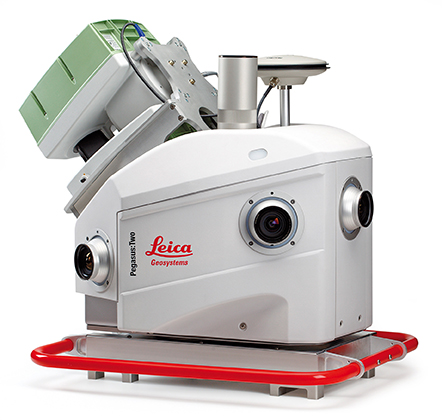
Leica Geosystems has introduced its next generation vehicle-independent mobile mapping platform, the Pegasus:Two. By calibrating imagery and LiDAR point cloud data, the Pegasus:Two delivers highly accurate and economical geospatial data in a 360° spherical view while providing two methods for extracting data — either through LiDAR or via photogrammetry.
With its enhanced sensor platform using six horizontal cameras, plus an optional rear camera and a skyward view camera, a single high-speed LiDAR sensor, and an external output for an additional sensor, the Pegasus:Two enables unlimited mobile mapping applications, from pavement analysis to geo-referencing railways systems, now possible within the same platform, the company said.
From hardware to post-processing, Pegasus:Two allows economic data collection by balancing the largest pixel to sensor ratio on the market (5.5 x 5.5 µm), delivering extremely high image resolution, in a 4-MB camera and using a single low-noise, high-speed profiler. Users can download data via Wi-Fi or wired Ethernet, or even faster by using the latest USB3 interface, by means of a multi-core, industrial PC with 1-TB storage and a solid state drive, enabling longer missions. An optional rotation mount, designed specifically for the Leica ScanStation P20, also makes mounting the terrestrial scanner upside down or right side up while also enabling left or right rotation.
The Pegasus:Two in its new streamlined housing with aerodynamic design.
Expanding on the success of Leica Geosystems’ mobile mapping software, the latest software now offers semi-automatic object extraction features, which enable easy-to-use two-click GIS metadata extraction or calculation of distances on-the-fly directly into ArcGIS for Desktop software.
Leica Geosystems also introduces an external timing output and trigger signal for use with a variety of additional sensors, from a thermal camera, to ground penetrating radar, sonar, or even a pollution monitor. The External Trigger feature synchronizes time stamping and coordinates user data with one simple click, making 3D mobile mapping very user-friendly.
Urban canyons. Equipped with the NovAtel’s ProPak6 high-precision receiver for the most demanding city or rugged environments, the Pegasus:Two offers users a truly global system. It is a future-proof investment that tracks signals of all available constellations, GPS, GLONASS, Galileo and BeiDou as well as L-band, SBAS, and QZSS band coverage to ensure the best signal even when moving through urban canyons. The system provides a low noise, 200hz Inertial Measurement Unit for tracking the vehicle path thereby ensuring data is positioned accurately.
Aerodynamic design. The Leica Pegasus:Two mobile mapping system now comes with a new streamlined and compact look and continues to fit in only two travel cases. A convenient handle surrounding the unit enables easy mounting on and off your vehicles. The Pegasus:Two is a vehicle-independent system with a rechargeable 11 hour battery, and can be used on any moving platform.
“The Leica Pegasus:Two platform is a unique complete solution,” said Stuart Woods, vice president for Leica Geosystems Geospatial Division. “By providing software and hardware designed to seamlessly work together, users not only receive the latest in mobile mapping technology but also optimal performance and faster workflows. By keeping the platform vehicle independent and adding new sensor options, we encourage our customers to find new ways, to try out different sensors, new revenue models, and new places to measure. ”
Along with the Pegasus:Two, the advanced prototype, Pegasus:T2, a trolley based mobile system weighing less than 20 kilograms will also be on display at the HxGN LIVE 2014 Conference in Las Vegas.
Esri has issued guidelines for users to protect themselve against the Heartbleed Bug, officially named OpenSSL Vulnerability CVE-2014-0160 (Heartbleed).
The Heartbleed Bug is a serious vulnerability in the popular OpenSSL cryptographic software library. This weakness allows stealing the information protected, under normal conditions, by the SSL/TLS encryption used to secure the Internet. SSL/TLS provides communication security and privacy over the Internet for applications such as web, email, instant messaging (IM) and some virtual private networks (VPNs).
Some 17 percent (around half a million) of the Internet’s secure web servers certified by trusted authorities were believed to be vulnerable to the attack, allowing theft of the servers’ private keys and users’ session cookies and passwords.
Since learning about the vulnerability, Esri staff have been performing maintenance to validate, secure, and patch Esri servers and infrastructure to close this vulnerability and ensure Esri customers are protected.
Esri suggests its customers read its Knowledge Base Technical Article to determine the action required for their particular ArcGIS products and services. As an extra precaution, users may want to change their passwords.
The Collector for ArcGIS app can be used offline to collect and edit maps and data regardless of network availability.
Esri has released new versions of Collector for ArcGIS and Operations Dashboard for ArcGIS. The Collector app now includes the ability to download maps to your smartphone or tablet device to collect and edit data when working offline. Operations Dashboard has added support for browsers so users can view operations on their iPad, Android tablet, or from their desktop. Both apps are available at no cost to ArcGIS Online subscribers and Portal for ArcGIS customers.
Collector for ArcGIS is a configurable field data collection app for iOS and Android devices. With the latest release, maps can be used anywhere regardless of network availability. Users can take map areas offline and work with them in remote locations where network availability is either nonexistent or unreliable. Users can download Esri basemaps as well as their own basemaps managed within their ArcGIS organization.
Operations Dashboard for ArcGIS provides a common operational picture for monitoring, tracking, and reporting events within your organization. The new version of Operations Dashboard now supports web browsers. That means you can have the same real-time view of operations on your tablet that you see on your Windows desktop.
Data sources inside Operations Dashboard have also been improved in the 10.2.2 version of the app. Users can now power operation views using dynamic map services as well as feature services, and other types of layers including real-time weather, traffic, and social media feeds.
Collector for ArcGIS can be downloaded from the Apple App Store and Google Play. Operations Dashboard is available through ArcGIS Online. Portal for ArcGIS users can access the Operations Dashboard app from the Customer Care portal.

 InVision 2.0 focuses on new and expanded capabilities for mobile viewing and editing workflows, analysis and reporting, and data authoring and interoperability.
 InVision 2.0 focuses on new and expanded capabilities for mobile viewing and editing workflows, analysis and reporting, and data authoring and interoperability.