Tag: automakers

  • Drones Take Off for Location Companies

    Drones Take Off for Location Companies

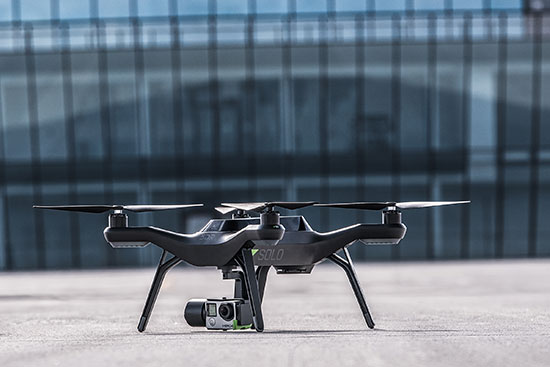
    3D Robotics Solo Drone with GPS embedded.
    3D Robotics Solo Drone with GPS embedded.

    The National Association of Broadcasters meeting in Las Vegas draws 100,000 attendees annually, making it one of the largest trade shows in the country. However, besides timing and some very niche markets, it has not been a big show for location companies. That is, until now, when NAB welcomed drone manufacturers, all of which embed GPS in their flying aircraft.

    Kevin Dennehy
    Kevin Dennehy

    LAS VEGAS — Commercial drones, a growing market for location companies, was one of the most popular topics at the National Association of Broadcasters Show, held here April 13-16.

    The market for drones has grown nearly five times in the last few years, said Eric Cheng of DJI, which uses GPS in its virtual positioning system that monitors and controls the aircraft. The company markets what they call “flying cameras” that look suspiciously like drones. “The market was initially hobbyists, but now some major broadcast players are buying the cameras,” Cheng said at the Showstoppers trade event the day before NAB.

    Most of the drones offer GPS-based automatic flight stabilization technology. Some even offer a long-range wireless signal and low-latency video transmission.

    Many of the drones are programmed so they don’t go higher than mandated FAA rules or go into restricted, no-fly aviation zones — and all use GPS to do this. Some of the drones even return to the user automatically when their batteries run low.
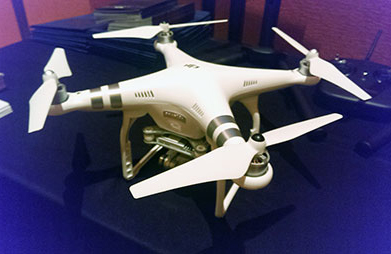
    DJI drone with embedded GPS.
    DJI drone with embedded GPS.

    DJI offers three cameras for the drones. The high-end Phantom 3 Advanced offers 1080P HD video at 60 frames per second. The 1080P version costs $995.

    In terms of privacy and government regulation, U.S. regulators are way behind Europe, Cheng said. “Other countries are way ahead of the [United States] in terms of working with drone companies,” he said. “In terms of privacy, the step ladder was the first tool for the invasion of privacy. They haven’t outlawed step ladders.”

    The slow U.S. regulatory process has forced some manufacturers to go to other countries to test their drones, said Roger Sollenberger, 3D Robotics’ editorial director. “[U.S. regulations] have moved slowly here — despite the government knowing about worldwide drone rollouts. In Japan, they have been using drones to crop dust for 20 years,” he said.
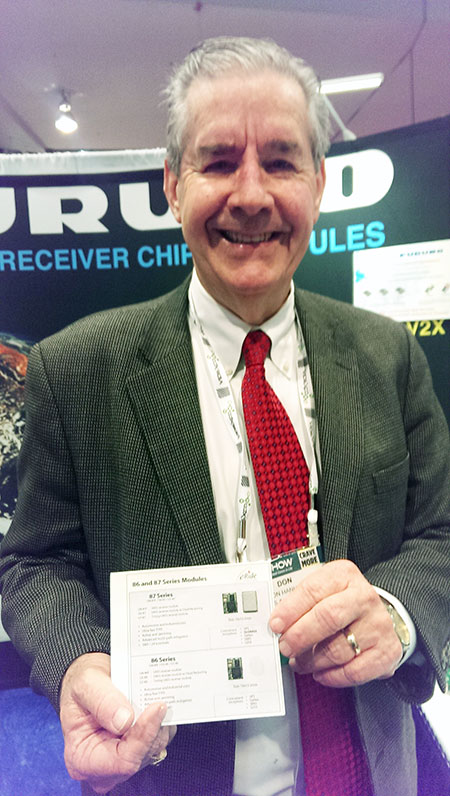
    Furuno's Don Hanham with GNSS modules at NAB.
    Furuno’s Don Hanham with GNSS modules at NAB.

    To signal increased interest in the commercial drone market, 3D Robotics raised $70 million dollars in funding, led by investor Qualcomm, Sollenberger said. The company, which partnered with action camera giant Go Pro, says its Solo drones can be used not only by broadcast companies, but for railroad track and building inspections.

    As GPS World reported, Furuno Electric Co.’s latest multi-GNSS receiver module, GN-87, has been adopted for the new quadcopter Bebop Drone. The broadcast market has been a good one for company’s timing products, drone integration and even weather prediction, said Don Hanham, a Furuno sales and marketing consultant.

    Furuno is marketing its Doppler Weather Radar System for broadcast. The system allows weather predictors to follow the development of short, localized rainstorms and extreme weather conditions.

    Booz Allen Hamilton Releases Report on 2015 Automaker Priorities

    The era of automotive connectivity, and subsequent heavy competition, is the focus of Booz Allen Hamilton’s new report, “Getting the Customer Experience Right: Auto Industry Priorities in 2015.”

    The company says that automakers should consider six key priorities this year: deliver innovation in months, not model years; differentiate with new partnerships to catch customers’ attention; secure connectivity to reinforce a relationship of trust with customers; address the “so what” of connected cars; personalize the customer experience via the tremendous potential buried in data; and find and build the market for alternative fuel vehicles.

    In terms of big connected vehicle technologies this year, Jon Allen, a principal with Booz, cites 4G pipe in GM and Audi vehicles and over-the-air updates by Ford and BMW, among others. “New parental controls in the Chevy Malibu report average speed and near misses while also preventing drivers from turning on the stereo until seatbelts are fastened. It’s easy to imagine this across vehicles, with parents receiving text messages in real time,” he said.

    Allen said, in terms of vehicle connectivity, automakers must answer the “so what” to set themselves apart from the competition. “We have yet to see the seminal, game-changing connectivity plays. Most companies are still in the ‘features’ mindset, offering new à la carte enhancements,” he said. “They’re not yet articulating a top-down strategy for re-envisioning the customer experience with connectivity.”

    One of the company’s six priorities concerns connected security, which has been a big industry issue since the recent release of the Markey Report, which focused on how vehicles can be hacked. “We have clients who get it.  They’ve identified a senior leader to champion vehicle cyber security and backed them up with a cross-functional team that works closely with counterparts across the organization — in product engineering, supply chain, safety, privacy and IT,” Allen said.  “Other OEMs are still formulating their approach. That said, there are pockets of cyber security across every organization, focused on implementing security controls on individual parts. The challenge is taking the next step —moving from this segmented, ‘assembly line approach’ to a more unified program that focuses on securing the complete vehicle ecosystem.”

    Allen said the company has to speak honestly to customers and regulators about how to manage vehicle cyber security risk. “Industry leaders must prioritize their security approach to ensure that higher risk scenarios are addressed first, rather than try to take on all elements of the challenge at once,” he said.

    Another priority addresses the long lead times, by automakers, to develop and roll out new features, which is a challenge, Allen said. “Consumer electronics, telecommunications and software companies are redefining the traditional industry boundaries that once distinguished them from OEMs. These companies focus on connectivity and services from the start of their product design process,” he said. “The key for automakers going forward is to continue learning from these new competitors, particularly around rethinking the vehicle lifecycle, connected product design, and managing vehicle software updates after purchase. In the near future, automakers will need different approaches to building and enhancing infotainment systems that can keep pace with customer demands.”

    The marriage of autonomy and connectivity is a game-changer, Allen said. “It isn’t just about plugging vehicles in to the Internet of Things. Autonomy transforms transportation,” he said. “When a car drives you, it becomes a retail outlet, a personal assistant, even a trusted chaperone — that all depends on getting both autonomy and connectivity right.”

    The rise of autonomous vehicles gets to the fundamental need for industry leaders to be willing to reimagine their product, Allen said. “Autonomous capabilities are not just about engineering a safer, more efficient, and more appealing mode of transportation. That’s important, but it’s really about a distinctly different product, one that creates a sustained, services-based relationship with the customer,” he said. “It will focus on the driving experience not just behind the wheel, but sitting comfortably inside of a self-driving vehicle. The connected, autonomous vehicle will change automotive for the better — and forever.”

    Allen said his company is seeing OEMs look beyond their individual vehicles to see the emerging connected society that includes ride sharing, multi-modal transportation and connected cities. “The way we go from point A to point B will look and feel drastically different 25 years from now; many OEMs are beginning to accept the change and embrace the challenge,” he said.

  • Ford, Telogis Expand Partnership to Commercial UK Customers

    Ford Motor Company and Telogis have expanded their exclusive partnership to bring Ford Telematics powered by Telogis to Ford’s commercial customers in the United Kingdom first, with other European markets to follow later this summer. Ford Telematics uses real-time information from Ford vehicles to enable businesses with workers in the field to have insight into vehicle location, driver behavior and fuel consumption.

    The telematics can save companies up to 20 percent on fuel, according to a 2012 Frost & Sullivan report.

    Since 2011, Telogis has been the exclusive technology provider to power Ford Telematics (formerly Ford Crew Chief) in the U.S. and Canada, with comprehensive and scalable telematics for commercial customers. The UK expansion of the Telogis-Ford partnership leverages the success of Ford Telematics in the U.S. and Canada and will meet the demand from current and new Ford customers in the UK for in the visibility into day-to-day operations including Ford vehicle diagnostics.

    “Ford Telematics is an innovative system that can deliver reductions in cost of ownership for businesses that operate Ford’s Transit commercial vehicles,” said Paul McDermott, manager, CV aftersales, Ford of Britain. “Real-time vehicle location and diagnostic data provides fleet customers with a powerful tool to manage their vehicles more effectively and also encourage safer driving.”

    Making its debut at the 2015 Commercial Vehicle Show, Ford Telematics will be available to fleet customers in May as a dealer-installed option, offered through Ford’s network of specialist Transit Centres.

    Ford Telematics functions by securely transmitting vehicle data and metrics from the vehicle to a dedicated Telogis website via an embedded cellular connection. The telematics system’s ability to access proprietary Ford vehicle data enables operators to track details such as oil change warnings, water contamination in diesel fuel, tire pressure, safety belt usage and airbag status.

    “The reality of being able to visualize field staff and the performance of each Ford vehicle — all on one screen — is here,” said Paul Reynolds, automotive director at Telogis. “This visibility enables Ford commercial customers to provide better service for their own customers and run their businesses more productively and efficiently — it’s no longer a ‘nice to have’ but a ‘have to have’ solution.”

    Based on the real-time data, the Ford Telematics powered by Telogis software platform delivers a comprehensive range of actionable business information that enables fleet managers to operate their vehicles in the most efficient way and to help ensure drivers are following safe and economical driving practices.

    Advances include a suite of more than 80 pre-loaded reports, integration with established business operating systems and fuel card services. Ford Telematics and the Telogis platform also allow for a BYOD (Bring Your Own Device) approach, helping to further reduce hardware costs and increase productivity.

    Ford Telematics is compatible with Ford’s latest range of Transit commercial vehicles — including the all-new Transit, Transit Custom, Transit Connect and Transit Courier — as well as the Ford Ranger pickup. Additionally, the same Telogis hardware can be fitted to any other vehicles on the fleet, regardless of manufacturer, allowing informed fleet managers to view the whole fleet in one place, with all the usual driver performance and vehicle tracking information that they expect.

    Ford Telematics also provides a gateway to the broader cloud-based Telogis platform that includes a suite of connected vehicle technologies including route optimisation and planning, commercial-grade navigation, work order management and mobile applications to drive additional efficiencies and productivity for mobile enterprises.

    “Ford Telematics is another example of Ford facilitating the delivery of smart technology to help our customers enjoy the highest quality, safest and most sustainable operation of commercial vehicles available today,” said Nick Themistocleous, director, Fleet Operations, Ford of Britain.


  • Connected Car Show: Issues Arise as Automakers Look to Autonomous Vehicles

    Hacking, Privacy, and Consumer Acceptance Top the List

    Vehicle styling, speed and looks took the back seat while capabilities driven by GPS, sensors and data were up front at this week’s Los Angeles Auto Show’s Connected Car Expo. Privacy and security, distractibility and safety, and human interfaces were all hot issues. The terms connected car and autonomous cars were being used interchangeably, as a continuum of an evolving set of capabilities. The least-asked question: If we build an autonomous vehicle, will it sell or become an expensive niche product? And how will the market respond to mechanical failures or accidents, even if the vehicles are proved to be overall safer and more reliable?

    Not Happy with Navigation. With little to individually distinguish car models, auto makers are looking to infotainment to uniquely brand their vehicles. Yet drivers identify navigation and multimedia among the “lower quality” features of their vehicles. While consumers report that the quality of almost all other features of their vehicles are improving, they indicate that the quality of their navigation and multimedia are declining. “The problem is overly complex systems,” reports Renne Stephens of J.D. Power. “Usability is now considered by consumers as a factor of quality.”

    Car makers are under enormous pressure to add functionality demanded by consumers, and make the whole experience simpler. Many of the features embraced by automakers have not attracted the interest of drivers. Stephens reports that valued features include surround view camera with rear vision, wireless charging station, near field communication and smartphone field integration. What they don’t value are eye tracking, tactile touch screens, hand gesture control and laser headlights.

    Hacking. Discussions on security were enlivened with the inclusion of hacker Chris Valasek. You may remember that last year Valasek and his partner, Charlie Miller, hacked into the steering and brakes of a Prius and Ford Escape, solely by attaching a laptop to the vehicles. Members of an Israeli intelligence unit reported that they had remotely hacked into a vehicle wirelessly via an aftermarket insurance dongle (in this case, Zubie) that was plugged into the vehicle’s OBDII port. Dongles might make people safer drivers, but could they lead to an unwanted adventure?

    Valasek and Miller created a list of the most hackable vehicles with the Jeep Cherokee, Cadillac Escalade and Toyota Prius as the most vulnerable. The Dodge Viper, Audi A8 and Honda Accord top the most secure list. Malicious attacks could range from enabling a microphone to eavesdrop to the catastrophic, such as controlling steering or brakes.

    Valasek assured conference goers that hacking vehicles isn’t easy. No matter how many layers of protection are created, no vehicle that communicates with the outside world will be hack-proof. Last month, automakers announced that they are forming a consortium that will be dedicated to deterring “black hat hackers” and will create a venue for the auto industry to share information about hacking attempts.


    Dreams and Nightmares. The best-case scenario for the automotive OEMs is a connected vehicle industry in which they control the ecosystem and derive high revenues, as well as driverless cars starting to become common around 2024. In reality, the OEMS may encounter lagging consumer acceptance, perhaps shattered by catastrophic accidents, reliability issues or privacy troubles. Regulation might cause insurmountable constraints. The driverless car could become a niche product and a costly failure.

    In another possible scenario, the connected autonomous vehicle becomes a success, but the tech and digital companies win the market with parallels similar to how the PCs took the industry from IBM. The OEMs become a pipeline with little value and the tech companies take home the bacon. If the market fails, the VCs will stop investing and some of these tech companies may fold. The Tesla offers an example of how this scenario might unfold.

    Privacy. Automakers are making a commitment to privacy in the vehicle far beyond that made by companies like Apple or Google, which are vying for a piece of connected vehicles. Nineteen automakers just signed a set of principles delivered to the Federal Trade Commission. “Google may want to become an automaker, but we don’t want to become Google,” said Mitch Bainwol of the Alliance of Automobile Manufacturers. The OEMs provide assurance that they will not share information from vehicles that is streamed back to automakers or that is downloaded from the vehicle’s computers. They pledge information won’t be handed over to authorities without a court order, sold to insurance or other companies or used to bombard them with ads for Starbucks, gas stations or other businesses they drive past, without their permission.

    “You just don’t want your car spying on you,” said Marc Rotenberg of the Electronic Privacy Information Center. “That’s the practical consequence of a lot of the new technologies that are being built into cars.” The automakers signing on to the principles are: Aston Martin, BMW, Chrysler, Ferrari, Ford, General Motors, Honda, Hyundai, Kia, Maserati, Mazda, Mercedes-Benz, Mitsubishi, Nissan, Porsche, Subaru, Toyota, Volkswagen and Volvo.

    Uptake. About half of us like to drive and the other half just want to get there, reports futurist Peter Schwartz. Younger populations are increasingly in the transport camp, as illustrated by the popularity of Uber, Lyft and Zip Cars. How to win the whole market is to “automate the boring parts of driving,” says Håkan Samuelsson of Volvo.”

    J.D. Powers reports that consumers perceive the autonomous vehicle as a driver completely detached from the driving experience. This isn’t too close to the reality that is within reach; the driver will need to be engaged and ready to assume control when called upon. But the dream of catching a few winks on the way to work is a good one. Will this vision be led by Detroit or Silicon Valley? We should find out soon.

  • Autonomous Vehicles Are Coming…But When?

    IAV_OMD_3760 Photo: Denso
    IAV Automotive Engineering test vehicle. Photo: Denso

    The autonomous, or driverless, vehicle market seems to be a big side topic at connected car conferences. Location technology will continue to play a role in the development of autonomous vehicle markets. However, many view a fully autonomous vehicle to be more than 10 years away — these are usually folks from the auto industry or academia. Others, those who lurk around Silicon Valley, believe that driverless cars will be on the road in half that time…and once again, if Detroit doesn’t move on it, they will.


    Just as GPS was once thought of as science fiction — something that naysayers said would not be fully operational for decades — autonomous vehicles are now thought of as an extension of the connected vehicle market. However, technology and legal issues will make the implementation of an autonomous, or driverless car, a tenuous road in the next few years.

    One executive from Verizon Telematics, which is a major player in connected car technology, said it is going to take time, perhaps between the years 2025-2030, to grow the autonomous vehicle market.

    “You just can’t flip a switch and have autonomous vehicles [on the road]. You have to take baby steps to develop a network, build an infrastructure and condition the marketplace,” said Kevin Link, Verizon Telematics senior vice president. “The collaboration is going to have to be more than one player, including the government. It was a while before desktop computers evolved into laptops.”

    While the technology hurdles will be significant for autonomous vehicles, there are features today that will help shape the market, Link said. “Mercedes cars remind people to steer and turn around corners, when to stop at a safe distance and to change lanes,” he said. “These are not taking you from point A to point B autonomously, but real-time connected car features will feed into the autonomous car.”

    The evolution of autonomous vehicles will not be derailed at this point, given the intensive research and investment focus from both the private and public sector, said Tim Johnson, NextEnergy director of transportation initiatives. “However, cars that ‘drive themselves’ will not be in mass production in the next five years. Ten years, maybe. Five, no,” he said. “This is not a technology-limited premise. The technologies are rapidly approaching realistic use in limited applications, but the regulatory, liability and infrastructure aspects are far from being fully implemented in the next five years.”

    Technology Hurdles Await Early Autonomous Vehicles — More Regulation than Technology?

    Some of the technology hurdles center around the speed, capacity and logic of the vehicle and infrastructure systems to manage the significant amount of information required for self-driving vehicles, Johnson said. “If it was possible to wave a magic wand and have all vehicles made simultaneously capable of these communications and logic decisions, it would be much more viable to create a mass, public environment for self-driving cars,” he said. “In reality, there will be an extensive transition period, possibly 15 to 20 years, where capable vehicles will need to deal with incapable vehicles. Once again, this is not so much a technology issue as it is policy, regulation and liability.”

    Autonomous Products Already Out There…

    Autonomous vehicles will only continue their current momentum as the technology for assisted driving is already well underway with features like self-parking, lane departure warning, predictive collision warning, back-up collision intervention and blind spot prevention, said Scott Frank, Airbiquity vice president of marketing.

    An example is the Infiniti Q50, which uses Airbiquity technology for Infiniti InTouch Apps. “What we’re going to see from here is a shift from driver assistance to zero driver involvement — the ultimate expression of autonomous vehicle — where the car does all the driving and there isn’t even a steering wheel or brake pedal,” Frank said. “We won’t see fully autonomous vehicles becoming commonplace in five years’ time due to the massive amount of technology, infrastructure development and integration that needs to happen to ensure the requisite amount of safety.”

    NextEnergy’s Johnson said that cars that drive themselves are already in use in restricted access sites, such as military bases, restricted commercial and university locations, national lab campuses and more. “These are the first real-world applications of both the vehicle and infrastructure technologies to test the practical limits of semi-autonomous driver-still-behind-the-wheel cars,” he said. “Much like the FAA use of limited test sites for the development of regulatory aspects of drone flight, these sites are providing the information and insight to move the potential of cars that drive themselves closer to everyday use.”

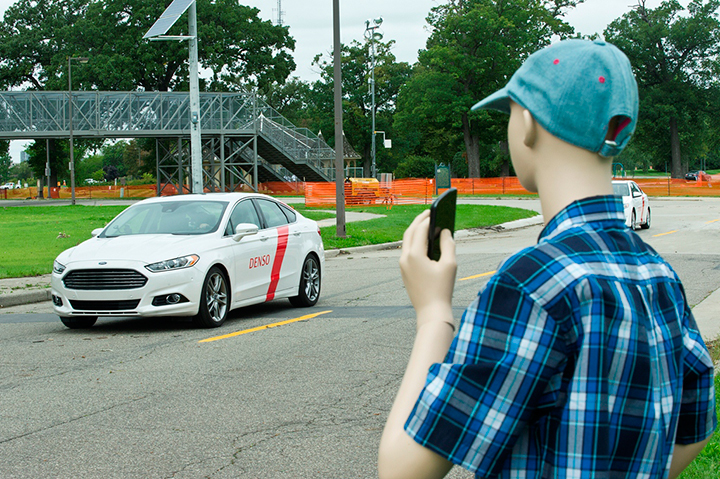
    Denso-W Photo: Denso
    A Denso autonomous test vehicle drives the track while a plastic friend looks on. Photo: Denso

    Will Public Transit Be the First Proving Ground?

    Most companies have different opinions when asked whether the public transit area will be the first major market, and serve as the catalyst, for autonomous vehicle growth. “Although we don’t know for sure, it could be that automated public transit programs, will operate in controlled environments with known routes [meaning low speed operation with pedestrians/bicycles operating on the same thoroughfare, but the automated transit system does not have rails or guide ways — the route planning is easily changeable with no impact to the transportation infrastructure],” said Roger Berg, Denso North American Research and Development office vice president.

    Denso believes the autonomous vehicle market will encourage additional functionality within the premium car model lines, but gradually these advanced driver assist systems will become more and more common and eventually spread through even the economy car segment, Berg said. “First systems deploy warnings or simple lateral and longitudinal vehicle control. But then functionality for what most people refer to as ‘driverless cars’ or ‘automated driving’ would only be usable under fairly benign driving and traffic conditions, such as some level of automated highway driving,” he said.

    Public transit as an “early adopter” business model is viewed to be less probable in the near term as many of the technical challenges facing autonomous operation require significant research and development and capital investment, said Chris Hennessy, IAV Automotive vice president, engineering. “Most of this capital is centered on markets where the return on the investment can be substantial. At the moment, the most likely scenario for a reasonable ROI is in the premium-brand automotive market, where consumers are willing to pay a premium for new technology,” he said. “This market and the technology growth that will occur from this early-adopter market will provide a foundation for cost-effective proliferation of this technology to other markets, where either the operational boundary conditions are narrower or the available capital is lower, which is typically where public transit would fall. Exceptions to this condition could be analogous to the light-rail market, where the interaction to the general public can be controlled and managed with isolated tracks or lanes of travel, but this would require significant planning and capital investment in infrastructure.”

    Airbiquity believes that public transit will not be a first adopter. “No, the first adopters will be private parties in urban areas providing a value proposition to people struggling with congested cities, long commutes, and high parking costs. You’re going to see small and innovative companies offering car services with autonomous vehicles operating on city grids at lower speeds,” Frank said. “They will source the autonomous vehicles from non-traditional automotive makers that move faster than traditional automotive makers. Local government will also be involved, since they own the majority of the infrastructure and need to ensure safety standards are established and met.”

    In other location news:

    • Kore Telematics, fueled by a large investment in it by ABRY Partners, bought RacoWireless in an all-cash deal, according to published reports. The transaction will give the companies a combined 3 million M2M subscribers.
  • Regulating Navigation and Mapping Apps?

    Steven Spriggs was pulled over by a motorcycle cop for using his iPhone while driving. He immediately held it up to show the officer that he was using Apple Maps, and not talking or texting. More about Mr. Spriggs later. With approval of the pending transportation bill in Congress, smartphone maps and navigation will be regulated. The National Highway Traffic Safety Administration (NHTSA) would receive the power to regulate apps like Google Maps or Apple Maps. NHTSA’s job would be to review navigation apps and order changes to decrease driver distractibility.

    Guess who is in favor of this new regulation for smartphone apps? Automakers. Embedded navigation systems, those found in the dashboard of vehicles, are already regulated by NHTSA. Smartphone navigation apps are a much cheaper option than the systems offered by automakers, who are looking for a more level playing field and a way to slow down the smartphone navigation juggernaut.

    The downside to this regulation is big. If it was just Apple and Google mapping, oversight would be simpler, but Apple App Store and Google Play Store are filled with hundreds of mapping and navigation apps. Logistically it doesn’t seem possible for the NHTSA to review all of the apps efficiently without causing interference in the market. NHTSA doesn’t currently have the budget, infrastructure or staffing to be successful.

    The forum of the radio show “Car Talk” is alive with discussion on NHTSA’s desire to control navigation. The vast majority of posters point out the distraction from using a paper map or being lost. “Personally, I prefer a full-sized road atlas on the seat beside me for all my navigation needs. Taking occasional readings with a sextant helps, but is difficult while eating my Big Mac and holding the wheel with my knee,” Paul Carney writes with sarcasm. On the other side, Victor Cooper responds, “YES! It is long overdue. And I think it is about time we treat texting while driving the same as we do drunk driving…criminal penalties and all.”

    I think regulation on mapping and navigation may help make the apps simpler to use and less distracting. Before passing a regulatory law, I’d like NHTSA to successfully demonstrate a review system that doesn’t impede innovation, significantly delay new products, or make it overwhelming difficult for small start-ups.

    So what happened to Steven Spriggs? The police officer went ahead and wrote a $165 ticket for using a cell phone while driving, despite Spriggs argument that the law didn’t apply to navigation apps. Spriggs challenged his ticket in California’s state appeal court and won. The $165 went back into Spriggs’ pocket and map users everywhere sighed with relief,

  • Record Number of Automakers at International CES

    It’s a daunting task — trying to find the big location story in a maze of 150,000 attendees and thousands of exhibitors at the International Consumer Electronics Show in Las Vegas. Aside from every automaker touting their connected vehicle efforts, the big deal this year at CES is wearable technology (last year it was 3D printing? Yawn). Despite sore feet from walking football-field lengths of booths, CES is still a cool show, blaring stereos, walls of TV screens, robots…and connected cars. 

    LAS VEGAS — Although the largest number of worldwide auto manufacturers attended this year’s International CES here, many industry experts believe that technology giants Google and Apple will swoop in and grab not only the market, but will control what will go into the connected automobile in the future.

    “Leading IT, consumer electronics and Internet companies will marginalize specialist vendors. I’m worried that Internet companies will take over the [connected car] market — away from the auto manufacturers,” said Thilo Koslowski, Gartner vice president at the Consumer Telematics Show, held the day before CES

    Koslowski’s fears have been partially validated as Google launched a partnership, called the Open Automotive Alliance, with automakers to bring the Android operating system into cars. The Google move comes after a similar announcement by Apple, which was launched to get its iOS platform into connected cars.

    Initial Open Automotive Alliance members include Audi, General Motors, Honda, Hyundai and Nvidia. Apple, in its group, has Jaguar Land Rover, Volvo, Mercedes-Benz, Honda, Ferrari, Nissan, Chevrolet, Infinity, Kia, Hyundai, Opel and Acura.

    “We think [Google] is a strong content partner — the deal gives [you] perspective on where we as a company are heading. Same on the Apple side,” said Charles Koch, Honda manager, new business development, at the Consumer Telematics Show.

    Despite standing room-only crowds at CES during most of the connected and automated car session, Koslowski said companies need to keep the right focus on the future. “[Connected vehicles] still are not a definite market, but we will see if it is in the next 3-4 years,” he said. “HMI and user interface will be biggest differentiators. Personalization will be important, but it will also be an expected feature.”

    Koslowski said the Holy Grail for connected vehicles in the future is the transition to autonomous capability. “It’s progressing very quickly. Automakers have to avoid the gold rush mentality as it may not be the treasure trove,” he said.  “They have to meet expectations [about the the technology] and avoid the creepiness factor that you know too much about the consumer.”

    Regardless of the future, Koslowski believes the connected vehicle is a disruptive opportunity.  “I can see carriers offering a car for free in exchange for lifetime data. Less dramatic would be with an eight-year data plan,” he said. “This would probably be a smaller, less expensive vehicle than a Ferrari or Audi.”

    Overall, the telematics market has gone through several market changes in the past 10 years, said Kevin Link, senior vice president and general manager, China, for Verizon Telematics.  Link said that Telematics 1.0 included door unlock, navigation, automatic collision notification, call centers and navigation. “It all began with GM and Mercedes becoming springboards for the industry. Initially, there was low consumer awareness; now, it is something like 88 percent in the United States,” he said.

    Outside the U.S., however, the consumer awareness for telematics drops into the single digits. “The business model, especially in the U.S., is a burden on the consumer. In China, it’s a business-to-business play, which is not a burden on the consumer, which also explains the high usage rate,” Link said.

    At CES, a record nine automakers attended and exhibited:  Audi, BMW, Chrysler, Ford, General Motors, Kia, Mazda, Mercedes and Toyota.

    AT&T Mobility Makes Big Announcements at CES

    In a pre-CES press conference, General Motors announced its first LTE-enabled vehicles — in which AT&T Mobility is powering the LTE network for GM’s OnStar service. The first LTE-enabled vehicles, which will be available this summer, are Impala, Spark, Volt, Orlando, Spark RV, Silverado, Silverado HD, Malibu, Equinox and Corvette Stingray.

    AT&T also announced it will provide connectivity for Ericsson Connected Vehicle Cloud which connects to the AT&T Drive platform for automakers

    “We expect about 50 million cars to be connected by 2020. The car will be another device in your life,” said Glenn Lurie, AT&T president, emerging enterprises and partnerships. “LTE in a car will get another set of application developers involved — how will they differentiate the car?  It’s a global opportunity.”

    Magellan and Navigation Solutions’ Nav System Features Proximity Capability

    Navigation Solutions, owned by Hertz, said it is working with Magellan to offer the NeverLost 6 navigation device that features connected services — many of which offer a consumer choices based on businesses and attractions near their current location.

    A number of new systems, including Magellan’s new models and Pioneer’s five NEX models, which consist of four navigation and an A/V receiver, feature connected services that allow access to navigation — even when the phone isn’t connected to a data source. This has been a sore subject for users of the free Google Maps on a phone — no Internet, no navigation.

    Magellan also announced a new line of RoadMate Personal Navigation Device (PND) units featuring Easy Touch screens and an underlying Android OS to improve navigation capabilities and features.

    In other CES news:

    • Broadcom continues to make strides in indoor and Wi-Fi position with several new product rollouts. The company also is rolling out its BCM47531 GNSS chip that can grab signals from five satellite constellations at the same time (GPS, GLONASS, QZSS, SBAS and BeiDou), said Mohamed Awad, Broadcom director, product marketing.
    • Alpine rolled out the aftermarket’s first 9-inch navigation system, which will cost $2,600 and be available in June.  The company is targeting used trucks and other vehicles as they are staying on the road longer, said Melvin Diaz, Alpine product planning manager.
    • In its press conference at CES, Kenwood said its navigation units are selling well.  Its flagship, a $1,500, 7-inch system, features INRIX traffic and Garmin navigation.
    • In the LBS Insider February blog, several industry experts will be interviewed about the future of the autonomous vehicle.
  • CTIA: Automakers Developing Their Own Infotainment Apps

    OnStar_logo-TBy Janice Partyka

    It’s a trifecta. The most interesting news at CES, Mobile World Congress, and now CTIA was the connected vehicle. Last week at CTIA, the biggest mobile conference in the U.S., GM and OnStar demonstrated ideas of what we can expect in vehicles once AT&T’s LTE network makes its way into vehicles. We heard about many of their concepts in February at Mobile World, but with the infotainment possibilities being shown at CTIA, it is clear the endeavor is evolving quickly. Providers of navigation, mapping, traffic, middleware, search, points of interest and mobile advertising have key roles. We’ll check in ahead with some of these companies.

    GM and OnStar envision an in-vehicle curated app ecosystem with downloadable apps and remote vehicle management. Developers will have access to APIs that can access the vehicle’s speed, performance, GPS, fuel economy and other information, but are kept out of areas that could cause safety issues. GM, as well as other OEMs, is not ready to let the app marketplace take money out of its pocket. The automaker is pushing to get apps built specially for its vehicles. Mary Chan of GM said that the business model hasn’t been decided, but the apps may be free, bundled into a service that GM charges for, or paid out to the developers. Another possibility is an app subscription paid for on a smartphone could be applied to a separate app in the car. We have to wait until model year 2015 to see it come off the assembly line.

    Snippets heard at CTIA:

    “The biggest challenge of indoor location is having a good enough return on investment by the venue.” Derek Peterson, Boingo

    “We hear many pitches from companies that want to supply us with indoor location technology, but so many of them are just unscalable.” David Hildebrandt, ATT

    “Relevant, connected car data trumps free.” Mary Chan, General Motors

    “The future killer mobile apps are banking, retail, medical (records, diagnosis) and government (voting, administrative).” Michael Saylor, MircoStrategy

    “The ownership of data in connected cars will be a huge issue. And what happens to data in a vehicle when you transfer ownership?” Mary Chan, General Motors

    Traffic Information Is Getting Better. Traffic information is getting more granular, hence more useful. INRIX and others are collecting traffic data in road segments about 250 meters long, a significant improvement from the past. Not too long ago, traffic data was provided solely by sensors, cameras and helicopters, which covered only highways and some arterial roads. The use of crowd-sourced traffic data now provides a leap in the amount of traffic data collected, enabling more current traffic conditions, as well more roads, to be monitored. “We can collect traffic data for these small road segments from all sources, crunch it and turn it around in under a minute,” says Bill Schwebel of INRIX.

    How Fast? In a few years, Schwebel says we will see an expansion of navigation that goes beyond driving from point A to point B. This would include accurate estimates of the entire length of your trip, for instance, driving from your home to arriving at your airport gate. “We will be getting more feeds from parking lots with electronic counters, but we can also see the dwell time in a parking lot, or cars that exit without parking, all from crowdsourcing,” adds Schwebel. Waits at TSA lines or rental car counters can be devised using historical and near real-time data. When schedules of events in the area and school calendars are added, the predictions get better.

    Navigation Changes Ahead. Turn-by-turn navigation will take a step forward to becoming more interactive when it becomes a two-way broadcast. Niall Berkery of Telenav, predicts that two-way connected navigation will appear in 2014-2016. “We are now focused on reducing the complexity of navigation and making it more personalized,” says Berkery. The entire industry, hindered by the perspective that navigation is free, is focusing on adding value. Telenav acquired ThinkNear to add hyperlocal marketing to its offering.

    Embedded Navigation and the Delivery Man. Berkery estimates that 30% of navigation systems are embedded in the vehicle, which can makes updating or servicing the devices challenging. Some years ago an interesting solution was developed in China. When an embedded navigation system needed servicing, it was handled by a package delivery service, similar to FedEx. The delivery person manually removed the navigation hard drive from a consumer’s vehicle and sent it off to be fixed or replaced. When the drive came back from the factory, the package delivery person reinstalled it. That’s pretty special service.

    If you missed last week’s CTIA show, held May 21-23 in Las Vegas, you will have to wait a year and a half for its next appearance. With CES and the Mobile World Congress positioned on the calendar prior to CTIA, the other shows drew the lion’s share of product announcements and crowds. CTIA will reposition itself in front of these competing shows. CTIA’s new “Super Mobility Week” will be more international and take the place of the current fall and spring CTIA shows. Super Mobility Week will be held Sept 9-11, 2014 in Las Vegas and will include MobileCON and other major partnerships to create a bigger show experience.

  • Automakers Move Ahead on Mobile Connectivity

    It wasn’t quite a call to arms, but Bill Ford, head of Ford Motor, called on the wireless community to work with car makers to avoid global gridlock and create a future of “urban mobility,” a network that will track vehicles and automatically instruct cars to change lanes, exit a road, or park. Vehicle connectivity was one of the major themes of the Mobile World Congress, held in February in Barcelona. For some of us, it brought up memories of the PATH automated highways project of the 1990s. You have likely seen photos of that prototype automated highway with platoons of driver-less vehicles riding on I-15 in southern California. The vision has changed, and we are headed towards autonomous, connected vehicles and away from the specialized, and prohibitively expensive, infrastructure that defined earlier efforts.

    By 2020, 90 percent of cars will have mobile connectivity, compared to 10 percent today, predicts Machina Research in a study funded by the GSMA. The industry is aflutter with connected activity. Sprint Nextel is partnering with Chrysler Group’s Uconnect voice-activated vehicle communications system that enables Sprint phones to connect to the vehicle’s audio system. The Ford Sync will be available to European customers. The Family Locator from TCS will be incorporated in connected vehicles.

    Smartphones Overtake Feature Phones. For the first time, close to half of Americans own smartphones, edging out feature phone ownership, reports the Pew Internet and American life project. According to its report, 45 percent of adults identify themselves as smartphone owners, compared to 41 percent who identify as feature phone owners. There was a notable increase in smartphone ownership by almost every demographic group, including men and women, younger and middle-age adults, urban and rural residential and wealthy and lower-income people.

    Apple Grown Maps. For a year, there have been signs that Google was developing its own mapping and navigation service. Apple has acquired digital mapping companies and listed licenses from many third-party location service companies. 9to5Mac reports that Apple’s mapping contract with Google expires at the end of 2012, and hasn’t yet been renewed. The just-released iPhoto application uses Apple-grown mapping, and not Google.

    Disappearing Ovi. Nokia is closing down the Ovi Share media sharing site to focus on offerings by its location and commerce division, dedicated to building consumer-centric social location products and applications, as well as platform services and local commerce solutions. Services include Nokia Drive, Nokia Maps, and Nokia Transport.

    Gambling Geo-Fence. In the U.S., online and mobile gambling is only legal within the state of Nevada. The location of the mobile user must be determined to ensure she is within state boundaries. Locaid Technologies is the first company to meet all the requirements of the Nevada Gaming Control Board to certify the location of a mobile gambler. Locaid uses geofencing to build virtual, digital perimeters around the state of Nevada and reports it can “prove that a user is physically with a mobile device, and whether the person is located within Nevada state borders, across any major carrier mobile network — whether the mobile device is indoors or outdoors, GPS-enabled or not, and whether the device is a smartphone, feature phone, or laptop computer.”

    February Black Friday. Shopkick announced results of an experiment to create a one-day boost in foot traffic at partner retail stores using holiday tactics during a non-peak shopping period. “We asked a simple question: What if retailers could create Black Friday shopping behavior any day of the year that they wanted?” said Cyriac Roeding of shopkick. The company reports that by doubling the incentives they deliver via smartphone, none worth more than a dollar, their retail partners experience double-digit increases. Retail partners include American Eagle, Macy’s, Old Navy, and Best Buy.

    Effectiveness of Mobile Shopping Apps? Smartphones are increasingly used for shopping, researching products, comparing prices, and finding retail locations. Nielsen metered the smartphones of 5,000 U.S. volunteers during the 2011 holiday shopping season. Nielsen’s analysis reveals that retail websites are more popular than retail apps. Both genders prefer retailers’ mobile websites over mobile apps. The top retail apps and websites combined were Amazon, Best Buy, eBay, Target, and Walmart, and reached nearly 60 percent of smartphone owners during the end of 2011.

    What Was Ford Thinking? In his Mobile World Congress address, Bill Ford, great grandson of Henry, warned that unless the wireless and automotive industries find a solution, global gridlock could one day become a “human rights issue.” In addition to working to end torture, does Mr. Ford think that Amnesty International should pursue the issue of vehicle traffic mitigation?