Tag: BeiDou-3

  • China launches new twin BeiDou-3 navigation satellites

    China launches new twin BeiDou-3 navigation satellites

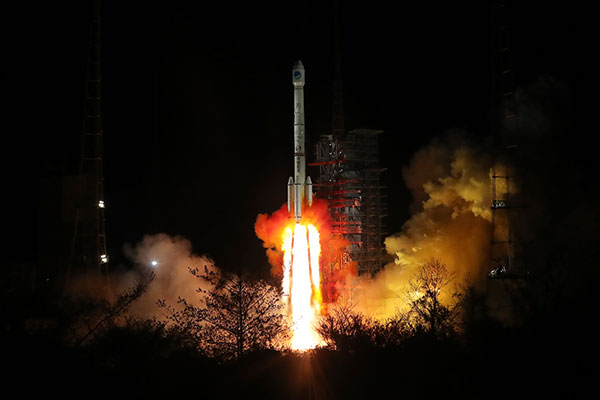
    China has launched another pair of BeiDou-3 navigation satellites, reports Xinhua News Agency, China’s state-run press agency.

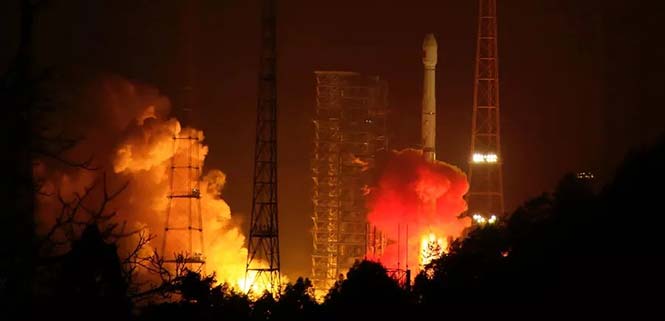
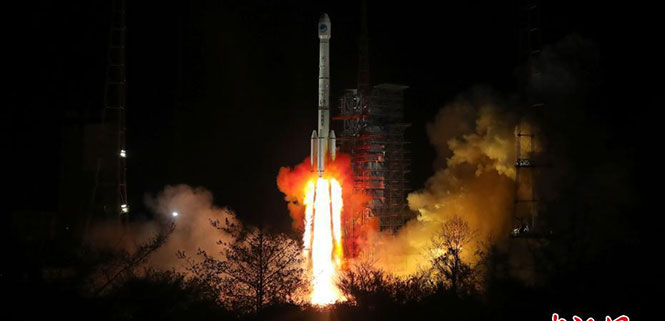
    A Long March-3B carrier rocket lifted off from Xichang Satellite Launch Center in southwest China’s Sichuan Province on July 29.

    The twin satellites are the 33rd and 34th of the BeiDou navigation system. They entered orbit more than three hours after the launch. After a series of tests, they will work together with eight BeiDou-3 satellites already in orbit, said the launch service provider.

    A basic system with 18 BeiDou-3 satellites orbiting will be in place by the end of 2018, and will serve countries participating in the China-proposed Belt and Road Initiative.

    Named after the Chinese term for the Big Dipper, the BeiDou system started serving China in 2000 and the Asia-Pacific region in 2012. It will the fourth global satellite navigation system after the U.S. GPS system, Russia’s GLONASS and the European Union’s Galileo.

    The satellites and the rocket for Sunday’s launch were developed by the China Academy of Space Technology and China Academy of Launch Vehicle Technology, respectively. This was the 281st mission of the Long March rocket series.

    China sends the 33rd and 34th BeiDou satellites into space on July 29. (Xinhua/Liang Keyan)
    China sends the 33rd and 34th BeiDou satellites into space on July 29. (Photo: Xinhua/Liang Keyan)
  • China to launch 11 more BeiDou-3 satellites this year

    China will launch 11 more BeiDou-3 satellites by the end of 2018, according to the Xinhua News Agency, the official state-run press agency.

    China has already launched eight BeiDou-3 satellites for its domestic BeiDou Navigation Satellite System. The satellites will provide initial services for countries and regions along the Belt and Road by the end of the year, said Wang Li, chairman of the China Satellite Navigation System Committee.

    Addressing the Ninth China Satellite Navigation Conference in Harbin, capital of northeast China’s Heilongjiang Province, Wang said the BeiDou system is moving to become a global service provider after offering stable and reliable time and space information for clients in the Asia-Pacific region.

    China launched the first two BeiDou-3 satellites into space via a single carrier rocket in November 2017, as its self-developed BeiDou system officially began to expand into a global network.

    Compared to earlier generation satellites, the BeiDou-3 is able to send signals that are more compatible with other satellite navigation systems and provide satellite-based augmentation, as well as search-and-rescue services in accordance with international standards. Its positioning accuracy has reached 2.5 to 5 meters.

  • Two more BeiDou-3 satellites launched for global coverage by 2020

    Two more BeiDou-3 satellites launched for global coverage by 2020

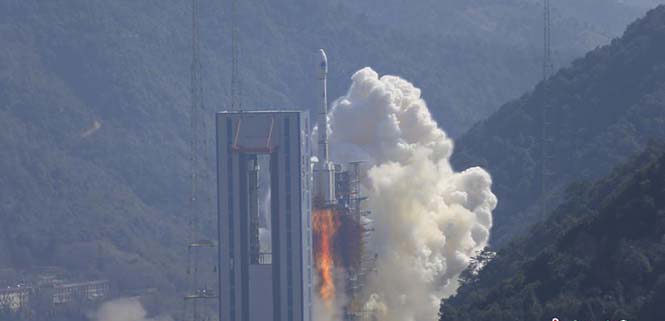
    China launched two more Beidou-3 satellites March 30, the seventh and eighth of the third phase of the Beidou system.

    Launch via Long March 3B rocket took place at 01:56 Beijing time Friday (17:56 UTC Thursday) from the Xichang Satellite Launch Centre, reports gbtimes.com.

    The satellites join six others orbiting at 21,000 kilometers above the Earth. BeiDou-3 is designed to expand Beidou navigation, positioning and timing services from regional to global coverage by 2020.

    The satellites were inserted into medium Earth orbits by a Yuanzheng-1 upper stage more than three hours after launch, with CASC, China’s main aerospace contractor, then confirming success.

    The satellites were developed by the Innovation Academy for Microsatellites at the Chinese Academy of Sciences (CAS), while the China Academy of Launch Vehicle Technology (CALT) under CASC provided the Long March 3B launch vehicle.

    A Long March rocket carries a pair of BeiDou-3 satellites to medium Earth orbit on March 30, 2018. (Photo: Liang Keyan/Xinhua)
  • The System: Accuracy from LEO birds improves

    The System: Accuracy from LEO birds improves

    Accuracy from LEO Birds Improves

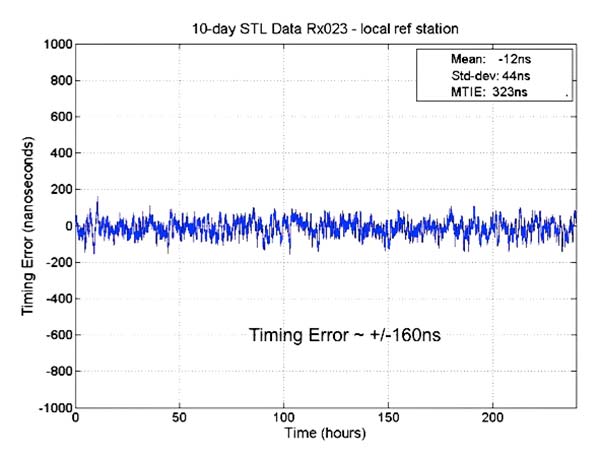
    Results from new tests of the Satellite Time and Location (STL) service, using equipment configurations with a differential source and with a more accurate OCXO clock, show timing accuracy of 160 nanoseconds.

    The STL service uses a signal from the low-Earth orbit (LEO) Iridium constellation.

    In 2016, Satelles demonstrated sub-microsecond timing using a stand-alone TCXO-based receiver (see “Innovation: Navigation from LEO,” July 2017 GPS World).

    New testing employed three different configurations of equipment, services and environment, including a Stanford Research Systems (SRS) rubidium vapor frequency reference, based on the PRS10 module, and a Satelles Evaluation Kit (EVK2) STL receiver, comprising a Maxim RF chip, Xylinx Spartan-3 FPGA, TI dual-core DSP chip, and internal OCXO (oven-controlled crystal oscillator) or external clock.

    Parameters and equipment for the three tests are:

    1. Optimal. Outdoor antenna, Rubidium clock powered on for months prior to data collection, receiver configured in static mode with a known location, and high-quality antenna.
    2. Sub-optimal. Indoor antenna, Rubidium clock powered on six hours prior to data collection, receiver configured in static mode with an unknown location, and low-quality antenna.
    3. Three independent receivers collecting data, receiver on-board OCXO, indoor antenna, receiver configured in static mode with an unknown location, low-quality antenna. Tests performed: 10 days with no local reference station running; 10 days with local reference station, 20-kilometers away from test receivers, providing timing corrections to STL ground segment.

    See Figure 1 for more extensive test results. Also see a previous article.

    FIGURE 1. OCXO timing result with base station.

    The 66-satellite Iridium LEO constellation transmits overlapping spot beams, which provide location-specific data that changes every few seconds.


    Air Force Issues GPS III Follow-on Contract

    The U.S. Air Force Space Command released its request for proposals to build 22 new GPS III satellites, called the GPS III Follow-On Phase 2 contract.

    The contract will be awarded to a single bidder, and has an estimated dollar value of $10 billion including all options.

    Phase 2 is planned as a single, predominantly fixed-price incentive-type contract awarded via full and open competition for production of 22 GPS III satellites. Deadline for proposals is April 16. Delivery of the first satellite is to be in 2026.

    Phase 1 contracts awarded in May 2016 to Boeing, Northrop Grumman and Lockheed Martin (builder of the first 10 GPS III satellites) “determined that viable, low-risk, high-confidence sources exist to conduct a full and open competition for Phase 2, the production of 22 GPS III SVs [space vehicles] starting in the FY19 timeframe.”


    BeiDou’s Long March

    On Feb. 12, BeiDou-3 28 and 29 were launched into medium-Earth orbits, following the launch of a pair of BeiDou satellites on Jan. 11. The satellites form part of a third phase of BeiDou deployment, taking BeiDou coverage from regional to covering the countries along the Belt and Road initiative by the end of 2018, and global by 2020.

    Stay up-to-date with GPS World’s “Upcoming GNSS Satellite Launches” table.

  • China launches another pair of BeiDou-3 satellites

    China launches another pair of BeiDou-3 satellites

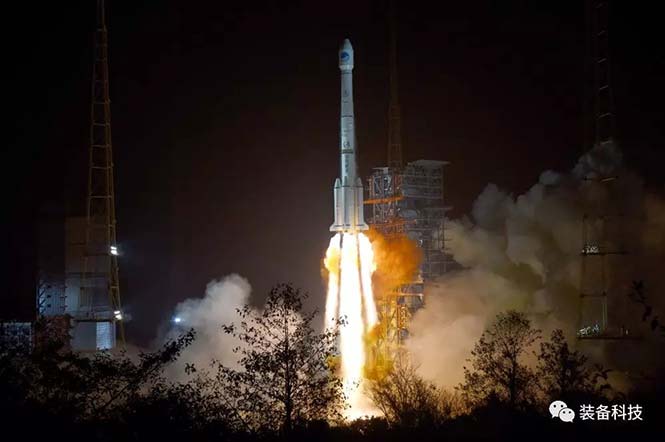
    China continues to update the BeiDou navigation satellite system. On Feb. 12, two more navigation and positioning satellites were launched into medium Earth orbits, following the successful launch of a pair of BeiDou satellites on Jan. 11.

    A Long March 3B rocket with a Yuanzheng-1 upper stage lifted off from the Xichang Satellite Launch Center, Sichuan Province, at 13:03 local time (05:03 UTC), according to gbtimes.com.


    Stay up-to-date with our Upcoming GNSS Satellite Launches table, maintained by Richard Langley.


    The launch had been set for the same window on Feb. 10, but was delayed by the visit of Chinese president Xi Jinping to the launch site.

    Success of the mission was confirmed four hours after launch, following insertion of the satellites into their intended orbits, around 21,000 kilometers above the Earth.

    The newly launched pair are BeiDou-3 28 and 29. The satellites are part of a third phase of Beidou deployment, which will take Beidou coverage from regional to covering the countries along the Belt and Road initiative by the end of 2018, and global by 2020.

    According to Nasaspaceflight.com, the satellites are using a new bus featuring a phased array antenna for navigation signals and a laser retroreflector, with a launch mass of 1,014 kg.

    The accuracy, stability and signal strength of the Beidou-3 satellites is improved over previous versions by developments in atomic clocks, laser communications and inter-satellite links.

    The Long March 3B/YZ-1 carrying Beidou satellites 28 and 29 lifts off from Xichang Satellite Launch Centre at 13:03 local time on Feb. 12. (Photo: CNS)
  • The System: China launches BeiDou-3 twins

    China launches BeiDou-3 twins

    China launched two BeiDou-3 navigation satellites into space on Jan. 12 as part of efforts to enable its BeiDou system to provide navigation and positioning services to countries along the Belt and Road by the end of 2018. The Belt and Road Initiative aims to create the world’s largest platform for economic cooperation, encompassing China, Southeast Asia, South Asia, Central and Western Asia, Middle East and Africa, and Central and Eastern Europe.

    The twin satellites are coded MEO-7 and MEO-8, the 26th and 27th satellites in the BeiDou Navigation Satellite System. They are based on a newly developed dedicated satellite bus that features a phased-array antenna for navigation signals and a laser retro-reflector. They each weigh about one metric ton, and both have two deployable solar arrays; their design life is 12 years. This was the first BeiDou launch in 2018, which will see an intensive further launch schedule throughout the year.

    In his December 2017 “Directions” article in GPS World, Changfeng Yang, chief BeiDou system architect, wrote that “Eighteen BD-3 MEO satellites and one BD-3 GEO satellite will be launched by around the end of 2018. Upon the deployment of those 19 satellites, BD-3 will possess the initial operational capability and serve the countries along the Belt and Road.”

    This would bring the constellation to an initial operational capability before the end of this year. China targets completion of the fully operational global system in 2020.

    B1C, B2A Control Document. On the Chinese part of the BeiDou website, there is now an English version of the Test ICD for the B1C and B2a signals. The link to the website item is www.beidou.gov.cn/icdb1cb2abeta.html, and the actual document is at www.beidou.gov.cn/attach/beidou/2333234155.pdf.


    More interference potential from another tower set

    Satellite operator Iridium asked the Federal Communications Commission (FCC) in April 2017 to modify its license to add a new class of ground stations called Certus for expanded terrestrial, maritime and aeronautical operations.

    Iridium’s 66-satellite constellation provides, in addition to mobile communications signals, the Satelles time and location service: microsecond timing accuracy and 20- to 50-meter unaided position accuracy worldwide (see the “Innovation” column, July 2017 GPS World).

    GPSIA. The GPS Innovation Alliance (GPSIA) commented in September, “GPSIA seeks to ensure that radio navigation satellite service (RNSS) receivers operating in the 1559–1610 MHz band are adequately protected from out-of-band emissions (OOBE) generated from the new Certus mobile Earth station (MES) terminals that will operate on the second-generation Iridium satellite system.

    “GPSIA and Iridium are actively engaged in constructive discussions regarding the adequacy of that protection, but no final resolution has yet been reached. [….]

    “In the unlikely event that GPSIA is unable to reach an agreement with Iridium, it asks the commission to impose limitations on the operation of Certus terminal devices to protect GPS/RNSS operations in the 1559–1610 MHz band at a level equivalent to what terrestrial terminals in the same and other frequency ranges provide at –95 dBW/MHz.”

    Hexagon. Hexagon, the parent company of GPS manufacturer NovAtel, commented on Jan. 8, “Certain statements in the modification application regarding output power and amount of terminals to be deployed cause great concern regarding the unimpeded operation of radio navigation satellite service (RNSS) receivers. The application does not include enough information to simulate the impact properly.

    “Hexagon politely requests that the FCC will exercise the same due diligence [as] during previous modification applications close to the RNSS bands (for example docket 11-109) and establish a technical working group or a similar testing process that ensures unimpeded coexistence of the modified Iridium terminals with the established RNSS systems.”

    Documents related to the case can be found here, on the FCC International Bureau website.


    Galileo security center moves to Spain

    The Galileo Security Monitoring Centre (GSMC) for the European Union’s Galileo satellite system will move from the United Kingdom to Madrid, Spain, as a result of Brexit.

    The center, not yet fully operational, is expected to grow to a staff of as many as 30. It controls access to the satellite system and provides around-the-clock monitoring when the main security center near Paris is offline.

    The GSMC is operated by the European GNSS Agency. It is one of a number of EU institutions leaving the UK as a result of the 2016 referendum vote.

    Spain has another of the fundamental centers of the program, the Loyola de Palacio GNSS Service Center, also in Madrid.

  • Spirent adds BeiDou-3 to its GNSS RF simulators

    The Spirent GSS9000 simulator.

    GNSS testing solutions company Spirent Communications has added BeiDou Phase 3 signals to its GNSS RF constellation simulators.

    BeiDou Phase 3 signals are available immediately on the GSS7000 and GSS9000 simulators, and existing users can obtain the software upgrade by contacting Spirent.

    The addition of these new signals to the GSS7000 and GSS9000 simulators follows the launch of the first two Beidou-3 satellites in November 2017. Two others were launched Jan. 12.

    Phase 3 of the Chinese BeiDou system will extend its coverage from Asia to the entire world. It will provide receiver developers and integrators with additional GNSS signals to make positioning, navigation and timing systems more accurate, and help to support new applications, such as autonomous vehicles.

    The new signals will use the same carrier frequencies as the GPS and Galileo systems, so chipset manufacturers and device developers will need to test integrated designs to avoid problems caused by confusing data from different GNSS.

    “By offering the BeiDou Phase 3 signals, our customers can test their designs well before the system is fully operational, which is expected in 2020,” said Stuart Smith, lead product manager at Spirent Communications. “With signals already starting to appear, it is important for developers to have test tools that can ensure devices will successfully make use of all GNSS signals.”

    To learn more about how to test devices for multi-GNSS, Spirent offers a white paper,  “Preparing for Multi-Frequency GPS/GNSS in Consumer Devices.”

  • China launches twin BeiDou-3 navigation satellites

    China launches twin BeiDou-3 navigation satellites

    China launched twin BeiDou-3 navigation satellites into space on Jan. 12 as part of efforts to enable its BeiDou system to provide navigation and positioning services to countries along the Belt and Road by the end of 2018, reports XinhuaNet.

    China’s Belt and Road Initiative aims to create the world’s largest platform for economic cooperation.

    The pair of satellites was launched at 7:18 a.m. local time aboard a Long March-3B carrier rocket from Xichang Satellite Launch Center in southwest China’s Sichuan Province. The twin satellites are coded the 26th and 27th satellites in the BeiDou Navigation Satellite System.

    This is the first launch of the BeiDou satellites in 2018, which will see intensive launches throughout the year.

    The twin satellites are coded MEO-7 and MEO-8, the 26th and 27th satellites in the BeiDou Navigation Satellite System.

  • ComNav Technology tracks third-generation Beidou signals

    Following the successful launch of the third-generation BeiDou satellites, ComNav Technology has been tracking and decoding the BD-3 satellite signals to provide better high-precision positioning services in the near future.

    As the world’s fourth navigation satellite system, the construction of BeiDou satellite navigation network consists of three steps: experimental period from 2000 to 2003, regional coverage by 2012, and global reach by 2020.

    On Nov. 5, 2017, the launch of two third-generation BeiDou satellites indicates that China has begun to upgrade its BeiDou Navigation Satellite System with global-coverage capabilities, according to the China Satellite Navigation Office.

    The new-generation BeiDou satellites feature better accuracy, stability and signal clarity, thanks to improvements in laser communication devices, intersatellite links and atomic clocks.

    Moreover, 18 third-generation BeiDou satellites will be launched by the end of 2018 to cover all nations involved in the Belt and Road Initiative. By the end of 2020, worldwide high-precision GNSS users are able to benefit from global reach of the third-generation Beidou system.

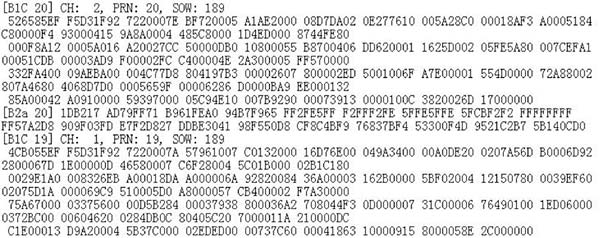
    ComNav Technology has tracked and decoded the latest format BD-3 satellite signals: B1C and B2a from satellites Beidou-19 and Beidou-20.

    The following figure shows the BD-3 No. 20 signal tracked with the SinoGNSS K708 GNSS OEM board.

    Chart: ComNav
    Chart: ComNav

    According to ComNav, with its strong R&D capability in high-precision GNSS, ComNav Technology plans to grow with the third-generation BeiDou navigation system to bring better positioning services all the time.

  • With Unicore, BeiDou navigates its way to global CES stage

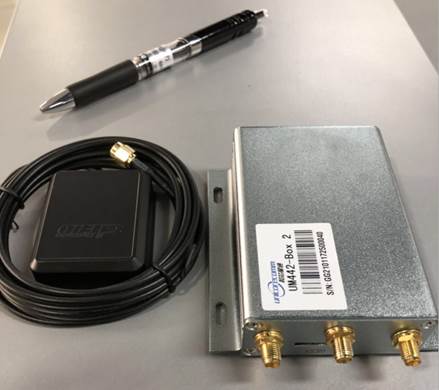
    UM442 Module.

    With the successful launch of newest BeiDou-3 navigation satellites, Beidou’s pace of globalization is quickening. As a provider of China’s domestic GNSS core products, Unicore Communications brought its full range of products to the Consumer Electronics Show (CES), which took place Jan. 9-12 in Las Vegas.

    Unicore’s exhibits are targeting intelligent drive and the internet of things (IoT).

    UM442 Evaluation Kit: UM442-BOX2 evaluation box, navigation antenna x2

    For intelligent drive, Unicore is showcasing its UM482 high-precision GNSS module, which is designed for high-end L3 self-driving and robots.

    Unicore also is introducing a cost-effective low-power GNSS module — UM442 — which is suitable for L2 ADAS applications and community-based GNSS navigation and maps.

    UM442 is a cost-efficient high-precision real-time kinematic (RTK) and heading module that can simultaneously track GPS, BDS, GLONASS and Galileo. It also supports SBAS and QZSS.

    Based on high-performance data-sharing technology and the simplified operation system of the Nebulas II chip, the UGypsophila RTK algorithm dramatically optimizes matrix processing. Therefore, the UM442 can track many more satellites and shorten the initialization time to 5 seconds.

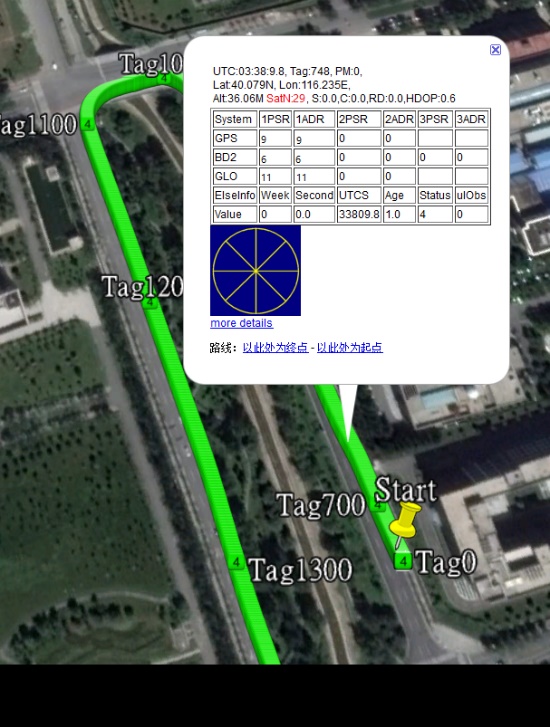
    Satellite view during a UM442 road test using the UGypsophila RTK algorithm. UM442 achieves centimeter-level RTK positioning using a low-cost ceramic antenna.

    With on-board MEMS and the U-Fusion integrated navigation algorithm, UM442 can achieve accurate and reliable positioning even in the most challenging environments such as urban canyons and tunnels.

    UM442 also provides attitude information such as rolling angle and pitching angle, which is suitable for many new applications such as community-based navigation maps and ADAS. Even with a low-cost ceramic antenna, the UM442 can achieve centimeter-level RTK positioning, as well as a 0.2-degree/1-meter baseline heading accuracy.

    At CES, Unicore plans to introduce BeiDou products into the large volume market of consumer electronics. Ufirebird is an ultra-small, ultra-low-power multi-GNSS positioning system-on-chip (SoC), using 28-nm technology. The chip supports BDS, GPS, GLONASS and Galileo signals, and the software can be extended to support WAAS/QZSS/EGNOS/MSAS/GANGAN enhanced signals.

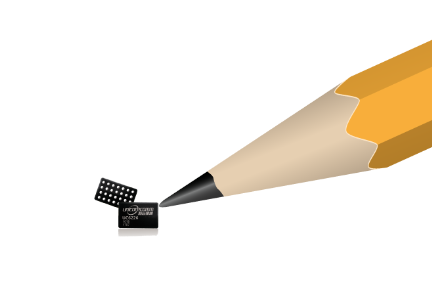
    Unicore’s UFirebird-UC6226 low-power GNSS SoC is designed for mobile devices.

    Two packaging methods are available: WLCSP and QFN40. For WLCSP packaging, the chip size is only 1.73 x 2.87 mm, and for QFN40 packaging, the chip is AEC-Q100 compliant, aimed for highly reliable automotive-grade applications.

    UC6226 is equipped with a built-in sensor hub capable of providing access for multiple sensors for fusion positioning. It supports Wi-Fi, Bluetooth, GNSS hybrid positioning, and better than 1-m differential positioning accuracy.

    Compared with Unicore’s previous generation GNSS SoC, UC6226 has reduced power consumption by 60%. The minimum tracking power consumption is lowered to 18 mW, significantly improving battery endurance.

    With a built-in anti-jamming module, LNA and -162dB sensitivity, UC6226 can maintain accurate and precise positioning under complex environments.

    UC6226 has been successfully applied by China’s bicycle sharing companies. In addition, the chip will be used in intelligent watches, smartphones, smart cameras and many other IoT devices requiring smaller size, lower power consumption.