Tag: BlueSky

  • Bluesky, Bird.i partner for online, instant aerial imagery

    Aerial mapping company Bluesky has signed a strategic partnership agreement with Bird.i to provide online, instantaneous visualization of its high-resolution aerial imagery.

    Bluesky has created and maintains a high-resolution, up-to-date and accurate archive of aerial images in the United Kingdom. Established in 2016, Bird.i has developed a platform for accessing satellite, airborne and UAV imagery with a plug-and-play API that works within mapping and location-based applications.

    “The partnership with Bluesky will allow businesses across multiple industry sectors to exploit location information more accurately and efficiently,” said Corentin Guillo, founder and CEO of Bird.i. “Our commitment is to serve the most accurate and recent images available, such as those on offer from Bluesky, to our clients for mass consumption of instantaneously accessible ‘image views’. Working in partnership with Bluesky, we will streamline the overall process of image consumption and open new markets”.

    “We are delighted to partner with Bird.i because we believe that instant visualization of our detailed and accurate aerial images offers great benefits to businesses,” said Rachel Tidmarsh, managing director of Bluesky. “We see in Bird.i an innovative way forward, simplifying online access and accelerating the visualization of our images for many applications that rely on evidence-based information.”

    The agreement between the two companies will give subscribers to Bird.i’s API the ability to integrate Bluesky’s high-quality aerial images within its existing mapping applications and location-based services.

  • Bluesky creates Microsoft UltraMap for aerial photomap production

    5-cm OrthoVista of RICOH Arena in Coventry.
    5-cm OrthoVista of RICOH Arena in Coventry.

    UK aerial mapping company Bluesky has reduced the time taken to process the terabytes of data captured by more than 75 percent, which will speed the production of aerial photography.

    Following a major research project, the team at Bluesky’s Leicestershire production facility has implemented an UltraMap system from Microsoft, which has allowed for the introduction of a continuous, uninterrupted processing workflow. By investing in an entirely new workflow, Bluesky has also improved the quality of the aerial images, reducing “building lean” and image distortion, and the accuracy of its digital height models.

    Bluesky’s investment in software follows the recent purchase of two UltraCam Eagle cameras, also from Microsoft, and the introduction of new flying practices.

    Bluesky has recently secured a number of high-profile contracts, including a multimillion pound contract for the supply of geographic data to Central Government organizations awarded by the Department for Environment, Food and Rural Affairs (DEFRA), and a four-year contract to supply the national mapping agency for Great Britain, Ordnance Survey.

    Earlier this year, Bluesky announced plans and commenced data capture for the first high-resolution aerial survey of the whole of the Republic of Ireland, and will also create digital surface models and terrain models.

    “2015 has been a phenomenal year in terms of data volumes to be processed,” said Bluesky’s Technical Director James Eddy. “We have introduced new flying methods, we have secured a number of large contracts and we are actively pursuing our own ambitious flying program. This has meant the volume of raw data to be processed is unprecedented.”

    Microsoft UltraMap is an end-to-end photogrammetric workflow system that provides highly automated processing capabilities, allowing Bluesky to rapidly generate quality data products from UltraCam cameras. The improved workflow is designed to process huge amounts of data in the shortest possible time with the highest degree of automation, supported by guided manual interaction, quality control tools and powerful visualization.

    “In order to process the many terabytes of data produced in a flying season — for example, we are looking at over a trillion DSM (digital surface model) points alone — the UltraMap system is just one component of a complex system,” continued Eddy. “We have also invested significantly in hardware, including an array of multi core processors, our network infrastructure, a robust backup system, internally produced software to increase and improve QA and improve productivity, and of course, perhaps most importantly, skilled and experienced staff.

    “We now believe we operate one of the most advanced aerial imaging processing facilities in the UK, if not the world and we have the capacity to handle our largest-ever projects.”

  • Survey lasers in on Iron-Age archaeology

    High-tech aerial laser surveying is being employed to reveal the hidden archaeology of an Iron-Age hill settlement in Lancashire, England.

    Visually, the archaeological features are difficult to see, but a Bluesky laser survey, commissioned by the Morecambe Bay Partnership, is expected to reveal previously undiscovered details of a settlement at Warton Crag. Identified as an important Heritage at Risk site, the site has already been subject to low-level archaeological investigations, which have identified remains from a small, well defended hill fort.

    “It is imperative that we get a better definition of the archaeological remains that are currently ‘hidden’ by the dense vegetation cover,” said Louise Martin, H2H cultural heritage officer at the Morecambe Bay Partnership. “This will enable us to develop conservation strategies for the site and work towards reducing the risk to the archaeological remains. The site is currently on Historic England’s ‘at risk’ register, so this work is crucial in developing partnerships and strategies to protect the monument for future generations.”

    The Bluesky lidar system uses lasers to accurately measure the earth’s terrain and record features on the ground in 3D. A dedicated survey plane is equipped with aerial photography equipment and will fly over the site during the winter months when the tree and canopy cover is at its minimum.

    Bluesky will process the millions of individual laser measurements to create detailed 3D computer models of the Earth’s relief — a Digital Terrain Model (DTM) — and ground surface including buildings and vegetation — a Digital Surface Model (DSM). This will allow the Morecambe Bay Partnership to model scenarios and strategies and share information with project partners.

  • Bluesky Completes Aerial Mapping Project for UK Utilities

    Bluesky Completes Aerial Mapping Project for UK Utilities

    Photo: Bluesky

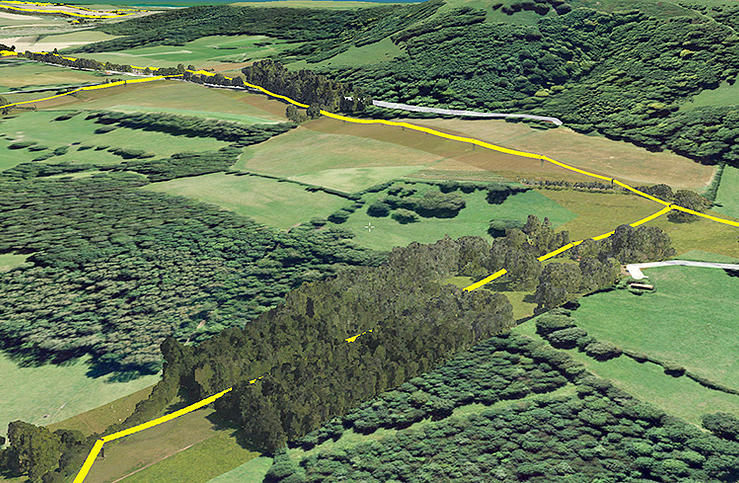
    Bluesky has completed a multi-million pound aerial mapping project to assess the impact of vegetation on the electricity network of East Anglia and the South East of England. Working on behalf of UK Power Networks, Bluesky undertook the largest ever combined laser mapping and aerial photography survey commissioned by an electricity distribution network operator in the UK — some 34,000 square kilometers.

    The laser mapped (LiDAR) data and aerial photographs were then analyzed to assess the proximity of vegetation to the overhead power lines in order to create a proactive three-year vegetation management program. Bluesky worked in partnership with ADAS, an agricultural and environmental consultancy, to complete the project.

    Dedicated survey planes equipped with a lidar mapping system and aerial survey equipment flew the whole of the South East and East of England. Capturing millions of individual laser mapped height measurements and approximately 310,000 aerial images in just over three months, Bluesky successfully completed the unprecedented data capture element of the project within tight project deadlines, in challenging weather conditions and in adherence with strict Air Traffic Control restrictions.

    The 80 terabytes of raw data was then processed and analyzed to identify which overhead line spans had vegetation infringement; for example the length of vegetation infestation along each span and its location and distance from the overhead line.

    This information has now been incorporated into a 3D web portal that can be viewed from the desktop, enabling UK Power Networks employees to carry out virtual patrols of the network, saving time and reducing the risk of foot patrols, sometimes across difficult terrain including physical barriers such as rivers, ditches, livestock and numerous other potential hazards.

    “This innovative £2.5 million project is of immense benefit to our customers and to the company,” said Nigel Hall, head of service development at UK Power Networks. “The risk-based tree-cutting program will help reduce tree-related power cuts for customers, with the additional benefit that it could be carried out without any disturbance to local landowners because it was done from the air rather than on foot.

    “As a company it will help us get best value from our £19 million annual tree cutting budget, and the web portal will mean staff can carry out ‘virtual patrols’ from their desk, saving them time and reducing the potential hazards if they had had to walk the lines themselves.”

    “Prior to commissioning the LiDAR and aerial mapping project, UK Power Networks undertook regular manual surveys as part of its assessment of network resilience, but the capture of LiDAR and associated aerial photography for the entire catchment area allows for evidence based decision making and long term planning, and provides a proven solution for other network operators,” added Rachel Tidmarsh, managing director of Bluesky.

    Roy Dyer, Head of Arboriculture in ADAS and manager of the ADAS contribution to this contract said, “This has been a ground breaking contract. The combination of Bluesky’s technical ability and ADAS’ consultancy experience in managing vegetation near overhead lines enabled us to successfully deliver this challenging contract and improve the management and resilience of the overhead lines owned by UK Power Networks.”

  • Air Pollution Monitoring Rocket Set for Second Launch Attempt

    air_pollution_rocket_blueskyScientists at the University of Leicester will make a second attempt to launch a rocket equipped with air pollution monitoring equipment on June 11 at the university’s Capesthorne Hall in Cheshire. The first launch attempt on Feb. 4 failed, according to airqualitynews.com.

    As part of a wider air pollution mapping project supported by Bluesky, an aerial survey company, a pollution monitoring system was developed by scientists at the University of Leicester to record how dangerous gases such as nitrogen dioxide dissipate with vertical distance from the earth. The micro sensors will be integrated with other technologies and launched into the atmosphere using Starchaser Industries‘ Tempest Research Rocket. The launch follows previous work mapping air pollution across entire cities from planes, cars and ground sensors.

    “We have already had great success mapping air pollution from an aerial survey plane giving us a better understanding of how dangerous gases, such as nitrogen dioxide, operate in the vertical plane,” says James Eddy, Bluesky’s technical director and industrial associate at the University of Leicester. “However, we hope this launch will take air pollution monitoring to another level.”

    The Tempest is a 14-foot-tall rocket that can reach speeds of up to 200 miles per hour and will hit an altitude of 3,000 feet on its flight before being safely recovered via parachute. In addition to the air pollution monitoring sensors, Tempest will also be carrying vital electronic systems that will be used aboard Starchaser’s future Space Tourism Rockets, an experimental GPS package with video cameras.

    “Air Quality continues to be a critical issue in our urbanising society, requiring us to explore novel solutions for monitoring, management and damage mitigation. We are grateful to Starchaser Industries for the opportunity to test our novel air quality monitoring techniques as part of this spectacular launch event,” says Dr. Roland Leigh, academic supervisor at the University of Leicester. “This project builds on work to date of Starchaser Industries, key academic expertise in instrument design and data manipulation, and once again benefits from a strong industrial partnership with Bluesky.”

    The latest phase of the Bluesky supported air pollution monitoring project will add to results already obtained from trials of the University of Leicester’s Compact Air Quality Spectrometer. Originally mounted on a dedicated aerial survey aircraft, the device monitors visible light and measures how much light is lost at specific wavelengths absorbed by nitrogen dioxide. The technology has previously been used as part the CityScan project with devices mounted on tall buildings in Leicester, Bologna and London during the Olympics to build 3D maps of pollution across the cities, according to the company.

  • Blue Sky Launches SkyRouter for Fleet Management Applications

    Blue Sky Network has launched the SkyRouter, a fleet management portal for land mobile, aviation, and marine applications. SkyRouter is a feature-rich, cloud-based solution designed to support connectivity with remotely dispersed mobile assets including Blue Sky Network’s advanced dual-mode GSM and iridium tracking and communications services, the company said.

    SkyRouter enables seamless connectivity with assets in problematic cellular reception areas, where only 10 percent of the Earth is covered, and in remote locations, Blue Sky Network said, adding that only Iridium-based communications devices and services work globally through connectivity via the world’s furthest reaching network.

    Today’s fleet managers require around-the-clock communication with widely distributed mobile assets. Overall safety and fleet efficiency can be achieved through alerts, monitoring of position data, and unique event reporting. New SkyRouter leverages the integration of Blue Sky Network’s HawkEye 5300, which enhances coverage of GSM cellular tracking capabilities with global coverage to deliver dual-mode tracking and event reporting of assets located anywhere in the world. Fleet managers can receive real-time updates that include GPS location information, messages, and on board diagnostic (OBDII) alerts, among others, everywhere.

    “Our next-generation New SkyRouter for land mobile fleet applications furthers our commitment to be a market leader in advanced tracking products for customers who demand customized solutions and exceptional customer service,” said Jon Gilbert, CEO and founder of Blue Sky Network. “This new platform, in concert with our superb products, means more mobile asset sectors can benefit from smooth integration of tracking hardware with a cloud-based portal for seamless command and control across multiple asset types and deployments.”

    SkyRouter works in combination with Blue Sky Network’s certified hardware, which can be installed on land, aviation, and marine assets. Features include over-the-air parameter settings, automated event reporting, local sensor data capture, and two-way messaging capability.

    “The new SkyRouter is an innovative solution from an important Iridium partner enabling fleet manager’s global visibility of their important assets though the cloud,” said Greg Ewert, executive vice president of global distribution channels at Iridium. “This level of visibility provides vital data delivery to fleet operators who are driving further efficiencies into their business, meeting regulatory requirements or protecting the safety of their personnel or assets.”