Tag: CAST Navigation

  • 2019 Simulator Buyers Guide

    2019 Simulator Buyers Guide

    GPS World’s 8th annual Simulator Buyers Guide features tools, devices and software from leading providers.


    CAST NAVIGATION JACKSON LABS TECHNOLOGY INC. OROLIA
    QASCOM RACELOGIC ROHDE & SCHWARZ
    SKYDEL SPIRENT FEDERAL SYSTEMS TALEN-X

    CAST NAVIGATION

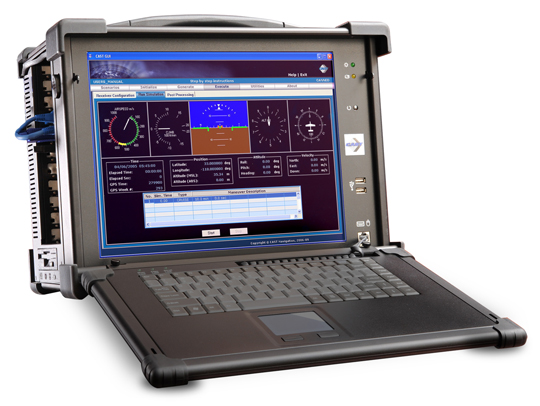
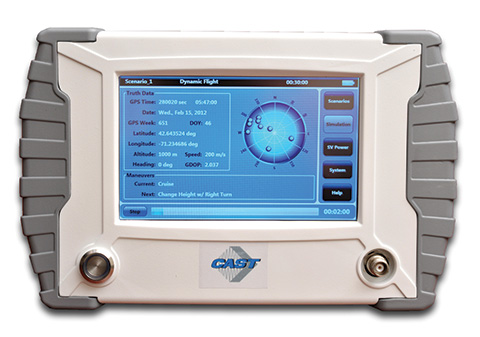
    CAST-5000 GPS wavefront generator
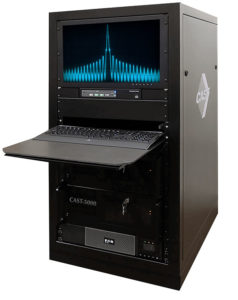
    Photo: CAST Navigation
    Photo: CAST Navigation

    The CAST-5000 produces a single coherent wavefront of GPS RF signals to provide repeatable testing in the laboratory environment or anechoic chamber. The basic system generates four independent, coherent simulations that reference a single point and is upgradeable to support seven elements for CRPA testing. With an intercard carrier- phase error of less than 1 millimeter, the CAST-5000 is extremely accurate.

    The system generates a wavefront of GPS when its GPS RF generator cards are operated in a ganged configuration. Each generator card provides a set of GPS satellites coherent with the overall configuration. Several RF generator cards may be utilized together, ensuring phase coherence among the bank of signal generator cards.

    The CAST-5000 Controlled Reception Pattern Antenna (CRPA) tester allows a full end-to-end test of the antenna system. The CRPA antenna, antenna electronics and the GPS receiver can be tested as a unit with or without radiating signals.

    The CAST-8000 is a new simulator that merges both the CAST-5000 CRPA tester with a CAST-3000 EGI tester.

    CAST-5000 Features

    • Generates single coherent wavefront of GPS
    • 6-DOF motion generation capability
    • Complete SV constellation editing
    • Post-mission processing via ICD-GPS-150/153
    • Differential/relative navigation
    • Antenna pattern modeling
    • Waypoint navigation
    • RAIM events
    • Multipath modeling
    • Spoofer simulation
    • Satellite clock errors
    • External trajectory input
    • External ephemeris and almanac
    • Several iono and tropo models
    • Modifiable navigation message
    • Modeled selective availability
    • Time-tagged satellite events
    • Selectable host vehicle parameters
    • Directional jamming

    www.castnav.com
    [email protected]
    (978) 858-0130

    [Back to top]

    JACKSON LABS TECHNOLOGY INC.

    Micro-Transcoder GPS Simulator/RF-Modulator
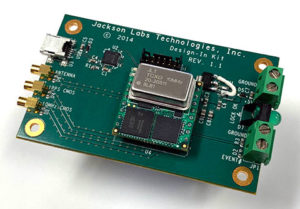
    Photo: Jackson Labs
    Photo: Jackson Labs

    The tiny 1-inch square Micro-Transcoder module allows glueless retrofitting of existing GPS equipment with secure and Assured-PNT (A-PNT) capability. It is the smallest, full-constellation, stand-alone, real-time 10-channel GPS simulator available from JLT. The unit is useful in upgrading existing legacy GPS receivers with external position, navigation and timing references such as INS, CSAC, SAASM, M-code, GNSS, eLoran or other alternative positioning and timing sources by simply replacing the legacy GPS antenna from an existing GPS system with the Micro-Transcoder RF output.

    The unit is based on the JLT CLAW GPS Simulator and RSR Transcoder technologies, and includes a general-purpose, stand-alone, full-constellation, 10-channel, real-time GPS simulator with integrated high-stability timing reference, as well as an internal GNSS receiver for monitoring the RF output signal for quality and accuracy. The unit will transmit a standard UTC time, position, velocity and heading GPS L1 C/A RF signal by simply applying 3.3V power to it.

    The Micro-Transcoder can also be operated as a generic GPS simulator with built-in GPS Disciplined Oscillator (GPSDO), and is supported by a free Windows application downloadable from the JLT website. The Windows application allows control of all the simulation aspects, creating and storing simulation vector commands and testing user equipment for leap-second and GPS week rollover event compatibility to identify weaknesses in user equipment. The unit does not require a connected PC to function. The Micro-Transcoder is also available mounted onto an evaluation board for easy evaluation. The unit transcodes baseband PNT NMEA signals into a GPS L1 RF signal with typically less than 100-ms latency. UTC 1PPS timing-transfer accuracy to the GPS RF output is typically better than 5 ns. The unit requires only 3.3V to operate, and setup, location and simulation vector file information can optionally be stored in its internal NV memory.

    [email protected]
    www.jackson-labs.com
    (702) 233-1334

    OROLIA

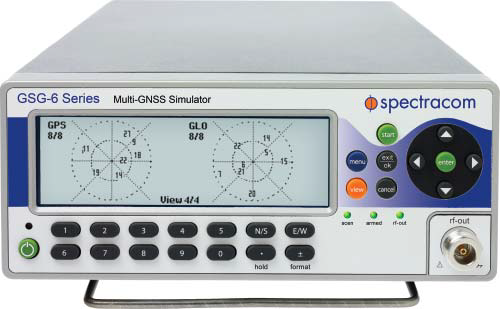
    GSG-5/6 Series

    All Constellations, All Frequencies
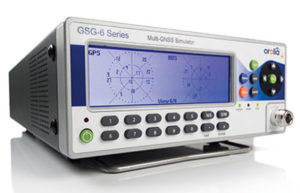
    Photo: Orolia
    Photo: Orolia

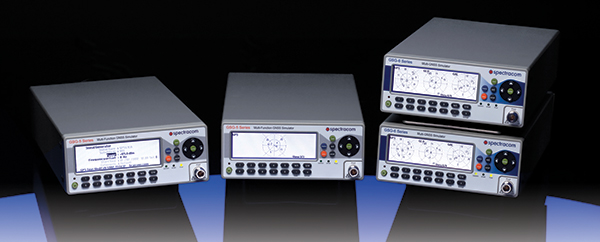
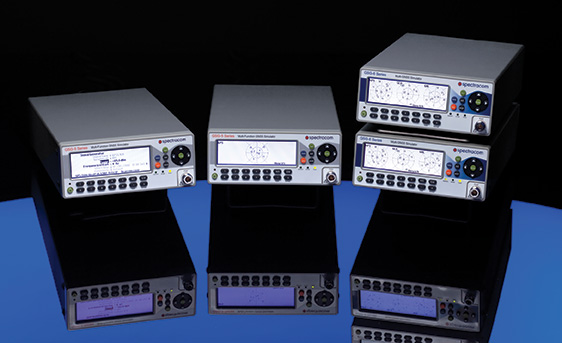
    For those responsible for mission-critical PNT applications, the Orolia GSG series of GPS/GNSS simulators is an important tool to evaluate risk for jamming, spoofing or any other threat. Orolia GSG-5/6 series simulators are easy to use, feature-rich and affordable, offering a way to harden GPS-based systems without the limitations of testing from “live sky” signals. The Orolia platform approach allows customers to buy only what they need today and upgrade later. The adaptability of the GNSS RF generation platform can extend to applications for intelligent repeating.

    Test Solutions

    • Position accuracy and dynamic range/sensitivity
    • Simulate movements/trajectories anywhere on or above Earth
    • Sensitivity to GPS impairments: loss of satellites, multipath, atmospheric conditions, interference, jamming and spoofing
    • Conducted or over-the-air RF
    • GPS time-transfer accuracy
    • Effect of leap-second transition
    • Multi-constellation testing
    • Modernization signals/frequencies
    • Keyless military SAASM, dual-frequency and survey-grade receiver testing
    • Application packages for real-time kinematic (RTK), controlled radiation pattern antennas (CRPA)
    • Hardware-in-the-loop (HIL) integration
    • Test solutions for eCall and ERA-GLONASS

    Infrastructure possibilities include zone-based indoor location (intelligent repeating) and pseudolite applications.

    GSG-6 Series 64-channel multi-frequency, advanced GNSS simulator is powerful enough for any cutting-edge test program. GPS, GLONASS, Galileo, Beidou, QZSS and NAVIC (IRNSS) signals are available across multiple frequencies. The GSG-6 is designed for military, research and professional applications.

    GSG-5 Series 16-channel multi-constellation L1-band GNSS simulator is designed for commercial development/integration programs. It is for developing commercial products with GNSS capability, and will shorten test programs with confidence.

    GSG-51 single-channel signal generator is designed for one purpose — fast, simple go/no-go manufacturing test and validation, ensuring the manufacturing line is operating at full capacity with confidence in quality.

    www.orolia.com
    [email protected]
    +1-585-321-5800

    [Back to top]

    QASCOM

    QA707 GNSS and Interference Software Simulator
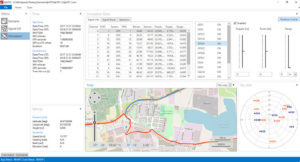
    Photo: Qascom
    Photo: Qascom

    Specifically designed for testing GNSS interferences and cyber-attacks. QA707 has been designed to test robustness against emerging cyber-threats beyond jamming and spoofing. It allows the creation of scenarios with signal and code jamming, data-level cyber-attacks, denial of service threats, low-level spoofing channels control, and trajectory-controlled spoofing.

    Optimal for signal modernization design. Being a flexible software defined radio (SDR) solution, QA707 is also suitable for testing of signal modernization and for the simulation of new signal components. An open API is provided to create specific signals simulation. Particularly, the tool is ready to support the upcoming Galileo Open Service Authentication (OSNMA).

    Runs on a standard PC or laptop with USRP or other hardware. QA707 is compatible with several third-party hardware RF up-converters, including National Instruments’ USRP. It also can support customer’s specific hardware through the hardware API interface. Qascom introduces the new frontier of GNSS security testing. QA707 is supported from back office with custom services as well as jamming and spoofing mitigation solutions for receivers and applications. This covers 100% of customer GNSS security needs.

    QA707 Main Features

    • Multi-constellation (GPS L1, Galileo E1, SBAS L1)
    • Galileo OSNMA ready
    • RF simulation, binary file dump, signal record and replay
    • Support to SDR platforms and open API for custom RF upconverters
    • Runtime scenario data UDP stream: motion, channel data, simulated inertial sensor
    • Data-level cyber attacks
    • Low-level spoofing signals control, trajectory spoofing, signal replay attacks
    • Narrowband, wideband, frequency modulated jamming
    • Integrity threats: evil waveform, erroneous ephemerides, code/carrier divergence, low satellite signal power, excessive range acceleration
    • Built-in editing tools: RF output calibration, RINEX editor, trajectory editor

    www.qascom.it
    [email protected]

    [Back to top]

    RACELOGIC

    LabSat 3 Wideband and Satgen Software

    LabSat 3 Wideband
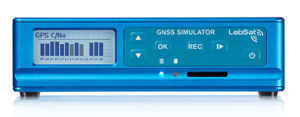
    Photo: Racelogic
    Photo: Racelogic

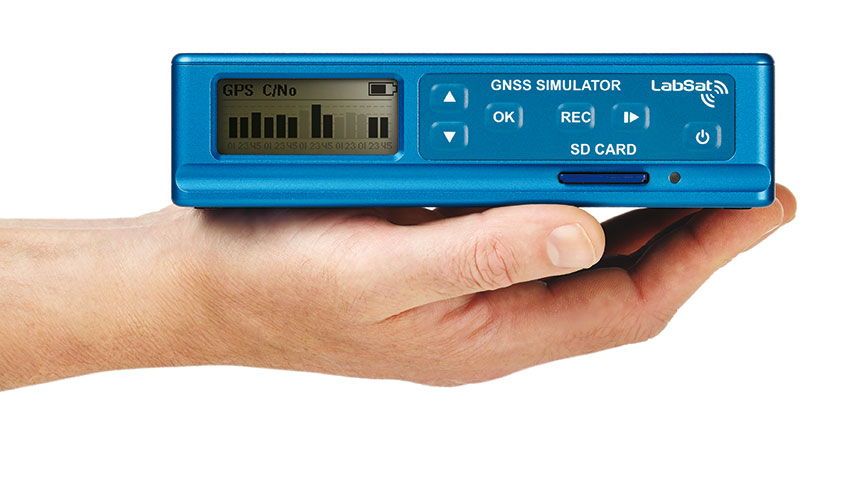
    The LabSat 3 Wideband is easy to use, cost-effective and produces extremely low noise, accurate and repeatable signals. Users can record and replay up to three different channels at 56 MHz with a bit depth of up to 3 bits I and 3 bits Q.

    The following signals can be recorded and replayed:

    • GPS: L1 / L2 / L5
    • GLONASS: L1 / L2 / L3
    • BeiDou: B1 / B2 / B3
    • QZSS: L1 / L2 / L5
    • Galileo: E1 / E1a / E5a / E5b / E6
    • IRNSS: L5
    • SBAS: WAAS, EGNOS, GAGAN, MSAS, SDCM
    • L-band GNSS correction services: Terrastar, Veripos, OmniSTAR, StarFire
    • 2X CAN, RS232, and digital inputs recorded and replayed tightly synchronized with GNSS data

    Small, battery or mains powered and with a removable SSD (up to 4 Tb), LabSat 3 Wideband allows detailed, real-world satellite data to be recorded then replayed on the bench. The rugged enclosure measures a compact 167 x 128 x 46 millimeters and weighs 1.2 kilograms, meaning it can be placed in a backpack and used to reliably record real-world signals in almost any situation.

    SatGen Signal Simulation Software

    If a user wants to simulate the signals from scratch, Racelogic’s latest SatGen signal simulation software can produce synthesized scenarios containing the full complement of popular GNSS signals: GPS L1, L2C, L5, GLONASS L1, L2, Galileo E1, E5, E6 and BeiDou B1, B2.

    SatGen software allows users to quickly create accurate scenarios with their own time, place and trajectory, with any combination of constellation and signal that is currently available or will become available in the near future.

    Mark Sampson, LabSat Product Manager
    [email protected]
    www.labsat.co.uk

    ROHDE & SCHWARZ

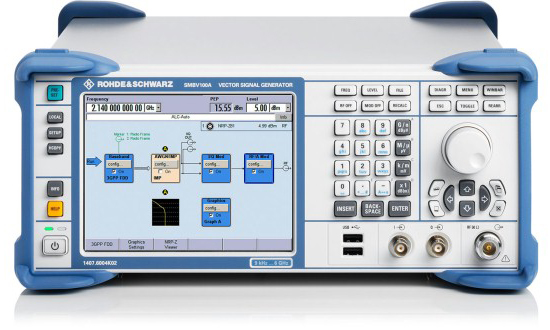
    R&S SMW200A and R&S SMBV100B simulators
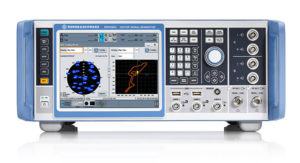
    Photo: Rohde & Schwarz
    Photo: Rohde & Schwarz

    Precision-sensitive applications such as autonomous driving, control of unmanned aerial vehicles (UAV), or positioning of aircrafts during landing procedures in coordination with ground-based augmentation systems (GBAS) require that modern GNSS receivers undergo detailed tests before implementation.

    Designed to generate highly realistic test scenarios, Rohde & Schwarz signal generators like the R&S SMW200A and the R&S SMBV100B offer a unique approach to generating complex and highly realistic scenarios for testing of GNSS receivers that are able to work with diverse navigational systems such as GPS, GLONASS, Galileo, BeiDou and QZSS/SBAS signals. The R&S SMW200A and the R&S SMBV100B can emulate them all for testing.

    R&S SMW200A

    The R&S SMW200A GNSS simulator (pictured above) can be used to produce complex interference scenarios with multiple interferers — all generated within the instrument itself. It can emulate up to 144 GNSS channels and can be equipped with up to four RF outputs. With its ability to simulate multi-constellation, multi-frequency, multi-antenna and multi-vehicle scenarios, the R&S SMW200A is able to cover a variety of high-end GNSS applications.

    R&S SMBV100B

    The R&S SMBV100B supports the same navigational systems, with access to 24 GNSS channels and one RF output, with the same ability to configure realistic scenarios including obscuration, multipath and atmospheric effects, as well as the specific characteristics of the antenna and the simulated vehicle. An integrated noise and CW interference generator can also be added.

    Since the devices do not require an external PC for scenario configuration, all the tests can be created quickly through the user-friendly GUI. Due to all-encompassing instrument options available, both simulators can be set up to fit unique user requirements.

    For testing GNSS receivers under controlled and repeatable conditions, the R&S SMW200A and the R&S SMBV100B provide extensive and cost-effective solutions. The platforms are ready to adapt to future requirements and testing of newly implemented GNSS signals.

    www.rohde-schwarz.com
    [email protected]
    +49 89 4129 12345

    [Back to top]

    SKYDEL

    Photo: Skydel
    Photo: Skydel

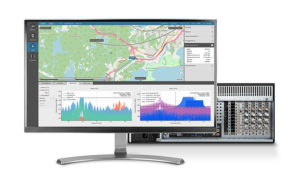
    SDX is a proven and advanced GNSS simulator based on GPU-accelerated computing and software-defined radio (SDR).

    It is available as a complete turnkey system suitable for all GNSS simulation needs, including everything from compact test benches to complete CRPA test systems, such as SDX wavefront and SDX anechoic. Moreover, its software-defined roots enable the selection of cost-effective hardware into configurations that can be repurposed for different projects.

    The architecture behind SDX provides real-time simulation of uncompromising accuracy. It features advanced signal customization and supports configurable outputs. IQ data can be generated in, or imported back into, the simulator as well. The API is embedded in the simulator core, enabling deep automation with a few simple clicks, as well as complex scripts developed with popular programming languages.

    SDX simulates multiple constellations on multiple frequencies (GPS, Galileo, GLONASS, BeiDou and SBAS) on a large number of channels. Encrypted codes are supported for GPS and Galileo.

    The Advanced Jammer module in SDX gives users complete control over interference creation. It is integrated directly into simulation scenarios to enable dynamic jammers (up to 120dB J/S) to interact with GNSS signals.

    SDX also allows users to create advanced scenarios suitable for any type of vehicle: antenna patterns (receiver and GNSS SV), LEO/GEO/HEO orbits, multipath, hardware-in-the-loop (HIL), additive pseudorange errors, message modification and corruption, raw logging and more.

    It is suitable for the design and validation of GNSS receivers, complex integration, academic research, NAVWAR and test engineering.

    SDX is developed and actively supported by Skydel’s engineering teams and worldwide distributors. Skydel offers direct support to clients to ensure prompt deployment and integration, or to review advanced customization requirements.

    www.skydelsolutions.com
    [email protected]
    1-438-239-7924

    [Back to top]

    SPIRENT FEDERAL SYSTEMS

    GSS9000, SIMMNSA, CRPA Test System, anechoic chamber testing, mid-range testing
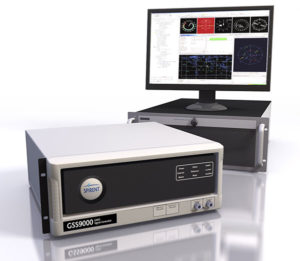
    Photo: Spirent
    Photo: Spirent

    Spirent Federal provides GPS/GNSS test equipment that covers all applications, including research and development, integration/verification, and production testing.

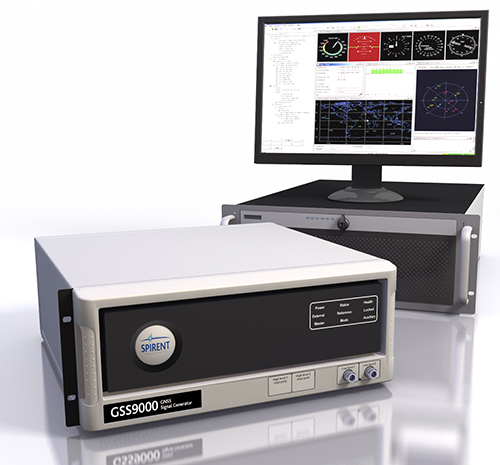
    GSS9000. The Spirent GSS9000 Multi-Frequency, Multi-GNSS RF Constellation Simulator is Spirent’s most comprehensive simulation solution. It can simulate signals from all GNSS and regional navigation systems and has a system iteration rate (SIR) of 1000 Hz (1 ms), enabling higher dynamic simulations with more accuracy and fidelity. The GSS9000 supports restricted/classified signals. Users can evaluate the resilience of navigation systems to interference and spoofing attacks, and have the flexibility to reconfigure constellations, channels, and frequencies between test runs or test cases.

    SimMNSA. SimMNSA allows authorized users to simulate true M-code for the first time ever. SimMNSA has been successfully delivered to users of the GSS9000 series simulator. SimMNSA has been granted Security Approval by the Global Positioning System Directorate.

    CRPA Test System. Spirent’s Controlled Reception Pattern Antenna (CRPA) Test System generates both GNSS and interference signals. Users can control multiple antenna elements. Null-steering and space/time adaptive CRPA testing are both supported by this comprehensive approach.

    Anechoic Chamber Testing. Spirent’s GSS9790 Multi-Output, Multi-GNSS RF Constellation Wave-Front Simulator System is a development of the GSS9000. The GSS9790 is a unique solution providing the core element for GNSS applications that require a test system that can be used in both conducted (lab) and radiated (chamber) conditions.

    Mid-Range Solutions. Spirent also offers solutions that cater to intermediate GPS/GNSS testing needs. The GSS7000 multi-constellation simulator provides an easy-to-use solution for GNSS testing that can grow with users’ requirements. The GSS6450 RF record & playback system enables replay of a real-world GNSS/GPS test repeatedly in the lab.

    Jeff Martin, [email protected]
    Kalani Needham, [email protected]
    Tyson Gurney, [email protected]

    www.spirentfederal.com
    (801) 785-1448
    [email protected]

    [Back to top]

    TALEN-X

    BroadSim

    Photo: Talen-X
    Photo: Talen-X

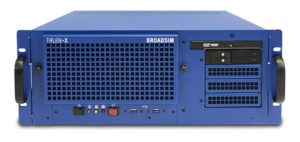
    A scalable software-defined simulation platform powered by Skydel’s SDX, capable of generating high-fidelity GNSS and jamming signals simultaneously across multiple constellations and vehicles. Simultaneously simulate every signal below:

    • GPS Open Codes: L1 C/A, L1C, L1P, L2P, L2C, L5
    • GPS Encrypted Codes: L1/L2 P(Y)-Code, L1/L2 AES M-code, L1/L2 MNSA (Coming soon)
    • GLONASS: G1, G2
    • Galileo: E1, E5a, E5b
    • BeiDou: B1, B2
    • SBAS: L1, L5
    • Jamming

    BroadSim’s software-defined platform includes intuitive user control and APIs; fast development cycles; flexible licensing and upgradability; and no additional hardware needed to maintain.

    Forms

    Original (4U)

    • Rack-mounted 4U simulator used for lab or field testing
    • 4 RF outputs (unlimited jamming signals generated on 1)
    • 1000-Hz simulation iteration rate
    • High-performance processor, GPUs and memory

    Anechoic

    • Simulation system used for anechoic chamber testing
    • 32 RF outputs and 16 dual-frequency antennas
    • Automatic antenna mapping
    • Automatic time delay and power loss calibration

    Wavefront

    • Phase coherent simulation system
    • Real-time automated phase calibration
    • Scalable from 4 to 16 elements
    • Supports CRPA and multi-element receiver testing
    • Supports jamming and spoofing

    Panacea

    An automated PNT performance and vulnerability test suite that supports up to 32 UUTs (units under test) in real time, from test plan creation to post-test evaluation.

    • Time synchronization to live sky
    • Compatible with 100+ different GNSS receiver brands
    • Create dynamic scenarios with parameters such as jamming patterns, motions, power loss, delays and more.
    • Manages receiver communication and standardizes data output for easy analysis, visualization and reporting

    www.talen-x.com
    [email protected]

  • CAST releases GPS wavefront generator

    CAST releases GPS wavefront generator

    CRPA and Attitude Determination Receiver Testing

    The CAST-5000 by CAST Navigation produces a single coherent wavefront of GPS RF signals to provide repeatable testing in the laboratory environment or anechoic chamber. The system generates up to seven independent, coherent simulations that reference a single point. With an intercard carrier-phase error of less than one centimeter, the CAST-5000 is extremely accurate, the company said.

    The system generates a wavefront of GPS when its GPS RF generator cards are operated in a ganged configuration. Each generator card provides a set of GPS satellites coherent with the overall configuration. Several RF generator cards may be utilized together, ensuring phase coherence among the bank of signal generator cards.

    The CAST-5000 is the only Controlled Reception Pattern Antenna (CRPA) tester that allows a full end-to-end test of the antenna system. The CRPA antenna, antenna electronics and the GPS receiver can be tested as a unit with or without radiating signals.

    CAST-5000 Features

    • Generates single coherent wavefront of GPS
    • 6 degrees of freedom (DOF) motion generation capability
    • Complete SV constellation editing
    • Post-mission processing via ICD-GPS-150/153
    • Differential/relative navigation
    • Antenna pattern modeling
    • Waypoint navigation
    • RAIM events
    • Multipath modeling
    • Spoofer simulation
    • Satellite clock errors
    • External trajectory input
    • External ephemeris and almanac
    • Several iono and tropo models
    • Modifiable navigation messag
    • Modeled selective availability
    • Time-tagged satellite events
    • Selectable host vehicle parameters
  • How to test: Simulator Q&A with the experts

    “Prepare for Tomorrow: Find Vulnerabilities Today” was the title of our wide-ranging webinar in July that focused on GNSS signal simulation for jamming and spoofing scenarios. We did not have time to address all the questions posed by the audience, so we return to them here.

    Q: While testing receivers, realistic scenarios for jamming and spoofing are very important. What is the typical approach to set the number of interference sources, their type and main signal parameters?

    A: From Spirent Federal Systems:

    Two different approaches are common, those involving the use of an anechoic chamber and those which are lab-based. Each approach has its limitations and merits. Each approach must address the number of significant interferers, their signal powers and the waveforms of the interference signals. Each must also consider the geometric arrangement of these interferers relative to the antenna under test and relative to the simulated constellations under test.

    Changes in signal phase, signal Doppler and signal power are as important for the interference signals as they for the wanted GNSS signals. These changes are caused by the simulated motion of the vehicle and potentially the motion of the interferers. These changes should also include the impact of terrain surrounding the vehicle and the interferers, and also the gain and phase patterns of the receive antenna on the vehicle and the transmit antennas on the interferers. Some interferers might be discounted from the significant set due to their signals being masked from the vehicle by the terrain or antenna patterns or by them being too far from the vehicle to have an impact. These interference signals may become significant as the scenario progresses due to vehicle or interferer motion.

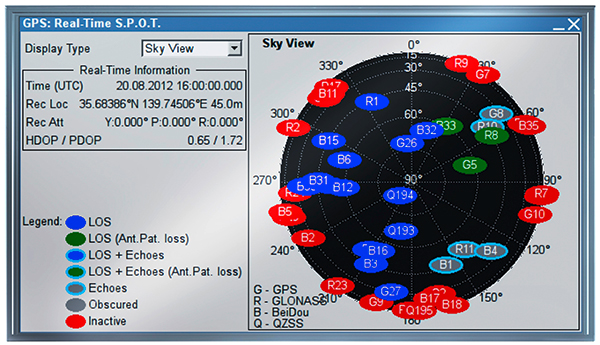
    Simulator graphical user interface. (Image: Spirent Federal Systems)

    Q: In GNSS navigation systems for commercial applications, what emphasis of design effort should be on anti-jamming/anti-spoofing over improving the navigation accuracy?

    A: From Spectracom, an Orolia brand:

    Commercial applications is a broad area, so it will depend on the particular application as to whether it needs more accuracy or more resiliency against AJ/AS, but in general, the accuracy of GNSS is fairly mature. Standard GNSS offers accuracies on the order of ~1 meter. Centimeter accuracy can be achieved with differential or real-time kinematic (RTK). Multi-constellation use can increase availability in areas with limited sky view such as urban canyons. Multi-frequency can aid in the reduction of multipath and improve accuracy. If the application needs accuracy, these features are readily available.

    However, integrity and resiliency are growing needs in commercial applications, especially ones that are in critical operations. Much more can be done to detect jamming and spoofing than what is in standards GNSS receivers today. In our systems, we include an additional software layer called BroadShield, which monitors internal state variables of the receiver, and will alarm on detection. Additional sensors combined with the GNSS receiver such as an inertial measurement unit (IMU), magnetometer, odometer, or even the much stronger Satellite Time and Location (STL) signal offer augmentation during periods of GNSS denial, or in the case of spoofing, authentication of the navigation solution.

    A: From Syntony:

    While both jamming and spoofing are intentional attacks, they are highly different in their set-up and serve very different purposes. Due to their simplicity, most jamming attacks can be mitigated thanks to adaptive filtering or pulse blanking. On the other hand, spoofing is a malicious attack, highly complicated, and requires knowledge of the GNSS signal structure as well as precise timing and positioning.

    The question is thus whether one should emphasize navigation accuracy over the ability to output a position (jamming case) or the possibility to output a completely erroneous position (spoofing case). The answer lies, obviously, in the end application and the coupling of GNSS receivers with other systems. High-precision non-life-critical applications should emphasize navigation accuracy while implementing simple jammer filtering strategies. Life-critical applications, being often coupled with other systems, should ensure the reliability of the solution even if that means being unable to compute a position due potential threats.

    Q: Do you have GPS/inertial navigation system (INS) test capabilities?

    A: From CAST Navigation:

    The CAST-3000 EGI integration system produces GPS RF signals commensurate with simulated IMU sensor data to provide repeatable testing in the integration laboratory for a wide range of military and government applications.

    CAST GNSS/INS simulators generate high-fidelity signals required for emulating the legacy GPS signals as well as those used by next-generation navigation technologies. This is because our sole business focus is supplying GNSS simulators, GNSS/INS test equipment, and GNSS/INS support services to government and military avionics laboratories, prime contractors, and GNSS receiver manufacturers. For 35 years we have provided off-the-shelf products to both the government and U.S. major defense contractors.

    CAST EGI integration tools are used by Northrop Grumman and Honeywell and are now also being used in integration laboratories worldwide. Our equipment supports system integration in major weapons platform labs and development at major military contractor labs. CAST simulators produce high-quality, accurate signals that are used in government, military and commercial labs around the globe.

    A: From IFEN:

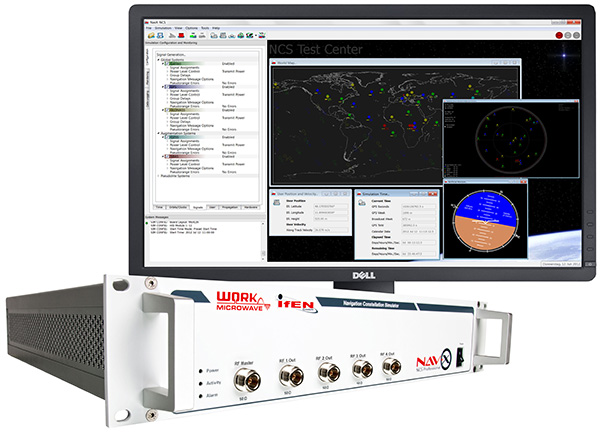
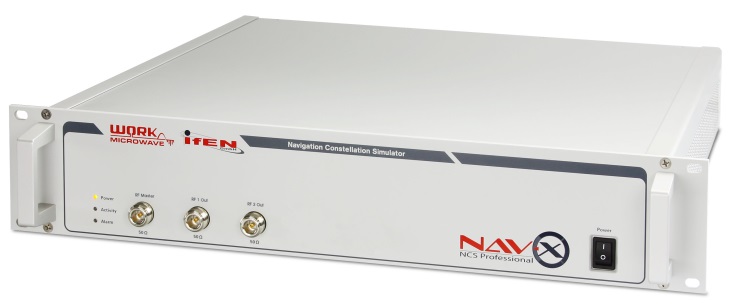
    Our NCS TITAN GNSS simulator is able to emulate the presence of IMUs and micro electro-mechanical systems (MEMS) sensors with the optional available real-time IMU/Sensor Emulation Package (SEP). The SEP upgrades the TITAN to support the simulation of inertial sensors, which nowadays are implemented as MEMS, among others, and of other common aiding sensors. To obtain more accurate positioning for location-based services and navigation, GNSS chipset and receiver manufacturers as well as system integrators combine more and more GNSS navigation with such sensor fusion or signals of opportunity.

    The optional SEP enables controlled and progressive testing of sensor-fusion algorithms when used with NCS Control Center operating software. This software supplies the SEP with an internally- or externally-generated center-of-gravity (CoG) trajectory for the device under test.

    The various sensor models to be emulated by the SEP run within the Control Center software. The device under test (vehicle) input trajectory at the CoG passes through the sensor model, which in turn generates the appropriate sensor output, by taking into account the corresponding error model for each sensor defined.

    A: From Syntony:

    We have added the capability to emulate INS/IMU data in addition to GNSS signals to our Constellator simulator, to offer to the customers a complete testing platform. Constellator can simulate up to six gyrometers and six accelerometers. The attitude of each sensor is defined with respect to the vehicle axes. Deterministic errors can be configured to simulate the axis misalignment and scale factors, and biases can be defined in order to simulate realistic sensors. Stochastic error models are also available such as random walk or Gauss-Markov models for each sensor (gyrometer or accelerometer) to improve the sensor emulation fidelity.

    Q: Do you have detailed scenarios for jamming and spoofing in timing use of GNSS receivers, that is, involving time synchronization for telecommunications companies?

    A: From Skydel:

    The simulated jammer’s signal specification must be very flexible in order to faithfully simulate real-world jamming events. For example, the jammer’s spectral shape should be flexible enough to simulate a Blue Force electronic attack (BFEA) on a GNSS receiver.

    Also, the simulator should be able to simulate dynamic scenarios by varying the power of the jammers as a function of their trajectories and as a function of different antenna patterns.

    Sometimes when testing receivers, the simulated jammers should replicate pre-recorded waveforms from real world. The ability to play back the pre-recorded IQ-baseband signal in conjunction with GNSS signals is another powerful feature of a simulator. Simulation of spoofing attacks on a GNSS timing receiver is only possible when the GNSS simulator provides fine-grained control of transmitted signal. This includes controlling the offsets on the pseudoranges with additive ramps, as well as individual signal power levels at very precise points in time.

    Also, the GNSS simulator must be able to synchronize itself with the live sky’s GNSS signal. Another way to achieve realistic spoofing is to use two simulators controlled independently (that is, full control on constellation, navigation message, propagation time offset, power and so on).

    FIGURE 1. Real-world jamming simulation must take into account key factors such as varying jammer power, as a function of their trajectories and antenna patterns. (Image: Skydel)

    Q: Please discuss how to simulate a smart spoofer that would generate a replica of a constellation (or all constellations) and then produces two full RF transissions: one that is the true signal, and a strong spoofed signal that pulls the receiver to a false location. Can you simulate the two full multi-band RF ensemble?

    A: From Racelogic:

    Two artificial synchronized scenarios could be created using SatGen signal generator software that can reproduce the GNSS signals from a number of constellations. The user could create two separate signal streams, both starting at exactly the same position and time and using the same constellations, chosen by the user.

    The second scenario could then be set to diverge away in position from the first scenario, while staying perfectly synchronized in time. The signal-to-noise ratio of each scenario could be adjusted independently of each other to simulate a spoofing situation where the spoofing signal is much stronger than the real signal. A file containing this twin scenario can be replayed using a LabSat Wideband with two separate RF outputs, each synchronously replaying the two different scenarios. This would closely simulate the actions of a smart spoofer, but in a completely repeatable, and controllable manner.

    A: From Jackson Labs:

    This could be accomplished by either combining the output of two of our CLAW GPS simulators, or by combining the output of a single CLAW simulator with live-sky signals using passive industry-standard splitters/combiners. The CLAW is able to receive a custom ephemeris download in RINEX format to match either the spoofed live-sky constellation, or to generate a synthesized constellation in the case where two CLAW simulators are being used.

    The simulator has a wide RF power adjustment range of over 45-dB, allowing the spoofing signal to be gradually introduced to the primary GPS constellation RF signal. This spoofing simulation could be accomplished with better than 0.5 meter peak-to-peak positioning accuracy and better than 5-ns real-mean-squared (rms) typical UTC (GPS) offset unit-to-unit, allowing the victim receiver to be pulled off of its true (live-sky) position with very high accuracy. Typically, GPS receivers are spoofed easily as long as the UTC timing synchronization is 500-ns or better between the live-sky and spoofed signals.

    Timing synchronization to the spoofed victim GPS signal to within nanoseconds is achievable through the external 1PPS reference input, the simulator accepting a position, navigation and timing (PNT) fix in real time via its NMEA serial and 1PPS inputs. This allows capturing a moving victim receiver by estimating its momentary position, then ramping up the spoofer power, and then presenting the victim receiver with alternate position information as required (see Figures 2 and 3).

    High position and timing accuracy between the spoofed and live-sky signal is important to prevent and mitigate spoofing detection via UTC phase or position jumps that could happen when the receiver gradually or quickly switches over to the spoofed satellite signals.

    FIGURE 2. Spoofing attack on a GPS receiver using a CLAW simulator to spoof a live-sky antenna signal. Initially the spoofer was phase- and frequency-synchronized to UTC(GPS), then spoofer RF power is ramped up, and once the victim GPS receiver is captured, a frequency offset is added to UTC(Spoofer), which pulls the system off-phase. (Figure: Jackson Labs)
    FIGURE 3. Simulating a spoofing attack on a timing application where the spoofer does not know the exact victim antenna location with certainty. The resulting antenna position offset error (50 meters in this simulation) still allows the victim receiver to be captured, and then causes a time error as satellites move in and out of view even with the spoofer being synchronized to UTC(GPS) at all times. This error is clearly visible in the resulting UTC(Spoofer) output from the victim receiver equipment. (Figure: Jackson Labs)

    Q: We want to correctly model and simulate effectiveness of various anti-jamming (AJ) and anti-spoofing (AS) solutions to make informed decisions about which AJ/AS solution is most effective for a specific mission and interference scenario. How can you help?

    A: From Spirent Federal Systems:

    Live-sky testing on a jamming/spoofing range provides a wealth of data, and reassurance that the system under test does work as intended. Record and playback systems (RPS) under live-sky conditions can allow further evaluation back in the lab, after the live-sky tests are complete. Performance parameters of the RPS may degrade the validity of the signal when played back; signal bandwidth and bit-depth are absolutely key, for example. Recordings that use too few bits will degrade the dynamic range of the recorded signals, so significant care should be taken when selecting an RPS.

    Either way, under live-sky or with recorded live-sky, you get what you get. It is extremely difficult to predict what the test parameters actually are. It is perilous to attempt to alter the test parameters after the event. Lab-based or anechoic chamber-based systems have their limitations, but they are repeatable, predictable and tweakable. Again, performance parameters of the simulation system play a key role in the validity of the testing. The ability to calibrate the simulation system to give a repeatable, predictable performance is as important as the realism of the simulation. Carrier-phase accuracy/repeatability among antenna elements and signal timing accuracy are important parameters when evaluating AJ and AS systems.

    Q: We had a receiver where the time stamp for any location report would drift off progressively, up to an hour off of the known true location. What might contribute to this? We do not believe this was an intentional threat, but an artifact of nearby electronics or other system conditions. It actually occurred on a pivot irrigation arm in motion, with substantial vibration. The receiver was electrically isolated. The results were repeatable on the pivot arm, but not on our vibration table.

    A: From Spectracom, an Orolia brand:

    Interesting problem with no obvious answer. Even the worst oscillator will take many months to drift off by up to an hour with no GNSS, even under horrible vibration conditions, so this is an unlikely cause. Is it drift or a jump in error? Nearby electrical noise could cause GNSS denial (jamming), but not erroneous data. That requires spoofing. If you have no reason to believe that it is intentional, that makes spoofing unlikely, but still possible. Is a GNSS repeater or a record/playback GNSS tester operating in the area? These are spoofers, even if they are unintentional.

    If this is a precision agriculture application, then an RTK reference station transmitting erroneous data could be the cause. What time-stamping format is used: local time or UTC? An unlikely but possible scenario is the unit is changing time zones so local time jumps an hour. Is there a processor/software app between your output and the actual GNSS receiver? This could introduce errors. What is the position output indicated when the time drift occurs? The best way to diagnose this is to record the time and position output as log files using a laptop PC connected to the serial data.

    Q: Do your simulators work as well for testing handheld, consumer-grade GPS? Please discuss the differences in testing techniques or approaches for high-precision vs. mass-market receivers?

    A: From Racelogic:

    We have a range of simulators suitable for all levels of GNSS testing. If you don’t need the high fidelity and wide bandwidth of the LabSat Wideband, then the entry level LabSat 3 will also work with any GNSS device including handheld consumer-grade products.

    To fully explore the performance of high-precision receivers, including multipath effects and P-code reception, a wider bandwidth and a greater number of bits would be required to capture and replay all of the available signals. For these applications, we recommend a bandwidth of 56 MHz and at least 4 bits of resolution.

    For testing of consumer-grade, handheld devices with simpler RF front ends, we recommend a much reduced bandwidth of around 9 MHz and only 2 bits of resolution. This smaller bandwidth and fidelity will easily reproduce the majority of real-world conditions, and the resulting data files will be much easier to handle.

    FIGURE 4. Simulator graphical user interface. (Image: Racelogic)

    Q: How many GNSS signals can a software-defined radio produce?

    A: From Skydel:

    The theoretical limits of a software-defined radio (SDR) are based on four distinct characteristics of the SDR: the digital-to-analog converter’s (DAC’s) bit resolution, the maximum sampling rate, the bandwidth and the number of RF outputs. With most SDRs, available bandwidth is defined by the sampling rate.

    With a 16-bit DAC, there is enough dynamic range to generate up to 50 GNSS signals and hundreds of multipath echos (with more than 60 dB of range to accommodate different signal power levels) per RF output.

    For example, with a sampling rate of 50 MSps, a 40-MHz wide signal — combining GNSS constellation signals such as GPS L1 C/A, Galileo E1, GLONASS G1 — can be generated. Nowadays, SDRs can have two or more RF outputs and are able to operate with sample rates of 100 MSps or higher. By distributing the GNSS signals across different RF outputs, the entire GNSS spectrum can be covered at a relatively low cost in terms of hardware.

    A handful of SDRs can easily be synchronized to form multiple RF output systems. In such cases, the complete range of GNSS signals for all visible satellites can be generated at the same time.

    Q: In a dual-frequency receiver would it be possible to still use L1 spoofed/jammed with L2 clean to get an accurate position? Is it possible to do a combination between the two signals in order to save the spoofed/jammed L1?

    A: From IFEN:

    In principal, it is still possible to use L1 spoofed/jammed with L2 clean in a dual-frequency receiver to get an accurate position. Such receivers are available as off-the-shelf products. These receivers use a special algorithm to detect if a GNSS frequency band is spoofed/jammed and automatically switch over to the clean frequency band. However, this principle can only be applied if the entire GNSS spectrum is not completely jammed. Whether a dual-frequency receiver can still use L1 spoofed/jammed with L2 clean to get an accurate position is therefore finally basically dependent on the overall bandwidth of the interferer/jammer.

    With IFEN’s TITAN simulator, it is possible to easily create the corresponding simulation scenarios for the real-time simulation of realistic test scenarios to test the robustness of GNSS receivers against interference/jamming and also spoofing. In doing so, various static and dynamic interference/jamming sources are supported by the simulator’s software.

    A: From Jackson Labs:

    It is possible to achieve a PNT solution using L2 signals only. This requires reception and decoding of either the military L2 P(Y) signal, or reception of the new but still pre-operational L2C commercial signal. Codeless or semi-codeless commercial L1/L2 receivers rely on tracking the carrier phase on L2 to be able to mitigate effects such as solar flares and ionospheric errors; however, they are not capable of generating a PNT solution with L2-only reception as would be the case under this spoofing/jamming scenario.

    P(Y) signal reception on L2 typically requires reception of the coarse acquisition (C/A) signal on L1 prior to tracking P(Y) unless the receiver has its own internal (atomic) time-base synchronized to UTC to the sub-microsecond level.

    On-Demand Webinars

    Simulation against Jamming and Spoofing: With cyber attacks on the rise, it is more critical now than ever to thoroughly test GPS and GNSS systems against jamming and spoofing.

    Integrated Tech for Industrial Positioning: Speakers discuss applications in the electric utility/telecom sector, such as site inspections, UAVs and mapping.


  • 2017 Simulator Buyers Guide

    Cast Navigation iP-Solutions Racelogic Skydel Spectracom
    Spirent Federal Systems Syntony-GNSS Talen-x

    Cast-5000 GPS wavefront generator

    CRPA and Attitude Determination Receiver Testing

    5000layeredwhite-castnavThe CAST-5000 produces a single coherent wavefront of GPS RF signals to provide repeatable testing in the laboratory environment or anechoic chamber. The basic system generates four independent, coherent simulations that reference a single point and is upgradeable to support seven elements for CRPA testing. With an intercard carrier- phase error of less than 1 centimeter, the CAST-5000 is extremely accurate.

    The system generates a wavefront of GPS when its GPS RF generator cards are operated in a ganged configuration. Each generator card provides a set of GPS satellites coherent with the overall configuration. Several RF generator cards may be utilized together, ensuring phase coherence among the bank of signal generator cards.

    The CAST-5000 Controlled Reception Pattern Antenna (CRPA) tester allows a full end-to-end test of the antenna system. The CRPA antenna, antenna electronics and the GPS receiver can be tested as a unit with or without radiating signals.

    Features

    • Generates single coherent wavefront of GPS.
    • 6-DOF motion generation capability.
    • Complete SV constellation editing.
    • Post-mission processing via ICD-GPS-150/153.
    • Differential/relative navigation.
    • Antenna pattern modeling.
    • Waypoint navigation.
    • RAIM events.
    • Multipath modeling.
    • Spoofer simulation.
    • Satellite clock errors.
    • External trajectory input.
    • External ephemeris and almanac.
    • Several iono and tropo models.
    • Modifiable navigation message.
    • Modeled selective availability.
    • Time-tagged satellite events.
    • Selectable host vehicle parameters.

    www.castnav.com
    phone: 978 858-0130
    email: [email protected]

    iP-Solutions, Zero-C Seven Inc.

    Simceiver, Replicator, ReGen

    iP-Solutions brings its 10-year development for designated users — including the Japan Aerospace Exploration Agency (JAXA) COSMODE ionospheric scintillation monitor — to general users worldwide.

    MFR1iP-Solutions users have a complete GNSS lab at their disposal. They can simulate, record and process signals in real-time with the company’s receiver, and playback almost any GNSS signal.

    Moreover, users have complete control over the simulated signals in real-time and with high fidelity.

    iP-Solutions provides mid-level and high-end simulation solutions with the same level of accuracy and fidelity.

    Mid-Level Solution
    iP-Solutions’ mid-level Simceiver simulator allows multi-frequency simulation of various GNSS signals with all essential models. The additional ANSI C API allows users to modify existing models or introduce their own.

    iP-Solutions’ mid-level solution range even includes a comprehensive interference and spoofing laboratory.

    The Simceiver is controlled usign the comprehensive ReGen software, providing the user with great freedom to create any desired signal.

    High-End Solution
    ninja-hresiP-Solutions’ high-end Ninja simulator allows for multi-antenna controlled radiation pattern antenna (CRPA) and local-area augmentation system (LAAS) simulation.

    Academia
    iP-Solutions’ educational packages for academia combine hardware at a special academic price with academic versions of all the software and two textbooks authored by iP-Solutions’ lead engineer Ivan Petrovski and JAXA lead scientist Toshiaki Tsujii (published by Cambridge University Press).

    www.ip-solutions.jp
    phone: +81-3-3560-7747
    e-mail: [email protected] (Japan)
    [email protected] (Nth. America)
    [email protected] (International)

    Racelogic

    LabSat 3 Wideband
    LabSat is a cost-effective and intuitive GNSS simulator.

    Labsat_Lid-OffNew to the LabSat range of GNSS record and replay devices is LabSat 3 Wideband, which continues with the established reliability, cost-effectiveness, and simplicity of operation that are the benchmarks of the LabSat system.

    A recording bandwidth of 56 MHz allows for the capture of a very wide range of live-sky satellite signals:

    • GPS: L1 / L2 / L5
    • GLONASS: L1 / L2 / L3
    • BeiDou: B1 / B2 / B3
    • QZSS: L1 / L2 / L5
    • Galileo: E1 / E1a / E5a / E5b / E6
    • IRNSS: L5
    • SBAS: WAAS / EGNOS / GAGAN / MSAS / SDCM

    Depending on the desired bandwidth, recording resolution can be set to 2, 4, or 6 bit. Check out the GNSS frequency guide on the LabSat website — labsat.co.uk — to see exactly which signals can be recorded and at which resolution.

    Even with this greatly increased capacity over the original LabSat 3, the new simulator remains extremely easy to use: one-touch recording, no connection to PC required, battery powered for up to two hours, and with a removable 1-TB solid-state hard drive that can be replaced in no time, the LabSat 3 Wideband is convenient to use. It measures a compact 167 x 128 x 46 millimeters and weighs 1.2 kilograms.

    SatGen Wideband
    For product future-proofing, the soon-to-be-launched SatGen Wideband will allow for testing with signals not yet fully available, such as GPS L2C and L5 — further increasing the power and versatility of the new LabSat 3 Wideband.
    www.labsat.co.uk
    phone: +44 (0)1280 823803

    Skydel

    SDX: Software-Defined GNSS Simulator

    skydel-sdxSDX uses GPU-accelerated computing and software-defined radios (SDR) to create an advanced and fully-featured GNSS simulator. SDX is available as complete turnkey systems or software only.

    The software-defined approach offers many benefits:

    • COTS hardware offers economy of scale and eliminates dependency over dedicated hardware platforms.
    • Generic hardware allow users to repurpose their equipment for different projects.
    • Configurable output to test receiver at various entry point with RF, IF or IQ data.
    • Uncompromised performance with high dynamics and accuracy.
    • Record user interactions and export them to scripts to automate complex use cases intuitively. The export feature reduces the learning curve for advanced concepts.
    • Advanced signal customization (signal signature, private encryption, etc.)

    SDX Key Features

    • Multi-constellation (GPS, GLONASS, Galileo, BeiDou), multi-frequency (upper and lower L-band).
    • Selectable RF, IF frequency and IQ file data.
    • GPS encrypted codes.
    • Fully integrated jammers (static or moving) with over 120-dB jamming-to-signal ratio.
    • Multipath.
    • Additive pseudorange (PSR) ramps.
    • Message modification and corruption.
    • 1000-Hz update rate and high dynamics.
    • Space (LEO-GEO), air and ground vehicle with 6DoF trajectories.
    • Hardware-in-the-loop (HIL) integration.
    • Street maps integration.
    • Raw data logging.
    • Real-time receiver deviation analysis.
    • Powerful and simple API.
    • On-the-fly reconfiguration.
    • Windows and Linux compatible.

    SDX is ideal for design and validation of GNSS receivers, complex integration, academic research, NAVWAR and test engineering.

    Skydel engineering and research teams offer direct support to clients to ensure prompt deployment and integration, or review advanced customization requirements.

    www.skydelsolutions.com
    [email protected]

    Spectracom

    For mission-critical PNT applications

    Spectracom_GSG_highres_smallThe Spectracom GSG series of GPS/GNSS simulators are an essential tool to evaluate risk to jamming, spoofing or any other threat. Spectracom GSG-5/6 series simulators are easy-to-use, feature-rich and affordable, offering high value for hardening GPS-based systems compared to the limitations of testing from live-sky signals. The Spectracom platform approach allows users to buy what they need today and upgrade later. The adaptability of the GNSS RF generation platform can extend to applications for intelligent repeating and meaconing.

    Test Solutions

    • Position accuracy and dynamic range/sensitivity.
    • Simulate movements/trajectories anywhere on or above Earth.
    • Sensitivity to GPS impairments: loss of satellites, multipath, atmospheric conditions, interference, jamming and spoofing.
    • Conducted or over-the-air RF.
    • GPS time-transfer accuracy.
    • Effect of leap-second transition.
    • Multi-constellation testing.
    • Modernization signals/frequencies.
    • Keyless military SAASM, dual-frequency and survey-grade receiver testing.
    • Application packages for, RTK, CRPA (controlled radiation pattern antennas).
    • Hardware-in-the-loop (HIL) integration.
    • Test solutions for eCall and ERA-GLONASS Infrastructure Possibilities.
    • Zone-based indoor location (intelligent repeating).
    • seudolite applications.

    GSG-6 Series 64-channel, multi-frequency, advanced GNSS simulator is powerful enough for any cutting-edge test program. GPS, GLONASS, Galileo, Beidou, QZSS and IRNSS signals are available across multiple frequencies. The GSG-6 is designed for military, research and professional applications.

    GSG-5 Series 16-channel multi-constellation L1-band GNSS Simulator is designed for commercial development/integration programs. If the user is developing commercial products with GNSS capability, the GSG-5 will shorten test programs with confidence.

    GSG-51 single channel signal generator is designed for one purpose — fast, simple Go/No-Go manufacturing test and validation, ensuring the manufacturing line is operating at full capacity with confidence in quality.

    spectracom.com
    email: [email protected]
    phone: +1-585-321-5800

    Spirent Federal Systems

    GSS9000, CRPA Test System, GSS6450 RPS, GSS200D
    Spirent Federal provides simulators that cover all applications, including research and development, integration/verification and production testing.

    GSS9000GSS9000. The Spirent GSS9000 Multi-Frequency, Multi-GNSS RF Constellation Simulator can simulate signals from all GNSS and regional navigation. The GSS9000 offers a four-fold increase in RF signal iteration rate (SIR) over Spirent’s GSS8000 simulator. The GSS9000 SIR is 1000 Hz (1ms), enabling higher dynamic simulations with more accuracy and fidelity. It includes support for restricted and classified signals from the GPS and Galileo systems as well as advanced capabilities for ultra-high dynamics. It can evaluate resilience of navigation systems to interference and spoofing attacks, and has the flexibility to reconfigure constellations, channels and frequencies between test runs or test cases.

    CRPA Test System. Spirent’s Controlled Reception Pattern Antenna (CRPA) Test System generates both GNSS and interference signals. Users can control multiple antenna elements. Null-steering and space/time adaptive CRPA testing are both supported by this comprehensive approach.

    GSS6450. The GSS6450 RF Record Playback System (RPS) takes RF recording and playback systems to a whole new level of performance and flexibility, while being housed in a small (8.5 x 7.8 x 3 inch) portable case. The GSS6450 can record any GNSS signals currently available with bit depths up to 16 bits (I&Q) and bandwidths of up to 50 MHz. The flexible product structure allows the system complexity to grow with the user’s testing needs.

    GSS200D. A truly end-to-end solution that builds up a complete picture of interference activity at site of interest. It continuously monitors the GNSS frequency bands for interference, then captures and analyzes them. The GSS200D is a detection system that operates simultaneously on multi-frequency.

    Spirent Federal Systems
    1402 W. State Rd.
    Pleasant Grove, UT 84062
    www.spirentfederal.com
    [email protected]
    phone: 801-785-1448
    fax: 801-785-1294

    Key contacts: Jeff Martin, VP of Business Development and Sales
    Kalani Needham, Sales West
    Tyson Gurney, Sales East

    Syntony-GNSS

    Montage-gui-constellatorConstellator is Syntony’s cost-effective full soft multi-constellation GNSS simulator. Designed to test receivers against current and future signals, Constellator matches top-end processing performance and RF quality and offers utmost flexibility in simulation control.
    Constellator

    • performs fair-weather tests, but also is designed to subject receivers to suboptimal conditions, extreme situations and combinations of errors difficult to access in real-world tests — all of it finely controlled and indefinitely repeatable.
    • is compatible with other best-in-class test solutions providing GNSS component end-to-end system tests, including hardware in the loop.
    • core is software, ensuring that all future constellations, satellites and codes can be handled. Most functional upgrades will then be software-only.
    • is used in aerospace and defense (among others) for: multi-antenna receiver testing for spacecraft launcher, satellite onboard receiver testing (telecom and observation) and defense UAV receiver testing.


    Main Features

    • 128 channels (extensible) delivering high-quality satellite signals on six distinct frequencies (L and S band)
    • Hardware-in-the-loop testing at 10- to 100-Hz refresh rates
    • Extensive simulation options:
      • • Full-time and location control
      • Receiver trajectories with extreme dynamics
      • Background noise, interference and jamming/spoofing (two units)
      • Atmospheric propagation errors
      • Satellite errors
      • Multipath and obscuration
      • On-the-fly scenario modifications
      • Receiver attitude control
      • Very accurate spaceborne trajectories

    Main Simulation and Modeling Capabilities

    Receiver trajectories: Includes four spatial reference frames and trajectory editors for ground, marine, aerial and spatial motion and import facility.

    Hardware-in-the-loop:
    Receives receiver’s position updates from test-rig in real time and generates corresponding GNSS signals and messages.

    Atmospheric errors: Propagation issues can be simulated at individual signal level with different models provided for ionosphere and troposphere.

    Satellite error modeling options include orbital errors, onboard clock errors, satellite electronics (front-end) defects, satellite dysfunctions and signal fade, disappearance and “evil waveform” incidents.

    www.syntony-gnss.com
    [email protected]
    phone :+33(0) 581 319 919

    Talen-x

    BroadSim: The NAVWAR Simulator
    BSim_stacked-forward-facing_reflectionBroadSim was developed to simplify advanced jamming and spoofing scenarios with Navigation Warfare (NAVWAR) testing in mind. Powered by Skydel SDX, a 1000-Hz GNSS simulator engine, BroadSim is able to simulate multiple vehicles, constellations, and code types (military and civil). BroadSim is ideal for supporting real-world field tests, NAVWAR testing and jamming.

    Field Testing. Field testing GPS receivers to determine their performance and vulnerabilities in degraded or competing environments is becoming standard practice. BroadSim has proven to excel in field testing events due to its integrated GPS receiver allowing for built-in live-sky synchronization, four independent RF outputs, and a wide dynamic range with up to 0 dBm transmit power. A typical configuration for a live-sky field test would have BroadSim time synchronized to live sky, transmitting C/A, P, Y and M on L1 while simultaneously transmitting P, Y and M on L2 all at 0 dBm.

    NAVWAR. BroadSim is great for NAVWAR testing because of how easy it is to use and configure multiple vehicles. Talen-X has carefully designed the simulator such that users can easily create true signals using two RF outputs and spoofed signals using the other two RF outputs. BroadSim’s graphical user interface (GUI) is intuitive and designed to meet the demand of NAVWAR testing.

    Advanced Jamming. An innovative feature that has been added to BroadSim is the ability to generate jamming signals without any additional hardware. Using a simple interface, users can specify the jammer location, power level, waveform type and antenna pattern. BroadSim uses its 1000-Hz engine to compute the I/Q data incident on the user antenna for both the GNSS and jammer signals. This new paradigm of jamming simulation makes it easy to simulate complex jamming environments.

    www.talen-x.com
    phone: +1-319-382-5369
    email: [email protected]

  • 2016 Simulator Buyers Guide

    2016 Simulator Buyers Guide

    Cast Navigation IFEN
    GmbH
    Racelogic Skydel Spectracom Spirent Federal Systems

    Cast Navigation

    CAST-3000: Complete GPS/INS Integration Testing

    Photo: Cast Navigation CAST-3000: Complete GPS/INS Integration TestingCAST GNSS/INS simulators generate high-fidelity GNSS RF signals along with the coherent digital inertial signals that allow for the precise stimulation of the next generation of GNSS/INS navigation equipment. CAST’s GNSS/INS systems provide the highly precise system performance that is required to aid in the integration and testing of the next-generation of GNSS navigation system technologies. The 35-year-old company’s business focus is supplying GNSS/INS simulators, GNSS/INS test equipment, and GPS/INS support services to government and military avionics laboratories, prime contractors, GNSS receiver manufacturers and system integrators.

    The CAST-3000 fully supports integration testing of GPS/INS navigation systems where the inertial sensor and GPS receiver are either tightly or ultra-tightly coupled. The CAST-3000 produces GPS RF signals coincident with simulated IMU sensor data that provide dynamic testing in the laboratory environment for military and government applications. CAST has worked closely with both Honeywell and Northrop Grumman over the past two decades in the development of the CAST-3000, which

      • provides strapdown IMU measurement data synchronized with GPS RF data to the navigation system under test.
      • contains a mature avionic sensor simulation Barometric Altimeter model.
      • includes high rate inertial measurements with very high degree of fidelity to support testing of high-performance coupled systems.
      • simulates sensors to provide the necessary fully coordinated, dynamic vertical channel aiding needed to maintain Kalman filter stability of the navigation system.
      • includes years of development and refinement of the precise GPS/INS synchronization capability needed for simulation of aircraft dynamics.
      • includes a complete 6-DOF motion generation capability.

    www.castnav.com
    phone: 978 858-0130
    email: [email protected]

    Ifen GmbH

    NavX-NCS Professional GNSS Simulator
    NavX-NCS Essential GNSS Simulator

    IFEN-NavX-NCSThe flexibility of the NavX-NCS Professional GNSS Simulator allows it to be configured with up to 108 channels and all of the following signals:

    • GPS L1/L2/L5 C/A and P-code and L2C
    • GLONASS G1/G2 standard and high-accuracy codes
    • Galileo E1/E5/E6 (BOC/CBOC/AltBOC)
    • BeiDou B1/B2/B3
    • SBAS L1/L5 (WAAS, EGNOS, MSAS, GAGAN, SDCM)
    • IRNSS L5/S-band
    • QZSS L1 and L1-SAIF
    • IMES

    The user can assign signals freely to any of the RF modules fitted to the simulator. This allows the same hardware to be used in a range of different configurations.

    Signals can be added by software license with no need to return the hardware for upgrade.

    Up to four independent RF outputs can be fitted, enabling the user to simulate multiple antenna locations simultaneously (allowing simulation of multiple antennas on one vehicle, multiple vehicles simultaneously, a mixture of static locations and mobile vehicles, and multiple antenna elements for Controlled Reception Pattern Antenna [CRPA] testing).

    The comprehensive and easy-to-use Control Center operating software allows the operator to quickly create realistic test scenarios for effective testing of user equipment.

    IFEN also offers the NavX-NCS Essential GNSS Simulator, which is available with 21 or 42 channels and is capable of simulating GPS L1 (including SBAS L1), GLONASS G1, Galileo E1, BeiDou B1, QZSS L1 and IMES. The simulator is also supplied with Control Center operating software for comprehensive scenario generation.

    www.ifen.com
    For USA and Canada:
    Mark Wilson
    phone: 951-739-7331
    email: [email protected]
    For Rest of World:
    Dr. Guenter Heinrichs
    phone: +49-8121-2238-20
    email: [email protected]

    Racelogic

    LabSat 3 and LabSat Real-Time

    Photo: Racelogic LabSat 3 and LabSat Real-TimeLabSat 3 from Racelogic is a low cost, stand-alone, battery-powered, multi-constellation, RF record and replay device, designed to assist GNSS engineers in the development and testing of their products. By capturing live-sky RF signals, it enables repeatable and realistic testing to be carried out under controlled conditions, and is available as a record and replay, or replay only version; either one, two or three constellation types generate a single, dual or triple constellation file.

    With standalone operation, LabSat 3 can be used in any outdoor location to create real-world scenarios for eventual replay back in the lab. As well as being able to simultaneously record or replay GPS, GLONASS, BeiDou, QZSS, Galileo and SBAS signals, it can log CAN bus, serial or digital data, embedded alongside the satellite information. This additional information can then be replayed alongside the GNSS output, with synchronization to within 60 nanoseconds. A 1 PPS signal can also be generated using the internal GPS receiver.
    LabSat 3 can be used as a replay system out of the box with a set of 60 pre-recorded scenarios supplied as part of the package, recorded from various locations around the globe.

    Additionally, SatGen software allows for scenario generation of user-defined trajectories, with precise control over velocity, heading, height and constellation profiles, giving the test engineer the ability to develop their product using simulations that would be difficult or impossible to record due to geographic location or safety constraints. NMEA and KML imports are supported.

    New for 2016 is LabSat Real-Time, which allows for bench testing of GNSS devices where a current time stamp is required. SatGen V3 PC software generates a live signal stream to a LabSat RT unit which up converts the RF data from digital to analogue with less than one second latency. LabSat RT operates on any two of the three constellations of GPS, GLONASS and BeiDou.

    www.labsat.co.uk
    phone: +44 (0)1280 823803

    Skydel

    SDX: Software-Defined GNSS Simulator
    Software-Defined Innovation

    Photo: Skydel SDX: Software-Defined GNSS Simulator Software-Defined InnovationSkydel brings a new generation of GNSS simulators to the market. With the SDX simulator, signals are modulated by the graphics processing unit (GPU) as opposed to dedicated FPGAs found in traditional simulators. This allows new possibilities, such as adding signals and constellations without resorting to additional hardware. This design offers many benefits:

    • The number of channels is defined by the GPU, eliminating the need to buy additional proprietary FPGA-based hardware whenever more channels are needed.
    • Price per simulated channel is greatly reduced by using powerful, mass-produced off-the-shelf hardware such as graphic cards and software-defined radios. Moreover, the same hardware can be repurposed for numerous applications.
    • Numerous hardware configurations provide flexibility ranging from single software-defined receiver (SDR) setups to racked instruments multi-element systems.
    • SDX can be distributed over many computers, GPUs and signal generators to expand its capabilities.

    Turnkey or Software-Only Solutions

    SDX users can reuse their own SDR with the software-only solution, or choose a turnkey solution that comes with all the required hardware and a preconfigured laptop or desktop. Skydel can customize turnkey solutions to meet special requirements.

    SDX Key Features

      • Real-time signal generation for multiple GNSS constellations
      • Directional jammers
      • Multi-element antenna with better than 1 degree of phase offset
      • SDK for GNSS signal customization (injection and modification of navigation message and code)
      • 1000-Hz update rate: realistic high-dynamic trajectories
      • High-quality and precise GNSS signal
      • Hardware-in-the-loop (HIL) integration
      • Generate Python automation scripts from the simulator’s graphical user interface (GUI)
      • Powerful Python, C++ and C# API to configure and control the simulator remotely
      • Windows and Linux compatible

    SDX is designed for military, research, industrial and consumer applications.

    www.skydelsolutions.com
    [email protected]

    Spectracom

    All Constellations, All Frequencies

    Photo: Spectracom All Constellations, All FrequenciesSpectracom GSG-5/6 series simulators are easy-to-use, feature-rich and affordable, offering value compared to the limitations of testing from “live sky” signals. The Spectracom platform approach allows users to buy what they need today and upgrade later. The adaptability of the GNSS RF generation platform can extend it to applications for intelligent repeating and meaconing.

    Test Solutions

    • Position accuracy and dynamic range/sensitivity
    • Simulate movements/trajectories anywhere on or above Earth
    • Sensitivity to GPS impairments: loss of satellites, multipath, atmospheric conditions, interference, jamming and spoofing
    • Conducted or over-the-air RF
    • GPS time-transfer accuracy
    • Effect of leap-second transition
    • Multi-constellation testing
    • Modernization signals/ frequencies
    • Keyless military SAASM and dual-frequency and survey-grade receiver testing
    • Application packages for RTK, A-GPS, CRPA (controlled radiation pattern antennas)
    • Hardware-in-the-loop (HIL) integration

    Infrastructure Possibilities

    • Zone-based indoor location (intelligent repeating)
    • Other meaconing applications

    GSG-6 Series 64-channel multi-frequency, advanced GNSS simulator is powerful enough for any cutting-edge test program. GPS, GLONASS, Galileo, Beidou, QZSS and IRNSS signals are available across multiple frequencies. The GSG-6 is designed for military, research or professional applications.

    GSG-5 Series 16-channel multi-constellation L1-band GNSS simulator is designed for commercial development/integration programs. If the user is developing commercial products with GNSS capability, the GSG-5 will shorten test programs with confidence.

    GSG-51 single channel signal generator is designed for one purpose — fast, simple Go/No-Go manufacturing test and validation, ensuring the manufacturing line is operating at full capacity with confidence in quality.

    spectracom.com
    email: [email protected]
    phone: +1-585-321-5800

    Spirent Federal Systems

    GSS9000 simulator, CRPA Test System, GSS6425 RPS

    Photo: Spirent Federal Systems GSS9000 simulator, CRPA Test System, GSS6425 RPSSpirent Federal provides simulators that cover all price points, from high-end research and development, to integration/verification, to single-channel production testing.
    GSS9000. The Spirent GSS9000 multi-frequency, multi-GNSS RF constellation simulator can simulate signals from all GNSS and regional navigation. The GSS9000 offers a four-fold increase in RF signal iteration rate (SIR) over Spirent’s GSS8000 simulator.

    The GSS9000 SIR is 1000 Hz (1ms), enabling higher dynamic simulations with more accuracy and fidelity. It includes support for restricted and classified signals from the GPS and Galileo systems, as well as advanced capabilities for ultra-high dynamics. It can evaluate resilience of navigation systems to interference and spoofing attacks, and has the flexibility to reconfigure constellations, channels and frequencies between test runs or test cases.

    Hardware changes can be made in the field, supported by the new on-board calibrator module. The GSS9000 is extensible and can support the widest range of carriers, ranging codes and data streams for the Galileo, GPS, GLONASS, and BeiDou systems, as well as regional/augmentation systems. Multi-antenna/multi-vehicle simulation for differential GNSS and attitude determination, and interference/jamming and spoofing testing, are also supported.

    CRPA Test System. Spirent’s Controlled Reception Pattern Antenna (CRPA) Test System generates both GNSS and interference signals. Users can control multiple antenna elements. Null-steering and space/time adaptive CRPA testing are both supported by this comprehensive approach.

    GSS6425. The Spirent GSS6425 RPS quickly and simply records complex real-world RF environments, capturing both GNSS signals and atmospheric/interference effects. These environments can then be replayed repeatedly to the hardware software under test, reducing project, travel and engineering costs.

    www.spirentfederal.com
    phone: 801 785 1448; fax: 801 785 1294
    email: [email protected]
    Key contacts:
    Jeff Martin, Sales East
    Kalani Needham, Sales West

  • 2015 Simulator Buyers Guide

    2015 Simulator Buyers Guide

    Special Section, March 2015. Download a PDF of this section, with the Simulator Product Showcase.

    CAST Navigation

    CAST-SGX GPS Satellite Simulator

    sgx_high-W
    The SGX GPS satellite signal simulator from CAST Navigation. Photo: CAST Navigation

    The SGX GPS satellite signal simulator from CAST Navigation provides the user with dynamic, repeatable GPS RF signals for use in the laboratory or in the field for a wide range of GPS applications. The SGX simulator is housed in a portable, lightweight, handheld enclosure measuring 7 x 11 x 3 inches and weighing just over 4 pounds.

    The SGX is lightweight and portable, operates on AC or battery power, and features 16 channels of L1 C/A and P codes. Based on CAST’s technology that has been developed for use in the company’s larger military products, it is extremely accurate and repeatable.

    The SGX is controlled via an intuitive touchscreen interface that allows the user to select, start, and stop scenarios, change screen views, and change satellite RF power levels while a scenario is running. Three test scenarios are delivered with the simulator.

    XGEN Plus Scenario Generation Software. This software gives the user the ability to generate custom scenarios for use with the SGX. The software allows for complete control over GPS almanac, ephemeris, and all satellite error sources.

    The user can select from a variety of vehicle types and simulate static or dynamic motion. The user can also employ antenna gain patterns and vehicle silhouettes if desired. The user can generate a customized high precision six-degree-of-freedom trajectory simply by defining a mission profile that is based on raw maneuvers, waypoints, Google Maps or a combination of these maneuver types.The new scenarios can be downloaded via USB port or SD card interfaces.

    CAST has been in the GPS simulation and support business for more than 30 years, designing, developing, manufacturing, and integrating innovative GPS/INS simulators and associated test equipment for government, military, prime vendor, and consumer markets.

    www.castnav.comphone: 978 858-0130; email: [email protected]

    Cobham AvComm (formerly Aeroflex)

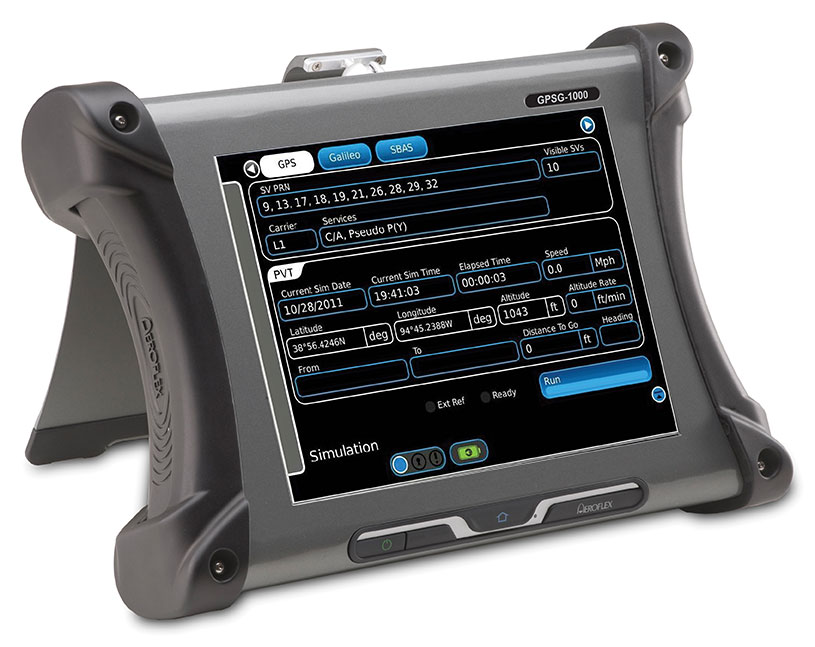
    GPSG-1000 — Portable GPS/Galileo/SBAS Positional Simulator

    Aeroflex GPSG-1000: Portable GPS/Galileo/SBAS Positional Simulator
    Aeroflex
    GPSG-1000: Portable GPS/Galileo/SBAS Positional Simulator Photo: Galileo

    Designed to be a versatile yet affordable satellite simulator, the GPSG-1000 is proving to be a vital instrument used by those validating and testing GNSS receivers in a variety of applications within the transportation, consumer electronics, aerospace and military industry segments, to name a few. 

    The GPSG-1000 is a single carrier, multi-channel GPS/Galileo simulator that is portable and ruggedized so it can be safely and confidently deployed in a variety of outdoor and indoor environments. The unit is available in a 6- or 12-channel configuration, and supports the following GNSS signals: L1, L1C, L2C, L5, E1, E5, E5a, E5b and SBAS (WAAS and EGNOS). 

    The GPSG-1000 can be directly connected to a GNSS receiver under test. It can also simulate actual “open-sky” situations whereby the unit can generate its signals through the included antenna coupler system that isolates and transmits to the UUT’s antenna(s). Utilizing an integrated GPS receiver, the GPSG-1000 simulates actual time of day and date as well as the real constellation that would be available for navigation at that specific point in time. Multiple almanacs and route files can be saved to the GPSG’s memory, thereby enabling current and past history dynamic motion, constellation environment creation/recreation and other significant troubleshooting capabilities. During any given static or dynamic simulation, space vehicle parametrics and health can be user controlled.

    The GPSG-1000 features a touchscreen user interface that can be remotely hosted via an integrated Ethernet port. The unit uses a rechargeable, Lithium Ion battery enabling hours of untethered use, and can also be used while the battery is recharging. 

    ats.aeroflex.com; phone: (316) 522-4981 or (800) 835-2352; email: [email protected]

    IFEN Inc.

    NavX-NCS Professional GNSS Simulator

    NavX-NCS Essential GNSS Simulator

    NCSPRO-MULTI_SW-W
    The NavX-NCS Professional GNSS Simulator by IFEN. Photo: IFEN

    The absolute flexibility of the NavX-NCS Professional GNSS Simulator allows it to be configured with up to 108 channels and all of the following signals:

    • GPS L1/L2/L5 C/A & P code and L2C
    • GLONASS G1/G2 standard & high accuracy codes
    • Galileo E1/E5/E6 (BOC/CBOC/AltBOC)
    • BeiDou B1/B2/B3
    • SBAS L1/L5 (WAAS, EGNOS, MSAS, GAGAN)
    • QZSS L1 & L1-SAIF
    • IMES

    The user is enabled to assign signals freely to any of the RF modules fitted to the simulator. This allows the same hardware to be used in a range of different configurations.

    Signals may be added by software license with no need to return the hardware for upgrade.

    Up to four independent RF outputs may be fitted, enabling the user to simulate multiple antenna locations simultaneously (allowing simulation of multiple antennas on one vehicle, multiple vehicles simultaneously, a mixture of static locations and mobile vehicles, and multiple antenna elements for Controlled Reception Pattern Antenna [CRPA] testing).

    The comprehensive and easy-to-use Control Center operating software allows the operator to quickly create realistic test scenarios for effective testing of user equipment.

    IFEN also offers the NavX-NCS Essential GNSS Simulator, which is available with 21 or 42 channels and is capable of simulating GPS L1 (including SBAS L1), GLONASS G1, Galileo E1, BeiDou B1, QZSS L1, and IMES. The simulator is also supplied with Control Center operating software for comprehensive scenario generation.

    www.ifen.com

    For USA and Canada: Mark Wilson; phone: 951-739-7331; email: [email protected]

    Racelogic

    LabSat 3 Triple Constellation Simulator

    Racelogic LabSat 3. Photo: RaceLogic
    RaceLogic LabSat 3. Photo: RaceLogic

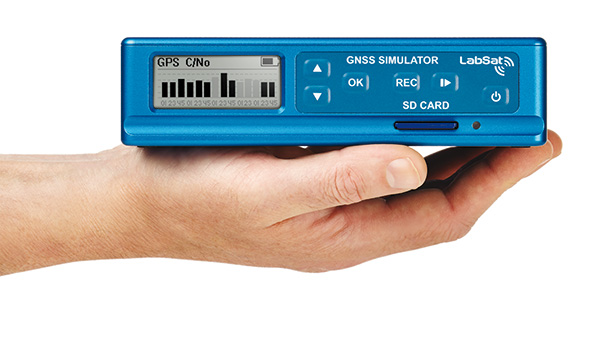
    LabSat 3 from Racelogic is a low cost, stand-alone, battery powered, multi-constellation RF record-and-replay device, designed to assist GNSS engineers in the development and testing of their products.

    With its small size and all-in-one design, LabSat 3 makes it easier than ever to collect raw satellite data in the same environment that end users experience in everyday use. This enables repeatable and realistic testing to be carried out under controlled conditions.

    LabSat 3 doesn’t need to be connected to a PC in order to record live-sky GNSS signals. With one-touch recording to SD card and a two-hour battery life, it can be used in any outdoor location to create real-world scenarios, for eventual replay back in the lab. As well as being able to simultaneously record or replay GPS, GLONASS, BeiDou, QZSS, Galileo, and SBAS signals, it can log CAN Bus, serial, or digital data, embedded alongside the satellite information. This additional information can then be replayed alongside the GNSS output, with synchronization to within 60 ns. A 1PPS signal can also be generated using the internal GPS receiver.

    LabSat 3 can be used as a replay system out of the box with a set of 60 pre-recorded scenarios supplied as part of the package, recorded from various locations around the globe. Additionally, SatGen software, a demo version of which is available from the LabSat website, allows for
    scenario generation of user-defined trajectories, with precise control over velocity, heading, height, and constellation profiles. Routes are also easily created in Google Maps, and the software also supports NMEA and KML file import. SatGen gives test engineers the ability to develop their products using simulations that would be difficult or impossible to record due to geographic location or safety constraints.

    LabSat 3 is available as a record and replay, or replay-only version; either one, two, or three constellation types generate a single, dual, or triple constellation file.

    LabSat is currently used by many leading manufacturers of GPS chipsets, portable navigation devices, smartphones, and by major car companies in their test, development and production processes.

    www.labsat.co.uk; phone: +44 (0)1280 823803

    Rohde & Schwarz

    R&S SMBV100A: GNSS Simulator in Vector Signal Generator

    The R&S SMBV100A: GNSS Simulator in Vector Signal Generator.
    The R&S SMBV100A: GNSS Simulator in Vector Signal Generator. Photo: R&S

    The GNSS simulator in the vector signal generator R&S SMBV100A is designed for development, verification and production of GNSS chipsets, modules and receivers. The simulator supports all possible scenarios, from simple setups with individual, static satellites all the way to flexible scenarios generated in real time with up to 24 dynamic GPS, GLONASS, Galileo, BeiDou and QZSS satellites.

    • GNSS simulator with support of GPS L1/L2 (C/A and P code), GLONASS L1/ L2, Galileo E1, BeiDou and QZSS L1, including hybrid constellations.
    • Real-time simulation of realistic constellations with up to 24 satellites and unlimited simulation time.
    • Flexible scenario generation including moving scenarios, dynamic power control and atmospheric modeling.
    • Configuration of realistic user environments, including obscuration and multipath, antenna characteristics and vehicle attitude.
    • Static mode for basic receiver testing using signals with zero or constant Doppler shift.
    • Support of Assisted GNSS (A-GNSS) test scenarios, including generation of assistance data for GPS, GLONASS, Galileo, BeiDou and QZSS.
    • Real-time external trajectory feed for hardware in the loop (HIL) applications.
    • High signal dynamics, simulation of spinning vehicles and precision code (P-code) simulations to support aerospace and defense applications.
    • Enhanced simulation capabilities for aerospace applications by supporting ground-based augmentation systems (GBAS).
    • Support of other digital communications and radio standards in the same instrument.

    www.rohde-schwarz.comemail: [email protected]

    Spectracom

    Afforable, Flexible and User-Friendly GNSS Simulators

    The Spectracom family of simulators.
    The Spectracom family of simulators. Photo: Spectracom

    Spectracom GNSS Simulators support test and development programs from simple manufacturing tests to multi-output testing across the diverse ecosphere of industries relying on GNSS technology. Spectracom’s innovation allows users of any skill level full control over the GNSS constellation, vehicle motion/attitude and signal path complications such as atmospherics and multipath to develop complex scenarios. Typical test conditions include:

    • Clock errors
    • Data errors
    • “Real-world” motion from embedded Google Maps
    • In-band noise generation
    • Multipath
    • Signal obstructions calculated from 3D building models
    • “Current time” simulation
    • Real-time HIL testing
    • Easy synchronization for multi-output testing
    • Automative download of the current almanac
    • Antenna pattern effects
    • Inertial sensor testing
    • Assisted GNSS testing

    No dedicated PC is required. Scenarios are run and managed from the front panel, SCPI commands, or any PC/tablet via a web interface. Users can select a flexible, field upgradeable Spectracom simulator, and then purchase the software options they need.

    GSG-6 Series multi-frequency, advanced GNSS simulator is powerful enough for any cutting-edge test program. GPS, GLONASS, Galileo, Beidou, QZSS and IRNSS signals are available across multiple frequencies. The GSG-6 is designed for military, research or professional applications.

    GSG-5 Series multi-constellation L1-band GNSS simulator is designed for commercial development/integration programs. If a user is developing commercial products with GNSS capability, the GSG-5 will shorten test programs with confidence.

    GSG-51 single channel signal generator is designed for one purpose — fast, simple go/no-go manufacturing test and validation, ensuring the manufacturing line is operating at full capacity with confidence in quality.

    www.spectracom.comemail: [email protected]; phone: 585-321-5800

    Spirent Federal Systems

    GNSS Simulators

    Spirent's GSS9000 constellation simulator.
    Spirent’s GSS9000 constellation simulator. Photo: Spirent

    Spirent provides simulators that cover all applications, including research and development, integration/verification and production testing.

    GSS9000. The newly released Spirent GSS9000 multi-frequency, multi-GNSS RF constellation simulator can simulate signals from all GNSS and regional navigation.  The GSS9000 offers a four-fold increase in RF signal iteration rate (SIR) over Spirent’s GSS8000 simulator. The GSS9000 SIR is 1000 Hz (1 ms), enabling higher dynamic simulations with more accuracy and fidelity. It includes support for restricted and classified signals from the GPS and Galileo systems, as well as advanced capabilities for ultra-high dynamics. It can evaluate resilience of navigation systems to interference and spoofing attacks, and has the flexibility to reconfigure constellations, channels and frequencies between test runs or test cases.

    Hardware changes can be done in the field, supported by the new on-board calibrator module. The GSS9000 is extensible and can support the widest range of carriers, ranging codes and data streams for the Galileo, GPS, GLONASS, and BeiDou systems, as well as regional/augmentation systems. Multi-antenna/multi-vehicle simulation, for differential-GNSS and attitude determination, and interference/jamming and spoofing testing are also supported.

    CRPA Test System. Spirent’s Controlled Reception Pattern Antenna (CRPA) Test System generates both GNSS and interference signals. Users can control multiple antenna elements. Null-steering and space/time adaptive CRPA testing are both supported by this comprehensive approach.

    GSS6425. The Spirent GSS6425 RPS quickly and simply records complex real-world RF environments, capturing both GNSS signals and atmospheric/interference effects. These environments can then be replayed repeatedly to the hardware software under test, reducing project, travel and engineering costs.

    www.spirentfederal.comJeff Martin, Director of Sales; Kalani Needham, Sales Manager; email: [email protected]; phone: 801-785-1448; fax: 801-785-1294

  • 2014 Simulator Buyers Guide

    2014 Simulator Buyers Guide

    In GPS World’s annual Simulator Buyers Guide, we feature simulator tools, devices, and software from six prominent companies. Also available as a downloadable PDF.


    CAST Navigation

    CAST-SGX GPS Satellite Simulator

    sgx_high-W

    The new SGX GPS satellite signal simulator from CAST Navigation provides the user with dynamic, repeatable GPS RF signals for use in the laboratory or in the field for a wide range of GPS applications. The SGX simulator is housed in a portable, lightweight, handheld enclosure measuring 7 x 11 x 3 inches and weighing just over 4 pounds.

    The SGX replaces the CAST-SIMCOM simulator, a 17- inch, 50-pound simulator. The SGX is lightweight and portable, operates on AC or battery power, and features 16 channels of L1 C/A and P codes. Based on CAST’s technology that has been developed for use in the company’s larger military products, it is extremely accurate and repeatable.

    The SGX is controlled via an intuitive touchscreen interface that allows the user to select, start, and stop scenarios, change screen views, and change satellite RF power levels while a scenario is running. Three test scenarios are delivered with the simulator.

    XGEN Plus Scenario Generation Software. This optional software gives the user the ability to generate custom scenarios for use with the SGX. The software allows for complete control over GPS almanac, ephemeris, and all satellite error sources.

    The user can select from a variety of vehicle types and simulate static or dynamic motion. The user may also employ antenna gain patterns and vehicle silhouettes if desired. The user may generate a trajectory by defining a total mission profile using a six-degree-of-freedom model. The new scenarios can be downloaded via USB port or SD card interfaces.

    CAST has been in the GPS simulation and support business for more than 30 years, designing, developing, manufacturing, and integrating innovative GPS/INS simulators and associated equipment for government, military, prime vendor, and consumer markets.

    www.castnav.com
    phone: 978 858-0130
    email: [email protected]

    IFEN Inc.

    NavX-NCS Professional GNSS Simulator
    NavX-NCS Essential GNSS Simulator

    NCSPRO-MULTI_SW-W

    The absolute flexibility of the NavX-NCS Professional GNSS Simulator allows it to be configured with up to 108 channels and all of the following signals:
    •    GPS L1/L2/L5 C/A & P code and L2C
    •    GLONASS G1/G2 standard & high accuracy codes
    •    Galileo E1/E5/E6 (BOC/CBOC/AltBOC)
    •    BeiDou B1/B2
    •    SBAS L1/L5 (WAAS, EGNOS, MSAS, GAGAN)
    •    QZSS L1 & L1-SAIF
    •    IMES

    The user is enabled to assign signals freely to any of the RF modules fitted to the simulator. This allows the same hardware to be used in a range of different configurations.

    Signals may be added by software license with no need to return the hardware for upgrade.

    Up to four independent RF outputs may be fitted, enabling the user to simulate multiple antenna locations simultaneously (allowing simulation of multiple antennas on one vehicle, multiple vehicles simultaneously, a mixture of static locations and mobile vehicles, and multiple antenna elements forControlled Reception Pattern Antenna [CRPA] testing).

    The comprehensive and easy-to-use Control Center operating software allows the operator to quickly create realistic test scenarios for effective testing of user equipment.

    IFEN also offers the NavX-NCS Essential GNSS Simulator, which is available with 21 or 42 channels and is capable of simulating GPS L1 (including SBAS L1), GLONASS G1, Galileo E1, BeiDou B1, QZSS L1, and IMES. The simulator is also supplied with Control Center operating software for comprehensive scenario generation.

    www.ifen.com
     
    For USA and Canada
    Mark Wilson
    phone: 951-739-7331
    email: [email protected]
    For Rest of World
    Dr. Guenter Heinrichs
    phone: +49-8121-2238-20
    email: [email protected]

    RaceLogic

    LabSat 3

    LabSat3_on-Hand-SD-Screen-W

    LabSat 3, the latest generation of GNSS simulators from Racelogic, is a low cost, stand-alone, battery powered, multi-constellation, RF record and replay device designed to assist GNSS engineers in the development and testing of their products. With its small size and all-in-one design, LabSat 3 makes it easier than ever to collect raw satellite data in the same environment that end users experience in everyday use. This enables repeatable and realistic testing to be carried out under controlled conditions.

    LabSat 3 doesn’t need to be connected to a PC to record live-sky GNSS signals. With one-touch recording to SD card and a two-hour battery life, it can be used in any outdoor location to create real-world scenarios, for eventual replay back in the lab. As well as recording GPS, GLONASS, BeiDou, QZSS, Galileo, and SBAS signals, it can simultaneously log CAN bus, serial, or digital data, embedded alongside the satellite information. This additional information can then be replayed alongside the GNSS output, with synchronization to within 60 ns. A 1 PPS signal can also be generated using the internal GPS receiver.

    LabSat 3 can be used as a replay system out of the box with a set of pre-recorded scenarios supplied as part of the package, recorded from various locations around the globe. SatGen software, a free version of which is included with LabSat 3, allows for scenario generation of user-defined trajectories, with precise control over velocity, heading, height, and constellation profiles. Routes are also easily created in Google Maps, and the software also supports NMEA and KML file import. SatGen gives the test engineer the ability to develop a product using simulations that would be difficult or impossible to record due to geographic location or safety constraints.

    LabSat 3 is available in four variants: replay only, or record and replay, of a single channel — one of GPS/Galileo/SBAS/QZSS, GLONASS, or BeiDou; and replay only, or record and replay, of dual channels — two of GPS/Galileo/SBAS/QZSS, GLONASS, or BeiDou.

    LabSat is currently used by many leading manufacturers of GPS chipsets, portable navigation devices, smartphones, and by major car companies in their test, development, and production processes.

    www.labsat.co.uk; phone: +44 (0)1280 823803

    Rohde & Schwarz

    R&S SMBV100A: GNSS Simulator on Vector Signal Generator

    Rohde-Schwarz-Beidou-W

    Rohde & Schwarz extends the functionality of the R&S SMBV100A vector signal generator by adding BeiDou/Compass capability to its integrated GNSS simulator. With the R&S SMBV-K107 option, the GNSS simulator now covers the BeiDou standard as well as the GPS, Galileo and GLONASS satellite navigation systems.

    The new option allows users to generate real-time scenarios with up to 24 BeiDou satellites. R&S SMBV-K107 supports all possible BeiDou orbits and can therefore even simulate satellites that are not yet in orbit. It also supports hybrid scenarios with GPS, Galileo, or GLONASS satellites. A software update makes it easy to upgrade existing GNSS simulators for BeiDou. No hardware modifications are required.

    The R&S SMBV100A permits users to quickly define their own satellite scenarios to test GNSS receivers under diverse conditions. A wide range of options are available for simulating realistic effects such as signal obscuration and multipath propagation. These scenarios can now be configured for BeiDou as well.

    This inexpensive solution is one of the few on the market that does not require an external PC for testing receivers and components of satellite-based navigations systems. In addition to GNSS signals, the R&S SMBV100A can simulate mobile radio, wireless, and radio standards, allowing users to test several functions with a single instrument.

    The new R&S SMBV-K107 option is now available from Rohde & Schwarz.

    www.rohde-schwarz.com
     
    email: [email protected]

    Spectracom

    Configurable, Upgradeable GNSS Simulators

    GSG_Family-SPECTRACOM-W

    Spectracom multi-channel, multi-frequency GSG Series GPS/GNSS Signal Simulators are designed for research, development and manufacturing. They provide powerful, affordable, and easy-to-use application-specific GNSS testing solutions allowing users to simulate virtually any condition through built-in and user-defined scenarios. The simulators now feature expanded capabilities and a flexible, field upgradeable design that allows users to select only the features needed for a specific application, upgrade when necessary.

    The GSG 5 and 6 Series simulators are portable and fully operational via front panel, web-based remote control (Ethernet, USB, GPIB), or SCPI protocol. The models include GSG StudioView PC Software to build, edit, and manage complex scenarios and trajectories. Advanced simulation features include: SBAS (WAAS, EGNOS, GAGAN, MSAS), multipath scenarios, interference detection and mitigation, white-noise generation, and trajectories. The new features and capabilities can be added to any GSG-5 or GSG-6 purchased since June 2012.

    GSG-6 Series Multi-Frequency, Advanced GNSS Simulator
    •    Up to 64 channels and 4-frequencies simultaneously
    •    GPS, GLONASS, Galileo, BeiDou
    •    Sync multiple units for testing hundreds of signals
    •    L1, L2, L2C, L5, E1, E5, B1; [E6, B2, B3 capable HW, with FW upgrade available in the future]
    •    P-code, pseudo P(Y) in L1 and L2
    •    Add-ons for real-time scenarios, record and playback, Assisted-GNSS, RTK/Differential measurements, high velocity
    •    Fully upgradable to future constellations and signals

    GSG-5 Series Multi-Channel, Advanced GNSS Simulator
    •    4, 8 or 16 channels
    •    GPS, GLONASS, Galileo, BeiDou
    •    L1, E1, B1
    •    Upgradeable to more channels and frequencies

    GSG-51 Low Cost Single Channel GPS Signal Generator
    •    1-channel GNSS tester for fast, simple manufacturing test and validation
    •    Fully upgradeable to GSG-5 and 6 series

    www.spectracom.com
     
    email: [email protected]; phone: 585-321-5800

    Spirent Federal Systems

    GNSS Simulators

    GSS8000-W

    Spirent provides simulators that cover all applications, including research and development, integration/verification, and production testing.

    GSS8000 (pictured). Spirent’s flagship simulator, the GSS8000, is fully approved for Y-code, SAASM, AES M-code and SDS M-code testing. Spirent provides options and configurations for testing GNSS interference effects and interference mitigation techniques, such as integrated GPS/inertial testing, CRPA testing, and jamming/anti-jam simulation.

    Spirent has delivered simulators that produce legacy signals as well as modernized signals such as 2C, L5, and L1C. In addition to GPS, systems can include GLONASS L1/L2, Galileo, and Beidou-2, plus SBAS (WAAS, MSAS, and EGNOS) and Japan’s Quasi-Zenith Satellite System (QZSS).

    CRPA Test System. Spirent’s Controlled Reception Pattern Antenna (CRPA) Test System generates both GPS L1/L2 and interference signals; multiple GSS8000 chassis may be combined to coherently control up to seven antenna elements. Null-steering and space/time adaptive CRPA testing are both supported by this comprehensive approach.

    GSS7790. Spirent’s GSS7790 Multi-Output Simulation System allows the signal from each satellite to be mapped to a separate RF output. These signals can then be fed to individual transmit antennas, which, when suitably deployed in an anechoic chamber, replicate the spatial diversity of satellite and jammer signals incident on the receiver antenna. Additional flexibility is offered as the signal is further split into its GPS L1 and L2 components, as appropriate.

    www.spirentfederal.com
     
    Jeff Martin, Director of Sales
    Kalani Needham, Sales Manager
    email: [email protected]
    phone: 801-785-1448; fax: 801-785-1294


  • What’s New in GNSS Simulation?

    What’s New in GNSS Simulation?

    It used to be that if you were going to build an RF navigation receiver, you had to also build your own simulation system to test it. I remember working with a couple of “home-built” RF simulation systems myself, way back when. We experience a lot of maintenance and support issues. And, of course, if you build something and also build something to test it, its likely that incorrect assumptions will end up in both systems. Today, there are a number of excellent sources for GNSS simulation equipment and support you can buy on the open market.

    The spectrum of today’s providers seems to range from highly sophisticated scientific systems used for development by precision receiver manufacturers, through systems with GNSS and aiding solutions, to specialized systems for both general and specific application developers and also for production test. So this month I’d like to try to summarize (in no particular order) what some of the suppliers of GNSS simulation systems are up to, how they may be positioned in the market and, wherever possible, what we might expect to see from them in the future.

    GSG Series 6 GNSS simulator.
    GSG Series 6 GNSS simulator.

    Spectracom is a more recent entrant to the GNSS simulation market, though the company has been providing frequency and time synchronization test equipment for about 40 years. Spectracom has integrated GPS into these products for more than ten years, and decided three years ago to use the knowledge it had gained to get into the GNSS simulation business.

    The GSG family of simulators is positioned at the “affordable” end of the simulation equipment scale, and is targeted at users and integrators of GNSS, rather than developers of receivers. Spectracom claims to have about 80 percent of the features of the top-end simulations systems, but its more capable (Series 6) systems sell in the $20-30k range. While new to the business, the Spectracom team feels that this allows them to bring the newest technology and innovation to the market.

    The Spectracom system is derived from its well-known frequency/time synthesizer equipment — in fact, it has the same look front panel and chassis — and also makes use of the same “easy-to-use” concepts. “It doesn’t take a navigation scientist to operate these simulators,” said John Fischer, chief technology officer at Spectracom. The accompanying Studio View software is reportedly relatively easy to use to generate trajectories and other test scenarios by connecting to Google Maps and uploading them to the simulator.

    But with all new firmware and FPGA implementation, 64 channels, and four frequency bands covering both GPS and GLONASS, the GSG family appears to be very well positioned for application developers integrating GNSS. Galileo and Beidou/Compass are in the works and expected this year, and will be supplied as upgrades to existing equipment.

    Spectracom anticipates significant growth in its target market for application developers in “anything that moves,” including automotive and airborne, video matching, radar/lidar, and handheld nav devices, including mobile phones. Spectracom has a number of product lines and around 100 people working for them, but the GNSS simulation group is around 12 strong.

    Rohde & Schwarz is another relatively recent GNSS simulation entrant with new products for the market.

    SMBV100A vector signal generator.
    SMBV100A vector signal generator.

    Its current offering — the SMBV100A Vector Signal Generator – can simulate 24 dynamic GPS, GLONASS and Galileo satellites.  The SMBV 100A has wide bandwidth and high output power levels. Real-time test scenarios can be customized by the user — including a neat facility that allows modeling of satellite masking by downtown buildings, along with anticipated multipath for the same urban scenario.

    While somewhat new to GNSS simulation, R&S has been around since the 1930s, and its experience with frequency synthesizers and similar equipment is being carried forward into what the company terms its “cost-effective” GNSS simulation offerings. R&S anticipates significant growth in automotive, aerospace, UAV, and cellular assisted-GNSS application markets.

    R&S has had success in the aerospace market for UAVs, and has developed the capability to model antenna patterns and UAV body mask as the vehicle rotates and attitude changes towards visible satellites. Along the same lines, R&S has hooked up its system to flight simulators and provided hardware-in-the-loop testing for clients. R&S also has the ability to run simulation scenarios for long periods of time, and for “very long” periods if the receiver is stationary — this feature makes use of large internal memory storage within the SMBV100A; of course, almanac validity limits just how long this is possible. P-code capability is provided as an option, and there is a roadmap for adding SBAS and Beidou capability later.

    IFEN NavX-NCS Professional
    IFEN NavX-NCS Professional

    In the meantime, IFEN in Germany is focusing on its NavX-NCS Navigation Constellation Simulator range of multi-GNSS signal simulators.

    IFEN emphasizes the flexibility of its design, with a platform scalable from a 12-channel GPS L1 system up to a full multi-GNSS system with 108 channels and 9 frequencies for GPS, GLONASS, Galileo, QZSS and SBAS. With this building-block approach, channels and capabilities can be added as and when additional testing complexity is required.

    IFEN claims that the capability to generate all GNSS signals — by combining different modulations with up to nine L-band frequencies — is the only existing solution on the market providing GPS, Galileo, GLONASS, QZSS and SBAS in one chassis at the same time. And, since April 2013, all IFEN NavX-NCS GNSS RF signal simulators are to include BeiDou B1 signal capability in accordance with the official Chinese BeiDou B1 ICD, and are ready for the other B2 and B3 BeiDou signals.

    IFEN also founded a subsidiary in the USA in January this year called IFEN, Inc., located in California and operational with Mark Wilson (formerly with Spirent) as VP Sales. In addition, IFEN has formed a partnership with WORK Microwave — a leading European manufacturer of advanced satellite communications and navigation equipment. WORK Microwave is responsible for RF and digital hardware design while IFEN develops the associated software and manages the distribution of the product range.

    Little-known IP-Solutions in Tokyo, Japan, has been working to develop its ReGen GNSS DIF signal simulator, a software simulator that simulates ionospheric effects, generates digital IF (DIF) signals similar to those recorded by an RF recorder, and comes with an optional capability of simulating integrated inertial navigation.

    IP-Solutions’ digital IF baseband signal simulator ReGen has been developed in close cooperation with the Japan Aerospace Exploration Agency (JAXA) to test and validate GNSS signal processing algorithms and methods for use on board aircraft using tight and ultra-tight integration with INS, including specific scintillation models and ionospheric bubble simulation.

    Actual recordedflight data (left), ReGen replicated flight data (right).
    Actual recorded flight data (left), ReGen replicated flight data (right).

    Various configurations of ReGen can produce multichannel GPS and GLONASS L1 signals and single-channel GPS L1, L2, L5 and GLONASS L1 and L2 signals, as well as simulating noise and interference.

    Meanwhile, Spirent, arguably the original market leader in GNSS simulation, has continued along its chosen path of supplying the industry with the greatest capability and most extensive simulation systems.

    BeiDou-Logo-150x142Spirent has recently released test systems with support for China’s BeiDou Navigation Satellite System in addition to GPS, GLONASS and Galileo.

    Spirent started shipping BeiDou-ready systems to its customers in 2012. Now these may be upgraded to full BeiDou capability using the information available in the first full issue of the BeiDou-2 Signal In Space Interface Control Document (ICD).

    Also aiming at mobile applications, Spirent’s Hybrid Location Technology Solution (HLTS) integrates Wi-Fi, Assisted Global Navigation Satellite System (A-GNSS), Micro Electro-Mechanical Systems (MEMS) sensor and cellular positioning technologies. HLTS integrates four very different and distinct location technologies and provides repeatable and reliable lab-based characterization of mobile devices supporting hybrid location technologies that will enable “accurate everywhere” location — including indoor user location determination.

    Other notable players in the GNSS simulation business include Racelogic, CAST Navigation and Agilent who are each pursuing their chosen niches in this expanding market segment. Racelogic’s LabSat GPS simulator is gaining popularity with a number of leading companies, providing the ability to record and replay real GNSS RF data as well as user-generated scenarios. CAST has an extensive line-up of GPS and GPS/INS simulation systems and support software, and Agilent has added to its impressive electronic testing portfolio with a very capable looking GPS simulation product line.

    Several other companies — some based in China and Russia — are also trying to figure out their development and marketing strategies to conquer their chosen GNSS simulation market niche. This is all a very healthy sign that there are many other companies with new embedded GNSS applications that they are bringing to market and who therefore need GNSS simulation/test capability. Overall, this means there is still significant growth underway and far wider applications of GNSS on their way to market. Great news for the GNSS industry!

    Tony Murfin
    GNSS Aerospace

  • GPSWorldTV – Cast Navigation at ION GNSS

    GPSWorldTV talks with John Clark of Cast Navigation, Inc. at the ION GNSS 2012 conference.

  • CAST Navigation: Signal Diversity and the PHGPST

    As loyal readers are aware, I have long been an advocate of signal diversity as a solution to many of the ills that plague the GPS user, especially outdated user equipment. Signal diversity potentially provides users with more signals and signal origins. More signals improve availability, the number-one user criteria by a huge margin, and serve as a defense against jamming and spoofing. Signal diversity also provides security and integrity, resulting in accurate and reliable GPS-derived data.

    For users to take full advantage of signal diversity, they must have the best software-defined user equipment available. And the best equipment, if it were available today, would be the PHGPST or Perfect Handheld GPS Transceiver, which has so often been a popular topic of discussion over the last several years. I cannot count the thousands of letters and emails from warfighters, first responders, and civil users who immediately see the value of software-defined receivers and want to know where to purchase the PHGPST. For now, some early GPS software-defined user equipment does exist, but to reach the goal of the PHGPST, receiver manufacturers must first be able to accurately and reliably simulate/generate all the diverse PNT (position, navigation and timing) signals available, which include some signals not ordinarily categorized as PNT signals today. Certainly not an easy task; however, there is hope. Recently, I heard about a small GNSS/INS simulation company that may be paving the way to the PHGPST — CAST Navigation in Tewksbury, Massachusetts.

    CAST Navigation

    CAST Navigation, which qualifies under current federal acquisition guidelines as a small company, bills itself as, and my military contacts confirm that they are indeed, a leading provider of GPS signal simulators, as well as a company that supports navigation system research, development, integration and testing at commercial and military laboratories worldwide. CAST develops cutting-edge GNSS/INS simulation systems with an expert staff that provides their customers with the latest technology and knowledgeable, experience-driven support.

    Tough Industry

    Those of you who are real GPS techies should not have to think very hard to call up the names of at least three GPS–PNT signal simulation companies that have gone belly-up in the past five to ten years, and some of those memories are just plain painful for the U.S. military and industry alike. This can really be a tough business.

    According to Susan Gove, vice president of CAST Navigation, “…the signal simulation field is certainly not an easy business and it is extremely competitive, but we have been around for a long time and are doing well,” which is exactly why a company like CAST Navigation — which has survived and grown for the last 25+ years with an outstanding track record — is of such interest when it comes to PNT signal diversity and the PHGPST.

    Add the fact that recent Information Assurance (IA) and cyber security requirements have just made the GNSS business tougher for all concerned and a reliable, professional, flexible GNSS/INS signal simulation company becomes critically important to the industry as a whole. According to John Clark, VP for Engineering at CAST Navigation, “…our scenario-based software simulations, which include jamming, interference, multipath signals and spoofing allow for simultaneous and multiple scenarios — indeed, almost any battlefield signal perturbation the user needs to simulate is doable with our hardware and software. In fact, we routinely help our customers tailor scenarios for specific needs, and our customer feedback mechanism tells us our customers are extremely happy and productive with CAST Navigation’s scenario-driven software capabilities.”

    cast_1000-W . Credit: Cast
    The CAST-1000 GPS Simulation System.

    Signal Diversity

    A major requirement for signal diverse solutions to GNSS issues — to include jamming, unintentional interference and high masking angles — is the right antenna. Conventional wisdom says the right antenna is a Controlled Radiation Pattern Antenna or CRPA. Ideally, the right CRPA will eventually be capable of receiving all space-based PNT and SBAS signals (GPS, GLONASS, Galileo, Beidou, WAAS, EGNOS etc.) as well as ground-based cellular and LF (low frequency) and/or eLORAN signals. The CAST-5000 Wavefront simulator allows companies and the military to perform a full end-to-end test of a platform’s CRPA, the antenna electronics, and the GPS receiver before that receiver is ever deployed to the field. So it is a must-have capability for the truly signal diverse GPS receiver manufacturer. But to be honest, GPS signals are still key; they are still the gold standard for PNT. I am not aware of any GLONASS-only receivers on the market today, nor am I aware of any Galileo-only receivers being planned. GPS is the key component for available, reliable, and accurate PNT data.

    Recently at the Munich Satellite Summit, all the European receiver manufacturers were touting GPS receivers with the Galileo/GLONASS option. Even if the marketing brochures list Galileo or GLONASS first in the name, a little probing makes it obvious that the primary baseline PNT system is GPS with augmentations. So although signal diversity is the goal and more and more systems are, to some extent, signal diverse or signal-diverse capable today, the reality is that GPS is still the Gold Standard. If we are ever to truly enjoy signal diversity and all the associated benefits, PNT signal generators and simulators will be a key developmental tool. To that end and with affordability in mind, CAST Navigation has the capability or is in the process of developing simulations for many of the diverse signals mentioned to include SAASM signals for the U.S. military and our allies.

    Simulations and Predictions

    For the past several years the DoD and several government agencies have made good use of a very functional PDOP (positional dilution of precision) prediction algorithm and tool named GIANT. General Dynamics originally developed the GIANT program under contract to the U.S. government. Currently, GIANT is being enhanced primarily by LINDQUIST, with the help of select government agencies; with the recent integration of Google Maps, GIANT is proving to be a very useful tool for the warfighter and first responder. Amazingly CAST Navigation has a very similar product that is available for all users to include the U.S. military. The CAST product is called TOP or Terrain Obscuration Program. Like GIANT it provides a real-time determination of satellite visibility based upon the terrain (presented in a 3-D visualization) surrounding the actual position or predicted position of specific GPS receivers, fixed or mobile.

    TOP170map . Credit: Cast
    (Click to enlarge.)

    While this concept sounds a bit academic at first, when you see it in action and talk to warfighters and planners who have benefited from GIANT first hand, it is clearly a mission-success parameter as well as a life-saving capability. For years GIANT was purely a flat Earth planning tool, and while it was useful, the addition of real-time processing, Google Maps, and DTED data have made both GIANT and TOP incredibly useful programs. Both programs help ensure GPS user equipment, applications, and weapon systems are more accurate, since signal availability is now predictable. The first time I saw the new GIANT tool in action, it literally took my breath away, and now that capability is available for everyone with the TOP product from CAST Navigation. Knowing first-hand what both GIANT and TOP are capable of for warfighters and first responders, I cannot now imagine a government, commercial, or civil planner, who must utilize or install GPS equipment or systems that depend on GPS capabilities, that would not benefit from these groundbreaking programs. In a natural or urban canyon situation, with high masking angles, installing GPS receivers or antennas with the greatest visibility would be pure guesswork without a program like TOP that guides planners and installation engineers with real-time data extrapolating optimal PNT reception locations, both fixed and mobile, over time.

    sgx_high-W . Credit: Cast

    SGX

    Combine the capability of GIANT or TOP with a portable or handheld GPS signal generator/simulator, such as the new handheld CAST SGX, and users are able to accurately characterize and predict the effects of area terrain and masking angles on any GPS receiver prior to actually venturing into the field. Users are able to determine which receivers will function optimally and produce the most reliable results in any physically constrained or sky-challenged environment. For both government and civil users, the fidelity of TOP and GIANT are a direct function of and only constrained by the Digital Terrain Element Data (DTED) access authorized for specific users.

    The CAST SGX (signal simulator/generator) is a GPS signal device housed in a portable lightweight handheld enclosure. In other words, it is a portable handheld GPS signal device at home in the laboratory, running on house current, or in the field running on long-life batteries. Regardless of the power source, the CAST SGX is capable of generating GPS L1 signals (with P-Code options) of up to 16 GPS satellites, which are more than most users would normally have in view at any one time.

    The CAST SGX is an important new development in GPS signal simulation and generation. Historically GPS signal simulators/generators have been huge, heavy and complicated pieces of laboratory equipment requiring a Ph.D. to run properly, and users were tied down to evaluating GPS receivers only where the unwieldy GPS signal simulator/generator was located. Now with the portable CAST SGX, the signal generator can go where the receivers are located and real-world data can be collected in real time. The scenarios the SBAS (satellite based augmentation system) capable SGX have made available are extraordinary, and I have purposefully not speculated on the military possibilities as those speculations become classified in a hurry. But just allow your imagination to wander a bit and you will see what I mean.

    SGX Software

    The optional CAST-XGen Plus software, which I have not had a chance to personally test but hope to in the near future, has the capability to integrate with Google Maps and reportedly gives the user the ability to generate advanced customized scenarios for use with the SGX device. The software allows for complete control over atmospheric effects, the GPS almanac, ephemeris and all satellite error sources to include masking angles and multipath. So you don’t actually have to take the SGX device out into the field, but the great part is now you can. Ruminate on that for awhile and the possibilities appear endless.

    According to Susan Gove, the handheld SGX is proving to be a huge success, and the SGX along with CAST Navigation software products will be available at the ION 2012 Joint Navigation Conference
 (ION JNC) June 12-15, at the Crowne Plaza Hotel in Colorado Springs, Colorado. Be sure to stop by and take a look at this amazing new product.

    Bottom Line

    I am impressed by what I have learned about CAST Navigation. They are a small, agile, innovative GNSS/INS simulation company that has brought much needed portability and availability of GPS signals and simulation to operators, planners, and system designers worldwide. CAST Navigation hopefully has a bright future and may well play a key role in the future of the availability and integrity of GPS signals for users globally. They may also help blaze the path to the PHGPST. Check them out at ION JNC.

    Until next time, happy navigating.


  • CAST Navigation Introduces Handheld Simulator

    CAST Navigation of Tewksbury, Massachusetts introduced its SGX GPS Satellite Simulator. With its compact size — 7 × 11× 3 inches — and weighing in at just over 4 pounds, the SGX is CAST’s newest and smallest fully capable simulator to date.

    The new SGX replaces the CAST-SIMCOM Simulator which was a 17-inch, 50-pound simulator. The SGX lightweight portability operates on AC or battery power, features 16 channels of L1 C/A and P codes, and is extremely accurate and repeatable, according to the company.

    Features include touch screen, individual satellite power control, and start and stop scenarios with a touch of a button.

    The CAST-SGX is portable, affordable, lightweight and utilizes CAST long standing proven technology.

    CAST has been in the GPS simulation and support business for more than 25 years, designing, developing, manufacturing, and integrating innovative GPS/INS simulators and associated equipment for government, military, prime vendor, and consumer markets.