Tag: CNES

  • Galileo 9 and 10 now broadcasting navigation messages

    News from the European Space Agency

    Europe’s ninth and tenth Galileo satellites have started broadcasting working navigation messages. The two satellites were launched together on Sept. 11, 2015.

    Once safely in orbit and their systems activated, their navigation payloads and search and rescue transponders were subjected to a rigorous process of in-orbit testing, to ensure their performance reached the necessary specifications to become part of the Galileo system.

    Radio-frequency measurements of the Galileo signals were made from ESA’s Redu centre in Belgium. The site boasts a 20 m-diameter dish to analyze their signal shape in high resolution.

    Along with assessing that the satellites themselves were functioning as planned, the test campaign also confirmed they could mesh properly with the worldwide Galileo ground network.

    The testing was coordinated from the Galileo Control Centres in Oberpfaffenhofen in Germany – performing the command and control of the satellites — and Fucino in Italy — overseeing the provision of navigation messages to users.

    Source: GPS world staff
    An artist’s depiction of four Galileo satellites sending navigation signals. (ESA)

    “This is the first recurrent launch of Galileo Full Operational Capability satellites from an in-orbit test point of view,” comments Christian Lezy, supervising the measurement campaign in Redu.

    “All tests were conducted in a seamless manner in parallel with the ongoing routine operations of the rest of the fleet.”

    The operations team, successfully led by SpaceOpal GmbH, completed the testing campaign few days ahead of schedule, with the satellites beginning to broadcast valid navigation signals on Jan. 29.

    The following two Galileos — satellites 11 and 12, launched on Dec. 17, 2015 — are undergoing their own in-orbit test campaign. Once their initial Launch and Early Operations Phase was completed at the Toulouse facility of France’s CNES space agency, both spacecraft were handed over to the Oberpfaffenhofen centre during the Christmas period.

    Platform commissioning and drift stop and fine positioning maneuvers have also been completed, placing both satellites into their final working orbits, while their payload activation is proceeding according to schedule.

    Galileo satellites 13 and 14 have completed all pre-flight testing at ESA’s ESTEC test centre in Noordwijk, the Netherlands, and have been put into storage ahead of their launch. Production of the remaining 12 satellites is continuing around the clock at OHB’s facility in Bremen, Germany.

    The complete Galileo constellation will be made up of 24 satellites across three orbital planes, with two ‘active spare’ satellites per orbital plane, ready to plug any gap in service should an operational Galileo malfunction.

    At the moment the satellites are transmitting navigation signals for technical validation purposes, being employed by Galileo engineers as well as the rest of the satnav industry to prepare Galileo-compatible products and services.

    The current status of the overall Galileo constellation can be checked at the European Commission’s European GNSS Service Centre website.
  • Galileo Launch Maintains 2015 Record Pace for Arianespace

    Galileo Launch Maintains 2015 Record Pace for Arianespace

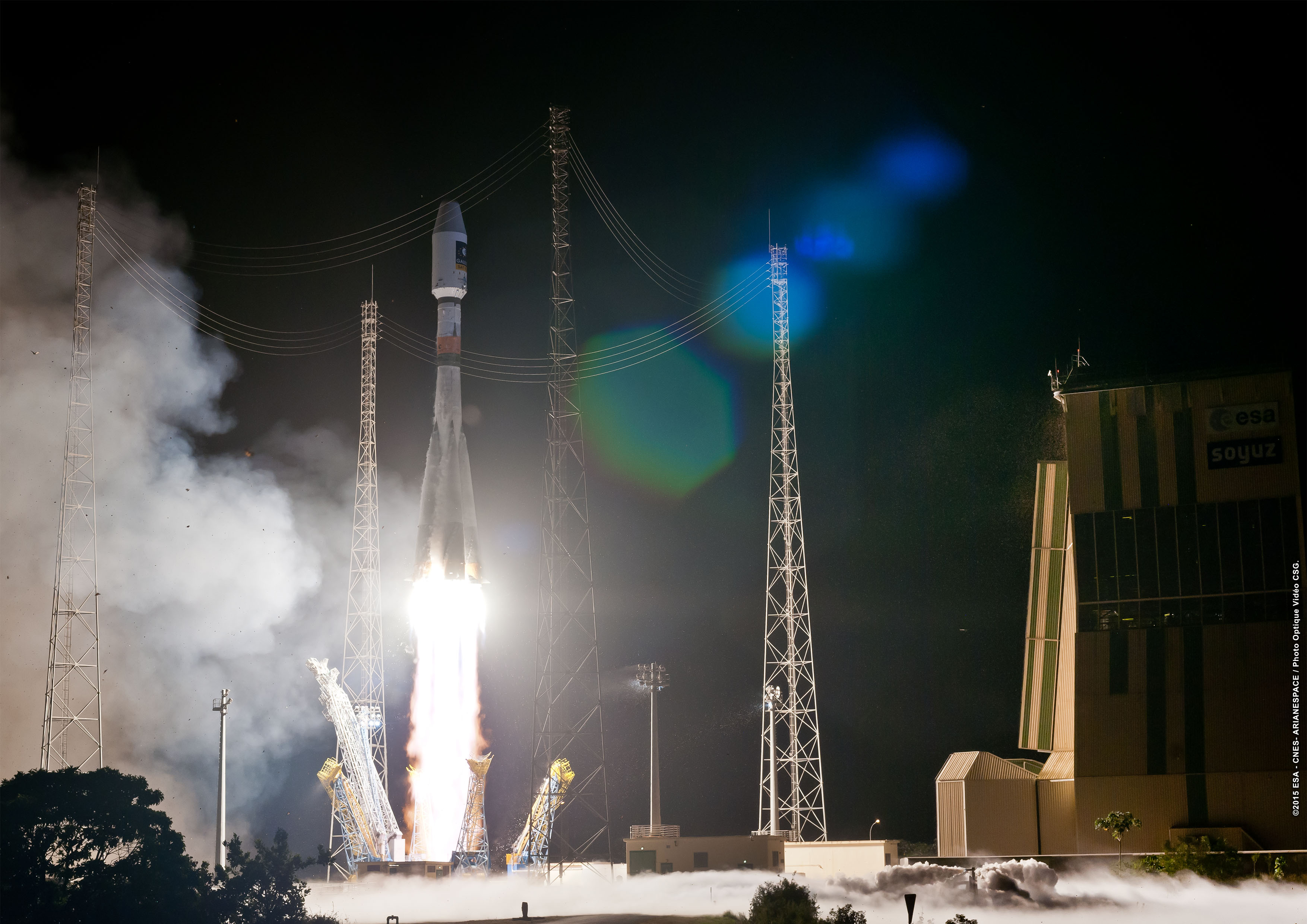
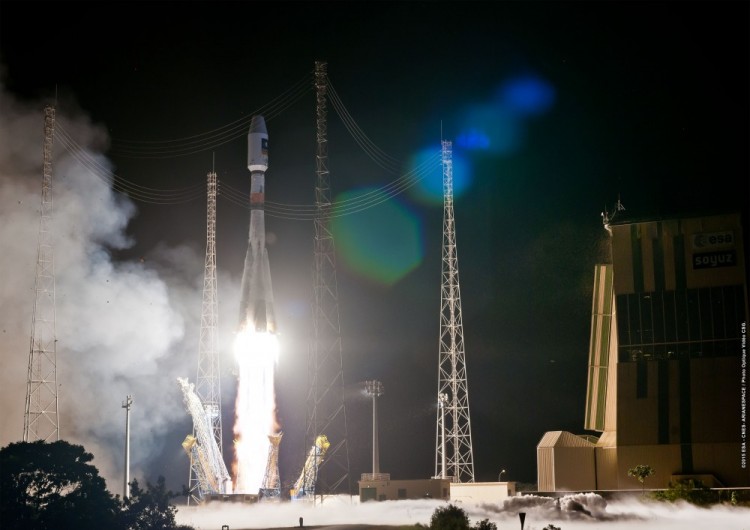
    Soyuz launches Galileo 9 and 10 into orbit on Sept.10. (Credit: Arianespace)
    Soyuz launches Galileo 9 and 10 into orbit on Sept.10. (Credit: Arianespace)

    Arianespace’s 12th Soyuz flight from the Spaceport in French Guiana orbited two more spacecraft for Europe’s Galileo satellite navigation system on Sept. 10.

    2015 is an important year for Arianespace at the service of European institutions, with 11 payloads to be orbited utilizing the company’s family of Soyuz, the heavy-lift Ariane 5 and lightweight Vega, Arianespace Chairman and CEO Stéphane Israël said after the liftoff.

    Departing the Spaceport’s ELS launch complex near the city of Sinnamary at the planned exact liftoff time of 11:08:10 p.m. (local time in French Guiana), Soyuz deployed its two latest Galileo passengers after a flight of just under three hours and 47 minutes. This included the propulsion of Soyuz’ first three stages and two burns of its Fregat upper stage.

    Israël noted these are the ninth and tenth Galileo spacecraft orbited by Arianespace, joining a constellation that ultimately will consist of 30 satellites. The satellites, named Alba and Oriana, are the latest FOC (Full Operational Capability) satellites, which are to operate in Galileo’s Orbital Plane A — one of three orbital planes being populated by the European navigation spacecraft.

    The European Commission is managing and funding Galileo’s FOC phase, during which the network’s complete operational and ground infrastructure is being deployed. Design and procurement agent responsibilities have been delegated to the European Space Agency (ESA) on the Commission’s behalf.

    Arianespace is set to launch two more satellites with Soyuz by year-end, before handing this task over to Ariane 5 beginning in 2016 with a launch carrying four satellites. One more Soyuz and two more Ariane 5s will continue the activity in 2017-2018.

    “Galileo keeps us busy, and Arianespace is very proud to be the reference partner of this European flagship space program,” Israël said.

    After expressing his appreciation to the European Commission and ESA for their confidence, he noted that 2015 is an important year for Arianespace at the service of European institutions, with 11 payloads to be orbited utilizing the company’s family of Soyuz, the heavy-lift Ariane 5 and lightweight Vega.

    “These satellites address all space applications: navigation, Earth observation, science and technology, meteorology and secured communications,” Israël explained. “Thanks to our launcher family, we are fully capable of addressing all needs of European institutions.”

    Soyuz’ flight with Galileo’s Alba and Oriana satellites occurred during the eighth of 12 Arianespace missions planned for 2015 — which will be a new record for the company’s launcher family.  Its preparations at the Spaceport included the first use of the new FCube fueling facility, which is part of improvements in French Guiana to increase launch capacity, flexibility and schedule robustness.

    Israël acknowledged those who contributed to this latest Arianespace success, including the Russian federal space agency, Roscosmos, and the country’s industrial partners; along with the European support companies; the French CNES space agency, and Arianespace own teams.