Tag: connected cars

  • Harman offers connected car program for service providers

    Harman International Industries has announced 10 new workflow, content and data service providers for the company’s Open Service Delivery Platform for the connected car.

    Harman made the announcement at the Mobile World Congress, taking place Feb. 22-25 in Barcelona, Spain.

    The service providers can provide automakers and drivers with a wide range of accurate, context-based and relevant services including real-time traffic and location-based services, shopping, parking, streaming audio and live news.

    Service providers include TomTom, Parkopedia, AccuWeather, Yelp, INRIX, CustomWeather, Deezer, AccuRadio, Wcities and NPR. The new services will be available to automakers for their connected car configurations.

    The Service Provider Program is a worldwide initiative available to workflow, content, data and service providers who are looking to bring their services to automakers, vehicles, drivers and passengers faster, while focusing on near-term opportunities in the automotive industry.

    By leveraging the industry’s leading enterprise cloud services platform, automakers can deploy a variety of services including infotainment and navigation, new software features after vehicle sale, vehicle data to predict part failures, forecasting for preventative maintenance, and analysis of warranty claims, Harman said.

    The Harman Service Delivery Platform is a comprehensive foundation with a collection of core services, third-party services and management features, fully integrated with vehicle systems and updated seamlessly over the air.

  • Auto industry adopts GSMA embedded SIM specs for connected cars

    Automotive and transportation companies are supporting the GSMA Embedded SIM Specification to help accelerate the growth of the connected car market, according to the GSMA.

    Automakers. The interoperable specification has been backed by international brands including General Motors, Jaguar Land Rover, Renault Nissan, Scania and Volvo Cars, and will enable automakers to remotely provision connectivity over the air to vehicles with an operator of their choice.

    It will help to deliver a range of in-vehicle services such as real-time navigation, infotainment, insurance and breakdown services, as well as telematics and remote diagnostics. The use of the specification will also help to quickly connect vehicles with local operators, regardless of where the cars are manufactured.

    Mobile Operators. To date, 22 mobile operators worldwide have commercially launched solutions based on the GSMA Embedded SIM Specification. New operators to launch commercial solutions include AIS, América Móvil, KPN, MTN, Rogers Wireless, Swisscom, Taiwan Mobile, Telenor, TIM as well as members of the Bridge Alliance and the Global M2M Association.

    The adoption of an interoperable specification will reduce fragmentation and help the industry to take advantage of the Internet of Things, an addressable market estimated to be worth US$1.1 trillion by 2020 according to Machina Research4. Bell Canada, Deutsche Telekom, Etisalat, Indosat, NTT DOCOMO, Orange, Tele2, Telefónica Brasil, Telefónica Group, TeliaSonera and Vodafone have already made commercial solutions available to the market.

    “The GSMA Embedded SIM Specification has progressed from the first availability of commercial solutions to industry adoption in a very short space of time. The automotive sector is set for huge growth and it is clear that a common, global standard will help mobile operators to provide scalable, reliable and secure connectivity to vehicles regardless of location,” said Alex Sinclair, Chief Technology Officer, GSMA. “This approach will help car manufacturers offer any type of in-car connected service through a single SIM, which can be provisioned with the profile of a mobile operator once the car is shipped, as well as at the end of a contract, without the SIM needing to be changed.”

    The connected car market is set for exponential growth. Gartner Research has forecast that one in five vehicles will have some form of wireless network connection by 2020, equating to more than 250 million connected vehicles in service.

    Additionally, Machina Research estimates that the total number of connections in the connected car market will grow at a CAGR of 31 per cent from 182 million in 2015 to 693 million in 2020.

    Analyst house Berg Insight also notes that in-vehicle embedded telematics systems shipped 1.9 million units in 2014, a figure that is expected to reach 15 million by 20203.

    “Jaguar Land Rover is putting connectivity at the heart of its vehicles to deliver a range of safety, security, convenience and infotainment features for our customers. The GSMA Embedded SIM Specification allows Jaguar Land Rover to reduce manufacturing complexity, adapt to changing regulatory frameworks and work with the best mobile operators, on a country-specific or regional basis, improving the customer offering to deliver the next generation of connected services over the lifetime of our vehicles,” said Mike Bell, Global Connected Car Director, Jaguar Land Rover.

    “The GSMA Embedded SIM Specification solves a number of fundamental issues in auto manufacturing principally in-market localisation and lifecycle management that enable us to provide an efficient, robust and global product,” said Fredrik Callenryd, Senior Business Strategy Manager, Scania CV AB.

    “The Renault – Nissan Alliance is a global industry innovator for technology for mainstream and mass-market consumers. Supporting the GSMA Embedded SIM Specification will help sustain our innovations by enforcing a reliable and stabilized solution and enable us to offer more flexible and agile solutions. We will be able to offer our customers ease of use and a high quality of service which are Renault – Nissan’s main objectives,” commented Alexandre Corjon, Renault-Nissan Alliance Global VP, Electrics Electronics & Systems Engineering.

    GSMA Intelligence research highlights that 76 percent of global M2M connections are now serviced by mobile operators that are deploying or are committed to the GSMA solution, underscoring the momentum behind the specification.

    GSMA Connected Living Programme at Mobile World Congress 2016

    The GSMA’s Connected Living Programme will showcase the GSMA Embedded SIM Specification at Mobile World Congress, Feb. 22-25 in Barcelona. There will be a number of live demonstrations of the specification in the GSMA Innovation City located at Stands 3A11 and 3A31 in Hall 3, Fira Gran Via, including scenarios from Bridge Alliance and the Global M2M Association.

    There will also be a number of workshops, seminars and presentations highlighting the impact of the GSMA Embedded SIM Specification on the international market.

    The GSM Association (GSMA), formed in 1995, is an association of mobile operators and related companies devoted to supporting the standardizing, deployment and promotion of the GSM mobile telephone system. It represents the interests of mobile operators worldwide, uniting nearly 800 of the world’s operators with 250 companies in the broader mobile ecosystem.

  • New CEVA Dragonfly platform designed for M2M systems

    CEVA Inc. has introduced the Dragonfly reference platform to accelerate the design of low-data-rate machine-to-machine (M2M) and Internet of Things (IoT) communication applications, including standalone wearables, smart grid, surveillance systems, asset tracking, remote monitoring systems, connected cars and smart utilities.

    The Dragonfly multifunction platform is enabled by the recently announced CEVA-XC5 and CEVA-XC8 digital signal processor (DSP) cores and accompanied by the hardware and software components required to rapidly design machine-type communications (MTC) systems.

    The platform supports GPS, Wi-Fi and other IoT-related communications standard set to be deployed for M2M communication as well as existing and emerging LTE MTC releases and LPWAN standards such as LoRa, SiGFox and Ingenu. LTE MTC — LTE Advanced for machine-type communications — significantly increases battery life, reduces device complexity, and enhances coverage for low data rate machine-type communications.

    At Mobile World Congress 2016, CEVA will demonstrate the Dragonfly reference platform running LTE Cat-0 and GPS concurrently on its silicon-based development platform together with test and measurement equipment from Keysight Technologies and a GNSS simulator from Galileo Satellite Navigation. Mobile World Congress takes place in Barcelona, Spain, Feb. 22-25. CEVA is located in Hall 6, Stand A50.

    Dragonfly offers system developers a flexible platform that allows for optimal hardware/software system partitioning, combining a low-power vector communication DSP with a range of hardware co-processors. Such partitioning enables the software flexibility essential for upgradability and long service life of typical M2M devices, while delivering the power efficiency required to support extended battery life of up to 10 years.

    As an example, for CEVA licensees developing M2M systems incorporating LTE Cat-1 or Cat-0 today, these systems can be easily upgraded to support LTE Cat-M or other future standards when available. The DSP can also be used to implement proprietary features for specific device use cases, such as seamless indoor and outdoor positioning concurrently with Wi-Fi 802.11n or LTE Cat-0, in a highly efficient manner.

    “Our Dragonfly reference platform brings together all of the essential hardware, software and system integration components required by customers developing low-power machine-type communication solutions, in a highly cost and power efficient manner,” said Michael Boukaya, vice president and general manager, Wireless Business Unit at CEVA. “We have leveraged our deep expertise in low-power baseband processing and complemented it with a range of software offerings to deliver a platform that is highly customizable and flexible for developing a broad range of IoT and M2M products, quickly and efficiently.”

    The Dragonfly reference platform includes the vector communications DSP and all the required co-processors and interfaces, together with software application layers and libraries, RTOS and drivers for MTC systems design. These hardware and software components are available for LTE MTC, Wi-Fi and GNSS standards. Also included is a 500-MHz silicon-based development system that includes all of these components together with RF front ends and a host interface.

  • CES 2016: Qualcomm unveils processor for connected cars

    Snapdragon-QualcommQualcomm Technologies has introduced its latest Qualcomm Snapdragon automotive processors, the Snapdragon 820 Automotive family, offering a scalable next-generation infotainment, graphics and multimedia platform with machine intelligence and a version with integrated LTE (long-term evolution)-Advanced connectivity.

    The Snapdragon 820A is Qualcomm Technologies’ newest automotive-grade system-on-chip (SoC). Qualcomm Technologies has taken a modular approach to designing the Snapdragon 820A, enabling a vehicle’s infotainment system to be upgradable through both hardware and software updates, thereby enabling vehicles to be easily upgraded with the latest technology.

    The Snapdragon 820A’s sensor integration provides cognitive awareness and vehicle self-diagnostics, supports ADAS features for improved vehicle safety systems, and provides location and navigation through GNSS and dead-reckoning technologies.

    Qualcomm Technologies is demonstrating the upgradeable module at the Qualcomm Automotive booth, North Hall #915, at CES 2016, being held in Las Vegas this week.

    The Snapdragon 820A family is based on 14-nm FinFET advanced process node running Qualcomm Technologies’ custom 64-bit Qualcomm Kryo CPU, Qualcomm Adreno 530 GPU, Qualcomm Hexagon 680 DSP with Hexagon Vector eXtension (HVX), Qualcomm Zeroth machine intelligence platform, and the Snapdragon 820Am version with integrated X12 LTE modem capable of 600 Mbps downlink/150 Mbps uplink. The 820A is engineered with custom-built, highly optimized cores designed for heterogeneous computing — the ability to combine its diverse processing engines within the SoC, such as the CPU, GPU and DSP cores, to achieve previously unattainable performance and power savings.

    The Zeroth initiative, a machine intelligence platform on Snapdragon 820A, is designed to enable automakers to develop state-of-the-art deep learning-based solutions using neural networks for advanced driver assistance systems (ADAS) and in-vehicle infotainment scenarios, and run them efficiently on embedded platforms in the vehicle. Zeroth accelerates execution of deep neural networks using the heterogeneous compute engines that are part of the Snapdragon 820A. A Zeroth-powered development kit for automotive solutions will be available for the Snapdragon 820A.

    “With the Snapdragon 820 Automotive processing platform, we are delivering an unprecedented level of performance and technology integration designed to significantly enhance the consumer’s safety and in-vehicle experience. Never before has the unparalleled combination of integrated LTE cloud connectivity, powerful heterogeneous computing, leading-edge multimedia performance and breakthrough machine learning capabilities been delivered in a single chip, fully integrated, automotive grade solution,” said Patrick Little, senior vice president and general manager, automotive, Qualcomm Technologies.

    “The automotive industry has long been asking for a single scalable solution capable of delivering the rich user experience and level of performance, connectivity and upgradability that consumers are accustomed to on their personal mobile devices,” Little said, “including real-time cloud connectivity and navigation, immersive 4K graphics and video displays, the flexibility of hardware and software upgradability, and the deep learning and remote diagnostic capabilities needed to deliver the next level of safety performance in the vehicle. The Snapdragon 820 Automotive platform has been designed to deliver all of these capabilities and much more.”

    The version with integrated X12 LTE modem is designed to support continuous in-car and cellular connectivity, featuring the leading 4G LTE Advanced Pro that can support up to 600 Mbps download/150Mbps upload speeds, stream HD movies into the car, serve as a Wi-Fi hotspot supporting 802.11ac 2×2 MIMO, connect multiple mobile devices inside the car, and support 802.11p DSRC for V2X (vehicle to vehicle/infrastructure/pedestrian) communications. Local connectivity inside the car via Bluetooth supports content sharing between mobile devices brought into the car and the car’s infotainment system.

    Qualcomm Technologies is also helping to lead the 3GPP in developing specifications for automotive V2X, for both LTE release 14 (LTE V2X) and 5G standards.

    “Like Qualcomm Technologies, AT&T is committed to the connected car and takes a similar approach to technology development with the AT&T Drive platform, offering a global, modular solution to automakers to enable best-in-class user experiences for their drivers,” said Chris Penrose, senior vice president, Internet of Things, AT&T Mobility. “We design our solutions to provide better connectivity, flexibility and upgradability on our network, and Qualcomm Technologies’ development of the Snapdragon 820A Smart LTE Module is a prime example of this same approach to technology.”

    By integrating advanced camera and sensor processing, the 820A supports critical always-on warnings and emergency services, extends standard cameras to Intelligent Cameras, and supports parking assist periphery vision features using surround view cameras. These features are supported by the on-chip Hexagon 680 DSP with HVX, which supports multiple automotive camera sensors connected simultaneously.

    The Snapdragon 820A family of automotive-grade processors is designed for the automotive ecosystem and offers these features:

    • Scalable and modular platform offering pin, package and software-compatibility, with optional integrated LTE capability that is hardware and software upgradeable as wireless network technology evolves.
    • Supports vertical tiering options by offering the Snapdragon 820A family across premium to standard performance configurations.
    • Comprehensive software support for QNX, Linux and Android, as well as substantial platform-level integration of high value sub-systems to respond to the acceleration in refresh cycles while managing cost.
    • The connectivity, multimedia and graphics capabilities allow many real-time cloud based features, including streaming multimedia, enterprise collaboration, real-time maps and location services, remote diagnostics and one-touch telematics, with substantial potential for performance, connectivity and multimedia innovation for auto OEMs.
    • The upgradability option allows a wireless operator to offer an 820A Smart LTE Module concept for the version with an integrated modem that allows cellular connectivity to be updated through both hardware and software when new features become available on the cellular network.

    Qualcomm Technologies is also collaborating with Aisin AW to develop the modular infotainment solution utilizing the Snapdragon 820A. “We expect the 820’s powerful features will deliver superior processing power, graphics performance and low power consumption demanded by next generation infotainment systems,” said Kyomi Morimoto, managing officer, Aisin AW.

    Automotive samples of the 820A family are expected to be available in the first quarter of 2016. A number of concept vehicles and demonstrations based on the Snapdragon 820A, from Qualcomm Technologies and other automotive industry leaders, will be shown in the Qualcomm Automotive booth, North Hall #915 at CES 2016.

  • P3 predicts connected car focus of upcoming automotive, tech shows

    Automotive and consumer technology teams in Detroit and Silicon Valley remain hard at work preparing to kick-off the New Year with new technology at two of the nation’s biggest showcases of automotive connectivity: CES 2016, held Jan. 6–9 in Las Vegas, and the North American International Auto Show, held Jan. 11–24 in Detroit.

    Samit Ghosh, Ph.D., president and CEO of P3 North America, has worked with U.S. automakers on connected vehicle technology since 2005. He shared his thoughts on the future of driving and what to expect at the upcoming shows in a news release from the company.

    “Autonomous driving, information and entertainment systems will continue to take center stage in 2016 as automakers focus on chips, sensors and smartphone applications as key consumer differentiators,” Ghosh said. “In-car entertainment and safety capabilities provided through telematics and infotainment technologies are rapidly becoming the reasons consumers buy vehicles, so the stakes have never been higher.”

    Underscoring the growing intersection of consumer technology and the car, Ghosh pointed to CES reports that its automotive exhibit space will grow 25 percent at the 2016 show, with nine auto makers and 115 automotive tech companies debuting products.

    “Complex technologies require efficient processes,” Ghosh said. “The connected car ecosystem is complicated and faces many challenges, but automakers are beginning to think differently about the way they incorporate technology into cars. They need to start by rethinking their organizations and processes, breaking down organizational silos and taking an end-to-end view of all the touch points that spell success in the rapidly changing IoT ecosystem.

    “Hot topics at this year’s auto shows will be the security of connected vehicle systems and the safety implications of evolving driver interfaces. Automakers also face the tough decision to remain proprietary or join the open source software movement, as smartphones become universal devices for controlling every consumer’s world. From personalized in-car entertainment to smart home integration, the car is becoming a critical link in our interconnected world,” he said.

    According to Ghosh, in the software-focused world, carmakers can achieve far greater economies of scale by sharing technology with all other automakers. He cited GENIVI open source In-Vehicle Infotainment software as one force working to shorten development cycles and reduce OEM costs.

    “As an independent systems integrator, P3 efficiently connects and unites large industry players to quickly and successfully innovate,” Ghosh said. “The way we manage projects and optimize our clients processes is extremely unique. Our international experience in both the automotive and the telecommunications industries gives us the exact perspective needed to help these converging industries accelerate the development of connected car technology.”

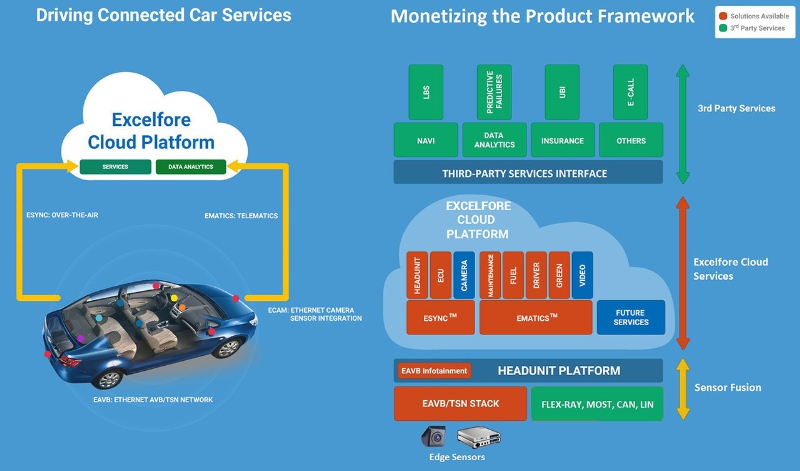
  • CES 2016: Excelfore to launch cloud solutions for intelligent transportation

    Excelfore, a provider of cloud solutions for intelligent transportation, will launch its comprehensive suite of secure cloud and connectivity solutions at CES 2016, the Consumer Electronics Show that will be held in Las Vegas this week.

    Excelfore provides an end-to-end intelligent transportation framework to the automotive industry using a cloud solutions platform along with in-vehicle connectivity technologies.

    Excelfore will demonstrate solutions during CES 2016 in two locations: at the Excelfore Suite (MGM Grand, Las Vegas, Nevada (Jan. 6-8), and at GenIVI Showcase at Trump International (Jan. 6-7).

    ESync enables full vehicle over-the-air update of all vehicle components for the Headunit, multiple Electronic Control Units (ECU) and Telematics units. ESync updates the firmware components (FOTA), and software components (SOTA), including OS, kernel, kernel, drivers and applications.

    Excelfore provides a cloud-based solution for connected car services. (Image: Excelfore)
    Excelfore provides a cloud-based solution for connected car services. (Image: Excelfore)

    Excelfore leverages its patented machine-to-machine (M2M) distributed architecture to support cloud-to-vehicle connectivity and multiple in-vehicle networks including LIN, CAN, FlexRay and Ethernet. New advanced security features include enhanced Hash functions, multiple-levels of encryptions, content-delivery network (CDN) integration and end-to-end security from the cloud to the vehicle-components.

    “Connected cars are revolutionizing the automotive industry,” said Erich Geiger, former CEO of Harman/Becker Automotive Systems. “Excelfore’s EMatics and ESync platform with their advanced security and scalability will help accelerate adoption of innovative solutions for the automotive industry.”

    “By continuing to deliver to the automotive industry over the last several years, our cloud platform has architecture has evolved into a sophisticated offering with advanced security and scalability,” said Shrinath Acharya, CEO of Excelfore. “Within our product framework, we also offer data analytics and monetization by integrating with third-party services. Our platform enables fast and cost-effective deployment solutions for OEMs and Tier-1s.”

    The Excelfore team has delivered OEM programs (US, European, and Japanese Tier-1s and OEMs) and aftermarket automotive solutions to millions of vehicles.

    Highlights of ESync

    • Tailored for automotive headunit and electronic control units (ECUs)
    • Updates headunits, ECUs, telematics units (TU), and IoT edge devices, including cameras
    • Updates using any communication link (over the air, other networks)
    • Ease of implementation of the cloud platform for SOTA/FOTA deployment
    • Key features of the OTA updater
    • Full campaign management capability
    • Secure administration
    • Creation and delivery of packages for faster transmission and updates
    • Complete, differential and incremental software updates
    • Patented adaptive compression and M2M technology

    Highlights of EMatics

    Fleet Monitoring: Access a fleet from anywhere in the world at anytime. Quickly access vehicle information including location, driver, fuel and battery voltage. Monitor vehicles closely when needed using high frequency tracking.

    Automated Service Scheduling: Automatically get timely reminders on upcoming services, and schedule vehicle servicing by notifying preferred vendors.

    Fuel Management: Get detailed fuel data for an entire fleet including usage, consumption and mileage trends.

    Driver Rating: See who the most fuel-efficient drivers are. Get insights on how to improve driving behavior to reduce fuel usage and costs.

    Vehicle Travel History: Get detailed trip information including distance, duration, idling time along with date and time of trips. Easily differentiate personal versus business trips and automate reporting.

    Vehicle Safety: Set geo-boundaries and curfew periods. Get notified instantly when any vehicle violates curfews.


  • Detroit and Silicon Valley Tech showcased at LA Auto Show

    Detroit and Silicon Valley Tech showcased at LA Auto Show

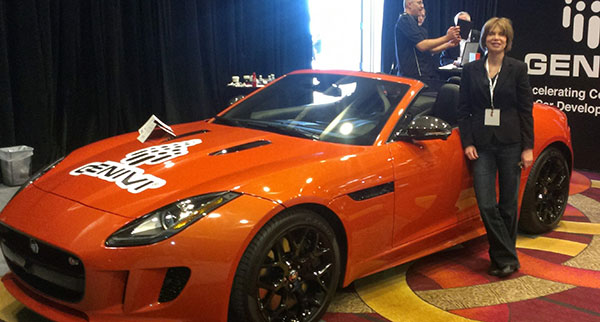
    Janice Partyka at the LA Auto Show with a car representing the GENIVI Alliance, a non-profit automotive industry alliance committed to driving the broad adoption of an in-vehicle Infotainment open-source development platform. (Photo: courtesy of Janice Partyka)
    Janice Partyka at the LA Auto Show with a car representing the GENIVI Alliance, a non-profit automotive industry alliance committed to driving the broad adoption of an in-vehicle Infotainment open-source development platform. (Photo: courtesy of Janice Partyka)

    LOS ANGELES — The Los Angeles Auto Show’s Connected Car Expo, held Nov. 18-19, puts LA at the intersection of Detroit and Silicon Valley. Cybersecurity garnered attention, as did the impact of the sharing economy on connected features. Caution was urged that these new technologies be carefully vetted for safety and reliability, as failures will impede market acceptance. And research shows safety to be one of consumers’ highest valued attributes that connected vehicles can offer.

    Call to action on automotive cybersecurity. Safeguarding the vehicle with its hugely complex supply chain is an enormous challenge. Sensors can be spoofed, wireless sensors and radar can be forged, and cameras can be blocked, warned Andre Wiemerskirch of the University of Michigan Transportation Research Institute. A greater following distance between cars would allow other systems to kick in, should some sensors be hacked. Wiemerskirch appealed for a delay on all connected vehicle features that make a vehicle too vulnerable to hacking until there are better cyber security solutions. He proposed confidence levels for determining the integrity of information coming back from sensors. And he called for a resilient architecture to be created with mature security solutions, such as those used in iPhone security.

    A dependable car hacker? Faith in vehicle reliability is one thing; faith that the vehicle won’t be hacked is another. I was looking forward to Chris Valasek’s appearance once again at the Connected Vehicle Show. He is a skilled automotive hacker, who has helped the industry become more secure. You may have read the account by Andy Greenberg in Wired magazine of how Valesek and a cohort hacked Greenberg’s Jeep (with permission) while he was traveling on a freeway. This included disabling its brakes, accelerator and other core functionality. Valasek didn’t show up for his scheduled talk, which, perhaps, can’t be seen as unexpected.

    How well do they perform? Connected vehicles struggle with performance in certain environments, warned Thomas Form of Volkswagen. More testing and work are needed for automated cars to handle bad weather, particularly conditions in which visibility is obscured, like fog or sandstorms. Unusual objects, such as tumbleweed skittering across the highway, can cause an automated vehicle to make an emergency stop. What would happen when a traffic light is red, but a police officer points to a driver to go, or indicates she needs to stop at a green light? Form exhorted attendees to test all scenarios, even the unlikely ones.

    Will driver skills erode? One attendee asked panelists if with automation, drivers’ skills will become rusty from disuse and be less able to handle manual driving, pointing to the airplane disasters of Asiana in San Francisco and Aeroflot in China. Both flights crashed due to pilots’ confusion with autopilot. The U.S. Federal Aviation Administration (FAA) claims two thirds of pilots make mistakes because of their reliance on technology. A common error is not recognizing that the autopilot has been disconnected. A report from the FAA reads, “pilots sometimes rely too much on automated systems and may be reluctant to intervene.”

    Industry worried about sharing. The exponential growth in the sharing economy and declining interest among young people in owning a vehicle was one theme of the conference. If this becomes a massive disruptive trend in mobility, do we know its influence on the uptake of connective technology? The young are most ready to embrace new technology, yet teenage driver license rates peaked in 1982 and have fallen ever since.

    New mobility options. Millennials, those born after 1980, are showing less enthusiasm for car ownership and driving than their predecessors. Less than 70 percent of those aged 16-24 have a driver’s license. John Zimmer of Lyft reported that 60 percent of their rides in San Francisco and 50 percent of those in New York City are with Lyft Line, a service in which strangers heading in the same direction share Lyft rides. Not only are riders accepting an unknown person to drive them in a personal car, they don’t mind sitting shoulder-to-shoulder with strangers in the intimate confines of a vehicle. Zimmer reported that Lyft is now looking to offer themed cars, such as those showing sports or other types of entertainment on video screens to create new market “verticals.”

    Transforming a personal car into rental vehicle. Cars are vastly under-utilized with the average U.S. household using its cars just four percent of the time with only 1.7 seats occupied on average. This has been duly noted by some car owners, who have created an economy of renting out their vehicles with the help of services like RelayRides. Automakers are taking stock of how Airbnb sliced into the hotel market and are looking at ways to own shared mobility. Ford is one of the OEMs experimenting in the sharing market. Alicia Agius of Ford described Go!Drive, which offers access to a fleet of cars for flexible and affordable one-way journeys throughout London. It also serves to introduce drivers to the Ford brand and build a loyal base among those who become car buyers.

    How are we doing? The intersection of tech and automotive is going remarkably well, and the OEMs are proud of how they have cut long development cycles and become more open to new ways of thinking. Tech has prided itself as the innovators, but a speaker from Google humbly remarked, “The automotive industry has been thinking about the future longer than those of us living in Silicon Valley and working at Google.” A nice tip of the hat.

  • Driverless conference focuses on strategies for autonomous car

    With automakers and Silicon Valley technology companies rolling out their strategies for the autonomous car, keeping on top of the latest technology, worldwide markets and regulation will be critical. Enter Driverless, a conference that will be held March 22-23, 2016, at the Crowne Plaza Hotel, San Francisco Airport.

    Attendees at the conference can find out what technology and markets will prevail from both Detroit and Silicon Valley perspectives from some of the most important executives in the business, explains event organizer and GPS World LBS Editor Kevin Dennehy.

    Driverless will feature more than 30 executive speakers covering the most important issues facing the autonomous vehicle industry. Driverless is an exclusive one-day conference that features an early bird reception on the evening before, a hosted luncheon, and an industry-best two-and-a-half hour reception with more than 15 exhibits from prominent companies.

    Those attending can learn the answers to these questions:

    • What technological, social and legal issues face ADAS and autonomous vehicle progression?
    • What technologies are solving the high cost of rolling out autonomous systems?
    • How can companies adequately test vehicles?
    • How will car sharing revolutionize the autonomous vehicle industry?
    • Who are the most innovative players and what are their intentions?
    • What are consumer expectations?
    • What systems are evolving… and for what markets?
    • Who owns this market? The technology companies or traditional automakers?

    Learn more at the conference website.

  • AT&T and Telogis Expand Efforts to Connect Fleets

    AT&T and Telogis, a SaaS-based connected vehicle technology provider, have announced a collaboration to offer solutions for companies with mobile workforces. Connecting vehicles of all sizes from small trucks to 18-wheelers and heavy equipment, the combination of AT&T’s global network and Telogis’ telematics, compliance, and mobile and navigation software creates full-fleet solutions for businesses around the world.

    The announcement was made at CTIA Super Mobility, being held this week in Las Vegas.

    Telogis works with some of the world’s largest mobile companies to provide the critical data they need for more informed decisions relating to operational efficiency, reducing costs and improving safety. Telogis is the exclusive connected commercial vehicle technology provider for Ford Motor Company, powering its factory-installed Ford Telematics solution. Telogis also works with General Motors, Hino, Volvo, Mack, Manitowoc Cranes and Isuzu to build its solutions into vehicles and equipment in the factory.

    Working with AT&T, Telogis is implementing a network solution to deliver a reliable, highly secure stream of data nearly anywhere in the world. The AT&T service management platform allows Telogis to easily manage the data, devices and services that support its customers. AT&T also is working with Telogis to help with over the air updates and provide unique split billing capabilities.

    “We’re offering Telogis a complete wireless network that enables two-way, real-time data communication between the vehicle and office,” said Chris Penrose, senior vice president, AT&T Internet of Things (IoT) Solutions. “We look forward to driving new innovative services together in the fleet marketplace and offering true global solutions to our mutual customers.”

    “Telogis provides mission-critical intelligence for some of the world’s largest mobile businesses and automotive manufacturers, and our customers demand the quality and reliability that only a provider like AT&T can deliver,” said David Cozzens, CEO, Telogis. “As we continue to capitalize on a rapidly growing, multi-billion dollar global market for connected vehicle and equipment technologies, AT&T provides the scalable infrastructure and backbone Telogis requires.”

    Read more about AT&T’s announcements at CTIA here.

  • AT&T Announces New Personal Security App, Connected Car Collaborations at CTIA

    AT&T Announces New Personal Security App, Connected Car Collaborations at CTIA

    It wasn’t enough for AT&T Mobility President & CEO Glenn Lurie to make just one major announcement during his keynote address at CTIA Super Mobility 2015 Thursday.

    He had to make several.

    Most significantly, AT&T used the stage in front of a packed crowd, including their biggest competitors, to introduce new personal security, fleet tracking and connected car solutions.

    On the personal security front, Lurie announced the Digital Life Personal Security app, essentially a panic button for your smartphone that’s fully monitored and connected to emergency services much like home security and automation components of the Digital Life portfolio. The innovation came from customer feedback that “Digital Life is terrific, but you can’t take it with you.”

    Lurie said this technology was personal to him as the father of a 19-year-old daughter.

    “Imagine the opportunity of a 24/7 monitoring facility taking care of her, the ability for her to hit a button and instantly know where she is and instantly have the police come,” he said. “We’re going to offer to digital life customers and offer to anybody who wants to add this to their smartphone.”

    AT&T also announced major collaborations with connected vehicle technology provider Telogis and automaker Jaguar Land Rover North America. Telogis’ software-as-a-service-based telematics software will allow AT&T to offer full-fleet solutions for business. Telogis is already the commercial vehicle telematics provider used by Ford, General Motors, Volvo, Mack and Isuzu. Meanwhile The AT&T service management platform allows Telogis to “manage the data, devices and services that support its customers,” according to a press release on the AT&T and Telogis announcement.


    With Jaguar and Land Rover, AT&T connectivity will power the infotainment features, including Wi-Fi hotspot, navigation and apps. AT&T had already begun equipping Range Rover models with the technology earlier this month; this announcement is an expansion of that to other Jaguar and Land Rover models, which will come later this year. AT&T customers will be able to share one data plan for their smartphone and car with a Mobile Share Value plan, which is $10 per month.

    “We view the connected car as the next great device in your life,” said Lurie, who also gave a keynote at last year’s CTIA conference. “About half of the cars this year will be connected by AT&T.”

  • Verizon Telematics’ Work on Mercedes mbrace Marks New Standard for Connected Cars

    Mike Peterson
    Mike Peterson

    VP says company remains “bullish”on in-car Wi-Fi, sees need for both embedded, bring-your-own-device solutions


    Mercedes-Benz has been in the news in the past month for offering connected car service as standard for five years on all new vehicles, one of the longest multi-year offers yet. But it isn’t just big news for Mercedes; it’s also a testament to Verizon’s continued investment in connected car technology.

    Verizon is one of the longest tenured telematics providers in the U.S. market and has worked with Mercedes-Benz since 2009, said Mike Peterson, vice president and general manager of OEM business for Verizon Telematics, in an exclusive interview with GPS World.

    “Mbrace has the widest breadth of services, including remote connection for door lock/unlock, remote vehicle start, a feature that consumers have been asking for for a long time as evidenced by after-market industry,” Peterson said. “We’re also delivering diagnostics data to dealers and adding the ability to access certain apps on the head unit without the user tethering their phone — that’s the big new thing.”

    Verizon is exhibiting mbrace at CTIA Super Mobility 2015 in Las Vegas this week. mbrace services include navigation, location apps, remote safety and security features, and advanced travel assistance.

    Embedded connectivity is a more expensive alternative to the bring-your-own-device (BYOD) model. Despite the embedded vs. BYOD debate in the industry at-large, Peterson doesn’t see one way as better than the other.

    “Part of it is always demographics. With Mercedes-Benz customers, while the majority are connected with smartphones, the simplicity of having to use a radio head unit as opposed to their phones will be the right experience to create for premium customers,” Peterson explained. “Other price sensitive brands will continue to see BYOD as the way to go.”

    Peterson admits the decision to equip all vehicles with the service is in part designed to prime customers so that the technology becomes a must-have. But, he adds, that the connected car creates a relationship between the manufacturer and consumer that benefits both, particularly with regard to safety.

    While Verizon is the telematics provider to six OEMs in the U.S., including Volkswagon and Hyundai, Peterson doesn’t take the credit for decisions like the one Mercedes made when extending mbrace’s reach.

    “I would call it a partnership heavily influenced by automakers. At the end of the day, the automaker decides what equipment to put into their vehicles. We provide all service, but they very much protect what goes into their car.”

    One feature of mbrace that Peterson calls “a big deal” is the ability to turn your vehicle into a Wi-Fi hotspot. It’s a feature that has gotten caught between customer demands and regulator concerns that those increased demands will lead to spectrum-sharing that hampers the progress of vehicle-to-vehicle (V2V) communications.

    “We are quite bullish on Wi-Fi in the car. You’re already equipping the vehicle with a connected device that’s Wi-Fi capable,” Peterson said. “We’ve done considerable research, and it’s all come back very positive.”

  • Nokia’s HERE Maps sold to BMW, Daimler and Volkswagen

    Nokia’s HERE Maps sold to BMW, Daimler and Volkswagen

    Photo: Nokia

    After months of negotiation, Nokia will sell its HERE Maps division to a consortium of German automakers — BMW, Daimler and Volkswagen — for $2.71 billion, according to the TU Automotive website.

    Under the agreement, HERE Maps would turn into an open platform that all car manufacturers can use for navigation and mapping inside vehicles, giving automakers independence from companies such as Google for maps and navigation at a time when the technology moves toward the connected and self-driving car, which rely on navigation technology.

    The three German car makers plan to offer the platform to Fiat Chrysler, Renault, Peugeot, Ford, Toyota and General Motors, allowing them to use the mapping service for free without licensing issues.

    Nokia is selling the entire unit of HERE, meaning the car consortium will likely continue hiring developers to work on the platform. Companies like Chinese search giant Baidu and Facebook use HERE Maps to power its own mapping services. It remains to be seen how the new deal will affect those services.

    In related news, TomTom announced a new initiative with Bosch — providing high-precision maps for automated vehicles that Bosch is testing in Germany and the U.S.

    “Only with high-precision maps will automated driving on freeways be possible from 2020,” said Bosch board member Dirk Hoheisel. TomTom says it plans to have new high-precision maps for automated driving for all freeways and freeway-like roads in Germany by the end of 2015.