
Tag: connected cars

  • What Mattered at CTIA

    What Mattered at CTIA

    The morning sunlight steams into the Sands Expo Center.
    The morning sunlight steams into the Sands Expo Center.

    To those attending CTIA’s Super Mobility Week in Las Vegas September 9-11, it was clear that we’ve entered a period of divergence. Sensors, multiple platforms, all sorts of devices, computing in clouds, processing in clouds, car companies, connected houses, smart watches and indoor location positioning are being touted as part of the “Internet of Things” that will work together seamlessly. Some day. The connected car was a highlight of the show and Ford held (purportedly) the automotive industry’s first developers’ conference. The exhibit floor was jammed with machine-to-machine (M2M) solutions, some positioned for the Internet of Things, most for traditional telematics. In the past, wearable devices were in the show’s fringe, but new smart watches have mainstreamed wearables.

    Telematics solutions were plentiful at CTIA, but these companies are all looking for new markets. The second-largest telematics market in the world is China, but it has been a bit of a mystery. C.J. Driscoll and Associates’ report on the Chinese commercial telematics market was just released. “There are five million fleet vehicles in China that use a tracking system,” says Clem Driscoll. “Regulations are part of the impetus for telematics, but the cost of transporting goods in China is very high, so economics play a role in the adoption.” Almost all telematics devices sold in the U.S. market are being manufactured in China.
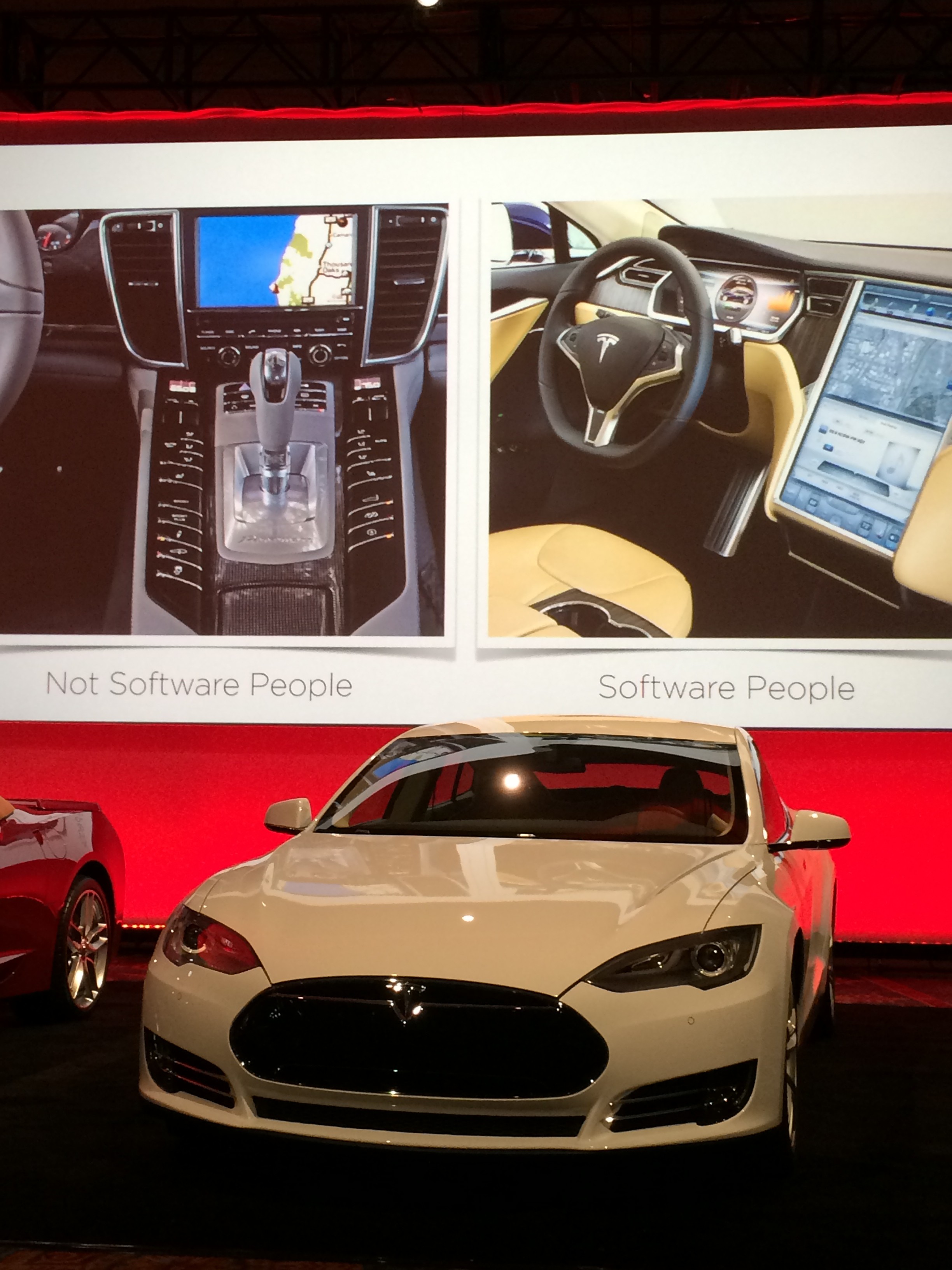
    Jeff Lawson, CEO of Twilio, comparing "hardware people" and "software people," says Tesla's Model S interior forgoes extra buttons for useful, adaptable software.
    Jeff Lawson, CEO of Twilio, comparing “hardware people” and “software people,” says Tesla’s Model S interior forgoes extra buttons for useful, adaptable software.

    Ford, a newbie at CTIA, entered the conference with a bang, hosting what it claimed to be the first developers’ conference for the automobile. Developers from 17 countries participated and received access to simulated vehicle data, including speed, fuel economy and GPS, based on data from Los Angeles. As the night wore on, I expect the floor was littered with spent energy drinks, coffee and pizza in the all-night coding session. Currently, there are 60 apps developed for Ford; the company forbids apps with games, videos and complicated demands on the driver. Ford had been at the forefront of the connected vehicle and already has connected collision avoidance, adaptive cruise control, smartphone integration, and parallel parking assistance.

    GM is furthest ahead in bringing cars to market with embedded connectivity and, unlike Ford, has plans for an app store. Embedding connectivity into the car greatly deepens the functionality of car apps and also allows for over-the-air updates of firmware and software (FOTA and SOTA). Maintenance issues can be caught quickly. “Software and firmware updates save OEMs the $400-$500 that it costs each time a vehicle is serviced at the dealer for a recall,” said Egil Juliussen of market research firm IHS. “Currently, 70 percent of recalls come into the dealers, but with over-the air-updates, I expect about 95 percent of car owners will obtain updates.” Juliussen expects to see self-driving vehicles on highway lanes in 2017, followed by automated lane switching and local road driving in 2025. His assessment is consistent with other automotive experts.
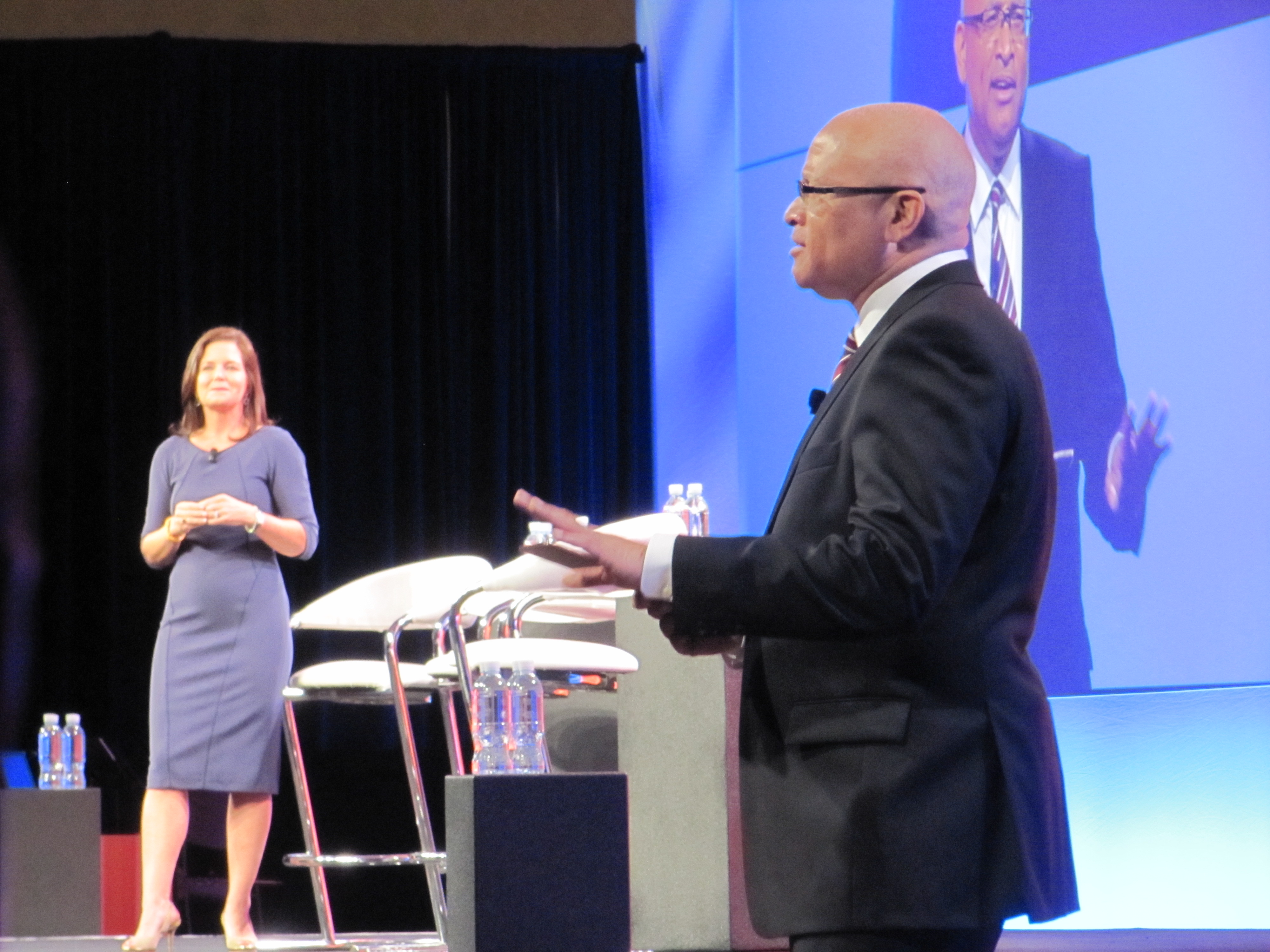
    CTIA President Meredith Atwell Baker laughs as The Daily Show's Larry Wilmore provides news updates between opening keynotes.
    CTIA President Meredith Atwell Baker laughs as The Daily Show’s Larry Wilmore provides news updates between opening keynotes.

    Besides pleading to the FCC for more spectrum, most keynote speakers talked about technologies or products that require LTE (often called 4G) for fast connectivity. GM, in partnership with AT&T, leads U.S. car makers in LTE deployment. The 2015 Chevrolet Malibu is the first 4G LTE-equipped GM vehicle, to be followed by more than 30 more GM models by the end of the year. In 2016, GM plans to roll out “Super Cruise” for hands-free highway driving, at both highway and stop-and-go speeds, as well as lane following, speed control and braking that will be available in an undisclosed Cadillac model in 2017.

    To spur usage, a three-month free data trial is being offered by GM, and 90 percent of owners with cars equipped with LTE are participating. Billing for in-car connectivity is complicated. Few OEMs have a mechanism for collecting ongoing fees, such as for data services. With the GM offering, current customers of AT&T can add a car (similar to adding another phone) onto a phone plan for $10 per month. Otherwise, data can be purchased in increments, the same way some pre-paid phone plans work.
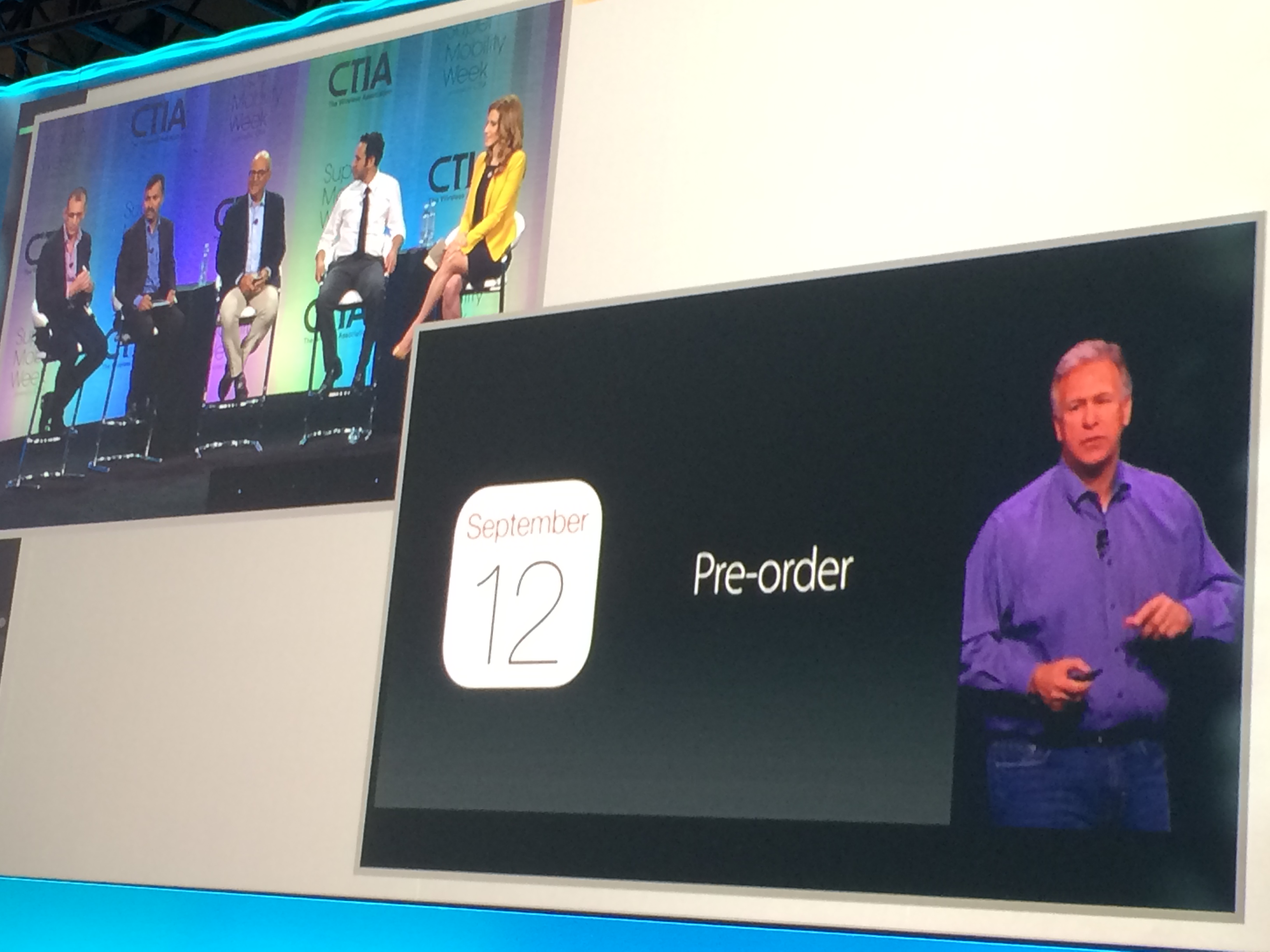
    CTIA fielded a panel of experts moderated by CNBC's Julia Boorstin to respond to Apple's Live Event.
    CTIA fielded a panel of experts moderated by CNBC’s Julia Boorstin to respond to Apple’s Live Event.

    Google and Apple each want to get a proprietary connected platform into vehicles as a way to control the integration of apps with vehicles, as well as to “own” the ecosystem. The traditional automotive players, including the OEMs, have banded together to create MirrorLink, a collaborative, standards-based non-proprietary platform, an effort facilitated by the Car Connectivity Consortium. MirrorLink is being created by collaborators from 105 countries who grapple with standardization issues. “The biggest concern we have right now, is how to get the platform distributed throughout the world,” remarked Alan Ewing of Car Connectivity Consortium. “In three years we will be talking about the ecosystem of apps, and you will see 100 more times than what we see today.” Who prevails with this platform — MirrorLink, Apple or Google — will have a huge advantage.

    The location services that deliver content to vehicles and devices have been in the foreground, but there is a quieter category of location services. Companies like LocationSmart and Locate are automatically identifying the location of customers (with permission) for enterprises that include asset management, mobile gaming, financial security services, and customer management services. Initially, the services were based on identifying the location of callers to customer service centers, who could then route callers accordingly. A broader set of use cases is now seen. “We’ve moved far beyond traditional location determination,” says Mario Proietti of LocationSmart. “For instance, LocationSmart is providing financial service companies with the location of a customer’s phone, which is matched with the location of financial transactions.” If a credit card is being used at a store in Chicago while the customer’s cell phone is in Miami, fraud may be involved.

    An engaging heat map of all attendees in the exhibit hall demonstrated the power of indoor positioning. On the hall’s ceiling, Mexia Interactive installed Wi-Fi/Bluetooth sensors to receive attendees’ cellular signals. The sensors were spaced at about every 10,000 square feet. Mexia has the distinction of being the only exhibitor mentioning a bathroom use case. A customer is using the sensors to keep 90 bathrooms clean. After the sensor receives signals from a set number of phones, the cleaning staff receives an alert to service the bathroom.
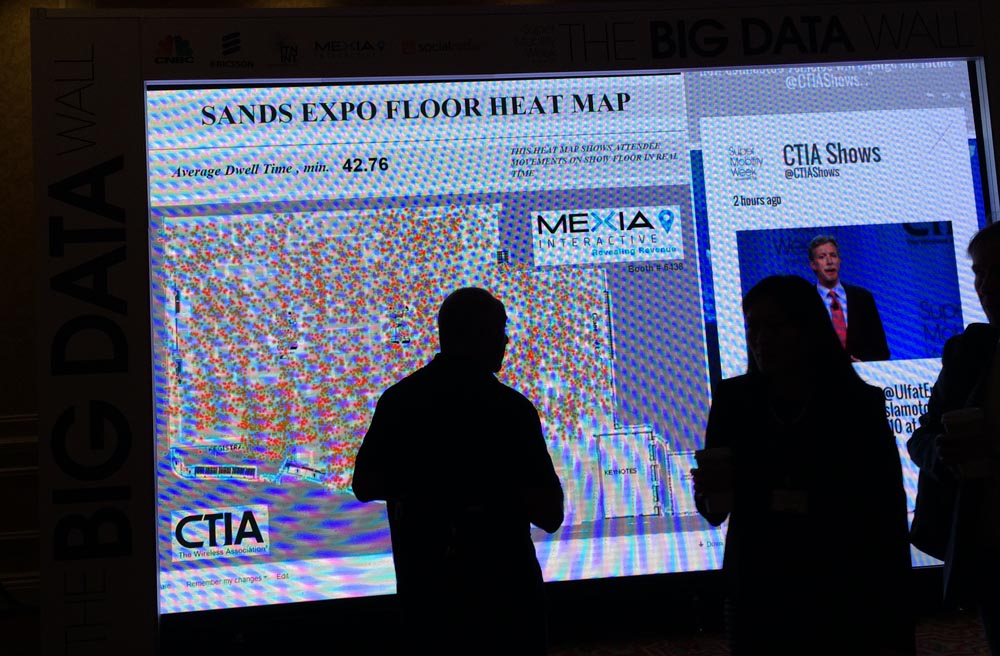
    The show floor heat map, by Mexia, uses sensors throughout Sands Expo to show where people are connecting to Wi-Fi.
    The show floor heat map, by Mexia, uses sensors throughout Sands Expo to show where people are connecting to Wi-Fi.

    Things people said:

    • “Wearable smart watches are not quite enough to get everyone to buy one.”  — Steve Mollenkopf, CEO, Qualcomm
    • “Wearables are highly unregulated. Experiential apps will always have a privacy component.  The most privacy-sensitive areas are fitness, health and children.” — Rudy Zefo, Vice President, Intel.
    • “Of consumers looking to buy a car within the next two years, 50 percent are willing to switch brands to get connected services.” — Ralph de la Vega, President and CEO, AT&T Mobile and Business Solutions.

    What will we be talking about at CTIA 2015? I’m betting that we will still be focused on the connected car and the Internet of Things.  I expect to see more automotive and indoor location companies, and of course, smart watches. And yes, there will be more pleas for added spectrum.


  • CTIA Connected Car Panel Highlights Safety, Innovation

    When comedian Larry Wilmore started out Day 2 at CTIA Super Mobility Week by reporting from a connected car on the show floor, he was only half joking when he said, “It’s almost like you’re driving in a smart phone, and with smart phones getting bigger it’s not too far off. I think I saw an HTC this size.”

    The experts in the keynote Connected Car panel agreed: The car is the new smart phone.

    Just ask Ralph de la Vega, CEO of the just-formed AT&T Mobile and Business Solutions Group, who called the Chevy Corvette “the best smart phone I’ve ever gotten to test.” The Corvette was conveniently displayed next to the stage, along with a connected Tesla Model S.

    As CTIA CEO Meredith Atwell Baker pointed out, what was once relegated to the CTIA show floor is now in dealerships all across the U.S. The statistics thrown out by de la Vega supported this observation. Thirty-two percent of new cars sold globally (and 60% of new cars sold in the U.S.) by 2017 will be embedded with cellular technology. Seventy-two percent of people would delay a new car purchase one year to buy a connected car by their preferred automaker.

    De la Vega co-moderated the panel with Glenn Lurie, his successor as CEO of AT&T Mobility. Panelists representing General Motors/OnStar, Ericsson, VoiceBox and Tesla overwhelmingly agreed that the emphasis on the connected car going forward has to be safety.

    “[Drivers are] trying to fill the time and be productive. People naturally want to do that. They’re going to bring the phone in, reach over, grab it and try to do things. And the more capabilities, the more they’ll do it,” said Mike Kennewick, co-founder & CEO of VoiceBox, maker of natural language technology. “It’s imperative as we bring the Internet into the car, there’s a component that allows you to do it safely.”

    What that would mean, exactly, though, was a matter of opinion. Each panelist had a chance to discuss their company’s recent and coming advancements.

    • De la Vega says AT&T’s studies show people prefer a shared family data plan that would allos them to share data across people and across devices, and a belief by the wireless provider that customers should be able to add their cars to their rate plans.
    • GM has successfully integrated 4G/LTE into 33 different models in the U.S. and Canada and next plans expansion in Europe, Mary Chan, President of Global Connected Consumer at GM shared.
    • VoiceBox’s Kennewick calls the voice recognition in cars today “just like the movies” but says VoiceBox strives to simplify the apps in cars and make voice activation less about reiterative command-and-control.
    • Telsa, a leader in over-the-air auto updates, will be launching a mass market car “in a few years” and is now exploring how best to keep the customer experience focused in the car. Tesla CIO Jay Vijayan also said the company is considering opening up its infotainment stystem to other partners.
  • AT&T to Host Hackathon, Demonstrate Connected Platforms at CTIA

    AT&T will be a major participant during CTIA’s Super Mobility Week in Las Vegas next week. Connected car, connected home and wearables will all be on display throughout AT&T’s activities:

    • The first AT&T Hackathon to take place at CTIA will give developers access to new APIs for the car and home.
    • A 60-foot x 40-foot booth showcasing the latest Connected Life products.
    • A keynote address delivered by AT&T Mobile and Business Solutions President and CEO Ralph de la Vega and AT&T Mobility President and CEO Glenn Lurie, in which they will host a panel on the Future of Connected Car.

    AT&T Hackathon at CTIA 

    AT&T is kicking off the week’s events with its very first CTIA Hackathon, Code for Car and the Home, which will match developers with companies, tools and services to innovate in the connected car and automated home marketplace.  Developers will turn ideas into apps using APIs and other technology resources from 30-plus industry sponsors. More than 300 developers are expected to compete in the two-day Hackathon which begins at 10 a.m. PT on Saturday, September 6, in the Chelsea Theater at the Cosmopolitan Hotel. More than $100,000 in cash and prizes are available.

    Connected Life Booth

    When the Super Mobility Week show floor opens at 11 a.m. PT on Tuesday, September 9, AT&T will showcase the latest in wearables, connected cars and homes. Volvo and Audi will demo their connected car experiences and a simulator will be on-site to showcase AT&T Drive, the company’s connected car platform. AT&T Drive is a modular, global solution that allows automakers to pick and choose what services and capabilities are important to them in order to differentiate their solutions in the marketplace.

    Attendees can also explore how to stay connected to the home by visiting the AT&T Digital Life station. Digital Life is an all-digital, all-wireless automation and home security platform that equips customers with control of their homes from virtually anywhere.  On-site activations will include demos such as augmented reality so visitors can learn about the Digital Life service and products, an interactive wall to experience the simple, easy to use Digital Life app and a hologram home to showcase how Digital Life integrates everything you need in one place, to help make your life safer and easier, and provide you with more freedom to live your life.

    AT&T is the leader in emerging devices and will showcase the latest wearables from Fitbit, Jawbone, LG, Martian and Pebble. Additionally, Timex, the first authentic watch brand to enter the smartwatch space, will be on-site showcasing the new Timex Ironman One GPS+. The new smartwatch is the first GPS-connected fitness watch to connect to the mobile internet wirelessly, transmitting performance data, location, messages and more.

    Also on display will be the AT&T EverThere and FiLIP safety devices.  AT&T EverThere is a small wearable device that can detect falls and quickly identify location, automatically connecting the user to a 24/7 call center for response and support. FiLIP is a smart locater for kids that keeps parents and kids in touch at the push of a button.

    The  booth, number 4423, will be in the Connected Life section of the show floor at the Sands Expo and Convention Center. Visitors can locate the booth by using the interactive floor plan.

    Connected Car Keynote

    On Wednesday, Sept.10, Ralph de la Vega, president and CEO, AT&T Mobile and Business Solutions and Glenn Lurie, president and CEO, AT&T Mobility, will wrap up the show when they take the stage to discuss the Future of Connected Car.

    The following guest panelists will join them on stage to discuss this rapidly growing landscape:

    • Mary Chan, President, Global Connected Consumer, General Motors
    • Arun Bhikshesvaran, CMO, Ericsson
    • Mike Kennewick, Co-Founder and CEO, VoiceBox
    • Diarmuid O’Connell, VP, Business Development, Tesla Motors

    The keynote will kick off at 9 a.m. PT.

  • Agenda, Speakers Announced for Connected Fleets USA

    Telematics Update has announced the agenda and speaker line-up for Connected Fleets USA 2014, formerly known as Telematics for Fleet Management USA. The conference and exhibition will take place November 20-21 in Atlanta, Georgia. The early registration discount ends September 26.

    As growth is seen in goods movement and driver shortages, integration of the connected fleet in the supply chain, service bays, and transport infrastructure is crucial to maintain growth in the U.S. and abroad. Experts anticipate that there will be more investment, mergers and acquisitions, and consolidation in a rush to deliver the best-in-class solution to drive fleet optimization.

    The speakers just announced to take the stage at Connected Fleets USA will be reflecting this change. They include some of the largest fleet rental/leaser, OEMs and companies from across the value chain such as Donlen, Hertz Equipment Rental, ARI, Ryder, Daimler, John Deere, Microsoft, Los Angeles County Metropolitan Transportation Authority and up-and-coming start-ups like Peloton Technology and Metro Tech, Inc.

    Connected Fleets USA 2014 will look into ways to capitalize on the integration of solutions in the supply and create solid partnership models that will increase profitability and drive the connected fleets in the mature North American market

    “It will be critical that companies evaluate the opportunity present from the integration of connected fleets into the wider enterprise and embrace key breakthroughs in the wider connected ecosystem to create an indispensable connected vehicle service package to add value to fleet operators and carriers,” Daniel Pavey, Connected Fleets USA 2014 project director, said.

    Topics and Trends

    The trends and topics to be discussed include:

    • Connectivity is the future of transportation. Explore case studies and the roadmap for autonomous vehicles and V2V/V2I technology that can be leveraged to improve transport infrastructure, mobility, goods movement and traditional fleet manager needs.
    • Enterprise and telematics converge. Integrate vehicle and telematics data to the wider connected ecosystem,  including enterprise resource planning, work order management and maintenance bays to map opportunities where connectivity can ease bottlenecks in the supply chain.
    • Complete the leasing puzzle. Overcome the complexities of fleet leasing by integrating back-end analytics from embedded and aftermarket solutions for a seamless approach for improved driver performance and vehicle life-cycle to engage government, small local and large long-haul fleets.
    • The law of connectivity. Review current and potential proposals for data logging and vehicle-to-vehicle communication to assess legal opportunities and challenges for automated and connected vehicle technologies including liability, litigation and privacy to anticipate potential roadblocks.
    • The investment drive. Investigate the motivation and strategies of private equity, industry players, and government investment, including improving congestion and road safety, widening portfolios and entering new markets to position solutions for investment.
    • Smarter services through data sharing and analytics. Crack open the OEM platform to create a sandbox of data that combine vehicle, driver and environmental data to offer a more precise service portfolio.

    Other sessions will be held on topics such as integration with the advanced connected transport project; commercial data ecosystem, platform and partnerships; and exclusive case studies and panel discussions from Donlen, Hertz Equipment Rental, ARI, Daimler, John Deere and Volvo.

    For the complete Connected Fleets USA 2014 conference program and speaker line-up, visit the conference website.

    Newly Announced Speaker Line-up

    The connected fleet specialists set to speak this year include:

    • Nick Ehrhart, Vice President Business Development, Donlen
    • Mike Dennis, Group Director Maintenance Operation, Ryder Systems, Inc.
    • Casey J Littleton, HERC Global Product Manager – Telematics, Hertz Equipment Rental
    • Shawn Meredith, Manager, Strategy & Product Management, Daimler Trucks North America
    • Conal Deedy, Director, Connected Vehicle Services, Volvo Trucks
    • Edward Olson, Program Manager, Telematics, John Deere Power Systems
    • Ernesto Chaves, Transportation Planning Manager, Los Angeles County Metropolitan Transportation Authority
    • Peter Vanderminden, Industry Manager, Manufacturing & Supply Chain, Microsoft
    • Mohammad Poorsartep, Research Scientist, Texas A&M Transportation Research Institute
    • Joshua Switkes, Founder and CEO, Peloton Technology Inc.
    • Christian Kotscher, CEO, MetroTech Net Inc.
    • Clem Driscoll, President, C.J Driscoll & Associates
    • Scott Mattson, Director, William Blair & Co

    and many other specialists from across the value chain. The full speaker line-up is available on the website.

    For the complete Connected Fleets USA 2014 conference program and speaker line-up, access the e-brochure or contact the Telematics Update team at [email protected]. Register before September 26 to take advantage of a $300 saving on all conference passes.


  • Connected Car Isn’t a Smart Car

    Janice Partyka
    Janice Partyka

    The most interesting thing in mobile and location in 2014 is the connected vehicle. Back in the early 1990s, a bigger vision of smarter highways began to be explored. The technology was refined, and resulted in successful demos of cars talking to each other and to roadside infrastructure like traffic lights. If you lived in Southern California, you might remember seeing platoons of automated vehicles zipping along a closed section of Route 15.

    Since those heady days, the timing and visioning for smart highways and vehicles were tempered by the massive cost of the infrastructure required. Now we are seeing the “connected vehicle” starting to roll out of the doors of dealerships, but with a different and more limited type of connectivity than we started to envision in the 1990s.

    Reminiscent of the mission started decades ago, a new year-long “smart car” project and demo will be held in Ann Arbor, Michigan. The objective of the smart car project is to determine whether wireless communication between vehicles can improve safety  Three thousand cars, buses and trucks will utilize data recorders and a technology similar to Wi-Fi that can transmit information about accidents or hazardous traffic conditions.

    Drivers participating in the demo will be warned of sudden changes in traffic patterns or potential collisions through data transmitted from similarly equipped cars and roadside devices. Eight major automakers will provide vehicles and engineering assistance to the study.

    Currently, some new car models are equipped with active safety devices that can alert drivers if they are drifting out of a traffic lane or traveling too close to another car. But the smart car demo differs because will share safety information with other smart cars on the road.

    The smart car system can give drivers visual or audio warnings about sudden traffic changes experienced by another connected vehicle. Several cameras installed in the connected vehicles will also capture data on how the drivers respond to accidents and sudden changes in traffic conditions.

    Today’s connected vehicle is sometimes referred to as a smartphone on wheels, a limited vision of what can be. Now is the time to determine if the savings of fewer accidents or increased capacity on our roads will outweigh the cost of new infrastructure and added functionality in vehicles.


  • Security, Spectrum in the Connected Vehicle

    Bethany Chambers
    Bethany Chambers

    With fall tradeshow season fast approaching and 2015 vehicles hitting the road, Scott McCormick, President of the Connected Vehicle Trade Association (CVTA), took the time to answer some questions for GPS World about one key conference, CTIA’s Super Mobility Week, and what to expect in the connected vehicle market for the second half of 2014. The CVTA is a nonprofit industry group dedicated to accelerating technologies in the consumer and commercial auto market. CVTA will be well represented at Super Mobility Week, with about a third of its membership comprised of companies involved in the wireless industry. However, McCormick won’t be in attendance in Las Vegas; that’s because he’s a member of the organizing committee and will be moderating sessions at ITS World Congress, being held that same week in Detroit.

    Do you think that ITS World Congress will end up cannibalizing the connected vehicle crowd from Super Mobility Week?

    Yes, I think it will a lot. Most of the connected vehicle companies don’t work solely in DSRC, they work in cellular and WiFi, too, so it really depends on where their business needs are. The company with the large multinational presence will certainly be at World Congress because that’s where the networking capability is, while CTIA will be most of the cellular providers. It’s about connecting with your channel partners, your supply base and your potential customers. It’s not really about seeing new technologies, but about engaging new customers.

    Will CVTA make any announcements at the shows?

    On September 11, we have our summit [The 5th Summit on the Future of the Connected Vehicle] and we do have a major announcement about a new service that we are going to be providing.

    Can you tell us more?

    What we are announcing is about doing something that will help benefit collaborative industries. We have our core industries, but there are now insurers, data mining companies, security companies, all these other companies that are not in the automotive space that are doing things related to it. A few years ago we had people in Silicon Valley begin working in the automotive space but they didn’t understand the user interface in the car, where you need to have control and return your attention to driving as quickly as possible. All the devices they knew were designed to focus your attention. It’s the same thing today: The insurers don’t know how to work with the automakers. Neither did the telecoms. They’re completely different business models, but they’re channel partners. This is not just about a company to hire, but where can we gain utility and expertise.

    So your announcement will be about reaching into a second tier of companies that just a few years ago were not involved in the connected vehicle space?

    That’s a perfect way to characterize these companies; they all have to deal with interoperability issues.

    What will be the hottest topics at Super Mobility Week? 

    There will be three: privacy, data ownership, and security. Security is the only one that’s important, and it’s for simple reasons. The United States has no personal privacy data law and it never will. The issue is one that we’re not going to solve. Everybody wants to talk but nothing ever comes of it. 

    The same question with data ownership. Why would my privacy or data ownership be device-specific? It should be device-agnostic. Anytime you transfer data, there are two levels of ownership. Of the data in the connected vehicle, an infinitesimally small amount is related to location or driving behavior. Although we talk about privacy and data ownership, nobody’s going to define data ownership. 

    Security, however, is a huge issue, because once you clear a gateway into the system, it can be breached. I’m not concerned about terrorists, it’s more just teens with nothing to do who want to rock the system. I’m most concerned about the insufficiency of the code. There’s an average of 43 networks in a car, and while they’re not likely going to affect braking, that doesn’t mean if you tinker with things long enough you couldn’t figure it out and remotely control functions. That’s really sophisticated and of very low value to do it to one vehicle. 

    It’s more important to ask if the overall infrastructure is protected. Systems have to be designed to be secure, detectable, and reparable. It’s incumbent upon cellular companies to take that responsibility.

    Will they accept that responsibility?

    If they don’t, people won’t use it. Now we understand that when a car is purchased it’s based largely on the perception of quality of service, not just on the quality of the engine or the comfort of the ride … it’s about how long until my connection breaks off and why didn’t I know about that traffic jam or that this road was icy if another guy did in a different make and model car.

    How do you think this year’s show will be different from last year’s show?

    Last year a lot of industries were still coming off the recession and going back to core competencies. This year I expect to see a lot of innovative companies coming out with much more focused sort of innovation where in the past it was about trying to be everything to everybody. In particular, the connected life stuff is going to be interesting because those are the people that when you look at it you’ll say, this is something I haven’t seen before or wasn’t aware of and it’s new and consequential.

    The automakers will be a part of a lot of those discussions. Do you think we’ll hear anything new?

    There will be some talk about the aftermarket. The average person keeps cars for 11 years. Now if I just bought a new car and next year someone has something really cool, I can’t just go buy a new car. But if I could add it … now there’s another revenue stream for the OEMs.

    What are some innovations you think we’ll see hitting the market in the next year?

    The machine-to-machine market is going to have a lot. Also, I just read a report that a lab figured out how to do 1000-times the data transmission speed of the fastest fiber-optic system by running it across copper. We have certain sized pipelines today and a certain time to get data from here to there, and we’re exploring how we can best do that with what we have.

    By all estimates the global connected car service market is expected to top $130 billion by 2019. What will fuel that growth the most? Safety and security? Infotainment? And is that growth sustainable?

    By 2020 we’re looking at a $200 billion market … and that’s going to be because of security. The problem with the automotive industry is that they have a very difficult time communicating the value proposition, because they’re used to selling business-to-business. But in the cellular industry you don’t question paying several hundred dollars a month for your phone, because they communicate that well to consumers. So the question is really one of both developing the product and service and understanding the consumer.

    CTIA has talked a lot about safe driving policy and distracted driving legislation. Where do you see this policy going in the next year? 

    I see the federal government moving at a glacial pace. They were 2 months late on the vehicle-to-vehicle report, they were supposed to work on the interstate commercial vehicle rule, and they’re struggling with a transportation authorization bill that’s not anywhere near where it should be. There are things that the federal government needs to be involved in and things they have no business being involved in, like setting standards. The automakers will do what the consumers want.  Look what happened with backup cameras. Even before there was legislation requiring backup cameras because of kids being hit, the automakers decided to put it on certain models because the consumers wanted it.

    What policies will come into play in the next year? 

    One is very critical. The American Jobs Act is pushing to allow unlicensed devices to use the 5.9 (GHz) spectrum (currently allocated to licensed Intelligent Transportation Systems), and we have conveyed what a bad idea that is. The FCC has tested it in lab conditions, not with hundreds of cars at an actual intersection. This is not like connecting a toaster and refrigerator, this is hundreds of people in the backseats of cars attempting to connect and disconnect (to WiFi). That’s the equivalent of a denial-of-service attack. Unless we deal with this soon, it’s going to be a real safety risk. The problem is once the spectrum gets reallocated, it’s going to be really hard to take it away.

  • Association Says Indoor Location Technology Not Ready

    Association Says Indoor Location Technology Not Ready

    Kevin Dennehy
    Kevin Dennehy

    Not everyone is talking up the accuracy of indoor positioning. Arlington, Virginia-based Telecommunications Industry Association says the technology, which is seen as the one way location-based services providers will be able to capture consumer interest, is not ready. In other LBS news, AT&T has come out with data pricing for its connected vehicle initiatives.

    In a recent FCC filing, the Telecommunications Industry Association said that indoor positioning technology is not sufficiently developed to support ongoing wireless E-911 location accuracy requirements.

    While TIA supports the FCC’s goal to improve location accuracy, “Imposing location accuracy mandates at this time would be premature, given the nascent stage of the technology that will be needed to accomplish the Commission’s objectives, and should neither favor nor disfavor specific technologies,” said the association in its filing.

    The NPRM proposes a requirement to achieve “rough” indoor location information, TIA said. It proposes to require providers to provide horizontal information for wireless 911 calls that originate indoors, specifically a caller’s location within 50 meters.

    TIA also disagrees with an FCC proposal to require mobile operators to provide z-axis, which is vertical location within 3 meters of a caller’s location, for 67 percent and 80 percent of indoor wireless 911 calls — ranging from three to five years after adoption. Again, TIA says that the technology is not fully developed.

    TIA quoted AT&T’s filing: “[The] time [is] right to begin discussing Indoor Location Accuracy for E-911” but the “FCC should be careful to ensure that any proposed rules on location accuracy are aligned with proven capabilities of the current state of technology and they should set realistic accuracy benchmarks that the industry and public safety can embrace.”

    The location industry has been counting on indoor positioning, with its beacons and Wi-Fi enhancements, to jump-start a location-based services market that always seems to have tremendous potential, but the numbers don’t back it up. Some big-time analysts have said that while the promise of indoor positioning is huge, it just isn’t there technically yet.

    In fact, one analyst said that the biggest technological breakthrough last year was indoor mapping. Such major retailers as Home Depot and Lowes launched indoor maps with product search locators. These same analysts say that indoor Wi-Fi positioning is not accurate enough for macro location.

    The big deal coming up is how FCC positioning accuracy regulations will affect beacons or Bluetooth low energy for micro location and proximity services.

    TIA said it supports initial FCC location accuracy requirements back to 2007. However, don’t ask TIA for more location regulation. “To date, the development of 911 and E911 location accuracy technologies and applications has been fostered by a voluntary and consensus-based standards process. This process has proven quite successful to date, and the Commission should refrain from imposing regulations that could slow additional development,” the association said.

    AT&T Announces Connected Car Pricing

    AT&T Mobility said standalone pricing for new LTE-enabled OnStar service will be $5 or $10 per month, depending on whether the driver is an OnStar subscriber. The company said it will allow customers, with a GM LTE-capable vehicle, to add the car as another device for $10 — which is the same price as a tablet.

    OnStar subscribers will get coverage ranging from $5 for 200 MB of data per month to $50 for 5 GB. GM is also allowing customers to buy one-time data packages.

    At this year’s CES, General Motors announced its first LTE-enabled vehicles — in which AT&T Mobility is powering the LTE network for GM’s OnStar service. The first LTE-enabled vehicles, which will be available this summer, are Impala, Spark, Volt, Orlando, Spark RV, Silverado, Silverado HD, Malibu, Equinox and Corvette Stingray. GM plans to have 30 Chevrolet, Buick, GMC and Cadillac vehicles LTE-equipped by the end of the year.

    AT&T also made recent deals to provide connectivity for Ericsson Connected Vehicle Cloud which connects to the AT&T Drive platform for automakers.

    CEA Hosts CES on the Hill

    Members of Congress and their staff had the opportunity to observe location technology during the Consumer Electronics Association’s recent CES on the Hill event in Washington. Exhibiting companies include Origo Safe, distracted driving; AT&T Drive; DashIt; Qualcomm, which showed off a geofencing product around schools; and RideScout.

    Washington-based Ridescout is a cool, and free, mobile app that allows a user to find the nearest subway, bus, taxi, bikeshare, sedan service, carshare, pedi-cab or carpool. A user can choose from a list of options by proximity, cost or arrival time.

    “We launched in November in Washington, D.C. We are in Austin, San Francisco, Boston, Chicago and planning several new markets,” said Steve Carroll, Ridescout vice president of operations.

    The app, which is on the iOS and Android platforms, generates revenue by sharing with the ride providers, large organizations and universities and the public transport network, Carroll said.

    Some of Ridescout’s partners include Mozio, RidePost, Metro of Washington, Bandwagon, Sidecar, Car2Go, Arlington Transit, Capital Bikeshare, Yellow Cab, DC Circulator and Dash.

    RideScout, founded by two Army veterans, was hatched when founder and CEO Joseph Kopser wanted an application to show him the best way to get to work in the Washington area. He could not find one and started the company with Craig Cummings. The company initially launched an alpha product at South by Southwest in 2013.

    Though it was the first to combine all modes of transportation in a single application, the company has some competition. Of course this competition is from the 800-pound location gorilla, Google.

    Google, with its Google Maps platform, shows the directions to the nearest transportation mode. Now it is incorporating Uber, which is an on-demand transportation provider.

    This is not the first time Google has launched a product in an effort to dominate a market place or niche. When it launched Google Maps in 2009, it put the hurt on many companies in the location industry, which underwent a three-year period of consolidation, company closings and layoffs.

  • DeCarta Search Engine for LBS Expands to 120 Countries

    deCarta, Inc., an independent LBS platform company, has expanded coverage of its advanced local search technology, the L2 Geospatial Search Engine, to 120 countries including Europe, North America, and most major countries around the world.

    L2 is a high-performance, scalable local search engine with single line input to enable a more intuitive user interface, the company said. deCarta sources and indexes premium map and POI (Points of Interest) content but also enables customers to index and control their own content using the L2 Index tools.

    deCarta’s L2 has advantages over most other search engines in that it can be used as a pure geocoder for address search, or for POI search….or simultaneously as a combination of the two mixed in a single line search query – with the additional ability to tune this behavior at runtime. This gives developers maximum flexibility and creativity in producing their mobile and desktop applications. The new expanded country coverage now enables deCarta customers to offer truly global services.

    The L2 Search engine is an integral component of deCarta’s LBS platform which provides specialized geospatial technologies for maps, routing, navigation, geocoding, local search and geo-data integration and processing. deCarta offers two deployment models for its LBS platform: a Hosted LBS Platform Service (PaaS) or, alternatively, customers can self-host the platform either on-premise or in a cloud service such as Amazon’s AWS. Both approaches utilize deCarta’s advanced REST API architecture and can scale to support billions of maps and searches and millions of users per month.

    L2 enables deCarta’s customers to offer flexible, advanced local search capabilities that are on par with Google Maps but beyond other search engines, deCarta said. Examples include:

    • Single line entry of POI or address or both
    • Fast typeahead, predictive entry – ideal for mobile devices and web interfaces
    • High tolerance for misspellings and partial entries
    • Random ordering of address parameters
    • Search for a POI near a POI, such as:
      • “Coffee near XYZ company”
      • “Restaurants on Main Street”
      • “ATMs near AMC Theater”
    • Search for POI near a specific address, such as “Parking near 1234 Main Street”

    Furthermore, the ability to integrate L2 with deCarta’s patented “Search Along A Route” technology gives automotive OEMs and Telematics Service Providers the ability to offer more advanced and helpful “driver-centric” connected car services.

    “We are excited by the market reaction to L2 since its introduction last year,” said J. Kim Fennell, CEO of deCarta. “We’re winning business competing with, and in some cases replacing, major local search engines such as Google Maps based on the merits of L2’s technology advantages, customization capabilities, flexible content offerings, less restrictive license terms and our superior customer service – all of which creates a more satisfied customer experience.”

    deCarta offers a “house blend” of premium map and POI content with L2. It works closely with worldwide and regional map data providers including TomTom, Nokia/HERE, OpenStreetMap (OSM), AND, Sensis, IPC, Nav2 and eMapgo; as well as leading POI providers and other content sources (traffic, parking, weather, speed cameras, etc). deCarta integrates and de-duplicates multiple content sources for optimum search results.

    deCarta provides the tools to let companies index and search on their own content for maximum control and commercial advantage. This content can stand alone or be merged with industry map and POI content. Customers can “boost” content and control rankings to suit their needs. These capabilities provide huge benefits for local search companies, Automotive OEMs and telematics service providers seeking to offer their users the best customer care and connected car services.

    For more information on L2, please visit deCarta’s web site at www.decarta.com or go straight to the demo. Developers can find more technical details at deCarta’s DevZone.

  • Mobile World Congress Features Connected Cars, Indoor Positioning

    Mobile World Congress Features Connected Cars, Indoor Positioning

    Mobile World Congress 2014.
    Mobile World Congress 2014.

    The Mobile World Congress in Barcelona has turned into a mini Consumer Electronics Show. The term “Internet of Things” is the new hot buzz word this year. The show had an estimated 75,000 attendees spread across two sites and eight football-field-sized exhibit halls. While the connected car continued to have high visibility, other technology such as location-enabled advertising and indoor positioning received buzz.

    BARCELONA — Fueled by connected car popularity, automakers and vendors converged on the Mobile World Congress here to assess the market in a continent that has not fared well economically. Some say the European market for location products is slower than that of North America — others say it is doing fine.

    In this climate, a few automobile analysts have indicated they were worried that a large player such as Google or Apple will swoop in and take control of the connected car market — and tell automakers what to put in a vehicle. Last month, Google even formed its own group, the Open Automobile Alliance, with GM, Honda, Audi, Hyundai and chipmaker Nvidia.

    Jorg Brakensiek, Car Connectivity Consortium chair of technical work group and Nokia principal architect, smart devices, doesn’t believe that Google will tell automakers what to do when it comes to connected vehicles. “Android is a consumer electronic device. Completely different than what we do,” he said. “Certainly, there are complimentary applications. We are not dominated by a single partner.”

    At MWC, the Car Connectivity Consortium, or CCC, rolled out MirrorLink Developer Fast Track to allow developers to gain MirrorLink certification, an industry standard for car-smartphone interoperability, for their connected car applications. “We believe in standardization of the technology.  But also do not put restrictions on business models and feel we allow a very open ecosystem [for members],” Brakensiek said.

    Several industry analysts have said that the connected car market will eventually drive the autonomous vehicle movement, also championed by Google. Brakensiek said people still have to make the decisions — driverless cars initially will not be fully autonomous. “People have to make the judgment whether to hit the kid, or drive into a car next to them. Will that decision be made entirely by a car? I hope not,” he said.

    CCC said that Coyote, Glympse and Parkopedia are the first developers admitted to the program. CCC said developers will have access to technical support, social media and press inclusion, promotion of the application among members and other benefits.

    At an MWC developer’s conference, CCC said that Peugeot Citroen will roll out two MirrorLink-enabled vehicles, the C1 and 108, at the Geneva International Motor Show.

    One company, Cincinnati-based RacoWireless, has been working with a number of overseas wireless carriers as well as automakers to power connected vehicles. The company recently signed a deal with AT&T Mobility to connect the Audi A3 line to LTE. As GPS World reported, AT&T had announced its LTE commitment to Audi at CES.

    “We want to have our customers get the connectivity they need.  We have signed dozens of carriers [worldwide], but now we are looking at more strategic partnerships,” said John Horn, RacoWireless president, who also says the Latin America is a growing market, working with its carrier partner, Telefonica, there.

    At MWC, RacoWireless said it would integrate Inmarsat’s M2M service into its Omega Management Suite. The OMS is a cloud-based dashboard that helps to enable RacoWireless’ network of more than 1,000 providers. The deal could be significant as satellite connectivity services, required in remote areas, are growing in the M2M market.

    Magellan Boss Outlines Strategic Vision

    One of the companies trying to establish deep roots in the connected vehicle market is Magellan. Peggy Fong, Magellan president, said the company’s strategic focus is now in two areas: Wearables and connected vehicles.

    “We have set a clear direction for the company in next few years.  Our focus will be the cloud connected car, which is not traditional navigation,” she said. “Our other focus will be wearables. We saw that market coming when we identified that [portable navigation device] sales were declining five years ago.”

    Magellan’s first foray into the wearable/smartwatch market wasn’t a success. The new product, Echo, was launched at CES, works with a smartphone. “The first product built a foundation. We are focusing on the sports watch market, which is different than the fitness market,” Fong said.

    In addition to Magellan’s rollout, Garmin teamed up with Sony at MWC to offer navigation on a smartwatch.  The app has speed warnings, traffic tracking, social media capability. The unit, launching later this spring, has a monthly service charge.

    Fong believes that navigation on a watch won’t catch on because consumers are already carrying a smartphone with that capability. “We don’t believe navigation is the best use for a watch,” said Fong, who indicated that the company was working on other applications for its own wearable product.

    Garmin also is offered its Navigon, Streetpilot navigation units for iPhones, iPad, Android and Windows phones at MWC.  Its Head-Up Display Plus was getting a lot of buzz at the Showstoppers event the day before the conference.

    Established Location Companies Exhibit at MWC

    Telecommunication Systems’ two location entities — one based in California and the other in Washington state — displayed location-based services and navigation systems at MWC.

    TCS rolled out its DopplerNav embedded weather overlays at the show. The company is also trying to establish a foothold with European wireless carriers with its Gokivo 2.0 location-based technologies for both Android and iPhone smartphones.

    “Users can see real-time weather and be able to adjust routes around it. The released version of the product is scheduled for April, but we are rolling it out in Europe,” said Michael Loo, TCS senior marketing manager, of the new DopplerNav unit.

    The company’s Seattle unit, which was made up of former Autodesk employees, is seeing inroads in Latin American markets.  Europe, however, has been a tough nut to crack as carriers haven’t signed up for its white label locater product.

    “Our Family Locater and Workforce Locator products are doing well in Latin America. We are trying to gain a foothold here in Europe,” said Javier Ferraez, TCS senior product manager, location applications.

    Overall, TCS was one of the companies that had been hurt by Google’s free maps and navigation, but is now seeing growth in niche LBS and navigation areas.

    Also at MWC, Nokia’s Here unit had a few product announcements such as a mapping product with CNN; Here maps and turn-by-turn navigation integration into the parent company’s first Android-based phone, Nokia X (which doesn’t incorporate Google maps and navigation); Here Auto Cloud that powers Volvo navigation; and even location-based games.

    Where’s Indoor Positioning? 

    Some of the usual industry players had displays on indoor positioning, but there were no big announcements. Such companies as SK Telecom displayed beacons with centimeter-level accuracy that leverage Bluetooth, Wi-Fi and UWB technology.

    “We have indoor and outdoor beacons. The outdoor beacons can last three years without a battery change,” said John Kwon, Idolink CEO, who was displaying a system that is not on the market to assess European carriers’ interest.

    SK Telecom displayed its augmented reality platform, also not yet on the market, which allows users to point a camera at an object, have it identified, mapped/located and described. The company says it will allow the development of many business-to-business and business-to-consumer augmented reality services and content by third-party developers. This may open the door to several markets such as advertising agencies, education and publishing companies.

    In other Mobile World Congress news:

    • ALK Technologies showed off its free CoPilot GPS app, which has turn-by-turn navigation. The app has a new feature called CommuteMe, which learns a driver’s daily commute routing, tracking streets and freeways they frequently use.  ALK was another company that focused on enterprise markets, particularly when Google invaded the market with free maps and navigation.
    • Is the Mobile World Congress outgrowing Barcelona? Seems as if it is almost as hard to get a hotel room, flight and other travel as it is to the Consumer Electronics Show in Las Vegas. One attendee said he found great lodging near the conference, but obtained it in October. Others in the industry believed that the enormous trade show is getting too expensive — and too far away — to realistically attend and market products and services.
    • There were many more meeting rooms this year than at previous MWCs.  Many companies are opting in on these private venues to talk with customers and potential customers.
    • Mark Zuckerberg came out in his trademark short sleeved T-shirt and jeans. He promoted Internet.org, an effort to get the web into underdeveloped countries. Of course, he was talking to a room of wireless executives and others who would have to build/pay for that capability. He also said he was done acquiring companies for now — does that mean there will be no $19 billion Whatsapp pay day for a location company?
  • Three More Companies Sign on to AT&T Connected Car Center

    Three More Companies Sign on to AT&T Connected Car Center

    AT&TDriveStudio

    Three additional companies — Qualcomm, Red Bend and QuickPlay — have signed on to work with the connected car industry at the AT&T Drive Studio, a connected car center for innovation and research in Atlanta, Georgia.

    “This is an exciting ecosystem and we are committed to leading the way to take the connected car to the next level for auto manufacturers and their drivers,” said Glenn Lurie, president, AT&T Emerging Enterprises and Partnerships, AT&T Mobility. “That’s the essence of the AT&T Drive Studio, to bring together the best players in the auto industry ecosystem to collaborate and create the future faster.”

    The AT&T Drive Studio will now include support from the following companies:

    Qualcomm Technologies, Inc., intends to showcase its newly announced Qualcomm Snapdragon Automotive Solutions for infotainment and telematics at the AT&T Drive Studio. Qualcomm Technologies plans to integrate these solutions with AT&T’s Drive portfolio, including AT&T’s global SIM, bifurcated billing, voice recognition, and the nation’s most reliable 4G LTE network.

    AT&T has selected Red Bend Software to be a solution provider to remotely manage automotive software in the new AT&T Drive Studio. Hosted in the AT&T cloud, the Red Bend Software Management Center is an OMA-DM standard-based platform designed for car manufacturers to manage in-vehicle software and applications over the air with reliability and efficiency. Red Bend’s comprehensive software management platform significantly reduces the time and cost for automotive OEMs to manage the lifecycle of all in-vehicle software, from head units to map content and ECUs.

    AT&T has selected QuickPlay Media to develop an in-vehicle video service. The offering will be powered by QuickPlay’s OpenVideo platform and will deliver Live Linear TV and streaming video on demand services to automotive manufacturers collaborating in the AT&T Drive Studio. QuickPlay’s solution will enable AT&T to provide in-car “infotainment” by delivering secure streaming of hundreds of live linear TV channels and hours of premium VoD content. The solution includes a configurable, customizable client application, support for adaptive streaming, complete content protection with DRM solutions like Microsoft PlayReady, user entitlements, dynamic advertising, banner ad support, multi-language support and featured content.

    Opened in January 2014, the AT&T Drive Studio is a dedicated facility for connected car innovation and research. Located in Atlanta, the more than 5,000-square foot AT&T Drive Studio features working garage bays, a speech lab, and a full showroom to exhibit the latest innovations.  The AT&T Drive Studio integrates AT&T solutions across multiple companies and serves as a hub where AT&T can respond to needs of automotive manufacturers and the auto ecosystem at large.

  • U.S. DoT to Move Ahead with Vehicle-to-Vehicle Communication Technology

    U.S. DoT to Move Ahead with Vehicle-to-Vehicle Communication Technology

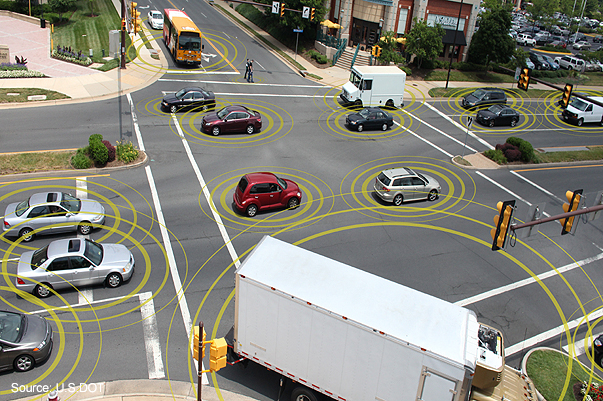
    Connected vehicles can help to mitigate crashes on busy urban streets.
    Connected vehicles can help to mitigate crashes on busy urban streets.

    The U.S. Department of Transportation’s (DOT) National Highway Traffic Safety Administration (NHTSA) announced today that it will begin taking steps to enable vehicle-to-vehicle (V2V) communication technology for light vehicles. This technology would improve safety by allowing vehicles to “talk” to each other and ultimately avoid many crashes altogether by exchanging basic safety data, such as speed and position, ten times per second, the agency said.

    “Vehicle-to-vehicle technology represents the next generation of auto safety improvements, building on the life-saving achievements we’ve already seen with safety belts and air bags,” said U.S. Transportation Secretary Anthony Foxx. “By helping drivers avoid crashes, this technology will play a key role in improving the way people get where they need to go while ensuring that the U.S. remains the leader in the global automotive industry.”

    DOT research indicates that safety applications using V2V technology can address a large majority of crashes involving two or more motor vehicles. With safety data such as speed and location flowing from nearby vehicles, vehicles can identify risks and provide drivers with warnings to avoid other vehicles in common crash types such as rear-end, lane change, and intersection crashes. These safety applications have been demonstrated with everyday drivers under both real-world and controlled test conditions.

    The safety applications being developed provide warnings to drivers so that they can prevent imminent collisions, but do not automatically operate any vehicle systems, such as braking or steering. NHTSA is also considering future actions on active safety technologies that rely on on-board sensors. Those technologies are eventually expected to blend with the V2V technology. NHTSA issued an Interim Statement of Policy in 2013 explaining its approach to these various streams of innovation. In addition to enhancing safety, these future applications and technologies could help drivers to conserve fuel and save time.

    V2V technology does not involve exchanging or recording personal information or tracking vehicle movements. The information sent between vehicles does not identify those vehicles, but merely contains basic safety data. In fact, the system as contemplated contains several layers of security and privacy protection to ensure that vehicles can rely on messages sent from other vehicles and that a vehicle or group of vehicles would be identifiable through defined procedures only if there is a need to fix a safety problem.

    In August 2012, DOT launched the Safety Pilot “model deployment” in Ann Arbor, Michigan, where nearly 3,000 vehicles were deployed in the largest-ever road test of V2V technology. DOT testing is indicating interoperability of V2V technology among products from different vehicle manufacturers and suppliers and has demonstrated that they work in real-world environments.

    In driver clinics conducted by the Department prior to the model deployment, the technology showed high favorability ratings and levels of customer acceptance. Participants indicated they would like to have V2V safety features on their personal vehicle.

    “V2V crash avoidance technology has game-changing potential to significantly reduce the number of crashes, injuries and deaths on our nation’s roads,” said NHTSA Acting Administrator David Friedman. “Decades from now, it’s likely we’ll look back at this time period as one in which the historical arc of transportation safety considerably changed for the better, similar to the introduction of standards for seat belts, airbags, and electronic stability control technology.”

    NHTSA is now finalizing its analysis of the data gathered as part of its year-long pilot program and will publish a research report on V2V communication technology for public comment in the coming weeks. The report will include analysis of the Department’s research findings in several key areas including technical feasibility, privacy and security, and preliminary estimates on costs and safety benefits. NHTSA will then begin working on a regulatory proposal that would require V2V devices in new vehicles in a future year, consistent with applicable legal requirements, Executive Orders, and guidance. DOT believes that the signal this announcement sends to the market will significantly enhance development of this technology and pave the way for market penetration of V2V safety applications.

    “We are pleased with the direction NHTSA is taking in terms of V2V technology,” said Greg Winfree, Assistant Secretary for Research and Technology. “The decision to move forward comes after years of dedicated research into the overwhelming safety benefits provided by a connected vehicle environment.”

    V2V communications can provide the vehicle and driver with 360-degree situational awareness to address additional crash situations — including those, for example, in which a driver needs to decide if it is safe to pass on a two-lane road (potential head-on collision), make a left turn across the path of oncoming traffic, or in which a vehicle approaching at an intersection appears to be on a collision course. In those situations, V2V communications can detect threats hundreds of yards from other vehicles that cannot be seen, often in situations in which on-board sensors alone cannot detect the threat.

    NHTSA has worked in close partnership in this research both with other DOT agencies, including the Office of the Assistant Secretary for Research and Technology and the Federal Highway Administration, and with several leading auto manufacturers and academic research institutions, who have invested significant resources into developing and testing V2V technology. The collaboration of government, industry and academia is critical to ensure V2V technology’s interoperability across vehicles.

    Find more more information on the Department’s vehicle-to-vehicle communication technology research.

  • NNG Provides Connected Navigation Software to Mazda3

    NNG Provides Connected Navigation Software to Mazda3

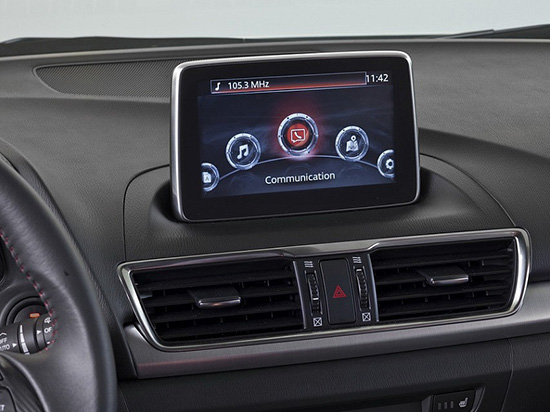
    Mazda3's infotainment system.
    Mazda3’s infotainment system.

    The new Mazda3 infotainment system, which appears in Mazda3’s Active Driving Display, is now running on NNG’s iGO navigation engine, and includes TTS, voice recognition and full 3D navigation.

    This solution, supported by Mazda’s MZD Connect, is also reportedly the first on the market to offer an embedded connected-service package with Internet connection provided through the driver’s smartphone. Drivers will be able to access dynamic local search, fuel prices, real-time traffic and weather information free of charge in the first 60 days, and benefit from three years of free map updates.

    “Mazda’s new design, KODO, has really inspired us to develop an integrated infotainment system, with knowledge and refined features matching the look and performance of the car,” said Péter Balogh, NNG. “We succeeded in offering cutting-edge solutions in the head unit, enhanced safety, usability and comfort to the driver.”