Tag: Consumer Electronics Show

  • $2.6 Billion GPS Fitness Device Market Overshadowed by Smart Devices and Wearables

    ​Despite major GPS fitness device OEMs announcing new fitness products at January’s International Consumer Electronics Show in Las Vegas, it looks like an increasingly difficult battle between smart devices and wearables, according to analysts at ABI Research.

    Garmin launched its Vivofit fitness band and Vivoki/Vivahub corporate wellness solution. Magallen is one of the few companies in the GPS device OEM space that continues to show flashes of innovation, opening up its Echo watch platform to a range of third-party smartphone application developers.

    At the high-end of the GPS fitness watch market, Polar has launched a new multi-sport watch, which features a barometric pressure sensor, support for new features such as a cycling power pedal. TomTom has launched an iOS application that links its current GPS watch range to an iPhone via Bluetooth.

    In ABI Research’s quarterly GPS/GNSS Device tracker, the impact of these new device categories on dedicated GPS fitness device growth can be fully seen. Senior analyst Patrick Connolly comments, “Our forecasts for the overall GPS-enabled fitness area remain strong, hitting $2.6 Billion in 2018, but as was the case with turn-by-turn navigation, converged devices and wearables will take an increasing part of the available market. The adage of keeping what we have is important here, retaining a firm eye on growth in professional users, with hardware and in particular eyewear, a major distinguisher.”

    Practice director Dominique Bonte adds, “Of the announcements, Garmin’s move into corporate wellness was the most striking. We are about to see a huge technological shift in the corporate/business sector, around BYOD, BYOW, wellness, security, and efficiency. What is interesting is that Garmin does not include a location element, which will be a core enabler in this sea change.”

    The findings are part of ABI Research’s Location Devices Research Service.

  • Google Rolls out Maps Engine Pro for Small Businesses

    Google Rolls out Maps Engine Pro for Small Businesses

    Google-Map-O

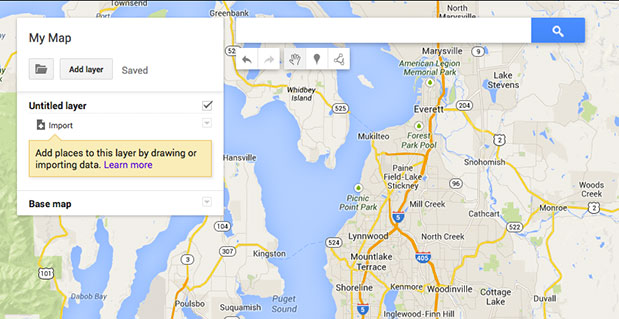
    Google Maps aren’t just for finding directions for consumers. The company is courting small businesses to grab a greater market share and provide differentiation from its competitors. In a slow news month, it appears Google, the 800-pound gorilla in the location industry, has a strong start in business markets.

    Google’s recent decision to roll out Maps Engine Pro, its software that allows small business to use the company’s location tools to create maps from location databases, is a solid step in the business-to-business market. However, the company also said there will be a mobile application for Maps Engine Pro, called Google Maps Engine, which will allow small businesses and users to edit and create maps while mobile.

    Companies can use the app to optimize personnel and assets, build mapping apps, and create internal and external maps that use data layers to make business decisions. Depending on licensing, Maps Engine Pro costs $5 per user, per month — or $50 per user, per year.

    One reason to roll out the enterprise product: Brian McClendon, vice president of Google Maps, said that there are 1 billion monthly active Google Maps users, making the business product familiar to companies who want to plot location data.

    Magnetic Indoor Positioning? 

    Although much-hyped in the last two years, most indoor positioning has been powered by both GPS and Wi-Fi positioning in most tests and rollouts worldwide. However, a startup called IndoorAtlas, which recently opened an office in Sunnyvale, California, and partnered with Finnish grocery chain Fonella, according to published reports, is using magnetic technology via compass chips in smartphones.

    Rather than using Wi-Fi signals to triangulate a device’s location, IndoorAtlas tracks differences in the Earth’s magnetic field to pinpoint location within a building. The magnetic field is all around most objects and animals. On the company website, this tidbit is found: “Many animals utilize local variations in the Earth’s magnetic field to find their way around. These magnetic variations commonly exist inside buildings as well. Many sources can contribute to these variations including Earth’s magnetic field, and the structures of the building. Modern smartphones can sense and record these magnetic variations to map indoor locations.”

    IndoorAtlas’ technology doesn’t require additional infrastructure like wireless access points, so the technology can be used by retailers. Other markets include search and rescue, museum tours, and a navigation aid for disabled people.

    Location Companies Going After Higher End Markets As Commoditization Settles In      

    As location technology, specifically GPS, becomes more of a commodity as many industry observers say, companies are looking at higher-margin market segments. For instance, Garmin, which has seen the portable navigation device market decrease, has been focusing on more expensive and specialized products.

    While still a big business for Garmin, PNDs’ market share has been eroded by tablets, smartphones — and even expensive installed telematics systems, which have grown with the connected vehicle’s rise.

    Garmin has offered several different types of high-end watches for swimmers, pilots, runners, golfers and others in the outdoor market. The newest entry is a $450 watch called Tactix, which any Navy SEAL could love. It features an altimeter, barometer, and jumpmaster software for airborne operations, and it’s even waterproof to a 50-meter depth.

    LBS Insider to Cover CES in January

    LBS Insider will be on site in Las Vegas to cover the huge Consumer Electronics Show. At CES, the connected vehicle market continues to be showcased. In published reports, Scott Keogh, Audi USA president, said that the company will make announcements about Audi Connect at the show.

    T-Mobile US provides 3G connectivity to Audi’s Connect service in the United States through an embedded SIM in the car’s dash. T-Mobile’s plan, which includes Wi-Fi for as many as eight devices, is offered to new and existing owners of cars equipped with Audi Connect. It costs $450 for data services for 30 months — or users pay $30 per month if they select the month-to-month option. Some of the features includes access weather, real-time news and fuel prices. Both Google Earth and Google Voice are offered.

    At CES, the LBS market has been de-emphasized by wireless carriers in the past three years.  Instead, most location-related panels have been dedicated to connected vehicles.

  • LiveViewGPS Transforms Cell Phone into Location Device

    LiveViewGPS, a GPS tracking company for business, government and individuals, is unveiling a prepaid Mobile Phone Locate Card in Booth #75015 in the Eureka Park area at the International CES Show in Las Vegas this week. The card allows users to transform a cell phone into a 24-hour safety location device for families and businesses without having to buy a $100 locator or expensive apps.

    Mobile Phone Locate capitalizes on the location technology already built into cell phones to instantly locate single or multiple phones, explained George Karonis, LiveViewGPS CEO. It uses both Assisted GPS and cell network data to ensure fast, accurate locates for discreet monitoring when and where it’s needed. Because location accuracy depends on cell phone reception, GPS settings, environmental conditions and more, results can vary from a few feet to several thousand feet.

    Under the program, a customer purchases a prepaid LiveViewGPS Mobile Phone Locate card either online or at a retail store. After signing up, users select a locate plan and register the phones they want to locate. An SMS text is sent to the target phone(s) requesting a reply. Once the phone users opt in, the Mobile Phone Locater service is immediately activated. With a single click, the target phone’s location is displayed on a high-resolution graphic or satellite view map. There is no software to install, no battery draining app to download, no expensive devices to buy, and no contract to sign.

    The Mobile Phone Locate service is approved for use and works with Tier 1 carriers in North America including AT&T, T-Mobile, Sprint PCS, Verizon, Boost Mobile and TracFone in the United States; and Rogers and Telus in Canada. More carriers and countries will be added as they become available.

    “For businesses, keeping track of a mobile workforce is easier than ever,” Karonis added. “Mobile Phone Locate is a cost-effective, in-the-field management solution that’s fast, easy and reliable. It offers value-driven, on demand mobile location services businesses can trust. Deployment is easy across one or 1000 phones, with no additional hardware to purchase or battery draining apps to install.

  • TI’s Wi-Link 8Q Provides Wireless Connectivity for Auto Infotainment

    Wireless connectivity is becoming a key feature in automobiles for sharing and viewing content from smartphones and tablets to in-car systems, easy pairing of devices, navigation and replacement of expensive cables for in-car communication. To answer this need, today Texas Instruments Incorporated (TI) introduced the WiLink 8Q family of wireless automotive connectivity solutions.

    “GNSS technology combines GPS and GLONASS signals with the on-chip positioning engine producing a more accurate fix of your location, making “urban canyons” non-existent,” according to the TI Behind the Wheel blog. TI is demonstrating WiLink 8Q and other technologies at the Consumer Electronics Show this week in Las Vegas.

    With its multi-radio technology, the WiLink 8Q family reaches new levels of cross platform scalability and delivers advanced features including in-car multimedia streaming video in parallel with Bluetooth hands-free calling and advanced audio distribution profile (A2DP) stereo sound. Additionally, with near field communications (NFC) for easy Wi-Fi and Bluetooth pairing, WiLink 8Q solutions enable an easy connection between a smartphone or tablet and the automobile, providing a seamless user experience, according to TI.

    The WiLink 8Q family is designed for Wi-Fi Certified Miracast operation. With an integrated power amplifier (PA) and complete software reuse across all family members, WiLink 8Q solutions provide a full range of products for wireless automotive infotainment including:

    • Super-combo SoCs with Wi-Fi, Bluetooth, Bluetooth low energy, NFC, and GNSS support.
    • Combo-connectivity system-on-chips (SoCs) with Wi-Fi and Bluetooth support.
    • More integrated combo-connectivity SoCs with Wi-Fi, Bluetooth, Bluetooth low energy and NFC.

    “Delivering the familiar experience consumers have with smartphones and the tablets into the automobile to share information and content from drivers’ and passengers’ devices is driving the need for strong wireless connectivity solutions. Wi-Fi, Bluetooth, NFC and GNSS have to work together seamlessly as integrated parts of the entire system,” said Mattias Lange, automotive connectivity product line manager, Wireless Connectivity Solutions, TI. “The WiLink 8Q family takes our expertise in wireless connectivity and automotive applications to the next level with support of four different RF technologies on one SoC – a truly integrated approach to automotive infotainment.”