Tag: consumer

  • Google Buys The Dealmap, Is Social Shopping Market LBS Driver?

    Once again, it looks as if Google is taking a giant leap into location-based services with its recent acquisition of The Dealmap. Is this deal a signal that LBS market viability may be tied to the social shopping market? The market is potentially huge, with two big players and a third, Google, quickly developing. But is this the market that will propel LBS to the next level? One analyst says yes…and no.


    Technology giant Google is once more trying to corner more of the social shopping market by buying The Dealmap, a 15-month-old company that offers its own location-based daily deal service.

    Menlo Park, Calif.-based The Dealmap collects data from hundreds of sources and arranges deals by location, on its website and a smartphone application. The start-up, founded last year, has 15 employees and 2 million users, according to published reports.

    Google tried to buy Groupon for as much as $6 billion last year, and decided to launch its own service, Google Offers, in Portland. Google’s service has since expanded to New York and the San Francisco Bay Area.

    Google has made many moves into the location business in the last two years. It is trying to grab a large share of the European traffic market by offering real-time services in 13 European companies. Google shook up the navigation market with free navigation service for Android phones in 2009.

    At least one analyst said he was intrigued by the acquisition, of which financial details were not disclosed. Mike Dobson, TeleMapics president, said that The Dealmap acts as a deal aggregator and cross-channel distributor for national in-store deals from brand retailers, restaurant chains, and other businesses; local daily deals (from Groupon, Living Social, and more than 200 other sources); and what The Dealmap calls “store window” deals from individual local businesses.

    In a recent presentation that The Dealmap made at the Kelsey Deal3D Conference, the company claimed to have grown in its first year to 2 million-plus cross-channel users, including more than 1 million mobile users, said Dobson, who authors a location blog. The volume of monthly deal searches on its network was more than 75 million and the monthly network reach was estimated at 85 million, he said.

    The Dealmap and others (Borrell Associates, Needham and Company, and Groupon) have predicted that the projected size of the local daily deal market will be sized at $10 billion by 2015, while the online local ad revenue will be $32 billion by 2013, Dobson said. “The Dealmap claims that its deals provide more than $10 million in savings each day, although it is less clear what earnings it creates in the way of margin/profit for distributors, such as, well, Dealmap,” he said.

    Dobson said that the “deal supplier” market appears to be dominated by top sites. Eighty percent of the local deal inventory nationwide is dominated by 20 sources, 69 percent by 10 sources, and 40 percent by two sources, Groupon and Living Social, he said. “The Dealmap claims that its daily ad inventory is supplied at a modest 6.25 deals per source, while half the deal supply sources offer only one-to-two deals a day,” he said.

    “Perhaps more disconcerting is the fact that 69 percent of deal suppliers have a presence in from two to nine markets, while 19 percent cover only a single market. Only 4 percent of The Dealmap’s suppliers have a national footprint, which the company defines as 25 or more markets, Dobson said. “While this could suggest that the deal market is inherently local, I think it suggests that local suppliers add the ‘long tail’ that is appended in local markets to the offerings of Groupon and Living Social. In other words, the market appears to be close to a duopoly at a national scope, with numerous smaller players operating as regional and local suppliers. My conclusion is that the market for local deals from individual local suppliers is quite small, and that the major force of deals in all markets are national chains who wish to present deals to draw local users to their shops.”

    Dobson says the reason he makes this distinction is that it does not appear likely that “deal-based advertising” is going to be the replacement for local newspaper advertising, or a real-time Yellow pages, at least not as currently configured.

    “The Dealmap indicates that in a sample taken from Chicago for one day of deals, the inventory from the two leading providers was split one-quarter each for fitness spas and shopping, while attractions and dining evenly split the last quarter of the pie,” Dobson said. “When all deal suppliers were added, salons and services deals added 10 percent each to the mix, while dental deals (3 percent) and hotel deals (5 percent) rounded out the categories. Who knew that people looking for social shopping deals were looking for an athletic workout and liked to meet in spas, followed by a good meal and a visit to an attraction?”

    According to The Dealmap, more than 50 percent of deals searched for nationwide by consumers are related to dining, followed by shopping at 20 percent, while attractions, bars, spas, travel and “things to do” to ranked in the single digits. On mobile devices the search profile is somewhat different, with dining at 40 percent, shopping at 30 percent, spas and travel each at 12 percent, “things to do” at 4 percent (a 5-percent loss compared to deal-search in general), and bars at a measly 1 percent (a 3-percent drop compared to deal-search in general), Dobson said.

    “I am not sure how others perceive the message that can be found in the numbers above, but I think it might be hard to find a long-term growth business here. Google acquired The Dealmap because Google needs to buttress its local advertising empire, but clearly this is a small-potatoes business,” Dobson said. “Yes, I understand that Groupon walked away from a $6-billion-dollar offer from Google, but I suspect that they already regret their bristliness during the negotiations. I guess this shows that just because you can market deals, does not mean that you know how to negotiate one for yourself.”

    What’s the Big Deal for LBS?

    Dobson said that the big deal may be for the LBS industry. “It appears to me that the concept of ‘location’ is in the process of occupying its rightful place in a variety of industries that are clearly location-centric, and were location-centric before any of us thought of using the term location-based services to describe those business services that had a location component,” he said. “Perhaps the only thing that has changed for these industries is that the consumerization of GPS and the inclusion of its functionality in phones, laptops, PNDs, and other navigation devices have allowed these businesses to pinpoint the location of consumers and provide relevant services to mobile users.”

    While The Dealmap certainly fits within Dobson’s notion of LBS, he suspects that the company sees itself in the deal-distribution business and has forward integrated into location services to expand its deal-distribution capacity. “Google almost certainly did not acquire The Dealmap because the company had a new, unique, and proprietary location technology. Instead, they acquired The Dealmap for the company’s distribution strength (its distribution network and deal-distribution applications) and their knowledge of how Groupon and Living Social operate,” he said. “It seems to me that the one trend that continues in LBS is that service businesses require strong distribution channels and few companies in this space have capabilities in this respect. For this reason, the action in LBS will continue to be acquisitions by companies who already have the distribution, but need the know-how that will allow them to leverage location as a method of increasing their distribution capability. In short, ours is a market segment in which companies need to innovate, out-perform, and pray that they get noticed by the industry leaders in other market segments.”

    There are no potential Google or Facebook success stories in our midst, Dobson said “Our task is to build location engines, use them to solve common but ubiquitous problems involving location — and hope that our efforts get us to the finish line before anyone else,” he said.
     

  • Consumer Time on Mobile Apps Surpasses Time on Web

    The world is spinning in a new direction. Consumers are spending more time on mobile apps than on the web. In June, mobile app use overtook both mobile and desktop web, as measured by apps analytic firm Flurry. Consumers spent an average of 81 minutes per day on mobile apps, and 74 minutes on the web. App use was measured on Apple’s iOS, Android, Blackberry, and J2ME platforms, and web use was measured on the open web, mobile web, and Facebook.

    Last year, the numbers told a different story. In 2010 iOS was popular, but Android was yet to skyrocket onto the market. Web time led with 64 daily usage minutes; mobile app time lagged at 43 minutes. What are consumers doing with their apps in 2011? Having fun, or more likely, wasting time. Games and social networking categories captured the significant majority of app usage. Consumers spent nearly half their time playing games, and a third were connecting with social networking apps. Together, these two categories account for 79 percent of consumers’ total mobile app time.

    Mapping Apple. Last month I wrote that rumors of Apple’s imminent release of its own mapping database was proven wrong by its renewal of Google maps. This doesn’t mean Google isn’t hard at work on it. MacRumors reports that there are legal disclaimers found in iOS 5 in a new section called “Map Data.” A diverse list of licenses appear from third parties that provide mapping data and services. Included are CoreLogic, Getchee, Increment P Corp, Localeze, MapData Sciences, DMTI, TomTom, Urban Mapping, and Waze. Urban Mapping provides in-depth neighborhood data and Waze offers crowd-sourced real-time map and traffic data.

    Foursquare is set to start making money. Foursquare made its name as a location-based check-in community that awards mayoralships and other rewards for visiting stores and restaurants. Users share recommendations for venues. If you wondered how the company was going to bring in revenue, here’s the dope. Foursquare will team with LivingSocial and Gilt Groupe to offer location-targeted daily coupon offers, its biggest move yet to harness its consumer buzz into a long-term revenue model.

    Foursquare will leverage its location-tracking capabilities and customer data to offer deals. The depth of Foursquare’s consumer database is extensive and should give the company insight into individual perspectives and behaviors, and provide an edge in targeting offers that will grab a high conversion rate.

    LightSquared causes GPS interference. “LightSquared should not be permitted to use the L-Band spectrum for a densely-deployed, non-integrated terrestrial-only network. Such a network would cause unacceptable interference to GPS operations, wiping out an installed base of over 500 million units used in a wide array of public safety, aviation, industrial and consumer applications.” So reads the technical working group’s final report to the FCC. The group concluded that no mitigation techniques, such as using filters on GPS receivers, were considered because they don’t exist and therefore cannot be tested. The FCC is currently holding a comment period and eventually the commission will make a decision about LightSquared band use.

    Continuing to press its case, LightSquared presented the FCC with a plan to mitigate interference with GPS by using Inmarsat’s lower spectrum band, enabling reduced power of base stations by more than 50 percent. However, the working group indicated testing of this lower channel does not eliminate harmful interference to GPS receivers.

    LightSquared has argued that the issue is with GPS receivers, not their proposed system: “Despite the commercial GPS device industry’s best record to rewrite the record and obfuscate the nature of the problem, the simple fact remains that GPS receivers do not adequately reject base-station transmissions in the adjacent band.” Jim Kirkland of Trimble and the Coalition to Save our GPS responded that GPS receivers were designed against satellite transmissions with an ancillary terrestrial component, consistent with LightSquared’s initial design, but not later changes.

    Despite mounting concern of GPS interference, LightSquared recently snared $265 million in financing for its LTE network. This year LightSquared raised a total of $2.3 billion and appears close to a Sprint deal. Does LightSquared have a viable “Plan B”?

    Action-based ads. A bit more than a third of mobile ad campaigns ask subscribers to click to call, click to map, click to download, or click to SMS, reports mobile advertiser, Jumptap. The remaining ads usually invite users to a website, and aren’t as immediately actionable. Mobile ad engagement peaks at mid-day, and click through rates are at the lowest during morning commute and initial workday hours.

    Moment of Zen. When asked about the stealth in which FourSquare just raised $50 million, CEO Dennis Crowley opined, “Loose Tweets sink companies.”

  • Expert Advice: Are We There Yet?

    The State of the Consumer Industry

    By Frank van Diggelen

    Frank van Diggelen
    Frank van Diggelen

    At the start of a new decade, let’s examine the state of the GNSS consumer market and technology. In the December 2009 issue of GPS World, I described the developments that put GPS in cell phones over the last decade. That technology revolution has brought GPS a very long way. Having come this far, we can ask that most famous of all navigation questions:

    Are we there yet?

    In this column, I focus on the question for the consumer segment of GNSS. Has the consumer market reached the point we expected it to be by now? Has the technology reached levels we anticipated?

    The cell-phone GPS revolution began with the catalyst of U.S. E911 legislation, which mandated that when an emergency (911) call is made from a cell phone, the location of the cell phone must be provided. Among several competing location technologies, GPS proved to be the big winner, thanks to seven technology enablers: assisted GPS, massive parallel correlation, high sensitivity, coarse-time navigation, low TOW, host-based GPS, and RF-CMOS.

    All of these together enable very low-cost implementation of GPS in cell phones, even phones on networks such as GSM and W-CDMA that do not have fine-time synchronization (that is, they are not precisely synchronized with the GPS system). GPS is now found in roughly 500 million phones in use today.

    Four Milestones. From a consumer market perspective, we have exceeded forecasts. From a technology perspective, we have kept track with Moore’s law. Chips and receivers are cheaper than expected — because, as well as Moore’s law, we have seen greatly increased volumes and competition. Low-cost chips have not come at the expense of performance; in fact, the opposite — as chips have evolved, they have become less costly and better performing.

    Small, cheap antennas have affected performance, but given the same antenna, I will demonstrate that a receiver with a single-die GPS chip costing less than $4 can outperform a $19,000 receiver.

    This sounds paradoxical, even impossible — indeed many of you may be penning letters to the editor right now! But the time-to-first-fix, sensitivity, and urban-accuracy data will prove my point.

    As a consequence of chip evolution, we are reaching plateaus of development for GPS-only systems. However, there remain many problems to solve, especially in urban canyons and indoors. These problems may never be solved with GPS alone, or with any single system alone. This decade will be characterized by GPS-plus; the days of GPS-only will soon recede into the past.

    Don’t interpret this as a failing of GPS — quite the opposite. Because GPS-only systems have worked so well, they have found their way into half a billion cell phones, and we are boldly taking GPS to places no navigation has gone before. As we do, we start to encounter the limitations of GPS-only performance.

    We will see the proliferation of GPS-plus: GPS+MEMS, GPS+Wi-Fi, GPS+NMR, and GPS+GLONASS, Compass, QZSS, and Galileo. The winners will be those with the greatest levels of integration. To paraphrase Winston Churchill, this is not the end of GPS, it is not even the beginning of the end. But it is, perhaps, the end of the beginning.

    GNSS Consumer Market

    For market forecasts made a few years ago, we can look at summaries provided in GNSS Markets and Applications, by Len Jacobson: a 2006 Frost & Sullivan report estimated the market for PNDs and handheld devices (not including cell phones) in 2010 would be $2.7 billion, with 8.3 million units, at an average selling price (ASP) of $325. In fact, this market today is approximately $6 billion, with 40 million units, at an ASP of $150.

    Twice the Size. The consumer market, not including cell phones, is twice as big (in dollars) as forecast just a few years ago, even though prices are less than half forecast. Unit sales are more than four times forecast.

    For the cell-phone market segment, in 1999 when the E911 rules were enacted in the United States, it was anticipated that A-GPS would be adopted only in fine-time (synchronized) networks, such as Verizon and Sprint CDMA. In coarse-time (non-synchronized) networks such as GSM, the expectation was that terrestrial wireless location techniques, such as time-difference-of-arrival (TDOA) and enhanced-offset-time-difference (E-OTD), would dominate. Today, only a few niches use TDOA, E-OTD is extinct, and GPS rules in coarse-time networks worldwide, including GSM in Europe and North America, and W-CDMA in Japan.

    The consumer market, in particular the cell-phone market, has grown so rapidly that more receivers have been built in cell phones in the last three years than all other GPS built, ever. Today, L1 C/A-code GPS accounts for more than 99 percent of all GNSS receivers manufactured each year.

    From a consumer market perspective, have we reached the point we expected to be by now?

    Yes! 

    Not only have we arrived, we have far surpassed expectations.

    GPS and Moore’s Law

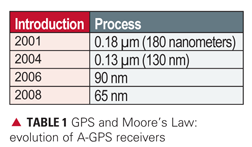
    Moore’s law says that for a given number of transistors, the chip size will halve every two years. Table 1 shows what this looks like in practice. For a particular class of GPS chip, the A-GPS receiver with massive parallel correlation, it shows release dates of different generations of these chips, and the technology process, which is the linear dimension of a single gate on the silicon die. As this dimension reduces to 70 percent of the previous value, the 2-dimensonal chip size reduces by 2 times. You can see Moore’s law in action here: approximately every two years, the technology process moves to the next level, and the chip size reduces by 2X. People are now talking about GPS chips in 45 nanometers, the next step.

    EA-table1

    For a comparison, consider the Broadcom BCM 4751 chip, designed for cell phones. This chip is 2.9 X 3.1 millimeters, the size of the letter B on this page. This is a single-die host-based GPS/SBAS receiver, including RF front end, low-noise amplifier, baseband, and power management unit. Ten iterations of Moore’s law have passed in the last 20 years. The same chip, had it been built 20 years ago, would have been 210 times (a thousand times) bigger.

    There were never chips that big. GPS chips aren’t just getting smaller with Moore’s law, they are getting vastly more complex and more capable.

    Performance

    At an elemental level, a GPS receiver does just three things: it starts, it tracks weak signals, and it computes position, 
velocity, and time. Strip away the 
obfuscating details, and performance may be summed up by: how fast, how sensitive, how accurate.

    Since the 1990s, time to first fix ( TTFF) and sensitivity have improved dramatically, thanks to the seven technology enablers discussed earlier. TTFF for assisted cold starts, or unassisted warm starts, is now as good as one second, even without fine-time. This is a 45X improvement on typical GPS performance of the 1990s. Sensitivity increased roughly 30X (to -150 dBm)  in 1998, then another 10X, (to -160 dBm) in 2006, and perhaps another three times to date, for a total of almost 1,000X extra sensitivity.

    What about accuracy?

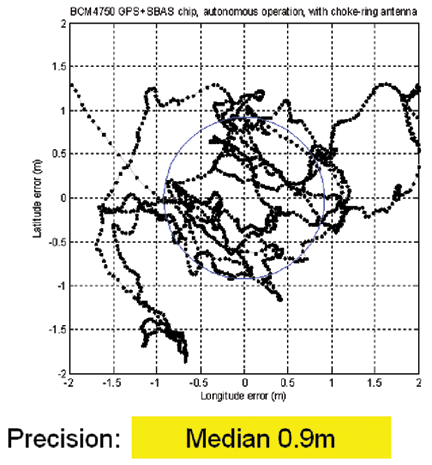
    Some perceive low-cost chips as synonymous with low accuracy. This is not true. It is true that small, cheap antennas reduce accuracy; but given the same antennas, the lowest cost receivers on the market today will outperform the most expensive in typical environments where cell phones are used. The following figures show data to prove this point.

    First we connect one of the smallest, lowest cost GPS receivers t
    o one of the best antennas, a choke ring, on a rooftop with a clear view of the sky. Figure 1 shows the scatter of positions. The blue circle shows the median distribution, which is 0.9 meters for this dataset of 2000 fixes.

    FIGURE 1. Low-cost GPS with large, rooftop antenna.
    FIGURE 1a. Low-cost GPS with large, rooftop antenna.
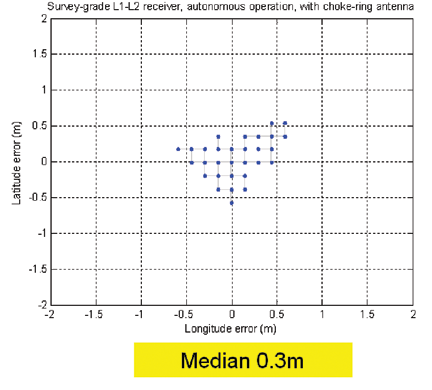
    FIGURE 1b. Survey-grade GPS with large, rooftop antenna.
    FIGURE 1b. Survey-grade GPS with large, rooftop antenna.


    The adjacent plot shows the positions obtained from a $19,000 survey-grade GPS receiver, connected to the same antenna. The survey-grade GPS, with a median distribution of 0.3 meters, shows a 60-centimeter advantage over the cell-phone GPS, or maybe a 3X advantage depending on how you look at it. But don’t get too hung up on this result, because this is neither the typical consumer scenario (on a rooftop with choke-ring antenna), nor the main challenge facing us today.

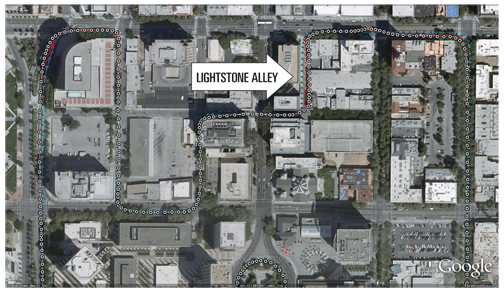
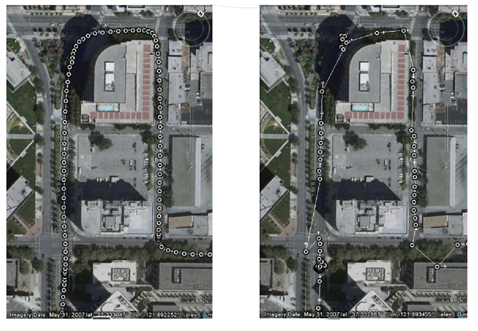
    Next we look at the accuracy achieved with a more typical consumer antenna, in a more typical environment. Figure 2 shows the positions obtained in downtown San Jose with an active patch antenna, such as found in PNDs. San Jose is a fairly typical U.S. city, not the hardest place to use GPS, but not the easiest either. Lightstone Alley, adjacent to tall buildings, is only five meters wide.

    FIGURE 2. Performance of cell-phone GPS (white) versus truth-reference system (blue). Median accuracy 4.4 meters, 67 percent 5.6 meters, 95 percent 11.2 meters.
    FIGURE 2. Performance of cell-phone GPS (white) versus truth-reference system (blue). Median accuracy 4.4 meters, 67 percent 5.6 meters, 95 percent 11.2 meters.

    To evaluate accuracy we used a truth-reference system combining GPS and a tactical-grade IMU with ring laser gyro to produce the blue dots on the figure. The white dots are the low-cost GPS positions. Most of the time, the white dots appear to be on top of the blue, but occasionally you see some separation, and there the red lines show the horizontal error. The median horizontal error is 4.4 meters.

    Figure 3 shows the comparison of low- and high-cost receivers, with the survey-grade receiver connected to the same patch antenna as the cell-phone GPS. There are many position gaps from the survey-grade receiver, and the position walks around when the vehicle is stationary (at the intersections, bottom left and top of the figure). This is because of the weak signals available in the urban environment. But don’t get too hung up on this result either, since we are still not at the real challenge of consumer GPS: location in severe urban canyons, such as San Francisco, New York, Chicago, Shanghai, Taipei, Shinjuku, and similar. In these, typically, only one or two GPS satellites can be seen directly. Other satellites may be tracked, but only by observing purely reflected signals. This is not classic GPS multipath, the combination of a direct and reflected signal; instead this is the combination of nothing but reflected signals. The direct signals are usually completely blocked by many buildings, and are not observable at all. So the whole premise of GPS — observing range from time of flight — breaks down, and it is very difficult to get good accuracy.

     FIGURE 3. Comparison of cell-phone (left) and survey (right) receivers, both with patch antenna
    FIGURE 3. Comparison of cell-phone (left) and survey (right) receivers, both with patch antenna

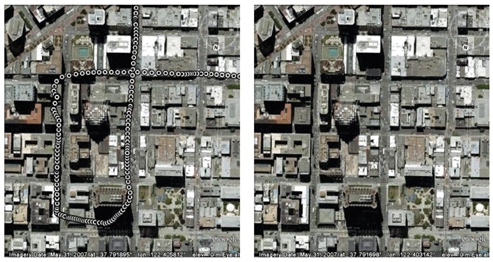
    Figure 4 compares the cell-phone GPS with the survey-grade GPS, connected to the same small antenna, under such circumstances in San Francisco’s Financial District. There are no fixes at all from the survey-grade receiver. Why?

     FIGURE 4. Cell-phone (left) and survey (right) receivers, in severe urban canyon
    FIGURE 4. Cell-phone (left) and survey (right) receivers, in severe urban canyon

    In Montgomery Street, there was only one directly visible satellite, with a signal strength of -132 dBm. All the other satellites were at -140 dBm or weaker, and traditional GPS receivers cannot acquire signals at this level. Hence the only receivers that work in this environment are modern high-sensitivity receivers most commonly found in cell phones.

    You can see that the move to lower-cost receivers has not come at the expense of performance. In fact, the opposite: TTFF and sensitivity have improved dramatically, while accuracy has not been compromised, and is in fact much better in urban environments than legacy receivers, and even modern survey-grade receivers.

    But are we there yet?

    Although the consumer GPS market has irrefutably arrived, from a technical perspective the answer is more nuanced. Consumer GPS technology has made tremendous leaps forward. But precisely because of these improvements, we are taking GPS where it was never expected to go. It is no longer enough for GPS to work indoors (which it can). The demand is now for it to work as well as if it were outdoors (which, presently, it cannot).

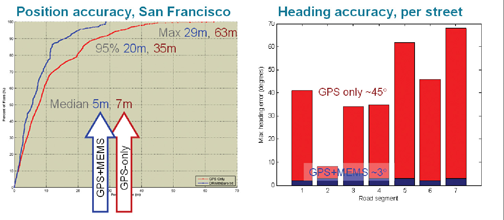
    Performance improvements seen with GPS-only will almost certainly not continue at the recent rate. We do not anticipate yet another 45X improvement in TTFF, or another 30 dB of sensitivity, for GPS alone. However, we do expect order-of-magnitude performance increases with the addition of other technologies. Figure 5 shows data from a TomTom 950, a GPS+MEMS containing the same GPS chip used in the earlier tests, MEMS accelerometers, and MEMS rate gyros. When tightly integrated and tested in the same deep urban canyons of San Francisco, the effect on position is good: median accuracy improved by 30 percent, worst-case errors are more than halved. But the result on heading accuracy is especially dramatic.

     FIGURE 5.  PND position accuracy (left), and heading accuracy (right), San Francisco
    FIGURE 5. PND position accuracy (left), and heading accuracy (right), San Francisco

    The bar graph shows the worst-case heading accuracy in each street. With GPS-only (red), the worst-case error is around 45 degrees, a familiar result to anyone who has used any GPS-only device in a similar environment: sooner or later the map will veer erroneously. However, with the integration of the MEMS rate gyros (blue), the worst-case heading errors drop to around 3 degrees, a 15X improvement in a key metric, similar to the improvements of the last decade, but now thanks to the effect of GPS-plus.

    We will soon see GPS-plus many other technologies: Wi-Fi, NMR/MRL (power measurements from GSM and 3G phones), and of course GPS+GLONASS, Compass, QZSS, and Galileo. Because many mobile devices now include GPS, Wi-Fi, and 3G, there is a natural path for the evolution of GPS technology to include Wi-Fi and MRL measurements.

    There is a also natural trend to source different radios from the same chip supplier. After all, why would you wish to undertake a do-it-yourself effort at removing co-existence issues in different radios, when a chip supplier has already done it for you?

    Looking forward, it is very likely that this new decade will be characterized by GPS-plus other technologies, and the winners will be those with the greatest levels of integration.


    Frank van Diggelen is senior technical director of GPS systems and chief navigation officer for Broadcom Corporation. He holds more than 45 U.S. patents, has a Ph.D. in electrical engineering from Cambridge University, and is the author of A-GPS: Assisted GPS, GNSS & SBAS.