Tag: core mate

  • Next-gen GPS IIIF satellites take shape

    Next-gen GPS IIIF satellites take shape

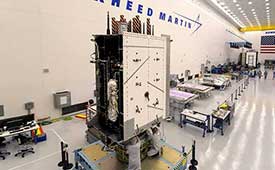
    Lockheed Martin has successfully completed the core mate phase of GPS IIIF Space Vehicle 11 ( SV11), a critical production milestone that marks the satellite’s formal “birth.”  

    Continued manufacturing and deployment of these next-generation GPS spacecraft is essential to maintaining reliable global coverage, with the GPS IIIF block introducing a suite of new capabilities that further strengthens the constellation’s resilience. GPS IIIF satellites are equipped with Regional Military Protection, improving anti-jamming capability by more than sixty times, giving warfighters a decisive edge against sophisticated electronic warfare threats. 

    GPS IIIF SV11 is the third GPS IIIF satellite to complete the core mate phase, after SV13 and SV14 completed core mate last year. GPS IIIF SV11 will be the first IIIF satellite to launch. 

    “Core mate of SV11 showcases the production momentum behind the next-generation GPS IIIF satellites as we continue to invest in advanced manufacturing,” said Christina Mancinelli, vice president of Global Communications & Navigation at Lockheed Martin. “With three GPS IIIF satellites past core mate, we’ve taken pivotal steps toward accelerating production, ensuring we’re delivering critical next-generation resiliency capabilities to the GPS constellation at the pace warfighters need to protect our nation.” 

    The SV11 satellite is also M-code-enabled, providing an encrypted, anti-spoofing signal that strengthens positioning, navigation and timing (PNT) capabilities for military users globally. Additionally, SV11 is equipped with a new search-and-rescue payload that will allow first responders to navigate to emergencies in remote locations.  

    With an eye on strengthening GPS, all GPS IIIF satellites starting with SV13 will be built on the evolved LM2100 Combat Bus, which adds additional cyber-hardening and improved spacecraft power, propulsion and electronics. These vehicles are equipped with extra size, weight and power, providing flexibility to integrate additional payloads quickly onto future space vehicles.

    GPS IIIF satellites are manufactured at Lockheed Martin’s Denver, Colorado, facility, where the company is accelerating production through the use of augmented reality and digital twins. Lockheed Martin is currently under contract through GPS IIIF SV22 and recently completed all launches of GPS III space vehicles. 

  • GPS III SV-08 ‘born’ with core mate complete, named Katherine Johnson

    GPS III SV-08 ‘born’ with core mate complete, named Katherine Johnson

    SV03 scheduled for June 30 launch

    News from Los Angeles Air Force Base, California

    The United States Space Force’s GPS III program reached another milestone with the successful core mate of GPS III Space Vehicle 08 at Lockheed Martin’s GPS III Processing Facility in Waterton, Colorado, April 15.

    With core mate complete, the space vehicle was named in honor of NASA trailblazer and “hidden figure” Katherine Johnson.

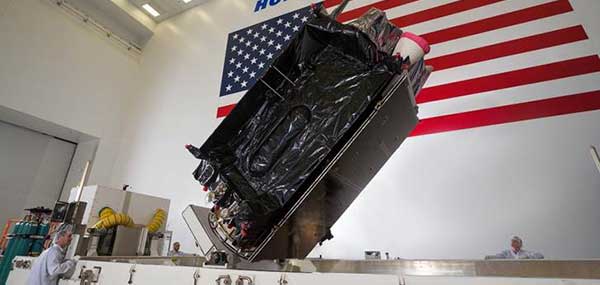
    The two-day core mate consisted of using a 10-ton crane to lift and complete a 90-degree rotation of the satellite’s system module, and then slowly lowering the system module onto the satellite’s vertical propulsion core. The two mated major subsystems come together to form an assembled GPS III space vehicle.

    Despite the COVID-19 pandemic, the Space and Missile Systems Center (SMC) and its mission partner Lockheed Martin ensured that SV08 core mate took place, in accordance with all Centers for Disease Control and local guidelines to minimize exposure or transmission of COVID-19. The GPS III Processing Facility’s cleanroom high bay was restricted to only key personnel directly supporting the operation.

    “Core mate is the most critical of the GPS space vehicle single-line-flow operations,” said Lt. Col. Margaret Sullivan, program manager and materiel lead for the GPS III program. “Despite the restrictions presented by the COVID-19 pandemic, our team adapted and worked tirelessly to achieve this essential milestone.”

    Katherine Johnson. (Photo: NASA)
    Katherine Johnson.
    (Photo: NASA)

    Katherine Johnson. When the core mate operation is successfully completed, a GPS III satellite is said to be “born.” In keeping with the team’s tradition of naming GPS III satellites after famous explorers and pioneers, SV08 was named “Katherine Johnson” in honor of the trailblazing NASA mathematician and “human computer” who designed and computed orbital trajectories for NASA’s Mercury, Apollo and space shuttle missions.

    One of four African-American women at the center of the nonfiction book by Margot Lee Shetterly and the movie Hidden Figures, Johnson was awarded the Presidential Medal of Freedom in 2015 for her groundbreaking contributions to the U.S. space program.

    Other GPS III satellites have been named in honor of explorers including GPS III SV01 “Vespucci” after Amerigo Vespucci; GPS III SV02 “Magellan” after Ferdinand Magellan; and GPS III SV03 “Columbus” after Christopher Columbus.

    Next up, performance tests. The next step for the newly christened “Katherine Johnson” is the post-mate Systems Performance Test (SPT) scheduled to begin in August. SPT electrically tests the performance of the satellite during the early phase of build and provides a baseline test data set to be compared to post-environmental test data.

    GPS III SV08 is currently scheduled to launch in 2022.

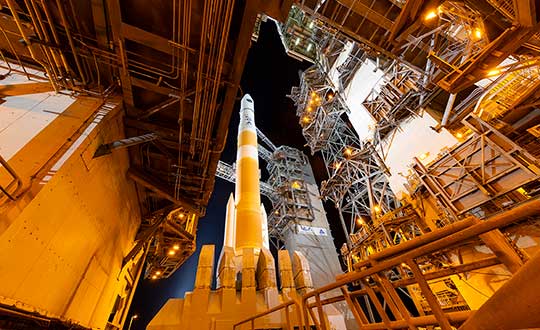
    The Mobile Service Tower rolls back from the ULA Delta IV rocket carrying the GPS III SV02 satellite in preparation for launch. (Photo: ULA)
    The Mobile Service Tower rolls back from the ULA Delta IV rocket carrying the GPS III SV02 satellite in preparation for launch. (Photo: ULA)

    GPS III is the most powerful GPS satellite ever developed. It is three times more accurate and provides up to eight times improved anti-jamming capability over previous GPS satellites on orbit. GPS III brings new capabilities to users as a fourth civilian signal (L1C), designed to enable interoperability between GPS and international satellite navigation systems, such as Europe’s Galileo system.

    GPS III satellites will also bring the full capability of the Military Code (M-code) signal, increasing anti-jam resiliency in support of the warfighter. These continued improvements and advancements to the GPS system makes it the premier space-based provider of positioning, navigation, and timing services for more than four billion worldwide.

    GPS III SV03 is scheduled to launch on June 30.. (Photo: Lockheed Martin)
    GPS III SV03 is scheduled to launch on June 30.. (Photo: Lockheed Martin)

    GPS III SV03 to Launch June 30. Launched in December 2018 and August 2019, GPS III SV01 and SV02 became part of today’s operational constellation of 31 satellites, on January 13 and April 1, 2020 respectively. GPS III SV03 is scheduled to launch on June 30.

    The SMC, located at the Los Angeles Air Force Base, California, is the center of excellence for acquiring and developing military space systems. Its portfolio includes the GPS, military satellite communications, defense meteorological satellites, space launch and range systems, satellite control networks, space based infrared systems, and space situational awareness capabilities.