Tag: critical design review

  • Airbus completes design review for Galileo 2-gen satellites

    Airbus completes design review for Galileo 2-gen satellites

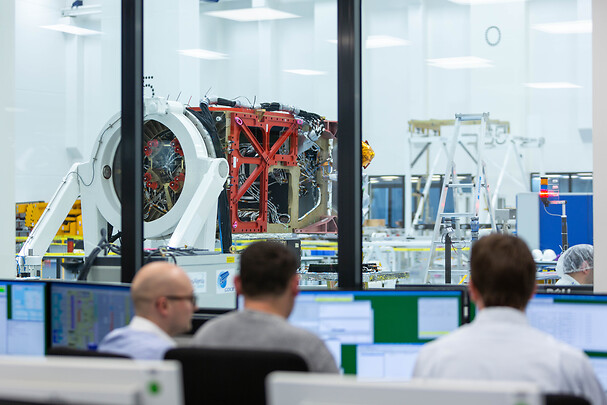
    Galileo second-generation satellites will be constructed at the Integrated Technology Centre (ITC) at Friedrichshafen, Germany. (Photo: Airbus)
    Galileo second-generation satellites will be constructed at the Integrated Technology Centre (ITC) at Friedrichshafen, Germany. (Photo: Airbus)

    Airbus satellite design passes important project milestone, preparing for industrialized manufacturing concept

    Airbus has successfully completed the preliminary design review (PDR) for its system concept for the second-generation Galileo navigation satellites. During this important milestone, Airbus’ proposed preliminary design and the customer’s system requirements have been fully reviewed and agreed upon. Galileo is managed and funded by the European Union.

    This milestone paves the way for further verification, acceptance and qualification at the equipment and module levels. Verification at the payload level is already in full swing, with the critical design review (CDR) for the satellite structure due shortly.

    In parallel, the Airbus site in Friedrichshafen, on Lake Constance, is preparing for an industrialized production line for six second-generation Galileo satellites. The satellite integration center is being upgraded to meet requirements for these satellites.
    Galileo Second Generation Batch#1B satellites. (Image: ESA).
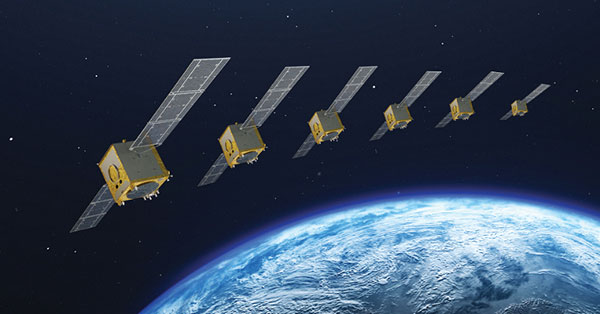
    Galileo Second Generation Batch#1B satellites. (Image: ESA).

    Airbus is bringing to the project more than 200 highly skilled space engineers. The first Galileo second-generation satellites are expected to launch in 2024.

    The second-generation Galileo satellites will make the Galileo service more accurate, secure, dependable and adaptable. Weighing 2.3 tons, each satellite is designed to operate for about 15 years. The all-electric medium-Earth-orbit (MEO) platform from Airbus reuses building blocks from the company’s telecoms and Earth observation programs. The flexible and modular navigation payload is also based on telecom elements for beam forming and signal generation.
  • L3Harris clears critical design review for experimental satellite navigation program

    L3Harris clears critical design review for experimental satellite navigation program

    Satellite NTS-3 above Earth. (Illustration: Lt. Jacob Lutz, AFRL Space Vehicles Directorate)
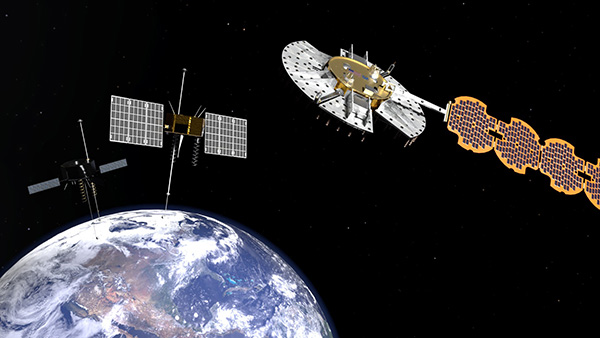
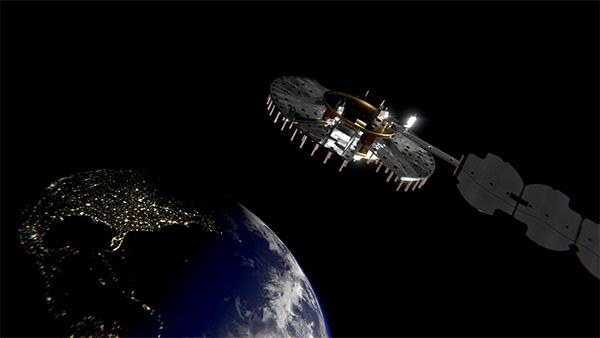
    Satellite NTS-3 above Earth. (Illustration: Lt. Jacob Lutz, AFRL Space Vehicles Directorate)

    L3Harris Technologies is on track to begin building the U.S. Air Force’s first Navigation Technology Satellite-3 (NTS-3) after completing the program’s critical design review.

    According to L3Harris, it will integrate the program’s experimental payload with an ESPAStar Platform, planned for launch in 2022. The system is designed to augment space-based position, navigation and timing (PNT) capabilities for warfighters.

    The NTS-3 payload features a modular design, and the experiment will demonstrate capabilities that can be accomplished through a stand-alone satellite constellation or as a hosted payload.

    “Collaboration with our customers has enabled us to move rapidly through important milestones to design this experimental satellite,” said Ed Zoiss, president, space and airborne systems, L3Harris. “Our goal is to deliver new signals to support rapidly evolving warfighter missions.”

    The Space Enterprise Consortium selected L3Harris for the $84 million contract in 2018 as the prime system integrator to design, develop, integrate and test NTS-3. The NTS-3 will examine ways to improve the resiliency of the military’s PNT capabilities. It will also develop key technologies relevant to the GPS constellation, with the opportunity for insertion of these technologies into the GPS IIIF program, L3Harris said.

    The program is a collaboration with the Air Force Research Laboratory, Space and Missile Systems Center, U.S.Space Force, and Air Force Lifecycle Management Center.