Armando Mendoza and Dave Huntingford, product managers for CSR, demonstrate the company’s SiRFstar location technology while at the 2014 ION GNSS+ Conference September 9-12 in Tampa, Florida.
Tag: CSR
-
CSR, Maestro Offer High-Performance GNSS Module
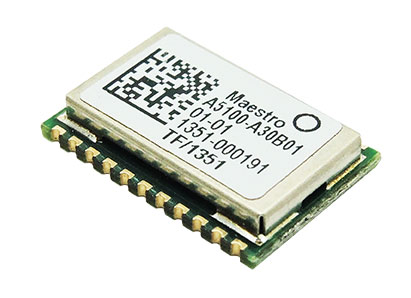
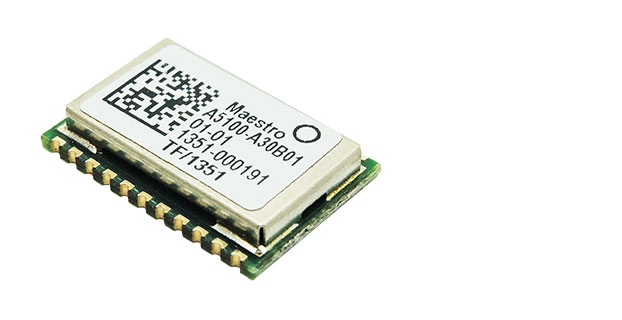
Hong Kong-based Maestro Wireless Solutions, a manufacturer of location receivers, and CSR plc, a global provider of silicon and software solutions for location-aware applications, announce the immediate availability of the A5100-A, a next-generation SiRFstarV GNSS positioning module that combines high-performance GPS and GLONASS receiver technology in a small 10 x 15 mm package.
The A5100-A is designed for a wide range of applications including wearable devices, cameras and automotive trackers.
The A5100-A is the first release within Maestro’s new line of GNSS receivers. It achieves high accuracy with quad-constellation support, up to 30 percent faster time-to-first-fix (TTFF), and up to 20 percent lower power consumption using CSR’s TricklePower and Push-to-Fix (PtF) modes. The module also accelerates customer time to market and reduces development risks by integrating a number of features, including TCXO, SAW filter, RTC, antenna-control mechanism, and flash memory for future-proof upgrades, as well as offering a drop-in replacement capability for Maestro’s previous SiRFstar4 generation modules. The castellated-edge form factor also enables simpler manufacturing and reduces assembly cost, the companies said.
Supporting all currently deployed GNSS, the A5100-A acquires and tracks all visible GPS, GLONASS, QZSS, and SBAS satellites. Concurrent GNSS performance enables the A5100-A to choose the best satellites from different constellations and deliver optimal location information. Immediate benefits are better coverage, enhanced stability, and accuracy in difficult environments, such as urban canyons, and stronger resilience to multipath and signal jamming. This ensures consumers maintain a position fix whether they’re in the middle of a busy city or in a remote rural location, the companies said.
The A5100-A offers a range of other features including:
- Direct to Battery connectivity: Connects directly to a rechargeable 1.8V-3.6V Lithium battery enabling system cost reduction and increased power efficiency.
- Low Power technology: Optimized for power consumption by incorporating CSR’s PtF technology. PtF rapidly establishes a valid position fix enabling the module to hibernate for longer periods of time, and adaptively changes power depending on the operating environment and motion conditions. Advanced algorithms and a powerful on-chip DSP processor maintain high accuracy (QoS) while achieving the lowest power level possible for the given environmental and motion conditions.
- InstantFix Extended Ephemeris (EE): Accelerates TTFF for devices without internet connectivity such as cameras and wearable devices, by autonomously predicting EE for as long as three days and up to 31 days when connected to a network that supports SiRFInstantFix server generated extended ephemeris data (SGEE).
“Maestro Wireless has worked closely with CSR for many years to design and commercialize highly accurate and reliable location products,” said Anthony Murray, senior vice president, Business Group at CSR. “But to win in today’s highly competitive consumer electronics market performance isn’t enough. That’s why we’ve worked with Maestro Wireless to develop a solution that excels in a range of performance metrics but also offers the small form factor essential for today’s compact devices and is highly integrated to help them get to market fast.”
“The A5100-A is perfect for customers designing highly integrated products that need uncompromising performance but are pressured by the speed required to go-to market and lack of development resources,” said Olivier Bernard, EVP of Business Development at Maestro. “By combining low power consumption with high sensitivity, high jamming immunity and concurrent GNSS operation, and with its drop in upgrade path to the A2200-A, the A5100-A creates a fast and convenient route to the latest GNSS offering in the marketplace, to meet these needs quickly.”
-
Expert Advice: Setting Standards for Indoor Position

Greg Turetsky Communications Security, Reliability, and Interoperability Council (CSRIC) Update
By Greg Turetsky
Many of us remember way back in 2001 when the FCC first announced E911 position reporting requirements for cell phones. That was a long time ago in many significant ways. Everyone had 2G phones and anxiously anticipated the arrival of 3G, and with it, data. Most people still had a landline at home, and used their mobile sparingly lest they overrun their monthly minutes. Roaming was very expensive and nearly impossible overseas. Very few phones had GPS, and people only turned it on when needed, as it significantly reduced battery life.
Now, in 2013, all of the technology has changed, but — not unexpectedly — the regulations have not. This is one of the reasons the U.S. Federal Communications Commission (FCC) created CSRIC.
The Communications Security, Reliability, and Interoperability Council’s mission is to provide recommendations to the FCC to ensure, among other things, optimal security and reliability of communications systems, including telecommunications, media, and public safety. The current council, CSRIC III, was born on March 19, 2011, and ended on March 18, 2013. Working Group 3 (WG-3), the E911 Location Accuracy group, has looked into both outdoor and indoor location accuracy issues to help the FCC shape new guidelines. I don’t think any of us would argue that given the current patterns of cell phone usage, the ability to provide a location indoors to a public safety answering point (PSAP) is something that is now needed, has significant value to the public, and would seem to lie within our grasp technically.
Working Group 3 is a fairly large group of experts from a wide variety of backgrounds. The actual list of participants is publicly available; what’s more interesting is the groups that they represent. Three main constituencies constitute the Working Group: the public safety community, the wireless operators, and the technology vendors. Each group has a slightly different goal, but they all worked well together to produce clear, unbiased reports that represent all the different members’ views in a way that lends more credibility to the overall report.
On March 14, the FCC released two reports created by WG-3: the “Indoor Location Test Bed Report,” and “Leveraging LBS and Emerging Location Technologies for Indoor Wireless E911 Report.” I will not review either document here as they are available publicly, but I will summarize the highlights of the reports from my perspective as a member of the location community and a concerned citizen, and attempt to predict where the process might lead next.
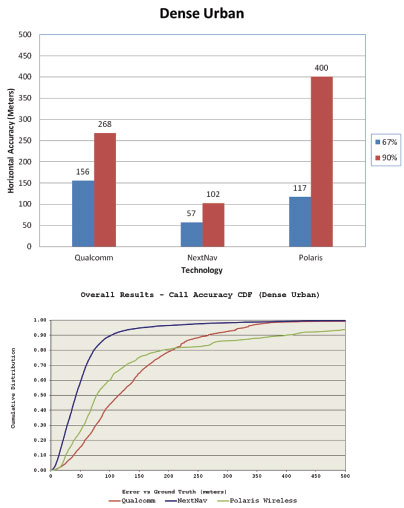
Figure 1. Indoor accuracy in the dense urban environment. Test Bed Report. In my mind, two key results emerged from the Test Bed Report. The first was very positive: the test bed showed that there are technologies capable of yielding positions indoors, and their performance can be compared analytically. This may seem like a bland statement, but it carries a significant amount of weight with both the public safety community and the FCC. It acknowledges that the technology has evolved sufficiently such that in a test bed setting, we can gather and compare, in an apples-to-apples way, the performance of diverse technologies in terms of yield and accuracy. Similar to the LightSquared reports, this report focuses on ensuring that the data itself is valid. The interpretation of the data is far too politically and economically charged to be agreed on by all parties involved. It is a great accomplishment to concur on a methodology by which testing should be done, and to produce a set of results that can be given to the FCC with the entire council’s approval.
The second highlight from my perspective was less positive. The test bed originally had seven participants, but in the end only three completed the process. This indicates that there are even more candidate technologies for solving the indoor E911 problem — but for a variety of reasons, they were not ready for CSRIC testing at this juncture. Although having three choices is good, seven (or even more) would be better for the FCC to feel confident in its ability to create a new mandate with sufficient flexibility on implementation. There are clearly many ways to skin this cat technically, but we have to ensure that the test bed methodology allows as many as possible viable alternatives to be compared. There is clearly a gap between those technologies that are commercially available and those that can be used for E911.
Leveraging LBS. The Leveraging LBS Technology report also reached some interesting conclusions. The concept of leveraging LBS was actually how I became involved in the CSRIC. The underlying question that the FCC asked me to explore was “Why can a smartphone user can get a dot on a map indoors (usually with an uncertainty circle, no less), but no location information shows up on the PSAP screen if he makes an E911 call?”
As we dug into this problem, it became clear that this was less of a technology problem and more of a business/policy one. Quite a few large companies make money by providing that indoor location for various applications, but there isn’t any real money in E911 — although there are lots of liabilities. Also, many of these solutions are proprietary either to the phone, the operating system, or the application, while an E911 solution would need to be standardized across all of those as well as different carriers.
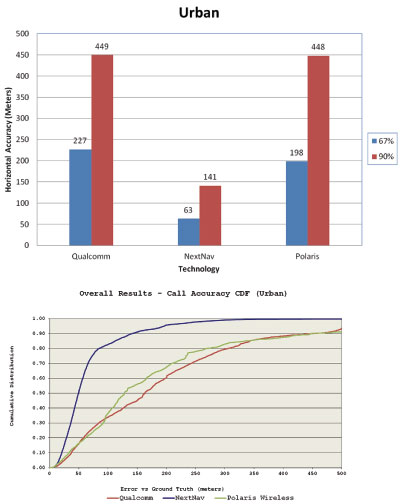
Figure 2. Indoor accuracy in the urban environment. Conclusion. The FCC has received two reports with similar conclusions: We have come a long way since 2001, but we might not be there — the indoor E911 promised land —just yet.
There is still more to come, however. Therefore, many participants and observers hope the work of the current CSRIC will lay the foundation for a rational conversation about indoor E911 right now, and still be around to allow for future improvements. We have recommended that the test bed be maintained so future results can be compared with current ones. At issue is the funding source for the test bed. The FCC has announced the coming of a CSRIC IV, but has not released any further details. It is certainly the hope of WG-3 that the work performed to date to establish and validate the test bed will be available for use by future technologies as they mature.
Locating emergency callers indoors is a critical capability that we as society must address — not for the callers’ convenience, but for their safety and or public safety generally. The problem has technical, commercial, regulatory, financial, legal, and public safety facets to it, making it a very complex issue.
I should also note, that although E911 is a U.S. regulation, the problem of indoor location is under scrutiny in nations all over the world. I earnestly hope that all sides can continue working together to find a solution that can be implemented for the benefit of everyone.
Greg Turetzky is senior director, CTO Office, for CSR. He served on the CSRIC Working Group 3 LBS Subgroup. He will participate in a April 16 GPS World Webinar on this topic. Registration is free.
-
Breaking Down Samsung’s Purchase of CSR
By Kevin Dennehy
There have not been many earth-shaking acquisitions of companies that have location as a big part of their offerings. However, the recent $310 million acquisition of CSR’s handset connectivity and location business by Samsung merits an additional look. CSR, along with Broadcom and Qualcomm, are looking at the indoor location market as a strong one in the next four years. In other news, the Mobile Resource Management market is seeing 20 percent growth—not a market with consumer excitability, but one that makes money.
The recent $310 million acquisition of CSR’s handset connectivity and location business by Samsung has put a number of competitors on notice. One analyst, Liam Quirke, IMS Research, says that because of GPS’ increasing presence on smartphones, and Samsung now being the largest handset manufacturer, it made sense for Samsung to want to own this part of the supply chain.
“This complements its already large manufacturing operations that supply a number of smartphone components, including its own Exynos branded application processor — in addition to manufacturing the Apple-designed Ax range of SoCs,” he said.
The Samsung-CSR transaction refers only to the mobile business (i.e., handsets and tablets). “Samsung’s GPS strategy here is inevitably focused around such devices. The trend within connectivity, particularly in devices with small form factors such as handsets and tablets, has been one of increasing integration,” Quirke said. “Connectivity has been packaged into a single chip with some IC suppliers also including GPS. An example would be Texas Instrument’s WiLink 8 solution. An alternative is to include GPS on the cellular baseband, a route which Qualcomm decided to take and has since begun to integrate into its application processors — and more recently also including Wi-Fi and Bluetooth.”
A number of restrictions placed upon CSR by Samsung, as part of the transaction, prevent CSR from selling a GPS product combined with an application processor into the mobile field for 10 years, hinting that this is a direction Samsung may take in terms of integration and subsequently removing additional potential competition, Quirke said.
In addition to the $310 million deal, Samsung will invest $34.4 million in return for 4.9 percent stake in the remaining CSR business. The completion of this acquisition is expected to be in the fourth quarter. Quirke said that as well as picking up the benefit of CSR’s patent portfolio, the acquisition also adds the research and development and marketing support for its Bluetooth and GPS technology for handsets.
The deal follows Samsung’s acquisition in June of Nanoradio, a developer of ultra-low power Wireless LAN for chipsets for devices such as smartphones and tablets, Quirke said. It also provides Samsung with the connectivity technologies with which to make an entrance into the wireless connectivity market.
During former founder Kanwar Chadha’s tenure at SiRF, which merged with CSR in 2009, the company acquired the GPS businesses of Motorola and Conexant as well some smaller companies such as Centrality, Enuvis, Impulsesoft, Kisel, and TrueSpan.
Indoor Location Market Will Be Important to CSR
CSR, along with competitor Broadcom, has become increasingly involved in the indoor location market, with the announcement of its SiRFusion location platform in November. However, Quirke said that the finer details of the transaction between Samsung and CSR indicate that Samsung has only purchased the technology license for GPS, not indoor location. “If correct, this means CSR is free to sell its indoor location technology to other handset OEMs, and in the reverse means that Samsung is not able to do this,” he said.
With that in mind, indoor location is one of the five key growth areas that CSR is targeting, Quirke said. “Indoor location, and the various applications associated with it, is centred around mobile devices and, as such, is why I feel CSR was eager to hold on to this portion of their mobile business. Indoor location remains a nascent market with much potential, particularly when considering the opportunity to provide highly targeted marketing material in commercial venues such as shopping malls — not to mention the opportunity in the enterprise space,” he said.
IMS predicts in its “Indoor Positioning, Mapping, Technology and Services 2012” study that 110,000 supermarkets, shopping malls, or large retail stores will have indoor maps by 2016, making extensive use of indoor location technology.
CSR has struggled in the mobile space in recent years, while Broadcom and Qualcomm have continued to succeed on the back of their strengths in connectivity combining ICs and cellular baseband chips, respectively, Quirke said. “Current indoor location solutions offered by the major IC suppliers reside on the GPS chip itself, making use of a number of wireless technologies and MEMS sensors. In light of this, CSR will need to provide a compelling reason for a handset manufacturer to choose its indoor location solution over one from Broadcom or Qualcomm,” he said. “On a more positive note, early indications suggest that CSR’s solution may be slightly ahead, in terms of providing an accurate working solution — of those from Broadcom and Qualcomm.”
Enterprise Market Strong…
In other industry news, the leading suppliers of GPS fleet management solutions for the local fleet and enterprise markets are continuing to grow at a strong rate, nearly 20 per year, said Clem Driscoll, president of CJ Driscoll Associates.
“FleetMatics, the largest supplier to small fleets, filed an S1 in May and the IPO is expected in the near future. Telogis continues its wave of acquisitions, most recently NavTrak, said Driscoll, who has completed his “2012-2013 Mobile Resource Management Systems Market Study” that profiles 100 MRM suppliers in several markets.
A strong trend in MRM for both local fleets and the trucking sector is monitoring driver behavior, Driscoll said. “Many suppliers monitor speeding, acceleration, deceleration, speed on turns, etc., and generate driver scorecards to identify the best and riskiest drivers,” he said. “This monitoring of driver performance, along with engine idling time and route adherence, also helps fleet operators minimize fuel consumption, which is a major concern these days.”
-
Samsung Buys CSR’s Mobile Chip Technology
Samsung Electronics Co. has acquired the mobile-technology business of U.K.-based Cambridge Silicon Radio PLC for $310 million. The agreement includes patents to the firm’s Bluetooth, Wi-Fi, and GPS location innovations. Samsung said the move would allow its semiconductor unit to strengthen its line-up of mobile-device processors.
Samsung competes for business from other handset makers against the chip-makers Qualcomm, Texas Instruments and Intel, reports BBC News. The firm’s chips are used in its Galaxy handsets as well as Apple’s iPhones and iPads.
Joep van Buerden, CSR’s chief executive, said his firm offered important technologies, but was aware of a trend in which larger firms were acting to integrate many functions into a single chipset, reducing demand for specialist parts, BBC News reported.
“I believe under Samsung’s ownership the handset operations will be in a better place to prosper in the global handset market,” Buerden said. “I would like to thank all our colleagues who will be transferring to Samsung for their outstanding service.”
CCS Insight analyst Geoff Blaber pointed out in a Yahoo! article that Samsung’s move came soon after the acquisition of Nanoradio, a Swedish Wi-Fi chipset company, which happened June 1. “It underlines Samsung’s commitment to strengthening its vertical advantage by extending silicon capability most notably in Wi-Fi and GPS,” he said.
About 310 members of CSR’s technology and handset team will move over to the South Korean firm.
SiRF founder Kanwar Chadha, who had been with CSR for three years after its acquisition of SiRF in June 2009, left CSR earlier this summer and is rumored to be starting a new venture.
-
Social Loco Conference Highlights LBS Brand Marketing
The Social Loco conference in San Francisco highlighted brands leveraging social location. However, it seems as if the conference focused more on the social than the location element. As one attendee said, “Location as a topic is almost like electricity as a topic, it’s just there.” In other industry news, veteran location executive Kanwar Chadha is moving on…
SAN FRANCISCO — Most companies and attendees at the recent Social Loco conference here realize that while social is big, and such companies as Home Depot and Kraft are looking hard at it, the location part of it still has detractors who don’t know what to do with it.
The problem with social location advertising is that ad execs and large companies don’t understand it — or know how to spend money against it, said Marc Prioleau, managing director of Prioleau Advisors.
Prioleau said location industry executives would talk to each other on who is going to rule the world, with little effect. “[The problem is] that no one came from brand backgrounds and were hacking around an application, rather than focusing on a brand’s objective. Some of the ideas that were hot two years ago…aren’t so hot now,” he said.
The big impact of location-based services, or social loco marketing, is getting consumers to take specific actions to get into a store, said speakers on a mobile panel. Location is relevant when a company can use it as a signal of intent to bring in a five- to 10-percent conversion [sale] rate. “There still has to be relevant and interesting ads, which will open the floodgates for innovation to come in,” said one panelist.
Proximity marketing may be the key ingredient to making LBS a big part of a brand’s advertising strategy. Panelists believe that a large part of consumer purchasing comes in the proximity of someone’s home. Around 40 percent of mobile searches are local.
The fact that a lot of searches are local is not enough, said Di-Ann Eisnor of Waze. “[Users] say that, ‘I am doing this thing already, what else could I be doing [around this area]?” she said. “Intent becomes very powerful — people sharing that intent.”
A venture capital speaker said that brand managers at Pepsi, Gatorade, Mountain Dew, and others are holding back money to find new ways to have consumers “buy that one more can of Pepsi.” He said that brands are looking at social location as ways to try something they haven’t before. “They will get some air time with some senior leaders because of that,” he said.
Still, hard to convice die-hard VCs that location is the way to go. “Social loco [constitutes] two important elements [of advertising]. But I don’t wake up and say, ‘Let’s do a social loco deal today’ — what is this business going to build over time?” asked John Malloy of BlueRun Ventures.
One VC said that LBS is a technology, not necessarily a business mobile. “Investing in mobile, yes, but that’s like saying we invest in people who walk around on two legs. The challenge with location is that it tells me where I am, but not necessarily tells me what to do,” he said. “We need to see a connection to revenue. That’s a challenge with companies such as foursquare — to get a distribution to a network of merchants. Until you are getting paid, it’s just theoretical.”
Travel May Be LBS Niche Market
Using social location applications helps travel companies, airlines, hotels, and others in that industry find customers, said panel members. “Consumers are starting to look at social commerce and social proofing as a way to intelligently tap into friends. They are looking at five hotels my friends have been to,” said Kevin Fliess, Room 77 general manager and vice president of products. “Location and price is a huge consideration — and reading reviews from friends has more value than reading anonymous reviews.”
“One of the challenges we face — location is sensitive — how they can share their trips [is important]. Clearly, the more options you deliver is confusing to consumers,” Nancy Ramamurthi, TripIt vice president, product management and marketing.
One of the off-shoots of travel may be photography. David Staas, CEO of jiwire, said that the company surveyed 800 mobile consumers who used smartphones as the primary device to take a photo. “There is a location component to it; 31 percent want to remember where they took the picture,” he said. “Men and women we surveyed had different behaviors. Women want to use location to communicate with a broader network; 91 percent take pictures on the go; 20 percent of them are more likely to location tag.”
Big Names and Big Companies Rarely Say Anything
At such conferences as Social Loco, big-name entities such as Facebook and Google speak, which draw attendees. Sad thing is that none them say anything, most knowledgeable industry vets agree.
Emily White, Facebook’s director of mobile partnerships, was a keynote speaker at Social Loco and fits in this big-company, no-substance conference speak genre. Yet the big media outlets, because it was Facebook speaking, quoted her with the earth-shaking news that mobile is important, and, hold on to your seat, “the web is being rebuilt around people.” Note to these big companies: Cut the PR stuff and ‘I’m so hip and my company owns the world’ talk, particularly when you are talking to a crowd of savvy marketing executives.
Privacy Is Dead: That’s News to Me
Actually, really isn’t news to me. Anytime a conference has a privacy panel, you know that fireworks will ensue and nothing ever gets resolved by the time the panel ends.
Social Loco’s privacy panel was no different. One panel member said privacy is boring. “It’s boring to legislate, like seatbelts and helmets,” he said.
A Qualcomm speaker said the company has a lawyer who does nothing but work privacy issues. Another speaker, in a rather politically incorrect manner, said more people are harmed from the Catholic Church than by Facebook’s location privacy policy.
Chadha Leaving CSR/SiRF after 17 Years
After more than 17 years with SiRF, including three as chief marketing officer following a merger with CSR, Kanwar Chadha is moving on. In a note to colleagues, he said he has “decided to move on and explore new destinations in my journey of adventure and discovery.”
When Chadha co-founded SiRF in 1995, the company wanted to sell GPS for consumers, which was revolutionary as most in the industry were still trying to sell survey equipment.
“Many thought we were pipe dreamers, some felt we were foolish to enter a market dominated by big companies with a technology controlled by the Department of Defense, and others looked at us as another flash-in-the-pan start-up,” he said. “We were technologists and evangelists at the same time. We developed innovative technologies and products to make GPS work in environments that system was never designed for, but are important for consumer usage such as urban canyons and dense foliage; all keeping in mind price points that mainstream consumers could afford.”
Chadha was proud of an idea book he called “Navigations,” which outlined “futuristic, but artistic concept devices and scenarios highlighting potential use cases of GPS in our daily lives,” he said. “Things we may take for granted today but seemed quite far-fetched in 1995. It was expensive collateral, but probably the best I have done in my life, and it became quite popular,” he said.
During his tenure at SiRF, the company acquired the GPS businesses of Motorola and Conexant as well some smaller companies such as Centrality, Enuvis, Impulsesoft, Kisel, and TrueSpan. He was at the company during the 2004 initial public offering and its merger with CSR in 2009.
“Many of the original SiRFers have moved on, and I have focused my last three years on helping transform CSR into a ‘platform-focused company’ from being just a component supplier. There are many interesting challenges ahead, such as making indoor location reliable and meeting consumer expectations with location across a broad range of applications,” Chadha said.
-
CSR Completes SiRF Acquisition
England’s CSR plc and U.S.-based SiRF Technology Holdings, Inc., have completed their merger, ending years of speculation over what may become of SiRF, a pioneering maker of GPS receivers that had become financially troubled during the current economic downturn.
“In bringing together the combined capabilities and broad range of CSR and SiRF technologies and platforms, we have created a new force in the industry and a world class organization with the commercial, technical and operational scale to build on CSR and SiRF’s existing customer relationships and deliver the next generation of connectivity and location enabled products,” said Joep van Beurden, CSR CEO. “Our strategic goal is to address the existing and emerging needs of our combined customer base for connectivity and location technologies. The potential applications and benefits to the end user of connectivity plus location are only just starting to open up, and these exciting new opportunities will be driven by our unique combination of leading location technologies and connectivity solutions.”
SiRF co-founder Kanwar Chadha echoed those sentiments. “CSR and SiRF have a shared vision of using innovation to bring the benefits of wireless connectivity and location to mainstream consumers and enterprises and to enable new and exciting user experiences,” said Chadha, now a CSR board member and chief marketing officer. “We believe that through this merger, our customers and consumers will derive benefits from a much stronger player whose focus is on delivering best in class connectivity and location platforms.”
For CSR’s customers, the merger with SiRF means CSR’s Connectivity Centre products are augmented by GPS technologies, including assisted GPS (A-GPS), dead reckoning, and location centric platforms, the companies said. Meanwhile, SiRF’s customers will see enhancements to SiRF’s location platforms with CSR’s Connectivity Centre capabilities.
The enlarged CSR group will have its global headquarters in Cambridge, United Kingdom, with SiRF’s headquarters remaining in San Jose, California, which will also serve as CSR’s U.S. headquarters. The combined CSR group is now among the top 10 fabless semiconductor companies, with a combined customer list including six of the top seven handset manufacturers, the top five personal navigation device makers, the top two automotive telematics suppliers, and other auto and consumer electronics providers, CSR said.
-
The Business: SiRF, CSR to Merge; Kanwar Chadha’s Perspective
» MASS MARKET OEM
SiRF, CSR to Merge; Kanwar Chadha’s Perspective
SiRF Technology Holdings, Inc., of San Jose, California, and CSR plc, formerly Cambridge Silicon Radio, headquartered in Cambridge, United Kingdom, will merge in a stock-for-stock transaction to create a new company, which will automatically assume a competitive, leading position in global connectivity and location markets. The companies expect the transaction to close in the second quarter of 2009.
“Financially, strategically, and commercially, this is a compelling transaction,” said Joep van Beurden, CEO of CSR — and analysts would almost universally agree. SiRF has been under the financial microscope since troubles surfaced in Q1 2008, and speculation about an acquisition had been rife.
Further, SiRF has been locked in a patent battle with Broadcom, the latter involved through its July 2007 acquisition of Global Locate.
CSR has made its mark in the Bluetooth connectivity sector, combining multiple connectivity technologies, while SiRF has long pioneered GPS location with multifunction system-on-chip (SoC) location platforms for consumer handhelds and cell phones. In January 2007, CSR purchased GNSS software receiver innovator NordNav.
 Chadha Says. “From a strategy viewpoint,” SiRF founder and vice president of marketing Kanwar Chadha told GPS World, “multi-function radios is something we have been talking about for two years. Market opportunities became much larger in the last six months, with Nokia driving loction into every mobile phone.
“When you see a market opportunity in front of you, it’s better to combine best-of-class than to build a solution from scratch.
“We have a strong customer base in automotive and PNDs, while we are expanding into wireless. CSR is compelementary: strong now in wireless, and so on.
“In easy times, you can build your own solution. In tough times, trying to build an additional platform of technology, if we start from scratch, that may take four to five years to prove out; that’s very difficult. Both of us tried to do that, by the way. They need GPS, we need Bluetooth.
“Now, our multimode AGPS with their EGPS, and the economies of scale enjoyed by a now close to a billion-dollar company, we feel very good about that. Bluetooth in hands-free mobile phones, that has a 50 percent penetration in handsets. It is much deeper than GPS today, although GPS is catching up.
“Their [CSR’s] world is very mobile-phone centric. We are more location-platform centric, more diverse in our view. It will be very interesting. GPS-Bluetooth-FM: for our customers, the handset vendors, this is their most requested combination. There are two ways to integrate these function: integrate GPS with a modem, as Qualcomm does, or integrate it into what CSR calls a connectivity center, of short-range wireless technologies.”
Lines Drawn. A significant market battle continues between the big four in the mass market OEM GPS chip sector: Broadcom, Qualcomm, CSR, and TI, formerly Texas Instruments — with Sony and Panasonic quietly going about their own business, making GPS chips for brand devices, but in a position to supply others, if they are not doing so already. The new ST-NXP Wireless joint venture with Ericsson (see story page 18) will also play in that arena.
Chadha does not expect to see competition from manufacturers in Taiwan and China, at least not immediately. “These are complex radio technologies, not simple digital technologies.”
Brand. “The SiRF brand won’t go away, it’s very strong,” he concluded. “We’ll continue to build on it. the location platform will be our recognizable art of the new company , and of course we’ll continue applying our expertise there.”
On a pro forma basis, the two companies combined would have had 2008 sales of approximately $927 million. The combination will create the single largest pure-play provider of integrated connectivity and location platforms and will be one of the top 10 fabless semiconductor companies in the world, according to a joint statement. Customers include four of the top five handset makers, the top five PND makers, the top two auto-telematics suppliers, and other leading electronics providers. CSR and SiRF will have design and customer-support centers around the world.
On closing of the transaction, SiRF stockholders are expected to own 27% and CSR shareholders are expected to own 73% of the combined company. CSR’s board will add SiRF interim CEO Dado Banatao and Chadha. The combined company, with CSR’s Van Beurden as CEO, will be based in Cambridge, and San Jose will serve as U.S. headquarters.
» TELECOMMUNICATIONS
Ericsson and STMicro Complete Mobile Merger
STMicroelectronics and Ericsson have closed their agreement merging Ericsson Mobile Platforms and ST-NXP Wireless into a 50/50 joint venture. The deal was completed on the terms originally announced on August 20, 2008.
The new company is designed for long-term stability and to become an industry leader in product research, as well as design, development, and the creation of mobile platforms and wireless semiconductors. The joint venture begins as a major supplier to four of the industry’s top five handset manufacturers, who together represent about 80 percent of global handset shipments, as well as to other industry leaders.
Ericsson contributed $1.1 billion net to the joint venture, out of which $0.7 billion was paid to STMicro. Before the closing of the transaction, STMicro exercised its option to buy out NXP’s 20 percent ownership stake of ST-NXP Wireless.
Alain Dutheil, CEO of ST-NXP Wireless and chief operating officer of STMicroelectronics, will lead the joint venture as president and chief executive officer.Employing about 8,000 people — roughly 3,000 from Ericsson and 5,000 from STMicro — the new wireless technologies company is headquartered in Geneva, Switzerland.
» MILITARY & GOVERNMENT

Honeywell T-Hawk Micro Vehicle Heads for U.K.
Honeywell received an order for six T-Hawk micro air vehicle (MAV) systems from the U.S. Navy, the contracting agency for the U.K. Ministry of Defence (MOD) for the T-Hawk MAV system procurement, in a contract valued at USD $5.7 million.
The new U.K. order comes in addition to the Navy’s existing T-Hawk contract with Honeywell, announced in November 2008, for 90 systems. The T-Hawk MAV will be used by joint force EOD (Explosive Ordinance Device) units in Iraq and Afghanistan, among other locations.
The circular vehicle, weighing 17 pounds and 14 inches in diameter, can fly down to inspect hazardous areas for threats without exposing warfighters to enemy fire. The T-Hawk MAV can take off and land vertically and fly more than 40 minutes, at more than 40 knots of airspeed, operating at altitudes of more than 10,000 feet.
An eye-in-the-sky for battlefield surveillance, the Honeywell MAV carries video cameras to relay real-time data and a GPS device. It identifies improvised explosive devices (IEDs) and can inspect suspected bomb sites in areas inaccessible by ground robots.
» MASS MARKET OEM
 Epson, Infineon Develop Tiny Single-Chip Receiver
Seiko Epson Corporation of Tokyo, Japan, and Infineon Technologies AG of Neubiberg, Germany, have developed a GPS single-chip design, the XPOSYS, which is optimized for mobile devices for the consumer market — especially cellular phones with navigation features.
Compared to existing solutions in the market, the XPOSYS, which is manufactured in a 65-nanometer process technology, provides increased performance and new levels of user experience, the companies said.
Sensitivity has been increased from -160 dBm to -165 dBm, allowing for pinpoint positional accuracy when indoors or in urban canyons. Power consumption has been reduced by 50 percent, increasing the battery life of products in which it is included. The footprint has been reduced to 2.8 x 2.9 millimeters, which the companies claim is 25 percent less than the smallest GPS chip available elsewhere.
 u-blox Launches Cards for Mobile Computers
A GPS PCI Express Mini card from u-blox (Thalwil, Switzerland) enables next-generation laptop, netbook, mobile internet device and Ultra Mobile PC OEMs to provide GPS and location-based services (LBS) such as personal navigation, services and people finders, and geo-tagging.
“With the explosive potential of next-generation GPS applications and services for mobile PCs, it is the right time to introduce a robust PCI Express mini card supporting location-based services,” said Thomas Nigg, Vice President Product Marketing at u-blox.Sales of mobile PCs with integrated GPS are projected to grow from 3 million units in 2007 to 45 million units in 2011, according to u-blox.
Qualcomm Launches Chipset for Low-Cost Smartphones
Qualcomm, Inc., has launched the Mobile Station Modem MSM7227 chipset designed to enable high-performance, sub-$150 smartphones. The MSM7227 chipset features integrated Bluetooth 2.1 and GPS, a 600-MHz applications processor with a floating point unit, 320-MHz application DSP, 400-MHz modem processor, hardware-accelerated 3D graphics, 8-megapixel camera, and 30-fps WVGA video encode and decode and display support.
The MSM7227 chipset is designed to provide advanced processing and multimedia while using HSDPA/HSUPA for broadband data speeds over 3G networks. It also can support all leading mobile operating systems including Android, Symbian S60, Windows Mobile and BREW Mobile Platform, according to the company.
The MSM7227 chipset has a 12 x 12 millimeter footprint and lower power consumption than previous MSM7xxx-series chips. It is sampling now, and commercial smartphones based on the chip are expected to launch later this year.
Broadcom Combos GPS, Bluetooth, and FM Radio System-on-Chip
Broadcom Corporation of Irvine, California, has released BCM2075, a new, integrated GPS, Bluetooth, and FM radio in a single-chip design, targeting location-based services (LBS) applications. The processor reduces the host and application processing required by competing combo solutions, enabling greater adoption in mass market handsets, according to the company.
The BCM2075 integrates four radios (Bluetooth, GPS, FM receive, and FM transmit), enabling the radios to operate simultaneously and with minimal interference.
The company expects the chip to drive key handset applications that network operators and consumers are looking to adopt, furthering the cause of LBS and advanced multimedia available on mid-range mobile phones. The GPS core uses a host-based integration architecture that splits the processing duties between the BCM2075 and the host CPU system and provides low GPS power, delivering a reported 50 percent better power performance compared to other chips, the company said. Broadcom’s GPS technology, stemming largely from its July 2007 purchase of Global Locate, enables a fast time-to-first-fix and provides integrated support for other positioning technologies, such as Wi-Fi positioning.
-
SiRF and CSR to Merge
SiRF Technology Holdings, Inc., based in San Jose, California, and CSR plc, formerly Cambridge Silicon Radio, headquartered in Cambridge, UK, will merge in a stock-for-stock transaction to create a new company, which will automatically assume a competitive/leading position in global connectivity and location markets. The companies expect the transaction to close in the second quarter of 2009.
“Financially, strategically and commercially, this is a compelling transaction,” stated Joep van Beurden, CEO of CSR — and analysts would almost universally agree. SiRF has been under the financial microscope since troubles surfaced in Q1 2008, and speculation about an acquisition had been rife.
Further, SiRF has been locked in a patent battle with Broadcom, the latter involved through its July 2007 acquisition of Global Locate.
CSR has made its mark in the Bluetooth connectivity sector, combining multiple connectivity technologies, while SiRF has long pioneered GPS location with multifunction system-on-chip (SoC) location platforms for consumer handhelds and cell phones. In January 2007, CSR purchased GNSS software receiver innovator NordNav.
For the moment, Qualcomm CDMA sits on the sidelines, but a significant and long-going market battle continues between (now) the big three in the mass market OEM GPS chip sector: Broadcom, Qualcomm, CSR — with Sony and Panasonic also quietly going about their business, primarily making GPS chips for their own brand devices, but certainly in a position to supply others, if they are not doing so already.
Based on CSR’s and SiRF’s results for fiscal year 2008, on a pro forma basis, the combined companies would have had sales of approximately $927 million. The combination will create the single largest pure play provider of integrated connectivity and location platforms and will be one of the top 10 fabless semiconductor companies in the world, according to a joint statement by the two. Customers of the combined company include four of the top five handset manufacturers, the top five personal navigation device makers, the top two auto-telematics suppliers, and other leading auto and consumer electronics providers. CSR and SiRF will have design and customer support centers around the world.
Under the terms of the agreement, SiRF stockholders will receive 0.741 of a CSR share for each share of SiRF common stock they own. Based on the closing stock price for CSR on February 9, this consideration would be equivalent to $2.06 of CSR stock for each SiRF share, representing total consideration of $136 million. This represents a premium to SiRF stockholders of approximately 91% over SiRF’s closing stock price on February 9. On closing of the transaction, SiRF stockholders are expected to own approximately 27% and CSR shareholders are expected to own approximately 73% of the combined company. The transaction is expected to be tax-free for SiRF stockholders.
SiRF, listed on the NASDAQ exchange, generated revenues of $232 million in 2008, and had gross assets of $195 million as of December 27, 2008.
CSR is listed on the London Stock Exchange. CSR’s customers include industry leaders such as Audi, Ford, LG, Motorola, NEC, Nokia, Panasonic, RIM, Samsung, Sharp, Sony, TomTo,m and Toshiba. CSR has its headquarters and offices in Cambridge, UK, and offices in Japan, Korea, Taiwan, China, India, France, Denmark, Sweden, and both Dallas and Detroit in the USA.
According to the companies, the transaction proffers the following benefits to both the companies themselves and their stockholders:
Combined Product Roadmap for Next-Generation Chips. The combined company will have significant R&D resources to deliver a broader portfolio of location and connectivity solutions to customers. R&D efforts will continue to support each company’s existing product lines and will also be focused on the delivery of additional multifunction radio chips, which combine CSR’s Bluetooth and other connectivity capabilities with SiRF’s GPS and GNSS technologies.
Growing Market Opportunities and Revenue Synergies. The combined company will benefit from significantly increased scale to meet the demand for both connectivity and location services in a broad range of products spanning mobile phones, automobiles, personal computers, mobile Internet devices, digital cameras, mobile gaming, and other consumer electronics products. The companies expect to achieve significant additional revenue synergies beginning in 2010 and beyond through a combination of cross-selling opportunities, deeper penetration of existing customers, new product offerings combining complementary technologies, and access to new markets.
Financial Synergies. The companies expect that annual cost synergies of at least $35 million in savings from gross margin improvements and reduced R&D, sales and marketing, and overhead costs can be achieved through steps that can be implemented within 60 days post completion of this transaction.
Financial Strength and Flexibility. The combined company is expected to have a strong balance sheet and cash position. At the end of fiscal year 2008, on a pro forma basis, the combined company had $378 million in cash and no bank debt.
Following the close of the transaction, CSR’s board of directors will be expanded to add two members of the SiRF board, interim CEO Dado Banatao and co-founder and VP of marketing Kanwar Chadha. Van Beurden will lead the combined company as CEO with the remaining leadership to be comprised of executives from both SiRF and CSR. The combined company will be headquartered in Cambridge (United Kingdom), and SiRF’s San Jose, California, headquarters will become the headquarters for CSR’s U.S. operations.
The transaction is subject to regulatory approvals and the approval of SiRF and CSR shareholders.
More information can be found at www.csr.com.