Tag: cyclone

  • NASA, New Zealand to collect climate data with commercial aircraft

    NASA, New Zealand to collect climate data with commercial aircraft

    NASA is partnering with the New Zealand Ministry of Business, Innovation and Employment, New Zealand Space Agency, Air New Zealand and the University of Auckland to install next-generation GNSS reflectometry receivers on passenger aircraft to collect environmental science data over New Zealand.

    The program is part of NASA’s Cyclone Global Navigation Satellite System (CYGNSS) mission, a constellation of eight small satellites launched in 2016 that use GPS satellite signals that reflect off Earth’s surface to collect science data.

    The CYGNSS satellites orbit above the tropics and their primary mission is to use GPS signals to measure wind speed over the ocean by examining GPS signal reflections off choppy versus calm water. This allows researchers to gain new insight into wind speed over the ocean and will allow them to better understand hurricanes and tropical cyclones.

    Measurements over land

    In addition to its primary over-water research capabilities, scientists have discovered that the CYGNSS technology is also capable of collecting valuable measurements over land, including of soil moisture, flooding, and wetland and coastal environments.

    “Partnering with New Zealand offers NASA and the CYGNSS team a unique opportunity to develop these secondary capabilities over land. Taken together over time, they’ll also have an important story to tell about the long-term impacts of climate change to these landscapes,” said Gail Skofronick-Jackson, CYGNSS program scientist at NASA Headquarters, Washington.

    The CYGNSS team, led by principal investigator Chris Ruf at the University of Michigan in Ann Arbor, has developed a next-generation GNSS reflectivity receiver with support from NASA’s Earth Science Technology Office. These receivers will be installed in late 2020 on one of Air New Zealand’s Q300 domestic aircraft.
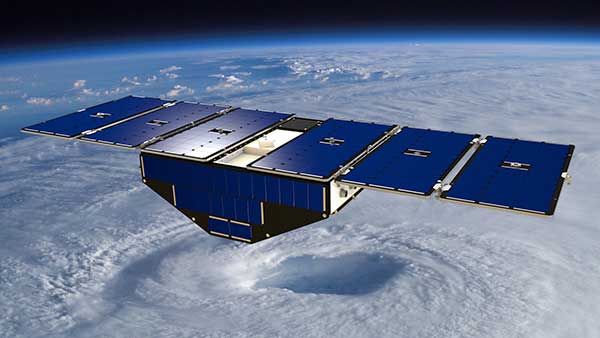
    Artist's concept of one of the eight CYGNSS satellites in orbit. (Image: NASA/University of Michigan)
    Artist’s concept of one of the eight CYGNSS satellites in orbit. (Image: NASA/University of Michigan)

    Aircraft overlap satellite path

    As the aircraft traverses New Zealand, it will collect data from the land below, some of which will overlap with the flight paths of the CYGNSS satellites.

    This overlap, which will have frequent data observations from regular commercial flights, will provide the CYGNSS team a wealth of data to use to validate and improve the CYNGSS satellite observations, said Ruf.

    In addition, the varied New Zealand terrain will provide comparison points with data collected in similar terrains in other parts of the world.

    “As a result of this partnership, both Air New Zealand engineers and researchers across New Zealand will now have the opportunity to work with NASA on a world-leading environmental science mission,” said Peter Crabtree, general manager of Science, Innovation and International at New Zealand’s Ministry of Business, Innovation and Employment.

    Science Payload Operation Centre

    The University of Auckland will host the Science Payload Operation Centre, which will begin operations and data collection in late 2020.

    “Over time, the data that will be collected by these receivers could form one of New Zealand’s largest bodies of long-term environmental data, and as such it represents a wide range of research opportunities,” said radar systems engineer and project lead Delwyn Moller of the University of Auckland.

    Air New Zealand will be the first passenger airline to partner with NASA to collect data for a science mission. Air New Zealand has 23 Q300s in its fleet, and if the approach is successful, the airline will explore introducing the technology more widely.
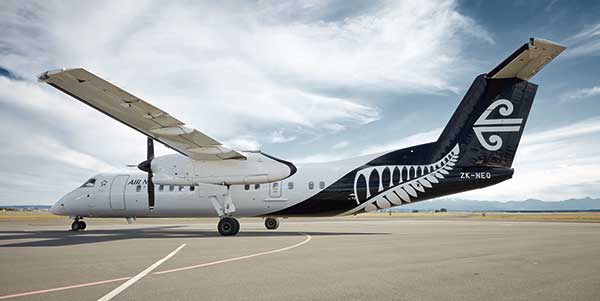
    An Air New Zealand Bombadier Q300. (Photo: Air New Zealand/NASA)
    An Air New Zealand Bombadier Q300. (Photo: Air New Zealand/NASA)

    “As an airline, we’re already seeing the impact of climate change, with flights impacted by volatile weather and storms. Climate change is our biggest sustainability challenge, so it’s incredible we can use our daily operations to enable this world-leading science,” said Air New Zealand Chief Operational Integrity and Standards Officer Captain David Morgan.

  • Leica Cyclone REGISTER 360, cloud services offered for digital reality-capture market

    Lieca-Cyclone-WHexagon announced today its new Leica Cyclone REGISTER 360 laser scanning software for simpler, automated registration, and its Cyclone Cloud Services platform for secure global collaboration through an on-demand software-as-a-service model.

    Together, the new products offer users smarter ways to register, visualize and collaborate around digital reality projects, delivering solutions into the architecture, engineering and construction (AEC), plant, survey and public safety markets through the connected Leica Cyclone family.

    “Digital realities are enabling professionals and newcomers to laser scanning to shape the world around us. Whether it’s on a construction site for building documentation or in a plant environment for life cycle updates, efficiencies and productivity gains are realised with the ability to merge reality and digital data quicker and with more accuracy,” said Hexagon President and CEO Ola Rollén. “These new developments in laser scanning registration with our Cyclone software improve the user experience and overall workflow of point cloud processing.”

    Lieca-Cyclone-W2Cyclone REGISTER 360 is the a professional-grade registration software that combines automation, high performance and ease of use into one powerful package available to novices and experts alike. Simplifying and automating the entire production process, Cyclone REGISTER 360 enables users to automatically process, validate and deliver point clouds according to rigorous quality control and reporting standards.

    Cyclone Cloud offers professionals a new way to consume and deliver digital reality data through a highly scalable, intuitive and web-based platform. TruView Cloud Services is the only cloud-based digital reality visualization and collaboration platform that enables quick setup of private user communities, connecting with and making the data available anywhere in the world.

    Users can publish digital reality content in Cyclone from handheld devices and terrestrial, mobile and unmanned aerial vehicles. With open application programming interfacing, the data can be delivered in any device and operating system with connectivity for building information modeling, geographic information systems and computed-aided drafting.

  • Airbus Imagery to Help Vanuatu in Wake of Cyclone

    Port Vila, the capital of Vanuatu, viewed by Pléiades satellites, before Cyclone Pam.
    Port Vila, the capital of Vanuatu, viewed by Pléiades satellites, before Cyclone Pam.
    Port Vila, the capital of Vanuatu, viewed by Pléiades satellites after the passage of Cyclone Pam.
    Port Vila, the capital of Vanuatu, viewed by Pléiades satellites after the passage of Cyclone Pam.

    Following Cyclone Pam, Airbus Defence and Space has acquired Pléiades and SPOT 6 and 7 imagery over the island nation of Vanuatu to support the International Charter and Copernicus Emergency Management Service.

    The data acquired will assist in assessing the damage and help rescue organizations in the delivery of humanitarian aid.

    The before and after Pléiades images over Port Vila, that can be downloaded here, show the devastation caused by the cyclone. The “before” Pléiades image was acquired on April 9, 2014, and the “after” Pléiades image was acquired on March 16, three days after the Cyclone hit Port Vila.