Tag: deformation

  • Trimble Launches New Version of 4D Control Software

    Trimble-deformation-O

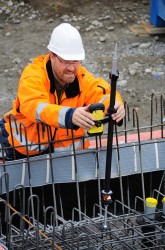
    Trimble has introduced the latest version of its deformation monitoring software, Trimble 4D Control version 4.3. The latest version features new optional monitoring applications — the High Rise App, the SeismoGeodetic App and the Trimble 4D Control Site Setup App for Trimble Access — to better analyze complex data communicated from a broad range of GNSS, optical, geotechnical, seismic, atmospheric and metrological sensors.

    Trimble says it is continuing to expand the ways in which quantifying movement change can be automated using a range of geodetic, seismic and engineering sensors. The opportunities in automation play a significant part in effective project safety management and construction strategies, the company said. Equally important is the analysis of complex data communicated via simple visual terms in order to understand the impacts of change between disciplines.

    Version 4.3 includes a dedicated page to support the functionality of the High Rise App and Composite Views for combining charts, plots and other displays. High-frequency charts, comparative bar charts, tabular and windrose analysis as well as a new visualization tool designated for in-place inclinometers and tilt meter arrays are ways to examine complex data and present findings in a meaningful way, Trimble said.

    In addition to the new High Rise App, SeismoGeodetic App and Trimble 4D Control Site Setup App, the software release and apps also provide new functionality for data processing, visualization and analysis. The interactive Web Interface, Trimble 4D Control Web, provides improved multi-select control and more granularity for customizing alarms.

    High Rise App: The High Rise App is intended to monitor high-rise structures during construction using GNSS and inclination sensors. Integrated processing of GNSS, total station and inclination data delivers precise and reliable coordinates on demand for stake-out jobs on structures subject to tilt such as towers and high rise buildings.

    SeismoGeodetic App: The SeismoGeodetic App integrates the advantages of high-precision GNSS data and high frequency strong motion data. The data from co-located GNSS receivers and Trimble REF TEK strong motion accelerometers can now be processed in an integrated approach resulting in high-precision 3D positions up to a sample rate of 500 Hz.

    Trimble 4D Control Site Setup App for Trimble Access: The Trimble 4D Control Site Setup App for Trimble Access field software allows the user to create, enhance or modify a total station site setup for Trimble 4D Control using a Trimble field controller. Once the site setup has been transferred to Trimble 4D Control, round measurements can be performed immediately without the need to run the Site Setup functionality on the server.

    Trimble 4D Control version 4.3, High Rise App, SeismoGeodetic App and the Trimble 4D Control Site Setup App for Trimble Access software are available now from Trimble’s worldwide Infrastructure distribution network.
  • Leica Geosystems Offers CC55 Controller

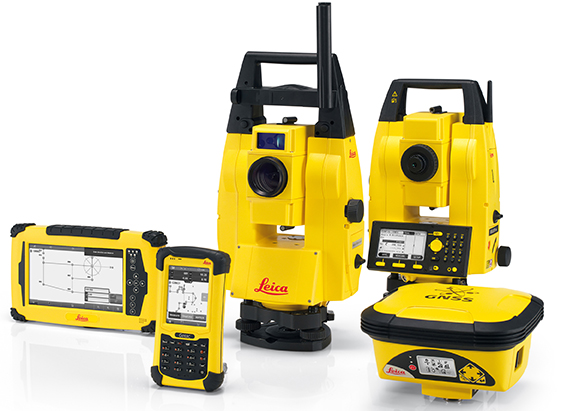
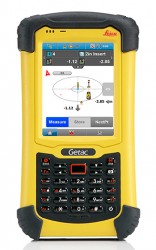
    The Leica iCON CC55 controller is part of the Leica iCON portfolio.
    The Leica iCON CC55 controller is part of the Leica iCON portfolio.

    Leica_ICON_CC55_with_screen-WLeica Geosystems now offers the Leica iCON CC55 controller, a versatile and rugged PDA with a 3.5-inch color display, as part of its iCON construction portfolio. The handheld controls Leica iCON sensors, runs the iCONstruct field software, and has a QuadraClear sunlight readable display and a fast 1-GHz processor.

    The smaller Leica iCON CC55 handheld controller, as well as the seven-inch Tablet PC Leica iCON CC65/66 field controller, are both fully integrated into Leica Geosystems’ iCON portfolio of hardware and software solutions. It runs the Leica iCON build or site software to display and connect measured points for as-built data capturing or to lay out points and construction lines directly from the digital construction plan. The controller provides flexible options for data communication and an extensive data storage.

    Leica_iCON_CC55_application-WThe Leica iCON CC55 can be used to control the Leica iCON robot total stations, enabling one-person operation, saving time and increasing productivity for construction layout tasks and as-built checks, the company said. The optional Long-Range Bluetooth allows communication with the iCON robot 50 at distances of more than 350 m/1150 feet. Alternatively, the iCON CC55 can be used as a data logger with the Leica Builder manual total station. Together with the versatile Leica iCON gps 60 SmartAntenna, the iCON CC55 creates a compact and light-weight GPS rover system.
    The iCON CC55 runs the state-of-the-art Windows Embedded Handheld 6.5 operating system and comes with 256MB NAND Flash memory and 8 GB of extended storage, enabling extensive data process and storage capacity. An internal WLAN module and Long-Range Bluetooth offer users impressive distance communication, the company said, and the longer life 5.6Ah battery lets users easily complete a full day’s work. The iCON CC55 also comes equipped with a 5-MP camera so users can document their construction projects.


  • Topcon Technology Hits the Road in North America


    Topcon Technology Roadshow 2014, by Topcon Positioning Systems, launches in April. The hands-on educational program is focused on advanced positioning technologies and will feature a 5,000 square-foot mobile classroom/theater housed in a custom-designed 18-wheeler.

    The Technology Roadshow will cover North America, traveling more than 23,000 miles in six months. Each of the currently scheduled 23 stops for the free educational program – beginning April 10 in Pleasanton, California, and ending in October at Riverside, California — will include multiple sessions over two days. The events will focus on technology trends in the construction, surveying and GIS, engineering and architecture/engineering/contractor (AEC) professions.

    “With technology advancing so rapidly, many of our customers are telling us that it is difficult for them to keep up,” said Mark Contino, Topcon vice president of global marketing. “The Technology Roadshow is a fresh ‘we’ll-bring-the-technology-to-you’ concept that will provide an educational experience to construction and surveying professionals who want to learn about these exiting new solutions first hand, so they can determine the best fit for their business. Instead of flying half way across the country to attend a trade show or conference, we’re excited for this opportunity to bring tomorrow’s positioning technology to the construction, engineering and surveying backbone of North America — on their timetable, close to home, on a one-on-one basis.”

    “The focus of this unique learning event will demonstrate how the entire breadth of Topcon solutions works seamlessly together,” Contino said. “The real beauty is we’re bringing it directly to decision makers and end-users, allowing every company — big or small — the opportunity to see first-hand how new solutions and technologies can help them to become more productive and profitable.

    “We believe this rolling ‘user conference’ is a proactive way to help make sure the opportunity to learn about new technology is available to anyone who wants to learn.”Topcon industry and application professionals will staff the traveling unit. Topcon dealer personnel from the local area are tour sponsors and will assist them at each stop.

    For more information, go to the official Topcon Technology Roadshow website and register for an event in your area.

  • Spectra Precision’s Latest Survey Receiver Uses Six GNSS Systems

    Spectra Precision’s Latest Survey Receiver Uses Six GNSS Systems

    Spectra-Precision-SP80-GNSS-Receiver-River-W

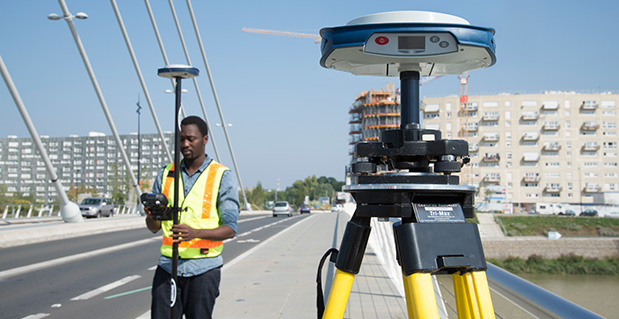
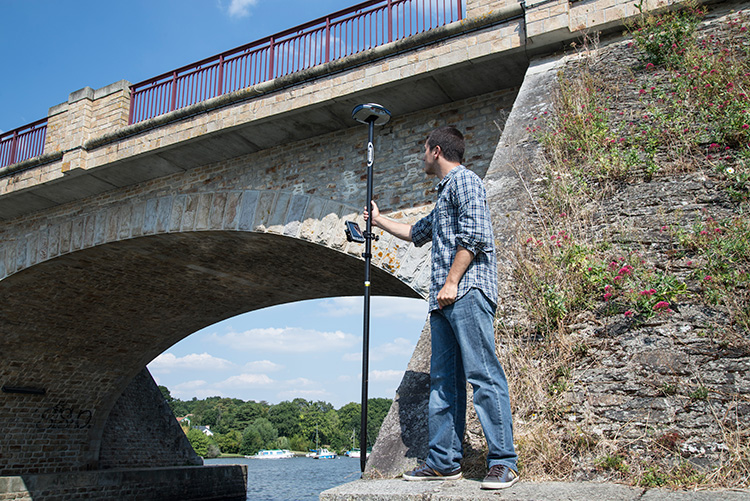
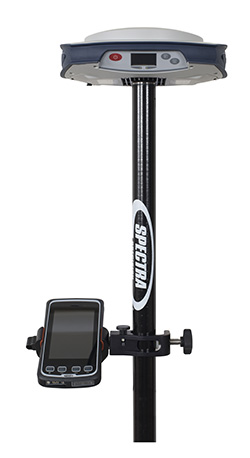
    Spectra Precision introduced today its next-generation Spectra Precision SP80 GNSS receiver. Designed to meet the evolving needs of the survey market, the new SP80 combines GNSS technology and a combination of communication capabilities with an ergonomic design, the company said. The SP80 is specifically designed for mainstream surveying and construction applications such as cadastral, topographic, control, stakeout and network RTK.

    Spectra Precision SP80 features Spectra Precision’s Z-Blade GNSS-centric technology running on a new-generation, 240-channel 6G chipset. The SP80 is capable of fully utilizing all six available GNSS systems (GPS, GLONASS, BeiDou, Galileo, QZSS and SBAS), but can also be configured to use only selected constellations in an RTK solution (GPS-only, GLONASS-only or BeiDou-only).The SP80 is also compliant with the new RTCM 3.2 standard, including the recently approved MSM RTCM messages, which means it supports all available GNSS corrections.

    SP80-GNSS-Front-with-Antenna-Pole-WThe extended communication capabilities of the SP80 receiver provide a combination of a 3.5G GSM/UMTS modem, Wi-Fi and Bluetooth connectivity, and an optional transmit UHF radio. The receiver’s built-in Wi-Fi and 3.5G modem can provide an Internet connection for RTK corrections and also send SMS or e-mails with system alerts. The SP80 features a unique anti-theft technology to safeguard the receiver and can detect if it is has been disturbed while in the field (for example, when operating as a GNSS base). The anti-theft protection feature informs the surveyor via SMS or e-mail if the SP80 receiver is moved and can provide its position to facilitate recovery.

    The Spectra Precision SP80 is rugged and waterproof, yet compact, lightweight and ergonomic for ease of use in the field, Spectra Precision said. When the UHF transmit radio module is used, its UHF antenna remains protected inside the rugged rod, extending the radio range performance. Powered with dual hot-swap batteries for typical all-day operation, the SP80 receiver is an ideal tool for any surveyor.

    “The Spectra Precision SP80 introduces several major enhancements and innovations, including the new 6G GNSS ASIC with enhanced Z-Blade technology, unique SMS and e-mail messaging and patented inside-the-rod mounted UHF antenna,” said Olivier Casabianca, business area director of Trimble’s Spectra Precision Division. “In addition, SP80 was designed as an extremely reliable receiver, making it suitable for a variety of challenging surveying projects.”

  • Trimble Adds Ultra High-Frequency RFID to Juno T41 Rugged Handhelds

    Trimble Adds Ultra High-Frequency RFID to Juno T41 Rugged Handhelds

    Juno-T41_Local-Govt_asset-W

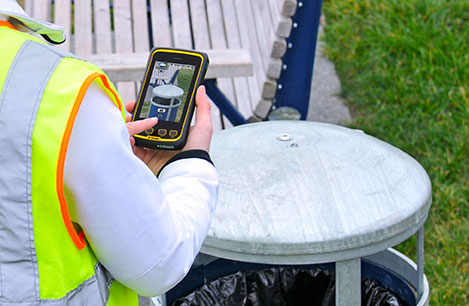
    Trimble has introduced the Juno T41 rugged handheld computer with integrated Ultra-High Frequency RFID capabilities. In addition to high-speed 1D/2D barcode imaging technology, smartphone capability and enhanced, real-time 1-2 meter GPS accuracy, the Juno T41 series now offers new models that provide more functionality and configuration choices for data collection and mobile workforce management, Trimble said.

    “Often the RFID tag is specifically used because the item being tracked is in difficult or harsh environments where a barcode won’t survive,” said Jim Sheldon, general manager of Trimble’s Mobile Computing Solutions Division. “The rugged design of this handheld computer is an ideal solution for reading RFID in outdoor and extreme situations.”

    The RFID capability can be combined with Enhanced GPS and/or smartphone connectivity so customers can choose a specific handheld model that meets their needs.

    The Juno T41 R will automatically recognize tags across a variety of frequencies and work with any size or style of RFID tag that is designed for customized solutions. UHF RFID is an increasingly commonplace technology using the 860 to 960 MHz frequency range.

    Using the latest EPCglobal Gen 2 RFID technology from Trimble’s ThingMagic Division, the device uses two different antenna ranges to read or recognize the unique identification of an asset anywhere in the world.

    • FCC Certified (North America): 902-928 MHz bands
    • ETSI Certified (EU): 865.6-867.6 MHz bands
    • ACMA Certified (AU/NZ): 920-926 MHz bands

    Trimble Juno T41 RFID handheld computers feature a 1-GHz processor and 512-MB RAM and 32-GB onboard storage with either Android 4.1 or Microsoft WEHH 6.5 operating systems. Other standard features include an 8-MP integrated camera, multi-touch capacitive 4.3-inch sunlight-readable display, all-day battery life and 2-4 meter GPS accuracy capability. Other features include:

    • Rapid-read, high-accuracy performance on multiple tags with multiple orientations, even in crowded conditions.
    • Consistent read-range over 3.5 meters for 5 cm2 (2″) UHF tags in unobstructed space.
    • Integrated antenna with the ability to transmit up to +30 dBm (1 Watt) power for demanding applications.
    • >Configurable performance settings and use-case parameters in the pre-loaded Trimble SearchLight application.
    • Software Development Kit to customize all settings including read-range, power-consumption and other features.

    The Juno T41 models are built to meet military-grade standards of ruggedness for drops, temperature, altitude, humidity extremes, vibration, chemical exposure and shock with either an IP65 or IP68 rating for water and dust.

  • Trimble Offers New Version of Deformation Monitoring Software


    Trimble introduced today the latest version of its deformation monitoring software, Trimble 4D Control version 4.2. The new version of the monitoring software delivers enhanced communications with the Trimble NetR9 and new NetR9 Ti-M GNSS receiver, REF TEK seismic sensors and the Trimble S8 total station. It also supports geotechnical sensors, weather stations, level data and it provides velocity and trend computations as well as a calculation facility for mathematical operations. The interactive Web interface provides advanced alarms, data visualization and analysis tools. Site access is controlled by user login credentials.

    The announcement was made today at Intergeo 2013, being held in Essen, Germany, October 8-10.

    Trimble NetR9 Ti-M. Trimble also introduced a dedicated GNSS monitoring receiver, the Trimble NetR9 Ti-M, designed for real-time monitoring applications. This instrument is the fourth-generation of the proven Trimble NetR9 series of GNSS reference receivers, and is specifically designed for the monitoring market and supported by Trimble 4D Control software.

    Trimble REF TEK Sensors. Following the acquisition of REF TEK, now a division of Trimble and a provider of seismic sensors and data recording instruments, support for REF TEK accelerometers has been included in Trimble 4D Control version 4.2. Different variants of peak acceleration that are used in monitoring the effects of vibration on structures such as micro-seismic activity, proximity blasting or impact piling can be visualized and alarmed in Trimble 4D Control.

    Trimble 4D Control is a fully scalable and comprehensive software solution for both real-time and post-processed monitoring projects. The software solution is ideal for the long-term, automated monitoring of dams, bridges, buildings, support piers, large-scale construction and excavation sites, open pit mines, landslides, tunnels and other structures. Real-time management and control of the monitoring system is available via the Trimble 4D Control Web Interface on-site, online and around the clock from any location with Internet or Intranet connectivity.

    “To date, this advanced technology has only been available to end users of an automated monitoring system.  We recognized the need to provide this functionality across the full spectrum of monitoring applications,” said Ulrich Vollath, general manager of Trimble’s Infrastructure Division. “We are pleased to announce the launch of Trimble 4D Lite, a cloud-based subscription service which will make this solution available to small- and medium-sized monitoring projects. With the introduction of 4D Lite, Trimble’s monitoring solutions are now available for the full spectrum of monitoring projects, from small, non-permanent, campaign monitoring projects through to permanent, fully automated monitoring systems.”

    Trimble 4D Lite – Advanced Cloud Monitoring Service. 4D Lite is a cloud-based application that is designed with an interface familiar to existing Trimble monitoring technology users. 4D Lite is designed for surveyors, engineers and scientists to perform campaign monitoring of data/time series without the need to integrate directly with onsite hardware and sensors. Trimble 4D Lite can be used to meet campaign monitoring needs of installations on dams, bridges, mines, landslides, buildings and other natural and man-made hazards or structures using sensors to monitor health. Data can be integrated from a wide range of sensors. The data can be visualized and analyzed on a variety of interactive charts and scatter plots and the sensors can be viewed in context with the structure using a variety of backdrops including maps, plans or photographs.

    Trimble 4D Control version 4.2, the NetR9 Ti-M GNSS receiver and the 4D Lite monitoring service are available now from Trimble’s worldwide Infrastructure distribution network.

  • Topcon’s Hybrid Positioning Combines GNSS, Optical Measurement

    Topcon’s Hybrid Positioning Combines GNSS, Optical Measurement

    Photo: Topcon Positioning Group
    Photo: Topcon Positioning Group

    Topcon Positioning Group announces a new technology — Hybrid Positioning — that increases efficiencies and improves productivity on job sites, regardless of conditions, terrain or location. Hybrid Positioning is enabled through the Topcon Magnet software suite, a Topcon enterprise solution for the geomatics industry.

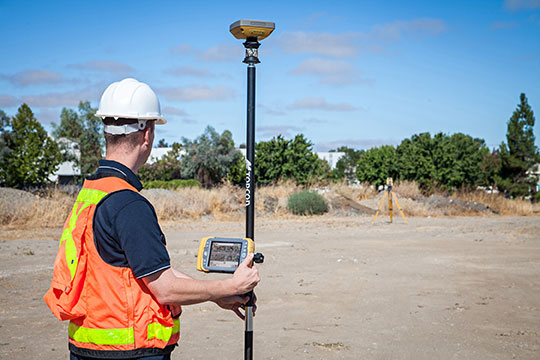
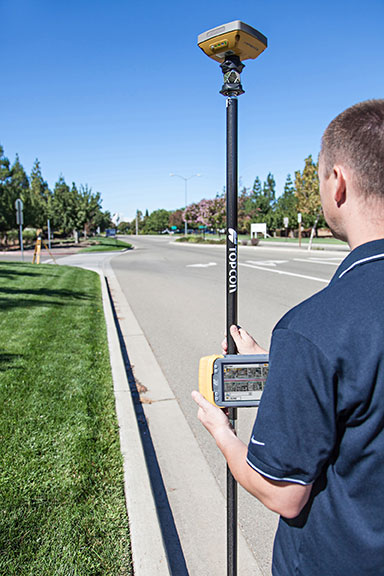
    The new Topcon technology allows precise positioning professionals in the survey, construction, civil engineering and GIS industries to simultaneously connect to GNSS signals and standard robotic measurements on a single rover pole.

    “This extremely clever and unique combination of GNSS and optical measurement is aimed squarely at improving a company’s profitability by allowing the use of GNSS positioning and optical positioning data at the same time,” said Ewout Korpershoek, chief marketing officer of Topcon Positioning Group. “When used with Topcon Magnet software, Hybrid Positioning improves field measurement efficiency at every phase of a project. With Hybrid Positioning technology, the key is versatility. For example, when line-of-sight is blocked, shots can be easily and quickly measured with the GNSS receiver. Now it is so easy to combine a standard Topcon robot and GNSS receiver to guarantee an integrated solution for the highest performance and productivity.

    Photo: Topcon Positioning Group
    Photo: Topcon Positioning Group

    “Combine these two proven solutions, plus advanced Magnet Field software, and you have Hybrid Positioning technology,” Korpershoek said. “By utilizing both GNSS and optical measurement, any project can be completed faster and with unsurpassed accuracy. By adding Magnet cloud-connected data workflow, truly outstanding increases in productivity and cost savings are assured.”

    The new technological breakthrough has four key components: Hybrid Lock, Hybrid Resection, Hybrid Switch and Auto-localization.

    Hybrid Lock allows accurate prism tracking by simply turning the instrument toward the prism location. Hybrid Resection ensures quick job site setup, as well as establishing RTK and geodetic coordinates. Hybrid Switch ensures a quick changeover from GNSS to optical measurement with a single touch. Auto-localization utilizes Bing Maps background, multi-point localization and works with RTK and NMEA positioning.

    “Regardless of job site location or adverse conditions or terrain, Hybrid Positioning systems will perform faster in the field than other instruments and with more versatility than an RTK-only system,” Korpershoek said.

  • iGage Introduces Low-Cost OPUS GPS Receiver

    iGage Introduces Low-Cost OPUS GPS Receiver

    X90_Lake
    Photo: iGage

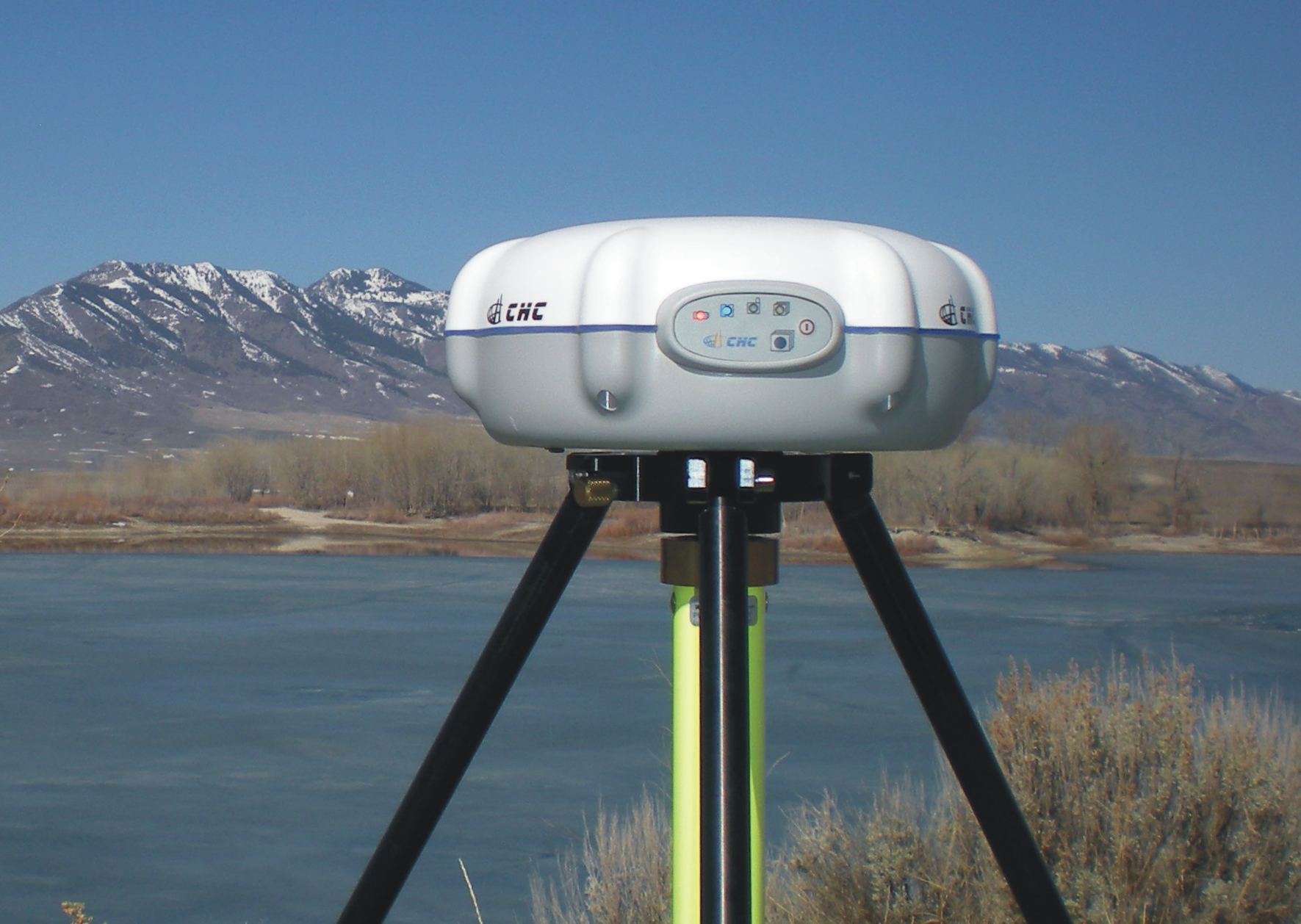
    iGage Corporation announces the introduction of a simple, low-cost, L1/L2/L2C GPS receiver specifically designed to use the National Geodetic Survey’s OPUS online post-processing service. The X90-OPUS has a single button interface and customized firmware/software to automate data submissions to OPUS for centimeter-level post-processing anywhere in the United States.

    At only US$2,450, iGage reports that the X90-OPUS is the least expensive L1/L2 GPS surveying receiver in the world. Its 4GB internal memory stores more than four years of 15-second interval data. A simple plug-and-play USB connection behaves exactly like a USB memory stick on the user’s computer for easy data download.

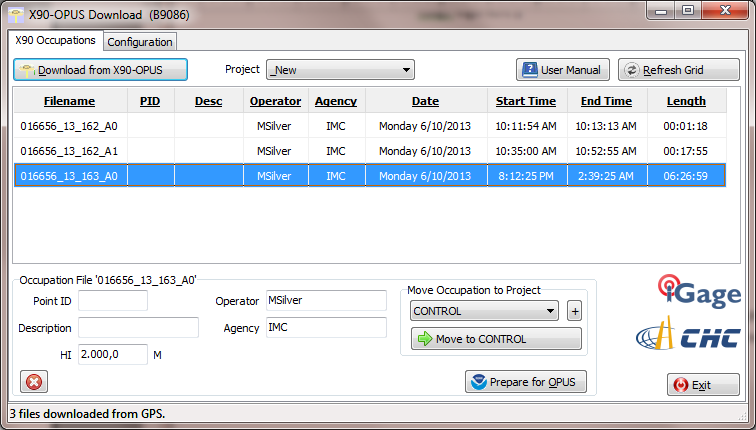
    The X90-OPUS Download software has single button download. Another button press decimates occupation data, ZIPS the observation file, and automatically fills in the entire OPUS online submission form.

    X90-software
    Photo: iGage

    According to the announcement, the X90-OPUS makes field surveying easy, no data collector is required just press the power button to begin and end an observation.

    “We have taken our years of static GPS surveying experience and boiled it down to a simple one-button operation,” said Mark Silver, President of iGage. “You turn it on and it works. There are no data collectors and no complicated displays. It is drop-dead simple.”

    The X90-OPUS receiver is waterproof, submersible, nonincendive, and it floats (IP-67). It carries a standard two-year warranty. The package includes two rechargeable batteries, a dual slot charger, external power cable, and hard shell carrying case.

    At 3.1 lbs and less than 8” in diameter, the 24-channel L1/L2/L2C X90-OPUS is ideal for surveying using OPUS, OPUS-RS, OPUS Projects, and standard static surveying campaigns. With a low cost of ownership, the X90-OPUS virtually eliminates the need for “leap-frogging” GPS receivers in large static campaigns.

    The X90-OPUS is available immediately. Details are available at http://www.x90gps.com.

  • Leica GeoMos Scanning Works with MS50 for Deformation Monitoring

    Leica GeoMos Scanning Works with MS50 for Deformation Monitoring

    Newly released Leica GeoMoS 6.0 software includes automatic scanning and deformation analysis integrating the new Leica Nova MS50 MultiStation to scan areas of inaccessible manmade and natural structures. The monitoring data is also processed automatically with the new n.Vec technology implemented by Leica Geosystems. Color-coded, visualized 3D deformation clouds enable easy analysis and interpretation of movements so users can make the right decisions to rectify static problems or protect peoples’ lives.

    Leica Geosystems announced version 6.0 at a media event held during the HXGN Live conference in Las Vegas today.

    Leica GeoMoS Scanning is an automatic scanning solution fully integrated into Leica GeoMoS Monitoring Solution. This ensures fast integration with existing Leica GeoMoS projects and an easy start for new users, Leica said. In addition to total stations, GNSS, tilt and geotechnical sensors, highly detailed scanning can now be added to the automated measurement cycle. The new scanning module is easy to configure and provides the complete workflow for automatic acquisition and processing of the data to visualize deformations and to notify key personnel in the case of an event. With Leica GeoMoS Web, the data can be accessed anywhere at any time.

    Leica GeoMoS 6.0 enhances conventional monitoring methods with automatic scanning of surfaces with the Leica Nova MS50 MultiStation. Used for inaccessible places or locations where prisms cannot be installed, e.g. a road cover, a roof, a pipeline or a natural structure, Leica GeoMoS real-time scanning solution monitors any deformation and makes sure that no movement is undetected. The big advantage of using the Leica Nova MS50 MultiStation is that it combines laser scanning and prism monitoring, and therefore the measurements to stable control points guarantee highly accurate setup corrections, including orientation and translations. Additional imaging functionality complements the set by providing yet another information source for better deformation analysis. The implemented scan wizard allows the image-assisted definition of scan areas using different parameter settings and different scan result types. Once defined, the scan area can be scanned manually and via the automatic measurement cycle.

    Leica GeoMoS 6.0 enhances conventional monitoring methods with automatic scanning of surfaces with the Leica Nova MS50 MultiStation.
    Leica GeoMoS 6.0 enhances conventional monitoring methods with automatic scanning of surfaces with the Leica Nova MS50 MultiStation.

    The new scanning feature uses all current automatic functionalities such as automatic measurement cycle scheduling, real-time notification via e.g. SMS/email, automatic limit level check, etc. In addition, the embedded point cloud and image viewer assures powerful 3D visualization of all results using color-coded deformation clouds with a fully traceable history of deformations of the scanned area.

    The new n.Vec technology in Leica GeoMoS 6.0 provides automatic scan cloud processing to deliver the real-time information about deformations. The data can quickly and easily be interpreted for informed decisions. Leica Geosystems’ unique n.Vec processing technology uses normal vectors to determine movements in man-made and natural structures through color-coded deformation maps. The deformation maps are created by comparing normal vectors from a reference epoch and the current epoch. To ensure maximum deformation interpretation quality, in an iterative and fully automatic procedure, n.Vec removes non-surface related scan artifacts to ensure uncontaminated surfaces and hence correct normal vectors.


  • Second Joint FIG/IAG/ISPRS Symposium on Deformation Monitoring

    The Second Joint FIG/IAG/ISPRS Symposium on Deformation Monitoring will be held at the University of Nottingham, in Nottingham, England, September 9-11, 2013. The conference aims to bring together scientists, engineers, educators, representatives from public authorities, policy makers in surveying, geodesy, civil, structural, geotechnical and mining engineering, geology, geodynamics, geosciences, geohazard studies and hydrology, to showcase the latest trends and innovation in deformation measurement, analysis and interpretation.

  • Applanix Introduces POS LV 120 for Improving Land Mobile Mapping Productivity

    Photo: Applanix
    Photo: Applanix

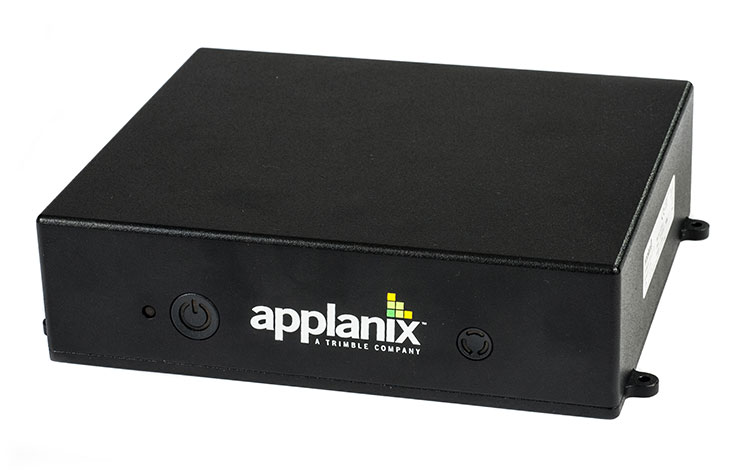
    Applanix has introduced the POS LV 120, the latest version of its positioning and orientation systems for land vehicles. Using commercial Micro-Electro-Mechanical (MEMS) inertial measurement unit (IMU) technology, the Applanix POS LV 120 is a small, lightweight system and provides an economical solution for any continuous positioning and orientation application.

    POS LV 120 is a fully integrated, turnkey position and orientation system, using integrated inertial technology to generate stable, reliable and repeatable positioning solutions for land-based vehicle applications, Applanix said. Redesigned to be smaller and lighter, it maintains identical data interfaces and software compatibility with the established POS LV line of products.

    “With a MEMS IMU and a 220 channel, dual-antenna GNSS receiver integrated into a single enclosure, the POS LV 120 is a cost-effective GNSS-Inertial solution designed to support many types of land-based mobile mapping projects,” said Kevin Andrews, product manager for Land Products at Applanix.  “The integrated system is smaller than the standard POS LV computer system (PCS), making it ideal for use in lightweight applications such as robotics, autonomous vehicles, centerline mapping, asset mapping and short-range direct georeferencing.”

    POS LV 120 is available now through the Applanix sales network.