Tag: Dru Smith

  • NGS Discusses the New NSRS at the International 2023 FIG Working Week

    NGS Discusses the New NSRS at the International 2023 FIG Working Week

    Anyone reading my previous columns knows that I have been highlighting the new, modernized, National Spatial Reference System (NSRS) of the National Geodetic Survey (NGS). During the 2023 Fédération Internationale des Géomètres (FIG) Working Week held on May 28 – June 30, in Orlando, Florida, NGS held an all-day session addressing various topics related to the NSRS modernization project.

    More than 30 NGS staff members supported two days of sessions that included a day on the NSRS modernization, sessions for the Young Surveyors Network, and FIG Commission 5 meetings, which focused on meeting the highest accuracy levels for positioning and measurement.

    Juliana Blackwell, director of NGS, kicked off the third plenary session tackling the global challenges, with a presentation titled “The Modernized U.S. National Spatial Reference System — Aligning National Geospatial Data to the Globe.”

    Blackwell highlighted the importance of geospatial data from many different sources being interoperable and defined within a modern reference frame. She noted that NGS is part of the National Oceanic and Atmospheric Administration (NOAA), the mission of which is to understand and predict changes in climate, weather, ocean, and coasts. This includes a mandate to define, maintain and provide access to the NSRS.

    NGS’s NSRS modernization project has been underway for a decade and is nearly complete. Blackwell explained that the new NSRS will align critical U.S. geospatial data assets within global data inventories and enable improved analysis and modeling of climate changes and impacts to society and the environment. The modernized NSRS will enable data integration of new and old technologies, adopts modern standards, and empowers growth in new fields and applications.

    The remainder of the presentations during the all-day event covered three themes: the practical implications of NSRS modernization — changing survey methodology; an update on the NOAA CORS Network and the Online Positioning User Service (OPUS); and case studies of surveys — what NGS does now and how they will change.

    Many of these topics have been discussed by NGS during their webinar series, but during these presentations NGS provided the latest information on many of the activities associated with the modernization of the NSRS. This venue allowed for participants to ask questions as opposed to typing them in a box. Also, the NGS employees that participated in the FIG working week were available for discussions before and after the session. I enjoyed my discussions with old colleagues as well as meeting some new NGS employees.

    The session titled “Practical Implications of NSRS Modernization — Changing Survey Methodology” addressed the following topics:

    practical impacts of the modernized NSRS

    Canada’s implementation of the modernized frames

    changes afoot: State Plane 2022 and Retirement of the U.S. Survey Foot and

    preparing for the modernization of the NSRS.

    Dru Smith, NSRS modernization manager, started by explaining the practical impact of the modernized NSRS and why it is needed. He mentioned that the current NSRS was defined in the pre-GNSS era and that it has failed to keep up with emerging requirements, such as accurately measuring sea level rise.
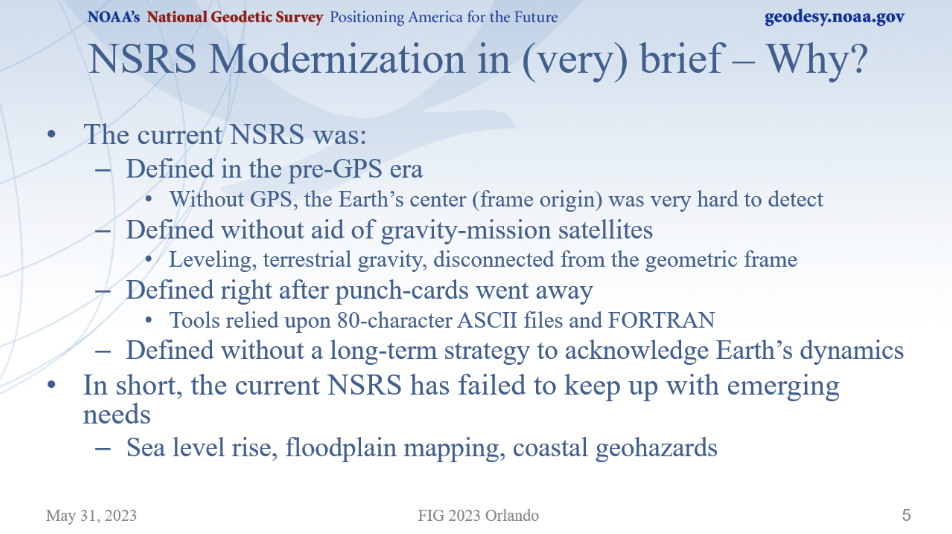
    (Image: NGS Website)
    (Image: NGS Website)

    He highlighted the practical implications of the modernized NSRS, such as that every latitude, longitude, and ellipsoid height will change from its NAD 83 values in the +/-2-meter range, and every orthometric height will change from its NAVD 88 values in the +/-2-meters median range.

    He mentioned that the published coordinate functions of the NOAA CORS Network (NCN) will be the primary geodetic control of the NSRS. He noted that NGS is working on the integration of web-based tools to improve consistency and reduce confusion, such as enhancements to NGS’s OPUS to ingest digital data from surveying instruments directly into OPUS 6 via a Geodetic Data Exchange (GDX) format. This would include raw measurements from GNSS receivers, levels, total stations, and gravimeters. The talk titled “Augmenting Data Exchange Formats for OPUS of the Future” by Ryan Hardy, discussed the GDX format in more detail.

    As with the International Terrestrial Reference Frame, the modernized NSRS will have a time-dependency component. It will be built into the new NSRS, but users will have the ability to disengage from it.

    Smith provided a timeline of the project for the next couple of years, which can be referenced in the image below. NGS plans to release data and support tools on their BETA website during 2024 and 2025.
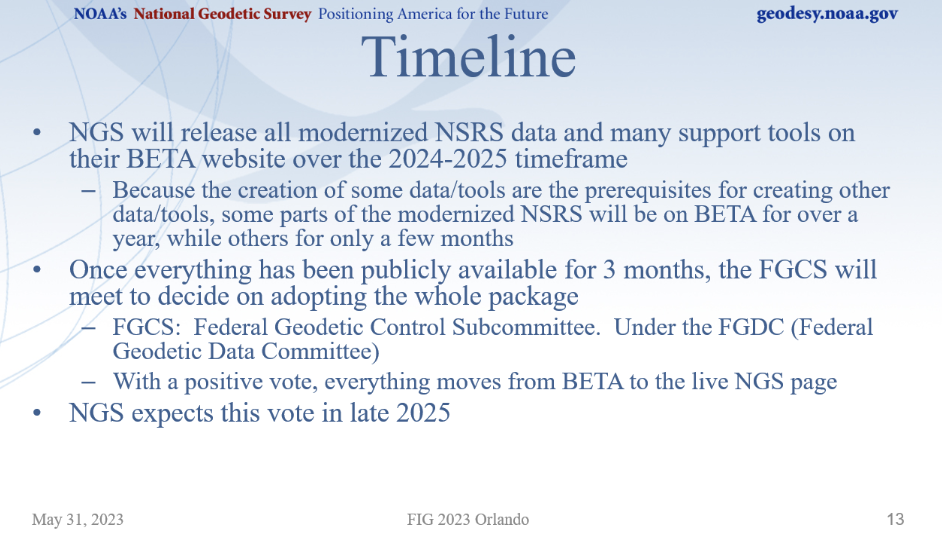
    (Image: NGS Website)
    (Image: NGS Website)

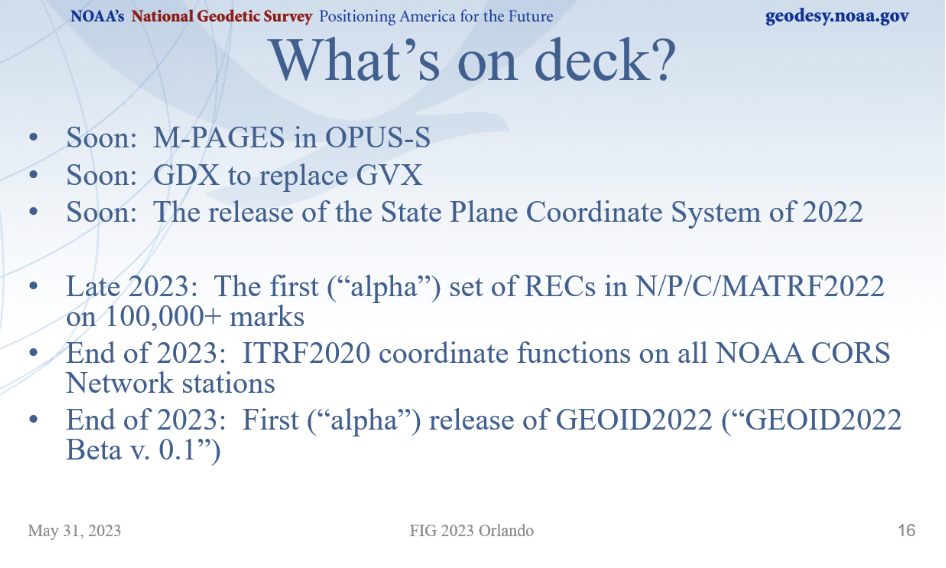
    Smith discussed how some products will be released early for users to test and evaluate how the new NSRS products will affect their products and services, and to be ready for their customers after the new NSRS is released for publication. Products scheduled for early releases (Alpha Release), include SPCS2022, EPP2022, and GEOID2022.

    He emphasized that Alpha products, by definition, can be one or more of the following:

    • incomplete
    • inaccurate
    • buggy
    • subject to change without notice

    As such, their early release is primarily for users to see the “big picture” such as formats of data and the general direction that NGS is taking.

    He provided a list of new products that will be announced soon, and some alpha products tentatively planned for release in 2023.
    (Image: NGS Website)
    (Image: NGS Website)

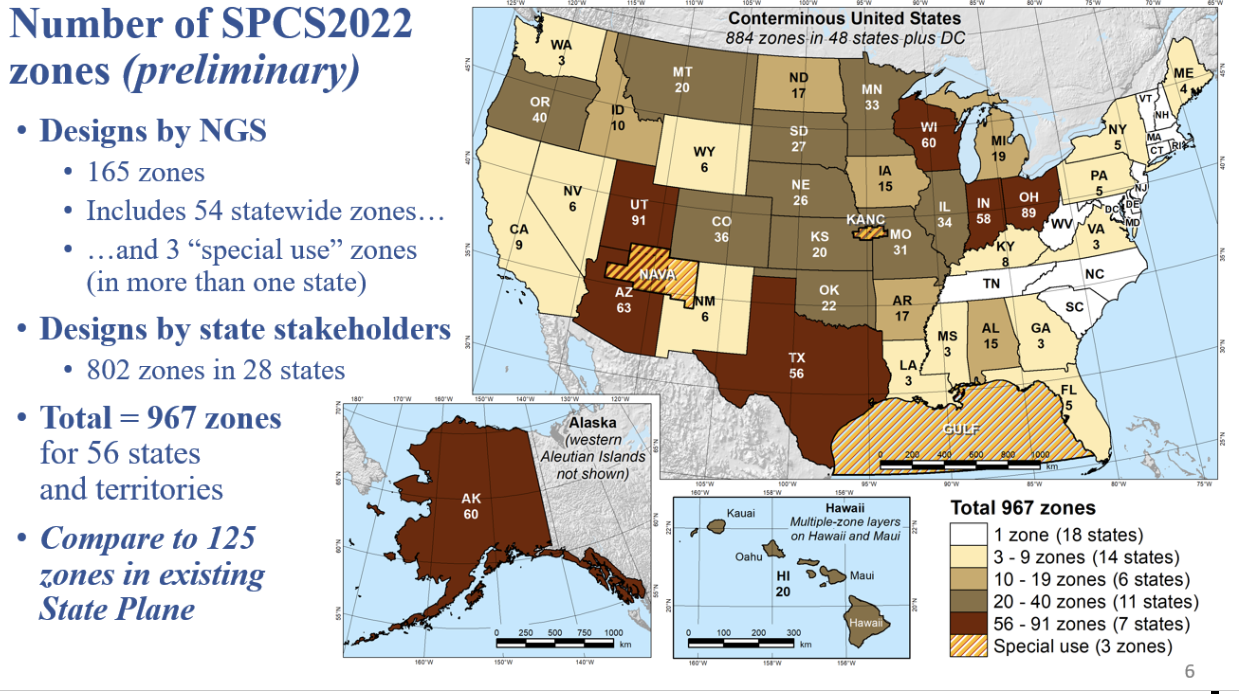
    Michael Dennis did a nice job of discussing the State Plane Coordinate System of 2022 (SPCS 2022) and the retirement of the U.S. Survey Foot. He mentioned that the U.S. Survey Foot was superseded by the international foot on December 31, 2022. His presentation gave a brief overview on the status and rollout plans for SPCS2022, along with how and why NGS will continue to support the U.S. Survey Foot in the existing NSRS (but not in the modernized NSRS).   

    See the image below for the number of zones for each state.  
    (Image: NGS Website)
    (Image: NGS Website)

    The SPCS2022 will be an alpha product released soon. Part of the alpha product will have options to view maps depicting the different zones in each state.  
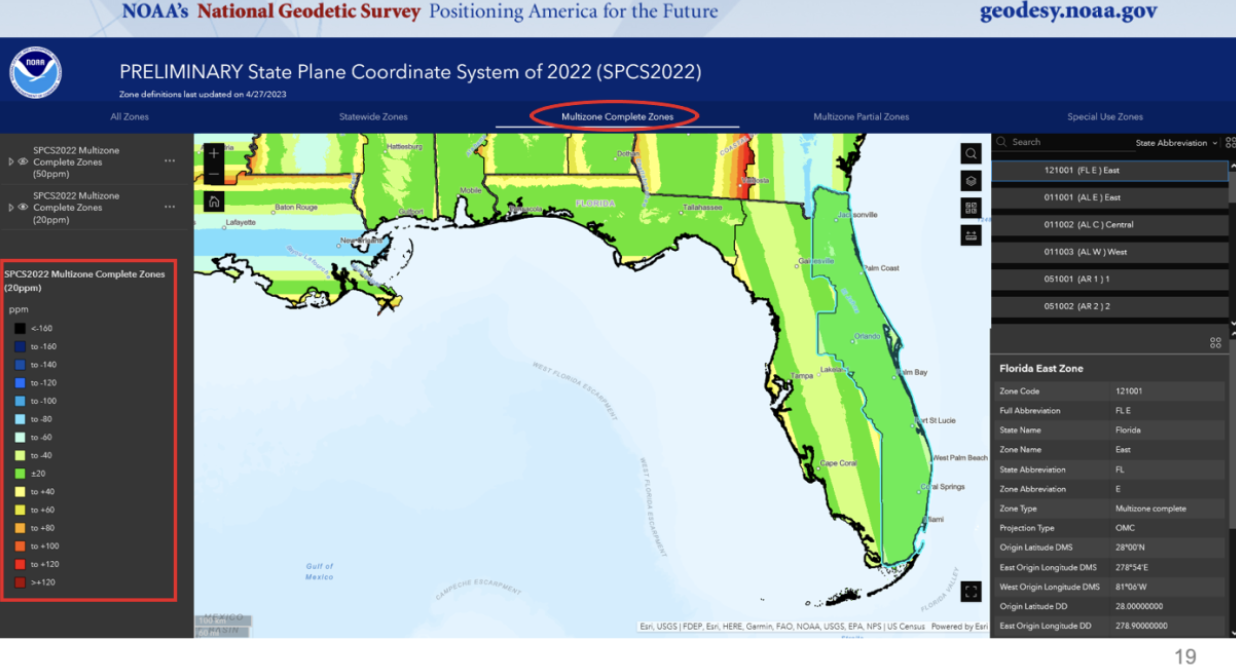
    Example of Florida Multizone Complete Zones. (Image: NGS Website)
    Example of Florida Multizone Complete Zones. (Image: NGS Website)

    When NCAT2022 is released in alpha product it will contain the SPCS2022.   
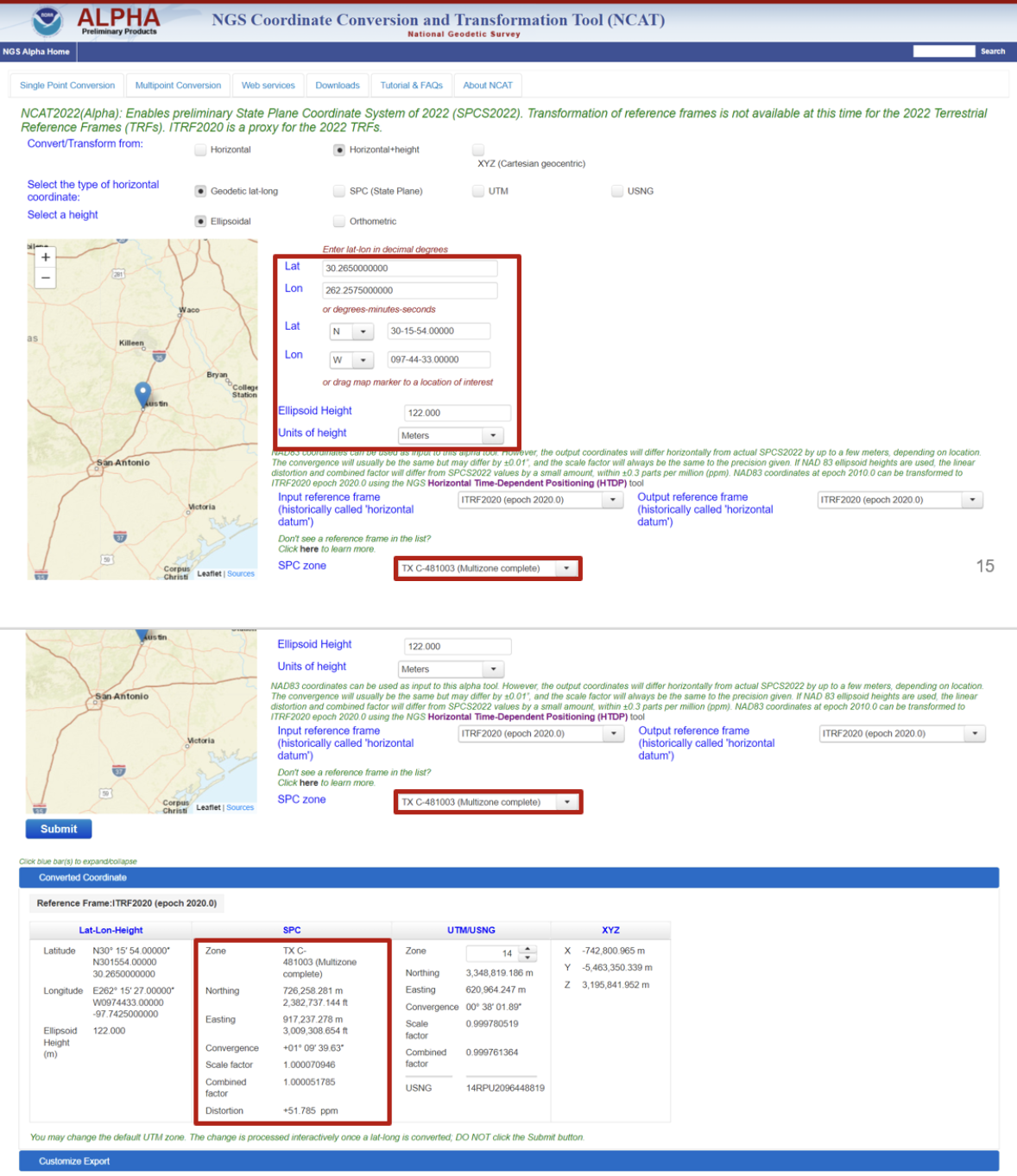
    Example of NCAT2022 (Alpha). (Image: NGS Website)
    Example of NCAT2022 (Alpha). (Image: NGS Website)

    Representatives from the Canadian Geodetic Survey presented and participated in the discussions. 

    The session titled “Update on the NOAA CORS Network and OPUS” addressed the following topics: 

    • the NOAA CORS Network (NCN) services 
    • updating OPUS-S to support multi-GNSS 
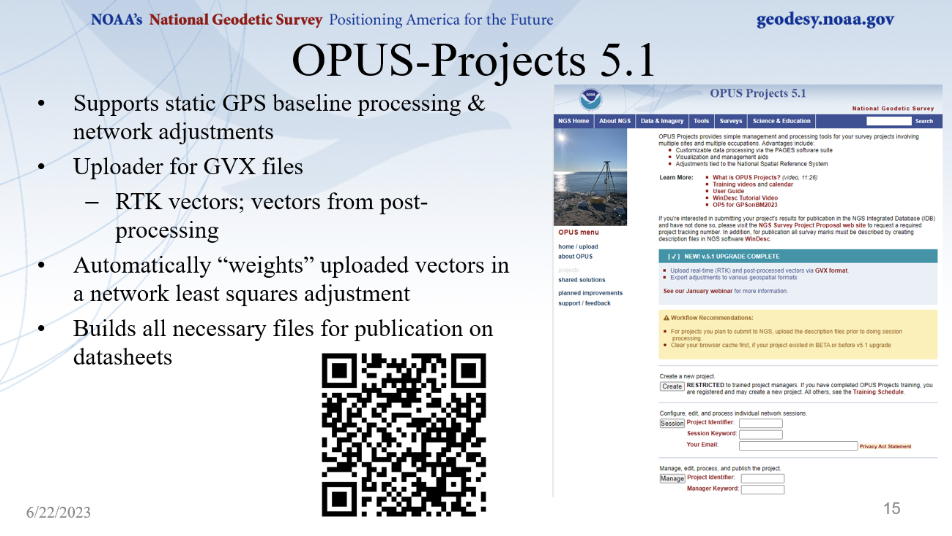
    • OPUS -Projects 5: supporting RTK for establishment of geodetic control 
    • OPUS projects for manager’s training – transitioning from instructor-led to online, self-paced instruction and 
    • augmenting data exchange formats for OPUS of the future. 

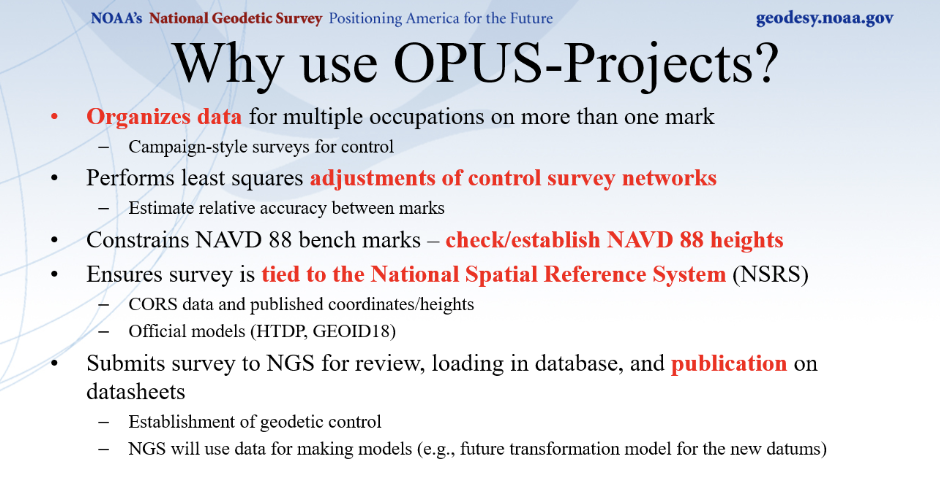
    Dan Gillins gave a presentation on the advantages of using NGS’s OPUS-Projects 5 web routine. OPUS-Projects make it easier for users to submit a GNSS project to NGS for publication. I discussed OPUS-Project 5.1, when it was released as a Beta product, in my October 2021 column.  
    (Image: NGS Website)
    (Image: NGS Website)
    (Image: NGS Website)
    (Image: NGS Website)

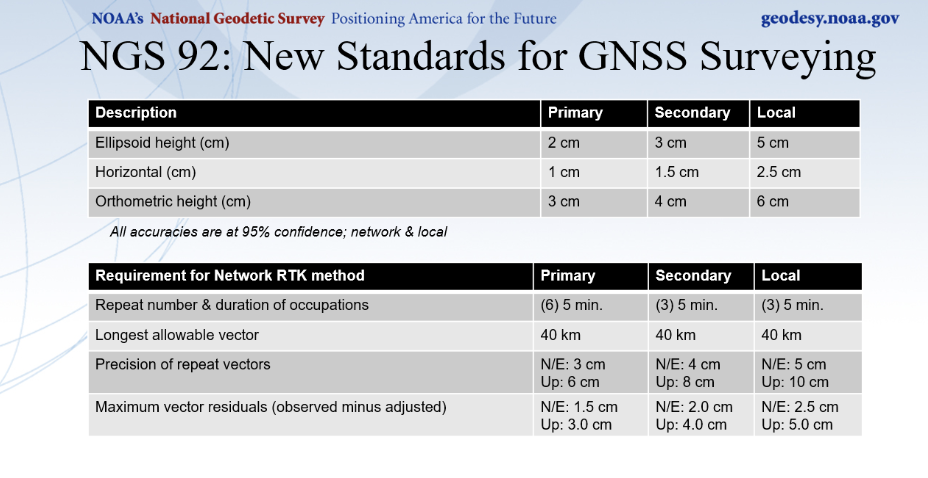
    Gillins mentioned that a new publication providing guidance to meet standards for GNSS surveying is being reviewed and will be available soon. I discussed these new standards in my May 2023 column.
    (Image: NGS Website)
    (Image: NGS Website)

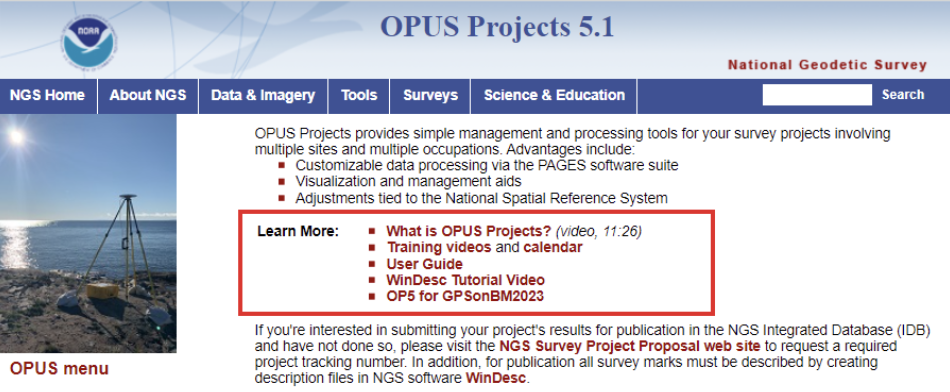
    Another presentation titled “OPUS-Projects for Manager’s Training – Transitioning from Instructor-Led to Online, Self-Paced Instruction” by Erika Little, described how NGS is transitioning to providing OPUS projects training on an online, self-paced instruction site. NGS has training material available for OPUS-Projects.
    (Image: NGS Website)
    (Image: NGS Website)

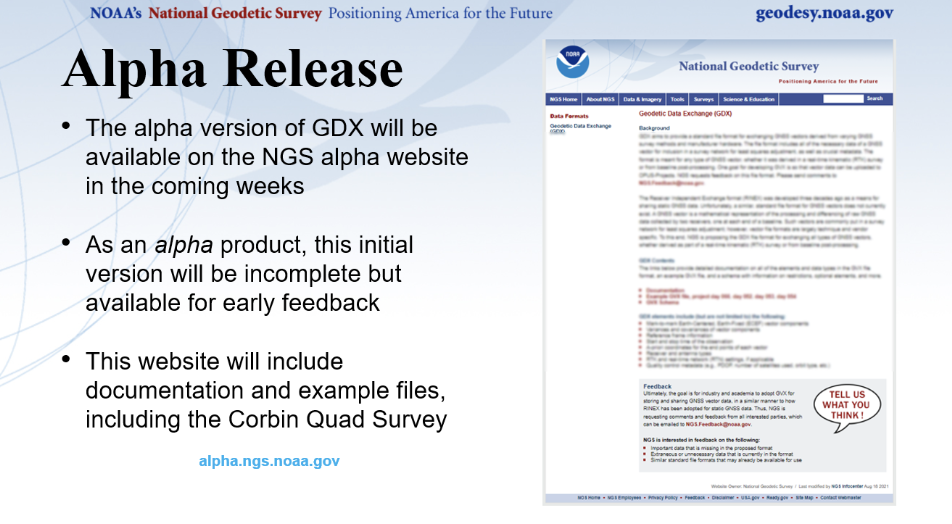
    Ryan A. Hardy gave a talk describing the new Geodetic Data Exchange (GDX). As previously mentioned, GDX is an XML-based data format that will be the input format for OPUS. GDX will be the successor to the GNSS Vector Exchange (GVX) format. GDX currently supports GNSS, classical, and leveling measurements.

    The GDX structure will have the following fields[[these are clearly the names of database fields; if it were a list of different types of information, we would not put them in all caps and would not use the underscores]]:

    • SOURCE_DATA
    • PROJECT_INFORMATION
    • PERSONNEL
    • UNITS
    • EQUIPMENT
    • POINTS
    • MEASUREMENT_SETTINGS
    • MEASUREMENTS
    • REDUCTIONS
    • OBSERVATIONS

    NGS is planning to release an alpha version of GDX soon.
    (Image: NGS Website)
    (Image: NGS Website)

    The session titled “Case Studies of Surveys — NGS Does Now and How They will Change” addressed the following topics: 

    • implementing NGS OPUS-Projects’ GVX feature to align RTK vectors to the NSRS to establish geodetic control for FirstNet indoor mapping 
    • IGLD: a case study for leveraging digital tools to enhance QA/QC on large scale static GNSS observation campaigns 
    • geodetic leveling in the modernized NSRS and 
    • NGS field operations: modernizing in many ways. 

    Ben Erickson gave a good presentation on leveling in the new NSRS, a topic about which I am very interested in knowing more[[Please avoid dangling participles, prepositions, conjunctions, and modifiers.]]. I discussed the new procedures in my June 2020 column.  

    One major change is that leveling surveys will require GNSS occupations to ensure that orthometric heights computed in leveling surveys are up to date and are connected to the NSRS through the NOAA CORS Network. The network accuracy is obtained through GNSS data and a high-accuracy geoid model, and the local accuracy is provided through the leveling data. Specific procedures will be required to incorporate leveling data in the North American Pacific Geopotential Datum (NAPGD2022).  
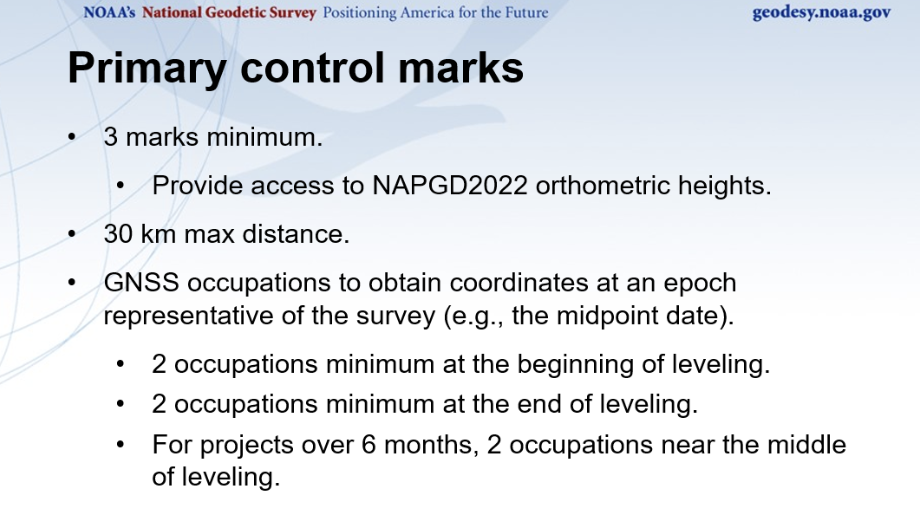
    Basic Procedures for NAPGD2022 Orthometric Heights. (Image: NGS Website)
    Basic Procedures for NAPGD2022 Orthometric Heights. (Image: NGS Website)

    I discussed these procedures in more detail in my June 2020 column. The image below provides a conceptual diagram that illustrates what this means to a typical leveling project.
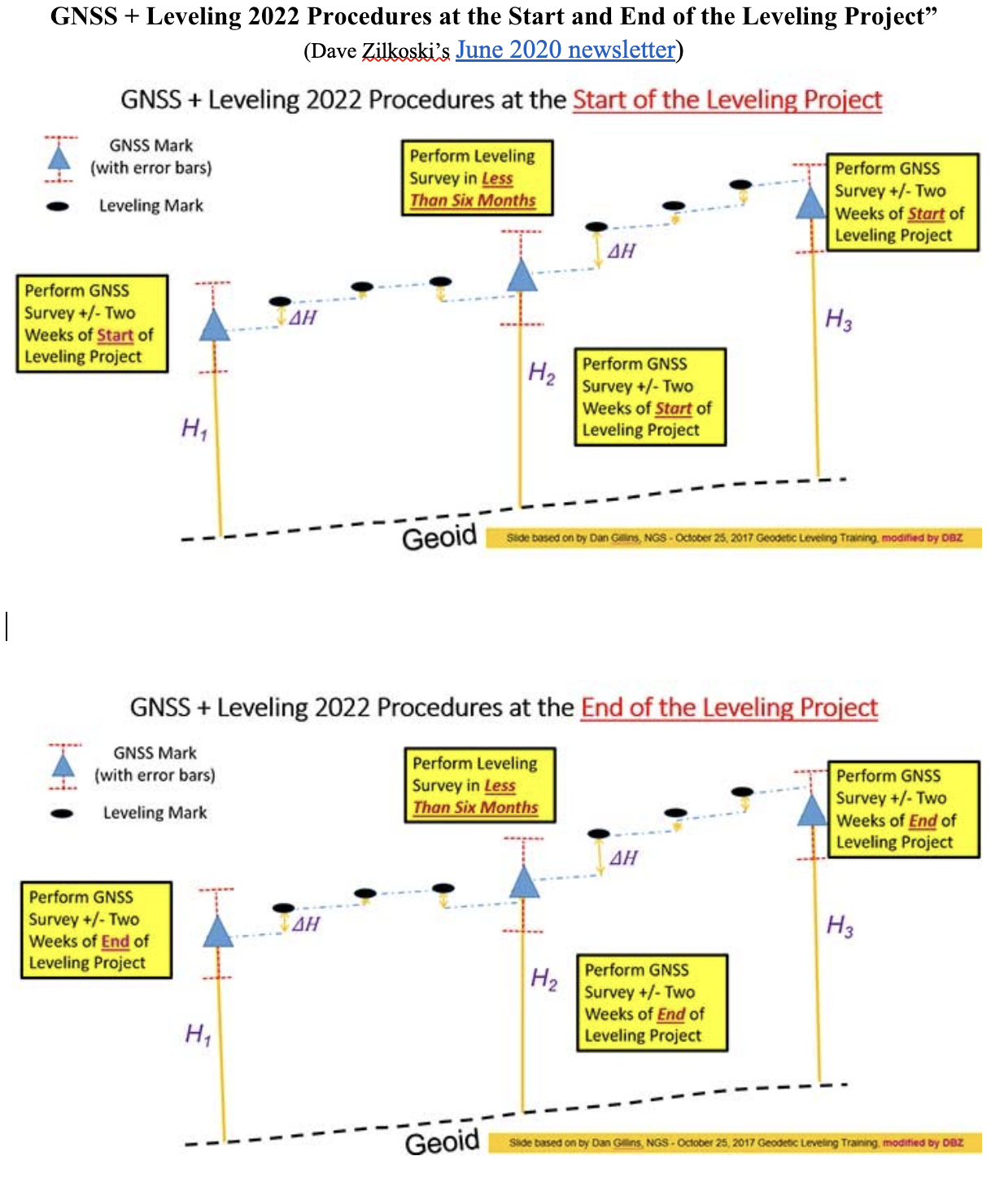
    GNSS + Leveling 2022 Procedures at the Start and End of the Leveling Project”. (Image: Diagram based on information from Dan Gillins, NGS, and modified by David B. Zilkoski)
    GNSS + Leveling 2022 Procedures at the Start and End of the Leveling Project”. (Image: Diagram based on information from Dan Gillins, NGS, and modified by David B. Zilkoski)

    Erickson provided a diagram of a level network that contained a loop, which can be referenced below.
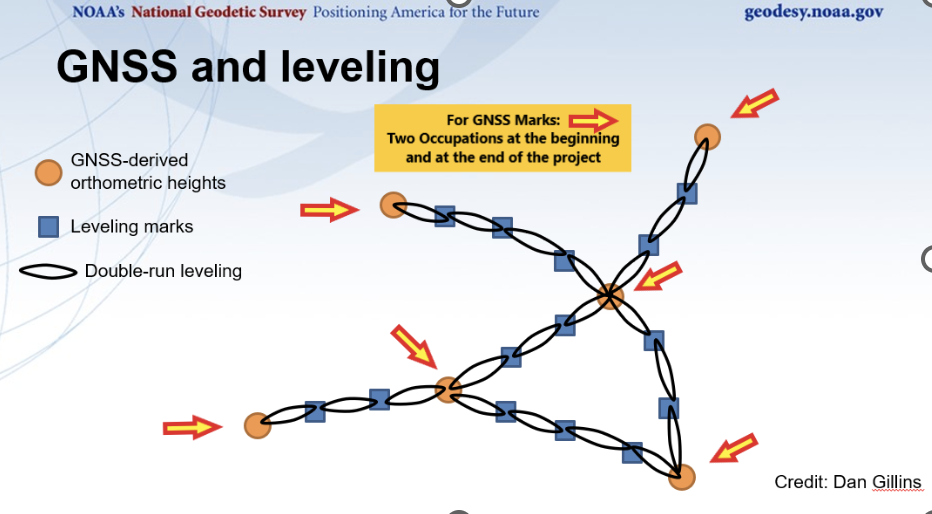
    (Image: NGS Website)
    (Image: NGS Website)

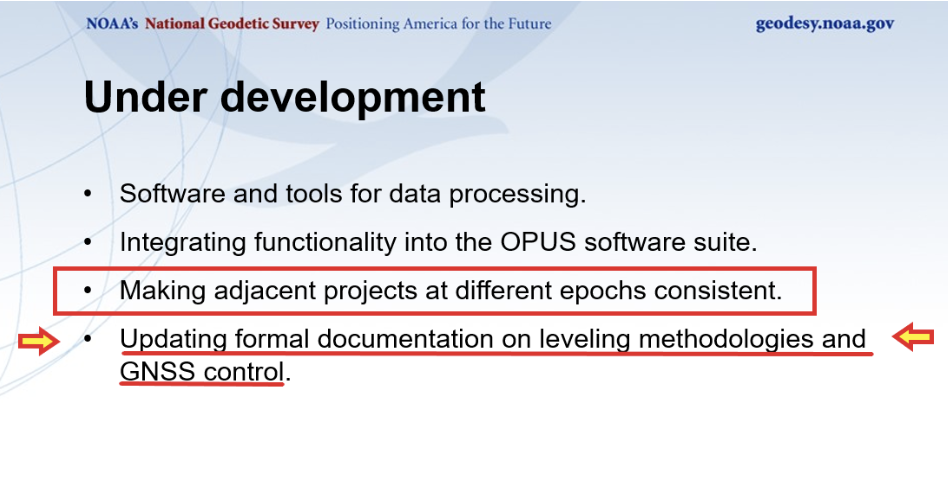
    I have worked with leveling data for most of my career and I am pleased to know that NGS is going to provide tools to incorporate leveling data into the new, modernized NSRS. When performing leveling projects, there is a requirement to level to previously established benchmarks that were within a certain distance from the project. This helped to ensure that different leveling projects were consistent with each other. NGS stated that making adjacent projects at different epoch consistent is under development, and their plans include updating leveling documentation to explain the leveling methodologies and GNSS control.
    (Image: NGS Website)
    (Image: NGS Website)

    I have only highlighted a few of the presentations. It was an all-day session, and a lot of information was presented on the new, modernized NSRS. The presentations can be downloaded from the NGS website at https://geodesy.noaa.gov/datums/newdatums/fig-2023.shtml. I would encourage everyone to download the presentations to obtain the latest information on NGS’s modernization of the NSRS. See the image below for the list of presentations and the links to download specific presentations.
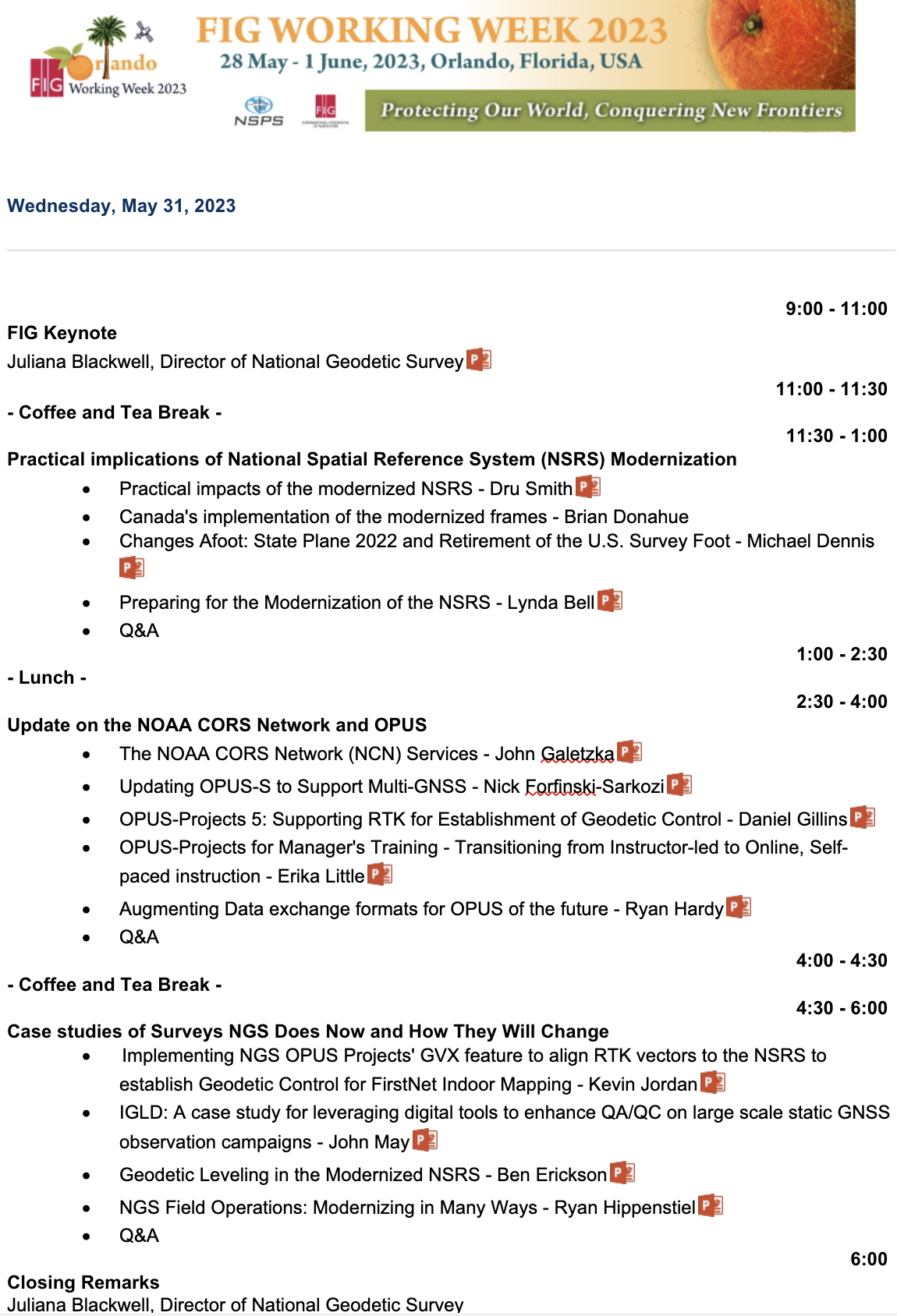
    NGS Presentations at FIG 2023 Working Week. (Image: NGS Website)
    NGS Presentations at FIG 2023 Working Week. (Image: NGS Website)
  • What will the data delivery system of the modernized 2022 NSRS look like?

    What will the data delivery system of the modernized 2022 NSRS look like?

    My previous column highlighted that orthometric heights in NAPGD2022 will be defined through ellipsoid heights and a geoid model, such as GEOID2022. Therefore, changes in the geoid model will be very important to users estimating orthometric heights using GNSS. I briefly described the geophysical reasons for changes in the geoid that affect the orthometric height of a mark.

    For the past four years, I have discussed in my columns the tasks associated with the new, modernized 2022 reference frames. It’s now the middle of 2022, so where are the new reference frames? Well, on June 9, Dru Smith, NSRS modernization manager for the National Geodetic Survey (NGS), provided an update on the status of the modernization in a webinar. The Powerpoint slides and video of the presentation can be downloaded from the NGS website under the following title: It’s 2022…Are You Done Yet? I will highlight some of the items from the webinar, but I encourage everyone to download the video and listen to the webinar.

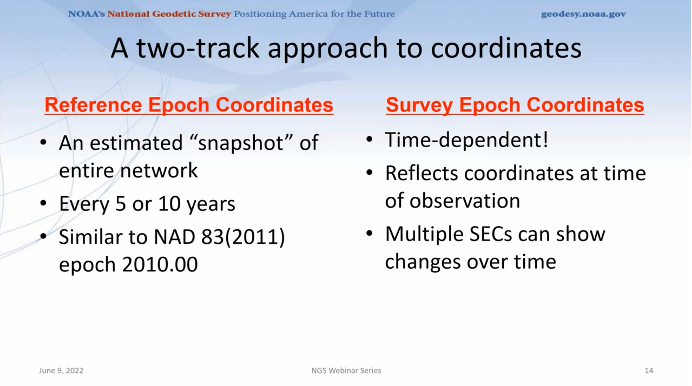
    First, Smith mentioned that NGS will be providing new types of coordinates. The NGS denotes this as a two-track approach to coordinates: Reference Epoch Coordinates (REC) and Survey Epoch Coordinates (SEC). See the box below.

    New Types of Coordinates (Image: NGS June 6th Webinar - It's 2022…are we done yet?)
    New types of coordinates (Image: NGS June 6 webinar)

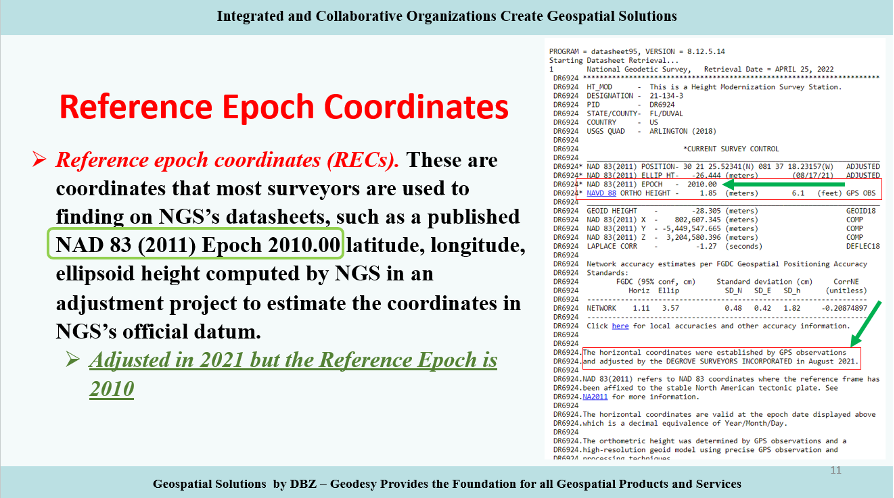
    Reference Epochs Coordinates (REC) are defined in NGS Blueprint for the Modernized NSRS, Part 3 as coordinates computed by NGS in an adjustment project to estimate the coordinates at one of the official reference epochs that NGS will define in 2025. RECs are similar to coordinates computed by NGS in a nationwide adjustment project such as the National Adjustment of 2011 (see the box below).

    NAD 83 (2011) Epoch 2010,00 Coordinates (Image: Dave Zilkoski)
    NAD 83 (2011) epoch 2010.00 coordinates (Image: NGS)

    NGS has not determined what data will be included in the first iteration of RECs. For the 2020.00 project, the current cutoff date for incorporating data is Dec. 31. Users can submit the data to NGS via OPUS projects and the OPUS-Share tool. To increase the submission of GNSS observations on marks, NGS has developed a beta OPUS-Projects 5.0 webtool that will allow real-time kinematic and real time network (RTK/RTN) observations to be submitted.

    As previously mentioned, at this time, the NGS has not determined the cutoff for the earliest data to be included in the determination of the 2020.00 RECs. The agency will be conducting experiments to determine the appropriate cutoff date. These coordinates will require an intra-frame velocity model (IFVM) to generate the RECs at the specific reference epoch.

    As of February 2021, based on NGS’ Blueprint for the Modernized NSRS, Part 3, version February 2021, the following is the agency’s policy with regard to RECs:

    • For a given mark and a given reference epoch, the REC will never be changed–except to correct a blunder.
    • This does not prevent NGS from adding new RECs
      • on points with new data that have not yet had an REC computed
      • for marks that do not have an REC in the most recently passed reference epoch, a new REC can be computed and added to the NSRS.
    • Per NGS’ Blueprint for the Modernized NSRS, Part 3, version February 2021, for simplicity, RECs may happen on the same schedule as SECs.

    Survey epoch coordinates (SECs) are defined as coordinates computed by NGS at a specific survey epoch. Users will submit their data and its metadata to NGS, and NGS will then check, adjust and define the coordinates at one “survey epoch.” These coordinates will be “part of the NSRS,” Smith said. NGS is computing coordinates in this manner to provide the best estimate of the coordinates at any mark at a specific moment in time, which is very important in areas influenced by crustal movement.

    So, how will NGS process and generate these SECs?

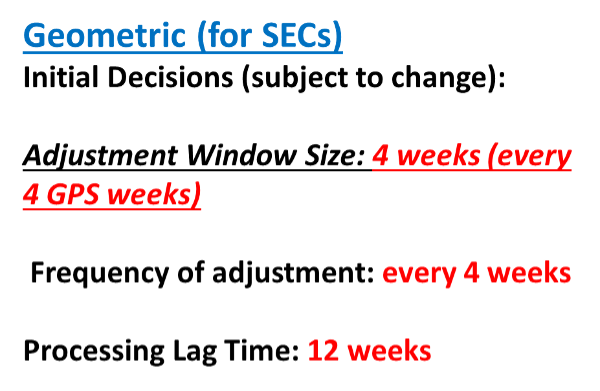
    Survey epoch coordinates (SECs) are designed to provide time-dependent geodetic coordinates. Therefore, NGS has to choose some time span in which all observations will be processed together to yield a single SEC of a mark. NGS denotes this time span as a “geometric adjustment window.” NGS wants the adjustment window to be short enough so that movement of a mark did not occur between repeat observations (or was small enough to be ignored) and long enough for users to efficiently and effectively collect redundant observations for submission to NGS (see the box below).

    Proposed SEC Geometric Adjustment Window
    Proposed SEC geometric adjustment window. (Image: NGS)

    As of February 2021, based on the NGS Blueprint for the Modernized NSRS, Part 3, the following is the policy with regard to SECs:

    • One or more GNSS occupation(s) over a single mark will be processed into one survey epoch coordinate when all occupations take place within one geometric adjustment window.
    • If a user submits two occupations on one mark, but they happen to fall in two consecutive geometric adjustment windows, NGS will use them to create two distinct survey epoch coordinates. Each SEC will be based on one occupation.

    Future columns will provide more explanation about this concept of a geometric adjustment window and how NGS will process the data to generate survey epoch coordinates.

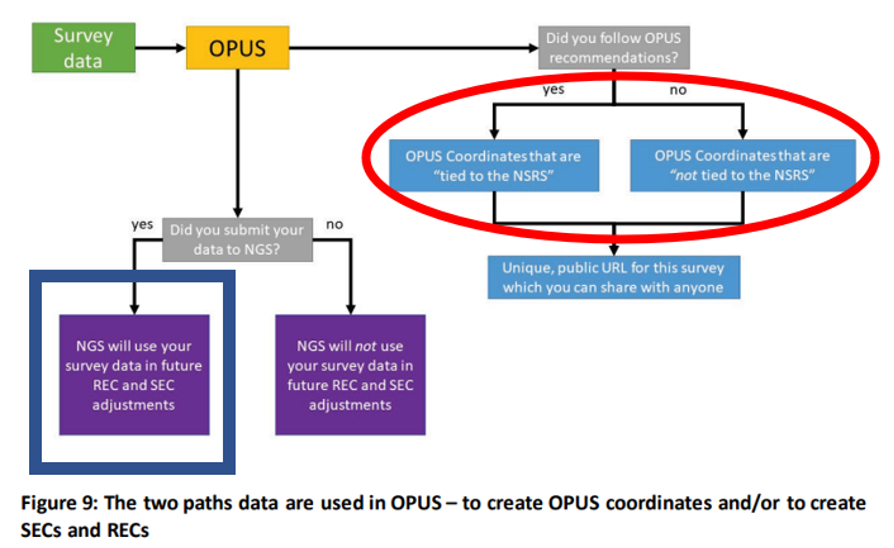
    NGS is developing models and tools for users to submit data to NGS to compute coordinates — including OPUS coordinates, reference epoch coordinates and survey epoch coordinates. Figure 9 from Blueprint for the Modernized NSRS, Part 3, version February 2021, is a schematic that shows the flexibility NGS is building into an OPUS-type webtool. Basically, if users follow NGS guidelines and rules, and submit their data to NGS, then NGS will compute and publish REC and SEC coordinates (see the blue outline in the box below). If users only want to compute OPUS coordinates, then they can use NGS’s webtool without submitting the data to NGS (see the red outline in the box below).

    Photo:
    Building flexibility into OPUS (Image: NGS)

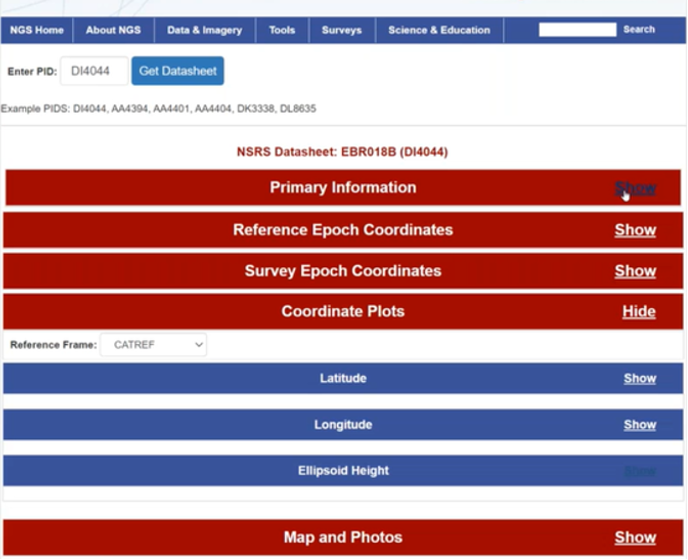
    Dru Smith’s June 9 update on the status of the modernization provided a mockup of how users will be able to retrieve data using their web browsers — a prototype is being developed. The data will also be available in downloadable form such as an XML file for users to input the data and metadata into their programs or databases. I recently discussed some of this material at seminars I presented at the Florida Surveyors and Mapping Society’s 67th annual conference held in Palm Beach Gardens. The participants were very interested in the prototype, but really wanted to learn more about the format and process of the downloadable XML files. I’m sure future NGS webinars will address this topic. I emphasized to the group that they should watch the entire presentation and provide feedback to NGS. As mentioned above, Powerpoint slides and video can be downloaded from the NGS webinar website.

    The boxes below highlight a few of the options NGS is considering. The box “Data Delivery – Prototype” is an example provided by Smith during his webinar. It should be noted that the images of the prototype are not included in the downable slides, but they are part of the video. The images presented in this column are screen captures from the video.

    Data Delivery - Prototype (Image: NGS June 6th Webinar - It's 2022…are we done yet?)
    Data delivery prototype. (Image: NGS)

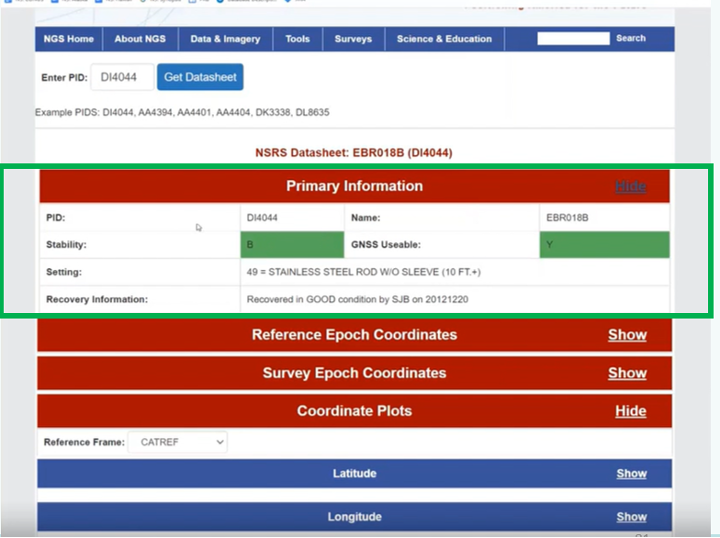
    The box below provides some of the basic information of a mark, such as its PID, name, stability, GNSS usable code, setting and the latest recovery information. Again, this is a prototype, so users should feel free to send feedback to NGS. NGS wants to generate a usable product, and is interested in user feedback.

    Primary Information – Prototype (Image: NGS June 6th Webinar - It's 2022…are we done yet?)
    Primary information prototype. (Image: NGS)

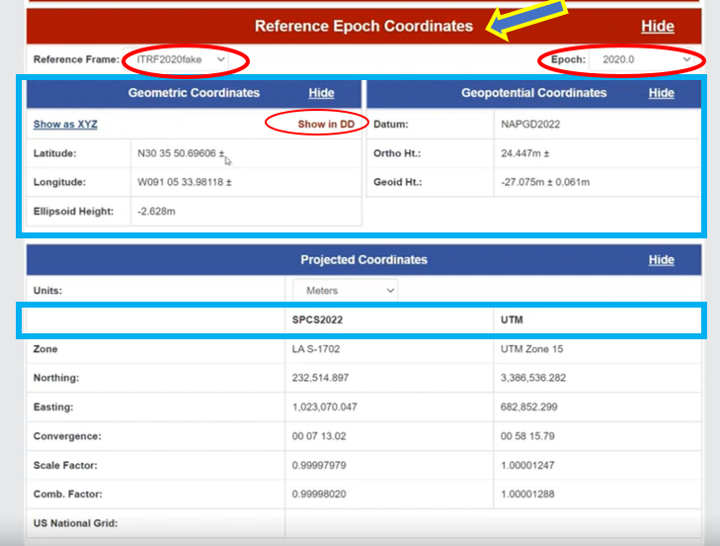
    As previously stated, NGS is implementing a two-track approach to coordinates: publishing REC and SEC. The box below provides the REC information of a mark when a user clicks the “Show” button. As shown in the diagram, the reference frame and epoch are provided, as well as the geometric coordinates (latitude, longitude, ellipsoid height) and geopotential coordinate information (NAPGD2022 orthometric height and geoid height).

    Reference Epoch Coordinates – Prototype (Image: NGS June 6th Webinar - It's 2022…are we done yet?)
    Reference epoch coordinates prototype. (Image: NGS)

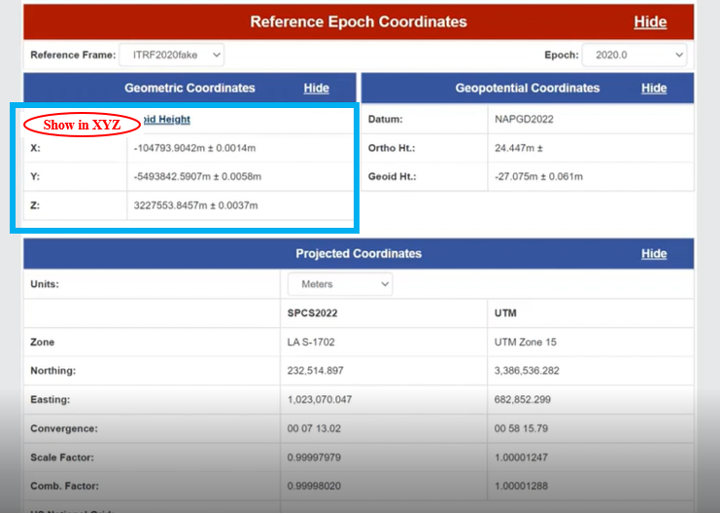
    NGS provides an option for individuals who want the geometric coordinates in the X, Y, Z format (see the box below). Remember, this is only a mockup of a prototype, to give us an idea of the direction NGS is going with its data delivery system in the new, modernized 2022 NSRS.

    REC Shown in X,Y,Z (Image: NGS June 6th Webinar - It's 2022…are we done yet?)
    REC Shown in X,Y,Z. (Image: NGS)

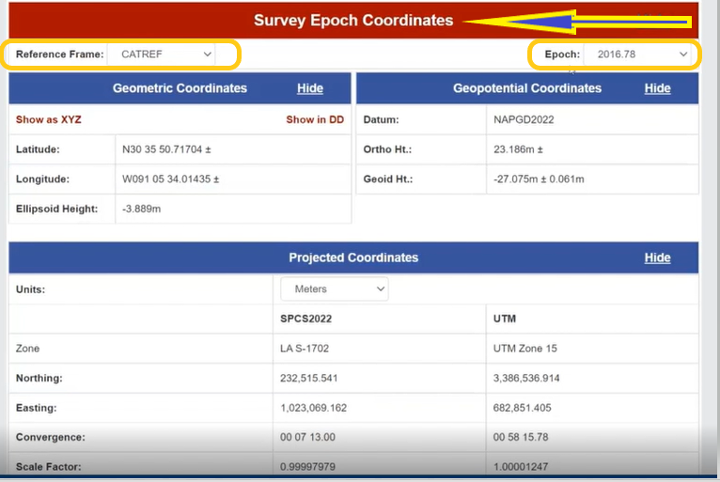
    Similar to the REC, the prototype includes SEC. For a mark, the latter are different from the former because SEC are computed at the epoch of the survey observations (see the box below).

    Survey Epoch Coordinates – Prototype (Image: NGS June 6th Webinar - It's 2022…are we done yet?)
    Survey epoch coordinates – prototype. (Image: NGS)

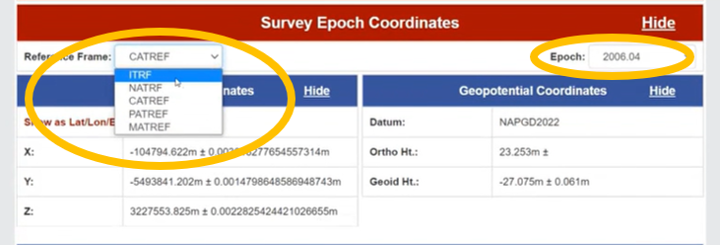
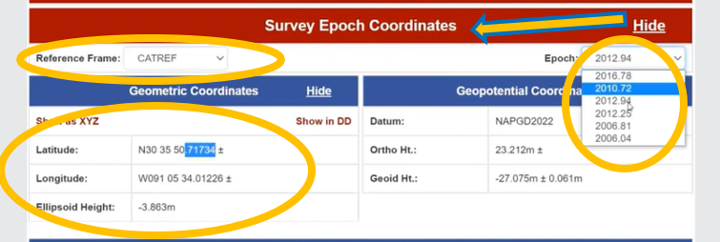
    The box titled “SEC in CATRF – Prototype” is an example of a mark in the CATRF reference frame and the survey epoch of 2012.94. As indicated in the diagrams, users will be able to select the reference frame (ITRF, NATRF, CATRF, PATRF and MATRF) and the survey epoch.

    SEC in CATRF – Prototype

     (Image from: NGS June 6th Webinar - It's 2022…are we done yet?)
    Option to Select Survey Epoch
    Photo:
    Options to select reference frame (Images: NGS)

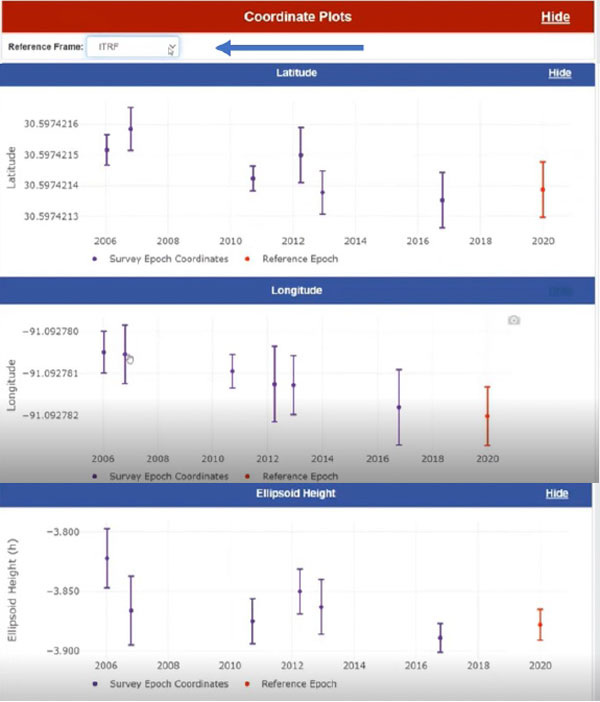
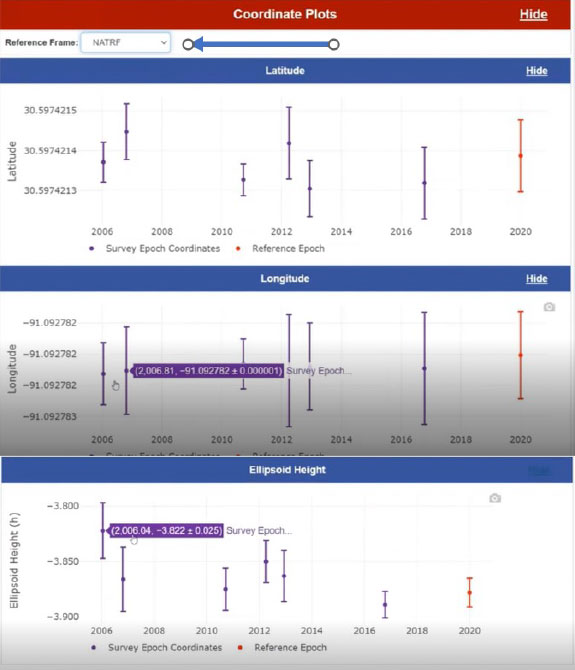
    Another feature of the data delivery system is that it provides plots of a mark’s survey epoch coordinate values at different epochs. In the example shown in the box below, the plots provide values of a mark’s latitude, longitude and ellipsoid heights based on each survey epoch data. The user can select various reference frames of the mark to understand the change based on the reference frame.

    Coordinates Plots in ITRF – Prototype (Image: NGS June 6th Webinar - It's 2022…are we done yet?)
    Coordinate plots in ITRF prototype. (Image: NGS)

    The box below clearly shows a slope in the changes in coordinates based on survey epochs, especially in the longitude. This is the plate rotating in time. You can see the changes in latitude, longitude and ellipsoid height in the NATRF reference frame for the same mark. The latitude and longitude plots do not show a slope because the plate rotation is removed using a model to change from the ITRF reference frame to the NATRF reference frame. That said, the ellipsoid height plots look the same because the rotation model does not change the ellipsoid height.

    Coordinate Plots in NATRF – Prototype (Image: NGS June 6th Webinar - It's 2022…are we done yet?)
    Coordinate plots in NATRF prototype. (Image: NGS)

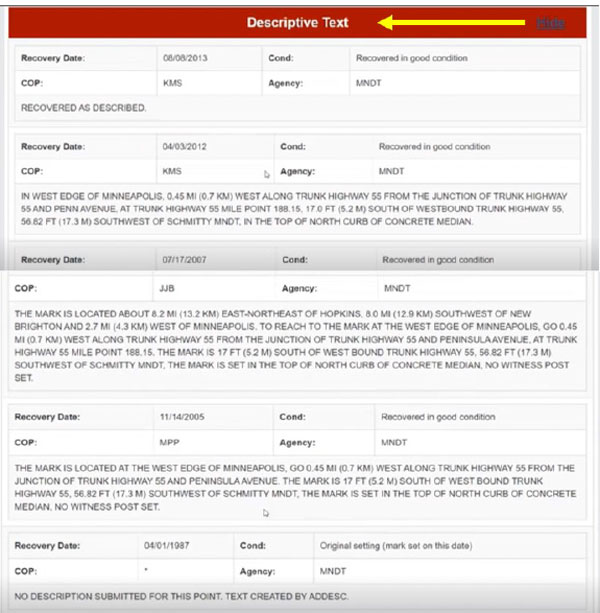
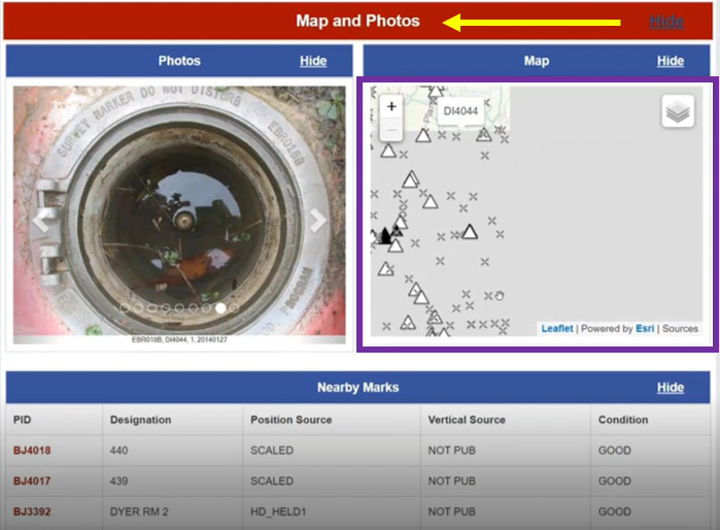
    The prototype also provides maps, photos and descriptive text of the mark.

    Map and Photos – Prototype (Image: NGS June 6th Webinar - It's 2022…are we done yet?)
    Map and photos of a mark in the prototype. (Image: NGS)
    Descriptive Text – Prototype (Image: NGS June 6th Webinar - It's 2022…are we done yet?)
    Descriptive text prototype (Image: NGS)

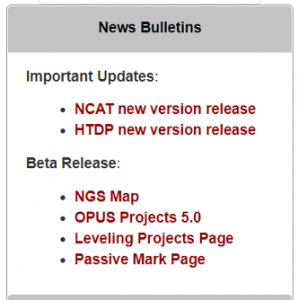
    Some of this data delivery output may seem familiar to users who have used the NGS beta routines (see the box below).

    Beta Routines

    NGS's Beta Routines (Images: NGS)
    Beta routines (Image: NGS)

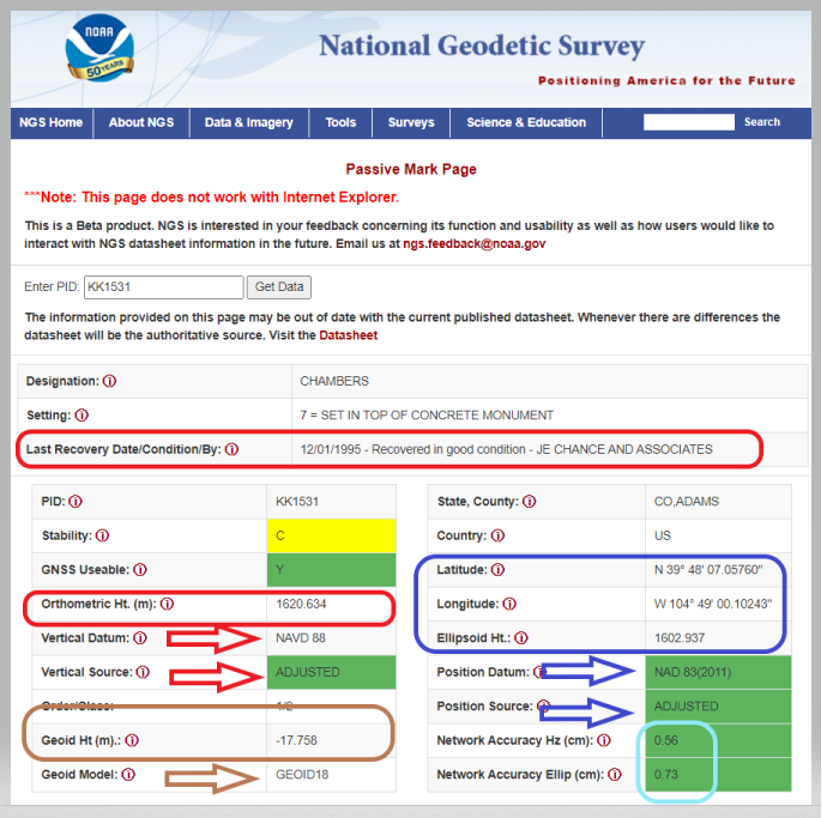
    For example, the Passive Mark Page Webtool provides the coordinate information for a mark. My October 2020 column described the tool is detail. See below for an example of the passive mark tool.

    Beta Passive Mark of KK1531 (Image: National Geodetic Survey)
    Beta Passive Mark of KK1531 (Image: NGS)

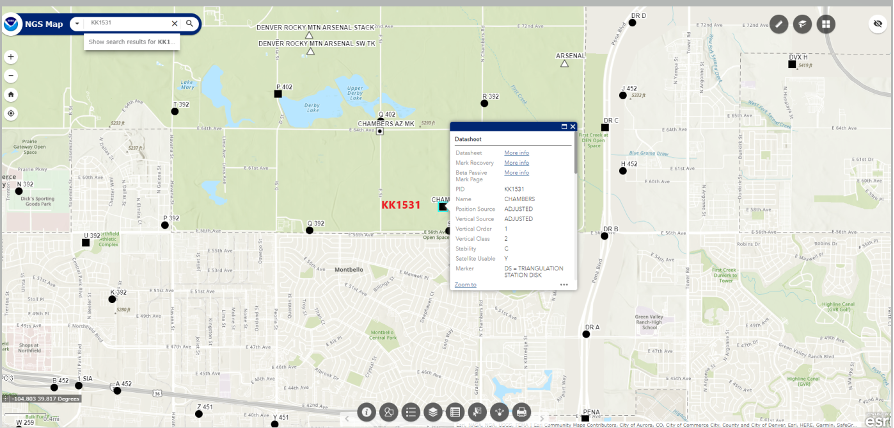
    The NGS Beta Map routine enables users to link to NGS datasheets, the passive mark tool and mark recovery, as well as connect to OPUS Shared Solutions and the NOAA CORS Network. See below for an example. It also provides a measuring tool, multiple basemaps and the ability to export data. My December 2021 column described the NGS Beta Map in detail.

    Example of NGS Beta Map Routine for KK1531 (Image: National Geodetic Survey)
    Example of NGS Beta Map Routine for KK1531 (Image: National Geodetic Survey)

    Only three years remain before the release of the new, modernized NSRS. I encourage everyone to try all of the beta products, and download Dru Smith’s June 6 webinar for a better understanding of the agency’s current thoughts on how it will provide data to users in the new, modernized NSRS. As for all the NGS beta products, the agency would like users to try the tools and provide feedback on what they liked and what they didn’t like, as well as any additional information you need or would like to see. The NGS is trying to develop tools useful to everyone, but that won’t be possible unless they hear from users.

    The following statement on NGS beta products explains how to provide feedback and why it is important:

    “This is a beta product. NGS is interested in your feedback concerning its function and usability as well as how users would like to interact with NGS datasheet information in the future. Email us at [email protected].”