Tag: engineering

  • Aligning the trades: GNSS for architecture, engineering and construction

    Aligning the trades: GNSS for architecture, engineering and construction

    Surveyors for architecture, engineering, and construction projects require GNSS receivers that have high accuracy and are rugged enough to survive the dust, water, and inevitable drops that they will endure at construction sites. They also need to be able to easily share data with architects, engineers, planners, and tradespeople, both at the sites and at the office.
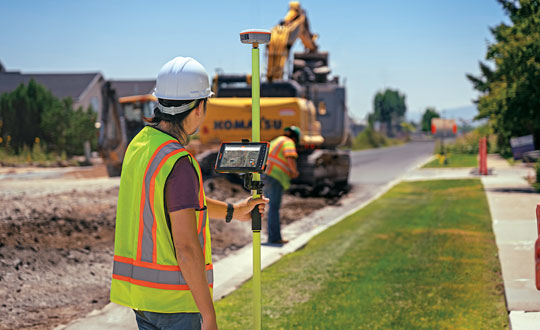
    Photo: Juniper Systems
    Photo: Juniper Systems

    Juniper Systems, which has more than 30 years of experience in mapping and data collection in a wide variety of applications across industries, recently released a real time-kinematics (RTK) activation for its Geode GNSS receiver that allows mapping accuracy down to a centimeter. Pairing a Geode with the company’s Uinta mapping and data collection software and a Mesa rugged tablet makes it easy for users to share their data — such as the locations of fiberoptic telecommunication lines or of utility manhole covers — with other people working on site or at the office. The Geode and the Mesa meet IP68 protection certification for water and dust ingress; they also have MIL-STD-810G certification against drops, vibration, and extreme temperatures.

    In this month’s cover image, the Geode is at the top of the survey pole, the Mesa Rugged Tablet is mounted near the user’s hand, and the screen on the Mesa depicts the Uinta mapping software.

    On construction sites, surveying is an ongoing process. Surveyors are the first on the site, before any other work begins, and the last ones there, to map the project “as built.” Total stations with GNSS receivers, as well as tablets and other mobile digital devices are their essential tools, increasingly complemented by unmanned aerial vehicles (UAV) and lidar scanners. Accuracy is their key contribution. In this month’s cover story on GNSS for architecture, engineering, and construction (AEC), we highlight three building projects: a skyscraper in Sweden, a highway in China, and a luxury resort in the Caribbean.

    Check out these perspectives on architecture, engineering and construction:

    ComNav Technology: Building Sweden’s Tallest Tower

    CHCNAV: Expanding a Highway in China

    EOS Positioning Systems: Building a System to Build an Island Resort
  • Teren kicks off nationwide lidar content library program

    Teren kicks off nationwide lidar content library program

    Image: Teren
    Image: Teren

    Teren, a climate resilience analytics company, has expanded its Premium 4D Content program for regions across the United States, including the Gulf Coast, Midwest, Rocky Mountains and West Coast.

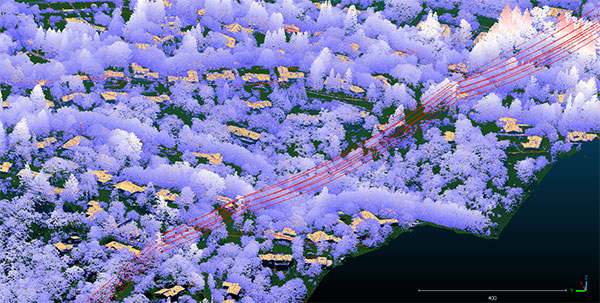
    Teren acquires and quickly processes high-fidelity lidar data, making it available via its content library, and delivers analytics with actionable insights to energy and engineering firms.

    “Climate change is causing drought, flooding, landslides and wildfires across the country – significantly impacting asset owners and project developers. As a result, the market demand for high-fidelity, temporal data to identify, prioritize, and monitor climate-related risk is higher than ever,” said Toby Kraft, Teren CEO.

    Teren is amassing a content library of remotely-sensed 3D (spatial) data across the United States. That data is updated on regular intervals to monitor changes over time providing a unique 4D (temporal) view. This 4D data library feeds analytics that identify risk, inform mitigation, and strengthen asset resilience. While remotely-sensed data has traditionally been sourced on a project-by-project basis, Teren offers its data and analytics as a subscription service. This model drives down the costs for clients and stakeholders, helping to maximize the speed of delivery, return on investment, and data value.

    “In our flagship content region, Appalachia, our customers tap into our 4D content library to identify and monitor the terrain and surface conditions surrounding their assets — primarily aiming to identify and mitigate landslides before they become catastrophic incidents,” Kraft said. “We’re expanding the program nationwide to meet the growing demand for terrain monitoring and climate resilience analytics around events such as erosion, flooding, wildfires and more.”

    Teren’s solution saved clients in Appalachia an estimated $152 million annually, preventing 24 failures per year due to landslides. While landslides are not as pervasive across the United States, companies can apply the data and analytics suite for the following:

    • Gulf Coast: inundation, subsidence, land movement
    • Midwest: erosion, flooding, subsidence
    • Rock Mountains: landslides, flooding, wildfire
    • West Coast: wildfires, land movement, flooding.

    Traditionally used by the energy sector, Teren’s data has also proven to be highly valuable to state and federal agencies, insurers and civil engineers. Teren expects to see increased variability across clients and use cases as the content region expands.

    To learn more about Teren or to request a demo, visit www.teren4d.com.

  • Hexagon acquires Jovix material tracking company

    Hexagon acquires Jovix material tracking company

    Photo: Jovix
    Photo: Jovix

    Hexagon AB, a global leader in digital reality solutions, has acquired the Jovix software and services business from Atlas RFID Solutions LLC of Birmingham, Alabama.

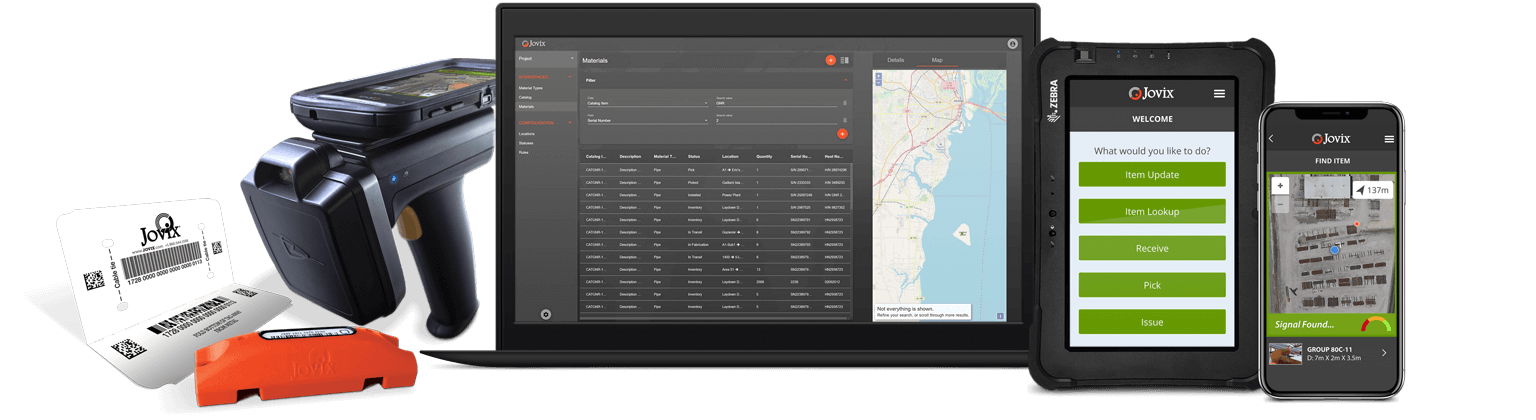
    Jovix is a material tracking software developed specifically for the construction industry, providing project decision-makers with real-time, actionable data regarding material status and location.

    The cloud-based and mobile configurable workflow platform offers visibility and traceability into the status and location of materials throughout the engineering, procurement and construction (EPC) lifecycle. This streamlined process, coined “material readiness” by Jovix, ensures construction crews have required materials without delay to complete their work according to plan. This is achieved by fully digitizing the supply chain to provide real-time, geo-contextual, and relational visibility from fabrication to installation.

    Jovix combines web-based server software with information from multiple types of sensor tags and readers to automate previously manual, paper-based data-collection workflows about the status and location of material as it moves throughout the construction supply chain.

    The software has been deployed in 25 countries on more than 650 job sites, including multibillion-dollar oil and gas and chemical construction projects. There are more than 7,500 Jovix users worldwide.

    “The acquisition supports our continued expansion into the procurement, fabrication, and construction market,” said Hexagon President and CEO Ola Rollén. “By removing impediments to productivity that result from material management issues intending to reduce material wait times to zero, Jovix provides value for owner-operators, EPC firms, contractors, fabricators, and suppliers.”

    Jovix will be fully consolidated as of Oct. 1, operating within Hexagon’s Project Portfolio Management division. The acquisition has no significant impact on Hexagon’s earnings.

  • Trimble Connects 10 million with collaboration platform

    Trimble Connects 10 million with collaboration platform

    Driven by COVID-19, the uptick in adoption supports collaboration among remote workers as businesses adapt.

    The Trimble Connect cloud-based collaboration platform has surpassed 10 million users. In response to COVID-19, distributed working has intensified the need for teams to share information and collaborate remotely, leading 1.2 million users to join Trimble Connect in March and April alone.

    To date, Trimble Connect has hosted more than 80,000 design and construction projects, making it possible for people to collaborate and work together from anywhere in the world.

    Photo: Trimble
    Photo: Trimble

    Trimble Connect is an open collaboration platform for design and construction that connects project stakeholders with the data they need to inform decisions and improve team efficiency. Project stakeholders can share, review, coordinate and comment on data-rich constructible models, schedules and critical project information in real time — reducing costly miscommunication and improving coordination to keep projects on time and on budget.

    In addition to adding new users, the activity on Trimble Connect has shown a considerable increase in collaboration for businesses in the architecture, engineering and construction (AEC) industry.

    The number of invitations to collaborate on projects increased 58% in April over the previous month, indicating that users are adjusting to new remote and distributed working dynamics and enabling teams to stay resilient, despite interruptions to their traditional daily routines.

    “This is an exciting milestone for Trimble Connect,” said Ray Bagley, business area director for Trimble Connect. “Businesses in the AEC industry need an open, common data environment that allows project stakeholders to unlock the real value of building information modeling (BIM), civil construction and geospatial data. The increased adoption of Trimble Connect in recent months shows us that businesses need reliable, open collaboration more than ever before.”

    Trimble Connect’s open API enables data-flow to and from a variety of applications and allows users to customize workflows by integrating with existing enterprise solutions. Users can access project files stored on Trimble Connect directly through a wide range of solutions, including Tekla Structures software, Trimble Access field software, Trimble FieldLink layout software, SketchUP 3D modeling software and ProjectSight  construction management software as well as third-party applications.

  • Topcon, Bentley Systems kick off Constructioneering Academy

    Topcon Positioning Group and Bentley Systems announced the kick-off date of their collaborative Constructioneering Academy initiative. The first session is scheduled for Feb. 13 in Livermore, California.

    Topcon and Bentley have joined efforts to provide opportunities designed to allow construction industry professionals to learn best practices in constructioneering, a process of managing and integrating survey, engineering and construction data, to streamline construction workflows and improve project delivery.

    “The courses are designed in a dialogue format to allow Topcon and Bentley personnel to interact directly with attendees to cater the experience for their specific questions and demands,” said Ron Oberlander, senior director of Topcon Professional Services. “The future of construction automation continues to move forward with constructioneering digital workflows, which make the work of surveyors, engineers, and construction professionals automated, continuous, and continuously more valuable, throughout project lifecycles and beyond completion.”

    “Topcon and Bentley’s federated constructioneering technologies enable firms to gain unprecedented digital visibility and insights into their project outcomes, as compared to traditional construction workflows. Attendees of our Constructioneering Academy will learn how their organizations can improve project delivery by leveraging constructioneering technology, methods, and best practices to execute their projects more efficiently, monitor construction performance and progress, and reduce project costs,” said Vinayak Trivedi, Bentley Institute vice president.

    The Constructioneering Academy will continue with additional sessions throughout learning centers located worldwide designed to reach industry professionals with hands-on training in real-world scenarios and workflows.

    To register, visit constructioneering.com.

  • Leica Cyclone REGISTER 360, cloud services offered for digital reality-capture market

    Lieca-Cyclone-WHexagon announced today its new Leica Cyclone REGISTER 360 laser scanning software for simpler, automated registration, and its Cyclone Cloud Services platform for secure global collaboration through an on-demand software-as-a-service model.

    Together, the new products offer users smarter ways to register, visualize and collaborate around digital reality projects, delivering solutions into the architecture, engineering and construction (AEC), plant, survey and public safety markets through the connected Leica Cyclone family.

    “Digital realities are enabling professionals and newcomers to laser scanning to shape the world around us. Whether it’s on a construction site for building documentation or in a plant environment for life cycle updates, efficiencies and productivity gains are realised with the ability to merge reality and digital data quicker and with more accuracy,” said Hexagon President and CEO Ola Rollén. “These new developments in laser scanning registration with our Cyclone software improve the user experience and overall workflow of point cloud processing.”

    Lieca-Cyclone-W2Cyclone REGISTER 360 is the a professional-grade registration software that combines automation, high performance and ease of use into one powerful package available to novices and experts alike. Simplifying and automating the entire production process, Cyclone REGISTER 360 enables users to automatically process, validate and deliver point clouds according to rigorous quality control and reporting standards.

    Cyclone Cloud offers professionals a new way to consume and deliver digital reality data through a highly scalable, intuitive and web-based platform. TruView Cloud Services is the only cloud-based digital reality visualization and collaboration platform that enables quick setup of private user communities, connecting with and making the data available anywhere in the world.

    Users can publish digital reality content in Cyclone from handheld devices and terrestrial, mobile and unmanned aerial vehicles. With open application programming interfacing, the data can be delivered in any device and operating system with connectivity for building information modeling, geographic information systems and computed-aided drafting.

  • Carlson releases BRx6 GNSS receiver for surveyors

    Carlson releases BRx6 GNSS receiver for surveyors

    Carlson Software has released the Carlson BRx6, a multi-GNSS, multi-frequency receiver. Each BRx6 contains a multi-constellation, multi-band 372-channel GNSS receiver, Athena RTK technology and an integrated Atlas L-band receiver.

    PositionIT-Carlson-620x620-e1464842339861In addition, the BRx6 contains electronic sensors that measure tilt, direction (electronic compass) and acceleration, supporting Carlson SurvCE’s advanced features such as LDL (live digital level or e-bubble), leveling tolerance, auto by level, tilted-pole correction and advanced stakeout features.

    SurvCE contains sophisticated checks for compass and acceleration anomalies to ensure accuracy.
    Designed for use by surveyors, contractors, builders and engineers, the Carlson BRx6 delivers the high positional accuracy at an affordable price.

    Manufactured to Carlson’s exacting specifications by Hemisphere GNSS, the BRx6 provides robust performance and high precision in a compact and rugged package, Carlson said. With multiple wireless communication ports and an open GNSS interface, the BRx6 can be used as a precise base station or as a lightweight and easy-to-use rover.

    The BRx6 receiver is powered by an Athena RTK (real-time kinematic) engine. RTK corrections can be received over UHF radio, cell modem, Wi-Fi, Bluetooth or serial connection.

    The BRx6 also works as a base and rover with the new Carlson Listen-Listen cloud-based low latency RTK correction delivery service. The Carlson Listen-Listen service taps the built-in cell modem and reduces the need for UHF radio communication.

    Multiple RTK rovers of any type can “talk to” a single BRx6 base by cell modem or Wi-Fi hot spot over extreme long distances. It reduces or eliminates dependency on VRS systems. Listen-Listen is provided on a free, 30-day trial basis with each BRx6 base and rover package purchased.

    The BRx6 receiver can also be used with the subscription-based Atlas service, Hemisphere’s industry leading global correction service provided over L-band communication satellites and the internet.

    When this service is included in an upcoming release of Carlson SurvCE, BRx6 users can achieve sub-decimeter positioning performance anywhere on earth, without the need for a fixed base station, a virtual reference network or other communication infrastructure.

    The BRx6 can be purchased as either a rover or as a base/rover package. The base/Rover package includes two BRx6 GNSS receivers, two hard-sided carrying cases, four BRx6 batteries with two chargers, one GPS tribrach and one tribrach adapter, and two Carlson GPS receiver poles. The Rover package includes the BRx6 GNSS receiver, carrying case, two BRx6 batteries with charger, and cables. The BRx6 rover is available as a network rover (GSM cell modem only) or as a complete rover with UHF radio and GSM cell modem.

    The Carlson BRx6 GNSS receiver is designed to work seamlessly with most data collectors including Carlson’s rugged and popular data collectors: the Carlson MINI2, the Carlson Surveyor2 and the Carlson RT3ruggedized tablet.

  • BYOD GPS Gets Real: Lessons Learned with the New Rules of GPS Data Collection

    Broadcast Date: April 14, 2016
    On-Demand Available Until: April 14, 2017
    Sponsor: TerraGo
    Summary: Our expert speaker panel examines how five organizations from five industries (oil & gas, engineering, water utility, transportation and natural resources) made the switch from GPS handhelds to smartphones and tablets for their field data collection needs.
    Speakers: Michael Gundling and Bryan Burns, TerraGo

  • Joint U.S./China Engineering Report on GNSS Now Available

    The National Academies Press has released Global Navigation Satellite Systems, the report of a joint workshop of the National Academy of Engineering and the Chinese Academy of Engineering held in Shanghai,  China, on May 24 and 25, 2011.

    According to the NAP, “The workshop featured presentations chosen based on the following criteria: they must have relevant engineering/technical content or usefulness; be of mutual interest; offer the opportunity for enhancing GNSS availability, accuracy, integrity, and/or continuity; and offer the possibility of recommendations for further actions and discussions. Global Navigation Satellite Systems is an essential report for engineers, workshop attendees, policy makers, educators, and relevant government agencies.”

    The 268-page report is available in both printed and electronic form. One may download either individual chapters or the complete report for personal use free of charge.