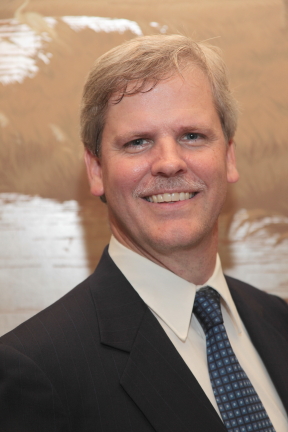
GPS World magazine interviews at the ESRI show, Eric Gakstatter is talking with Neil Vancans of Altus Positioning Systems.
Tag: Eric Gakstatter
-
Gakstatter Reports on CGSIC Meeting
GPS World Survey and GIS editor Eric Gaskstatter attended the CGSIC (Civil GPS Service Interface Committee) State and Local Government subcommittee meeting in Seattle August 14, and provided a report in his Survey Scene editorial.
The Civil GPS Service Interface Committee (CGSIC) was established to facilitate communication among civilian GPS users, identify civilian user community needs, and report to the Office of the Assistant Secretary for Transportation. The U.S. state and local government subcommittee meeting moves around to different parts of the U.S. The next meeting is the annual CGSIC meeting, typically held the two days prior to the Institute of Navigation (ION) GNSS conference. This year it’s being held in Nashville, Tennessee.
Gakstatter reports on how GNSS receiver technology is moving much faster than GPS policymakers can keep up with, the National Telcommunications and Information Administration’s efforts to execute the National Broadband Plan, and a whether illegal jamming has been on the rise.
-
Gakstatter Speaks at Field Tech Conference, Registration Now Open
 Eric Gakstatter, GPS World’s editor for survey and Geospatial Solutions Weekly, will be a keynote speaker at the Second Annual Field Technology Conference (FTC 2012). FTC 2012 is hosted by the Western Forestry and Conservation Association (WFCA), GPS World magazine, and Geospatial Solutions Weekly.
The conference will be held September 26-27 at the Holiday Inn Convention Center in Portland, Oregon. This unique conference, centered around geospatial technology, features tracks on field devices (handhelds/tablets, GPS, lasers, 3D scanning), remote sensing (aerial photography, satellite imagery, airborne lidar), and mapping software (mobile GIS, open source GIS, datum conversions).
The opening general plenary session will feature world-class experts in emerging geospatial technologies of Unmanned Aerial Vehicles/Systems (UAV/UAS), Mobile GIS, Open Source GIS, and GPS/GNSS. The keynote speakers will discuss how these emerging technologies are changing the way geospatial data is collected and managed. Besides Gakstatter, featured speakers include:
- Dr. Joe Paiva – Paiva Consulting
- Jeff Shaner – Esri Mobile Technology Program Manager
- David Percy – Portland State University GIS Research Faculty
“Audience feedback from last year’s conference was very good,” said keynote/moderator Eric Gakstatter. “Attendees said they appreciated our intimate and focused content as well as expert analysis of technology trends. Listening to feedback from last year’s attendees, we’ve expanded a bit this year to include outdoor demonstration sessions with UAVs, handhelds/tablets, laser rangefinders, mobile phones, and GPS units. We’ve also attracted more experts from around the country to present their work and thought leadership.”
Registration for the Second Annual Field Technology Conference (FTC) is now open. 2011 attendees included representatives from federal, state, and local government, Fortune 1000 companies, Native American tribes, higher education, and natural resource consultancies.
The registration fee is $245 if registered by September 21, and $295 if registered after September 21, 2012. The registration fee includes lunch on both days as well as refreshments during breaks. The conference room rate is $99/night plus tax. After September 5, the reduced rate will be subject to availability.
For more information as well as a draft of the conference agenda, visit the website.
Sponsorship opportunities are available. Contact Richard Zabel.
A two-minute Youtube video of last year’s conference:
-
Gakstatter to Give GNSS Technology Update at Esri Conference
Eric Gakstatter, GPS World’s contributing editor for Survey/GIS, will speak at the 2012 Esri International User Conference, which will be held July 23-27 in San Diego, California.
In his “GPS/GNSS Technology Update,” Gakstatter will provide a discussion on how current and upcoming satellite systems affect the user. The talk will be held in Room 31B at 10:15-11:30 a.m. on Thursday, July 26. Here is the official description:
ArcGIS Mobile users around the world are challenged to keep current with evolving satellite systems. There are new GPS satellites being launched with new GPS signals being broadcast (L5). The Russian GLONASS system is near operational and Europe has launched its first two Galileo satellites. Not only are the satellite systems changing but also GPS augmentation systems such as WAAS, DGPS, EGNOS, MSAS and GAGAN systems. ArcGIS Mobile users take advantage of these GPS/GNSS augmentation systems and should be aware of how they are evolving. The LightSquared controversy is still a major threat to GPS/GNSS users. How might that affect the future of GPS/GNSS mapping/surveying? How do these changes affect spatial data collection and navigation services within ArcGIS Mobile? Which factors should one consider when using these different satellite systems. What are the current trends and developments that one should consider when preparing GPS/GNSS mapping hardware budgets?
To learn more about the conference, read about it in our Events section here.
-
Survey/GIS Editor Eric Gakstatter to Conduct GPS/GNSS Workshop at East Carolina University May 10, 2012
GPS World Survey/GIS editor Eric Gakstatter will conduct a one day workshop at the East Carolina University Center for Geographic Information Science in Greenville, NC on May 10, 2012. The workshop is suited for professional GPS/GNSS users in GIS, land surveying, engineering, construction, agriculture, and other high precision applications.
Workshop Theme:
“GNSS technology is going to change much more in the next five years than it has in the past five years”
Workshop Topics:
1. GPS/GNSS: How does it work and how accurate is it?2. What is GNSS and what can it do for me?3. Market survey of professional and consumer GPS/GNSS receivers.4. The future of GPS/GNSS receivers. New signals? How much? How accurate?5. Real-time corrections or post-processing. Which should I use?6. Sources of real-time corrections. Free and subscription-based.7. Source of post-processing software and data.8. GPS/GNSS for high-precision GIS: The value and the headaches.9. Evaluating GPS/GNSS equipment: Which one is right for you?10. How to measure the accuracy of a GPS/GNSS receiver. Accuracy vs. PrecisionVenue:East Carolina University Center for Geographic Information ScienceGreenville, NC USADate/Time:Thursday, May 10, 2012. 8:30a – 5:00pClick here for details and registration form. -
Gakstatter to Discuss LightSquared on America’s Web Radio February 27
Eric Gakstatter, Survey Scene and GIS editor, along with Gavin Schrock (Administrator, Washington State Reference Network) and Laurence Socci (ACSM/NSPS Government Affairs Consultant) will be guests on America’s Web Radio on Monday, February 27, at 11 a.m. Eastern Time to discuss the latest developments in the LightSquared/GPS interference debate as well as other GPS/GNSS issues.
The one-hour program is hosted and moderated by American Congress on Surveying and Mapping’s (ACSM) executive director Curt Sumner.You can listen to the radio broadcast by visiting America’s Web Radio website. The show will also be recorded and available on the ACSM and GPS World websites for download.ACSM, with its largest Member Organization being the National Society of Professional Surveyors (NSPS), was founded in June 1941 and is incorporated as a non-profit educational organization whose goal is to advance the sciences of surveying and mapping and related fields, in furtherance of the welfare of those who use and make maps. ACSM also encourages the development of educational programs and supports publications that represent the professional and technical interests of surveying and mapping. The society is comprised of four independently incorporated Member Organizations which include more than 5000 surveyors, cartographers, geodesist, and other spatial data information related professionals from private industry, government, and academia throughout the world. Each member Organization serves the specific interests of their respective members, while working collectively to achieve the overall goals of ACSM.