The Soyuz launcher for Arianespace’s upcoming mission with two European Galileo navigation satellites is taking shape at the Spaceport for a March 27 liftoff from French Guiana.
“During activity in the Spaceport’s Soyuz Launcher Integration Building, the medium-lift workhorse began to assume its iconic form with integration of the four first-stage strap-on boosters to the Block A core second stage,” Arianespace wrote in an statement.
“The next step will be the mating of Soyuz’ Block I third stage to the launcher’s core, completing the basic build-up, and readying the vehicle for its rollout to the launch pad — where the payload will be mated.”
The March 27 flight will be the 11th Soyuz flight from French Guiana since the launcher’s introduction at the Spaceport in October 2011. It is designated Flight VS11 in Arianespace’s numbering system for its launcher family, which also includes the heavy-lift Soyuz and lightweight Vega.
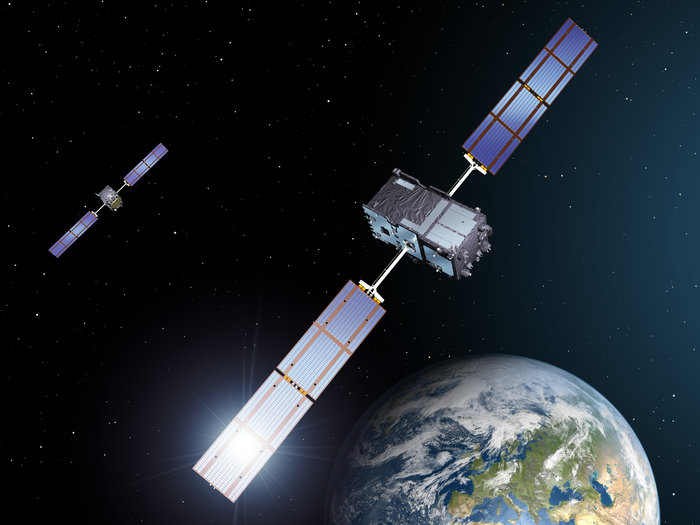
For the upcoming Soyuz mission, Arianespace will loft Galileo’s third and fourth Galileo Full Operational Capability (FOC) satellites to further expand the constellation. Flight VS11’s two satellites were built by OHB System, with Surrey Satellite Technology Ltd. supplying their navigation payloads.
Galileo’s complete operational network and its ground infrastructure will be deployed during the program’s Full Operational Capability phase, which is managed and funded by the European Commission. The European Space Agency has been delegated as the design and procurement agent on the Commission’s behalf.
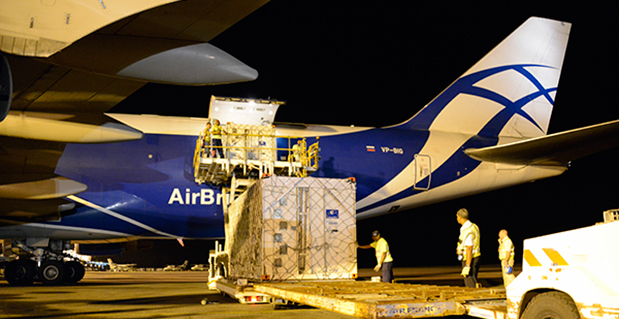
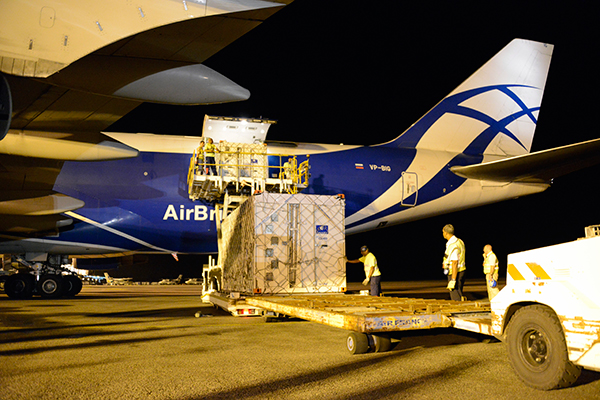
Europe’s next two Galileo satellites are unloaded from the Boeing 747 cargo aircraft at Cayenne. The two satellites are scheduled to be launched together by Soyuz from Europe’s Spaceport this summer.
The first two Galileo Full Operational Capability (FOC) satellites arrived safely at a clean room in Kourou, French Guiana, at 20:00 on Wednesday, May 7, in preparation for launch this summer.
Named “Doresa” and “Milena,” the two Galileo FOC satellites arrived at the Félix Éboué international airport in French Guiana at 02:00 local time. They spent the day in an airlock to acclimatize before being taken to their new home, the S1A clean room, where they could be safely unpacked to begin the launch campaign.
Europe’s two latest Galileo navigation satellites touched down at Europe’s Spaceport in French Guiana packed safely within protective and environmentally controlled containers. The satellites were carried across the Atlantic aboard a 747 cargo carrier, according to the European Space Agency.
Manufactured by OHB in Bremen, Germany, with navigation payloads contributed by Surrey Satellite Technology Ltd. in Guildford, UK, these satellites – the first of 22 full-capability models — had spent several months at ESA’s Technical Centre, ESTEC, in Noordwijk, the Netherlands, where they underwent exhaustive testing in simulated space conditions.
“Adam”, the third Galileo FOC satellite is currently undergoing testing under space conditions at ESTEC. The fourth Galileo FOC satellite, “Anastacia,” will begin final testing at OHB in Bremen before being shipped to ESTEC. The Galileo satellites are named for the children who won a painting competition organized by the European Commission in 2011.
After successfully passing the Flight Readiness Review (FRR) last week, Doresa and Milena were released for shipment to the French overseas department. “Thanks to the good collaboration between the participating industrial teams and the experts at the European Space Agency ESA as our customer, OHB was able to successfully finish the FRR,” says OHB’s Director of Navigation Wolfgang Paetsch who will be personally overseeing the launch preparations in Kourou.
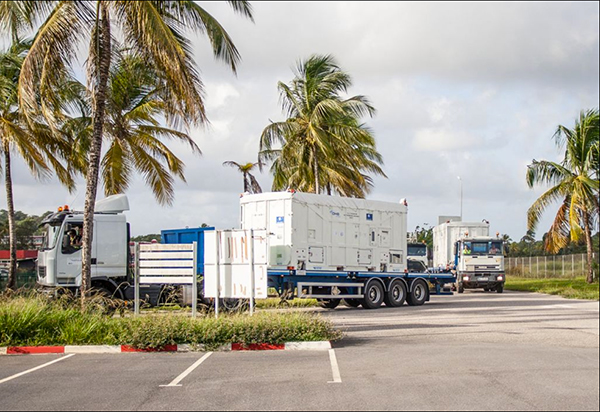
On May 5, the two satellites left on a pair of lorries for Frankfurt Airport in Germany, from where they flew the following evening. After landing in French Guiana, the satellites were driven to the clean room. The pair will be launched together aboard a Soyuz rocket, joining the four Galileos already in orbit. This initial quartet — the minimum number needed for achieving a position fix — has demonstrated the overall system works as planned, while also serving as the operational nucleus of the coming full constellation.
“Similar arrival scenes should become familiar over the next couple of years,” said Giuliano Gatti, Head of ESA’s Galileo Space Segment Procurement Office. “These first two Full Operational Capability satellites are effectively preparing the way for the rest of the constellation, allowing the final validation of assembly, testing and launch preparation procedures. A steady stream of satellites is foreseen, coming from OHB to ESTEC for acceptance testing and then on to French Guiana. Thanks to the preparatory work done with these pioneer satellites, future Galileos will be processed more rapidly.”
The definition, development and in-orbit validation phases of the Galileo programme were carried out by ESA and co-funded by ESA and the EU. The Full Operational Capability phase is managed and fully funded by the European Commission. The commission and ESA have signed a delegation agreement by which ESA acts as design and procurement agent on behalf of the commission. OHB System is the industrial prime contractor responsible for the total of 22 Galileo FOC satellites.
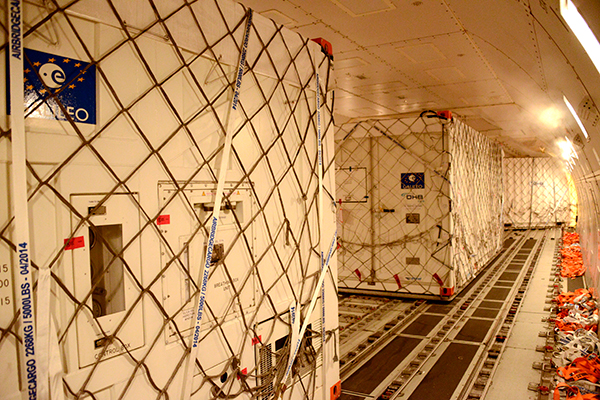
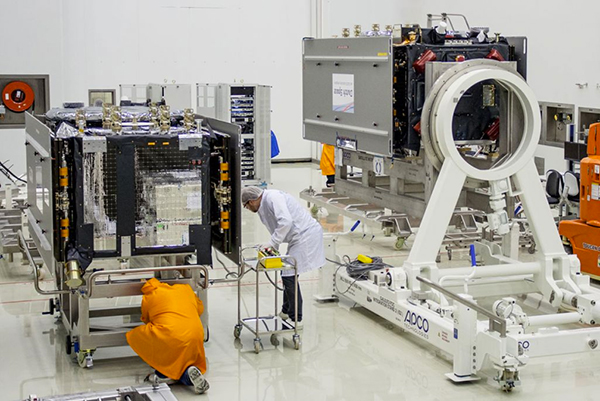
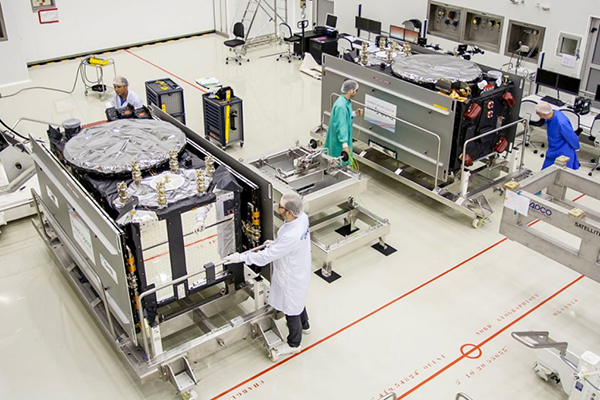
The two Galileo FOC satellites were enclosed in protective, air-conditioned containers for their flight.“Doresa” and “Milena” head to the clean room.The two satellites in the clean room.Dorese and Milena rest side by side in clean room S1A.
Assembly process for the Soyuz launcher began with integration of the four first-stage strap-on boosters to the Block A core second stage (photos at left and center). At right, the Block I third stage is seen after its mating to the launcher’s core.
The launcher for Arianespace’s next Soyuz mission from the Spaceport in French Guiana is completing its initial checkout for a flight in the second half of 2012, which will carry another two spacecraft for Europe’s Galileo satellite navigation constellation, according to Arianespace.
During activity at the Spaceport’s Soyuz Launcher Integration Building — known by its Russian “MIK” designation — the vehicle’s four first-stage strap-on boosters have been mated with the Block A core second stage, followed by integration of the Block I third stage.
With its initial build-up concluded, the Soyuz is undergoing regular maintenance checks that are standard for the Russian-built vehicles that have been in storage prior to their mission. Such verifications include testing of the launcher’s pneumatic and electrical systems, Arianespace said.
This Soyuz will carry Europe’s next two Galileo In-Orbit Validation (IOV) satellites, joining the first pair of spacecraft lofted on Arianespace’s historic maiden flight of the Russian-built launcher from French Guiana in October 2011. Once the four IOV satellites are in orbit, they will provide the minimum information needed for space-based navigation: latitude, longitude and altitude data, along with ranging accuracy, enabling assessment of the Galileo system’s performance, while also allowing suppliers to realistically check their receivers and services against actual signals.
Arianespace has been chosen to deploy the entire Galileo constellation of 30 satellites. This began with the launch of the first two experimental satellites, GIOVE-A and GIOVE-B, orbited by Arianespace’s Starsem affiliate on Soyuz launchers from Baikonur Cosmodrome in 2005 and 2007. Subsequently, Arianespace lofted the initial pair of In-Orbit Validation spacecraft on Soyuz’ October 2011 inaugural mission from the Spaceport.
The remaining 24 Galileo constellation satellites will be orbited through 2015, using six additional Soyuz vehicles carrying two spacecraft each, along with three Ariane 5s configured with four per launch.
Initial phases of the Galileo program were carried out by the European Space Agency (ESA) in activity co-funded with the European Commission. Galileo’s Full Operational Capability phase is being managed and funded by the European Commission, with ESA and the Commission having signed a delegation agreement by which the space agency acts as design and procurement agent.
The upcoming Galileo mission is designated VS03 in the numbering system for Arianespace’s launcher family — which is composed of the medium-lift Soyuz, heavy-lift Ariane 5 and light-lift Vega – all operated at the Spaceport. The “V” represents the French word for “flight” (Vol), while “S” signifies the use of a Soyuz launch vehicle. Its “3” denotes the third Arianespace mission of Soyuz from French Guiana.
The first Galileo navigation satellite has arrived in Europe’s Spaceport in French Guiana, ready to begin preparations for launch on October 20, reports the European Space Agency (ESA). Packed within a protective, air-conditioned container, the satellite known as Flight Model 2 (FM2) landed at Cayenne Rochambeau Airport aboard an Antonov aircraft at 06:45 local time on Wednesday after departing from Thales Alenia Space Italy’s Rome facility where it was built.
A Thales and ESA team stood ready to receive FM2, having flown into French Guiana the previous week, along with all the testing and support equipment. The team loaded the satellite container on a lorry for transport to the Guiana Space Center, where it arrived at 10:00 local time and was moved into the preparation facility. It stayed there overnight for the temperature to settle before it was taken out of its container the following morning.
The FM2 satellite is due to be launched aboard a Soyuz ST-B vehicle on October 20, together with a second Galileo satellite called the Proto-Flight Model (PFM), now being readied for its own flight to French Guiana.
This will be the first launch of Russia’s Soyuz rocket from French Guiana, and the first Soyuz launch from a spaceport outside of Baikonur in Kazakhstan or Plesetsk in Russia. The launch will take place from a new facility 13 km northwest of the Ariane 5 launch site. French Guiana is much closer to the equator, so each launch will benefit from Earth’s spin, increasing the maximum payload into geostationary transfer orbit from 1.7 tonnes to 3 tonnes.
The first four Galileo satellites, built by a consortium led by EADS Astrium Germany, will form the operational nucleus of the full Galileo satnav constellation.
The European Space Agency (ESA) announced that two Soyuz launchers which will fly the first four satellites of Europe’s Galileo navigation system into orbit have arrived at Kourou harbour in French Guiana, completing a journey that took them halfway round the world.
The first two Galileo In Orbit Validation satellites are set to be launched from Europe’s Spaceport on 20 October, with two more following them into orbit by mid-2012. The October launch will be the first flight of a Soyuz rocket from French Guiana.
The two Soyuz ST-B launchers and their Fregat-MT upper stages were carried across the Atlantic aboard Arianespace vessel MN Colibri, arriving on June 18. The rocket hardware left by train from the Soyuz manufacturing plant in Samara, Russia and the Fregat factory in Moscow to St. Petersburg harbour, where it was loaded for shipment, leaving on June 3 for French Guiana.
Soyuz ST-B launchers at Kourou harbor.
According to the ESA, the next step will be the Launcher Flight Readiness Review, due to take place on 21 July. Authorisation will then be given to begin assembling the rocket hardware and deployingthe initial Soyuz ST-B launcher for the first Galileo campaign.
The first two Galileo satellites — known as PFM and FM2, for Protoflight Model and Flight Model 2 – are currently undergoing their final qualification and acceptance tests at Thales Alenia Space in Rome, Italy. Once Satellite Flight Readiness Review has given the green light, both satellites and their ground equipment and launch teams will arrive at the beginning of September for the launch campaign.
Soyuz ST-B is the most powerful version of the famous Soyuz launcher, while the Fregat-MT is an upgraded version of the Fregat upper stage.
Other Soyuz hardware is already in storage at Kourou but only the combination of Soyuz ST-B and Fregat-MT was up to the demanding task of conveying the Galileo satellites into their circular 23,222 km orbits. A European dispenser will hold the satellites in place as they share their ride to orbit, and then release them into their final orbits.
Baseline versions of the reignitable Fregat were previously employed to deliver ESA’s GIOVE-A and -B experimental satellites in 2006 and 2008, which secured the rights to Galileo’s radio frequencies. Fregat-MT carries an additional 900 kg of propellants for its double-satellite load.
The ESA says that October’s launch will be a historic occasion, the first time that a Soyuz launcher lifts off from a spaceport other than Baikonur in Kazakhstan or Plesetsk in Russia.
Because French Guiana is so close to the equator each launch will benefit from Earth’s spin, increasing the maximum payload to geostationary transfer orbit from 1.7 tonnes to three tonnes, says the ESA. As a medium-class launcher, Soyuz will complement Ariane and Vega to enhance the flexibility and competitiveness of Europe’s launcher family. Each three-stage rocket will be assembled horizontally in the traditional Russian manner, transferred to the launch site and moved to the vertical so that its payload can be mated onto it from above. A new mobile launch gantry enables this process, while protecting the satellites and the launcher from the humid tropical environment.
These first four Galileo satellites will form the operational nucleus of the full Galileo satnav constellation, according to the announcement. They are fully representative of the others that will follow them into orbit, combining the best atomic clock ever flown for navigation — accurate to one second in three million years.