Tag: GIS software

  • GeoMobile Innovations hosts ‘Evaluating the Mobile GIS Landscape’ workshop

    Mobile GIS expert GeoMobile Innovations is hosting an Evaluating the Mobile GIS Landscape workshop on Jan. 14, 2016. The inaugural course will provide an extensive overview and best practice assessment for those seeking solutions in an often confusing menu of choices for Mobile GIS.

    The workshop, which will be conducted via live instruction at GeoMobile’s headquarters in Corvallis, Oregon, will be led by GeoMobile’s Technical Director Craig Greenwald. Greenwald is a highly experienced ESRI/Mobile GIS expert and software developer, the company said.

    When asked about the impetus for the class, GeoMobile President Rich Ash responded, “We are hearing about a lot of confusion in the Mobile GIS marketplace. There are many new offerings being aggressively marketed to organizations and it can be tempting to jump in to a new tool without a clear line of decision making. Advancements and new options are exciting, but Mobile GIS tools are not a one size fits all proposition; professional organizations need to adequately assess their project needs, considering multiple criteria.”

    Evaluating the Mobile GIS Landscape is a consultative workshop that is proposed to offer meaningful real-world information without the sales pitch, the organizers said. It will help an organization assess appropriate GIS workflows and ask meaningful questions about deploying software and hardware tools suitable for their projects.

    Lead instructor and mobile GIS software developer Craig Greenwald emphasized his approach in the workshop is helping students in seeking practical solutions. “Having provided consulting and professional software services to organizations large and small, I’m often brought in after decisions have already been made about software and hardware,” Greenwald said. “By being proactive, we can save folks headache and expense in having to make significant adjustments mid-project. The beauty of this course is in that in a short, focused period of time, each student will have a chance to assess their own requirements and we will take them through a decision-making worksheet “

    The class is $195 per participant and includes lunch. More information and a downloadable registration form is available at the event website, or by email if requested from [email protected].

  • Hexagon launches M.App Chest cloud app

    Hexagon Geospatial has officially launched M.App Chest, a cloud-based application associated with Hexagon Smart M.App.

    In September, Hexagon Geospatial introduced the M.App Chest Early Access Program, which provided an opportunity for users to test out the new cloud-based innovation for storing, managing and distributing large volumes of geospatial data.

    M.App Chest provides a means to quickly upload, organize and share imagery and point cloud data in the cloud. It also provides optional compression capabilities along with streaming and delivery via web services.

    “Since 2003, we have created the equivalent of five exabytes of data. Clearly, today’s organizations need the right tools for managing and leveraging high volumes of data,” said Mladen Stojic, President of Hexagon Geospatial. “M.App Chest provides a better experience for easily uploading, storing and sharing geospatial data in ways that can transform any organization.”

    Following are key features and benefits of M.App Chest:

    • View M.App Chest Data Online: The free M.App Reader allows users to view data online with interactive roam and zoom tools. Data from M.App Chest can also be consumed into other applications via web services.
    • Availability and Access: M.App Chest flexibly ingests a variety of data types and provides secure data access, even to teams who are dispersed across the globe.
    • Big Data Support: M.App Chest supports large files and provides advanced compression, helping to solve Big Data problems.
    • 360-Degree Geospatial Content Management: Manage data, including business data like documents, spreadsheets, and multimedia files, all in the same secure cloud-based system.
    • No Installation: No installation is required. Users can sign up, and pay as they go.
  • SimActive strengthens enterprise UAV offering with version 6.3

    Photogrammetry software developer SimActive has announced Correlator3D version 6.3 with an expanded UAV enterprise offering. A new floating licensing option allows computers on the same network to seamlessly borrow licenses from a pool, increasing transferability for enterprise requirements.

    Because of the worldwide client base of Correlator3D, SimActive has also introduced multi-language support with this version. Users can now operate the software in multiple languages, along with the default English option. Examples of the increased selection include Chinese, Japanese and French.

    “With users in over 50 countries, including many with enterprise requirements, we continue adding features to meet the immense industry demand for the product,” said Louis Simard, CTO of SimActive. “With processing speed at least 10 times faster than entry-level UAV software, Correlator3D is the only affordable global enterprise solution.”

    For a live demonstration at the Capturing Reality Forum (Nov. 23-25, Salzburg, Austria), visit booth 37 or send an email to [email protected].

  • Bentley Announces Winners of 2015 Be Inspired Awards

    Bentley Systems, a global provider of software solutions for infrastructure, has announced the winners of the 2015 Be Inspired Awards at its Year in Infrastructure 2015 Conference. The awards honor the extraordinary work of Bentley users improving the world’s infrastructure.

    At a ceremony and gala held Nov. 4 in London, 18 Be Inspired Awards winners and five Be Inspired Special Recognition Awards winners were presented. In addition, Bentley’s Lifetime Achievement Award was awarded to J.P. (Peter) Blake, director, Project Delivery Group for Hatch. Blake was recognized for his exceptional vision, numerous career achievements, leadership, and effectiveness as a change agent, having tirelessly advocated throughout his career for improving infrastructure workflows through the better application of advanced technologies. Equally important, he was honored as a great friend and mentor to the infrastructure community at large.

    The Year in Infrastructure Conference is a global gathering of executives in the world of infrastructure design, construction and operations. It features presentations and interactive sessions exploring the intersection of technology and business drivers, and how they are shaping the future of infrastructure delivery and investment returns. The 2015 event was also attended by more than 100 members of the media from publications around the globe who met with Bentley executives on Monday for the company’s annual Media Briefing. The agenda also included presentations by finalists in the Be Inspired Awards program, culminating in the selection of the winning projects.

    This year, 10 independent panels of jurors, comprising distinguished industry experts, selected the 18 Be Inspired Awards winners from 54 project finalists. These finalists had been previously chosen from 360 submissions by organizations in 66 countries.

    Candidates for Bentley’s Be Inspired Special Recognition Awards were selected by the jurors from the top finalist projects as well as other exemplary nominations. This selection was based on the projects’ uniquely innovative and visionary achievements that transcend the narrower focus of the standing Be Inspired Awards categories. The nominees were then reviewed by a panel of Bentley executives, who evaluated them based on the criteria established for each award.

    “This has been a year of major achievements for Bentley Systems that include the introduction of our CONNECT Edition infrastructure engineering software, providing a common environment for comprehensive project delivery,” Bentley Systems CEO Greg Bentley said. “But the achievements that my colleagues and I are most proud of are those of our users. For while our goal at Bentley is advancing infrastructure, we can only accomplish it through the vision, talent, and dedication of the architects, engineers, constructors, and operations professionals who creatively apply our technology in pursuit of effective strategies for achieving new levels of project and/or infrastructure asset performance.

    “Such achievements are exemplified by the extraordinary Be Inspired Award-winning projects we celebrated last night. I heartily congratulate the organizations that were instrumental in the delivery or operations of these truly inspiring projects. Moreover, I applaud all of the project nominees in this year’s awards program for their contributions to improving quality of life around the globe.”
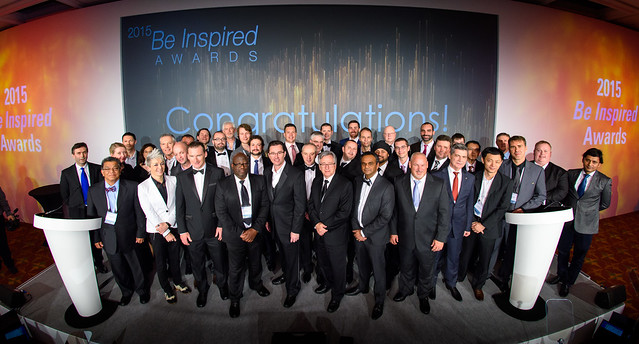
    2015 Be Inspired Award Winners

    2015 Be Inspired Special Recognition Awards

    Advancing Collaborative BIM

    Morphosis Architects – Bill & Melinda Gates Hall – (Ithaca, New York, United States)

    Advancing Comprehensive BIM “Playbooks”

    Hatch Ltd – Keeyask Hydroelectric Generating Station Project – (Nelson River, Manitoba, Canada)

    Advancing Construction Modeling

    Jacobs – NAG Project – (Baytown, Texas, United States)

    Advancing Information Mobility in Operations

    Western Power Distribution – EMU for iPad – (Exeter, United Kingdom)

    Advancing Integrated Projects

    HDR – Union Station to Oak Cliff Streetcar TIGER Design-Build Project – (Dallas, Texas, United States)

    2015 Be Inspired Awards

    Innovation in Asset Performance Management

    SA Water – Predictive and Operational Analytics Tools, Adelaide Metro Water Distribution Network – (Adelaide, South Australia, Australia)

    Innovation in Bridges

    LCW Consult – The Ceira River Bridge – (Coimbra, Coimbra District, Portugal)

    Innovation in Building

    Robin Partington and Partners – One Merchant Square – (London, United Kingdom)

    Innovation in Construction

    Vic’s Crane & Heavy Haul, Inc. – Unit 25 Project – (Rosemount, Minnesota, United States)

    Innovation in Government

    Singapore Land Authority – Mapping Singapore in 3D – (Singapore)

    Innovation in Land Development

    Tata Consulting Engineers Ltd. – Detailed Design of Utility Infrastructure – (Dharampur, Gujarat, India)

    Innovation in Megaprojects

    AECOM – E4 Stockholm Bypass FSK02 Rock Tunnels Design Contract – (Stockholm, Sweden)

    Innovation in Mining

    Tetra Tech Proteus – Kvanefjeld Rare Earth: Uranium Project – (Narsaq, Kujalleq, Greenland)

    Innovation in Offshore

    Keystone Engineering Inc. – Block Island Wind Farm – (Block Island, Rhode Island, United States)

    Innovation in Power Generation

    MWH Global – Tyseley Resource Recovery Centre – (Birmingham, West Midland, United Kingdom)

    Innovation in Process Manufacturing

    Giprotyumenneftegaz – Preliminary Water Removal Unit: North Vankor Field – (Igarka, Krasnoyarsk Territory, Russia)

    Innovation in Project Delivery

    AECOM – Global Project Collaboration in a Design-build-finance-operate (DBFO) World – (Global)

    Innovation in Rail and Transit

    London Underground Ltd – Bond Street to Baker Street Tunnel Remediation Project – (London, United Kingdom)

    Innovation in Roads

    Grontmij – A6 to Manchester Relief Road – (Stockport, Manchester and Cheshire, United Kingdom)

    Innovation in Structures

    Stanley D. Lindsey and Associates, Ltd. – SkyHouse Apartments – (Denver, Colorado; Atlanta, Georgia; Orlando and Tampa, Florida; Charlotte and Raleigh, North Carolina; Nashville, Tennessee; Austin, Houston, and Dallas, Texas, United States)

    Innovation in Utilities and Communications

    Pacific Gas and Electric Company – Engineering Contractor Collaboration Solution Using ProjectWise and Bentley Substation – (San Ramon, California, United States)

    Innovation in Water Network Analysis

    Prolagos/Aegea – Water Master Plan for the Região dos Lagos – (Região dos Lagos, Rio de Janeiro, Brazil)

    Innovation in Water Treatment Plants

    Aqua+ – Complex Scheduling and Automatic Water Quality Monitoring of Groundwater – (Khabarovsk, Far East Federal District, Russia)

    Bentley Systems has posted highlights of this year’s winning projects on its website. It will include more detailed descriptions of all nominated projects in the print and digital versions of its 2015 Infrastructure Yearbook, which will be published after the first of the year. To review the past 11 editions of this publication, which together feature more than 2,500 world-class projects recognized in the Be Inspired Awards program since 2004, access Bentley’s Infrastructure Yearbooks.

  • Bentley Systems offers new sewer and stormwater products


    StormCAD from within OpenRoads.
    StormCAD from within OpenRoads.

    Bentley Systems’ latest infrastructure products are now available. They include SewerGEMS, SewerCAD, StormCAD and CivilStorm V8i (SELECTseries 5) products for the analysis and design of wastewater and stormwater systems. All of the V8i (SELECTseries 5) sewer and stormwater products can be used as stand-alone products, or be run on CAD and GIS platforms.

    They can also now be used from within the V8i (SELECTseries 4) versions of OpenRoads-based products — combining 3D design and hydraulic analysis capabilities in the same platform. The resulting comprehensive civil solution eliminates the need for extra import/export steps or file conversions, Bentley Systems said.

    “The integration of Bentley’s OpenRoads civil design functionality with the advanced capabilities of Bentley’s storm and sewer analysis products will be a huge benefit to productivity and quality for our highway drainage design workflows,” said Chris Haines, senior civil engineer and PAR-BIM technical lead, Drainage and Utilities, Parsons.

    Terrain model elevations on profiles.
    Terrain model elevations on profiles.

    “With these new releases, the automated hydraulic design functionality of our sewer and storm products can be effortlessly combined with the 3D physical design and terrain modeling capabilities of Bentley’s other civil products,” said Gregg Herrin, Bentley Systems director of product management, hydraulics and hydrology. “From an information mobility standpoint, this has a direct and substantial positive impact on roadway, site and municipal work where hydraulic engineering is just one part of a much larger project.”

    Bentley’s SewerGEMS, SewerCAD, StormCAD and CivilStorm V8i (SELECTseries 5) products provide the following capabilities:

    • Ground elevations from terrain models may be used during automated design runs to consider “cover” along a pipe’s length, improving decision making related to system design.
    • Terrain model elevations can also now be added to profiles, improving the resulting visualization and the user’s understanding of the physical network.
    • New low-impact development (LID) elements are now available, making it easier to model a wider range of controls for stormwater management.
    • With the new lateral link element, engineers can include lateral pipes in their hydraulic analysis without creating “fake” elements where the laterals connect to the main pipe.
    • Easy access to the Bentley Communities professional networking site is embedded within the applications, facilitating communications between users and Bentley’s hydraulic modeling experts.

    Users of any of these SELECTseries 5 releases now benefit from the products’ support of MicroStation V8i (SELECTseries 3), OpenRoads V8i (SELECTseries 4), AutoCAD 2015 and 2016, and ArcGIS 10.2 and 10.3 (SewerGEMS only), giving them the ability to model from within the latest MicroStation, OpenRoads, AutoCAD or ArcGIS version.

  • Open Geospatial Consortium Seeks Participants for Elevation-Data Experiment

    The Open Geospatial Consortium (OGC) announces a Call for Participation in the OGC GeoPackage Elevation Extension Interoperability Experiment (GPKG-EE IE).

    The OGC GeoPackage Standards Working Group (SWG) has identified a need to store tiled gridded elevation data in a GeoPackage. GeoPackage is an open, standards-based, platform-independent, portable, self-describing, compact format for transferring geospatial information. The SWG has developed a candidate extension to the GeoPackage Encoding Standard to support elevation data.

    This capability will be used to support use cases such as the following:

    • Visualization
      • 2D (hillshade, color relief, slope)
      • 3D (supporting changing view angles and level of detail)
    • Analysis
      • Viewshed and line-of-sight
      • Cross-country mobility (off-road routing)
      • Site suitability and planning (slope analysis such as helicopter landing zones)
      • 3D geometry representations of features (ground-based, airspace)
      • Terrain association (associating images to mapped locations)
      • Augmented reality based training

    The SWG proposes validating the extension by running an Open Geospatial Consortium Interoperability Experiment. An OGC Interoperability Experiment is a rapid, low overhead, formally structured OGC-facilitated activity in which members achieve specific technical objectives that further the OGC Standards Baseline. The GPKG-EE IE will test and refine the elevation extension. To do this, the SWG needs the international support and acceptance of a globally representative community that provides both domain and technical expertise to this project. While the OGC is a member-driven organization and the SWG needs a core of OGC members to support and initiate this work, non-members can participate as “observers.”

    The GPKG-EE IE will perform the following experiments:

    • Experiment #1: produce GeoPackages containing tiled gridded elevation data in accordance with the proposed extension.
    • Experiment #2: use the GeoPackages to perform visualization and/or analysis operations as described above.

    The results of the Interoperability Experiment will be documented in an OGC Engineering Report. In addition to the Engineering Report, a demonstration is tentatively scheduled for the OGC Technical Committee meeting in Washington, D.C., in March 2016.

    The OGC asks interested organizations to indicate their support and commitment to be involved in this Interoperability Experiment. A summary of the activity plan, requirements for participation, schedule, and kick-off meeting details are available. Contact details are included in the activity plan.

    Participants in the GPKG-EE IE, which will run until March 31, 2016, will test implementations and provide constructive comments on the exchange data model and resulting trial documentation. Experience has shown that those working in these initiatives gain valuable insights that can be used to improve existing information systems or fast-track the development of new systems. Participants gain sufficient expertise to start deploying working services for their existing data and local situations.

    The following OGC members proposed the GeoPackage Elevation Extension Interoperability Experiment:

    • Luciad, Belgium
    • Image Matters LLC
    • Compusult, Canada
    • U.S. Army Geospatial Center

    The OGC is an international geospatial standards consortium of more than 515 companies, government agencies, research organizations and universities participating in a consensus process to develop publicly available standards. OGC standards support interoperable solutions that “geo-enable” the Web, wireless and location-based services and mainstream IT.

  • National Map Corps Updates Volunteer Badges

    VGI,-new-badges-W

    The National Map Corps has updated the recognition badges that it awards for participation in its crowdsourcing mapping project. Volunteer “citizen scientists” who collect manmade structure data such as police stations, schools, hospitals and cemeteries, to provide more precise spatial data for the USGS web-based mapping products can earn points and virtual badges.

    Due to continuous project growth and popularity, TNMCorps has added more badge levels and revised the current awards. More than 160,000 points have been edited or verified to date.

    The project started in 2012, and since that time, the increasing number of volunteers have verified, edited, deleted and created more than 160,000 structures points. In appreciation for the efforts of these “free” mappers, those who reach certain milestones are celebrated in the form of virtual badges.

    The newly designed badges showcase the same classic surveying tools and aerial data collection methods, but have been colorfully updated and highlight a variety of amazing landscapes across the United States.

    A second set of badges based on aerial data collection was introduced a year ago as some extra-energetic volunteers quickly surpassed the first set of badge levels. Currently, 11 possible badges can be earned beginning with the Order of the Surveyor’s Chain (25 points) and ending with the Squadron of Biplane Spectators (6000 + points).

    As volunteer map editors attain each level, a congratulatory email is sent to the awardee with a description of the badge and encouragement to achieve the next level. With permission, volunteer accomplishments are highlighted on TNMCorps Recognition page, and The National Map Twitter (#TNMCorps).

    NatlMapCorps-W


  • Leica Geosystems, NCTech Streamline Workflows, Improve Productivity

    Leica-Cyclone-panorama-O

    Leica Geosystems has teamed with NCTech, developer of reality imaging systems, to deliver automated, colorized 3D point clouds. In Leica Cyclone, 3D point cloud processing software, users can now automatically import and align high-dynamic range (HDR) data from NCTech’s iSTAR camera database, producing enhanced deliverables quicker and easier, Leica Geosystems said.

    “It is not only about attractive images but also the accuracy to which these images fit the 3D point cloud data that is paramount, and NCTech’s iSTAR camera produces high-quality HDR imaging at the accuracy everyone expects,” said Faheem Khan, vice president, business development for Leica Geosystems High-Definition Surveying (HDS). “Including this capability directly into Leica Cyclone provides fully optimized workflows for maximum productivity. This starts from data collection through to deliverable production that leverage new products, such as Leica TruView Global and JetStream to tackle the increasingly complex challenge of multi-platform, multi-device and multi-discipline project delivery.”

    Previously, Leica Cyclone users accessed iSTAR imagery database through NCTech’s ColourCloud software application, which produced colourised point clouds in E57 format. With the new partnership, export and re-import of this highly-accurate data is eliminated, speeding up and simplifying the overall 3D point cloud creation process.

    “We are excited to collaborate with Leica Geosystems on this development, which provides direct access for Leica Cyclone users across the world to colourise their point clouds using iSTAR’s panoramic HDR imaging,” said Cameron Ure, CEO of NCTech. “With our iSTAR products, we are focussed on capturing the most accurate colour data as rapidly as possible, and everyone benefits when that data is seamlessly integrated into our partners’ applications.”

    Photo: Leica Geosystems

  • Blue Marble Offers Lidar Module Upgrade

    Blue Marble’s Global Mapper V17‘s Lidar Module is an optional enhancement to its software that provides advanced lidar processing tools, including automatic point-cloud classification, feature extraction, cross-sectional viewing and editing, faster surface generation, and more. It is designed for anyone using or managing terrestrial or airborne lidar as well as other point cloud datasets.

    The Lidar Module was first released with Global Mapper V15, and a host of new lidar tools have since been added. Building on the existing functionality for identifying ground, building and vegetation points in an unclassified point cloud, the latest release of the module includes a powerful new tool for detecting and automatically reclassifying above-ground utility lines.

    After customizing the reclassification parameters, such as minimum height above ground and linear offset threshold, the points representing power lines are automatically attributed with the Wire – Conductor ASPRS lidar class. Analysis of linear patterns in these reclassified points can subsequently be used to create 3D vector lines.

    Addressing a major concern among lidar users, the latest release of the Global Mapper Lidar Module provides an efficient and effective way to remove noise from point cloud data. This powerful filtering tool can reclassify or automatically delete any points that are beyond a prescribed elevation or height above ground threshold within a local area.

    Other enhancements to the module include dramatically faster data rendering and processing as well as updated filtering tools for selecting and, if necessary, removing points based on class, return intensity, color range, and many other parameters.

    Additional functionality offered in the Lidar Module includes:

    • A convenient Lidar Toolbar for easy access to key editing and analysis functions
    • Multiple gridding options for faster DSM or DTM generation
    • Access to point cloud files containing a billion points or more
    • Automatic point classification tools that automatically distinguish building, ground, vegetation and power lines and above-ground utility cables in unclassified layers
    • Feature extraction functionality to automatically create 3D building footprints, trees and power lines
    • Cross-sectional rendering using Global Mapper’s Path Profile tool for viewing and editing the point cloud in a vertical perspective
    • Advanced filtering options to efficiently remove erroneous or unneeded points
    • Detect and reclassify or delete noise points
    • Lidar scripting commands for streamlining workflow
    • Point colorization from underlying imagery offering photo-realistic point cloud rendering in Global Mapper’s 3D Viewer
    • Support for reporting lidar statistics
    • Support for importing and exporting most common lidar formats
    • Support for NIR (near-infrared) data


  • Trimble to Provide Geospatial Software, Training for UNIGIS Distance Learning Programs

    Trimble will provide access to Trimble geospatial software products and online training for UNIGIS post-graduate distance learning students. Students can also take part in Trimble’s User Community to access training materials and participate in forums and discussions.

    The UNIGIS International Association is a distance education initiative offering masters and postgraduate diploma and certificate programs in geographical information science and systems.

    “We are pleased to provide geospatial software and online training programs to students in UNIGIS programs,” said Alain Samaha, business area director of GIS and Software for Trimble’s Geospatial Division. “Working with UNIGIS, we can further support the industry by providing technology tools that enable students to be prepared for their careers.”

    Trimble will provide UNIGIS distance learning students worldwide with access to eCognition, Inpho, UASMaster, GPS Pathfinder Office, SketchUp Pro and other software technologies for their study assignments and thesis development.

    “UNIGIS is addressing the geospatial industry’s critical bottleneck of capacity building. This needs the sustained support of leading-edge companies like Trimble. Working together we can enhance the educational experience for students to promote future innovation and advancement of the geospatial industry,” said Prof. Josef Strobl at University of Salzburg and chair of UNIGIS International.

  • 2015 Field Technology Conference Registration Opens

    The Western Forestry and Conservation Association (WFCA) has announced that registration for the Fifth Annual Field Technology Conference (FTC) is open. FTC 2015 is hosted by WFCA, Pacific Northwest Aquatic Monitoring Partnership (PNAMP) and StreamNet. The conference will be held Nov. 18-19 at the Holiday Inn Convention Center in Portland, Ore.

    The Field Technology Conference offers attendees an insightful look at trends in field data collection hardware (smartphones, handheld/tablet computers, GPS receivers, laser rangefinders, and other data collection instruments), remote sensing (UAVs, photogrammetry, lidar) and mapping software (data collection, data processing, map building) along with outdoor demonstrations and a field trip.

    “This will be our fifth conference. With the addition of the fisheries track and participation from the Civil GPS Interface Committee, we should have a significant attendance increase this year,” said moderator/co-organizer Eric Gakstatter. “We continue to attract speakers with strong expertise in their disciplines to present their work and thought leadership.”

    The conference offers three tracks:

    • Common field technology: Discussing field data collection technology used across all disciplines such as UAVs, GPS, and mobile devices.
    • Forestry: Forestry-specific technology presentations.
    • Fisheries: Fisheries-specific technology presentations.

    In addition to the three technical tracks, there will be outdoor technology demonstrations as well as a fisheries field trip to a local slough for a live demonstration of field data collection technology (space limited).

    On the second day of the two-day conference, there will be presentations from the Civil GPS Interface Service Committee (CGSIC). CGSIC is the only forum in which civilians have the opportunity to interact directly with US GPS authorities.

    FTC 2014 attendees included representatives from Federal/State/Local government, Fortune 1000 companies, Native American tribes, higher education and natural resource consultancies.

    The registration fee is $250 if registered by Nov. 5 and $295 if registered after that date. The government rate is $195 and $245 if registered after that date. Attendance to the CGSIC presentations on November 19 is free of charge and open to the public (lunch not included).

    The registration fee includes lunch on both days as well as refreshments during breaks. The conference room rate is $99/night plus tax. After Oct. 27, the reduced rate will be subject to availability.

    To register or learn more about the conference agenda, go to the conference website.

    Sponsorship opportunities are available. Please contact Richard Zabel [email protected], 503/226-4562.

  • Leica Offers Point-Cloud Workflow Tips in Webinars

    In two new webinars, Leica Geosystems expert Bill Wallace presents time-saving tips for point-cloud workflows.

    How to Cut 3D Scanning Project Time Nearly in Half

    Leica-3DscanningWorking with large scanning projects with billions of data points can be a tedious and time-consuming process, often resulting in breaking the project into manageable pieces and duplicating data sets across your organization. However, a new solution by Leica enables users to instantly load point clouds regardless of size and create CAD deliverables with increased productivity.

    In this 60-minute webinar, Wallace shows how Leica JetStream, when paired with CloudWorx, can cut project time by up to 40 percent while allowing multiple users to stream the full data set simultaneously for added efficiency.

    Covered topics include:

    • How to greatly improve data processing speed
    • How to reduce storage requirements with enhanced data management
    • How to accelerate the loading, display, and rendering of point cloud images for an application.

    Learn more here.

    How to Broaden the Reach and Impact of Your Point Clouds

    Leica-pointcloudThe free Leica TruView panoramic point-cloud viewer enables users to view, zoom in or pan over point clouds naturally and intuitively. In this 60-minute webinar, Wallace and David Langley provide a exclusive behind-the-scenes look at this point-cloud sharing tool.

    Covered topics include:

    • How to communicate more effectively through point clouds by sharing them from any browser on any device, with no plug-ins required.
    • How to use new project management tools to make a team’s performance — and clients’ interaction with the data — more efficient.
    • How to take deliverables to the next level by incorporating strategies from some of today’s most successful innovative thinkers.

    Learn more here.