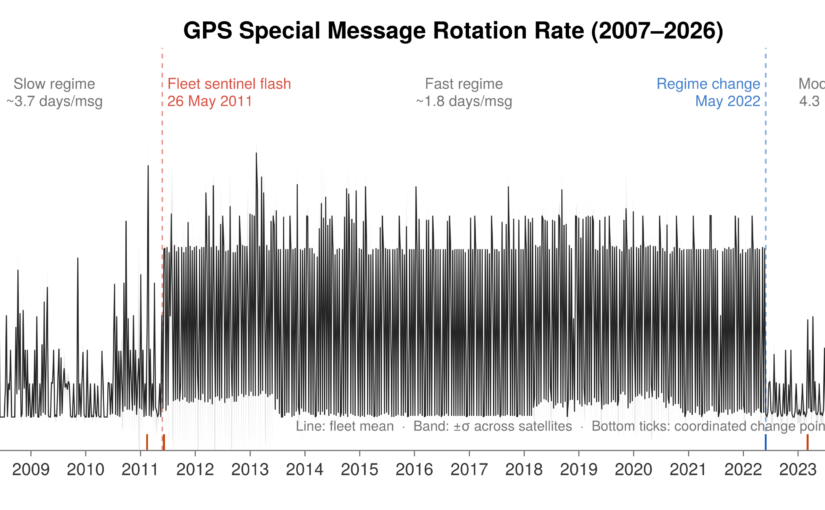
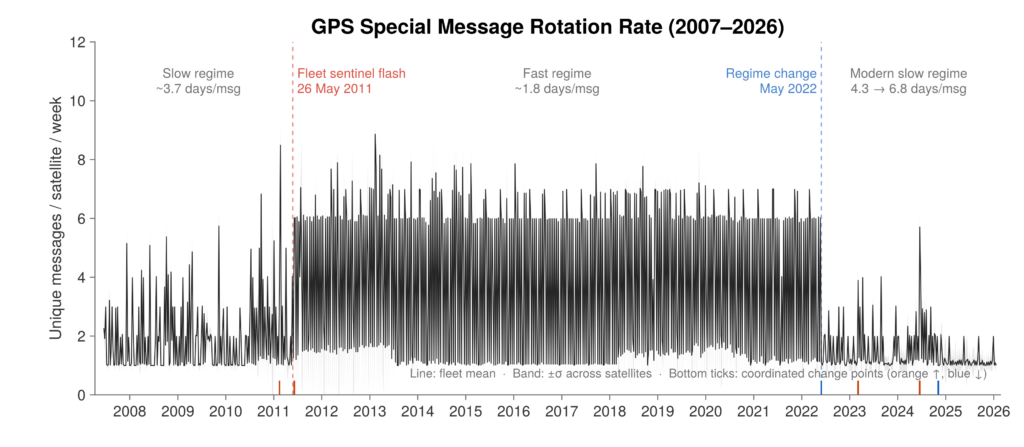
The Information Security researchers at University College London (UCL) analyzed an archive of 12.16 million GPS observations collected between 2007 and early 2026 to understand what the broadcasts actually contain.
To make processing this massive dataset practical, the researchers built a Julia pipeline to extract the bits directly into a DuckDB database. This setup allowed them to run queries across 19 years of global ground-station data in milliseconds.
Read the full analysis in the researchers’ blog here.
Septentrio’s latest GNSS boards and modules now support PX4 Autopilot for faster integration of high-accuracy positioning into UAVs and robots.
Both the AsteRx-m3 and mosaic receivers support PX4 Autopilot, opening the door to reliable and resilient real-time kinematic positioning.
PX4 Autopilot is one of the largest commercially adopted open-source navigation control stacks, enabling an innovative community to build and maintain drone hardware and software in a scalable way. Drones and robots, which operate autonomously or where a high level of safety is required, now benefit from Septentrio’s accurate positioning receivers, known to be secure against GPS jamming and spoofing with built-in AIM+ Advanced Interference Mitigation technology.
“Our developer community is looking forward to integrating Septentrio’s secure GNSS positioning technology into UAVs and robots, especially in those applications where reliability matters from mapping to surveillance and delivery,” said Ramon Roche, general manager, Dronecode Foundation. “Septentrio’s presence and talk at the PX4 Developer Summit will be an opportunity for developers and integrators to connect with Septentrio and to learn about the latest high-accuracy positioning tech for the PX4 ecosystem.”
“Septentrio has had a fantastic collaboration momentum with Dronecode and the larger PX4 community during the integration of Septentrio receivers into the PX4 Autopilot ecosystem,” said Gustavo Lopez, market access manager at Septentrio. “This collaboration is important because it brings resilient and secure GPS technology to the UAV industry, with tremendous potential in terms of assured positioning and improved safety.”
PX4 is supported by Septentrio’s GNSS boards and modules with both single-antenna and dual-antenna configurations, which offer either heading and pitch or heading and roll angles on top of accurate GNSS positioning.
The Septentrio PX4 driver is freely available on the GitHub.
The open-source collaboration features Orolia Atomic Reference Time Cards powered by its Spectratime micro-atomic clock
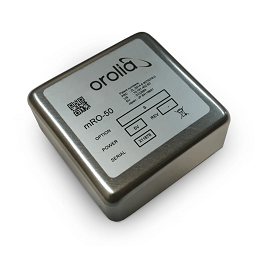
Orolia is providing Atomic Reference Time (ART) Cards to support Meta’s implementation of high-precision timing protocols within its distributed timing infrastructure. The architecture of Orolia ART Cards is powered by the company’s Spectratime mRO-50 mini rubidium atomic-clock technology.
The Spectratime mRO-50. (Photo: Orolia)
“We are honored to have this opportunity to collaborate with Meta’s incredibly talented team of engineers to develop a unique open-source solution using our mRO-50 technology,” said Jean-Yves Courtois, Orolia CEO. “We look forward to a continuing partnership with Meta and other global network leaders working to advance solutions to ensure ongoing timing accuracy and resilience.”
Orolia developed the ART Card solution in collaboration with the Meta engineering team to fulfill a new specification that Meta published for the Time Appliances Project Initiative of the Open Compute Project. This new collaborative community is focused on designing from scratch new hardware and software to efficiently support the critical timing accuracy and resilience demands on computer network infrastructure. This project is fully open-sourced and available on Orolia’s GitHub.
In 2020, Meta began converting its data-center servers to a new time-distribution service based on network time protocol (NTP) and precision time protocol (PTP). The new service, built in-house and later open-sourced, was more scalable and improved the accuracy of timekeeping within the Meta infrastructure from 10 milliseconds to 100 microseconds. Orolia ART Cards will further increase the accuracy, resiliency and adoption of Meta’s new timing platform.
Developed with long-term support in mind, Orolia’s ART Cards deliver management, disciplining and monitoring functions that can be integrated into any computer with a PCIe port and bring accurate and resilient timing for the most demanding applications such as NTP/PTP time reference, time stamping and latency calculation.