Tag: GNSS constellations

  • Simulator suppliers discuss latest technology and trends

    Simulator suppliers discuss latest technology and trends

    The number of GNSS constellations, satellites and signals is constantly growing. The threats to GNSS — from unintentional radio frequency interference (RFI), jamming, spoofing, multipath… and Federal Communications Commission rulings — are increasing, as are the public’s expectations of GNSS accuracy.

    All these factors contribute to the need for ever more powerful and advanced simulators that can realistically simulate a wide range of optimal and suboptimal environments. That is why simulators are a rapidly growing sector of the GNSS industry.

    At present, the main defense against jamming are continuous radiation pattern antennas (CRPA). Therefore, it is essential that simulators be able to accurately reproduce signals from CRPAs. They are even more useful when they can generate M-code (MNSA) signals, which not all simulators do.

    Additionally, the development of autonomous vehicles requires engineers to simulate driving millions of miles, under a variety of environmental and traffic circumstances. To accomplish this in a reasonable amount of time requires them to run simulations faster than in real time, or run many simulations in parallel.
    Finally, there is an increasing need to simulate alternative positioning, navigation and timing (PNT) signals being developed as supplements to and substitutes for GNSS signals in circumstances that make the latter unavailable or unreliable.

    These are some of the challenges facing manufacturers of GNSS simulators. What follows are their brief descriptions of the approaches they are taking and the innovations they are introducing.

    CAST Navigation Orolia Racelogic
    Rohde & Schwarz Spirent Federal Systems Syntony GNSS

    CAST Navigation

    Headshot: John Clark
    John Clark
    VP of Engineering

    What is your most recent innovation?
    Our latest simulator innovations contain wave-front generation signal technology, which allows you to generate GNSS and interference signals that represent the received signals for each antenna element in a phased array antenna manifold, usually referred to as a controlled radiation pattern antenna (CRPA). Our modular design approach enables users to simulate IMU data commensurate with the wave-front signals for a complete coherent GNSS/IMU simulation that is ideal for stimulating receivers that contain CRPA and IMU capabilities. Our simulators also contain proprietary synchronization technology that allows users to synchronize multiple systems to produce a “wave-front” of GNSS and IMU signals for multiple vehicles, or even an entire fleet.
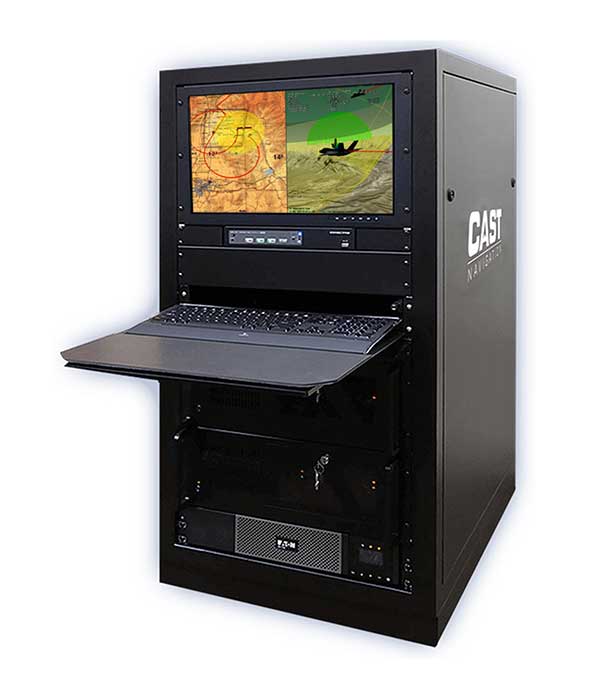
    Photo: CAST Navigation
    Photo: CAST Navigation

    What is your approach to jamming and spoofing?
    CAST Navigations’ family of GNSS simulators are capable of realistically simulating a wide range of suboptimal conditions—such as jamming/spoofing, multipath, RF interference and satellite constellation perturbations—for virtually any commercial or military environment. Our interference signals or “jammers” can be located at any terrestrial location and can be static or dynamic in nature. A distinguishing feature of CAST Navigations’ simulation systems is that our interference signals are phase-controlled and coherent, allowing for proper phase transmission of each signal type for each receiving antenna element. You can also add an INS capability to any of our systems. These types of systems are perfect for testing GNSS and GNSS/INS types of navigation equipment.

    What’s coming by 2023?
    One of the key trends is the ability to generate M-code (MNSA) signals. Jamming and spoofing are becoming more prevalent, not just to the military but also to consumers. Every day, the military, as well as people like you and me, are starting to encounter more instances of interference that can deny GNSS equipment and even phones the ability to track some GNSS satellites or that transmit incorrect GNSS data, causing receivers to display incorrect position solutions. So, our focus is on products and capabilities that enable our customers to simulate those types of environments and help them to mitigate those kinds of events.


    Orolia
    Headshot: Lisa Perdue
    Lisa Perdue
    Product Manager

    What is your most recent innovation?
    At Orolia we continue to evolve our innovative software-defined simulator approach. Our most recent innovation is our advanced spoofing option. We have taken our ability to define multiple jamming transmitters, each with their own trajectory and antenna pattern, and added the ability for the transmitters to send spoofing signals as well. By utilizing our capability to run multiple simulations on a single system, we give the user the ability to control every parameter of the generated spoofing constellation(s). The system automatically calculates the signal time of flight and the propagation loss, making this advanced capability powerful and easy to use.

    What is your approach to jamming and spoofing?
    Simulation of threat environments is a critical component of GNSS receiver testing. As awareness of the impact that jamming and spoofing can have on a GNSS-based system rises, so does the need to test. That is why we have implemented advanced jamming and spoofing options into our Skydel simulator’s core engine. Replication of degraded environments with threats ranging from one to hundreds is possible using the same hardware and software used for generating GNSS signals. No third-party hardware or software is required for complete testing against jamming and spoofing because we feel that this capability should be part of the core system, not an afterthought.
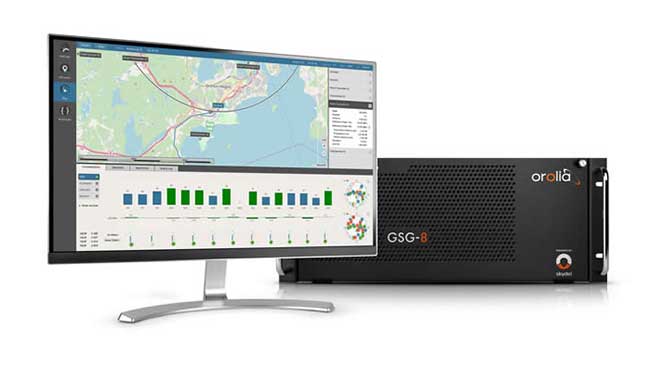
    Photo: Orolia
    Photo: Orolia

    What’s coming by 2023?
    In the coming years, we expect to see more requirements for simulation of alternative positioning, navigation, and timing (PNT) signals. As governments and organizations continue to investigate alternate technologies, it will become necessary to simulate low Earth orbit (LEO) PNT, ground-based transmitters, and other signals being considered.

    Another growing trend is the adoption of controlled reception pattern antennas (CRPAs) for their anti-jam capabilities. These anti-jam antenna systems can only be tested by specialized simulation systems, so we can imagine these simulation systems being commercialized for a broader market around 2023.


    Racelogic

    Headshot: Julian Thomas
    Julian Thomas
    Managing Director

    What is your most recent innovation?
    Recognizing the need of our customers to test their products with a simple solution that uses the latest GNSS signals, we have updated our SatGen software to create accurate simulations using all satellite data currently being transmitted across the various constellations. We have also optimized the performance of SatGen so that a standard desktop PC can be used to simulate these signals in real time. Also, the simulation can now be driven using an external NMEA stream, allowing full remote control of the trajectory.

    What is your approach to jamming and spoofing?
    The LabSat 3 Wideband records and replays all available GNSS signals in high fidelity, allowing jamming and spoofing signals to be reproduced accurately on the test bench.
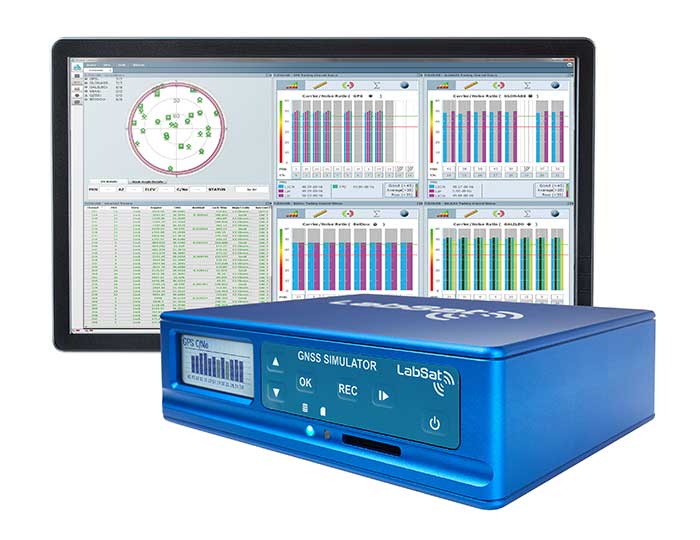
    Photo: Racelogic
    Photo: Racelogic

    What’s coming by 2023?
    With so many employees now working from home due to COVID-19, the pressing concern for many companies developing GNSS technology is how to provide employees with suitable equipment that is required for them to carry out their jobs efficiently away from the office. Usually these employees would utilize the shared resources of a well-equipped office, with experts on hand to help, but working from home has made access to these devices challenging. Due to LabSat 3’s small size, low cost and ease of use, we have seen a significant increase in sales to companies furnishing their employees with a suitable method of testing their GNSS devices while working from home.

    With the advent of a new breed of high-performance, low-cost GNSS receiver, many new applications are being developed in new and exciting sectors, utilizing a level of accuracy previously considered too expensive to be a commercial proposition. The number of GNSS engines will therefore increase rapidly in the marketplace, with a corresponding increase in demand for cost-effective signal simulation for test and development.


    Rohde & Schwarz
    Headshot: Markus Irsigler
    Markus Irsigler
    Product Manager Signal Generators, Power Meters

    What is your most recent innovation?
    We further improved multi-frequency, multi-constellation simulation capabilities in our high-end segment. The GNSS high-end simulator R&S SMW200A provides signals for all GNSS frequency bands on a single RF output. A second internal RF path can be used for advanced interferer simulation, testing the receiver’s resilience to spoofing or to address dual-antenna scenarios. This keeps setups simple and compact. When more than two RF paths are required, two or more R&S SMW200A can be operated together in a master/slave configuration. Such setups are required for multi-antenna receiver test applications where the signals’ relative carrier phases are analyzed, like CRPA or attitude determination tests. Our new RF ports alignment software automates alignment of the GNSS signals and guarantees correct amplitude, time and phase relations at the RF inputs of the device under test. We also increased the maximum channel count to more than 600 channels to improve testing of multi-constellation, multi-frequency receivers against multipath, jamming and spoofing.

    What is your approach to jamming and spoofing?
    Besides our recent innovations, Rohde & Schwarz plans to provide new interference simulation capabilities within the GNSS simulator. This new feature will allow the user to replay recorded jammer signals as well as user-defined waveforms. The R&S Pulse Sequencer software helps with the definition of most complex interferer scenarios.
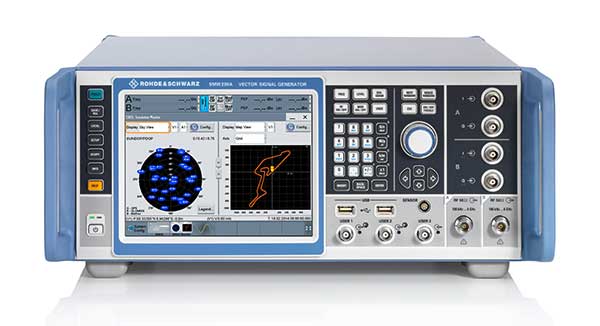
    Photo: Rohde & Schwarz
    Photo: Rohde & Schwarz

    What’s coming by 2023?
    Developments in the field of advanced driver-assistance systems (ADAS) aiming for fully autonomous vehicles raise new challenges for reliable PNT solutions. Simulation of interference and jamming scenarios will hence become important in the automotive market. Antenna arrays have proven suitable to counteract RF interference (RFI) by incorporating spatial-processing techniques and might therefore find greater entry into the automotive market. Test solutions must address requirements for simulating all kinds of intentional and unintentional RFI for multi-constellation, multi-frequency and multi-antenna receivers. Apart from simulating GNSS and interference sources, test solutions for autonomous driving will require several other techniques and signals to be applied or simulated, such as RTK/PPP or outputs from other vehicle sensors to perform sensor fusion.


    Spirent Federal Systems
    Headshot: Jeff Martin
    Jeff Martin
    Vice President, Sales

    What is your most recent innovation?
    Launched in 2018, SimMNSA became the first MNSA simulator to achieve GPS Directorate security approval. The software enables users to simulate true MNSA M-code with real-time code and message generation, removing the constraints imposed by simulator data sets (SDS). SimMNSA v2.0 does even more. It is able to broadcast nominal M-code conditions and recreate SDS-defined events. It incorporates an advanced editor to edit military navigation (MNAV) content, allows users to craft and define scenarios, and much more.

    What is your approach to jamming and spoofing?
    Spirent offers numerous capabilities for emulating GNSS signals in the presence of interference and spoofing attacks. Our solutions provide accurate, repeatable and quantifiable signals, enabling customers to conduct accurate tests with trusted results. We can test against internally generated interference enabling multiple “fields” of jammers with various interference types; hundreds of interference signals using external IQ blended with simulator-generated GNSS, and Blue Force Electronic Attack jamming waveforms for testing MGUE devices operating in GPS-denied environments. Spoofing capabilities include signal, navigation data and cyber-level attacks via manipulation of up to 12 copies of each primary GNSS constellation, each fully editable; intuitive spoof attack generation via Spirent’s SimSAFE software option — which also allows live sky synchronization/spoofing, and more.
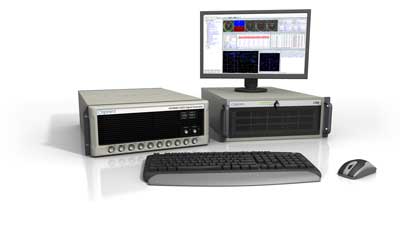
    Photo: Spirent
    Photo: Spirent

    What’s coming by 2023?
    Threats to reliable and accurate GNSS navigation and timing are developing rapidly. Fortunately, innovative solutions for resilient PNT are in development and will continue to challenge the industry for years to come. The ability to simulate these threats and the mitigation techniques to overcome them is changing the landscape for the simulator industry. It’s more important than ever to have up-to-date test tools. Robust signals along with frequency and constellation diversity will continue to drive the market in addition to GNSS backup systems, or AltNav. The FCC has certainly presented the GNSS industry with an immense challenge.


    Syntony GNSS

    Headshot: Sylvain Daubas
    Sylvain Daubas
    Simulator Activity Manager

    What is your most recent innovation?
    Yesterday, GPS systems had to “work.” Today, they must work fine. This is the difference, and all equipment vendors have realized this. It is no longer acceptable to have 200 meters or more of error in an urban environment. Because of the extreme complexity of the electromagnetic situation in the GNSS spectrum, making a reliable and precise location system requires more and more powerful and advanced simulators. This is why the GNSS simulator market is booming.

    Among the many new features implemented in Syntony’s GNSS simulator this year, two stand out.

    First, 1000-Hz hardware-in-the-loop now allows an accurate simulation for high-dynamic receivers (up to more than 100 Gs!), with zero artifact and zero-effective latency. This is the ultimate in trajectory management.
    Second, signal computing capacity has made a significant leap forward due to hardware and software optimizations. Constellator can now simultaneously generate up to 660 L1 C/A-equivalent signals. And this level of performance can be unlocked remotely, without a hardware update.
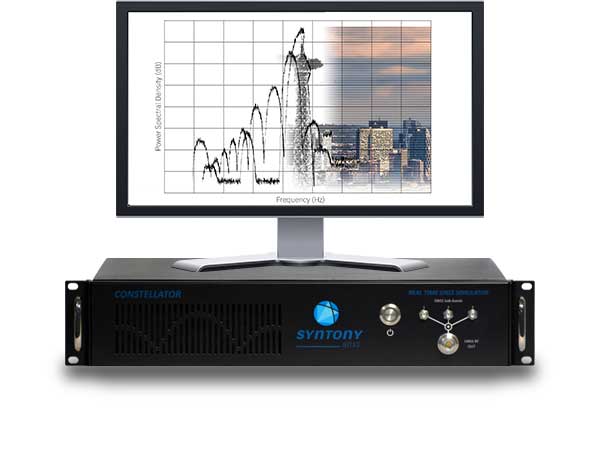
    Photo: Syntony GNSS
    Photo: Syntony GNSS

    What is your approach to jamming and spoofing?
    Simulating a GNSS environment with a set of jamming or spoofing signal sources today is the standard. But what about a simulation of an extremely complex urban scene with 50 or 100 jamming/spoofing sources? The only reasonable solution to implement this would be a massive parallel software-defined radio (SDR)-based simulator solution. This is what Syntony can and will do, thanks to its full software GNSS simulator architecture, which can be distributed on a server farm.

    What’s coming by 2023?
    A revolution is arriving: the possibility of generating a full GNSS simulation including many hundreds of satellites and signals, in real time and in pure software. This is now possible, and Syntony has demonstrated it with the Constellator. This will change the simulation world. First of all, Moore’s law will bring significant improvements to this domain year after year. More importantly, new systems and services will be possible: massive parallel scenario simulation including jamming and spoofing, floating simulator licenses, software as a service, etc. In this trend, playback machines will be needed, and obviously a strong internet connection will be necessary to download hundreds of gigabytes of I/Q files overnight.


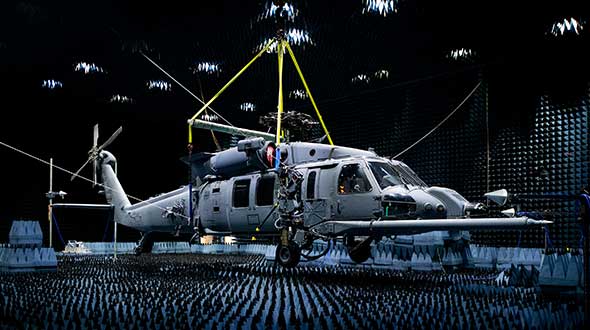
    Feature image: Samuel King Jr./United States Air Force
  • Survey accuracy: The future of precision with 5 GNSS constellations

    Survey accuracy: The future of precision with 5 GNSS constellations

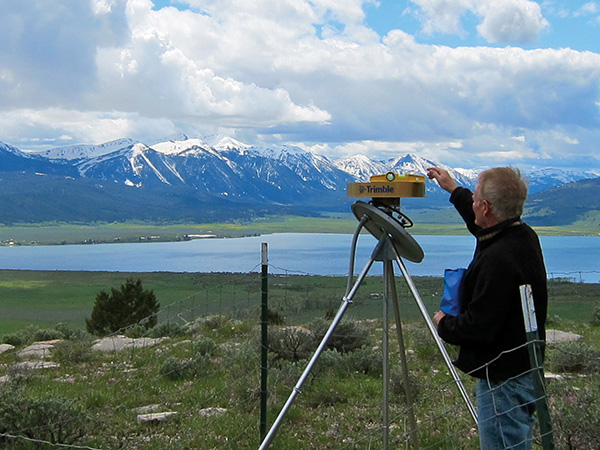
    Mountainous areas present special problems for surveyors, overcome by the expanded availability of multi-GNSS. (Photo: Trimble)
    Mountainous areas present special problems for surveyors, overcome by the expanded availability of multi-GNSS. (Photo: Trimble)

    Today’s GNSS satellites transmit on three or more carrier frequencies. The quality of the data in these signals from GPS, BeiDou, Galileo, GLONASS and QZSS reveals the expected measurement precisions. This article explores the noise of the range residual and ionospheric residual to indicate the oncoming capabilities.

    Today, four GNSSs transmit various codes on various carrier frequencies: the USA’s GPS, Russia’s GLONASS, Europe’s Galileo and China’s BeiDou. Most of the carrier phase and pseudorange data are available using civilian GNSS receivers. Improvements in signal quality as well as reliability of the satellites are foreseen through the generations, as well as the introduction of new signals, such as L1C, L2C, L5 carrier and codes, and M-codes, on top of the existing L1-C/A code and the P(Y) code on both L1 and L2. Improvements are also seen in boosting the transmitting power.

    This article investigates the use of two approaches to analyze the relative noise in the various carrier phase and pseudorange observable for GPS, BeiDou, Galileo, GLONASS and Japan’s Quasi-Zenith Satellite System (QZSS) augmentation. Two approaches analyze the relative noise in the observables: the range residual and the ionospheric residual. Both techniques can also be used to detect cycle slips.

    Range Residual

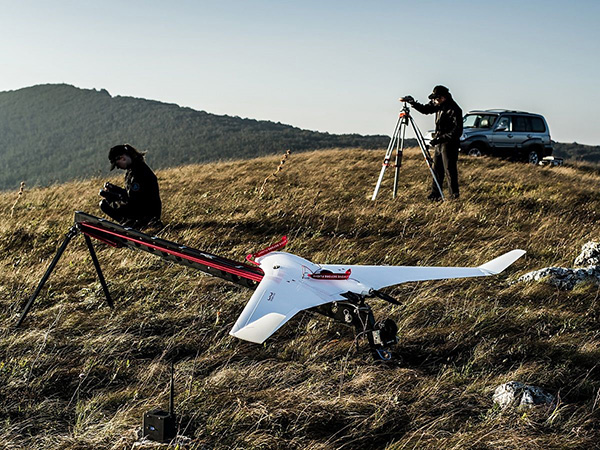
    UAV survey operations benefit from multi-GNSS receivers. (Photo: Septentrio)
    UAV survey operations benefit from multi-GNSS receivers. (Photo: Septentrio)

    The range residual is simply the change from one epoch to the next in the difference in the range calculated using the pseudorange and the range calculated by the carrier phase on a specific frequency. The pseudorange values are scaled using the wavelength to an equivalent range in units of the carrier’s cycles rather than meters. Equation 1 illustrates the range residual between the pseudorange ρ on a specific carrier frequency and the carrier phase observable φ, using the wavelength λ of the carrier to scale the pseudorange. The values of these observables are compared between adjacent epochs.

    RR = (p/λ) – φ       (1)

    Two adjacent epochs are used, as then the integer ambiguity value, as well as the ionospheric and tropospheric errors, and satellite and receiver clock errors are the same, or negligibly different at such small (<1 s) epoch intervals. Therefore, these are all canceled out, and the resulting value is the measurement receiver and observable noise. The pseudorange observable will be significantly noisier than the carrier phase observable, therefore this method is a good way to calculate the measurement noise for the pseudoranges.

    Ionospheric Residual

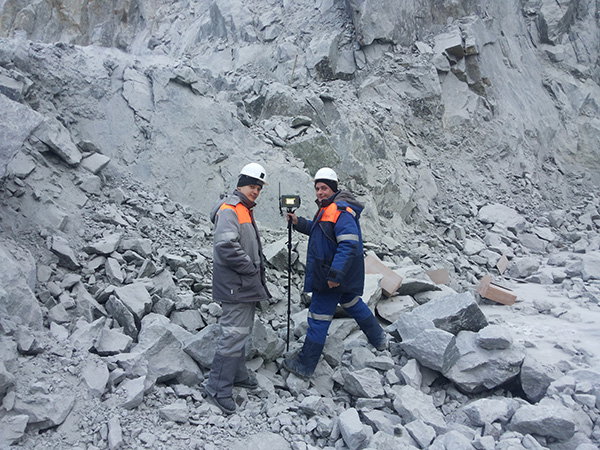
    Surveyors work the Berezitovy mine in the North Amur region of Russia. (Photo: Javad GNSS)
    Surveyors work the Berezitovy mine in the North Amur region of Russia. (Photo: Javad GNSS)

    If the carrier waves traveled only through a vacuum, then a phase observation from a specific satellite to a specific GNSS receiver could be scaled and converted to an equivalent phase measurement on another frequency using the frequencies of the carrier waves. However, as the signal passes through the ionosphere, systematic errors that are frequency dependent are introduced, so it is not possible to directly convert from one carrier phase value to another for a specific range measurement. The error is known as the ionospheric residual, and this will change slowly over time as the satellite passes overhead and the ionosphere being passed through changes, and also as the ionosphere slowly changes its characteristics over time, mainly due to the sun’s activities.

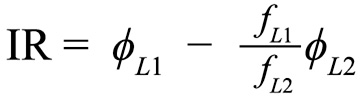
    Equation 2 shows the calculation, using L1 and L2 carrier phase readings and corresponding frequencies, used to calculate the ionospheric residual. Again, the difference in the ionospheric residual values between adjacent epochs is used, as in the same way as the range residual values, external noise sources are eliminated.

    Image: Authors        (2)

    Results

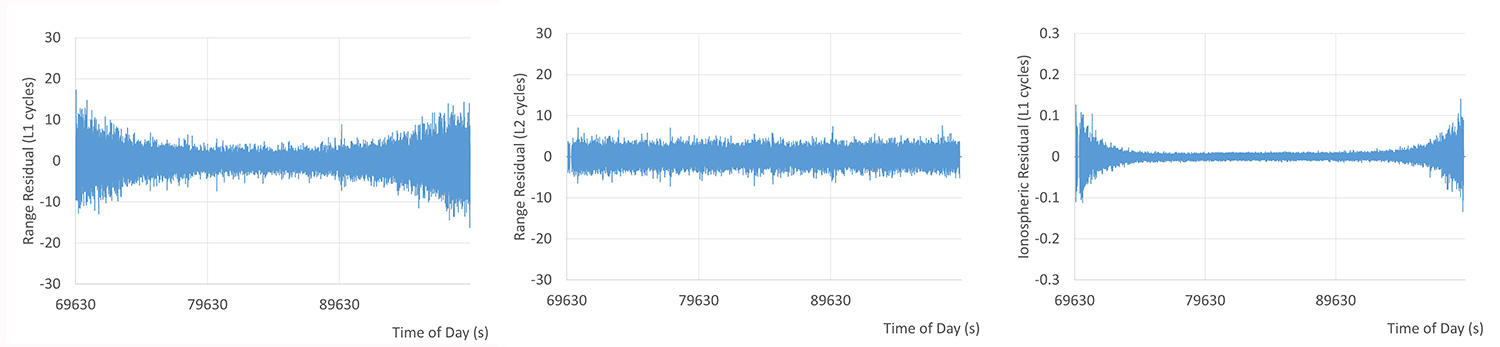
    The results presented here are a subset of a much larger set. Figure 1 illustrates the range residuals for L1 and L2 as well as the L1L2 ionospheric residual for PRN32 (Block IIA satellite).

    Figure 1. L1 range residual (left) L2 range residual (center) and L1L2 ionospheric residual (right) for GPS PRN32 (Block IIA) satellite. (Charts: Authors)
    Figure 1. L1 range residual (left) L2 range residual (center) and L1L2 ionospheric residual (right) for GPS PRN32 (Block IIA) satellite. (Charts: Authors)

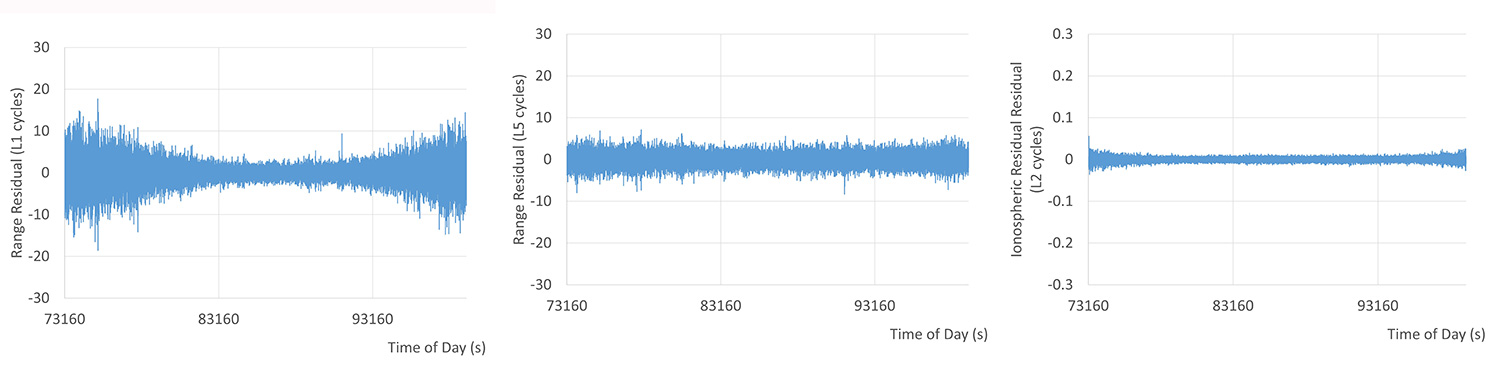
    Figure 2 illustrates the L1 and L5 range residuals and the L2 (C-code) L5 ionospheric residual for PRN01 (Block IIF satellite).Both figures’ data are for the complete passing of the satellites from horizon over and back down again.The data for PRN32 is all that exists in the datafile, as this satellite only transmits L1 CA code and P(Y) code, as well as L2 P(Y) code, and corresponding carrier values.

    Figure 2. L1 range residual (left) L5 range residual (center) and L2 (C code) L5 ionospheric residual (right) for GPS PRN01 (Block IIF) satellite. (Charts: Authors)
    Figure 2. L1 range residual (left) L5 range residual (center) and L2 (C code) L5 ionospheric residual (right) for GPS PRN01 (Block IIF) satellite. (Charts: Authors)

    PRN01 is a block IIF satellite, and data for L1 CA code, L2 P(Y) code as well as L2 C-code, L5 code, and corresponding carrier phase values are recorded in the datafile.The block IIF satellites can result in four range residual values and five ionospheric residual combinations.Figure 2 only illustrates three of these combinations.The data were obtained from the Curtin University GNSS repository on Sept. 1, 2015, gathered at a 1-Hz epoch interval; 29,908 epoch of data were gathered for PRN32, and 26,073 epochs for PRN01.

    It can be seen from these figures that the L1 range residuals are similar in characteristics for both PRN01 and PRN32.The values are noisy at the start and the end of the time series, indicating that the CA code is more prone to noise at low elevations.Comparing these to the L2 (PRN32) and L5 (PRN01) range residuals, we can see that both the L2 and L5 range residuals are not as prone to low elevation noise. Also, the two L2 and L5 range residuals are visually similar in characteristcs.By comparing the L1L2 and L2L5 ionospheric residuals (Figure 1, right, and Figure 2, right), we can see that the L1L2 combination is slightly noisier than the L2L5, in particular at low elevation angles.

    If we compare BeiDou ionospheric residual results, we can see the comparison of noise on the three ionospheric residual combinations, B1B2, B1B3 and B2B3, as well as the results from the three types of satellite orbits, ie MEO, IGSO and GEO. Figure 3 illustrates the ionospheric residual results for PRN07 (IGSO) for the three frequency combinations, from data gathered on a static pillar located on top of the University of Nottingham Ningbo China’s Science and Engineering Building.

    Figure 3. Ionospheric residual results for BeiDou PRN07 (IGSO) for combinations B1B2 (left), B1B3 (center), B2B3 (right). (Chart: Authors)
    Figure 3. Ionospheric residual results for BeiDou PRN07 (IGSO) for combinations B1B2 (left), B1B3 (center), B2B3 (right). (Chart: Authors)

    Figure 4 illustrates the ionospheric residual results for PRN01 (GEO) for the three frequency combinations.

    Figure 4. Ionospheric residual results for BeiDou PRN01 (GEO) for combinations B1B2 (left), B1B3 (center), B2B3 (right). (Chart: Authors)
    Figure 4. Ionospheric residual results for BeiDou PRN01 (GEO) for combinations B1B2 (left), B1B3 (center), B2B3 (right). (Chart: Authors)

    Figure 5 illustrates the ionospheric residual results for PRN12 (MEO) for the three frequency combinations. Here it can be seen that the B2B3 combination is generally less noisy than the B1B2 and B1B3. In addition to this, it can be seen that when the MEO and IGSO satellites are at lower elevation angles, the observables also become noisier. The GEO satellites have a constant elevation angle, and do not experience this phenomenon.

    Figure 5. Ionospheric residual results for BeiDou PRN12 (MEO) for combinations B1B2 (left), B1B3 (center), B2B3 (right). (Charts: Authors)
    Figure 5. Ionospheric residual results for BeiDou PRN12 (MEO) for combinations B1B2 (left), B1B3 (center), B2B3 (right). (Charts: Authors)

    Detailed Results

    The data, gathered on a single GNSS receiver located at the University of Curtin’s GNSS research center, was downloaded in BINEX format and converted into RINEX 3.02 format using RTKLIB software. Software was developed by the authors in Matlab in order to interrogate the data files and implement the range residual and ionospheric residual algorithms. RINEX 3.02 format was chosen due to its compatibility with multi-GNSS and multi-frequencies.

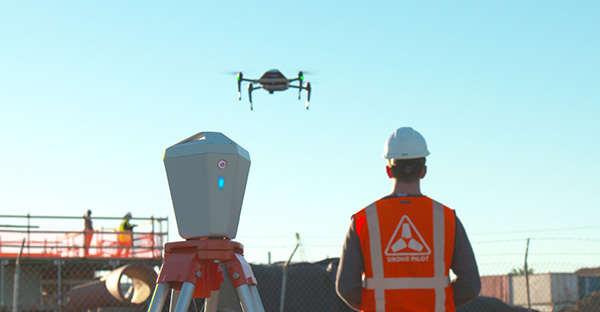
    Industrial UAV applications such as construction draw benefits from multi-GNSS receivers’ capabilities. (Photo: Skycatch, Swift Navigation)
    Industrial UAV applications such as construction draw benefits from multi-GNSS receivers’ capabilities. (Photo: Skycatch, Swift Navigation)

    Results are presented for both ionospheric residual and range residual results for various GNSS. These results have been calculated with varying elevation mask angles, ranging from 0° to 55° at 5° intervals. The RMS values of the resulting ionospheric residuals and range residuals were calculated and plotted against the respective elevation mask angle for each satellite and frequency combinations. This illustrates the influence of the elevation mask angle used on the results.

    Typically, tens of thousands of epochs of data were used for every plotted point in the following figures. Further to this, not only are the results for the various frequencies and frequency combinations for the various GNSS illustrated, but also the various satellite types, MEO, GEO and IGSO, and various satellite Blocks for GNSS. GPS Block IIA (PRN04 and PRN32), Block IIR (PRN14), Block IIR-M (PRN31) and Block IIF (PRN01, PRN26, PRN25) data were all analyzed. Thus, the comparison of the various frequencies within each satellite system are illustrated, as well as the variations by comparing the various satellite constellation types and the various generations of GPS satellites.

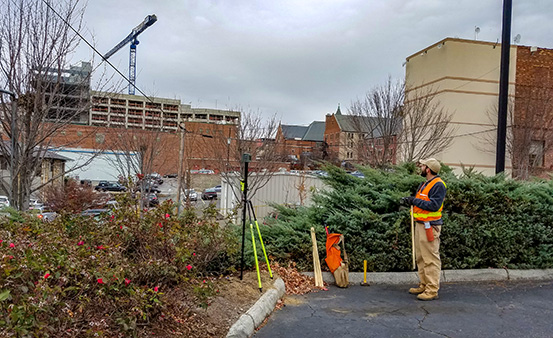
    Surveying accuracy is critical to roadway construction. (Photo: Leica Geosystems)
    Surveying accuracy is critical to roadway construction. (Photo: Leica Geosystems)

    The BeiDou data illustrated are MEO (C12, C14, C11), IGSO (C09, C10, C07) and GEO (C01, C02). The data used were gathered on Sept. 1, 2015, in order to include GPS Block IIA satellites (PRN04 and PRN32). PRN32 was retired in June 2016, and PRN04 was taken out of active service in November 2015, but the satellite was reactivated in March 2018, this time broadcasting PRN18.

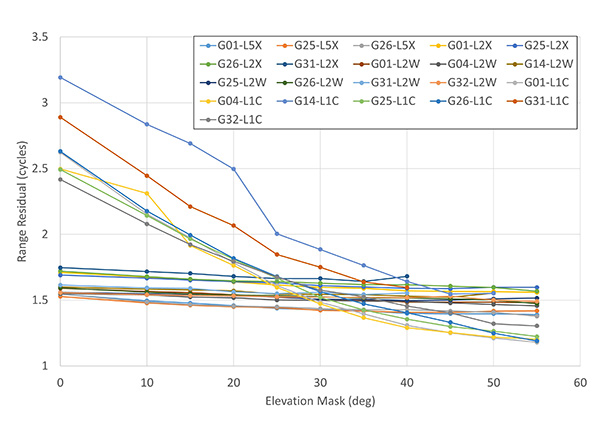
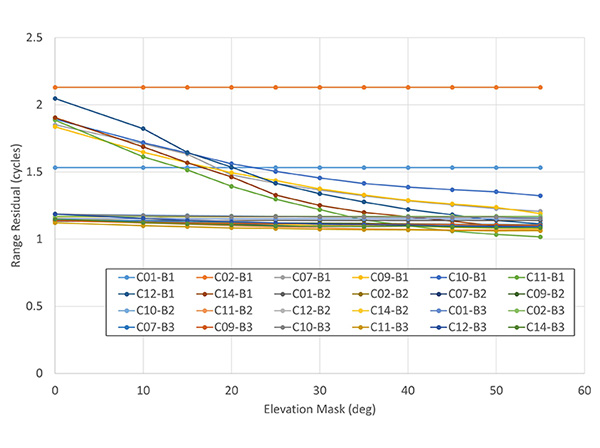
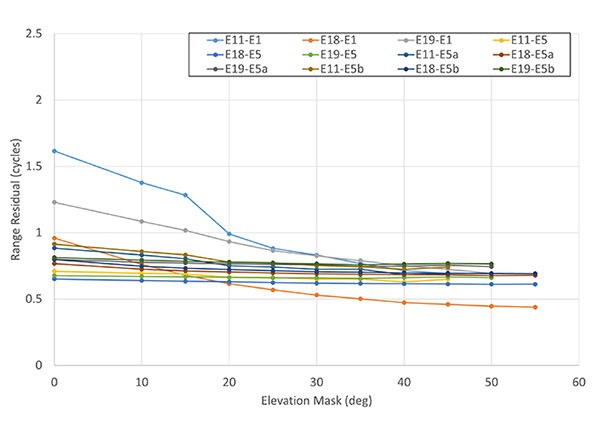
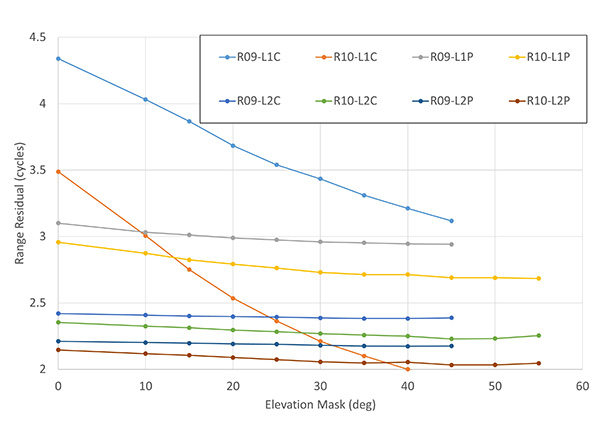
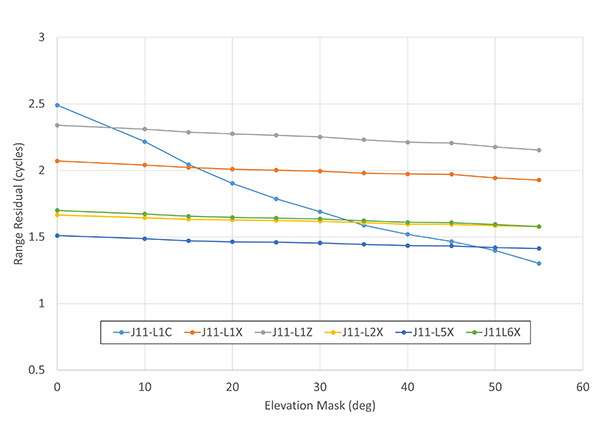
    Figure 6 illustrates RMS of the range residual results for GPS (a), BeiDou (b), Galileo (c), GLONASS (d) and QZSS (e) respectively. These figures have been drawn so that the y-axis ranges are the same for each, hence illustrating the relative values.

    Figure 6A illustrates the range residual results for GPS. It can be seen that the L1 CA code results are the noisiest, with PRN14 being the noisiest, followed by PRN31, PRN26, PRN01, PRN04, PRN25 and PRN32. It can also be seen with these results that lower elevation angle mask increases the noise level. Both the L2 and L5 code results are less noisy.

    Figure 6A. RMS range residual results for GPS. (Chart: Authors)
    Figure 6A. RMS range residual results for GPS. (Chart: Authors)

    Looking at the detail, the L5 code results is less noisy than the L2 and affected less than the L1 results by the changes in elevation mask angles used. Interestingly enough, the data file includes both the L2 P(Y) code and L2C code results. L2C only exists on the Block IIR-M and Block IIF satellites. The L2C code results are generally noisier than the L2 P(Y) code.

    Figure 6B illustrates the results for the range residuals for the BeiDou satellites. Here it can be seen that the B1 code is affected more by low elevation mask angles than B2 and B3. It can also be seen that both the geostationary satellites’ B1 results stand out, with satellite C02 being noisier than C01. The B2 and B3 values for both these GEO satellites are bunched up with the majority of the other results towards the middle of the figure. The pairs of B2 and B3 results for the GEO satellites are close to each other in values, and the pairs of B2 and B3 results for the other satellites are also close to each other.

    Figure 6B. RMS range residual results for BeiDou. (Chart: Authors)
    Figure 6B. RMS range residual results for BeiDou. (Chart: Authors)

    It can also be seen that the range residual results for BeiDou are generally less noisy than than GPS, in units of cycles.

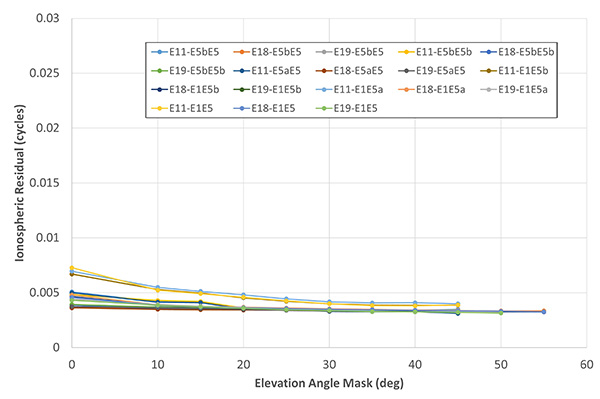
    Similarly, for Galileo, Figure 6C, the E1 results are worst, and affected more by low elevation masks. Again, generally the Galileo results are seen to be improved over GPS. The GLONASS results, Figure  6D, illustrate that the L1C results are generally noisier, and then the L1P, followed by L2C and L2P. PRN09 is also consistently generally noisier than PRN10. Finally, Figure 6E illustrates the results for QZSS. Again, L1C is the noisiest and affected most by low elevation mask angles.

    Figure 6C. RMS range residual results for Galileo. (Chart: Authors)
    Figure 6C. RMS range residual results for Galileo.
    (Chart: Authors)
    Figure 6D. RMS range residual results for GLONASS. (Chart: Authors)
    Figure 6D. RMS range residual results for GLONASS. (Chart: Authors)
    Figure 6E. RMS range residual results for QZSS. (Chart: Authors)
    Figure 6E. RMS range residual results for QZSS. (Chart: Authors)

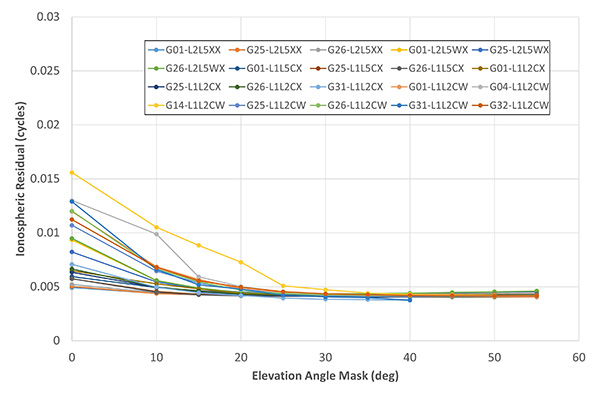
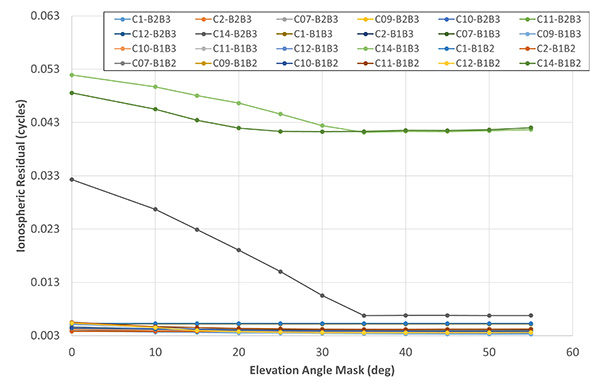
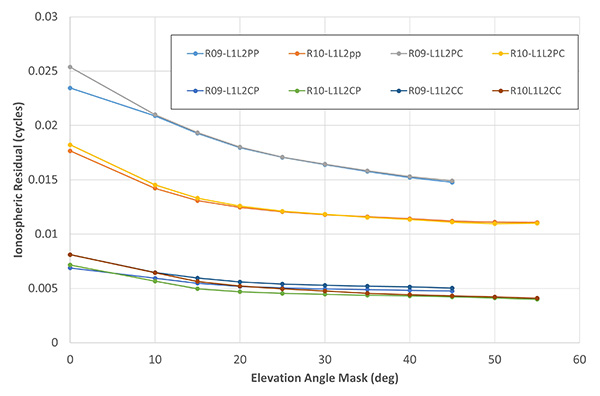
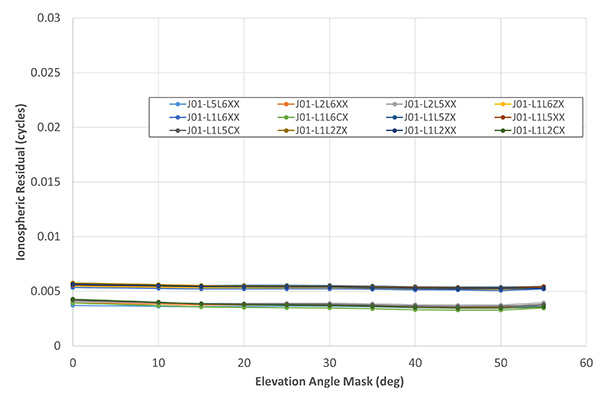
    Figure 7 illustrates the ionspheric residual results for the same satellites as Figure 6. This time, however, the resulting ionospheric residual values are calculated using pairs of data from the same satellite on different carrier frequencies. The range residual results compare the code and carrier from specific satellites and frequencies.

    Figure 7(a) shows that the ionospheric residual results are affected by low elevation masks, and that the L1L2CW (L1 CA code and L2 P(Y) code available on all the satellites) combinations are the noisiest, followed by L2L5WX (L2 P(Y) code and L5 code available on Block IIF satellites, PRN 26, PRN01, PRN25), followed by L1L2CX (L1 CA code and L2 C code available on Block IIF and Block IIR-M satellites, PRN31, PRN26, PRN01 and PRN25), followed by L1L5CX (L1 CA code and L5 code, Block IIF satellites, PRN01, PRN25, PRN26) and finally the least noisy were the L2L5XX results (L2 C code and L5 code available on Block IIF satellites, PRN26, PRN25 and PRN01).

    Figure 7A. Ionospheric residual results for GPS.(Chart: Authors)
    Figure 7A. Ionospheric residual results for GPS. (Chart: Authors)

    Figure 7(b) illustrates the BeiDou ionospheric residual plots, illustrating that satellite C14 is much noisier for all three combinations of B1B3, BB1B2 and B2B3 in that order. The B1B2 combinations for the satellites are generally the noisiest, and then the B1B3 and B2B3 combinations are intertwined. The Galileo results again illustrate that the E1 combinations are generally noisier, and again we see the effect of low elevation angle masks, Figure 7(c). Generally, however, the Galileo results are less noisy than GPS, as are the BeiDou results.

    Figure 7B. Ionospheric residual results for BeiDou. (Chart: Authors)
    Figure 7B. Ionospheric residual results for BeiDou. (Chart: Authors)
    Figure 7C. Ionospheric residual results for Galileo. (Chart: Authors)
    Figure 7C. Ionospheric residual results for Galileo. (Chart: Authors)

    The GLONASS results are again generally the noisiest, and again PRN09 is noisier than PRN10, with the L1P combinations being noisier, Figure 7(d). Figure 7(e) for QZSS shows that there are generally two groups of results. The upper set consists of L1L2ZX, L1L5ZX, L1L2XX, L1L5XX, L1L6ZX and L1L6XX from highest to lowest noise respectively. The lower, less noisy, group consists of L1L2CX, L1L5CX, L2L5XX, L2L6XX, L1L6CX and L5L6XX from highest to lowest noise respectively. Further details about the various codes and carrier values can be found in the RINEX 3.02 manual produced by the IGS.

    Figure 7D. Ionospheric residual results for GLONASS. (Chart: Authors)
    Figure 7D. Ionospheric residual results for GLONASS. (Chart: Authors)
    Figure 7E. Ionospheric residual results for QZSS.(Chart: Authors)
    Figure 7E. Ionospheric residual results for QZSS.(Chart: Authors)

    Conclusions

    A surveyor checks an urban construction project. (Photo: Topcon)
    A surveyor checks an urban construction project. (Photo: Topcon)

    These preliminary results illustrate that there are differences in the noise values for various GNSS, frequencies as well as satellite generations and orbit types. It can be seen that generally L1, B1 and E1 have noisier results, and are affected moreso by low elevation mask data, and hence multipath. It can also be seen that newer generations of satellites do indeed produce better quality data.

    Some specific satellites produce lower quality data such as GLONASS PRN09 and BeiDou C14. This could be due to multipath produced at the satellite.

    Today roughly 100 GNSS transmit data, and typically users can gather data from 30 to 50 at any time. Positioning requires nowhere near this number of satellites, therefore decisions are needed as to which satellites and which data to use in a positioning solution. Our findings imply that our approach could be used in such decision-making in GNSS processing software, helping the software to choose the optimum satellites to draw from in a positioning solution.

    Acknowledgments

    This work described in this article was first presented at the FIG 2018 conference held in Istanbul, Turkey. The authors acknowledge the use of data supplied from the Curtin University GNSS Centre.

    Manufacturers

    The GNSS receiver used is a Trimble NET R9, and the antenna is a Trimble TRM 59800.00 SCIS choke ring antenna. A ComNav K508 GNSS receiver supplied some of the BeiDou results.


    GETHIN WYN ROBERTS is an associate professor at Fróðskaparsetur, the University of the Faroe Islands. He is past Chairman of the FIG’s Commission 6, Engineering Surveys, and previously held posts at the University of Nottingham both in the UK and in China. He holds a Ph.D. in engineering surveying and geodesy from the University of Nottingham.

    CRAIG M. HANCOCK is an associate professor in Geodesy and Surveying Engineering and the head of the Department of Civil Engineering at the University of Nottingham, Ningbo, China as well as the head of the Geospatial and Geohazards Research Group. He holds a PhD from the University of Newcastle Upon Tyne.

    XU TANG is a research fellow at the University of Nottingham, Ningbo, China. He holds a PhD from Nanjing University.

  • IGNSS focuses on autonomy in February Sydney conference

    The upcoming annual conference sponsored by the IGNSS Society will take a close look at autonomy and provide GNSS constellation updates.

    IGNSS is the southeast Asian region’s premier conference on GNSS and related position, navigation and timing (PNT) technologies.

    This year’s conference theme is “Trusted Positioning: From Here to Autonomy.” The event, sponsored by Lockheed Martin, takes place Feb. 7-9 on the campus of the University of New South Wales in Sydney, Australia.

    At the conference, leaders in GNSS and PNT will gather to examine the latest technology, present cutting-edge research and discuss in open forums the implications for policy, market development and positioning infrastructure deployment.

    IGNSS 2018 will showcase a number of contemporary topics, including

    • the role of PNT in automated land, aerial and marine vehicles;
    • the growing range of commercial precise positioning services;
    • hard infrastructure issues such as space based augmentation systems; and
    • soft infrastructure issues such as datum modernization and mitigation of system vulnerabilities.

    These topics will be discussed in the context of the latest system developments fueling the multi-GNSS era.

    Running over two days immediately prior to IGNSS2018 is a meeting of the RTCM SC-104; all attendees are invited to attend.

    Also running one day before IGNSS2018 is the Japan-Australia Quasi-Zenith Satellite System Industry Utilisation Workshop. IGNSS delegates are also welcome to attend this free workshop.

    The IGNSS conference takes place on the UNSW campus in Sydney. (Photo: University of New South Wales)
    The IGNSS conference takes place on the UNSW campus in Sydney. (Photo: University of New South Wales)

    IGNSS2018 Highlight Sessions

    • Global GNSS service provider updates
    • SBAS Testbed overview and project updates
    • Panel: positioning autonomous systems

    Keynote Speakers

    • Air Vice-Marshall Kym Osley, Department of Defence
    • Kent Rosser, Discipline Leader Aerial Autonomous Systems, DST Group
    • Dorota Grejner-Brzezinska, The Ohio State University
    • Joe Burns, Sensurion
    • Rod Bryant, u-blox
    • Kendall Ferguson, RTCM Board of Directors & SC-104 Chair
    • Representative from the Expert Reference Group conducting the Review of Australia’s Space Industry Capability
    • Representative from the iMove CRC

    The IGNSS Association runs the SE Asian region’s premier conference on Global Navigation Satellite Systems and related Position, Navigation & Timing technologies. This year’s IGNSS is hosted in conjuction with the Australian Centre for Space Engineering Research at UNSW Sydney.

  • Out in Front: Europa, Europa

    Not so long ago, we occasionally speculated on the order of GNSS preference for both manufacturers and end users. GPS first, of course. Only the most radical of future visions saw anything different. But after that? GLONASS, Galileo, BeiDou — or switch them around? A case could be made for almost any sequence, by virtue of active constellation size or geometry, code structure, interoperability, government funding, or national economies.

    It was once felt that a maximum of two GNSS could be made to fit cost-beneficially on a chip destined for mass-market devices; professional OEM boards had, of course, far more leeway and budget. Then engineering ingenuity found space for three on a chip.

    A wag noted during that timeframe that in GNSS as in the Olympics, one can win gold, silver, or bronze. There is no prize for fourth place.

    Lately, however, it seems there may be room for all. Our feature article this month affirms that “the silicon manufacturer must continue the path towards the fully flexible multi-constellation mass-market receiver.”

    Nevertheless, choices will be made in design and manufacturing: different choices by different manufacturers in different regions, on different products. I now think that market size and connectivity will be the strongest drivers for selection of GNSS in product design. Constellations, at least in their order of establishment, almost don’t matter. Government mandates to use the respective national (or regional) GNSS in official or officially linked applications will add to the weight of market size.

    These government-mandated applications encompass air, rail, and maritime navigation and management, survey and construction, road tolling, and road-user charging, just to start with. With emergency calling, it’s not hard to envision such mandates extending to telecomm as well, the most plentiful in end-user devices.

    In that light, consider the words of political scientist John McCormick from his book Why Europe Matters.

    “The European Union has a population of more than half a billion. It is the wealthiest marketplace in the world, is the biggest trading power in the world, is the biggest source of (and magnet for) foreign direct investment, and has shown that it is possible to wield influence without relying on military power.”

    Even should Galileo finish fourth in the race to establish a full constellation, smart money may put Galileo on every future GNSS chip, high precision or mass market.

  • GLONASS 743 Maneuvers toward New Position

    News courtesy of CANSPACE Listserv.

    According to tracking data from NORAD/JSpOC, GLONASS 743 experienced a delta-V maneuver on or about February 12 as it approached its new orbital position at Slot 8 in Plane 1.

    Note that GLONASS 743 is not currently in service but will likely rejoin the active constellation once the move is completed, replacing GLONASS 701K in the broadcast almanac.

    Although GLONASS 701K, the test GLONASS K1 satellite, is currently transmitting on frequency channel -5, it continues to be set unhealthy in the almanac.