Tag: GNSS simulators

  • 2019 Simulator Buyers Guide

    2019 Simulator Buyers Guide

    GPS World’s 8th annual Simulator Buyers Guide features tools, devices and software from leading providers.


    CAST NAVIGATION JACKSON LABS TECHNOLOGY INC. OROLIA
    QASCOM RACELOGIC ROHDE & SCHWARZ
    SKYDEL SPIRENT FEDERAL SYSTEMS TALEN-X

    CAST NAVIGATION

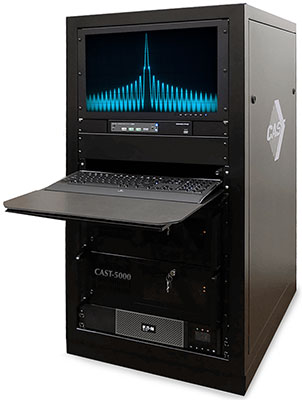
    CAST-5000 GPS wavefront generator
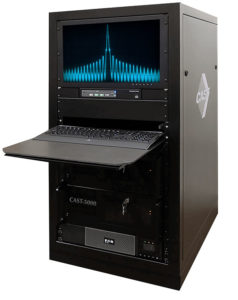
    Photo: CAST Navigation
    Photo: CAST Navigation

    The CAST-5000 produces a single coherent wavefront of GPS RF signals to provide repeatable testing in the laboratory environment or anechoic chamber. The basic system generates four independent, coherent simulations that reference a single point and is upgradeable to support seven elements for CRPA testing. With an intercard carrier- phase error of less than 1 millimeter, the CAST-5000 is extremely accurate.

    The system generates a wavefront of GPS when its GPS RF generator cards are operated in a ganged configuration. Each generator card provides a set of GPS satellites coherent with the overall configuration. Several RF generator cards may be utilized together, ensuring phase coherence among the bank of signal generator cards.

    The CAST-5000 Controlled Reception Pattern Antenna (CRPA) tester allows a full end-to-end test of the antenna system. The CRPA antenna, antenna electronics and the GPS receiver can be tested as a unit with or without radiating signals.

    The CAST-8000 is a new simulator that merges both the CAST-5000 CRPA tester with a CAST-3000 EGI tester.

    CAST-5000 Features

    • Generates single coherent wavefront of GPS
    • 6-DOF motion generation capability
    • Complete SV constellation editing
    • Post-mission processing via ICD-GPS-150/153
    • Differential/relative navigation
    • Antenna pattern modeling
    • Waypoint navigation
    • RAIM events
    • Multipath modeling
    • Spoofer simulation
    • Satellite clock errors
    • External trajectory input
    • External ephemeris and almanac
    • Several iono and tropo models
    • Modifiable navigation message
    • Modeled selective availability
    • Time-tagged satellite events
    • Selectable host vehicle parameters
    • Directional jamming

    www.castnav.com
    [email protected]
    (978) 858-0130

    [Back to top]

    JACKSON LABS TECHNOLOGY INC.

    Micro-Transcoder GPS Simulator/RF-Modulator
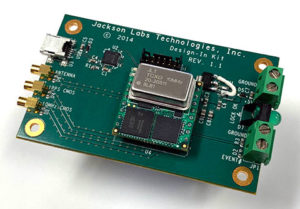
    Photo: Jackson Labs
    Photo: Jackson Labs

    The tiny 1-inch square Micro-Transcoder module allows glueless retrofitting of existing GPS equipment with secure and Assured-PNT (A-PNT) capability. It is the smallest, full-constellation, stand-alone, real-time 10-channel GPS simulator available from JLT. The unit is useful in upgrading existing legacy GPS receivers with external position, navigation and timing references such as INS, CSAC, SAASM, M-code, GNSS, eLoran or other alternative positioning and timing sources by simply replacing the legacy GPS antenna from an existing GPS system with the Micro-Transcoder RF output.

    The unit is based on the JLT CLAW GPS Simulator and RSR Transcoder technologies, and includes a general-purpose, stand-alone, full-constellation, 10-channel, real-time GPS simulator with integrated high-stability timing reference, as well as an internal GNSS receiver for monitoring the RF output signal for quality and accuracy. The unit will transmit a standard UTC time, position, velocity and heading GPS L1 C/A RF signal by simply applying 3.3V power to it.

    The Micro-Transcoder can also be operated as a generic GPS simulator with built-in GPS Disciplined Oscillator (GPSDO), and is supported by a free Windows application downloadable from the JLT website. The Windows application allows control of all the simulation aspects, creating and storing simulation vector commands and testing user equipment for leap-second and GPS week rollover event compatibility to identify weaknesses in user equipment. The unit does not require a connected PC to function. The Micro-Transcoder is also available mounted onto an evaluation board for easy evaluation. The unit transcodes baseband PNT NMEA signals into a GPS L1 RF signal with typically less than 100-ms latency. UTC 1PPS timing-transfer accuracy to the GPS RF output is typically better than 5 ns. The unit requires only 3.3V to operate, and setup, location and simulation vector file information can optionally be stored in its internal NV memory.

    [email protected]
    www.jackson-labs.com
    (702) 233-1334

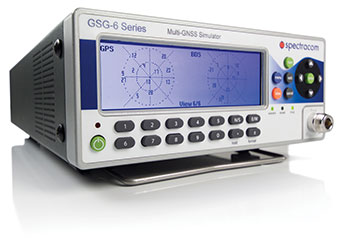
    OROLIA

    GSG-5/6 Series

    All Constellations, All Frequencies
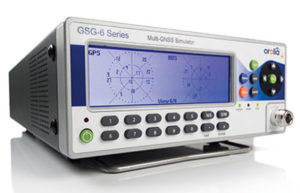
    Photo: Orolia
    Photo: Orolia

    For those responsible for mission-critical PNT applications, the Orolia GSG series of GPS/GNSS simulators is an important tool to evaluate risk for jamming, spoofing or any other threat. Orolia GSG-5/6 series simulators are easy to use, feature-rich and affordable, offering a way to harden GPS-based systems without the limitations of testing from “live sky” signals. The Orolia platform approach allows customers to buy only what they need today and upgrade later. The adaptability of the GNSS RF generation platform can extend to applications for intelligent repeating.

    Test Solutions

    • Position accuracy and dynamic range/sensitivity
    • Simulate movements/trajectories anywhere on or above Earth
    • Sensitivity to GPS impairments: loss of satellites, multipath, atmospheric conditions, interference, jamming and spoofing
    • Conducted or over-the-air RF
    • GPS time-transfer accuracy
    • Effect of leap-second transition
    • Multi-constellation testing
    • Modernization signals/frequencies
    • Keyless military SAASM, dual-frequency and survey-grade receiver testing
    • Application packages for real-time kinematic (RTK), controlled radiation pattern antennas (CRPA)
    • Hardware-in-the-loop (HIL) integration
    • Test solutions for eCall and ERA-GLONASS

    Infrastructure possibilities include zone-based indoor location (intelligent repeating) and pseudolite applications.

    GSG-6 Series 64-channel multi-frequency, advanced GNSS simulator is powerful enough for any cutting-edge test program. GPS, GLONASS, Galileo, Beidou, QZSS and NAVIC (IRNSS) signals are available across multiple frequencies. The GSG-6 is designed for military, research and professional applications.

    GSG-5 Series 16-channel multi-constellation L1-band GNSS simulator is designed for commercial development/integration programs. It is for developing commercial products with GNSS capability, and will shorten test programs with confidence.

    GSG-51 single-channel signal generator is designed for one purpose — fast, simple go/no-go manufacturing test and validation, ensuring the manufacturing line is operating at full capacity with confidence in quality.

    www.orolia.com
    [email protected]
    +1-585-321-5800

    [Back to top]

    QASCOM

    QA707 GNSS and Interference Software Simulator
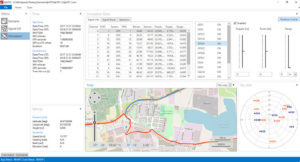
    Photo: Qascom
    Photo: Qascom

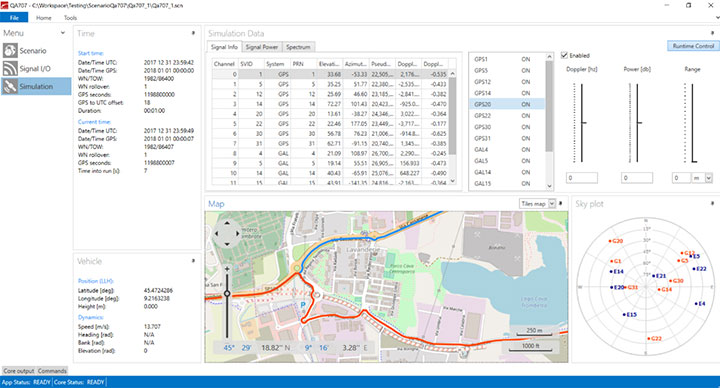
    Specifically designed for testing GNSS interferences and cyber-attacks. QA707 has been designed to test robustness against emerging cyber-threats beyond jamming and spoofing. It allows the creation of scenarios with signal and code jamming, data-level cyber-attacks, denial of service threats, low-level spoofing channels control, and trajectory-controlled spoofing.

    Optimal for signal modernization design. Being a flexible software defined radio (SDR) solution, QA707 is also suitable for testing of signal modernization and for the simulation of new signal components. An open API is provided to create specific signals simulation. Particularly, the tool is ready to support the upcoming Galileo Open Service Authentication (OSNMA).

    Runs on a standard PC or laptop with USRP or other hardware. QA707 is compatible with several third-party hardware RF up-converters, including National Instruments’ USRP. It also can support customer’s specific hardware through the hardware API interface. Qascom introduces the new frontier of GNSS security testing. QA707 is supported from back office with custom services as well as jamming and spoofing mitigation solutions for receivers and applications. This covers 100% of customer GNSS security needs.

    QA707 Main Features

    • Multi-constellation (GPS L1, Galileo E1, SBAS L1)
    • Galileo OSNMA ready
    • RF simulation, binary file dump, signal record and replay
    • Support to SDR platforms and open API for custom RF upconverters
    • Runtime scenario data UDP stream: motion, channel data, simulated inertial sensor
    • Data-level cyber attacks
    • Low-level spoofing signals control, trajectory spoofing, signal replay attacks
    • Narrowband, wideband, frequency modulated jamming
    • Integrity threats: evil waveform, erroneous ephemerides, code/carrier divergence, low satellite signal power, excessive range acceleration
    • Built-in editing tools: RF output calibration, RINEX editor, trajectory editor

    www.qascom.it
    [email protected]

    [Back to top]

    RACELOGIC

    LabSat 3 Wideband and Satgen Software

    LabSat 3 Wideband
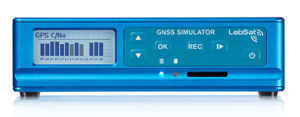
    Photo: Racelogic
    Photo: Racelogic

    The LabSat 3 Wideband is easy to use, cost-effective and produces extremely low noise, accurate and repeatable signals. Users can record and replay up to three different channels at 56 MHz with a bit depth of up to 3 bits I and 3 bits Q.

    The following signals can be recorded and replayed:

    • GPS: L1 / L2 / L5
    • GLONASS: L1 / L2 / L3
    • BeiDou: B1 / B2 / B3
    • QZSS: L1 / L2 / L5
    • Galileo: E1 / E1a / E5a / E5b / E6
    • IRNSS: L5
    • SBAS: WAAS, EGNOS, GAGAN, MSAS, SDCM
    • L-band GNSS correction services: Terrastar, Veripos, OmniSTAR, StarFire
    • 2X CAN, RS232, and digital inputs recorded and replayed tightly synchronized with GNSS data

    Small, battery or mains powered and with a removable SSD (up to 4 Tb), LabSat 3 Wideband allows detailed, real-world satellite data to be recorded then replayed on the bench. The rugged enclosure measures a compact 167 x 128 x 46 millimeters and weighs 1.2 kilograms, meaning it can be placed in a backpack and used to reliably record real-world signals in almost any situation.

    SatGen Signal Simulation Software

    If a user wants to simulate the signals from scratch, Racelogic’s latest SatGen signal simulation software can produce synthesized scenarios containing the full complement of popular GNSS signals: GPS L1, L2C, L5, GLONASS L1, L2, Galileo E1, E5, E6 and BeiDou B1, B2.

    SatGen software allows users to quickly create accurate scenarios with their own time, place and trajectory, with any combination of constellation and signal that is currently available or will become available in the near future.

    Mark Sampson, LabSat Product Manager
    [email protected]
    www.labsat.co.uk

    ROHDE & SCHWARZ

    R&S SMW200A and R&S SMBV100B simulators
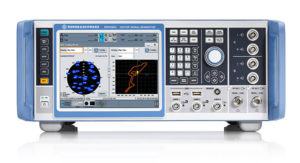
    Photo: Rohde & Schwarz
    Photo: Rohde & Schwarz

    Precision-sensitive applications such as autonomous driving, control of unmanned aerial vehicles (UAV), or positioning of aircrafts during landing procedures in coordination with ground-based augmentation systems (GBAS) require that modern GNSS receivers undergo detailed tests before implementation.

    Designed to generate highly realistic test scenarios, Rohde & Schwarz signal generators like the R&S SMW200A and the R&S SMBV100B offer a unique approach to generating complex and highly realistic scenarios for testing of GNSS receivers that are able to work with diverse navigational systems such as GPS, GLONASS, Galileo, BeiDou and QZSS/SBAS signals. The R&S SMW200A and the R&S SMBV100B can emulate them all for testing.

    R&S SMW200A

    The R&S SMW200A GNSS simulator (pictured above) can be used to produce complex interference scenarios with multiple interferers — all generated within the instrument itself. It can emulate up to 144 GNSS channels and can be equipped with up to four RF outputs. With its ability to simulate multi-constellation, multi-frequency, multi-antenna and multi-vehicle scenarios, the R&S SMW200A is able to cover a variety of high-end GNSS applications.

    R&S SMBV100B

    The R&S SMBV100B supports the same navigational systems, with access to 24 GNSS channels and one RF output, with the same ability to configure realistic scenarios including obscuration, multipath and atmospheric effects, as well as the specific characteristics of the antenna and the simulated vehicle. An integrated noise and CW interference generator can also be added.

    Since the devices do not require an external PC for scenario configuration, all the tests can be created quickly through the user-friendly GUI. Due to all-encompassing instrument options available, both simulators can be set up to fit unique user requirements.

    For testing GNSS receivers under controlled and repeatable conditions, the R&S SMW200A and the R&S SMBV100B provide extensive and cost-effective solutions. The platforms are ready to adapt to future requirements and testing of newly implemented GNSS signals.

    www.rohde-schwarz.com
    [email protected]
    +49 89 4129 12345

    [Back to top]

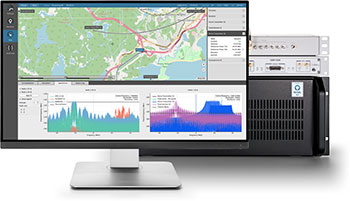
    SKYDEL

    Photo: Skydel
    Photo: Skydel

    SDX is a proven and advanced GNSS simulator based on GPU-accelerated computing and software-defined radio (SDR).

    It is available as a complete turnkey system suitable for all GNSS simulation needs, including everything from compact test benches to complete CRPA test systems, such as SDX wavefront and SDX anechoic. Moreover, its software-defined roots enable the selection of cost-effective hardware into configurations that can be repurposed for different projects.

    The architecture behind SDX provides real-time simulation of uncompromising accuracy. It features advanced signal customization and supports configurable outputs. IQ data can be generated in, or imported back into, the simulator as well. The API is embedded in the simulator core, enabling deep automation with a few simple clicks, as well as complex scripts developed with popular programming languages.

    SDX simulates multiple constellations on multiple frequencies (GPS, Galileo, GLONASS, BeiDou and SBAS) on a large number of channels. Encrypted codes are supported for GPS and Galileo.

    The Advanced Jammer module in SDX gives users complete control over interference creation. It is integrated directly into simulation scenarios to enable dynamic jammers (up to 120dB J/S) to interact with GNSS signals.

    SDX also allows users to create advanced scenarios suitable for any type of vehicle: antenna patterns (receiver and GNSS SV), LEO/GEO/HEO orbits, multipath, hardware-in-the-loop (HIL), additive pseudorange errors, message modification and corruption, raw logging and more.

    It is suitable for the design and validation of GNSS receivers, complex integration, academic research, NAVWAR and test engineering.

    SDX is developed and actively supported by Skydel’s engineering teams and worldwide distributors. Skydel offers direct support to clients to ensure prompt deployment and integration, or to review advanced customization requirements.

    www.skydelsolutions.com
    [email protected]
    1-438-239-7924

    [Back to top]

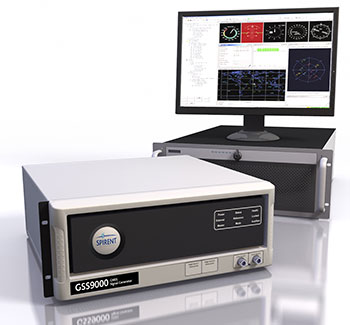
    SPIRENT FEDERAL SYSTEMS

    GSS9000, SIMMNSA, CRPA Test System, anechoic chamber testing, mid-range testing
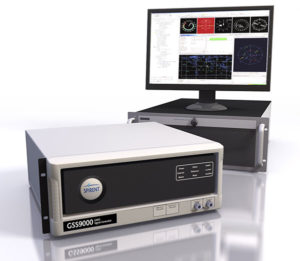
    Photo: Spirent
    Photo: Spirent

    Spirent Federal provides GPS/GNSS test equipment that covers all applications, including research and development, integration/verification, and production testing.

    GSS9000. The Spirent GSS9000 Multi-Frequency, Multi-GNSS RF Constellation Simulator is Spirent’s most comprehensive simulation solution. It can simulate signals from all GNSS and regional navigation systems and has a system iteration rate (SIR) of 1000 Hz (1 ms), enabling higher dynamic simulations with more accuracy and fidelity. The GSS9000 supports restricted/classified signals. Users can evaluate the resilience of navigation systems to interference and spoofing attacks, and have the flexibility to reconfigure constellations, channels, and frequencies between test runs or test cases.

    SimMNSA. SimMNSA allows authorized users to simulate true M-code for the first time ever. SimMNSA has been successfully delivered to users of the GSS9000 series simulator. SimMNSA has been granted Security Approval by the Global Positioning System Directorate.

    CRPA Test System. Spirent’s Controlled Reception Pattern Antenna (CRPA) Test System generates both GNSS and interference signals. Users can control multiple antenna elements. Null-steering and space/time adaptive CRPA testing are both supported by this comprehensive approach.

    Anechoic Chamber Testing. Spirent’s GSS9790 Multi-Output, Multi-GNSS RF Constellation Wave-Front Simulator System is a development of the GSS9000. The GSS9790 is a unique solution providing the core element for GNSS applications that require a test system that can be used in both conducted (lab) and radiated (chamber) conditions.

    Mid-Range Solutions. Spirent also offers solutions that cater to intermediate GPS/GNSS testing needs. The GSS7000 multi-constellation simulator provides an easy-to-use solution for GNSS testing that can grow with users’ requirements. The GSS6450 RF record & playback system enables replay of a real-world GNSS/GPS test repeatedly in the lab.

    Jeff Martin, [email protected]
    Kalani Needham, [email protected]
    Tyson Gurney, [email protected]

    www.spirentfederal.com
    (801) 785-1448
    [email protected]

    [Back to top]

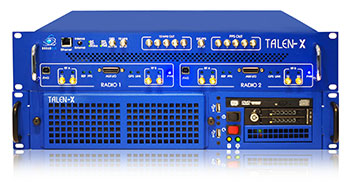
    TALEN-X

    BroadSim

    Photo: Talen-X
    Photo: Talen-X

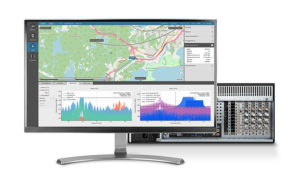
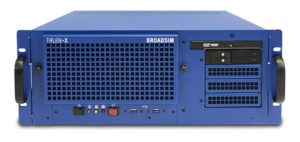
    A scalable software-defined simulation platform powered by Skydel’s SDX, capable of generating high-fidelity GNSS and jamming signals simultaneously across multiple constellations and vehicles. Simultaneously simulate every signal below:

    • GPS Open Codes: L1 C/A, L1C, L1P, L2P, L2C, L5
    • GPS Encrypted Codes: L1/L2 P(Y)-Code, L1/L2 AES M-code, L1/L2 MNSA (Coming soon)
    • GLONASS: G1, G2
    • Galileo: E1, E5a, E5b
    • BeiDou: B1, B2
    • SBAS: L1, L5
    • Jamming

    BroadSim’s software-defined platform includes intuitive user control and APIs; fast development cycles; flexible licensing and upgradability; and no additional hardware needed to maintain.

    Forms

    Original (4U)

    • Rack-mounted 4U simulator used for lab or field testing
    • 4 RF outputs (unlimited jamming signals generated on 1)
    • 1000-Hz simulation iteration rate
    • High-performance processor, GPUs and memory

    Anechoic

    • Simulation system used for anechoic chamber testing
    • 32 RF outputs and 16 dual-frequency antennas
    • Automatic antenna mapping
    • Automatic time delay and power loss calibration

    Wavefront

    • Phase coherent simulation system
    • Real-time automated phase calibration
    • Scalable from 4 to 16 elements
    • Supports CRPA and multi-element receiver testing
    • Supports jamming and spoofing

    Panacea

    An automated PNT performance and vulnerability test suite that supports up to 32 UUTs (units under test) in real time, from test plan creation to post-test evaluation.

    • Time synchronization to live sky
    • Compatible with 100+ different GNSS receiver brands
    • Create dynamic scenarios with parameters such as jamming patterns, motions, power loss, delays and more.
    • Manages receiver communication and standardizes data output for easy analysis, visualization and reporting

    www.talen-x.com
    [email protected]

  • Editorial Advisory Board PNT Q&A: Simulation challenges

    Editorial Advisory Board PNT Q&A: Simulation challenges

    What’s the biggest challenge in simulating new GNSS signals for manufacturers’ product testing?

    John Fischer
    John Fischer

    “Anyone can follow a spec, but real expertise is required for interpreting nascent ICDs, looking for inconsistencies and pitfalls. The first receivers to market may not always get it right, especially before and during early live-sky signal broadcasts.” — John Fischer, Orolia


    Ellen Hall
    Ellen Hall

    “The challenge is twofold. Manufacturers are constantly implementing new signals, which is extremely difficult and expensive to do without the use of a simulator in a lab. The second problem manufacturers are facing is integrating secure signals across international constellations.” — Ellen Hall, Spirent Federal Systems


    Julian Thomas
    Julian Thomas

    “The industry has been stimulated by growing constellations and the arrival of new signals, resulting in an increasing number of sophisticated receivers hitting the market. Our biggest challenge is ensuring that all simulated signals work on all of these receivers.” — Julian Thomas, Racelogic Ltd.

  • Expert Opinions: How simulation can aid in anti-spoofing developments

    Q: How can simulation aid in the development of anti-spoofing measures or product features?

    Lou, Pelosi, VP, Cast Navigation

    A: Anti-spoofing is a receiver function. It is the ability of a GNSS receiver to distinguish between actual navigation signals and false signals. Simulators allow a receiver developer to play “what if” games with their receiver. A simulator user controls every variable that a receiver processes. Time, satellite information and almanac are all specifiable.


    Mark Wilson, Vice President of Sales, IFEN

    A: With a simulator, a user may include spoofing signals in a variety of test scenarios. The results from the receiver under test may then be compared to the “truth” data available from the simulator, in order to demonstrate any susceptibility to spoofing. As anti-spoofing measures or product features are developed and applied, the same tests may be repeated, in order to evaluate the effectiveness of the countermeasures.


    Said Jackson, President, Jackson Labs Technologies

    A: Since live-air spoofing is illegal, simulators provide a fully controlled and repeatable environment for evaluating spoofing resilience of algorithms and products. Newly available low-cost simulators may also reduce the overall cost and time, and increase the confidence level as well as reduce the environmental impact compared to having to go to a military test-range for live testing. Simulators also provide the ability to test spoofing scenarios that may not yet be possible with today’s technology, such as multi-GNSS spoofing.


    Mark Sampson
    LabSat Product Manager, Racelogic

    A: Simulation is of great benefit when developing product features due to its repeatability. By replaying a consistent scenario, new products can have GNSS capabilities edge-tested for criteria such as receiver sensitivity, programming robustness and latency. Additionally, by replaying two scenarios created with signal-generator software on a multi-constellation simulator, starting at the same position and time and using the same constellation(s) but with one that diverges in position, spoofing vulnerabilities can be assessed.


    Iurie Ilie, CTO & Co-Founder, Skydel

    A: One of the most effective methods for mitigating GNSS spoofing is spatial discrimination. This supposes two or more receiving antennas are used. To test such systems and help designers to tune their algorithms in a controlled environment, the spoofing and truth GNSS signals must be simulated by a wavefront approach. This ensures that the signals’ code and carrier-phase offsets at the antennas’ phase center will be a function of the relative receiver/transmitter geometry.


    Phil Bonilla, Systems Engineer, Spirent Federal

    A: A flexible, high-quality RF constellation simulator provides the capability to model a multitude of scenarios in realistic environments. Users can configure signals and data to perform spoofing attacks, echoing both those observed and those purely theoretical today. Performing these tests via RF simulation provides highly controlled, repeatable system tests while providing flexibility to evaluate performance thresholds. The ability to assess risk and evaluate system robustness using simulation is vital in the evolving GNSS threat environment.


    Joel Korsakissok, President, Syntony GNSS

    A: A spoofer is a simulator that has been modified to be a slave of a master system, which defines the signal and trajectory to be emitted. To test an anti-spoofing system, it is necessary to have two simulators: the first will emit the real GPS constellation and the second will emit the spoofing signal, which will be probably synchronized in time and position at the beginning, but with divergent evolution in time.


    Tim Erbes, Chief Technology Officer, Talen-X

    A: Simulation is currently the best method to develop and test anti-spoofing algorithms. To ensure realism, it is often necessary to simulate both the true and spoofed signals from separate simulators. This provides flexibility for the threat to be modeled differently than the real satellites, a critical nuance that is often overlooked. Without the repeatability and control that such simulation provides, it would be impossible to adequately test the anti-spoofing capabilities of a GNSS receiver.

  • 2018 Simulator Buyers Guide

    2018 Simulator Buyers Guide

    GPS World’s 7th annual Simulator Buyers Guide features tools, devices and software from leading providers.


    CAST NAVIGATION IFEN GMBH JACKSON LABS TECHNOLOGY INC.
    RACELOGIC SKYDEL SPIRENT FEDERAL SYSTEMS
    SYNTONY GNSS TALEN-X OROLIA/SPECTRACOM

    CAST NAVIGATION

    CAST-5000 GPS wavefront generator

    The CAST-5000 produces a single coherent wavefront of GPS RF signals to provide repeatable testing in the laboratory environment or anechoic chamber. The basic system generates four independent, coherent simulations that reference a single point and is upgradeable to support seven elements for CRPA testing. With an intercard carrier- phase error of less than 1 millimeter, the CAST-5000 is extremely accurate.

    The system generates a wavefront of GPS when its GPS RF generator cards are operated in a ganged configuration. Each generator card provides a set of GPS satellites coherent with the overall configuration. Several RF generator cards may be utilized together, ensuring phase coherence among the bank of signal generator cards.

    The CAST-5000 Controlled Reception Pattern Antenna (CRPA) tester allows a full end-to-end test of the antenna system. The CRPA antenna, antenna electronics and the GPS receiver can be tested as a unit with or without radiating signals.

    Features

    • Generates single coherent wavefront of GPS
    • 6-DOF motion generation capability
    • Complete SV constellation editing
    • Post-mission processing via ICD-GPS-150/153
    • Differential/relative navigation
    • Antenna pattern modeling
    • Waypoint navigation
    • RAIM events
    • Multipath modeling
    • Spoofer simulation
    • Satellite clock errors
    • External trajectory input
    • External ephemeris and almanac
    • Several iono and tropo models
    • Modifiable navigation message
    • Modeled selective availability
    • Time-tagged satellite events
    • Selectable host vehicle parameters

    www.castnav.com
    Phone: 978 858-0130
    Email: [email protected]


    IFEN GMBH

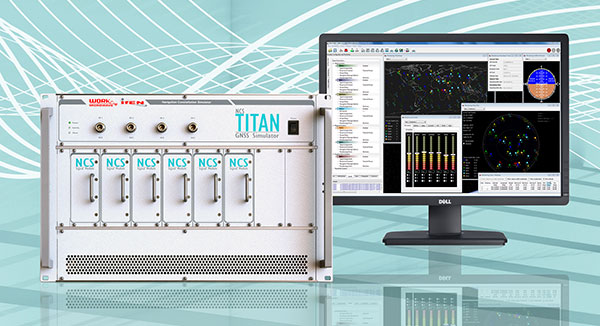
    NCS Titan and NavX-NCS Essential Simulators

    NCS TITAN GNSS Simulator

    The NCS TITAN GNSS simulator is a leading-edge satellite navigation testing and R&D solution. It is fully capable of multi-constellation and multi-frequency simulation for a wide range of GNSS applications. The NCS TITAN GNSS simulator consists of the TITAN RF signal generation unit and NCS Control Center navigation simulation software (on MS Windows and Linux OS).

    The NCS TITAN is flexible and offers exceptional performance. With up to 256 channels and up to 4 RF outputs per chassis, the extra complexity and cost of using additional signal generators or intricate architectures involving several hardware boxes is minimized. For customers with advanced simulation needs, several TITAN units can be combined (CRPA testing with 8, 12 or 16 RF outputs at several frequencies simultaneously).

    The NCS TITAN GNSS simulator provides all current and future signals for GPS, GLONASS, Galileo, BeiDou, NavIC/IRNSS, QZSS, SBAS L1 and L5 in one box. All signals are available using a flexible licensing scheme.

    NavX-NCS Essential Simulator

    The NavX-NCS Essential is an easy-to-use multi-constellation GNSS simulator focused on R&D, system integration and production testing for single-frequency applications such as consumer, automotive and location-based services (LBS) applications.
    The NavX-NCS Essential provides unique capabilities, including emulating various vehicle motion sensors for today’s multi-sensor vehicle navigation systems. It offers integration with Google Earth (for accurate trajectory visualization), superior high-dynamic range (for indoor and urban canyon simulation) and Assisted-GPS (A-GNSS) performance test case support.

    www.ifen.com
    Email: [email protected]
    Phone: +49 8121 223820


    JACKSON LABS TECHNOLOGY INC.

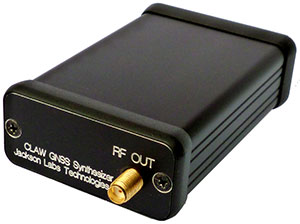
    CLAW 18-channel real-time GPS simulator for manufacturing testing, laboratory and desktop simulation applications

    The CLAW simulator operates as a fully stand-alone simulator with multipath simulation capability, external real-time NMEA to GPS-RF transcoding capability, sub 5-ns UTC time-encoding accuracy. It can work either from internally stored motion files, a fixed-position, externally applied NMEA stimulus input, or controlled via a Jackson Labs Windows application. The CLAW allows comprehensive scenarios to be set up inACKcluding uploading of custom almanac and ephemerides via RINEX import, and full control of simulation time and date making it easy to simulate GPS events such as leap seconds and week 1023 rollover events. The highly accurate simulator can be used as an embedded module to transcode modern GNSS or inertial navigation system (INS) position, navigation and timing signals including SAASM and M-code into legacy GPS RF signals. This capability allows retrofitting any existing legacy GPS receiver to the latest Assured-PNT capability. It can also be used as a GPS firewall to automatically detect and mitigate spoofing and jamming events.

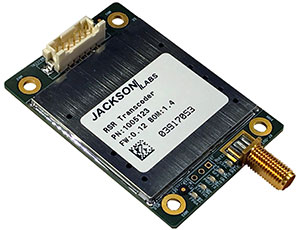
    RSR transcoder GPS simulator for retrofitting existing legacy GPS equipment to any GNSS, INS and atomic holdover capability

    The size of a postage stamp, the RSR Transcoder is based on the Jackson Labs CLAW simulator technology and is designed to be integrated into systems requiring retrofit of existing GPS legacy equipment with INS and atomic clock holdover capability, as well as the latest GNSS capability such as Galileo, GLONASS, BeiDou, SAASM, M-code and CSAC technology. Because the RSR Transcoder is fully self-contained, it also can work as a generic stand-alone GPS simulator for manufacturing environments or laboratory use. It is compatible with various external MIL-STD GPS receivers for glueless integration into existing vehicles by replacing the existing GPS antenna with the RSR Transcoder connected to an external GNSS receiver and optional high-performance INS. The RSR Transcoders ability to convert latest-generation GNSS receiver NMEA information into legacy GPS RF signals can also be used to upgrade low-performance legacy GPS receivers with modern –167 dBm and SBAS tracking capability for indoor reception and increased PNT accuracy in challenged environments.

    Said Jackson, (702) 233-1334
    www.jackson-labs.com


    RACELOGIC

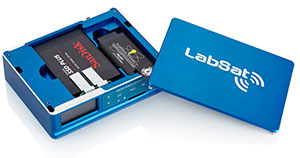
    LabSat 3 Wideband

    LabSat is a cost-effective and intuitive GNSS simulator.

    New to the LabSat range of GNSS record and replay devices is LabSat 3 Wideband, which continues with the established reliability, cost-effectiveness, and simplicity of operation that are the benchmarks of the LabSat system.

    A recording bandwidth of 56 MHz allows for the capture of a very wide range of live-sky satellite signals:

    • GPS: L1 / L2 / L5
    • GLONASS: L1 / L2 / L3
    • BeiDou: B1 / B2 / B3
    • QZSS: L1 / L2 / L5
    • Galileo: E1 / E1a / E5a / E5b / E6
    • IRNSS: L5
    • SBAS: WAAS / EGNOS / GAGAN / MSAS / SDCMx

    Depending on the desired bandwidth, recording resolution can be set to 2, 4, or 6 bit. Check out the GNSS frequency guide on the LabSat website — labsat.co.uk — to see exactly which signals can be recorded and at which resolution.

    Even with this greatly increased capacity over the original LabSat 3, the new simulator remains extremely easy to use: one-touch recording, no connection to PC required, battery powered for up to two hours, and with a removable 1-TB solid-state hard drive that can be replaced in no time, the LabSat 3 Wideband is convenient to use. It measures a compact 167 x 128 x 46 millimeters and weighs 1.2 kilograms.

    The LabSat 3 Wideband can now be controlled via a web browser. Easily accessed via the Ethernet connection, the HTML interface graphically displays bandwidth, center frequency and signal capture.

    An online demonstration of this is also available on the LabSat website.

    www.labsat.co.uk
    Phone: +44 (0)1280 823803


    SKYDEL

    SDX: Software-Defined GNSS Simulator

    SDX uses GPU-accelerated computing and software-defined radios (SDR) to create an advanced and fully-featured GNSS simulator. SDX is available as a complete turnkey system or software only, from simple test benches to 32 RF outputs test systems. The software-defined approach offers many benefits:

    • COTS hardware offers economies of scale and eliminates dependency upon dedicated hardware platforms
    • Generic hardware enables users to repurpose their equipment for different projects.
    • Uncompromised performance with high dynamics and accuracy
    • Record user interactions and export them as scripts to automate complex use cases intuitively. The export feature reduces the learning curve for advanced concepts
    • Advanced signal customization (signal signature, private encryption, etc.)

    SDX key features

    SDX is ideal for design and validation of GNSS receivers, complex integration, academic research, NAVWAR and test engineering. Applications include radiated emissions testing in anechoic chambers, CRPA testing, receiver testing under interference (jamming and spoofing), aerospace and automotive scenarios, RTK and more. Skydel engineering and research teams offer direct support to clients to ensure prompt deployment and integration, or to review advanced customization requirements.

    • Multi-constellation (GPS, GLONASS, Galileo, BeiDou, SBAS), multi-frequency (upper and lower L-band) support
    • Selectable RF, IF frequency and IQ File Data
    • Encrypted GPS codes
    • Fully-integrated jammers (static or moving) with more than 120-dB jamming-to-signal ratio
    • Multipath
    • Additive pseudorange ramps
    • Message modification and corruption
    • 1000-Hz update rate and high dynamics
    • Space (LEO-GEO), air and ground vehicle with 6DoF trajectories
    • Hardware-in-the-loop (HIL) integration
    • Raw data logging
    • Real-time receiver deviation analysis
    • Powerful and simple API
    • On-the-fly reconfiguration
    • Multiple simulator synchronization


    SPIRENT FEDERAL SYSTEMS

    GSS9000, CRPA Test System, GSS6450, GSS200D

    Spirent Federal provides test equipment that covers all applications, including research and development, integration/verification and production testing.

    GSS9000

    The Spirent GSS9000 Multi-Frequency, Multi-GNSS RF Constellation Simulator can simulate signals from all GNSS
and regional navigation systems. The GSS9000 offers a four-fold increase
in RF signal iteration rate (SIR) over Spirent’s GSS8000 simulator. The GSS9000 SIR is 1000 Hz (1 ms), enabling higher dynamic simulations with more accuracy and fidelity. It includes support for restricted and classified signals as well as advanced capabilities for ultra-high dynamics. Users can evaluate the resilience of navigation systems to interference and spoofing attacks, and have the flexibility to reconfigure constellations, channels and frequencies between test runs or test cases.

    CRPA test system

    Spirent’s Controlled Reception Pattern Antenna (CRPA) Test System generates both GNSS and interference signals. Users can control multiple antenna elements. Null-steering and space/time adaptive CRPA testing are both supported by this comprehensive approach.

    GSS6450

    The GSS6450 RF Record Playback System (RPS) takes RF recording and playback systems to a new level of performance and flexibility, while being housed in a small (8.5 x 7.8 x 3 inch) portable case. The GSS6450 can record any GNSS signals currently available with bit depths up to 16 bits (I&Q) and bandwidths of up to 50 MHz. The flexible product structure allows the system complexity to grow with the user’s testing needs.

    GSS200D

    The GSS200D is an end-to-end solution that builds up a complete picture of interference activity at the site of interest. It continuously monitors the GNSS frequency bands for interference, and then captures them for analysis. The GSS200D supports multi-frequency applications.

    Jeff Martin, [email protected]
    Kalani Needham, [email protected]
    Tyson Gurney, [email protected]

    Spirent Federal Systems
    1402 W. State Rd.
    Pleasant Grove, UT 84062

    www.spirentfederal.com
    [email protected]
    phone: 801-785-1448
    fax: 801-785-1294


    SYNTONY GNSS

    CONSTELLATOR, ECHO

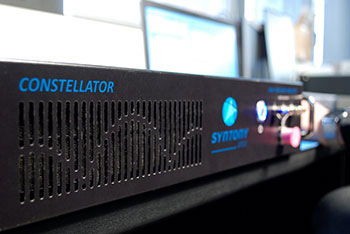
    Constellator is a high-end GNSS simulator capable of supporting all constellation signals available today and tomorrow and providing a high level of service: standalone mode (on ground and in space), hardware-in-the-loop mode with very small latency and high internal frequency update (1 kHz), multi-frequency, up to 200 channels, all typical synchronization interfaces, and the ability to generate any additional signal for realistic simulation (jamming, spoofing, multipath, etc.).

    The Constellator product is available in different ranges, from an entry-level unit supporting L1C/A up to a six-signal-frequencies/200 channels rack, supporting the most demanding configurations.
    Constellator is used extensively in the aeronautic, space and defense industries, where the requirements are highly demanding. Constellator has been carefully evaluated and selected by major industrial companies and agencies worldwide, and is used to test aircraft receivers, spacecraft, launchers and similar systems for defense and armies. Particularly in the space domain, Constellator implements the most accurate models (earth gravity, drag, etc.) needed to achieve “meter-precision” in standalone mode around a complete orbit.

    Constellator is based on modern, powerful software-defined radio (SDR) systems, which make it capable of extreme adaptability and upgradeability after purchase, even without any hardware upgrade. Though a high-end simulator, it is cost-effective because of its software-based architecture; instead of requiring one RF stage per signal, it requires just one per frequency band used.

    The Echo Record and Playback unit allows users to record real-life signals and environments and replay them in the laboratory, which is always more realistic than any simulation.

    Echo is typically used to replay predefined complex and very long realistic scenarios, avoiding the need to use costly satellite simulators for long-run tests or for production tests.

    Echo offers three RF channels of 100-Mhz bandwidth each, 16 bits I, 16 bits Q, and more than 10 hours of record and replay duration. As such, it is high-end record/replay equipment, offering high-end replay fidelity.

    www.syntony-gnss.com
    Email: François Goudenove, chief sales officer, [email protected] (ask François for the contacts of distributors in the U.S., Europe, India, China, South Korea, Japan.)
    Phone: +33.5.81.319.919


    TALEN-X

    BroadSim and PANACEA

    BroadSimSoftware-defined GNSS simulator

    • Intuitive control using Skydel’s SDX software interface
    • Model true and spoofed signals
    • Generate high-fidelity jamming and interference signals
    • Utilize 4 RF outputs with multiple simultaneous constellations
    • Generate and simulate multiple signal types
    • GPS: L1 (C, C/A, P, Y, AES-M), L2 (C, P, Y, AES-M), L5
    • GLONASS: G1, G2
    • Galileo: E1, E5a/b
    • BeiDou: B1, B2
    • SBAS

    PANACEA

    Autonomous PNT performance and vulnerability test suite

    • Simultaneously control, collect and analyze data from up to 32 units under test (UUT) in real time
    • Compatible with 100+ different receiver brands
    • Manages receiver communication, standardizes output for easy post-test analysis
    • Time synchronization to live-sky
    • Simulate dynamic scenarios with parameters such as jamming patterns, motions, power loss, delays and more

    www.talen-x.com
    Email: [email protected]

    OROLIA/SPECTRACOM

    All constellations, all frequencies

    For users responsible for mission-critical positioning, navigation and timing (PNT) applications, the Spectracom GSG series of GPS/GNSS simulators is an essential tool to evaluate risk of jamming, spoofing or other threats.

    Spectracom GSG-5/6 series simulators are an easy-to-use and feature-rich way to harden GPS-based systems without the limitations of testing from “live sky” signals. The Spectracom platform approach allows users to buy only what they need today and upgrade later. The adaptability of the GNSS RF generation platform can extend to applications for intelligent repeating.
    Test solutions

    • Position accuracy and dynamic range/sensitivity
    • Simulate movements/trajectories anywhere on or above Earth
    • Sensitivity to GPS impairments: loss of satellites, multipath, atmospheric conditions, interference, jamming and spoofing
    • Conducted or over-the-air RF
    • GPS time-transfer accuracy
    • Effect of leap-second transition
    • Multi-constellation testing
    • Modernization signals/frequencies
    • Keyless military SAASM, dual-frequency and survey-grade receiver testing
    • Application packages for RTK, CRPA (controlled radiation pattern antennas)
    • Hardware-in-the-loop integration
    • Test solutions for eCall and ERA-GLONASS

    Infrastructure possibilities

    • Zone-based indoor location (intelligent repeating)
    • Pseudolite applications

    The GSG-6 Series 64-channel multi-frequency, advanced GNSS simulator is powerful enough for any cutting-edge test program. GPS, GLONASS, Galileo, Beidou, QZSS and NAVIC (IRNSS) signals are available across multiple frequencies. It is designed for military, research and professional applications.

    The GSG-5 Series 16-channel multi-constellation L1-band GNSS simulator is designed for commercial development/integration programs. For users developing commercial products with GNSS capability, the GSG-5 will shorten test programs with confidence.

    The GSG-51 single-channel signal generator is designed for one purpose — fast, simple go/no-go manufacturing test and validation, ensuring the manufacturing line is operating at full capacity with confidence in quality.

    spectracom.com
    E-mail: [email protected]
    Phone: +1-585-321-5800

  • Spirent adds BeiDou-3 to its GNSS RF simulators

    The Spirent GSS9000 simulator.

    GNSS testing solutions company Spirent Communications has added BeiDou Phase 3 signals to its GNSS RF constellation simulators.

    BeiDou Phase 3 signals are available immediately on the GSS7000 and GSS9000 simulators, and existing users can obtain the software upgrade by contacting Spirent.

    The addition of these new signals to the GSS7000 and GSS9000 simulators follows the launch of the first two Beidou-3 satellites in November 2017. Two others were launched Jan. 12.

    Phase 3 of the Chinese BeiDou system will extend its coverage from Asia to the entire world. It will provide receiver developers and integrators with additional GNSS signals to make positioning, navigation and timing systems more accurate, and help to support new applications, such as autonomous vehicles.

    The new signals will use the same carrier frequencies as the GPS and Galileo systems, so chipset manufacturers and device developers will need to test integrated designs to avoid problems caused by confusing data from different GNSS.

    “By offering the BeiDou Phase 3 signals, our customers can test their designs well before the system is fully operational, which is expected in 2020,” said Stuart Smith, lead product manager at Spirent Communications. “With signals already starting to appear, it is important for developers to have test tools that can ensure devices will successfully make use of all GNSS signals.”

    To learn more about how to test devices for multi-GNSS, Spirent offers a white paper,  “Preparing for Multi-Frequency GPS/GNSS in Consumer Devices.”

  • What does ION GNSS+ reveal about the GNSS industry?

    What does ION GNSS+ reveal about the GNSS industry?

    Back again in Portland, Oregon, the 2016 Institute of Navigation’s ION GNSS+ conference was a great opportunity for the GNSS community to catch up on what’s been cooking in the industry, and of course who’s been doing what in the research community.

    The attendees eagerly took to a wide range of technical paper presentation sessions, and from time to time came to take a look at what industry had to offer on the exhibit floor. Lots of engaging research reports, from work undertaken over the last year by academia, again drew a significant number of attendees from around the world.

    On the other hand, industry continued the trend to go to trade shows in application sectors and pull back somewhat from ION GNSS+ as a place to look for product sales. So the number of companies on the ION show floor remained around the same or maybe a little less than in the previous few years. Nevertheless, the quality of the companies exhibiting remained high and there were some interesting newcomers.

    A number of major GNSS receiver manufactures have pulled back from ION, so there were only two established U.S. companies and two new U.S. entrants at the show. On the other hand, GNSS simulation companies were at ION in force — eight all told, or twice as many as the receiver manufacturers present who have been their historic customers. But the trend in GNSS simulation now appears to be to move down stream towards the needs of integrators and systems outfits — in segments such as automotive, UAV and agriculture — with lower cost, very capable simulators.

    Receiver makers roll out new tech

    As a consequence, the NovAtel and Septentrio booths got a lot of attendee traffic, while BDStar (Unicore receivers and Harxon antennas) and ComNav also had a number of visitors to their booths. As usual, NavTech, who represent almost all the manufacturers, also had a busy exhibit.

    OEM7600 dual-frequency receiver.
    OEM7600 dual-frequency receiver.

    NovAtel chose to launch its OEM-7 series of GNSS receivers and a newly designed VEXXIS high-precision antenna at ION GNSS+, which is a somewhat refreshing return to the ION GNSS+ launch platform we used to see in the past. A new highly integrated ASIC at the heart of this receiver now provides, amongst other features, 555 channels, L-band support, inertial SPAN capability and an intriguing “Interference Toolbox”. The toolbox enables integrators to localize interference effects over a wide band — especially helpful for densely packed electronics, which you might expect in a UAV, for instance.

    Interference Toolbox Screenshot.
    Interference Toolbox Screenshot.

    Septentrio didn’t have a whole lot of new product announcements, but as usual the company has been working hard at improving existing capabilities on its receivers. The AsteRx4 receiver that uses a new ASIC has been available for a while, but it too boasts 544 channels — perhaps too many to actually be used in practice — robust heading, centimeter-level RTK and decimeter-level PPP (with TerraStar and Veripos corrections) with dual L-band channels, and an improved suite of advanced interference mitigation (AIM+) capabilities. This helps detection and removal of the effects of “chirp jamming” from low-power “cigarette-lighter” jammers — using signal analysis and adjustment of adaptive notch filters.

    Septentrio did announce a new PolaRx5TR packaged time-and-frequency transfer receiver and a contract with the Jet Propulsion Laboratory (JPL) for reference stations and timing. A report by UNAVCO also found its way into my inbox, which related comparative testing of the PolaRx5 and other manufacturers’ receivers in connection with a UNAVCO RFP – Septentrio did O.K. and was selected as a preferred vendor, which no doubt influenced the JPL award and added to an already good first half year for the company.

    The Septentrio PolaRX5TR.
    The Septentrio PolaRX5TR.

    BDStar had a range of GPS, GLONASS, Beidou receivers from its subsidiary Unicorecomm, along with an impressive selection of antennas from Harxon, another of its Chinese subsidiaries. Both product lines have done very well in the Chinese market, and BDStar would like to sell more in North America.

    ComNav also displayed a similar range of GNSS receivers and antennas, with new versions of both since last year, and a strong desire to break through into the US market.

    Simulators a big presence

    Simulator companies at ION included the more established Spirent, Spectracom, CAST, IFEN and Rohde & Schwarz — we could even now consider RaceLogic/LabSat as a record-and-playback fixture in the market. But in the wings and making lots of waves at the show were Syntony from France and Skydel from Montreal, Canada.

    Spirent brought its usual large-scale GNSS simulators to ION, but also featured an interference detection and software analysis suite, a 16-bit high-fidelity record/playback unit, along with a new multi-frequency simulator aimed at downstream integrators. The GSS200D Detector finds interference effects and is able to relate them to the threats in the environment around a receiver. The object is to help debug an installation by finding internal interferers. The analysis tools can also help differentiate between regular equipment interference and potential external jammers.

    Spirent's new GSS200D detector.
    Spirent’s new GSS200D detector.

    Spirent also displayed a record/playback unit that has 16-bit playback capability, enabling a user to record and review a particular interference event, and then feed their new commercial simulator in order to replicate the interference. So a passing isolated jamming event can be analyzed in detail. Multiple reruns are possible to confirm the effect on the target system, and following equipment modifications, prove that the problem has indeed been neutralized.

    Spirent analysis tools.
    Spirent analysis tools.

    RaceLogic introduced its new wideband LabSat 3 record/playback system for GPS L1, GLONASS L1, Galileo E1, BeiDou B1, QZSS and SBAS. Recording live signals for any or all of these signals then allows later playback of a canned sample for equipment debugging on the bench. The LabSat product line has been around for some time, and this addition increases the debug capability for downstream users at an affordable price in a very portable format. When used with the RaceLogic SatGen software system, the user has access to a powerful toolset for testing new GNSS devices.

    labsat-real-time-w
    LabSat 3 and SatGen test set-up.

    Spectrcom displayed its multi-frequency, multi-constellation simulator and also featured a GNSS vulnerability test system for interference detection and system debugging. The company’s approach requires two simulators, both synchronized by an atomic clock, allowing a PC-based Test Scenario Control to generate reproducible interference effects for debugging.

    CAST Navigation is already moving downstream quite quickly with its CAST-SGX handheld GNSS simulator. With a touchscreen display, this simplified L1 GPS simulator (with P-code option) is ideal for test-bench debugging.

    Rohde & Schwarz had its usual array of high-end test equipment, with a test set-up aimed at demonstrating testing of a Wi-Fi indoor location application on a smartphone.

    rohdeschwarz-test-slide

    IFEN showed up with a completely re-engineered simulator with huge frequency/channel capacity. The Titan GNSS Simulator houses up to 8 RFSIM modules, each of which carries 32 configurable satellite signals. A fully configured Titan chassis can therefore provide 256 channels of GPS L1/L2/L5, GLONASS G1/G2/G3, Galileo E1/E5/E6, Beidou B1/B2/B3, IRNSS L5 and S-band, QZSS L1/L2/L5/LEX and all current L1/L5 SBAS signals. Titan also has up to four independent RF outputs.

    IFEN Titan GNSS Simulator.
    IFEN Titan GNSS Simulator.

    Skydel is one of the newcomers in GNSS simulation, but has made significant inroads first appearing last year at ION. Skydel now boasts a full-up, reconfigurable GPS, GLONASS, Galileo, Beidou “software” simulator which the company claims to sell at a 1/3 the price of a conventional hardware simulator. And during the year, Skydel teamed up with Talen-X in Ohio, who have embedded Skydel software-defined in a U.S.-sourced GPS/GLONASS/Galileo/Beidou simulator that can include GPS P/Y and M-code.

    Broadsim from Talen-X powered by Skydel.
    Broadsim from Talen-X powered by Skydel.

    Syntony rises high by going under (the ground)

    The noise in simulation at ION was, however, created by Syntony from Toulouse in France. Syntony recently won a 15-simulator order from OneWeb — the outfit that plans to launch a 640 internet connectivity satellite constellation through 2020. With funding secured from Virgin Group and Qualcomm in 2015, initial satellite build is underway at Airbus Defence and Space, launch services are contracted with Arianespace to provide 21 multi-sat launches on Soyuz beginning in 2017 with optional launch service with Virgin Galactic. So Syntony is likely going to be able to build, deliver and be paid for its 15 simulators, which will be used for testing GPS capability that is integrated into each comms satellite.

    Syntony 128-channel GNSS Simulator "Constellator."
    Syntony 128-channel GNSS Simulator “Constellator.”

    Syntony’s simulator is also software-defined and is reconfigurable. The software-defined heart of this system comes from a Syntony GPS/Galileo receiver, and a version of this receiver has now been sold for use in the Airbus Adeline re-usable space module. This receiver is a “multi-antenna receiver” in order to avoid signal or tracking loss while switching between antennas during the Safran launcher rotation. The catch here is that Syntony must develop this receiver to Airbus critical airborne software=qualification standards — no mean feat! Syntony is also providing a version of its Constellator simulator for testing this multi-antenna input receiver.

    An ECHO record/playback system is also available, which includes high-fidelity 16-bit RF outputs.

    Finally, Syntony was able to capture a proof-of-concept location infrastructure project for Stockholm, Sweden’s, underground metro. The metro stations are pretty deep underground, as they have been dug under the sea in and around Stockholm, and no one had been able to come up with a system that would enable emergency 911 calls with associated essential localized position information to be carried from within the stations. Syntony was able to provide a GPS-like signal infrastructure at the stations which is compatible with GPS-enabled smartphones. It worked well, and Syntony verified that there was no radiation of the signal outside any of the entrances to the test station — so no GPS interference. It actually worked so well that Syntony got the contract to equip all 50 metro stations in Stockholm, and the Syntony is now working to spread its system around the metros of all major cities, worldwide.

    Defining the Galileo PRS signal…

    Then I came across Fraunhofer towards the end of the show, and their posters about a Galileo PRS (Public Regulated Service) receiver. Now, we know that there has been significant discussion between the different security services of countries across the European Union, and its taken a lot of time to get to a definition of the PRS signal and who has access. So it wasn’t surprising that there was no hardware on the Fraunhofer booth; what’s surprising is that there was any mention of such a receiver being available and telling attendees at a conference in the U.S. that it’s available.

    I talked to a couple of people at their booth, and indeed there is such a receiver, but they really couldn’t tell me anything about it because telling is strictly verboten! Another strange anomaly of the Galileo program — the participants seem to want to let the U.S. know that they have the capability for a special access service, and a receiver is available to work with it, but they can’t tell us anything about it. I guess the idea may be to rattle the cage of the U.S. P-code/M-code guys, and let them know Galileo has caught up at last… But Fraunhofer has an idea of how to make things available to, well, err …. to somebody. They have a concept to have cellphone users who want PRS to connect with their cloud receiver, and they will decode and provide PRS position back over the internet. That solves the whole security thing…. OK, that should do it.

    Where inertial stands

    I also made the rounds of the inertial and inertial/GPS guys at the show, and there were quite a few. From Northrop Grumman and Systron Donner and their mil-spec high-end FOG and RLG and Quartz MEMS tube-shaped inertial units — could they be for shells or missiles? — to Silicon Sensing’s MEMS accels and gyros and their move out of automotive and towards high-precision performance, to Sensonor’s high-performance commercial MEMS/GNSS units, there were actually only a few of the inertial-aiding outfits present. Yet everything we hear is that for anything that moves, we really should use integrated inertial/GNSS, and UAVs especially want lots of that! So this part of the business looks to be quite healthy too…

    Now another ION GNSS+ conference has come and gone — and I was reminded that maybe I’ve actually been to 95 percent of the ION September conferences over the last 30 years. And as I write, the last of the late Friday paper sessions are crawling to a close.

    ION still remains a good place to come and learn, a place to meet industry colleagues and a place to see a little of what industry is up to. Definitely worth the trip, and don’t forget your business cards next year.

    Tony Murfin
    GNSS Aerospace

  • Averna Emulator Receives Four-Diamond Ranking from Cable Industry

    Averna, developer of test solutions and services for communications and electronics device-makers worldwide, today announced it has received a Broadband Technology Report (BTR) Diamond Technology Review ranking of 4 “Diamonds” for its DOCSIS Channel Emulator (DCE).

    Now in its ninth year, the BTR Diamond Technology Reviews is a renowned industry program that was developed to recognize some of the top products and solutions available to the cable industry as determined by a distinguished panel of cable telecommunications engineering experts. Engineering executives from Boyer Broadband, Time Warner Cable, Bright House Networks, Suddenlink Communications, Comcast, Charter and Cox were among the third-party judges for the 2013 Diamonds. The judges had this to say about Averna’s DCE:

    • “A handy and cost-effective solution for equipment manufacturers to test and validate new DOCSIS products that use bonded channels. MSOs may also have an interest in the product for validating new modem modulation profiles or their own internal product validation efforts.”
    • “Improved DOCSIS performance testing capabilities, at lower cost and with smaller footprint, for equipment manufacturers and network operators.”
    • “A creative way to test DOCSIS networks.”

    Averna’s DOCSIS Channel Emulator (DCE) is a small-footprint channel-emulation platform that helps device makers ensure that their DOCSIS and EuroDOCSIS products deliver optimum performance in the field. It is capable of acquiring, impairing and generating up to 24 downstream (DS) channels in real time.

    The DCE’s flexible FPGA-based design is powered by National Instruments’ vector signal transceiver (VST), which enables Averna to increase the number of supported channels without increasing the DCE’s hardware footprint. The DCE helps users ensure that their equipment meets standards such as the SCTE 40 specifications or MSO-specific configurations. Furthermore, the DCE’s software-based approach and modular architecture protect the client’s investment, allowing them to easily cover both current and future test needs.

    “We are proud to achieve such a high score in the Diamond Technology Reviews,” said Jean-Levy Beaudoin, VP Sales, West USA and Latin America, for Averna. “As the DOCSIS industry moves to high channel counts, the DOCSIS Channel Emulator is the first test instrument specifically developed for this new environment, enabling testing that was not economically and technically possible before. Broadband device makers can now increase test coverage and accelerate testing, improving product quality and time-to-market.”

  • Racelogic Wins Two Queen’s Awards for Enterprise

    Simulator company Racelogic, based in the United Kingdom, has been honored with two 2012 Queen’s Awards for Enterprise. The awards were given April 21 to 209 companies to mark Queen Elizabeth’s birthday. Racelogic was one of four companies to be honored with the awards for both Innovation and International Trade.

    Racelogic won the Innovation award for advances in GPS/GLONASS test simulation, with customers such as Broadcom, ST-Ericsson, and Telefonica using LabSat to test their devices.

    Almost 90% of Racelogic’s sales are now to countries other than the UK, with customers in 92 countries around the world. Racelogic received the International Trade Award to recognize this achievement.

    “We are extremely proud to be named as a winner of these two awards, with many highly reputable companies in the UK competing for these honors,” Racelogic’s CEO, Graham Mackie, said. “As a company we continue to grow and now employ more than 50 people in the UK alone. We have distributors located all over the world who help us to market and sell our systems to a wide variety of markets and customers.”

    All winners will be invited to collect their awards at a reception hosted by the Queen in Buckingham Palace later this year.

  • Higher Timing Accuracy, Lower Cost

    Higher Timing Accuracy, Lower Cost

    AURORA BOREALIS seen from Churchill, Manitoba, Canada. Ionospheric scintillation research can benefit from this new method.
    AURORA BOREALIS seen from Churchill, Manitoba, Canada. Ionospheric scintillation research can benefit from this new method. (Photo: Aiden Morrison)
    tank
    Photo: Canadian Armed Forces

    By Aiden Morrison, University of Calgary

    Two broad user groups will find important consequences in this article:
    • Time synchronization and test equipment manufacturers, whose GPS-disciplined oscillators have excellent long-term performance but short- to medium-term behavior limited by the quality, and therefore cost, of the integrated quartz device. This article portends a family of devices delivering oven-controlled crystal oscillator (OCXO) performance down to the 10-millisecond level, with an oscillator costing pennies, rather than tens or hundreds of dollars. Applications include ionospheric scintillation research (above).
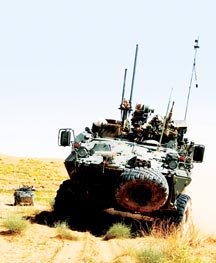
    • High-performance receiver manufacturers who design products for high-dynamic or high-vibration environments (see cover) where the contribution of phase noise from the local oscillator to velocity error cannot be ignored. In these areas, the strategy outlined here would produce equipment that can perform to higher specifications with the same or a lower-cost oscillator.
    The trade-off requires two tracking channels per satellite signal, but this should not pose a problem. At ION GNSS 2009, manufacturers showed receivers with 226 tracking channels. There are currently only 75 live signals in the sky, including all of GPSL1/L2/L5 and GLONASS L1/L2. — Gérard Lachapelle

    If the channel data within a GNSS receiver is handled in an effective manner, it is possible to form meaningful estimates of the local-oscillator phase deviations on timescales of 10 milliseconds (ms) or less. Moreover, if certain criteria are met, these estimates will be available with related uncertainties similar to the deviations produced by a typical oven-controlled crystal oscillator (OCXO). The processing delay required to form this estimate is limited to between 10 and 20 ms. In short, it becomes possible in near-real-time to remove the majority of the phase noise of a local oscillator that possesses short-term instability worse than an OCXO, using standalone GNSS. This represents both a new method to accurately determine the Allan deviation of a local oscillator at time scales previously impractical to assess using a conventional GNSS receiver, and the potential for the reduction in observable Doppler uncertainty at the output of the receiver, as well as ionospheric scintillation detection not reliant on an expensive local OCXO.

    Concept. Inside a typical GNSS receiver, the estimate of the error in the local oscillator is formed as a component of the navigation solution, which is in turn based on the output of each satellite-tracking channel propagating its estimate of carrier and code measurements to a common future point. While this method of ensuring simultaneous measurements is necessary, it regrettably limits the resolution with which the noise of the local oscillator can be quantified, due to the scaling of non-simultaneous samples of local oscillator noise through the measurement propagation process. To bypass these shortcomings requires a method of coherently gathering information about the phase change in the local oscillator across all available satellite signals: to use the same samples simultaneously for all satellites in view to estimate the center-point phase error common across the visible constellation.

    To explain how this is feasible, we must first understand the limitations imposed by the conventional receiver architecture, with respect to accurately estimating short-term oscillator behavior, and subsequently to determine the potential pitfalls of the proposed modifications, including processing delays needed for bit wipe-off, expected observation noise, and user dynamics effects.

    Typical Receiver Shortfalls

    In a typical receiver, while information about local time offset and local oscillator frequency bias may be recovered, information about phase noise in the local oscillator is distorted and discarded, as a consequence of scaling non-simultaneous observations to a common epoch.

    As shown in FIGURE 1, coherent summation intervals in a receiver are used to approximate values of the phase error, including oscillator phase, measured at the non-simultaneous interval centrers in each channel, which are then propagated to a common navigation solution epoch. Each channel will intrinsically contain a partially overlapping midpoint estimate of oscillator noise over the coherent summation interval that will then be scaled by the process of extrapolation. As these estimates are scaled and partially overlapping, they do not make optimal use of the information known about the effects of the local oscillator, and form a poor basis for estimating the contributions of this device to the uncertainty in the channel measurements. As shown in Figure 1, the phase error measured in each channel will be distorted by an over unity scaling factor.

    FIGURE 1. Propagation and scaling of phase estimates within a typical receiver.
    FIGURE 1. Propagation and scaling of phase estimates within
    a typical receiver.

    Depending on implementation decisions made by the designers of a given GNSS system, the average value of the propagation interval relative to the bit period will have different expected values. Assuming the destination epoch is the immediate end of the furthest advanced (most delayed) satellite bitstream, and that integration is carried out over full bit periods, the minimum propagation interval for this satellite would be ½-bit period.

    For the average satellite however, the propagation delay would be this ½-bit period plus the mean skew between the furthest satellite and the bitstreams of other space vehicles. Ignoring further skew effects due to the clock errors within the satellites, which are typically limited well below the ms level, the skew between highest and lowest elevation GPS satellites for a user on the surface of earth would be approximately 10 ms. The average value of this skew due to ranging change over orbit, assuming an even distribution of satellites in the sky at different elevation angles, would therefore be 5 ms.

    Combining the minimum value of the skew interval with the minimum propagation interval of the most delayed satellite yields a total average propagation interval of 15 ms. In turn, this gives a typical scaling factor of 1.75, used from this point forward when referring to the effects of scaling this quantity.

    Proposed Implementation

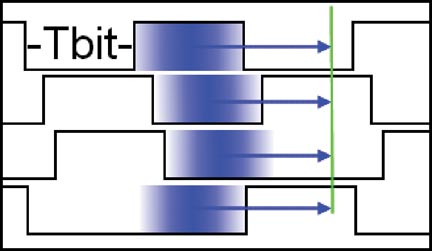
    Overcoming limitations of a typical receiver requires recording the approximate bit-timing and history of each tracked satellite as well as a short segment of past samples. This retained data guarantees that the bit-period boundaries of the satellites will not pose an obstacle to forming common N-ms coherent periods between all visible satellites, over which simultaneous integration may proceed by wiping off bit transitions. Using this approach as shown in FIGURE 2, all available constellation signal power is used to estimate a single parameter, namely the epoch-to-epoch phase change in the local oscillator.

     FIGURE 2. Common intervals over which to accurately estimate local oscillator phase changes.
    FIGURE 2. Common intervals over which to accurately estimate local oscillator phase changes.

    Having viewed the existence of these common periods, it becomes evident that it is conceptually possible to form time-synchronized estimates of the phase contribution of the common system oscillator alternately across one N-ms time slice, then the next, in turn forming an unb
    roken time series of estimates of the phase change of the system oscillator. Forming the difference between the adjacent discriminator outputs will provide the following information:

    • The ΔEps (change in the noise term in the local loop)
    • The ΔOsc (change in the phase of the local oscillator, the parameter of interest)
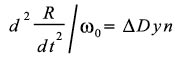
    • The ΔDyn (change in the untracked/residual of real and apparent dynamics of the local loop/estimator)

    Noticing that term 1 may be considered entirely independent across independent PRNs (GPS, Galileo, Compass) or frequency channels (GLONASS), and that the value of term 3 over a 10-ms period is expected to be small over these short intervals, it becomes obvious that term 2 can be recovered from the available information. To determine the weighting for each satellite channel, the variance of the output of the discriminator is needed.

    Performance Determination

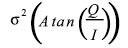
    To allow the realistic weighting of discriminator output deltas, it becomes desirable to estimate at very short time intervals the variance of the output of the phase discriminator. In the case of a 2-quadrant arctangent discriminator, this means one wishes to quantify the variance

    E-1

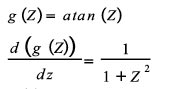
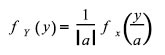
    Letting Q/I 5 Z, recall that if Y 5 aX then

    E-2

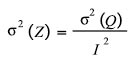
    Applying this to the variance of the input to the arctangent discriminator in terms of the in phase and quadrature accumulators, this would give

    E-3

    Rather than proceed with a direct evaluation from this point onward to determine the expression for the variance at the output of the discriminator, it is convenient to recognize that simpler alternatives exist since

    E-4

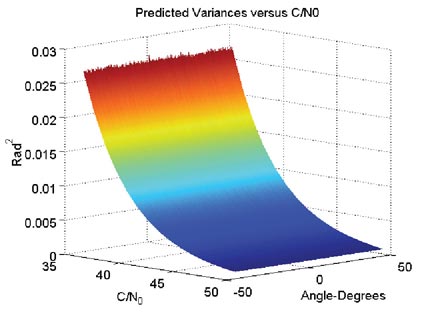
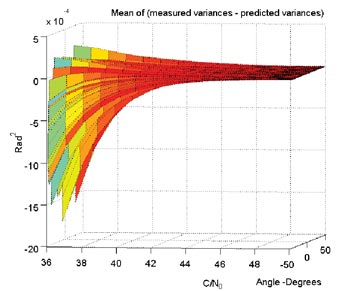
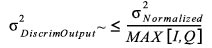
    The implication is that since the slope of the arctangent transfer function is very nearly equal to 1 in the central, typical operating region, and universally less than 1 outside of this region, it is easy to recognize that the variance at the output of the arctangent discriminator is universally less than that at the input, and can be pessimistically quantified as the variance of the input, or  σ2(Z). This assumption has been verified by simulation, its result shown in FIGURE 3, where the response has been shown after taking into account the effect of operating at a point anywhere in the range ±45 degrees. While the consequence of the simplification of the variance expression is an exaggeration of discriminator output variance, FIGURE 4 shows output variance is well bounded by the estimate, and within a small margin of error for strong signals.

    FIGURE 3. Predicted variances at the output of the ATAN2 discriminator versus C/N0.
    FIGURE 3. Predicted variances at the output of the ATAN2
    discriminator versus C/N0.
     FIGURE 4. Difference between actual and predicted variance at output of discriminator.
    FIGURE 4. Difference between actual and predicted variance at output of discriminator.

    The gap between real and predicted output variance may also be narrowed in cases where Q>I by using a type of discriminator which interchanges Q and I in this case and adds an appropriate angular offset to the output as

    E-5

    Proceeding in this vein, the next required parameter is the normalized variance of the in-phase and quadrature arms.

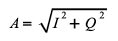
    The carrier amplitude A can be roughly approximated as

    E-6

    Resulting in a carrier power C

    E-7

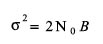
    Further, the noise power is given as

    E-8

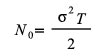
    Expressing bandwidth B as the inverse of the coherent integration time, and rearranging now gives noise density N0 as

    E-9

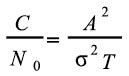
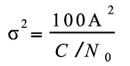
    Combining this expression, and the one previously given for the carrier power C results in the following expression for the carrier to noise density ratio:

    E-10

    This latest expression can be rearranged to find the desired variance term. Assuming the 10-ms coherent integration time discussed earlier is used, this yields

    E-11

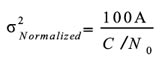
    Normalizing for the carrier amplitude gives the normalized variance in terms of radians squared:

    E-12

    In any situation where the carrier is sufficiently strong to be tracked, it is likely that the carrier power term employed above can be gathered from the immediate I and Q values, ignoring the contribution of the noise term to its magnitude.

    Oscillator Phase Effect. Determining the expected magnitude of the local oscillator phase deviation requires only three steps, assuming that certain criteria can be met. The first requirement is that the averaging times in question must be short relative to the duration, at which processes other than white phase and flicker phase modulation begin to dominate the noise characteristics of the oscillator. Typically the crossover point between the dominance of these processes and others is above 1 s in averaging interval length, when quartz oscillators are concerned. Since this article discusses a specific implementation interval of 10 ms within systems expected to be using quartz oscillators, it is reasonable to assume that this constraint will be met.

    The second requirement is that the Allan deviation of the given system oscillator must be known for at least one averaging interval within the region of interest. Since the Allan deviation follows a linear slope of -1 with respect to averaging interval on a log-log scale within the white-phase noise region, this single value will allow an accurate prediction of the Allan deviation at any other point on the interval and, in turn, of the phase uncertainty at the 10 ms averaging interval level.

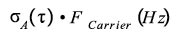
    Letting σΔ(τ) represent the Allan deviation at a specific averaging interval, recall that this quantity is the midpoint average of the standard deviation of fractional frequency error over the averaging interval τ. Scaling this quantity by a frequency of interest results in the standard deviation of the absolute frequency error on the averaging interval:

    E-13

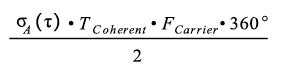
    By integrating this average difference in frequency deviations over the coherent period of interest, one obtains a measure of the standard deviation in degrees, of a signal generated by this reference:

    E-14

    Note that the averaging interval τ must be identical to the coherent integration time.

    Turning to a practical example, if the oscillator in question has a 1 s Allan Deviation of 1 part per hundred billion (1 in 1011), a stability value between that of an OCXO and microcomputer compensated crystal oscillator (MCXO) standard, and shown to be somewhat pessimistic, this would scale linearly to be 1e-9 at a 10-ms averaging interval, under the previous assumption that the oscillator uncertainty is dominated by the white phase-noise term at these intervals. Also, for illustration purposes, if one assumes the carrier of interest to be the nominal GPS L1 carrier, the uncertainty in the local carrier replica due to the local oscillator over a 10-ms coherent integration time becomes

    E-15

    When stated in a more readily digested format, this represents roughly 15 centimeter/second in the line-of-sight velocity uncertainty. In an operating receiver, two additional factors modify this effect. The first is the previously discussed scaling effect that will tend to exaggerate this effect by a typical factor of 1.75, as previously discussed. The second factor is that this noise contribution is filtered by the bandwidth-limiting effects of the local loop filter, producing a modification to the noise affecting velocity estimates, as well as reduced information about the behaviour of the local oscillator.

    Impact of Apparent Dynamics. When considering the error sources within the system, it is important to realize which individual sources of error will contribute to estimation errors, and which will not. One area of potential concern would appear to be the errors in the satellite ephemerides, encompassing both the satellite-orbit trajectory misrepresentation and the satellite clock error. While the errors in the satellite ephemerides are of concern for point positioning, they are not of consequence to this application, as the apparent error introduced by a deviation of the true orbit from that expressed in the broadcast orbital parameters does not affect the tracking of that satellite at the loop level.

    Additionally, while the satellite clock will add uncertainty to the epoch-to-epoch phase change within each channel independently, the magnitude of this change is minimal relative to the contribution of uncertainty due to the variance at the output of the discriminator guaranteed by the low carrier-to-noise density ratio of a received GNSS signal. Since this contribution is uncorrelated between satellites and relatively small compared to other noise contributions affecting these measurements, even when compared to the soon-to-be-discontinued Uragan GLONASS satellites that had generally less stable onboard clocks, it is likely safe to ignore. When compared to the more stable oscillators aboard GPS or GLONASS-M satellites, it is a reasonable assumption that this will be a dismissible contribution to received signal-phase uncertainty change.

    While atmospheric effects present an obstacle which will directly affect the epoch-to-epoch output of the discriminators, it is believed that under conditions that do not include the effects of ionospheric scintillation the majority of the contribution of apparent dynamics due to atmospheric changes will have a power spectral density (PSD) heavily concentrated below a fraction of 1 Hz. The consequence of this concentration is that the tracking loops will remove the vast majority of this contribution, and that the difference operator that will be applied between adjacent phase measurements, as in the case of dynamics, will nullify the majority of the remaining influence.

    Impact of Real Dynamics. Real dynamics present constraints on performance, as do any tracking loop transients. For example, a low-bandwidth loop-tracking dynamics will have long-lasting transients of a magnitude significant relative to levels of local oscillator noise. For this reason it is necessary to adopt a strategy of using the epoch-to-epoch change in the discriminator as the figure of interest, as opposed to the absolute error-value output at each epoch. This can reasonably be expected to remove the vast majority of the effects of dynamics of the user on the solution.

    To validate this assumption under typical conditions calls for a short verification example. Assuming the use of a second-order phase-locked loop (PLL) for carrier tracking, with a 10-Hz loop bandwidth the effects of dynamics on the loop are given by these equations:

    Letting Bn be 10 Hz, one can write

    E-16

    Recall that the dynamic tracking error in a second-order tracking loop is given by

    E-17

    Given the choices above, this would result in a constant offset of 0.00281 cycles, or 1.011 degrees of constant tracking error due to dynamics, following from the relation between line-of-sight acceleration and loop bandwidth to tracking error. Since this constant bias will be eliminated by the difference operator discussed earlier, it is necessary to examine higher order dynamics.

    Further, if one used a coherent integration interval of 10 ms as assumed earlier, and let the dynamics of interest be a jerk of 1 g/s, this results in a midpoint average of 0.005 g on this interval:

    Eq-18

    Substituting this result into equation 16 produces the associated change in dynamic error over the integration interval, which is in this case:

    E-19

    This value will be kept in mind when evaluating capabilities of the estimation approach to determine when it will be of consequence. As the estimation process will be run after a short delay, an existing estimate of platform dynamics could form the basis of a smoothing strategy to reduce this dynamic contribution further.

    Estimated Capabilities

    In the absence of the influence of any unmodeled effects, the expected performance of this method is dependent on only the number of satellite observables and their respective C/N0 ratios. Across each of these scenarios we assume for simplicity’s sake that each satellite in view is received at a common C/N0 ratio and over a common integration period of 10 ms.

    If the assumption of minimal dynamic influences is met, the situation at hand becomes one in which multiple measures of a single quantity are present, each containing independent (due to CDMA or FDMA channel separation) noise influences with a nearly zero mean. When one can express the available data form:

    x[n] = R + w[n]

    where x[n] is the nth channel discriminator delta which includes the desired measure of the local oscillator delta (R), as well as w[n], a strong, nearly white-noise component, there are multiple approaches for the estimation of R.

    The straightforward solution to estimate R in this case is to use the predicted variances of each measure to serve as an inverse weighting to the contribution of each individual term, followed by normalization by the total variance, as expressed by

    E-20

    Now, since it is desired to bound the uncertainty of the estimate of R, the variance of this quantity should also be noted. This uncertainty can be determined as

    E-21

    To determine the performance of the estimation method for a given constellation configuration, with specific power levels and available carrier signals, it is necessary to utilize the predicted variances plotted in Figure 3 as inputs to equations 20 and 21. To provide numerical examples of the performance of this method, three scenarios span the expected range of performance.

    Scenario 1 is intended to be char-acteristic of that visible to a single-freq-uency GPS user under slight attenuation. It is assumed that 12 single-frequency satellites are visible at a common C/N0 of 36 dB-Hz, yielding from the simulation curves a value for each channel of 0.0265 rad2. When substituted into equation 24, this predicts an estimation uncertainty of

    E-22

    This is a level of estimation uncertainty similar to that assumed to be intrinsic to the local oscillator in the previous section. The result implies that with this minimally powerful set of satellites, it becomes possible to quantify the behavior of the local oscillator with a level of uncertainty commensurate with the actual uncertainty in the oscillator over the 10 ms averaging interval.

    Consequentially, this indicates that the Allan deviation of this system oscillator could be wholly evaluated under these conditions at any interval of 10 ms or longer. Further, if the system oscillator were in fact the less stable MCXO from the resource above, this estimate uncertainty would be significantly lower than the actual uncertainty intrinsic to the oscillator, providing an opportunity to “clean” the velocity measurements.

    Scenario 2 is intended to be characteristic of a near future multi-constellation single-frequency receiver. It is assumed that eight satellites from three constellations are visible on a single frequency each, with a common C/N0 of 42 dB-Hz, yielding a value for each channel of 6.4e-3 rad2, leading to an estimation uncertainty of

    E-23

    Scenario 3 is intended to serve as an optimistic scenario involving a future multi-frequency, multi-constellation receiver. It is assumed that nine future satellites are available from each of three constellations, each with four independent carriers, all received at 45 dB-Hz, yielding a value for each channel of 3.2e-3 rad2, leading to an estimation uncertainty of

    E-24

    Application to Observations

    The theoretical benefit of subtracting these phase changes from the measurements of an individual loop prior to propagating that measurement to the common position solution epoch ranges from moderate to very high depending on the satellite timing skew relative to the solution point. The most beneficial scenario is total elimination of oscillator noise effects (within the uncertainty of the estimate), which is experienced in the special case (Case A, FIGURE 5), where the bit period of a given satellite falls entirely over two of the 10-ms subsections. The uncertainty would increase to 2x the level of uncertainty in the estimate in the special case (Case B) where the satellite bit period straddles one full 10-ms period and two 5-ms halves of adjacent periods, and would lie somewhere between 1 and 2 times the level of uncertainty for the general case where three subintervals are covered, yet the bit period is not centered (Case C).

    FIGURE 5. Special cases of oscillator estimate versus bit-period alignment.
    FIGURE 5. Special cases of oscillator estimate versus bit-period alignment.

    While the application to observations of the predicted oscillator phase changes between integration intervals does not appear immediately useful for high-end receiver users with the exception of those in high-vibration or scintillation-detection applications, it could be applied to consumer-grade receivers to facilitate the use of inexpensive system clocks while providing observables with error levels as low as those provided by much more expensive receivers incorporating ovenized frequency references.

    Further Points

    While the chosen coherent integration period may be lengthened to increase the certainty of the measurement from a noise averaging perspective, this modification risks degrading the usefulness of said measurement due to dynamics sensitivities. Additionally, as the coherent integration time is increased, the granularity with which the pre-propagation oscillator contribution may be removed from an individual loop will be reduced. While this may be useful in cases of very low dynamics where the system is intended to estimate phase errors in a local oscillator with high certainty, it would be of little use if one desires to provide low-noise observables at the output.

    For this reason, it is recommended that increases in coherent integration time be approached with caution, and extra thought be given to use of dynamics estimation techniques such as smoothing, via use of the subsequent n-ms segment in the formation of the estimate of dynamics for the “current” segment. This carries the penalty of increased processing latency, but could greatly reduce dynamics effects by enabling their more reliable excision from the desired phase-delta measurements.

    Acknowledgments

    The author thanks his supervisors, Gerard Lachapelle and Elizabeth Cannon, and the Natural Sciences and Engineering Research Council of Canada, the Alberta Informatics Circle of Research Excellence, the Canadian Northern Studies Trust, the Association of Canadian Universities for Northern Studies, and Environment Canada for financial and logistical support.


    AIDEN MORRISON is a Ph.D. candidate in the Position, Location, and Navigation (PLAN) Group, Department of Geomatics Engineering, Schulich School of Engineering at the University of Calgary, where he has developed a software-defined GPS/GLONASS receiver for his research.