Tag: government

  • Esri and Leica partner to offer grants to governments

    Geographic information system (GIS) provider Esri has partnered with Swiss-based spatial measurement instrument manufacturer Leica Geosystems to encourage innovation of mobile field data collection in government by offering grants totaling $143,250 in goods and services.

    esri-logo

    Known as the Smart Communities Innovation Challenge, 10 governments that submit detailed project proposals demonstrating increased efficiencies in collecting data for decision support or improved productivity in delivering governmental services will be selected to receive a grant.

    Project proposals will be accepted from Aug. 15, 2016, until the official submission deadline at 5 p.m. (Pacific daylight time) on Oct. 14, 2016. Grant recipients will be announced on Oct. 31.

    leica_logoTo be entered for consideration, proposal submissions must be uploaded in conjunction with the organization’s identifying information through a form on the Smart Communities Innovation Challenge landing page.

    So long as operations are based in the United States, any government or department, whether municipal, regional, special districts, state, city, county, or otherwise, is qualified to receive a grant.

    To be selected, it is necessary that a project confirm the value of combining GIS and Global Positioning System (GPS) technologies for data collection, optimizing workloads, and providing real-time information that supports field mobility. Proposal reviewers will look for ideas that support complete workflows extended to back-office processes such as operational dashboards.

    Priority will be given to projects that tie GIS and GPS to daily workloads, influence sharing of geographically enabled data across multiple jurisdictions or interdepartmental ventures, and clearly convey a perceived benefit or return on investment.

    The intent of the joint program is to supply governments with the tools to succeed as they implement progressive methods to streamline workflows. By providing technology, training, and technical support grants, Esri and Leica aim to inspire legislative bodies to devise transformational approaches to improving the efficiency of mobile fieldworkers.

    As innovative ideas from the government community are brought forward for solving real-world problems, the best applications will be those of universal appeal and the ability to be shared between governments through an open exchange hub.

    The challenge’s grant winners will be thought-leading governments that have plans in place to jump-start projects such as facility inspections, emergency reporting, asset inventory, environmental management and monitoring, efficient employee routing, code enforcement, population and housing enumeration, mosquito abatement and/or sign inventory.

    To learn more about the Smart Communities Innovation Challenge and other grants sponsored by Esri, visit go.esri.com/pr-mobilegrant.

  • FAA expands online UAV registration to commercial users

    Starting March 31, owners of small unmanned aircraft systems (UAS) used for commercial, public and other non-model aircraft operations will be able to use the FAA’s new, streamlined, web-based registration process to register their aircraft.

    The web-based process will significantly speed up registration for a variety of commercial, public use and other users. Registration for those users is $5, the same fee that model aircraft owners pay.

    “Registration is an important tool to help us educate aircraft owners and safely integrate this exciting new technology into the same airspace as other aircraft operations,” said FAA Administrator Michael Huerta.

    All owners of small UAS used for purposes other than as model aircraft must currently obtain a 333 exemption, a public certificate of authorization or other FAA authorization to legally operate, in addition to registering their aircraft. Before today, the FAA required all non-hobby unmanned aircraft owners to register their aircraft with the FAA’s legacy aircraft registry in Oklahoma City, Oklahoma.

    Those owners who already have registered in the legacy system do not have to re-register in the new system. However, the FAA is encouraging new owners who are registering for the first time to use the new, web-based registration system.

    Owners who register under the new system can easily access the records for all of the aircraft they have registered by logging into their on-line account.

    Small UAS owners who have registered under the web-based system who intend to use their aircraft for purposes other than as model aircraft will also need to re-register to provide aircraft specific information.

    The FAA first opened up the web-based registration for model unmanned aircraft owners on Dec. 21, 2015.

    The agency is expanding that existing website to accommodate owners of aircraft used for purposes other than model aircraft. This registration process includes additional information on the manufacturer, model and serial number, in addition to the owner’s physical and email addresses. Like the model aircraft registration process, a certificate is good for three years, but each certificate covers only one aircraft.

    Register here.

  • MediaMapper Mobile featured at GEOINT App Store

    Red Hen Systems‘ MediaMapper Mobile app for Android is available for download at the GEOINT App Store at no cost to credentialed U.S. government employees, first responders and the Department of Defense. It is the second app developed in the private sector to be added to the store.

    MediaMapperMediaMapper Mobile shows users where they have been, what they have seen, and what the environmental conditions were. This app is a Tactical Handheld Intelligence, Surveillance and Reconnaissance (THISR) tool that captures photos and video, geotags points of interest, records notes with images, and creates date and time stamps. “You can literally back up data collection from any mission, real-time, using MediaMapper Mobile,” said Retired Army Special Forces Captain Bruce Donaldson.

    MediaMapper Mobile’s uses extend beyond defense to include asset management, biosurveillance, biodiversity studies, natural resources management, road and highway surveillance, and more.

    Download MediaMapper Mobile from the GEOINT App Store to an Android mobile device and complete these tasks:

    Collect Information

    • Embed GPS data (time, longitude, and altitude) and sensor information (altitude, temperature, humidity) in photos and videos.
    • Mark features of interest (FOI) while taking photographs and recording audio notes.
    • Take sequential photos based on time or distance intervals.

    View Information

    • View a complete video, along with its track log and route on a map, showing where it was taken.
    • See thumbnails of photos and videos on Google Earth to identify their locations.
    • Use photo triangulation to determine the location of a remote object photographed from at least two positions.

    Share Information

    • Generate a PDF of any photo or map screen, complete with GPS and Laser Range Finder information, then annotate the PDF, add a QR code and email it.
    • Upload photos to a server or share them via email, along with their latitude, longitude, pitch, roll and yaw.

    Download for free.

  • Mapillary raises $8M Series A to map world through photos

    Mapillary, a community-based photomapping platform, has received an $8 million Series A funding round led by Atomico, with participation from Sequoia, LDV Capital and PlayFair.

    Anyone can contribute photos to the Mapillary platform and mobile app (available on iOS and Android) with a smartphone or action camera. The company’s computer vision software automatically extracts geographic information, blurs license plates and faces, and detects traffic signs from each photo uploaded. Then, the photos are meticulously stitched together on the map alongside other users’ photos, creating a digital representation of each location through the eyes of those who have been there.

    Mapillary’s growing global community has uploaded more than 50 million photos and mapped more than 1.2 million kilometers in over 170 countries to date.

    “Mapillary is reinventing the way we map and navigate our world,” said Niklas Zennström, CEO and founding partner at Atomico. “Their ambition is to transform the way we plan our cities, develop transport networks, and understand all parts of the globe. We’re proud to invest in the next phase of their growth and we look forward to working alongside Jan Erik and his team as they advance their technology and scale the business.”

    Cities, corporations, and nonprofits can access Mapillary’s platform through an extensive API, which holds multiple layers of visual data. Mapillary’s ArcGIS integration — built in partnership with Esri — lets governments, nonprofits and businesses see locations evolve in real-time, arming them with insight into infrastructural problems like inefficient public transportation and changes in road conditions.

    Mapillary partners with several nonprofits to help them improve infrastructure in developing countries around the world. The World Bank trains university students and local community members to use Mapillary in Dar Es Salaam, Tanzania, to create accurate maps of the most flood-prone areas of the city, and the Red Cross has been mapping Haiti so NGOs and individuals can use the data to better respond to crises affecting the area. Mapillary allows nonprofits to allocate resources more efficiently and to empower communities to contribute to the growth and development of their cities and towns.

    From backyards to Antarctica, Mapillary allows anyone to be immersed in places both familiar and unknown. This funding is bringing the company one step closer to accomplishing its goal of creating an open and complete digital representation of the earth to benefit governments, businesses, nonprofit organizations and curious explorers alike.

  • OGC seeks comment on land and infrastructure standard

    The membership of the Open Geospatial Consortium (OGC) seeks public comment on its candidate OGC Land and Infrastructure Conceptual Model Standard (LandInfra). Deadline for comments is March 2.

    LandInfra defines concepts for land and civil engineering infrastructure facilities.This conceptual standard will provide a basis for one or more implementation standards for encoding infrastructure data. Developers will use the encoding standard to implement software and services that enable users of diverse technologies and vendor platforms to efficiently exchange information about land and civil engineering infrastructure facilities.

    The extended stakeholder community for this standard spans civil engineering (such as road and rail) and surveying; land parcel; facility and asset management; and government information communities. It is applicable throughout the entire facility lifecycle, including planning, design, construction, operations, maintenance, and removal. It represents a seminal venture into GIS-CAD-BIM integration.

    After evaluating the LandXML 1.2 schema, the OGC Land and Infrastructure Domain Working Group (LandInfraDWG) recommended the development of an alternative standard to be part of the OGC standards baseline. With shared interest by the buildingSMART International Infrastructure Room, it was agreed that this would be a concepts-only document — encodings such as GML, IFC, and possibly others would follow as separate implementation standardization efforts. An anticipated GML encoding will be compatible with other GML standards such as CityGML. Having a common underlying Conceptual Model across all LandInfra encodings will help ensure compatibility across multiple encoding standards.

    The OGC is an international consortium of more than 515 companies, government agencies, research organizations, and universities participating in a consensus process to develop publicly available geospatial standards. OGC standards support interoperable solutions that “geo-enable” the web, wireless and location-based services, and mainstream IT. OGC standards empower technology developers to make geospatial information and services accessible and useful with any application that needs to be geospatially enabled.

  • AUVSI provides interactive map of UAS legislation

    As the 2016 legislative session kicked off this month, the Association for Unmanned Vehicles Systems International (AUVSI) has been tracking all active legislation pertaining to unmanned systems. This year, to provide the best information to its members, legislators, regulators and the media, AUVSI has organized data on all unmanned systems-related state legislation into a sortable, interactive map with details that include a summary of each bill.

    Included are bills that place restrictions on police, recreational or commercial unmanned aircraft systems; legislation that forms unmanned systems or autonomous vehicle commissions and task forces; bills that try to treat unmanned technology differently than other information-gathering devices; and bills that place operating limitations on unmanned aerial systems (UAS) in specific scenarios such as preventing all UAS from flying over prisons or from interfering with hunting and fishing.

    To date, more than 150 active bills in more than 30 states have either carried over from 2015 or been introduced this year.

    See the map below.

  • Eos Positioning announces RTK NTRIP app for Android

    Google Maps is tightly integrated with the app to display the user’s location anywhere in the world, and detailed satellite information includes a skyplot tracking each visible satellite.
    Google Maps is tightly integrated with the app to display the user’s location anywhere in the world, and detailed satellite information includes a skyplot tracking each visible satellite.

    Eos Positioning Systems has introduced a comprehensive RTK NTRIP app for Android that works with its Arrow line of RTK GNSS receivers. An Arrow GNSS receiver combined with the NTRIP app turns an Android smartphone or tablet into a powerful data collector capable of recording 1-centimeter accurate GIS data in real-time.

    “We designed Eos Tools Pro for the RTK user,” said Chief Technology Officer Jean-Yves Lauture. ”It is, by far, the most comprehensive NTRIP app for Android on the market today, turning smartphones and inexpensive Android tablets into powerful high-precision GNSS data collection devices.“

    The app, named Eos Tools Pro, has user-configurable audible and visual alarms to alert the user of high PDOP, lost RTK correction, unacceptable correction age and several other important metrics. It supports all current and future constellations — GPS, GLONASS, Galileo and Beidou.

    The Arrow 200 by Eos Positioning Systems.
    The Arrow 200 by Eos Positioning Systems.

    To eliminate any confusion as to which GPS/GNSS device the user’s app is using, Eos Tools Pro features a dropdown menu so the user may select any receiver the Android device has been paired with.

    “The Eos Tools Pro app enables Android devices running Esri’s Collector app on Android smartphones and tablets to collect data as accurate as 1cm when connected to an Arrow GNSS receiver,” said Esri Product Manager Jeff Shaner. “It’s a big leap forward to enable Collector to serve the high-precision GNSS user.”

    Google Maps is tightly integrated with the app to display the user’s location anywhere in the world. Detailed satellite information such as a skyplot that plots each visible satellite, whether it’s being used or not, and signal strength bar graphs from each constellation are also displayed. Finally, a Terminal screen displays the NMEA data flowing and allows the user to send commands to the receiver.

    Eos Tools Pro and Arrow receivers are targeted at high-accuracy applications like GIS; environmental; agriculture; electric, gas, water utilities; surveying; machine control; and federal, state, and local government.


  • Eos Positioning announces RTK NTRIP app for Android

    Eos Positioning Systems has introduced a comprehensive RTK NTRIP app for Android that works with its Arrow line of RTK GNSS receivers. An Arrow GNSS receiver combined with the NTRIP app turns an Android smartphone or tablet into a powerful data collector capable of recording 1-centimeter accurate GIS data in real-time.

    “We designed Eos Tools Pro for the RTK user,” said Chief Technology Officer Jean-Yves Lauture. “It is, by far, the most comprehensive NTRIP app for Android on the market today, turning smartphones and inexpensive Android tablets into powerful high-precision GNSS data collection devices.“

    The app, named Eos Tools Pro, has user-configurable audible and visual alarms to alert the user of high PDOP, lost RTK correction, unacceptable correction age and several other important metrics. It supports all current and future constellations (GPS, GLONASS, Galileo and Beidou).

    To eliminate any confusion as to which GPS/GNSS device the user’s app is using, Eos Tools Pro features a dropdown menu so the user may select any receiver the Android device has been paired with.

    “The Eos Tools Pro app enables Android devices running Esri’s Collector app on Android smartphones and tablets to collect data as accurate as 1cm when connected to an Arrow GNSS receiver,” said Esri Product Manager Jeff Shaner. “It’s a big leap forward to enable Collector to serve the high-precision GNSS user.”

    Google Maps is tightly integrated with the app to display the user’s location anywhere in the world. Detailed satellite information such as a skyplot that plots each visible satellite, whether it’s being used or not, and signal strength bar graphs from each constellation are also displayed. Finally, a Terminal screen displays the NMEA data flowing and allows the user to send commands to the receiver.

    Eos Tools Pro and Arrow receivers are targeted at high-accuracy applications like GIS; environmental; agriculture; electric, gas, water utilities; surveying; machine control; and federal, state, and local government.

  • Microsemi offers security-hardened NTP timing platform

    Microsemi Corporation, a provider of semiconductor solutions differentiated by power, security, reliability and performance, today announced its SyncServer S6xx series of Network Time Protocol (NTP) servers.

    The new SyncServers provide a highly secure, accurate and flexible timing and frequency platform for synchronizing network elements and mission-critical electronics systems in enterprise information technology (IT) applications such as Internet protocol telephony and physical security, and government instrumentation applications such as satellite communications and defense operational infrastructure.

    “Microsemi’s new SyncServer series is a rock-solid enterprise level time server, interoperating easily with our Domain Time II software,” said Jeffry Dwight, president of Greyware Automation Products, the leading provider of time synchronization, management, and auditing software for Windows. “The new SyncServer raises the bar for accurate time synchronization with hardware-based time stamp support, which we found significantly reduced jitter and latency in time served, without losing accuracy. Installation was also much more flexible than any other GPS/GNSS unit we’ve tested. Anyone needing dependable high-quality NTP timestamps should consider Microsemi’s new SyncServer series.”

    The new series features SyncServer S600, a security-hardened NTP time server with Microsemi’s NTP Reflector technology for robust security, accuracy and reliability of network time services, and the SyncServer S650, a highly versatile timing and frequency system with the company’s FlexPort technology for multiport, user definable output signal configuration.

    The SyncServer S600 is designed for enterprise IT customers managing corporate networks in industries such as financial services and healthcare, while the SyncServer S650 is designed for electronics system engineers synchronizing mission-critical, system-level instruments.

    “Robust security, system agility and flexibility of time services are essential for modern IT networks,” said Sri Purisai, vice president of timing and synchronization business, at Microsemi. “Our innovative SyncServer S6xx series timing platform makes significant advances in the security hardening of timing ports, as well as adaptability to various network topologies and flexibility of timing output configuration. This next-generation offering from Microsemi provides our customers a simple migration path to meet future requirements for faster, more agile and scalable network operations.”

    According to the 2014 U.S. State of Cybercrime Survey, organizations use a gamut of security technologies to protect network operations. Time plays a vital role in determining the critical “when” of several key security technologies. Survey respondents cited intrusion detection (62 percent), log monitoring to identify intrusion attempts (49 percent) and security event analysis (40 percent) as technologies used for network protection. Without accurate time synchronization to UTC across the network, the effectiveness of these tools in securing the network becomes marginal.

    SyncServer S600

    Microsemi’s SyncServer S600 is a network time server with security-hardened NTP Reflector technology, supporting extremely high-capacity and ultra-accurate NTP server operations in a multiport, dedicated network time appliance. Easily integrated into existing, future and cloud network topologies, including software-defined networking (SDN), the SyncServer is designed for IT network administrators and architects who are heavily reliant upon server log files for network management.

    SyncServer S600 comes with four 1 Gigabit Ethernet (GbE) local area network (LAN) ports, each port equipped with hardware time stamping, multiplying the network configuration possibilities. All ports are equipped with high-resolution hardware time stamping, and the S600 is NTP and precision time protocol (PTP) ready in a multiport PTP configuration.

    A simple software update and license purchase/installation will be available in a future software release. Other benefits include interoperability, ease-of-use, extensive security choices and a modern web interface, Microsemi said.

    Additional features:

    • NTP hardware time stamping standard, with nanosecond accuracy
    • NTP reflector technology for improved security, NTP throughput and accuracy
    • Comprehensive suite of security protocols

    SyncServer S650

    As a superset of Microsemi’s SyncServer S600, the SyncServer S650 provides all the features of the SyncServer S600, as well as additional offerings. Leveraging the company’s FlexPort timing technology, it delivers flexibility in precise time and stable frequency synchronization in a price competitive commercial off-the-shelf (COTS) solution.

    FlexPort timing technology efficiently and cost-effectively adds innovative “any signal, any connector” technology through software configuration, eliminating the wasted space inherent with legacy-style fixed-signal modules with fixed-signal types.

    Specially designed for system and instrumentation engineers in the electrical, system, metrology, communications and defense markets looking to easily output a variety of accurate and stable time and frequency signal types in a cost-effective manner, the device provides network-based timing features with software upgrades to completely security-harden the system.

    The GPS referenced SyncServer S650 is built for modern electronic systems and networks that require synchronization performance adaptable to a wide range of applications. Microsemi’s FlexPort configurations eliminate the need for distribution chassis, saving time and costs, in addition to providing an easy-to-use system, Microsemi said. Other benefits include high accuracy and signal quality, as well as environmental design robustness.

    In addition to the features of the SyncServer S600, the SyncServer S650 has:

    • Clock accuracy typically better than 10 nanoseconds to universal time
    • Standard timing I/O card that meets most popular timing output requirements, eliminating the need to purchase multiple plug-in modules
    • FlexPort technology option for any signal, any connector flexibility.
  • Report: Commercial UAV market to reach $2 billion by 2022

    Report: Commercial UAV market to reach $2 billion by 2022


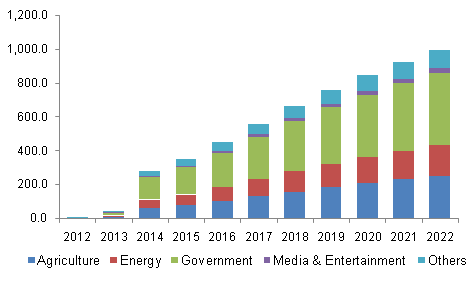
    The global commercial UAV market is expected to reach $2.07 billion by 2022, according to a new study by Grand View Research Inc.

    Increasing applications in agriculture and law enforcement are expected to drive commercial UAV industry growth over the forecast period. Commercial drones are finding applications across various industry verticals globally. Every industrialized country in the world is making investments in drones, thus driving the scope and technological developments for applications in the commercial UAV market.

    Drones are contemporary alternatives for activities where human life cannot be risked. Such drones find applications in various industrial verticals including military, homeland security, retail and agriculture. The demand is significantly higher for military applications, although commercial applications are progressively catching up.

    Aviation regulatory bodies such as the Federal Aviation Administration (FAA) have imposed restrictions on the use of such drones taking into consideration the difficulties in managing such huge air traffic and the safety of the citizens. However, the FAA is known to be undertaking an initiative to accelerate the UAV approval process for public safety agencies and broaden access to civilian organizations for a variety of commercial, industrial and other applications.

    Further key findings from the report suggest:

    • Rotary blade drones accounted for more than 70 percent of the global market share owing to their easy maneuverability and compact design. Moreover, such single and multi-rotor drones equipped with rotary blades have Vertical Take-Off and Landing (VTOL) abilities for applications, where there is limitation of space for fixed blade drones to take off. The development of advanced hybrid UAVs that operate on non-conventional sources of energy and nano, small miniature drones serve multiple applications across various industry verticals.
    • Government applications dominated the global commercial UAV industry constituting more than 40 percent of the market share in 2014. Increasing applications in law enforcement, security and surveillance, R&D activities, infrastructure, disaster management, and environmental studies have led to an increased demand for such unmanned aerial vehicles from the concerned government agencies. Innovative applications across agricultural sector have made it the fastest growing application segment, which is projected to grow at a CAGR of more than 18 percent from 2015 to 2022. Special agricultural drones can take snapshots of fields and help in analyzing crops. In addition, fix winged drones can be used for applications such as watering, spreading seeds, fertilizers, and pesticides over large farm fields that drastically reduce the time required and increase the efficiency.
    • North America is expected to grow at a CAGR of more than 16 percent over the forecast period on account of concentration of major drone manufacturers and increasing applications in the commercial sectors in the region. Governments and technology giants across the world are striving hard to provide internet to the people as a basic necessity. Facebook Inc. recently acquired Ascenta, a drone manufacturer for its pilot project to provide internet in remote areas using drones as movable wireless access points. Relaxation in regulations and increasing use of drones in law enforcement activities in Europe have led to the regional industry growth.
    • Major industry participants include AeroVironment Inc., BAE Systems, DJI, Elbit Systems, Parrot SA, Israel Aerospace Industries, The Boeing Company, and Textron Inc. Manufacturers resort to mergers and acquisitions as their key growth strategy to make their presence felt in the industry. Augmented funding, technological collaborations, and government agencies are expected to emerge as critical success factors for industry growth.

    Grand View Research has segmented the global commercial UAV market on the basis of product, application, and region:

    • Commercial UAV Product Outlook (revenue, USD billion, 2012-2022)
      • Fixed wing
      • Rotary blade
      • Nano
      • Hybrid
    • Commercial UAV Application Outlook (revenue, USD billion, 2012-2022)
      • Agriculture
      • Energy
      • Government
      • Media & Entertainment
      • Others
    • Commercial UAV Regional Outlook (revenue, USD billion, 2012-2022)
      • North America
      • Europe
      • Asia Pacific
      • Latin America
      • MEA

    Learn more about the report here.

  • Aeryon Named UAV Partner for Microsoft Video Platform for Police Agencies

    Aeryon Named UAV Partner for Microsoft Video Platform for Police Agencies

    MAPP

    Aeryon Labs is partnering with Microsoft on its new Microsoft Advanced Patrol Platform (MAPP) vehicle. Microsoft has chosen Aeryon’s SkyRanger UAV to demonstrate aerial image and data capture for MAPP.

    Aeryon Labs is a provider of small Unmanned Aerial Systems (sUAS) for military, public safety and commercial operators worldwide.

    “Law enforcement organizations throughout the world rely on Aeryon sUAS to collect aerial intelligence wherever and whenever they need it,” said Dave Kroetsch, president and CEO of Aeryon Labs Inc. “Including SkyRanger within the MAPP vehicle rounds out the comprehensive suite of technologies and highlights the value of aerial intelligence for ground-based personnel.”

    Aeryon Labs' SkyRanger UAV helps law enforcement
    Aeryon Labs’ SkyRanger UAV provides real-time intelligence to law enforcement. (Photo: Aeryon Labs Inc.)

    MAPP will connect its drivers to helpful and easy-to-navigate information, Aeryon said. Currently, patrol officers spend vast amounts of valuable time bound to their cars, clicking between windows on bulky, often dated laptops. MAPP will consolidate the many elements officers must keep track of — providing dispatch information, driving directions, suspect history, a voice activated license plate reader, a missing persons list, location-based crime bulletins and statistics, a feed of shift reports and more.

    For first responders, surveillance teams and investigators, high-quality aerial imagery provides the real-time intelligence needed to assess a situation immediately, ensure safety on the ground, and capture detailed evidence and forensics. By integrating aerial images from Aeryon sUAS with other cutting-edge hardware and software solutions, the MAPP program sets a new technological standard in policing and helps officers operate with better awareness, efficiency, mobility and safety.

    Aeryon Labs is showcasing the integrated solution at the IACP 2015 law enforcement and public safety conference, being held Oct. 25-27 in Chicago.

  • Large Turn-Out Demonstrates Government’s Interest in Open Source Software

    A sold-out crowd of more than 650 people filled the Kossiakoff Conference Center at the Johns Hopkins Applied Physics Laboratory on Wednesday, 30 May 2012 to participate in the Open Source Industry Day co-hosted by the National Security Agency and the Open Source Software Institute.


    “The Open Source Industry Day event could not have gone better,” said event volunteer co-chairman John Farrell of HP Enterprise Security. “We had a sell-out crowd, fantastic speakers and packed panel discussions that kept audience and panelist engaged all day. Our thanks go to the many volunteer supporters and government participants who worked together to make this event successful.”
    According to the day-long, unclassified event featured senior-level government leaders, tech industry representatives and open source community experts who participated in interactive panel discussions covering a range of topics identified by government users as specific areas of interest.
    “We worked closely with our government partners to choose topics that were timely and relevant to helping meet their interest and mission needs,” Farrell said. “After we agreed on a set number of primary topics, we reached out to the top-level experts in each field and were flooded with responses from speakers and subject-matter experts. The overwhelming success of this event helps to demonstrate the level of interest for open source software solutions by government agencies.”
    A list of discussion topics and participating speakers is available at the OSSI website: oss-institute.org.
    The event also featured highly-regarded keynote speakers from the Defense and Intelligence Communities. Keynote speakers included John A. Marshall, Chief Technology Officer at US Joint Chiefs of Staff, J2 Intelligence Directorate; Charlie Stein, Program Executive Office for Information Assurance at the National Security Agency; Don Davidson, Chief Outreach & Standardization (Trusted Mission Systems & Networks) at US Department of Defense; and Dan Risacher of the Office of CIO at US Department of Defense.
    As follow up to the Industry Day, OSSI is using the feedback from the event to prioritize follow up discussions at their regular monthly meetings and there will be a “Call for Papers” shortly.
    “The event attracted leaders and senior level professionals from nine government agencies and more than 300 corporations in what can only be described as an open and honest discussion,” said OSSI Regional Director Carl Livesay. “OSSI leveraged resources in the open source community to organize, manage and provide speakers for the event. The results were a tremendous value to attendees and a collaboration from contributors. We thank those who attended and those who contributed.”
    OSSI is in discussion with several other government agencies to hold similar events focused on their individual missions.