Tag: GPS anti-jamming

  • BAE Systems provides enhanced GPS technology for F-15 Eagle fighters

    BAE Systems provides enhanced GPS technology for F-15 Eagle fighters

    BAE Systems has received a $13 million contract for advanced GPS technology to protect U.S. F-15E aircraft from GPS signal jamming and spoofing. The company’s Digital GPS Anti-jam Receiver (DIGAR) will ensure the reliability of military GPS systems for aircraft operating in challenging signal environments.

    DIGAR uses advanced antenna electronics, high-performance signal-processing and digital beamforming — a capability that combines 16 steered beams — for better GPS signal reception and superior jamming immunity. These capabilities are critical for high-speed aircraft as they maneuver through the battlespace.

    The F-15 Eagle is the second U.S. Air Force fighter platform to receive DIGAR GPS upgrades, following the F-16 Fighting Falcon. DIGAR also provides advanced GPS capabilities for intelligence, surveillance and reconnaissance aircraft as well as multiple unmanned aerial vehicles.

    Two U.S. Marine Attack Squadron 211 F-35B Lightning IIs and two U.S. Air Force F-15 Eagles assigned to the 67th Fighter Squadron, fly over United Kingdom aircraft carrier HMS Queen Elizabeth over the west Indo-Pacific region in August 2021. (Photo: USAF/Staff Sgt. Kyle Johnson)
    Two U.S. Marine Attack Squadron 211 F-35B Lightning IIs and two U.S. Air Force F-15 Eagles assigned to the 67th Fighter Squadron, fly over United Kingdom aircraft carrier HMS Queen Elizabeth over the west Indo-Pacific region in August 2021. (Photo: USAF/Staff Sgt. Kyle Johnson)

    “Modern airborne missions require accurate positioning and navigation data, and GPS systems must be able to withstand adversaries’ best disruption efforts,” said Greg Wild, Navigation and Sensor Systems product line director at BAE Systems. “Our DIGAR antenna electronics are trusted to protect these platforms in contested environments.”

    BAE Systems’ family of military GPS products offer size, weight and power characteristics suitable for a variety of applications, including handheld electronics, vehicles, unmanned aerial vehicles, aircraft and precision-guided munitions. In addition to GPS anti-jam products, the company is delivering advanced GPS products compatible with the next-generation M-code satellite signal, and is developing the next generation of receivers to ensure dependable GPS for warfighters across land, air and sea domains.

    BAE Systems work on military GPS technology takes place in Cedar Rapids, where the company is investing more than $100 million to build a 278,000-square-foot, state-of-the-art research and manufacturing center.
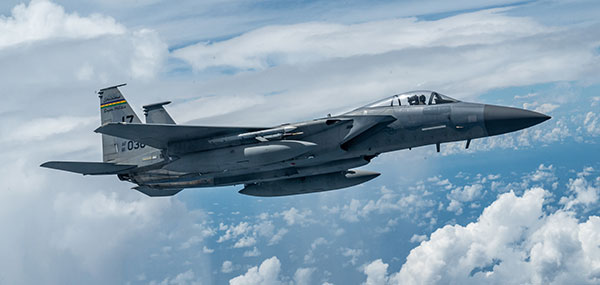
    An F-15 Eagle with the 159th Fighter Wing, Louisiana. (Photo: USAF/Tiffany A. Emery)
    An F-15 Eagle with the 159th Fighter Wing, Louisiana. (Photo: USAF/Tiffany A. Emery)
  • 5G promises deeper connections

    5G promises deeper connections

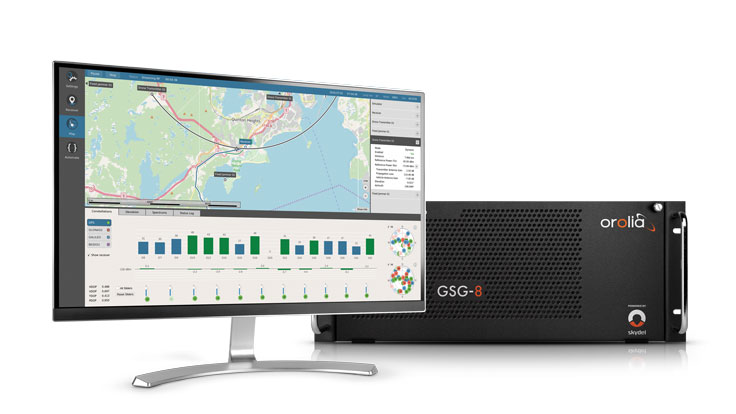
    Orolia developed the Skydel GSG-8, a PNT test solution in its GSG family of simulators, to deliver GNSS signal testing and sensor simulation performance in an easy to use, upgradable and scalable platform. (Photo: Orolia)
    Orolia developed the Skydel GSG-8, a PNT test solution in its GSG family of simulators, to deliver GNSS signal testing and sensor simulation performance in an easy to use, upgradable and scalable platform. (Photo: Orolia)

    We discussed complementary PNT with Erik Oehler, marketing director at Orolia.

    What are some of the most promising approaches to complementary PNT and how does simulation technology help?

    5G is the most promising for the future. I believe the benefits in infrastructure, speed, precision, reliability, and the industry incentives 5G offer are superior to GNSS. Alternative signals of opportunity and new commercial satellite-based providers are always valuable as extra layers of resilience. However, PNT from 5G is not quite ready yet. There will be a transition period during which systems use GNSS and these signals of opportunity simultaneously, so simulation enables receivers of any complementary signal to be tested in the same environments and with the same potential threats faced by primary constellation signals.

    How does Orolia fit in that mix?

    Orolia has the most atomic clocks in orbit, including those aboard the Galileo constellation. We integrate anti-jam antennas and build Interference Detection and Mitigation (IDM) into our products. We partner with companies that offer alternative signals, such as STL from Satelles. Our SecureSync NTP and PTP time servers live in the world’s biggest data centers and support encrypted signals, such as M and Y code for our militaries. We innovate with industry leaders such as Meta on building a better PCIe Time Card. We offer edge time servers with the ability to automatically add Hoptroff’s Traceable Time as a Service. If 5G PNT becomes a standard, we are already providing industry leaders such as Anritsu with solutions for acceptance testing on a major carrier’s backbone. With our pending acquisition by Safran and access to a world-leading portfolio of INS components, we are one of the most qualified companies in the world to solve nearly any PNT challenge.

    What kinds of complementary PNT are most useful in addressing specifically the challenges posed by jamming and spoofing, and how does simulation help?

    In two technical notes published by NIST, they recognize STL as one of four recommended solutions for PNT resilience and the only one being both independent of GNSS and capable of sub-microsecond accuracy. Being closer to Earth, it is a stronger signal, making it 1,000 times less susceptible to jamming. Additionally, because it is encrypted it is inherently immune to spoofing. The aforementioned Hoptroff TTaS is time delivered over VPN, removing the outside environment component completely. For positioning and navigation, the integration of an IMU provides a contiguous PNT solution even during periods of GNSS denial, analogous to how an atomic clock provides precise time holdover during these denial periods. Combined with anti-jam antenna technology and IDM software, a robust PNT solution is always available.

    Simulation helps by (1) identifying the vulnerabilities your PNT system might have (or could have in the future to evolving threats) and (2) verifying the total integrated resilient system. Our GSG-8 Advanced GNSS Simulator supports hundreds of GNSS full spectrum signals, custom signals, and hardware-in-the-loop testing of integrated IMUs at up to 1000 Hz iteration rate. Our Skydel Wavefront and Anechoic simulators can verify the most complex GNSS anti-jam antenna systems.

  • New developments in GPS

    New developments in GPS

    Matteo Luccio
    Matteo Luccio

    “What’s new with GPS?” people often ask me when I tell them my job. Recently, I have been responding by telling them about the other three GNSS constellations now fully available. However, as reflected every month in these pages, that is but one of many developments that combine to make satellite navigation ever more accurate, reliable and ubiquitous.

    While the GPS program is old by the standards of the digital age, it has never been static. In the 1970s, when GPS was developed, the expected accuracy for civilians was tens of meters, though pioneering commercial users began right away to chip away at the system’s limitations by developing differential GPS (DGPS), carrier-phase positioning, and other techniques. By the end of the next decade, better signal processing and the implementation of DGPS had brought civilian accuracy to about one meter. In the 1990s, phase-ambiguity resolution made real-time centimeter accuracy standard for surveyors.

    As the adoption of cell phones exploded, it became imperative to locate them to preserve the 911 system. Initially, this was done using the time-of-arrival of signals to handsets from towers, because it was assumed that GPS receivers could not be made sufficiently small, cheap, fast, power-efficient and accurate to work in cell phones. The implementation of assisted GPS, now standard in all smartphones, largely solved those problems.

    Precision for civil GPS users increased by an order of magnitude in May 2000, when President Clinton ordered the removal of Selective Availability, and substantially once enough satellites began to broadcast the L2 civil (L2C) code, enabling ionospheric corrections. Later, the modernized signals in the L5 band enabled sub-meter accuracy without augmentations and very long-range operations with augmentations. There are now more than 80 signals in that band, on GPS, Galileo and BeiDou satellites. On the military side, the effort to deploy M-code signals, cards and receivers continues.

    Over the years, in addition to modernized satellites and signals, improvements have included the development of PPP, RTK and hybrid techniques; the proliferation of local, regional and global correction services; improved jamming and spoofing detection; and the increasing integration of GNSS receivers with other RF receivers as well as with inertial, optical, radar, lidar and other sensors.

    Future improvements may include:

    • signal authentication
    • commercial systems in low Earth orbit that would have a signal strength on the surface three orders of magnitude greater than current GNSS, greatly boosting indoor reception and protection from jamming
    • inertially aided extended coherent integration, a.k.a. “supercorrelation,” which makes moving GNSS receivers more sensitive to signals they receive directly than to reflected ones
    • 3D-mapping-aided GNSS, which enhances the positioning algorithms by identifying non-line-of-sight signals; this is being pioneered by Google in nearly 4,000 cities, relying on its 3D city models and machine learning.

    The moment I send this month’s issue to the printer, I will think of more past and future improvements. As soon as you receive it, many of you will think of yet more. What’s new with GPS? A lot.

    Matteo Luccio | Editor-in-Chief
    [email protected]

  • British Army Light Dragoons demo anti-jam technology

    British Army Light Dragoons demo anti-jam technology

    NATO forces are deployed in some of the world’s most aggressive electronic-warfare (EW) environments. Intentional interference comes both from “personal protection” devices and large, high-powered EW assets.

    To navigate despite EW, armed forces need reliable and resilient GNSS/GPS positioning with anti-jam technology. The Light Dragoons — a light cavalry regiment of the British Army — are in a perfect position to test anti-jam technology for assured positioning, navigation and timing (A-PNT).

    The Light Dragoons were deployed as the United Kingdom’s Light Cavalry contribution to “Battlegroup Poland,” part of NATO’s enhanced Forward Presence. On the front line, the Light Cavalry engage in reconnaissance, mark targets for indirect fires, and prepare routes for the rest of the force. In this role, being prepared for EW is essential.

    To test A-PNT technologies, the Light Cavalry took part in Project Thundercat, a light cavalry capability investigation run by the Armoured Trials and Development Unit (ATDU). A Hexagon | NovAtel GPS anti-jam technology (GAJT) antenna, the GAJT-410ML, was fitted to a Jackal high-mobility transporter and integrated with its onboard positioning system.

    GAJT successfully defeats jamming on GPS L1 and L2 and Galileo E1 frequencies. When interference is detected, GAJT recognizes the unwanted interference and reduces reception in that direction. The result is a more resilient GNSS solution, protected measurements and A-PNT.

    The Light Dragoons found that GAJT successfully protected their positioning system despite experiencing interference. The GAJT-410ML antenna was easy to install in a simple plug-in-and-go process.

    In upcoming experiments, the British Army will use NovAtel technology to gain electronic situational-awareness data to characterize the radio frequency environment.

    GAJT systems are offered by NovAtel with customized offerings for land, marine and air applications.

    The Light Dragoons test NovAtel GAJT anti-jamming antennas in Project Thundercat. (Photo: Photo: British Army}
    The Light Dragoons test NovAtel GAJT anti-jamming antennas in Project Thundercat. (Photo: Photo: British Army)
  • Anti-jamming market for GPS to be worth $5.9 billion by 2025

    Anti-jamming market for GPS to be worth $5.9 billion by 2025

    Photo: Milan_Jovic/E+/Getty Images
    Photo: Milan_Jovic/E+/Getty Images

    According to a new market research report, “Anti-Jamming Market for GPS with COVID-19 Impact, by Receiver Type (Military and Government Grade and Commercial Transportation Grade), Technique (Nulling, Beam Steering and Civilian), End-User, Application and Geography — Global Forecast to 2025,” the anti-jamming market for GPS is valued at $4 billion in 2020 and is expected to reach $5.9 billion by 2025.

    The report, published by MarketsandMarkets, also states that the market is expected to grow at a CAGR of 7.9% from 2020 to 2025. Some of the key factors driving this growth include high demand for GPS technology in military applications and ongoing developments to improve overall GPS structure. Factors such as the growing demand for unmanned airborne vehicles and systems and the development of low-cost GPS anti-jamming solutions also are expected to provide growth opportunities to players in the GPS anti-jamming market.

    According to the report, Nulling Technique is expected to hold largest share of GPS anti-jamming market from 2020 to 2025. In addition, surveillance and reconnaissance are expected to hold largest share of GPS anti-jamming market during the forecast period.

    The GPS anti-jamming market in Asia Pacific is expected to grow significantly, as a result of a rise in the number of terror attacks in the region, which has led to countries enhancing their surveillance and antiterrorism capabilities, the report added. Countries in this area are also manufacture defense aircraft, which is expected to increase the scope of GPS anti-jamming for defense and aerospace systems. An increase in the defense expenditures of India and China, among other countries, and the expansion of militaries in emerging economies also have accelerated the demand for GPS anti-jamming solutions in Asia Pacific.

    Raytheon Technologies, Hexagon, Thales Group, L3Harris Technologies, BAE Systems, Cobham, Mayflower Communications, infinDome, Lockheed Martin, Israel Aerospace Industries, Furuno Electric and Meteksan Defense are few major players in the GPS anti-jamming market.

    MarketsandMarkets provides B2B research on 30,000 niche opportunities/threats that will impact 70% to 80% of worldwide companies’ revenues, the research firm said.