A SpaceX Falcon 9 rocket lifts off from Space Launch Complex 4E at Vandenberg Air Force Base, California, Jan. 14. (Photo: SpaceX)
Starting this month, the inspector general for the U.S. Pentagon will be reviewing how SpaceX’s rockets became certified to launch payloads for the U.S. Air Force, a decision made in May 2015.
“Our objective is to determine whether the U.S. Air Force complied with the Launch Services New Entrant Certification Guide when certifying the launch system design for the Evolved Expendable Launch Vehicle-class SpaceX Falcon 9 and Falcon Heavy launch vehicles,” wrote Michael J. Roark, deputy inspector general for Intelligence and Special Program Assessments, in a Feb. 11 memorandum to the Air Force.
In April 2016, the U.S. Air Force awarded SpaceX the first competitively sourced National Security Space (NSS) launch services contract in more than a decade, when the company won the GPS III Launch Services contract, fixed at $82,700,000.
Less than one year later, SpaceX was awarded a second contract for launch services to deliver a GPS III satellite to its intended orbit.
The evaluation will be performed at the Space and Missile Systems Center, a unit of Air Force Space Command, headquartered at Los Angeles Air Force Base in El Segundo, California. Additional locations may also be identified as part of the audit.
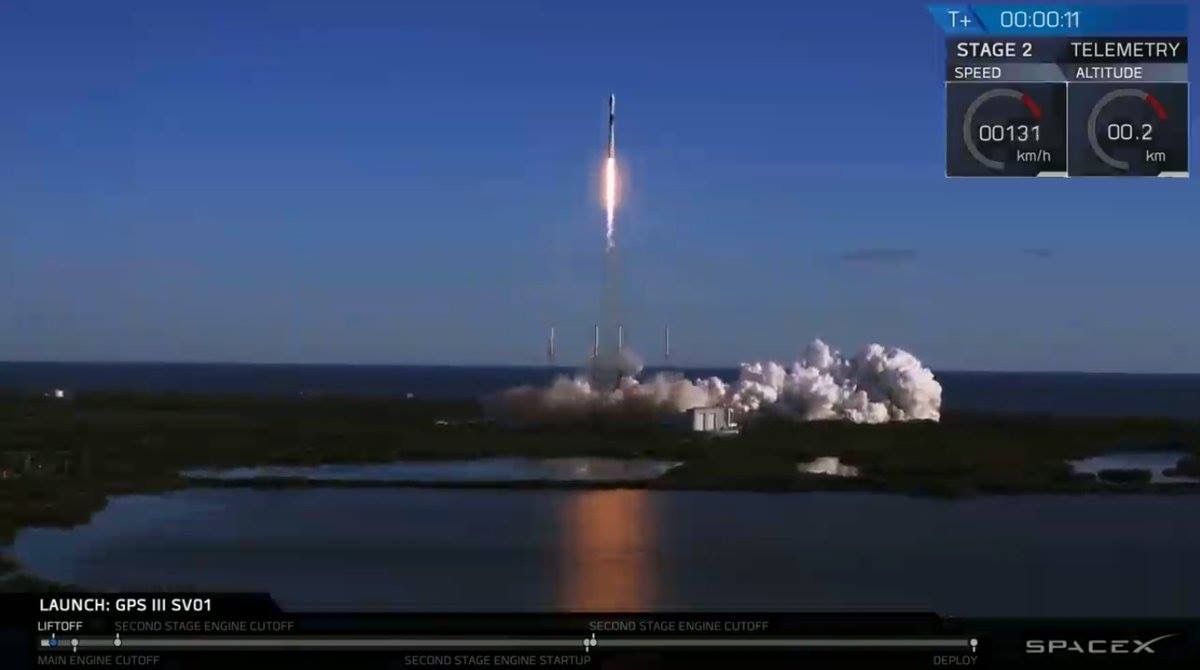
After several delays, the first GPS III satellite has successfully deployed from the SpaceX Falcon 9 rocket, which launched from the Cape Canaveral Air Force Station in Florida at 8:51 a.m. EST on Dec. 23. The satellite, built by Lockheed Martin, will serve in space for 15 years.
Ten days following the launch, the satellite will circularize its orbit at an altitude of 12,550 miles to begin a period of checkout and testing that could last up to 18 months, before entering service in the GPS constellation providing navigation and timing signals worldwide.
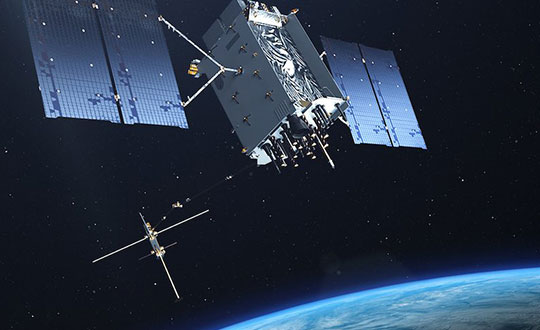
The satellite, known as GPS III SV01 and nicknamed “Vespucci” after Italian explorer Amerigo Vespucci, is the first in a new generation of GPS navigation stations designed with improved services and longer lifetimes to ensure the U.S. military-run network remains available to troops, pilots, sailors and the public for decades to come.
“Launch is always a monumental event, and especially so since this is the first GPS satellite of its generation launched on SpaceX’s first national security space mission,” said Lt. Gen. John Thompson, commander of the U.S. Air Force’s Space and Missile Systems Center and the Air Force’s program executive officer for space. “As more GPS III satellites join the constellation, it will bring better service at a lower cost to a technology that is now fully woven into the fabric of any modern civilization.”
Ground System
The U.S. Air Force used Raytheon Company’s GPS Next-Generation Operational Control System, known as GPS OCX, to support the launch. Following launch, GPS OCX will maneuver the GPS III satellite into its final orbit, a process that takes the ground control system 10 days to accomplish.
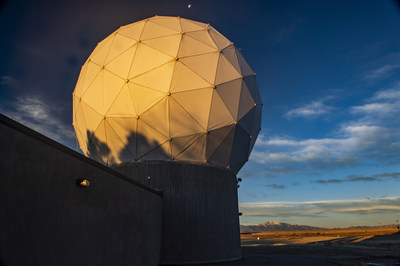
Ground antenna at Schriever Air Force Base, home of the 50th Space Wing. (Photo: Raytheon)
“The GPS OCX Block 0 launch and checkout system is foundational to the improved precision, navigation and timing of the entire constellation,” said Dave Wajsgras, president of Raytheon Intelligence, Information and Services. “And we’ll all benefit from the system’s unprecedented level of cybersecurity protections.”
The fully modernized GPS OCX Block 0 launch and checkout system will support the launch of future GPS III satellites, enabling the introduction of a new civil signal, enhanced military signals, and anti-jam capabilities.
The ground system has achieved the highest level of cybersecurity protections of any Department of Defense space system, and its open architecture allows it to integrate new capabilities and signals as they become available, ensuring continued protection against future cyber threats.
In addition to GPS OCX’s role, RGNext, a joint venture between Raytheon and General Dynamics IT, provided operational launch support to ensure the safe launch of the Falcon 9 rocket that was carrying the GPS III satellite. RGNext operates the launch range on behalf of the U.S. Air Force, providing maintenance, range safety, weather monitoring, communication and surveillance support for all launches conducted by defense, civil and commercial companies at the range.
After several delays, the first GPS III satellite has successfully deployed from the SpaceX Falcon 9 rocket, which launched from Cape Canaveral Air Force Station in Florida at 8:51 a.m. EST on Dec. 23. (Photo: Lockheed Martin)SpaceX’s Falcon 9 rocket orbited the first GPS III satellite on Dec. 23, 2018. (Photo: USAF)
The scheduled launch of the first GPS III satellite on December 18 was scrubbed, reportedly due to first stage liquid oxygen thermal limit constraints aboard the SpaceX Falcon 9 Block 5 launch vehicle’s first stage reaching safety limits. A second attempt on December 19 was later ruled out due to ongoing evaluations into the sensor issue.
The launch window may open again on Dec. 20.
This was to have been the first GPS launch aboard a SpaceX rocket, as well as the first SpaceX contracted U.S. National Security mission.
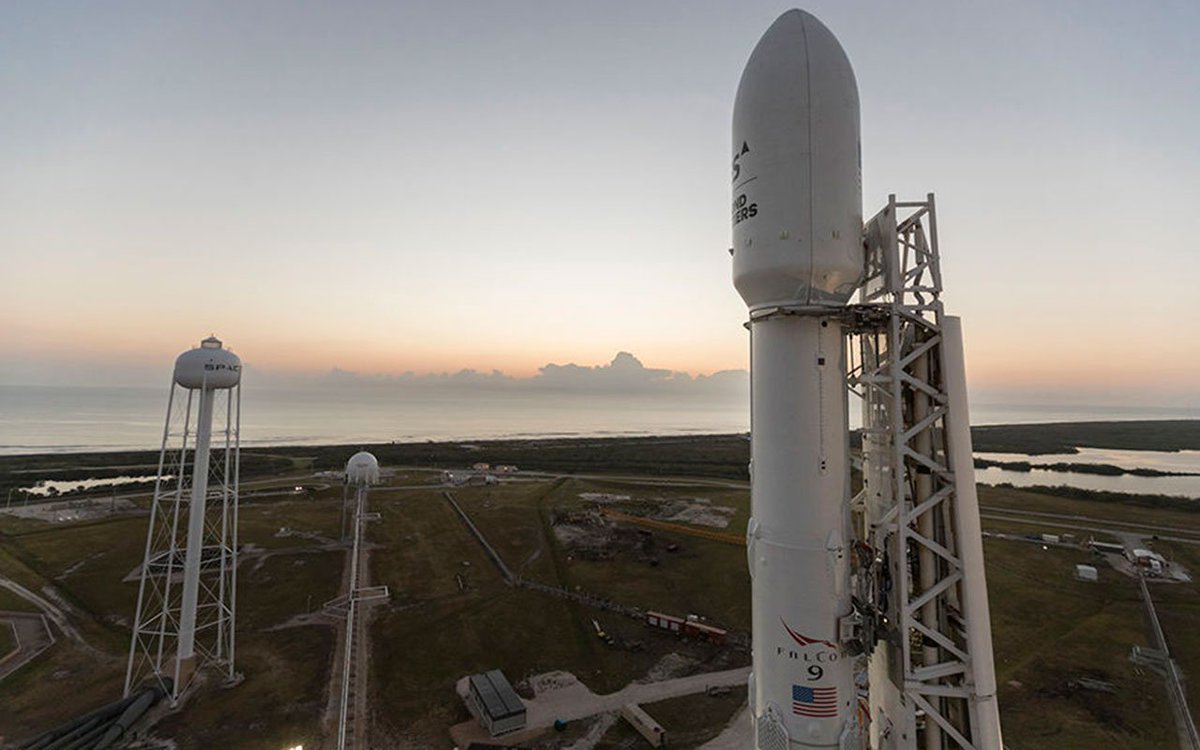
A Falcon 9 rocket awaits launch. (Photo: SpaceX)
The first GPS III satellite was originally scheduled to ride aboard a United Launch Alliance (ULA) Delta IV M+ rocket. ULA and/or its prime partners, Lockheed-Martin and Boeing, have conducted every GPS satellite launch since the start of the program. However, due to an assortment of issues variously involving delayed technology development and lawsuits regarding competitive bidding, the Air Force re-opened bidding for the contract as part of its Evolved Expendable Launch Vehicle (EELV) program — “evolved” signifying that the rocket can be recovered and reused.
Recycling Rockets. ULA did not bid on the re-opened contract, citing concerns over the selection process and potential risks with the anticipated lower launch cost. In 2016, the Air Force selected SpaceX to take over most GPS III launches.
SpaceX’s Falcon 9 for this launch will use a new first stage core, the B1054. Although it has re-use capability, it will fly in an expendable configuration this time, with no landing legs and no grid fins. It will be disposed of into the Atlantic Ocean after separation from the second stage.
In other missions, after the satellite-bearing stage separates from the rest of the rocket, the remaining core launcher fires additional fuel to return intact to land or to sea aboard an Autonomous Spaceport Drone Ship (ASDS), a converted barge awaiting in the Atlantic or Pacific Ocean.
New Generation of GPS. As attentive readers already know, GPS III SV01 is the first of an entirely new design of GPS satellite that will help the Air Force modernize today’s GPS constellation with new technology and advanced capabilities.
GPS III has three times better accuracy and up to eight times improved anti-jamming capabilities. Spacecraft life will extend to 15 years, 25 percent longer than any of the GPS satellites on-orbit today. GPS III’s new L1C civil signal also will make it the first GPS satellite broadcasting a compatible signal with other international global navigation satellite systems, like Galileo, improving connectivity for civilian users.
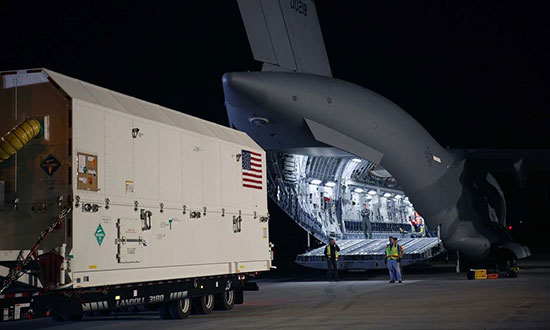
Lockheed Martin developed GPS III and manufactured GPS III SV01 at its GPS III Processing Facility near Denver. In September 2017, the Air Force declared the satellite “Available for Launch” (AFL) and had the company place it into storage. In 2018, the Air Force called up the satellite for launch and Lockheed Martin delivered it to Florida on Aug. 20. The Air Force nicknamed the satellite “Vespucci” after Italian explorer, navigator and cartographer Amerigo Vespucci.
GPS III SV01 is the first of 10 GPS III satellites originally ordered by the Air Force. GPS III SV03-08 are now in various stages of assembly and test. In August, the Air Force declared the second GPS III AFL and in November called GPS III SV02 up for 2019 launch.
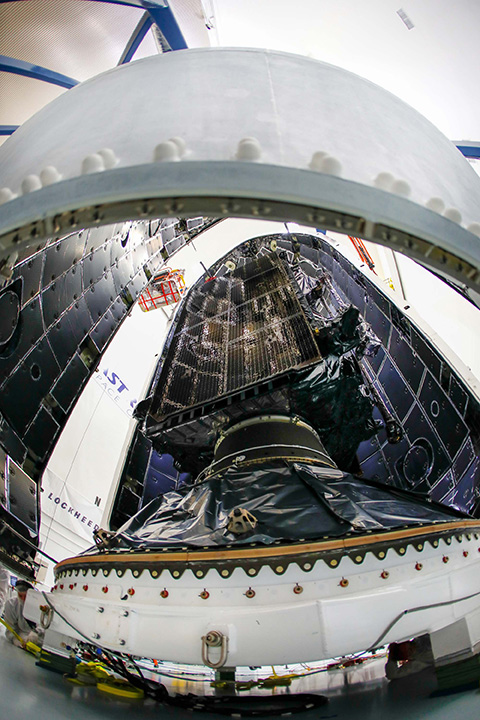
GPS III SV01 is now encapsulated and will be placed on the SpaceX rocket for Dec. 18 launch. (Photo: Lockheed Martin)
The U.S. Air Force’s first Lockheed Martin-built GPS III satellite is now encapsulated for its planned Dec. 18 launch from Cape Canaveral Air Force Station, Florida, on a SpaceX Falcon 9 rocket.
GPS III Space Vehicle 01 (GPS III SV01) underwent pre-launch processing, fueling and encapsulation at Astrotech Space Operations in Titusville, Florida. During encapsulation, GPS III SV01 was sealed in its launch fairing — an aerodynamic, nose-cone shell that protects the satellite during launch.
In the coming days, the fairing-enclosed satellite will be mounted to the rocket as launch preparations continue.
GPS III SV01 is the first of an entirely new design of GPS satellite that will help the Air Force modernize today’s GPS constellation with new technology and advanced capabilities.
GPS III has three times better accuracy and up to eight times improved anti-jamming capabilities. Spacecraft life will extend to 15 years, 25 percent longer than any of the GPS satellites on-orbit today. GPS III’s new L1C civil signal also will make it the first GPS satellite broadcasting a compatible signal with other international global navigation satellite systems, like Galileo, improving connectivity for civilian users.
“The world is dependent on GPS. More than four billion military, commercial and civilian users connect with signals generated by GPS satellites every day,” said Johnathon Caldwell, Lockheed Martin’s vice president for Navigation Systems. “The launch of GPS III SV01 will be the first step in modernizing the Air Force’s GPS constellation with the most powerful and resilient GPS satellites ever designed and built.”
Lockheed Martin developed GPS III and manufactured GPS III SV01 at its advanced $128-million GPS III Processing Facility near Denver. In September 2017, the Air Force declared the satellite “Available for Launch” (AFL) and had the company place it into storage.
In 2017, the Air Force “called up” the satellite for launch and Lockheed Martin delivered it to Florida on Aug. 20. The Air Force nicknamed the satellite “Vespucci” after Italian explorer Amerigo Vespucci.
GPS III SV01 is the first of 10 GPS III satellites originally ordered by the Air Force. GPS III SV03-08 are now in various stages of assembly and test. In August, the Air Force declared the second GPS III “AFL” and, in November, called GPS III SV02 up for 2019 launch.
In September, the Air Force selected Lockheed Martin for the GPS III Follow On (GPS IIIF) program, an estimated $7.2 billion opportunity to build up to 22 additional GPS IIIF satellites with additional capabilities.
GPS IIIF builds off Lockheed Martin’s existing modular GPS III, which was designed to evolve with new technology and changing mission needs. On Sept. 26, the Air Force awarded Lockheed Martin a $1.4 billion contract for support to start up the program and to contract the 11th and 12th GPS III satellite.
The U.S. Air Force has awarded Lockheed Martin a $7.2 billion contract to build 22 more GPS III satellites.
Like the first batch of 10 GPS III satellites, the GPS III Follow-On (GPS IIIF) satellites “will provide greater accuracy, and improved anti-jamming capabilities, making them more resilient,” said Air Force Secretary Heather Wilson in a statement.
The satellites will be built at the company’s Waterton campus in the Denver suburb of Littleton.
Under a previous contract, Lockheed is in the process of building 10 GPS III satellites, the first of which is slated to launch in December. The first GPS IIIF satellite could be ready for launch in 2026.
GPS III SV01 on Aug. 20 boards a U.S. Air Force C-17 for its flight to Cape Canaveral, Florida. (Photo: Lockheed Martin)
“We’re grateful for the U.S. Air Force’s continued confidence in Lockheed Martin on the GPS III/IIIF program,” said Johnathon Caldwell, Lockheed Martin’s program manager for Navigation Systems. “We’ve worked hard to develop and produce GPS III to help the Air Force modernize the GPS constellation with new, more powerful, and more resilient, technology.
“This new contract for GPS IIIF will bring GPS to a whole new level. It takes full advantage of our flexible satellite design to incorporate additional new technology like a 100% digital navigation payload, Regional Military Protection and new search-and-rescue payloads into the constellation. We are proud to be bringing these new capabilities to our warfighters and the world.”
Both Boeing and Northrop Grumman declined to bid on the contract, leaving Lockheed Martin the lone provider.
Boeing has decided to not submit a proposal to build up to 22 GPS III satellites for the U.S. Air Force. The GPS III Follow On (GPS IIIF) program will supply additional upgraded satellites to replace ones now in the constellation.
“We have not put in a proposal for GPS III,” said Rico Attanasio, Boeing’s director of Department of Defense and civil navigation and communications programs, to Space News.
Lockheed has been the only producer of GPS III satellites, and is now under contract to build the first 10. Boeing built earlier versions of GPS satellites.
In February, the U.S. Air Force Space Command (AFSC) released its request for proposals (RFP) to build the 22 GPS III satellites, called the GPS III Follow-On Phase 2 contract. The estimated dollar value of the acquisition is $10 billion including all options.
Phase 2 is planned as a single, predominantly fixed-price incentive-type contract awarded via full and open competition for production of 22 GPS III satellites. Deadline for proposals is April 16. Construction is to begin in fiscal year 2019 (Oct. 1, 2018), with delivery of the first satellite in 2026.
Boeing thought it could compete based on “innovation, resilience [and] a new payload, but that wasn’t emphasized,” Attanasio told Space News. “It wasn’t a good fit for us.”
The first advanced GPS III satellite successfully established remote connectivity and communicated with the next-generation Operational Control System (OCX), further validating the U.S. Air Force’s modernized GPS is ready to launch its first satellite.
On Nov. 2, GPS III Space Vehicle 01 (GPS III SV01), the first of 10 GPS III satellites designed by Lockheed Martin, and OCX, being developed by Raytheon Corporation, successfully completed Factory Mission Readiness Testing (FMRT).
The FMRT validated the command and control interaction between GPS III and the OCX’s Launch and Checkout System (LCS) through a simulated full launch and early orbit mission event sequence.
During this end-to-end system demonstration, command signals were sent from the latest OCX LCS software installed at Lockheed Martin’s Launch and Check Out Capability node in Denver to Schriever Air Force Base in Colorado Springs, Colorado.
From there, the commands were uplinked back to the GPS III SV01 satellite, currently awaiting a call up for launch at Lockheed Martin.
“During FMRT, GPS III SV01 received and successfully processed OCX commands that are routinely sent during launch, transfer orbit maneuvers, deployments and payload initialization,” said Mark Stewart, Lockheed Martin’s vice president for Navigation Systems. “We thoroughly tested the first GPS III satellite just like we are going to fly it in 2018.”
GPS III SV01 and OCX first “talked” to each other during a link check on October 3, 2017.
“This was the first time the launch and checkout system directly interfaced with the GPS III satellite,” said Bill Sullivan, vice president of Raytheon’s GPS OCX program. “We’re making consistent, steady progress, and that’s driving us toward a successful launch next year.”
The demo further verifies the space-to-ground compatibility between GPS III satellites and OCX. During a 2013 Compatibility & Integration test, Lockheed Martin’s GPS III Nonflight Satellite Testbed (GNST) — a full-sized, functional satellite prototype — also connected with and received commands from an earlier version of Raytheon’s OCX LCS software.
On Sept. 22, the Air Force declared GPS III SV01 “available for launch,” with launch expected in 2018. The successful FMRT was the final validation that GPS III SV01 is ready to be shipped to the launch pad.
GPS III will have three times better accuracy and up to eight times improved anti-jamming capabilities. Spacecraft life will extend to 15 years, 25 percent longer than the newest GPS satellites on-orbit today. GPS III’s new L1C civil signal also will make it the first GPS satellite to be interoperable with other international global navigation satellite systems, like Galileo.
OCX will revolutionize GPS command and control and mission management capabilities. It will control all legacy and new signals, provide protection against evolving cyber threats, and reduce operation and sustainment costs through efficient software architecture, automation and performance-based logistics. OCX represents a quantum leap in capabilities over the current system, providing flexibility and adaptability to meet future GPS mission needs.
The GPS III and OCX teams are led by the Global Positioning Systems Directorate at the U.S. Air Force Space and Missile Systems Center. Air Force Space Command’s 2nd Space Operations Squadron (2SOPS), based at Schriever Air Force Base, Colorado, manages and operates the GPS constellation for both civil and military users.
The U.S. Air Force’s third GPS III satellite in production flow at Lockheed Martin’s advanced satellite manufacturing facility in Denver is now fully integrated into a complete space vehicle.
GPS III Space Vehicle 03 (GPS III SV03) followed the first two GPS III satellites on a streamlined assembly and test production line. Technicians successfully integrated the satellite’s major components — its system module, navigation payload and propulsion core — into one fully assembled space vehicle on Aug. 14.
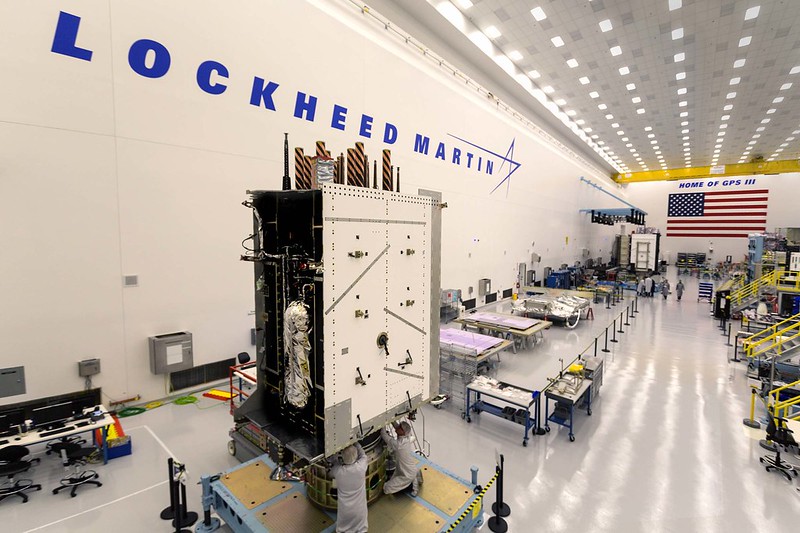
GPS III SV03 was assembled in Lockheed Martin’s GPS III Processing Facility, a $128 million, cleanroom factory designed in a virtual reality environment to drive efficiency and reduce costs in satellite production. Now fully assembled, the third satellite is being prepared to begin environmental testing.
GPS III SV03 is scheduled to launch on June 30. (Photo: Lockheed Martin)
GPS III SV03 closely follows the company’s second satellite in production flow. GPS III SV02 completed integration in May, finished acoustic testing in July and moved into thermal vacuum testing in August. The second GPS III satellite is expected to be delivered to the U.S. Air Force in 2018.
The fourth GPS III satellite is close behind the third. Lockheed Martin received the navigation payload for GPS III SV04 in October and the payload is now integrated with the space vehicle. The satellite is expected to be integrated into a complete space vehicle in January 2018.
In August, Lockheed Martin technicians began major assembly work on GPS III SV05.
All of these satellites are following Lockheed Martin’s first GPS III satellite, GPS III SV01, through production flow. In September, the Air Force accepted and declared GPS III SV01 “available for launch,” with launch expected in 2018.
“GPS III is the most powerful and complex GPS satellite ever designed and built, and it’s now into a smooth production flow,” said Mark Stewart, Lockheed Martin’s vice president for navigation systems. “The real credit goes to the Air Force for all the Back to Basics work done in advance, reducing program risk for all the GPS III satellites going forward. We are looking forward to bringing GPS III’s advanced capabilities to our warfighters in 2018.”
Lockheed Martin is under contract for 10 next-generation GPS III satellites as part of the Air Force’s modernized GPS. GPS III will have three times better accuracy and up to eight times improved anti-jamming capabilities. Spacecraft life will extend to 15 years, 25 percent longer than the newest GPS satellites on-orbit today. GPS III’s new L1C civil signal also will make it the first GPS satellite to be interoperable with other international global navigation satellite systems.
Lockheed Martin’s unique GPS III satellite design includes a flexible, modular architecture that allows for the insertion of new technology as it becomes available in the future or if the Air Force’s mission needs change. Satellites based off this design are already proven compatible with both the Air Force’s next generation Operational Control System (OCX) and the existing GPS constellation.
The GPS III team is led by the GPS Directorate at the U.S. Air Force Space and Missile Systems Center. Air Force Space Command’s 2nd Space Operations Squadron (2SOPS), based at Schriever Air Force Base, Colorado, manages and operates the GPS constellation for both civil and military users.
Harris Corporation has completed development of its fully digital Mission Data Unit (MDU), which is at the heart of its navigation payload for Lockheed Martin’s GPS III satellites 11 and beyond.
The current Harris payload for GPS III space vehicles (SVs) 1-10 includes a greater than three times reduction in range error, up to eight times increase in anti-jamming power, added signals — including one compatible with other Global Navigation Satellite Systems (GNSS) — and greater signal integrity.
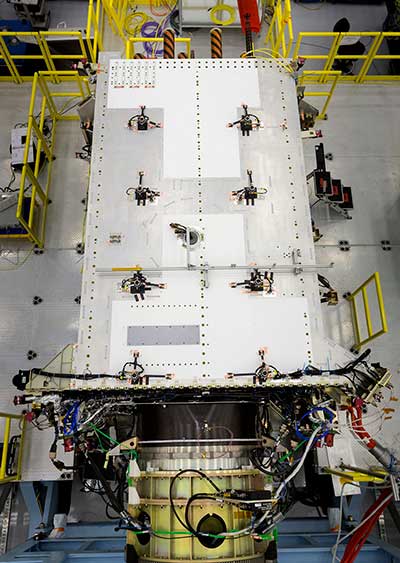
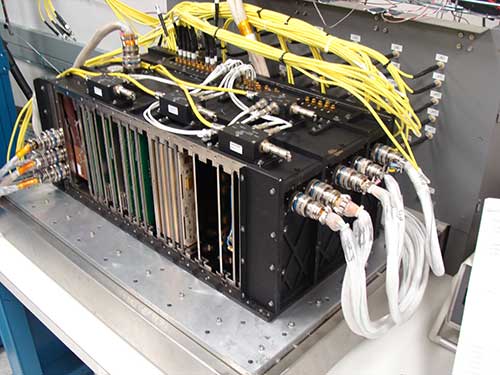
The fully digital Mission Data Unit (MDU) will create precise civil and military timing navigation signals for GPS III satellites 11 and beyond. Pictured here is the advanced MDU on navigation payloads being delivered for GPS III Space Vehicles 1-10. (Photo: Harris)
Harris’ GPS III SV11+ fully digital navigation payload will further improve on performance for the U.S. Air Force by providing more powerful signals, plus built-in flexibility to adapt to advances in GPS technology, as well as future changes in mission needs.
“This design is fully mature — an Engineering Development Model, not a prototype — and is ready to be inserted into GPS III SV11+,” said Bill Gattle, president, Harris Space and Intelligence Systems. “The payload has the flexibility to serve the warfighter over the entire mission life and can be upgraded incrementally over its mission life due to built-in adaptability.”
Harris navigation payloads are already integrated in the second GPS III space vehicle, pictured here, and the first GPS III satellite, declared available to launch in 2018. (Photo: Lockheed Martin)
The payload design also ensures flawless atomic clock operations, providing the reliable GPS signal that millions of people — including U.S. soldiers — and billions of dollars in commerce depend on every day, the company said. It also will provide the clock signal for a new GPS III Search and Rescue (SAR) payload.
Beyond flexibility and reliability, the new Harris SV11+ navigation payload offers a smooth transition to the Air Force’s GPS OCX ground control segment. The Harris payload for the first ten GPS III satellites already has been verified for OCX compatibility, and this will allow Harris to seamlessly port the Harris SV11+ design, minimizing integration risks and associated costs.
The U.S. Air Force has declared the first Lockheed Martin-built GPS III satellite “available for launch,” (AFL) ushering in a new era of advanced GPS technology.
The Air Force’s “AFL” declaration is the final acceptance of Lockheed Martin’s first GPS III Space Vehicle (GPS III SV01) before its expected 2018 launch. GPS III SV01 will bring new capabilities to U.S. and allied military forces, and a new civil signal that will improve future connectivity worldwide for commercial and civilian users.
GPS III SV01 now awaits a call up to begin pre-launch preparations. In the meantime, the advanced satellite is stored in an environmentally controlled clean room, where engineers can perform maintenance and continue to service the satellite.
New GPS Capabilities
The U.S. Air Force declared the first Lockheed Martin-built, next-generation GPS III satellite “Available for Launch” in 2018. (Photo: Lockheed Martin)
GPS III SV01 is the first space vehicle of an entirely new satellite design. GPS III is a next generation technology and capability leap over any of the 31 GPS Block II satellites that currently populate today’s operational GPS constellation.
Better accuracy. For military forces, precision is essential. GPS III signals will provide them three times more accuracy than any current GPS satellites. How accurate is that? We cannot get specific, but stretch your arms out, we are within that range now.
Improved anti-jam. It is no secret that future adversaries will try to nullify tools like GPS that give our military an edge in conflicts. GPS III’s powerful new signals have eight times improved anti-jamming capability, and the satellites’ nearly 70 percent digital payload will provide the Air Force with greater operational flexibility.
Stronger design. Space is a tough neighborhood and GPS III is built tough. GPS III comes with a more resilient design and a design life which can expand its operational life to 15 years. That’s 25 percent longer than the newest GPS satellites on-orbit today.
New civil signal. GPS III will be the first GPS satellite broadcasting L1C, a new, common signal being adopted by other international Global Navigation Satellite Systems (GNSS), like Europe’s Galileo. In the future, users of civilian GPS receivers will be able to connect to L1C from multiple GNSS constellations, allowing for greater connectivity.
Designed for the Future
One of the keys to Lockheed Martin’s GPS III is it was designed for today’s mission with an eye on tomorrow’s needs.
“As we designed GPS III, we knew that mission needs would change in the future and that new technology will become available,” said Mark Stewart, vice president of Lockheed Martin’s Navigation Systems mission area. “We wanted the satellite to be flexible to adapt to those changes. To do that, we intentionally developed GPS III with a modular design. This allows us to easily insert new technology into our production line.”
Future satellites — already with a robust, production-ready design — also would benefit from the inherent risk-reductions already proven out in GPS III, like compatibility with OCX and the existing GPS constellation. Significant work has already been completed on future requirements like an accuracy-improving Laser Retro-reflector Array and a Search and Rescue payload.
For Lockheed Martin, the completion of GPS III SV01 is a major milestone on a challenging development program to design and build the most powerful GPS satellites ever envisioned. With all major development risks behind them, the company is now in full production on ten GPS III satellites at its GPS III Processing Facility near Denver.
“Lockheed Martin’s GPS III team owes much of its success to the Air Force’s Back to Basics program,” Stewart added. “We are proud to partner with the Air Force on this important program and look forward to launching the first GPS III satellite in 2018.”
The GPS III team is led by the Global Positioning Systems Directorate at the U.S. Air Force Space and Missile Systems Center. Air Force Space Command’s 2nd Space Operations Squadron (2SOPS), based at Schriever Air Force Base, Colorado, manages and operates the GPS constellation for both civil and military users.
The second Lockheed Martin GPS III satellite completes a test simulating a strenuous launch environment.
The launch is the most strenuous part of a satellite’s life. To survive the extreme sound wave pressure and pounding vibrations generated by more than 700,000 pounds of thundering rocket thrust, spacecraft need a solid, reliable design if they hope to arrive operational on orbit.
On July 13, Lockheed Martin’s second, fully assembled GPS III space vehicle (SV) completed a realistic simulation of its future launch experience and passed this critical acoustic environmental test with flying colors, the company said.
During acoustic testing, GPS III SV02 was blasted with deafening sound reaching 140 decibels in a specialized test chamber equipped with high-powered horns. (Photo: Lockheed Martin)
During acoustic testing, the GPS III SV02 satellite was continuously blasted with sound reaching 140 decibels in a specialized test chamber equipped with high-powered horns. For comparison, that is about as loud as an aircraft carrier deck and human hearing starts to be damaged back at about 85 decibels, the company said. The test uses sound loud enough to literally shake loose anything not properly attached.
“With this launch-simulation test, we are talking about sophisticated, advanced satellite technology and electronics enduring tremendous forces and then working flawlessly afterward,” said Mark Stewart, Lockheed Martin’s vice president for Navigation Systems. “Passing this test with GPS III SV02 further validates the robustness of our GPS III design. We credit this success and risk-retirement to all the pathfinding work we accomplished early in the program.”
The GPS III SV02 satellite is part of the U.S. Air Force’s next generation of GPS satellites and will bring critical new capabilities to the warfighter. GPS III will have three times better accuracy and up to eight times improved anti-jamming capabilities.
Spacecraft life will extend to 15 years, 25 percent longer than the newest GPS satellites on-orbit today. GPS III’s new L1C civil signal also will make it the first GPS satellite to be interoperable with other international global navigation satellite systems.
GPS III SV02 is Lockheed Martin’s second GPS III satellite to successfully complete acoustic testing. The company’s first satellite, GPS III SV01 — which is in storage awaiting its expected 2018 launch — completed acoustic testing in 2015.
The GPS III SV02 satellite is now being prepared for Thermal Vacuum (TVAC) testing this fall, where it will be subjected to extreme cold and heat in zero atmosphere, simulating its on-orbit life. The satellite is expected to be delivered complete to the Air Force in early 2018.
GPS III SV02 is the second of 10 GPS III satellites Lockheed Martin is contracted for and is assembling in full production at the company’s GPS III Processing Facility near Denver. The $128 million, state-of-the-art manufacturing factory includes a specialized cleanroom and testing chambers designed to streamline satellite production.
Lockheed Martin’s GPS III satellite design includes a flexible, modular architecture that allows for the insertion of new technology as it becomes available in the future or if the Air Force’s mission needs change. Satellites based off this design are already proven compatible with both the Air Force’s next generation Operational Control System (OCX) and the existing GPS constellation.
In a specialized cleanroom designed to streamline satellite production, Lockheed Martin is in full production building GPS III — the world’s most powerful GPS satellite, according to the company. The company’s second GPS III satellite is now assembled and preparing for environmental testing, and the third satellite is close behind, having just received its navigation payload.
In May 2017, the U.S. Air Force’s second GPS III satellite was fully assembled and entered into Space Vehicle (SV) single line flow.
In May, the U.S. Air Force’s second GPS III satellite was fully assembled and entered into Space Vehicle (SV) single line flow when Lockheed Martin technicians successfully integrated its system module, propulsion core and antenna deck. GPS III SV02 smoothly came together through a series of carefully-orchestrated manufacturing maneuvers utilizing a 10-ton crane.
GPS III SV02 is part of the Air Force’s next generation of GPS satellites, which have three times better accuracy and up to eight times improved anti-jamming capabilities. Spacecraft life will extend to 15 years, 25 percent longer than the newest GPS satellites on-orbit today.
“Now fully-integrated, GPS III SV02 will begin environmental testing this summer to ensure the satellite is ready for the rigors of space,” said Mark Stewart, vice president of Navigation Systems for Lockheed Martin. “This testing simulates harsh launch and space environments the satellite will endure, and further reduces any risk prior to it being available for launch in 2018.”
A Factory Full of GPS III Satellites
Right behind GPS III SV02, eight more contracted GPS III satellites are moving through production flow at Lockheed Martin’s nearly 40,000 sq. ft., state-of-the-art GPS III Processing Facility near Denver.
GPS III SV03 recently completed initial power on of its bus, which contains the electronics that operate the satellite. The company received SV03’s navigation payload from its supplier, Harris Corporation, in May. After further system testing, SV03 will be ready for full integration later this fall.
GPS III SV04’s major electronics are being populated as it prepares for its own initial power on. This satellite’s navigation payload is expected to arrive and be integrated into its space vehicle before the end of the year.
Right behind the second GPS III space vehicle (GPS III SV02), eight more contracted GPS III satellites are moving through production flow at Lockheed Martin’s nearly 40,000 sq. ft., state-of-the-art GPS III Processing Facility (GPF) near Denver.
Components of the next six satellites, GPS III SV05-10, are arriving at Lockheed Martin daily from more than 250 suppliers in 29 states. To date, more than 70 percent of parts and materials for SV05-08 have been received. The company was put under production contract for SV09-10 in late 2016.
All of these satellites are now following the Air Force’s first GPS III satellite, GPS III SV01, through a proven assembly, integration and test flow. SV01 completed its final Factory Functional Qualification Testing and was placed into storage in February 2017 ahead of its expected 2018 launch.
Investing in the Future of GPS III
With multiple satellites now in production, Lockheed Martin engineers are building GPS III smarter and faster. Key to their success is the company’s GPS III Processing Facility, a cleanroom manufacturing center designed in a virtual-reality environment to maximize production efficiency. Lockheed Martin invested $128 million in the new center, which opened in 2011.
The company’s unique satellite design includes a flexible, modular architecture that allows for the easy insertion of new technology as it becomes available in the future or if the Air Force’s mission needs change. Satellites based off this design also will already be compatible with both the Air Force’s next generation Operational Control System (OCX) and the existing GPS constellation.
“From day one, GPS III has been a team effort and our successes would not have been possible without a strong Air Force partnership,” Stewart said. “GPS III will ensure the U.S. maintains the gold standard for positioning, navigation and timing. We look forward to bringing GPS III’s new capabilities to our warfighters and beginning to launch these satellites in 2018.”
The GPS III team is led by the Global Positioning Systems Directorate at the U.S. Air Force Space and Missile Systems Center. Air Force Space Command’s 2nd Space Operations Squadron (2SOPS), based at Schriever Air Force Base, Colorado, manages and operates the GPS constellation for both civil and military users.