The U.S. Coast Guard has issued a statement on a possible GPS software bug that could send systems back to 2002.
The potential vulnerability may cause an event of the “GPS Week Number Rollover” type to occur within systems utilizing Network Timing Protocol Daemon (NTPD) and GPS Daemon (GPSD) software.
On Oct. 24, a bug in older versions of the software may trigger the system date to roll back to sometime in March 2002. All systems running the most recent software update, version 3.23.1 (released Sept. 21) should be unaffected.
While this is not a problem with GPS, this has the potential to cause significant impact, the Coast Guard stated. All networks operating are encouraged to verify that they are using the most recent version (3.23.1) and report any problems to the Navigation Center watch by phone 703-313-5900 or by email at [email protected].
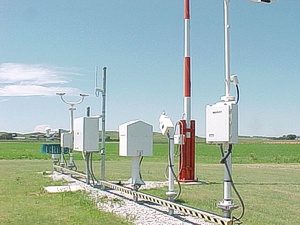
The GPS Week Number Rollover, which took place April 6, has caused several automated NOAA stations to go offline.
Some of the outages could last until November.
Photo: NOAA
According to the EOS website, 19 National Oceanic and Atmospheric Administration (NOAA) coastal and marine automated stations were not updated to mitigate the issue, and those stations are out of commission until workers can service them on location.
The New York Times is reporting that at 7:59 p.m. EDT on Saturday, the New York City Wireless Network went dark, interrupting functions such as the collection and transmission of information from some Police Department license plate readers, Department of Transportation traffic-light programming, and communications at remote work sites for the sanitation and parks departments.
The city is now working overtime to bring affected systems back online, reports StateScoop.
Previously, GPS World reported on rollover issue for the Australian Bureau of Meteorology’s (BOM) weather balloons, as well as Boeing aircraft. Read more about the Boeing issue here.
Launch of a weather balloon in Australia. (Photo: Townsville Meteorological Office/Bureau of Meteorology)
The GPS Week Number Rollover, which took place April 6, has grounded the Australian Bureau of Meteorology’s (BOM) weather balloons.
The fault was caused by the rollover of the time stamp in GPS signals, reports ABC news, which caused a “technical fault with the equipment’s communications systems.”
The weather balloons carry a radiosonde that includes GPS tracking. The radiosondes measure various atmospheric parameters and transmits them by radio to a ground receiver.
BOM said its equipment supplier advised the bureau of the fault after the rollover on April 7, and balloon launches ceased on April 8.
GPS clocks returned to zero early on Sunday morning.
Usually, BOM launches 56 weather balloons each day from 38 locations to provide vital information to help meet international obligations under the Convention of the World Meteorological Organization.
Boeing aircraft affected
Also affected by the rollover were some Boeing aircraft. The GPS clock rollover caused “a limited number of 787 airplanes” to display the wrong date, according to Boeing, causing them to be temporarily grounded in China.
Other reports are that at least one KLM 777 flight and a large number of China Airlines 777 and 787 aircraft were grounded due to the issues, while technicians updated the software. A Shanghai Airlines 787 was also reportedly affected.
In all the reported cases so far, the GPS systems were supplied by Honeywell, which issued a service update on the issue.
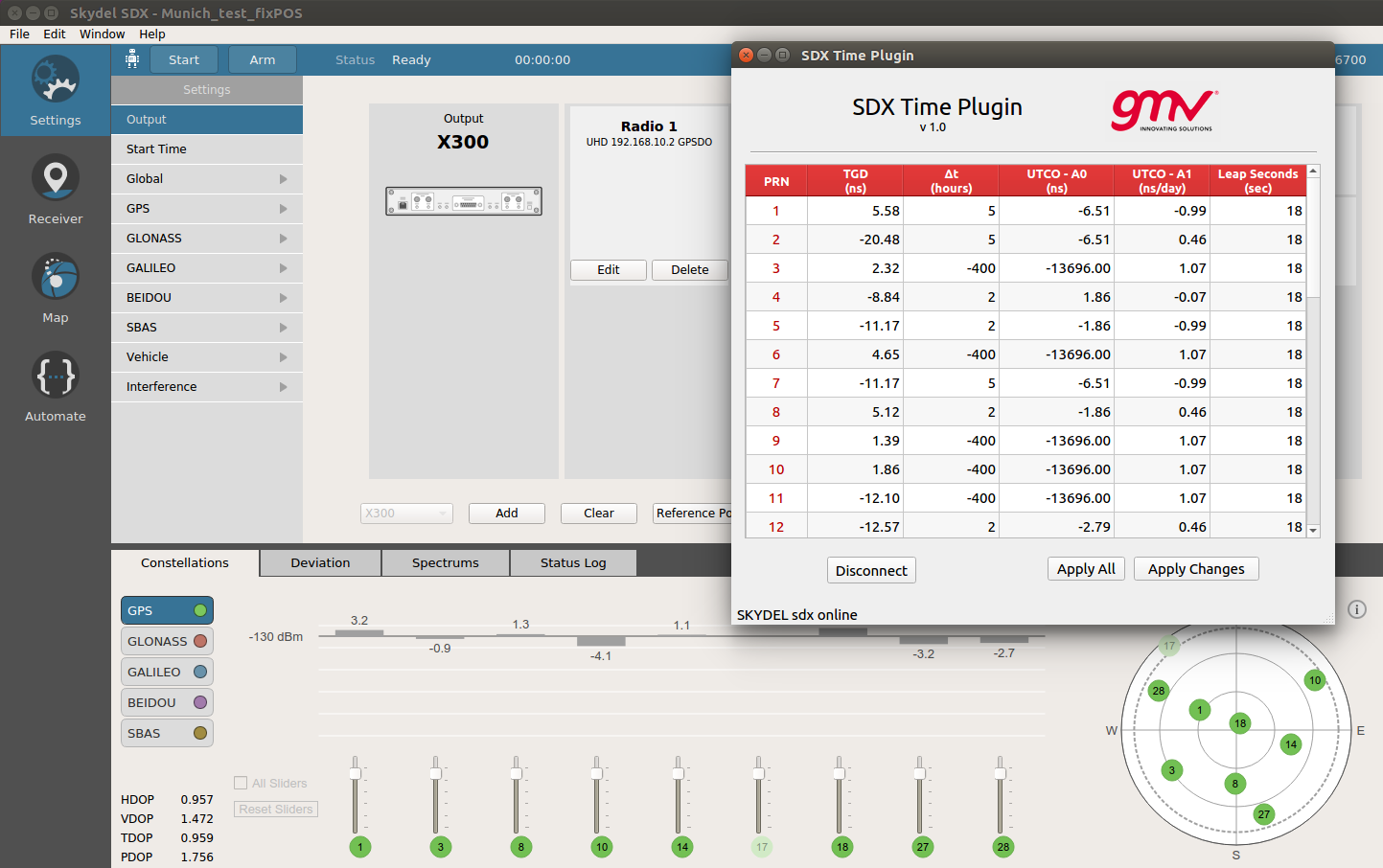
With Orolia’s Skydel SDX API, GMV has developed a “Time Plugin” that allows to batch edit the numerical values associated to TGDs, UTCO and Leap Seconds. (Image: GMV)
GMV uses the flexibility of Skydel SDX to simulate GNSS timing events.
The upcoming GPS Week Number Rollover (WNRO) on April 6 is a known feature of GPS that occurs only every roughly 20 years and thus can be anticipated and tested in a receiver using a GNSS simulator.
A less-known rollover effect is also present in the Week Number (WN) associated to the UTC Offset (UTCO) transmitted by GPS. This WN has only 8 bits, which implies a range of values from 0-255, equivalent to a rollover every roughly 5 years. A possible failure in the receiver interpretation of the UTCO WN would not have such dramatic effects as a general GPS WNRO, but it could seriously affect the output of a GPS timing receiver.
Other than WN rollovers, un-programmed GNSS timing glitches are extremely rare but not impossible. A well known case is the GPS anomaly of Jan. 25-26, 2016, when around half of the satellites in the constellation transmitted an incorrect UTCO value during 12 hours. The transmitted value was of the order of 13 microseconds, when the correct value is usually of the order of just a few nanoseconds. This caused many timing receivers around the world to provide an incorrect timing information or to fail altogether.
Other fields in the GPS navigation message that could potentially be corrupt and cause incorrect timing output are Timing Group Delays (TGDs), and Leap Second information. In general, any event related to the contents of the GPS navigation message can be simulated by editing the associated bits in the message, for each satellite PRN.
However this is a cumbersome and prone-to-error task. Orolia’s Skydel SDX simulator provides an Application Programming Interface (API) that allows to develop SDX extensions to tackle particular simulation problems in an easy and flexible way.
By using this API, GMV has developed a “Time Plugin” that allows to edit directly on a user interface the numerical values associated to TGDs, UTCO, and Leap Seconds, per individual satellite PRN. These values are then converted to bits in the GPS message and transmitted in the RF stream to feed the receiver under test. Events like, for example, the GPS anomaly of Jan. 25-26, 2016, can be easily tested (as shown in the screenshot).
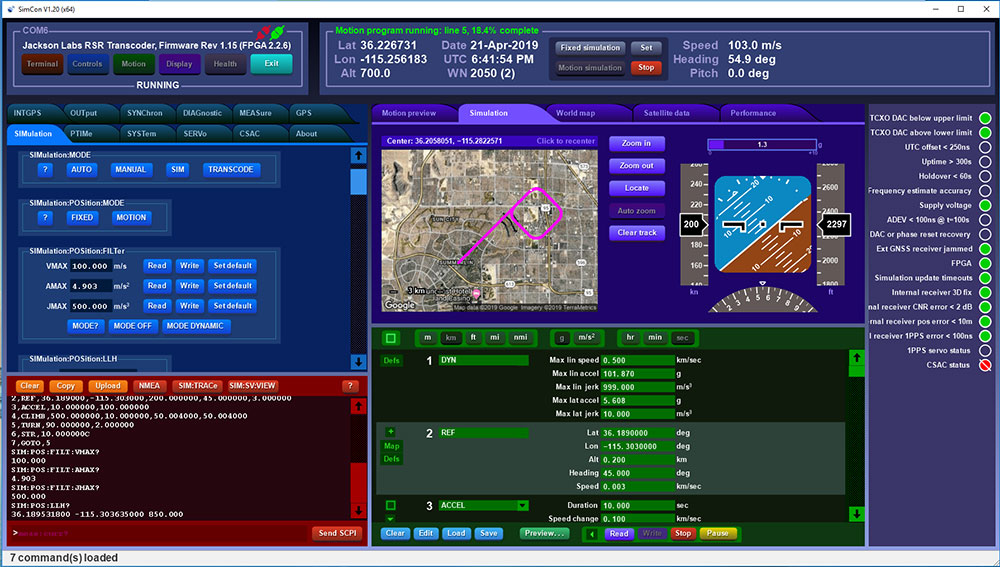
Jackson Labs Technologies has released the latest upgrades to its GPS simulator and transcoder product line.
Screenshot: Jackson Labs
The latest version of freeware application SimCon rev. 1.20 is now available. New features include:
Single-button GPS Week Number Rollover testing to test when GPS receivers will fail (hardly any will fail April 6; most older units will fail sometime between now and 2025).
Single-button GPS receiver leap second testing: Some GPS receivers might have an issue operating properly when the next leap second happens after the upcoming April 6 week number rollover, and SimCon makes that trivially easy to check.
Additional support for modern external GNSS receiver NMEA sentences for transcoding such as $GNGGA, $GLGGA, etc.
Improvements in GPS receiver switchover performance when switching from a fully GPS-denied area (running from INS) to GPS-available while transcoding in aircraft and vehicles.
This was fine-tuned based on extensive flight tests with the Navy/Air force.
Added support for the new Micro-Transcoder with its new Eval board.
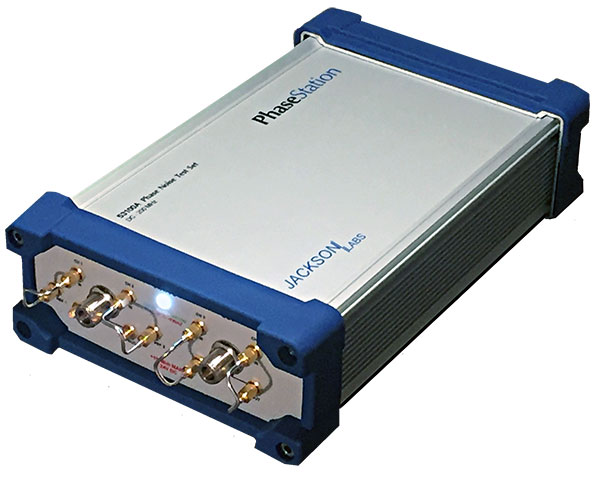
Photo: Jackson Labs
Jackson Labs also announced a new product line, the PhaseStation ADEV Frequency Stability phase noise test system (signal source analyzer).
The test system is:
useful in testing signal performance in a host of products such as GPS or GNSS disciplined oscillators.
useful to qualify and evaluate local oscillator (LO) performance for GNSS receiver design, including GPS TCXO evaluation and parametrization.
stability measurements of 1PPS and arbitrary frequency outputs from GNSS receivers
useful in optimization of GNSS receiver Kalman filter design via the GNSS receiver 1PPS output signals.
automatically synchronizes and syntonizes (calibrates) the internal dual oscillator DOCXO option to external GNSS receivers via 1PPS input.
On April 6, the GPS system used by many organizations for critical infrastructure will perform a rollover. The rollover is the result of a legacy GPS navigation message which gives a week number as a 10-bit parameter.
As a result, the week number parameter in the GPS navigation message needs to reset to zero every 1024 weeks. That means from that date onwards, users are likely to start seeing rollover problems in GPS receivers that aren’t programmed to cope with the week number reset.
Meinberg, a GNSS receiver maker based in Germany, has a different approach with its GPS receivers. Instead of a 10-bit parameter, Meinberg’s firmware uses a 16-bit week number, and it is incremented at the end of each week.
This means that by the first rollover on Aug. 21, 1999, the week number sent by the satellites rolled from 1023 back to 0, while the internal (Meinberg) week number simply counted to 1024, then to 1025 and so forth. So, on April 6, the GPS week counter will reset to 0, but Meinberg’s internal one, which will have been reached the value of 2047 by that time, will continue to count in a consecutive order.
More information about the GPS Week Number Rollover can be found on our Meinberg’s Knowledge Base.
The Coast Guard Navigation Center has published a special notice to mariners that use GPS equipment. The special notice outlines the details of the GPS Week Number Rollover that will occur April 6-7.
To best prepare for the rollover event, users of GPS equipment who are concerned should update their firmware, or contact their equipment manufacturer to ensure their equipment is ready for this event.
When the week number reaches 1024 at 18 seconds before midnight (UTC) on April 6, it will reset to zero as it keeps counting. This has happened once before, in August 1999.
Recent devices have likely been designed to handle the rollover event.
Older GPS receivers, however, or receivers that have not been provided manufacturer updates, may be affected by the rollover. The impact might occur in April, or could affect such equipment at a later date. The date might revert back to August 1999, or may revert to another date. Since this issue does not affect the other parts of the GPS navigation message (it only affects the date), the receiver’s ability to calculate the position and to display the exact time of day should not be impacted.
Additional information about GPS and the GPS Week Number Rollover is available here:
Civil GPS users are encouraged to report disruptions or anomalies to the U.S. Coast Guard Navigation Center or via phone at 703-313-5900, 24 hours a day.
The 50th Space Wing Public Affairs office of Schriever Air Force Base has established and posted guidelines, known as Interface Specification GPS-200 (IS-GPS-200), for receiver manufacturers to ensure continued capability during the April 6 GPS Week Number Rollover on Coordinated Universal Time derived from GPS devices.
According to the 50th Space Wing, users should be aware of the upcoming GPS Week Number Rollover as it may impact receivers that are not manufactured in compliance with IS-GPS-200 specifications.
The GPS Week Number count began around midnight on Jan. 5, 1980. Since then, the count has been incremented by one each week and years later broadcast as part of the GPS message. One of the GPS week number fields in the legacy navigation message counts from zero to 1,023 weeks. At the completion of every 1,024 GPS weeks, the field rolls from 1,023 to zero and starts counting again.
The first occurrence took place the evening of Aug. 21, 1999, and the message field rolled to zero at midnight GPS time.
The next similar GPS Week Number Rollover is set to take place April 6.
“We appreciate the four billion people around the world who use GPS signals on a daily basis, which is why we are transparent in providing detailed guidance on use for compatibility,” said Lt. Col. Stephen Toth, 2nd Space Operations Squadron commander.
Civil GPS users are encouraged to submit reports of GPS problems to the Coast Guard Navigation Center; civil aviation users are encouraged to report GPS anomalies to the Federal Aviation Administration; and military users should contact the GPS Operations Center.
U.S. Coast Guard issues testing notice on GPS Week Number Rollover.
The GPS Directorate has released a Federal Register Notice announcing plans to execute a test in February to investigate legacy receiver week roll-over behavior and analyze any off-nominal behavior exhibited, according to a U.S. Coast Guard notice.
Photo: andrey_l/Shutterstock.com
The GPS week number rollover occurs in the GPS legacy navigation (LNAV) message every 1024 weeks due to the GPS week number being represented by only 10 bits within the LNAV message.
The next GPS week number roll over will occur 18 seconds prior to the 0000Z boundary (Coordinated Universal Time) between April 6/7 2019.
In most cases, any negative response from a GPS receiver caused by a problem accounting for the 10-bit week number roll over would likely affect the calendar conversion from GPS time to UTC date/time and could result in the GPS receiver thinking it had jumped backward in time by 1024 weeks to 21/22 August 1999.
To participate in the test, submit the answers to the nine questions in the Federal Register Notice to the SMC/GPE mailbox by Feb. 4. After the submission of the questionnaire, the team will schedule individual meetings with interested civil vendors to further discuss their participation in the test in more detail.
In April 2018, the Civil GPS Service Interface Committee (CGSIC) announced the Department of Homeland Security release of the memorandum titled “U.S. Owners and Operators Using GPS to Obtain Time,” which is intended to provide an understanding of the possible effects of the April 6, 2019, GPS Week Number Rollover on Coordinated Universal Time derived from GPS devices.
GPS users should review this memorandum and be aware of the potential impacts to their equipment when the GPS Week Number rolls over to 0 on April 6, 2019 / April 7, 2019.
If you have questions about how your equipment may be impacted by the GPS Week Number rollover, we recommend you contact your equipment manufacturer.