Tag: GSS

  • New Galileo sensor station operating in South Pacific

    New Galileo sensor station operating in South Pacific

    Photo:
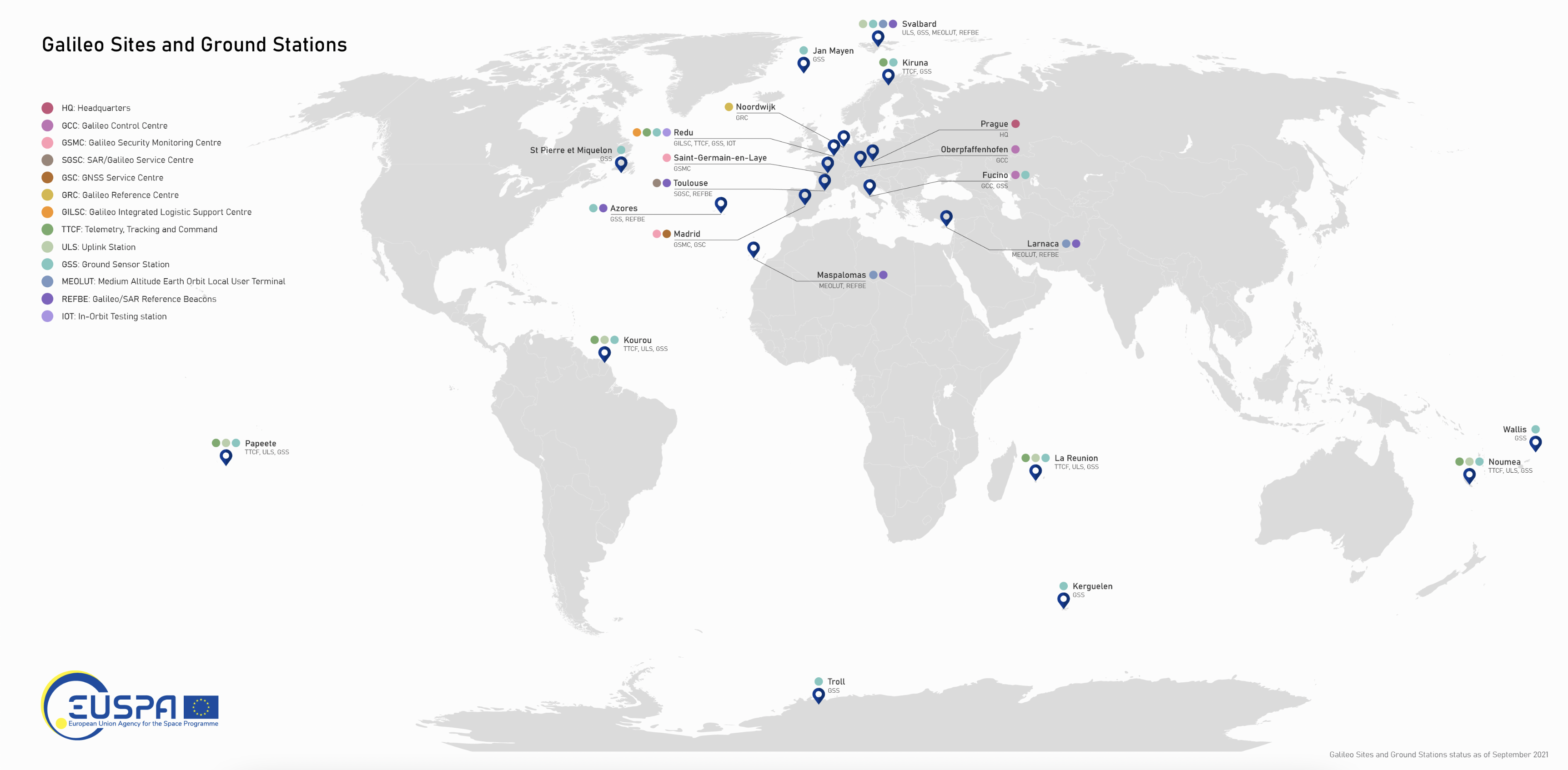
    Image: Screenshot of GSS Map from EUSPA

    The newest addition to the network of Galileo sensor stations (GSS) is up and running in Wallis and Futuna, a French territory in the South Pacific consisting of three main islands and many tiny islets. It enables increased Galileo coverage in the southern hemisphere.

    The European Union Agency for the Space Programme (EUSPA) reported that the decision for the new station was made in June 2020; however, due to COVID-19, its deployment did not begin until summer 2022. In October 2022, the second mission to Wallis and Futana took place to complete the deployment and connect the station to the ground mission segment network for data collection.

    The GSS is a network of antennas deployed at remote locations around the world. They have small, omnidirectional receiving antennas 50 cm high that check the accuracy and signal quality of individual satellites and pinpoint current satellite orbits. Establishing GSS is difficult and requires security accreditation by EUSPA’s Security Accreditation Board.

    To make the best use of the Galileo services, users rely on more than just the satellites. Dedicated facilities such as the Galileo control centers, sensors, and uplink stations are important components that make up the Galileo ground segment — which supports the service provision of Europe’s GNSS. The GSS is an important element of Galileo’s ground segment.

  • A look at LocationTech open source geospatial solutions

    LocationTech open source project provides core technology for geospatial big-data analytic solutions.

    LocationTech has released five open source projects that provide core technology used to build geospatial big data analytics solutions.

    A working group of the not-for-profit Eclipse Foundation, the LocationTech community builds software for geospatial technology. The Eclipse Foundation enables collaboration on open source software. Besides geospatial technology, the foundation’s 300-plus open source projects include tools for software developers, system engineers and scientific research.

    LocationTech provides technology for the $500 billion in worldwide geospatial industry. Its projects can be used to efficiently process satellite images, analyze maps for the agriculture industry, visualize smart-city sensor data, and in many other geospatial use cases.

    The LocationTech community has grown to include nine open source projects, 18 member organizations and more than 100 developers.Collaborating geospatial organizations include Boundless, Red Hat, Radiant Solutions, IBM and Oracle.

    “Geospatial big data analytics technology is becoming more and more important across all industries, such as agriculture, transportation, and government,” said Mike Milinkovich, executive director of the Eclipse Foundation. “LocationTech is delivering on the promise of providing key technology for companies that enable large-scale analytics of geospatial data. Having an open source community, like LocationTech, that accelerates adoption and innovation of geospatial technology will have a significant impact on the entire industry.”

    The new project releases include the following:

    GeoWave is a software library that connects the scalability of distributed computing frameworks and key-value stores with modern geospatial software to store, retrieve, and analyze massive geospatial datasets. GeoWave takes multidimensional data, such as spatial or spatial-temporal, and indexes it into a key-value store such as Apache Accumulo or Apache HBase. These distributed storage technologies, in addition to complementary distributing processing frameworks such as Apache Hadoop and Apache Spark, have proven capabilities to unlock the potential of massive datasets across a variety of domains.

    GeoGig 1.2 is a tool for geospatial data versioning. It enables users to leverage versioning of their geospatial data and to enable replication and synchronization workflows, in addition to supporting end-to-end data management workflows. The new GeoGig 1.2 release improves the collaborative version workflow by improving cloning and push/pull performance and provides an updated Web API to align with the latest version of GeoServer.

    GeoGig-sample-W

    GeoTrellis 1.2 is a geographic data processing Scala library designed to work with large geospatial raster datasets. The tool provides developers with a set of utilities to help create useful, high performing web services that load and manipulate raster data (data normally used to represent satellite or aerial images). The new release includes a number of optimizations and new features including distributed computation support for viewshed and Euclidean distance through Apache Spark.

    GeoTrellis-example-W

    GeoMesa 1.3.5 is a distributed, spatio-temporal database built on a number of distributed cloud data storage systems, including Apache Accumulo, Apache HBase, Apache Cassandra, and Apache Kafka. The suite of tools brings spatial-temporal data, real-time IoT, and sensor workloads to the cloud. GeoMesa’s novel indexing schema enables efficient queries resulting in rapid access to large data stores for any client application.

    GeoMesa-taxi-casestudy

    Java Topology Suite (JTS) 1.15 is a Java library for vector geometry providing spatial data types, spatial relationships and spatial operations. JTS is an established open source project that recently moved to the LocationTech community. New technical features for JTS 1.15 include K-Nearest Neighbor search for STR-Tree, improved handling of Quadtree queries, support for GeometryCollection, and a new JTSTestRunner command-line application. This initial LocationTech release the project is changing from LGPL to a dual license of Eclipse Distribution License (EDL) / Eclipse Public License (EPL) . This license change opens up JTS to a wider range of organizations and applications.

    “LocationTech is becoming the critical nexus for organizations looking to develop and deploy geospatial Big Data solutions,” says Eddie Pickle, Managing Director of Open Source Programs at Radiant Solutions.

    “The latest release of GeoGig to LocationTech represents a huge leap forward. Not only does it support versioning workflows for traditional geospatial data, but it is now optimized for spatio-temporal analysis of big data and streaming datasets from IoT sensors,” says Anthony Calamito, Chief Geospatial Officer and Vice President of Products

    The LocationTech Working Group is also organizing the annual FOSS4G NA conference May 14-16, 2018, in St. Louis, Missouri, followed by a Community Day on May 17. Members of the LocationTech community will be speaking and showcasing their open source projects at this conference.

    The vision of the LocationTech community is to be the leading provider of core technology for geospatial big data analytics. The five projects being released reflect the growing investment towards achieving this vision.
  • NGA’s Bryan Goltry Honored with Lt. Michael P. Murphy Award

    This morning at the United States Geospatial Intelligence Foundation’s (USGIF) GEOINT 2013* Symposium, the 2013 Lt. Michael P. Murphy Award in Geospatial Intelligence was presented to Bryan Goltry, an analyst at the National Geospatial-Intelligence Agency (NGA). NGA Director Letitia A. Long and Dr. Todd S. Bacastow, professor of practice for geospatial intelligence at Penn State University, presented the award to Goltry on the main stage directly following Long’s keynote address.

    “The Murphy award committee felt that Bryan’s independent studies made an exceptional contribution to understanding the principle dimensions of the geospatial intelligence profession,” said Bacastow.

    Goltry is a geospatial analyst with NGA’s Analysis Directorate, and recently completed Penn State’s master’s degree program in homeland security with a GEOINT focus. Goltry began his GEOINT career with Earth Satellite Corp., where he assisted with NGA’s GeoCover project. He then served as an imagery analyst at NGA from 2002 to 2006. In 2006, he worked in the private sector with 3001 Inc. as a program manager providing imagery and geospatial analysis services to customers in the Intelligence and Defense Communities. Goltry received his bachelor’s degree in geographic sciences with concentrations in GIS, global studies, and environmental studies from James Madison University.

    “Goltry’s contributions to NGA and his tradecraft continue the high standards established by the Murphy Award,” said Mark Brender, executive director of the DigitalGlobe Foundation. “We congratulate him for his excellent work and passion for his industry.”

    The Murphy Award is named for Navy SEAL Lt. Michael P. Murphy, a distinguished Penn State alumnus. Murphy was killed June 28, 2005, by enemy forces during a reconnaissance mission in Afghanistan. For his selfless leadership and courageous actions, he was posthumously awarded the Medal of Honor. The award, in his honor, recognizes achievement by a Penn State graduate student who is serving or has served in the U.S. Armed Forces or U.S. Intelligence Community. Recipients are
    chosen based upon demonstration of exceptional contributions to the discipline after completing Penn State’s Graduate Certificate in Geospatial Intelligence, as part of the university’s Master of Geographic Information Systems program.
    The generosity of USGIF, the DigitalGlobe Foundation, and faculty, staff, and friends of Penn State fund the Murphy Award.

  • USGIF Chairman Stu Shea Steps Down After 10 Years of Service

    After founding the United States Geospatial Intelligence Foundation (USGIF) in 2004, serving as its first president and chief executive officer, and presiding as the Chairman of the Board for 10 years, Stu Shea this morning announced during the GEOINT 2013* Symposium he is stepping down from his position as chairman of the foundation. The Honorable Jeffrey K. Harris was elected Shea’s successor by the board of directors at its last meeting. Harris will assume chairman duties effective immediately.

    “USGIF has grown over the past decade to become exactly what myself and the other founders envisioned for the GEOINT Community,” Shea said. “From a small gathering of intelligence professionals, USGIF has built a community around and furthered GEOINT tradecraft, fueled by the strategic direction of the Board, the talented USGIF staff, and countless Foundation members, partners, and volunteers. Our accomplishments have been a team effort, and I am so very proud to have been a part of this success.”

    Since USGIF was incorporated as a 501(c)(3) educational, nonprofit foundation in January 2004, Shea has dedicated much of his time and energy as chairman. He served USGIF in a part-time capacity, one that sometimes equaled a second full-time job.

    Under Shea’s leadership, the foundation has grown from seven founding companies to nearly 250 member organizations, awarded nearly $700,000 in scholarships, accredited eight collegiate geospatial certificate programs, and expanded the GEOINT Symposium from a fledgling event into the largest annual gathering of intelligence professionals, numbering more than 4,000 attendees annually.

    “Stu is a valuable asset to the entire Intelligence Community, but particularly the GEOINT Community,” said USGIF Chief Operating Officer Aimee McGranahan. “I’ve been a part of USGIF since the beginning, and it has been an honor every day to be a part of the Foundation’s success under his leadership. Stu’s ability to make decisions and set direction, as well as his enthusiasm and passion for national security, has driven the organization to accomplish many successes. It was these same characteristics the board carefully sought when making the decision to elect Jeff as Stu’s successor.”

    Former director of the National Reconnaissance Office (NRO) and undersecretary of the U.S. Air Force, Jeffrey K. Harris has contributed to U.S. national security in both government and industry for 35 years. He has fostered new technologies, programs, and capabilities that have contributed significantly toward keeping our nation secure.

    Harris is retired from Lockheed Martin, where he was a corporate officer and served as president of Lockheed Martin Missiles and Space, as well as president of Lockheed Martin Special Programs. Prior, he served as president of Space Imaging, the first company to provide commercial high-resolution satellite imagery.

    Before entering the private sector, Harris served in federal leadership positions, including Assistant Secretary of the Air Force for Space, director of the NRO, and associate executive director of the Intelligence Community Management Staff. In all of these capacities, he provided direct support to both the Secretary of Defense and the Director of Central Intelligence.
    Harris has received numerous awards, most notably the National Intelligence Distinguished Service Medal, the CIA Distinguished Service Medal, the NRO Medal for Distinguished Service, Aviation Week’s Laureate Citation, and the James V. Hartinger Award for military space achievement. He was also the 2006 recipient of USGIF’s Lifetime Achievement Award.

    USGIF is a nonprofit educational foundation dedicated to promoting the geospatial intelligence tradecraft and developing a stronger GEOINT Community with government, industry, academia, professional organizations, and individuals who apply geospatial intelligence to address national security challenges. USGIF’s mission is to build the community, advance the tradecraft, and accelerate innovation. The GEOINT Symposium is hosted annually by USGIF.

  • Tax Day Mapped: How Do States Tax Residents?

    Esri has provided an interactive state taxes story map. Using the map, you can view tax rates by state for income tax, sales tax, and property tax to see how each state raises money from its residents. You can also explore demographic information in the popups to see whether the state’s population and relative wealth affects how it chooses to tax its citizens. See below:

  • Trimble Delivers 3D Scanning Extension for SketchU

    Trimble Business Center Version 3.20

    Trimble has released the Trimble Scan Explorer Extension for SketchUp Pro, what it calls a powerful, easy-to-use tool enabling architects, engineers and geospatial professionals to create models from 3D scanning data.

    The new software connects the high-resolution field data from Trimble scanners with intuitive and powerful professional modeling software, to simplify the process of creating, accessing and sharing precise 3D models of the real-world environment.

    The Trimble Scan Explorer Extension dramatically reduces the time required to generate a SketchUp Pro 3D model from scan data, the company said. Streamlined tools and one-touch features allow users to quickly extract construction points and lines that are used as a guide to simplify and expedite the modeling process. Automated plane extraction tools further increase modeling efficiency, particularly when modeling building interiors and facades.

    For improved visual references when working with point clouds, the extension includes a simple-to-use edge extraction tool, allowing users to easily decipher important cues from the scan data directly into their model building space. Structural edges are brought into SketchUp as guidelines, and one button push displays the shell of the structure.

    “By seamlessly integrating powerful tools across our broad range of best-in-class solutions, Trimble is helping transform the way our customers work and accomplish more every day. The integrated workflow provided by Scan Explorer brings the accessibility of 3D modeling to more users for as-built analysis and design changes,” said Alain Samaha, business area director of GIS and Software for Trimble’s Geospatial Division. “Professionals can now easily create visual 3D models that provide a true representation of the environment they are working in—improving the communication, collaboration and quality of deliverable that they can provide to their clients.”

    “SketchUp’s enormous popularity as a design tool is rooted in its capacity to make many complex processes easier and more efficient,” said Chris Keating, director of the Architecture Division within Trimble Buildings Group. ”The Trimble Scan Explorer Extension for SketchUp Pro reinforces our mission to deliver SketchUp’s benefits to new users and for new uses.”

    The release was announced at SPAR International 2014, a conference for 3D data capture, processing and delivery technologies.

    Trimble Scan Explorer Extension for SketchUp Pro is available through Trimble’s Geospatial distribution network and online.

    Trimble RealWorks Version 8.1 Bridge Clearance

    Trimble Trident Version 6.1

  • Report from GEOINT: The Search for Malaysia Flight 370

    Day One Coverage

    Today I attended the “GEOINT Forward” which is a pre-conference day consisting of over a dozen loosely related sessions. If there was a common theme it would have to be the increasing evolution of the GEOINT community toward Human Geography, Social Media, Big Data, Small Satellites and Chaos Management.

    A most interesting keynote speaker was Dave Snowden (no relation to NSA whistleblower Edward Snowden) founder and chief scientific officer of Cognitive Edge working to analyze complex issues relating to strategy and organizational  decision making.  He pioneered a science based analysis of organizations drawing on anthropology, neuroscience and complex adaptive systems theory.  The key analysis tool they created  is SensesMaker, a survey tool that extracts and organizes how respondents make sense of the world through micro-narratives in social settings.  Using a patented method the respondent interprets their own story into a series of abstract constructs that feel more like a game than a survey, but allows profound meaning to emerge. This interpretation adds layers of meaning rather than simply interpreting the story and provides quantitative data which can always be linked back to the original material.

    There were several sessions related to Chaos Management of disasters both natural and man-made. Dr. Shay Har-Noy of Digital Globe demonstrated TomNod (www.tomnod.com/nod/) which is a crowd sourcing effort of Digital Globe in which the public has access to thousands of images so that millions of eyes could help scour the imagery looking for signs of the missing aircraft. Once potential sites were indentified, experts could then focus their attention on the sites.  Here is a short video clip of some examples.  (Excuse the quality of the video, the room was dark, sound system poor and the built-in microphone less than ideal)

  • LizardTech to Showcase Express Server at the GEOINT

    GeoExpress Previewer with Infrared.
    GeoExpress Previewer with Infrared.

    LizardTech will conduct defense-oriented demonstrations of its recently launched Express Server software product next week at the GEOINT 2013* Symposium in booth number 4079. The symposium will take place April 14 – 17 at the Tampa Convention Center in Tampa, Florida. LizardTech is a provider of software solutions for managing and distributing geospatial content.

    Express Server is image-delivery software for compressed raster imagery, including multispectral imagery. The latest version includes the ExpressZip web application for browsing, finding, and exporting imagery straight from the web browser. Users can view all of their collections and query by location, by keyword, by projection, and more. If users need to take their imagery on the go, they can use the built-in selection tools to export regions of interest. The ExpressZip application is open source and customizable.

    “We look forward to sharing Express Server 9 with the intelligence community at GEOINT next week,” said Jon Skiffington, director of product management at LizardTech. “Most LizardTech users know MrSID and how it can be used to drastically reduce image sizes while retaining visual quality. What they may not be aware of is that  Express Server is the fastest, easiest, and most stable way to distribute compressed, high-resolution raster imagery via standard protocols. And now with ExpressZip, our customers will be able to access all of their collections in one place and export imagery straight from the web browser.”

    LizardTech will also showcase its GeoExpress software for compressing and manipulating satellite and aerial imagery, and its LiDAR Compressor software, which turns giant point cloud datasets into efficient MrSID files.

  • Scene Sharp USA to Unveil Fuze Go V2.0 Image Fusion Software at GEOINT

    Scene Sharp USA will introduce Version 2.0 of its Fuze Go universal image fusion technology April 14-17, 2014, at the GEOINT 13* Symposium in Tampa, Florida. Scene Sharp will be hosted in Global Marketing Insights booth #2091 where it will demonstrate the new Fuze Go MS Sharp and Fuze Go SAR Sharp image fusion processing tools.

    Scene Sharp is  division of PraEis Ltd., a geospatially focused technology transfer organization with offices in Ohio and New Hampshire USA.

    “Fuze Go is a fully automated technology that enables users to quickly and easily fuse data sets to add color to non-colorized satellite and aerial imagery with just a few mouse clicks,” said Scene Sharp CEO Ian Lucas. “By colorizing image data, GIS users can visualize and extract richer information content from remotely sensed data to make better informed decisions.”

    In one simple step, the Fuze Go MS Sharp software fuses high-resolution panchromatic image data with lower-resolution multispectral data to generate a high-resolution color image. The full information content of the multispectral bands is retained in the fused image. More importantly, Fuze Go MS Sharp is the only fusion software capable of simultaneously merging up to 30 bands of multispectral data with a panchromatic image.

    “Fuze Go MS Sharp runs at least five times faster and yields more consistent results than pan-sharpening applications that can only process four bands of data,” said Lucas. “As is true with the entire line of existing and planned Fuze Go products from Scene Sharp, no expertise in GIS or image processing is needed to use Fuze Go MS Sharp.”

    As a universal image fusion tool, Fuze Go MS Sharp can handle data formats from any commercial image processing and enterprise GIS software packages. In cooperation with Exelis Inc., Scene Sharp created a Fuze Go MS Sharp plugin for the popular Exelis ENVI 5.0 and 5.1 image processing package.

    “The plugin enables ENVI users to access the Fuze Go MS Sharp tool either within the ENVI workflow or outside of it so that fusion can be performed as a stand-alone application, freeing up the ENVI software license for other image processing activities,” said Lucas. “We are developing similar plugin capabilities for other major GIS and image processing packages.”

    Fuze Go SAR Sharp was designed by Scene Sharp for more effective exploitation of data captured by satellite-based synthetic aperture radar (SAR) sensors. Fuze Go SAR Sharp fuses gray-scale radar data with optical multispectral bands to colorize the SAR data set. This image fusion presents the unique SAR data, which is captured through darkness and clouds, in a color context that greatly enhances the user’s ability to interpret the radar data and extract actionable intelligence from it.

    Fuze Go MS Sharp and SAR Sharp are available for purchase for an annual license fee. Batch processing versions of the software packages are also offered to perform automatic fusion of multiple optical or SAR scenes.

    “The ease of use and attractive pricing of Fuze Go software products make them far superior solutions to any other applications in the geospatial market today,” said Dr. Shawana Johnson, President of Global Marketing Insights. “With their seamless integration into existing image exploitation workflows, Fuze Go products can have immediate impacts in defense/intelligence, homeland security, mining, agriculture, forestry and oil & gas applications.”

  • The Upcoming GEOINT Symposium

    Art Kalinski
    Art Kalinski

    The 2013* Conference, April 13-17, 2014

    This month’s column is a short one since I’m attending GEOINT 2013* in Tampa. The asterisk on 2013 is a way for USGIF to save a few bucks by not reprinting banners, displays and handouts for the 2014 date. In talking to the USGIF staff, I learned this will be the only symposium for the year, with the next GEOINT Symposium being held in the spring of 2015. The location will be announced soon.

    For your information, this is the latest list of keynote speakers:

    • The Honorable James R. Clapper, Director of National Intelligence (DNI)
    • LTG Michael T. Flynn, U.S. Army, Director, Defense Intelligence Agency (DIA)
    • Ms. Letitia A. Long, Director, National Geospatial-Intelligence Agency (NGA)
    • ADM William H. McRaven, U.S. Navy, Commander, U.S. Special Operations Command (USSOCOM)
    • Ms. Betty J. Sapp, Director, National Reconnaissance Office (NRO)
    • Mr. Robert Scoble & Mr. Shel Israel, Co-Authors, “Age of Context”

    While attending next week, I’m going to shoot video clips and write blogs that will be posted to this publication. If you’re attending GEOINT and see me (bald head, easy to spot), please stop me and say hello.

    If you won’t be able to attend and need eyes on a particular presentation or exhibitor, please contact me.  I’ll try my best to sit in on the session and take notes, or visit an exhibitor’s booth to get the information you need. I may shoot a video clip, or at least give you my impression of the session or booth.

  • SuperGIS Engine 3.2 Released for Customizing GIS Applications

    SuperGIS-Supergeo

    Supergeo Technologies, a global provider of GIS software and solutions, officially released SuperGIS Engine 3.2 to assists GIS developers in customizing GIS applications to meet diverse requirements of each project.

    Developed by Supergeo through integrating mapping and GIS technologies, SuperGIS Engine 3.2, as the COM-structured development component, provides developers with complete GIS core components. The developed applications can be seamlessly embedded into programming language in Windows developing environment and integrated with other systems for strong system development, Supergeo said.

    SuperGIS Engine 3.2 offers complete development resources. GIS programmers or developers are allowed to efficiently develop applications with GIS functionalities such as Display Layer, Edit, Query, Access Spatial Database, etc. Hundreds of GIS-related objects, diverse controls, comprehensive developing samples and object diagram are given to technical users, to effectively build programs and deploy to multiple end-users.

    A variety of new components are contained in SuperGIS Engine 3.2. For example, “Internet Connection Component” for Proxy Server settings and “Data Exclusion” for excluding specified vector data for better map display are newly supported. In terms of mapping, point symbols can be rotated and resized according to their attributes for more flexible displaying effect.

    To know more information and download the free trial, visit www.supergeotek.com/ProductPage_SE.aspx.

  • National Map Corps Celebrates One Year of Crowdsourced Mapping

    Status map showing the location and density of volunteer submitted structure edits.
    Status map showing the location and density of volunteer submitted structure edits.

    This April marks the one year anniversary of the transition of the USGS’s The National Map Corps (TNMCorps) from a small regional pilot project in the heart of Denver, Colorado, into a successful nationwide project. During the past year, civilian volunteers in every state have increasingly provided accurate mapping data to the National Geospatial Program’s publicly available application called The National Map.

    Using crowdsourcing techniques, TNMCorps’ Volunteered Geographic Information (VGI) project engages citizen scientists to collect man-made structures data including schools, hospitals, post offices, police stations and other important public buildings.

    Over the past year TNMCorps has achieved the following significant milestones:

    • 1,422 – volunteers
    • 42,009 – contributions (counts each person’s edit per single point)
    • 33,698 – unique points edited (individual structures)
    • 50,696 – total number of edits (the sum of all edits made by volunteers)
    • 50  – number of states involved
    • 18 – number of volunteers who have earned more than 500 points
    • 4,691 –  state with largest number of edited points; Colorado

    “This project has proven that we can count on volunteers to provide quality information to be included in authoritative government databases,” said Kari Craun, director of the National Geospatial Technical Operations Center. “The people that have contributed their time are performing a community service by ensuring key structures data are available publicly.” 

    To volunteer, go to The National Map Corps project site. The project is seeking anyone with access to the Internet willing to dedicate some time editing map data. Participants can earn badges and public recognition by a series of points.

    While some familiarity with the area that a volunteer chooses is helpful, volunteers don’t have to live near a particular place to contribute. The tools on TNMCorps website, along with ancillary information available on the Internet, are generally sufficient to edit a distant area.