Tag: Gulf of Mexico

  • Burning ring of fire: Mapping high ocean temps off Florida coast

    Burning ring of fire: Mapping high ocean temps off Florida coast

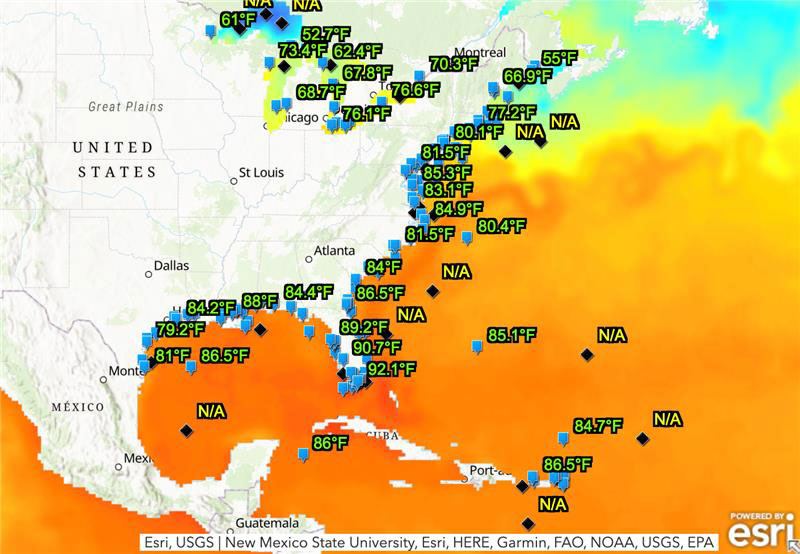
    The ocean off the Gulf of Mexico is undergoing a marine heat wave that could pose a threat to coral reefs, as water temperatures reach 90°F. A coral reef watch map, provided by the National Environmental Satellite, Data, and Information Service of the National Oceanic and Atmospheric Administration (NOAA), shows that the water near the Florida Keys is significantly higher than usual, which causes coral bleaching and other marine life concerns.

    Image: NOAA
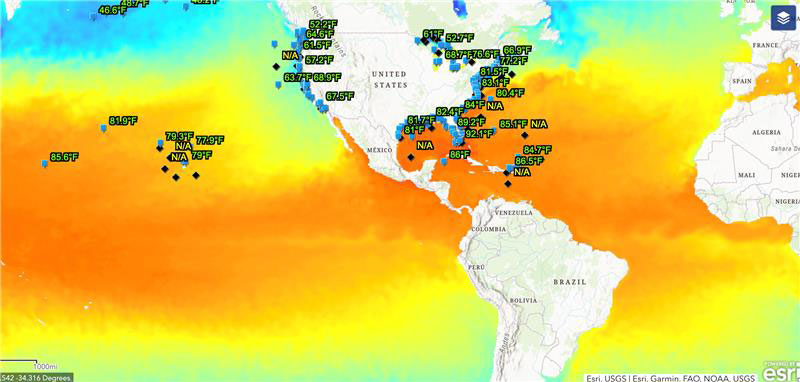
    Image: NOAA

    The Gulf of Mexico is not the only place that is suffering this marine heat wave. 40% of the globe is experiencing extreme temperatures, Dillon Amaya, a physical scientist at NOAA, stated in an interview with the New York Times.  

    This map provides water temperatures globally. The blue-green colors represent cooler temperatures whereas yellow-orange colors represent hot temperatures. (Image: NOAA)
    This map provides water temperatures globally. The blue-green colors represent cooler temperatures whereas yellow-orange colors represent hot temperatures. (Image: NOAA)

    The current water temperatures are the hottest ever recorded. Scientists say that these high temperatures are typical, but not until August or September. It is only July. 

    The marine heat wave is mainly due to a climate phenomenon, El Niño, that typically brings warmer ocean temperatures. However, now El Niño is coming on top of long-term warming caused by greenhouse gas emissions and worldwide contribution to global warming.  

    When sea temperatures rise too high, corals bleach, expelling the algae they need to live. If the water does not cool quickly enough, and if bleaching events happen frequently, the corals die. Coral reefs are vital to the marine life that relies on them and 25% of all marine life — including more than 4,000 kinds of fish — depends on reefs, according to NOAA. 

  • TCarta Marine offers Gulf of Mexico basemap, bathymetry data

    TCarta Marine, a global provider of marine geospatial products, will unveil two new offshore data offerings at the 2017 Esri Petroleum GIS Conference in Houston — the Gulf of Mexico Marine Basemap Plus service and 2-meter Satellite Derived Bathymetry dataset.

    The Marine Basemap Plus is a streaming data service that delivers up-to-date value-added marine layers directly into Esri ArcGIS on a subscription basis.

    LandingImages-TCarta-WThe 2-meter Bathymetry product is an off-the-shelf shallow water, coastal zone bathymetric dataset derived from high-resolution satellite imagery.

    Both products will be demonstrated by TCarta Marine in booth #403 at the Esri Petroleum Conference being held April 12-13, in Houston’s George R. Brown Convention Center.

    “The Marine Basemap service covering the entire Gulf of Mexico is available now,” said TCarta Marine President Kyle Goodrich. “Datasets for additional marine regions around the world will be added this year with the North Sea available this summer.”

    The streaming data service was developed with the oil and gas industry in mind, allowing customers to choose from two subscription tiers for the Gulf of Mexico. The GoM Marine Basemap is a tiled map service intended to provide users with an informative and aesthetically pleasing backdrop streamed into the desktop GIS environment. The Basemap is a scale-dependent display of a stylized bathymetry image with labeled contour lines and marine feature names

    The Marine Basemap Plus incorporates best-available resolution bathymetry grids, contour lines and other valuable data for modeling, analysis and derivative work. The entire gulf is covered at 90-meter resolution while many areas have been mapped at 30-meters, with higher resolution data to be added.

    “Marine Basemap Plus will appeal to oil and gas companies of all sizes because the streaming data is extremely affordable and updated constantly through the subscription process,” said Goodrich. “The GIS manager at an energy company will never have to worry about obtaining the most recent or highest quality offshore data because it will be downloaded automatically.”

    The Gulf of Mexico Marine Basemap Plus also includes information enhanced from authoritative sources such as the National Oceanic and Atmospheric Association (NOAA), National Ocean Service, Department of Energy and Bureau of Energy Management. The five main value-added layers relate to:

    • Navigation – Seafloor elevation data including dredged channels and shipping lanes
    • Geology – Natural features and seismic anomalies
    • Lease Blocks – Active leases, well, and pipeline information
    • Habitat – Reefs, grasses, corals and other marine ecosystems
    • Shoreline – Vector derived from lidar and satellite imagery

    Also making its U.S. debut at the Esri Petroleum show will be the 2-meter Satellite Derived Bathymetry offering developed by TCarta Marine, DHI and DigitalGlobe with funding from the European Space Agency. This is an off-the-shelf version of a custom product introduced in 2011 by Proteus Geo, which merged with TCarta Marine this year. It will eventually be a global marine dataset.

    To create this product, accurate seafloor depths are extracted by DHI using a primary production technique before TCarta Marine ensures that all data undergoes a rigorous quality control procedure. All depths are derived from eight-band multispectral imagery captured by DigitalGlobe’s high-resolution WorldView satellites, the commercial imaging constellation.

    “This process derives bathymetric measurements at 2-meter resolution to an average depth of 20 meters in the near-shore coastal zone, where environmental conditions allow,” Goodrich said. “The 2-meter product will be sold by the square kilometer, which means clients only pay for the data they need, making this a very cost-effective product.”

    The off-the-shelf 2-meter product covering the Arabian Gulf is available for purchase now, with the Red Sea planned for completion by later this year. By mid-2017, TCarta Marine will make the 2-meter products available for instant searching, purchasing and downloading through an online portal called Bathymetrics.

    The Gulf of Mexico Marine Basemap Plus and 2-meter Bathymetric products can be ordered through [email protected].
  • Enhanced Sea-level Prediction System to Improve Coastal Flooding Plans

    National Geodetic Survey logoAs the Gulf Coast begins another hurricane season, researchers with the Conrad Blucher Institute for Surveying and Science (CBI) at Texas A&M University-Corpus Christi will be improving the data collection system to allow for more accurate planning and predictions for flooding and sea-level rise.

    CBI has been awarded $1.35 million to enhance the National Spatial Reference System that helps model and predict sea level rise.

    Forecasters are predicting a hurricane season with one or two major hurricanes, but flooding can still pose significant threat, especially to the vital infrastructure along the Gulf coast, which includes 10 of the 14 largest ports. The long-term stability of this region’s infrastructure is in question due to the impact of sea level rise and associated increases in risks of flooding. Growing Gulf coastal populations, up 32 percent from 1990 to 2008, compound the risks. Preparing for sea level rise, flooding and other impacts requires accurate data about what’s occurring at the water’s edge. Collection methods for this type of geospatial data will be enhanced through this project.

    The funding, from the National Geodetic Survey, a project of the National Oceanic and Atmospheric Administration, provides the foundation for modeling along the northern Gulf of Mexico through the National Spatial Reference System.

    The project focuses on an area that is most exposed to inundation from tropical storm surge and has a high risk of flooding and long-term effects of climate change and subsidence.

    “We are excited to be part of this project to provide the latest geospatial data with information from tide gauges, sea level observations, land elevation reference points, and 3D positioning,” said Gary Jeffress, director of CBI. “This system will help local and regional leaders plan for improved resilience to the impacts of sea level rise and flooding and develop long-term strategies to address impacts along the northern Gulf of Mexico.”

    The project will extend and improve monitoring stations from Texas to the Florida Keys to provide additional measurements, including more accurate data regarding elevations, 3D positioning, subsidence rates and sea level observations, that will establish ongoing monitoring of the relative sea-level change along the northern Gulf of Mexico in the coming decades.

    Jeffress, Ruizhi Chen and James Rizzo, with CBI and Texas Spatial Reference Center, will lead the project for A&M-Corpus Christi. Researchers from University of Southern Mississippi, Louisiana State University and Florida Atlantic University are also partners in the project.