Tag: in-vehicle services

  • Researchers Use Traffic App Data to Identify Accident Hotspots

    Researchers at Israel’s Ben-Gurion University of the Negev (BGU) say reveal that data culled from geosocial networks like the GPS traffic app Waze can help prevent traffic incidents with better deployment of police resources at the most accident prone areas.

    “Only now are we beginning to discover the potential in the huge amount of data collected daily,” explains BGU researcher and Ph.D. student Michael Fire. “Studies of this kind, which monitor events such as traffic accidents over time, can help the police identify dangerous sections of roads in real time, or alternatively, locations where few police are needed.”

    The paper, “Data Mining Opportunities in Geosocial Networks for Improving Road Safety,” was presented at the IEEE 27th Convention of Electrical and Electronics Engineers in Israel.

    Waze records location data and enables users to upload and share comments on any detail, including traffic alerts, accidents or police presence. According to its website, Waze has 30 million worldwide users and describes itself as “a community-based traffic and navigation app whose users share real-time traffic and road info, saving time and gas money.”

    Using Waze data and Google Earth, the BGU researchers determined that three-quarters (75 percent) of the locations in Israel with the highest number of accidents were intersections. They then analyzed references to a police presence to determine if the police were present at the spots that had the worst traffic accidents.

    “There were numerous instances where the police were manning quieter intersections, while busier intersections went unmonitored,” Fire explains.  “According to the data, police response time varied from 20 minutes to 40 minutes in some situations.”

    Using Waze, data from May and June 2012 was collected and analyzed on accident reports, police presence, traffic jams, and speed traps. BGU researchers identified 579 different locations in Israel that had at least five reoccurring accidents during this time where 5,156 reported accidents occurred. Police were reported at least 15 times at more than 3,500 locations.

    Other researchers involved with the study from BGU’s Department of Information Systems Engineering and BGU’s Telekom Innovation Laboratories include Prof. Yuval Elovici, head of the lab, as well as Dr. Rami Puzis, Prof. Lior Rokach as well as student Dima Kagan.

  • Trimble, ng Connect Collaborate on Connected Service Vehicle Demo

    Trimble’s ThingMagic Mercury6 (M6) RFID Reader will be part of the ng Connect Program’s Connected Service Vehicle, which showcases a full suite of cloud-based services designed to deliver office productivity to vehicle-based workers. In this concept vehicle, the ThingMagic reader will be used to support work-order based inventory management and tool tracking applications to illustrate aspects of a typical service visit.

    The ng Connect Program, founded by Alcatel-Lucent, is a multi-industry ecosystem dedicated to the creation of the new generation connected user experience. ng Connect is comprised of more than 190 Contributing and Associate member companies including network, consumer electronics, application and content providers. Twelve proof of concept demos will be featured this year in the Alcatel-Lucent CES booth at the 2013 Consumer Electronics Show, January 8-11, in Las Vegas.

    As a collaborating member of the ng Connect program, Trimble is providing the development platform for in-vehicle RFID solutions and sensor technology for high-volume commercial, industrial and enterprise applications. Achievements in the automotive market include receiving the Ford World Excellence Award for contributions to a first-to-market RFID-enabled solution designed to help contractors track and manage their tools.

    “We’re honored to join the ecosystem of innovative, market-shaping companies in the ng Connect program,” said Bernd Schoner, vice president of business development at Trimble’s ThingMagic Division. “Using the vehicle as the basic point of data capture can enhance productivity. Uploading asset information from the vehicle to a central data aggregation layer for anywhere, anytime consumption by a variety of applications is the future.”

  • Agero Unveils Auto Infotainment Development Kit

    Agero Connected Services has announced the development of the AgeroView DevKit, a new cross-platform toolkit designed to accelerate the deployment of cloud-based automotive infotainment system applications. The DevKit includes specialized APIs (Application Programming Interfaces) and associated support to enable access to a variety of in-vehicle platforms ranging from safety and GPS positioning to multimedia and climate control.

    The DevKit, which will include an application software development kit (SDK) as well as a hardware evaluation kit, will be evaluated by select automakers during the first half of 2013 before its release.

    According to Agero, the launch of the AgeroView DevKit will remove significant barriers that constrain today’s in-vehicle infotainment systems. Until now, infotainment system features have always remained relatively static over the course of the vehicle’s lifetime. With the DevKit, automakers and developers can deploy more exciting and convenient experiences even years after the vehicle is sold. Drivers and passengers will be able to personalize their device interfaces on demand, and dealers will have the opportunity to introduce new content and interfaces.

    The AgeroView DevKit will allow the deployment of far more efficient and practical applications, particularly those involving navigation, messaging, and safety/diagnostics. Motorists will receive  the added value created by the vehicle’s ever-improving array of functions, content, and service offerings.

    “With the AgeroView DevKit, automakers will now be able to target the applications critical to their brand and quickly deliver a user experience that builds brand equity,” said Frank Hirschenberger, Agero’s senior director of Innovation. “Moreover, the DevKit lets developers create apps with a simple, easy-to-learn interface that takes into account evolving knowledge on minimizing driver distraction.”

    The AgeroView DevKit also provides the critical portal between Agero’s AgeroView in-vehicle cloud services and the in-vehicle electronics. The DevKit makes it simple for developers to write and validate production-ready, automotive-centric apps through the use of standard Web technologies, the company said.

    The AgeroView DevKit resides as a component in the AgeroView cloud platform developed by Agero in partnership with M-Way Solutions, GmbH. The platform gives automakers and vehicle owners the flexibility to substitute providers of specific content such as navigation, entertainment, and news as well as customize graphic and audio interfaces whenever desired.

  • iOnRoad Steers iPhone Navigation Towards Safer Driving

    iOnRoad,  the maker of the iOnRoad app that improves driving in real-time using the power of modern computer vision algorithms and smart-phone cameras, has released its award-winning app on iOS 6 operating systems. iOnRoad, now available for immediate download in the App Store, is taking advantage of the leap in processing power of the iPhone 5 and  new navigation integration offered on iOS 6, the company said.

    iOnRoad’s new iOS 6 features bring about a whole new depth to driving assistance applications. The iOnRoad application’s advanced fusion with iOS 6 navigation allows the driver the benefit of turn-by-turn navigation along with iOnRoad’s augmented driving UI. Furthermore, iOnRoad’s new “black-box” like video recording feature acts as a virtual driving log, archiving users’ driving history. Should an accident occur, drivers may now be given a greater understanding of the events leading up to it.

    “We have serviced hundreds of thousands of mobile users over the past year and are excited to provide iPhone users an enhanced version of iOnRoad,” said Alon Atsmon, CEO of iOnRoad. “In addition, the new in-phone analytics dashboard tells a driver how safe and ‘green’ the drive was and can even estimate gas prices, which is quite useful given the fluctuation in gas prices today.”

    iOnRoad uses the iPhone camera and sensors to detect lanes and vehicles in front of the vehicle, alerting drivers when they are in danger. The app provides a range of personal driving assistance functions including augmented driving, collision warning, speeding alert and safety scoring.

    “We are witnessing a trend in which  systems and features that we used to find in jet-planes such as navigation, collision warnings, HUD and night vision are increasingly finding their way into the driving environment,” says Atsmon. iOnRoad’s innovation and market leadership has been validated by numerous industry awards including the 2012 CTIA E-Tech Award, CES 2012 showcase award, and one of Gartner’s cool vendors in automotive for 2012.

    View a video of iOnRoad in action.

  • TI’s Wi-Link 8Q Provides Wireless Connectivity for Auto Infotainment

    Wireless connectivity is becoming a key feature in automobiles for sharing and viewing content from smartphones and tablets to in-car systems, easy pairing of devices, navigation and replacement of expensive cables for in-car communication. To answer this need, today Texas Instruments Incorporated (TI) introduced the WiLink 8Q family of wireless automotive connectivity solutions.

    “GNSS technology combines GPS and GLONASS signals with the on-chip positioning engine producing a more accurate fix of your location, making “urban canyons” non-existent,” according to the TI Behind the Wheel blog. TI is demonstrating WiLink 8Q and other technologies at the Consumer Electronics Show this week in Las Vegas.

    With its multi-radio technology, the WiLink 8Q family reaches new levels of cross platform scalability and delivers advanced features including in-car multimedia streaming video in parallel with Bluetooth hands-free calling and advanced audio distribution profile (A2DP) stereo sound. Additionally, with near field communications (NFC) for easy Wi-Fi and Bluetooth pairing, WiLink 8Q solutions enable an easy connection between a smartphone or tablet and the automobile, providing a seamless user experience, according to TI.

    The WiLink 8Q family is designed for Wi-Fi Certified Miracast operation. With an integrated power amplifier (PA) and complete software reuse across all family members, WiLink 8Q solutions provide a full range of products for wireless automotive infotainment including:

    • Super-combo SoCs with Wi-Fi, Bluetooth, Bluetooth low energy, NFC, and GNSS support.
    • Combo-connectivity system-on-chips (SoCs) with Wi-Fi and Bluetooth support.
    • More integrated combo-connectivity SoCs with Wi-Fi, Bluetooth, Bluetooth low energy and NFC.

    “Delivering the familiar experience consumers have with smartphones and the tablets into the automobile to share information and content from drivers’ and passengers’ devices is driving the need for strong wireless connectivity solutions. Wi-Fi, Bluetooth, NFC and GNSS have to work together seamlessly as integrated parts of the entire system,” said Mattias Lange, automotive connectivity product line manager, Wireless Connectivity Solutions, TI. “The WiLink 8Q family takes our expertise in wireless connectivity and automotive applications to the next level with support of four different RF technologies on one SoC – a truly integrated approach to automotive infotainment.”

  • Navman Wireless Debuts Professional Services for Fleet Tracking

    Navman Wireless today announced the availability of two professional services packages designed to expedite, optimize and provide problem resolution for 100+-vehicle implementations of its OnlineAVL2 fleet management platform. Going beyond basic customer support, the new services can reduce rollout and configuration time by up to 80 percent, produce a 50 percent faster return on investment, and help corporate and construction fleet managers derive maximum value from the system by doubling the number of features used.

    “Most fleet tracking vendors say they provide support services, but usually those services are limited to basic phone assistance and coordination of system installation with a third-party vendor. Through our work with customers who track hundreds of on- and/or off-road vehicles, we recognized that large installations need substantially more assistance for timely deployment as well as to take full advantage of system capabilities to reduce costs and streamline operations,” said Nels Erickson, field services manager at Navman Wireless. “We launched our professional services packages specifically to meet these needs.”

    Both the Standard and Turnkey professional services bundles entitle customers to a dedicated project and account team, including a field services engineer serving as a single point of contact and project manager, plus the use of a dedicated phone line staffed with support specialists assigned exclusively to handle larger accounts.

    The Standard package includes installation support, basic OnlineAVL2 configuration, a training website and weekly group training webinars, priority issue escalation, and a yearly account review to evaluate the customer’s use of the system and identify opportunities to realize greater benefits from the deployment.

    The Turnkey package includes all Standard features plus 80 hours of project management time for on-site project planning and user training as well as weekly update calls and advanced OnlineAVL2 configuration for features such as geofences, maintenance module setup, report scheduling, and email and text alerts. This premium package also includes ongoing best practice guidance, regular on-site business reviews, API-based integration into backend systems, and guaranteed 45-day implementation with appropriate advanced notice and asset availability.

    Optional add-on services include custom training and documentation, installation and training at additional depots or terminals, and advanced project management for complex implementations.

  • CE-Traffic Launches Premium RDS-TMC in Poland

    CE-Traffic, a traffic data provider in Central-Eastern Europe, has extended its portfolio of traffic services in Poland, the country where over last five years the number of vehicles has grown by 50 percent. Drivers in Poland can look forward to more options in receiving real-time traffic information with the launch of the new Premium RDS-TMC service by CE-Traffic, the company said.

    “We looked at TMC solution with all its limitations and asked ourselves: how we can get more out of the technology that has been around for more than a decade so that navigation systems vendors can offer to their customers an easy-to-implement and affordable traffic service of a real value? Our Premium RDS- TMC offers drivers an access to very detailed traffic information without any mobile telecommunication cost and subscription fees,” said Jiri Novobilsky, CEO of CE-Traffic.

    Competitive advantage of CE-Traffic Premium RDS-TMC is based on smart use of TMC components, according to CE-Traffic. Up-to-date traffic flow data and journalistic information are smartly aggregated and regionally filtered. CE- Traffic TISA certified Location Table (LTN 6) offers the best available coverage. It includes not only all major roads and streets but also lower category roads commonly used by drivers like shortcuts or alternative routes. RDS channel with enhanced capacity allows broadcasting high number of traffic messages (over 1,000). The service is available country-wide thanks to partnership with Radio ZET – leading Polish radio station.

    Tomasz Przeździęk, CE-Traffic director for Poland, added: “When looking at overall traffic offering for personal and in-car navigation systems in Poland one can see that expensive connected devices did not achieve the major market acceptance. Proven TMC standard together with high quality CE-Traffic Floating Car Data is an easy to implement alternative to provide drivers with the most accurate and up-to-date traffic information.”

  • Rand McNally Device Turns GPS Devices into Compliant EOBR Systems

    Rand McNally unveiled its HD 100 device — which provides electronic Hours of Service (HOS) recording, text- and dispatch-integrated messaging plus driver performance monitoring capabilities — at the American Trucking Association Management Conference and Exhibition.

    The HD 100 will be commercially available in April 2013 for use with Android tablets and the Rand McNally IntelliRoute TND 720 truck GPS device. Later in the year, the HD 100 will integrate with other platforms including Android smart phones and iOS tablets and smart phones.

    Designed to work seamlessly with a variety of mobile devices, the HD 100’s Hours of Service recorder qualifies as a compliant electronic driver log. The HD 100 plugs into a truck’s on-board diagnostics port and records the truck’s GPS position along with critical vehicle-specific information such as engine diagnostics and driving behavior. The device — 3 ½ inches by 5 inches — can be installed in less than 10 minutes.

    Drivers interact with the HD 100’s HOS and messaging functions through an application that they download and run on their mobile device or Rand McNally’s IntelliRoute TND 720.

    “With the HD 100, Rand McNally now provides a wide range of options for compliance, communication, and electronic Hours of Service. Our product line offers large fleets and smaller operators unparalleled flexibility with features and pricing options,” said Dave Muscatel, CEO of Rand McNally. “Our goal is to be hardware agnostic in order to provide a cost-effective EOBR (electronic on-board recording) solution for owner operators who already own a smart phone, tablet, or one of our GPS devices and the HD 100 accomplishes this objective. The HD 100 will help fleets and drivers alike with meeting the upcoming EOBR implementation mandated by MAP 21.”

    Just as with the company’s premier enterprise solution, TPC 7600, and the robust cost-effective single-box device, the TND 760, the HD 100 allows data integration with more than 20 third-party dispatch and fuel tax applications via Rand McNally Connect software.

  • Rand McNally GPS for RVers Includes Weather, Rear-View Camera Capability

    Photo: Randy McNally GPS
    Photo: Randy McNally GPS

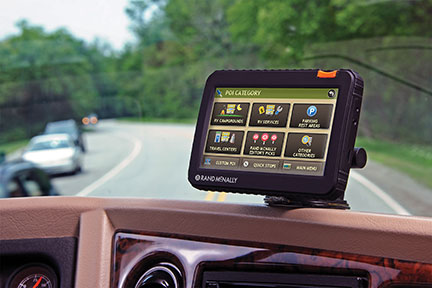
    Rand McNally today introduced the RVND 7720, a 7-inch RV GPS device with Wi-Fi connectivity allowing for real-time weather information and display, and new hardware with rugged casing, video input, and brighter screen.

    The new device — shipping now to stores, online retailers, and RV dealers and distributors — joins Rand McNally’s line of RVND GPS devices for RVers. Rand McNally pioneered RV-specific navigation by launching the first GPS device designed specifically for RVers and campers, the company said.

    RV-specific navigation is necessary to route large vehicles and towables around road restrictions, low bridges and other physical hazards. However, like all Rand McNally RV GPS devices, the RVND 7720 can be used as a car GPS by changing a simple setting.

    One of the key new features of the RVND 7720 is Wi-Fi connectivity, which enables the transmission and display of weather as well as other real-time information. With updated weather information, RVers will be able to anticipate delays and make plans by viewing current and predicted conditions displayed on the map and along the route, the company said. Besides weather, other RV-specific connected services will be coming soon for this device.

    The RVND 7720 has a new hardware platform as well, with a rugged design with ridged casing for added protection, a brighter screen that adjusts for low and strong light, and video input compatible with a range of back-up and rear-view cameras, Rand McNally said.

    The base maps and overlaying content, such as campgrounds, parks, RV service and other RV points of interest, also have been updated for the RVND 7720.

    The new device ships with Lifetime Maps, so owners will be able to update their devices at no additional cost.

    The RVND 7720 GPS includes the following additional new features:

    • Fully updated road data, including RV-specific information such as speed limits, legal and physical restrictions, and all Rand McNally proprietary RV data
    • Fully updated points of interest necessary for safe and convenient routing, including travel centers and RV parking information at rest stops, exits, and other locations
    • Fuel logs, which are accessible from the Virtual Dashboard or via RV Tools; the feature enables drivers to record fuel purchases for a trip
    • Additional routing options such as “Avoid State or Province” and “Avoid Smaller Roads”
    • Address book icon enhancement, which enables unique icons to be created by group and shown on the map for imported locations; address book items can be sorted by name, distance from current location or date added
    • Text-to-speech alert details for user-imported custom points of interest, such as red light cameras, to reduce driver distraction

    The RVND 7720 also has these features: Virtual Dashboard; junction view with lane assist; free downloads of Rand McNally’s proprietary construction information and software updates; Exits Quick View, which shows RV parking and amenities at exits; RV Tools, RV amenities and locations such as campgrounds, RV services, and dumps; Woodall’s Campground information with searchable amenities; Rand McNally exclusive pre-planned trips with photos and video; and routing for 11 types of RVs as well as for cars.

  • Toyota, Denso Develop Device for Real-time Vehicle Data Collection

    Toyota Motor Corporation and DENSO Corporation are jointly developing an on-board communications network device, CAN-Gateway ECU, that can take data gathered while driving and apply it to create a virtual simulation that enables a new way to enjoy driving.

    The CAN-Gateway ECU captures driving data — including GPS data, accelerator pedal strokes, steering angles, brake operation signals, gear shift signals, engine rpm count, water temperature, and vehicle speed — from a dedicated on-board GPS as well as CAN information exchanged among on-board ECUs. The device can wirelessly transmit (by Bluetooth) the data to software installed on smartphones or other devices for real-time monitoring. As this data is accumulated, it can serve as a driving coaching guide.

    Furthermore, software makers can use the data to create games or a wide variety of other software using standard creation tools, with no need to deal with the complicated nature of the onboard CAN protocol.

    The CAN-Gateway ECU can be fitted to the Toyota “86” rear-wheel-drive compact sports car. It is scheduled to be tested in Japan in spring 2013 by people active in car racing, before the scheduled Japan launch at the end of 2013.

    Further development is under way to enable vehicle data from drives on major circuits in Japan such as Fuji Speedway to be recorded onto USB flash drives for input into the racing game Gran Turismo, a PlayStation 3 home entertainment console title. Driving scenarios can then be recreated with the data and run simultaneously with other data to enjoy real-time, side-by-side track-run comparisons. Additionally, the user can reproduce aspects of a drive on a circuit such as the steering path taken, and where and when the brakes and accelerator were used, in the game for analysis and critique.

    USB memory data format and Bluetooth transmission protocol will be finalized after Toyota and DENSO review feedback with Polyphony Digital Inc., Densan System Co., Ltd. and other software makers, taking their expertise into account before specifications are finalized. Following this, information necessary for connecting to the CAN-Gateway ECU will be gradually made available to other software makers, DENSO said, thereby allowing for even broader development of software that explores new ways of enjoying cars.


  • ABI Research: In-Car Nav Market Bottoms out at $22 Billion, New Services Key to Rebound

    ​The total in-car navigation market has been in continual decline for the last three years, but ABI Research believes it has now reached its lowest ebb. While pure navigation is unlikely to reach the highs of 2008 again, the overall market is reaching a revenue plateau, creating a solid platform on which connected in-car services can bring a new generation of revenue growth, the market research firm concluded.

    Senior analyst Patrick Connolly stated,” When we look at the decline from 2008 to 2011, there is a perfect storm of economic conditions, low-cost/free smartphone navigation, the decline of PNDs, and falling car sales. The market is forecast to reach a low of $22 billion this year, before fluctuating around the $22-$24 billion mark, as a new period of growth for factory-fitted solutions, coupled with smartphone solutions, will take in-car navigation towards saturation point in many regions by 2017.”

    Factory-fitted solutions will bring new revenue opportunities, especially for PND manufacturers, ABI Research said. But the real growth opportunity will be the additional revenues that in-car connectivity will bring. Companies are fighting for a near-30 million connected car platform market in 2017, with many of the winners and losers decided over the next two years.

    Practice director Dominique Bonte added, “The opportunity is there to leverage navigation, to bring a host of new services around driver performance, infotainment, car diagnostics, and insurance.”

    These findings are part of ABI Research’s GPS & GNSS Research Service, which includes additional Competitive Analyses, Vendor Matrices, Market Data, and Insights. In ABI Research’s quarterly service, “GPS&GNSS”, all forms of in-car navigation are considered, including factory fitted, aftermarket, PNDs, and smartphones.

  • Telematic Future: eCall, Insurance, Drive-Share

    By Moni Malek

    Consider two notable developments in 2011 that will influence the development of consumer transportation:

    • China became the largest manufacturer of automobiles, producing more than 18 million vehicles, easily overtaking Europe and North America.
    • Smartphone volume shipments surpassed the volume of laptops and desktop PCs combined.

    Reflecting these two rising economic rockets, the November Munich Telematics show drew its largest attendance yet, 500-plus participants, and a greatly expanded exhibit area.

    The rising dominance of smartphones — one participant observed that they are taking over the world —will have a big impact on how users expect to access or view their telematics data; that is, any wireless information accessed by them while in their car. Developers and manufactures used to have a problem regarding which system to support, but with Android now at more than 50 percent of smartphones share, it is becoming the de facto first-choice standard and will probably become the user interface model.

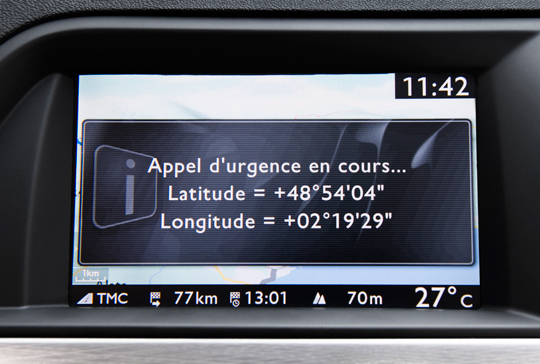
    eCall. Also in 2011, the European Union finally mandated eCall, the emergency call system in automobiles that sends vehicle position to emergency services after a crash. Unfortunately, the mandate is for 2015. I guess this gives them a chance to use the European satnav system Galileo, which hopefully may have something to offer hopefully by then.

    This year the Russians leapfrogged the Western Europeans and mandated their own version of eCall, known as ERA, for 2013. It will use GLONASS, the Russian satnav system, which unlike Galileo is operational now. Of course, GPS is still employed, and the real benefit today is using GLONASS plus GPS in a multi-constellation fix mode for higher reliability especially in urban areas compared to GPS alone.
    Malek-1A . Credit: Moni Malek
    Malek-2B . Credit: Moni Malek

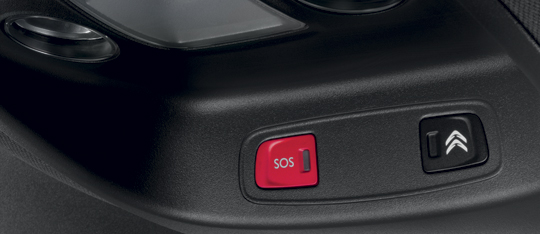
    Emergency call in progress, triggered by SOS button in PSA Peugeot Citroen’s roof panel (bottom photo).

    At the Munich Telematics show it was clear that the Russian mandate has put wind into the telematics emergency call market’s sails. From the Russian company Cesar’s presentation, we learned that following road accidents in Russia, 14 percent of car occupants die, compared to 2 percent in the United States. Getting emergency support to the scene more quickly is critical to reducing fatalities, and on this basis Russia has got some catching up to do.

    You would think that everyone would be rushing to get more safety, and as one market research presenter said, it comes high on the user wish list. Another presenter stated that while people may desire it, they seem reluctant to pay for it at first. As an historical example, initially when people had the option of paying for airbags as an extra, it was practically never taken as an option. Now it is standard in all cars for drivers and passengers.Think about it — would you now buy a car without an airbag?

    PSA Peugeot Citroen, the big French car company, shows the way with a version of eCall in their cars that doesn’t lose money! There is a big debate about who gets called when a crash happens. Is it the public service access points (PSAPs) or third-party services (TPS). Peugeot favours the TPS model, which can filter the more common breakdown and false alarms from true crash calls to be forwarded to the emergency services at PSAPs. While eCall initially favoured PSAP, the trend seems to support Peugeot’s decision and TPS.

    The PSA eCall also does not support the so-called in-band modem, which allows crash-position data to be sent over a voice call on the eCall box by encoding the data into a speech-like signal. The modem theory is, you need to keep the voice call open to keep talking to the person in the automobile. According to PSA, apart from the issue of patents with the in-band modem, it seems that 30 percent of the data is lost, and 40 percent of the PSAPs in Germany cannot handle it.

    GPRS is the best way of sending crash-position data with SMS text message as a back-up. As for voice, most people get out of their car after an accident and do not speak on the eCall box. I guess if people are unconscious and are not able to get out of the car, they won’t speak either.

    While smartphones dominate in many areas, they have been ruled out for eCall safety apps in cars, as no one can guarantee a smartphone will work after an accident. As for crash detection, that can only work if a device is bolted down to the car frame. Only that way can you sense the high-G forces during a crash.

    Insurance. Until the mandates kick in for eCall/ERA, you can understand why an automobile manufacturer’s marketing imagery does not include one of their car crashing or breaking down. So selling the eCall feature in this mindset is hard. On the other side are guys that do have the image of helping you after a crash: the insurance companies. And true to form, the big business has become insurance telematics.

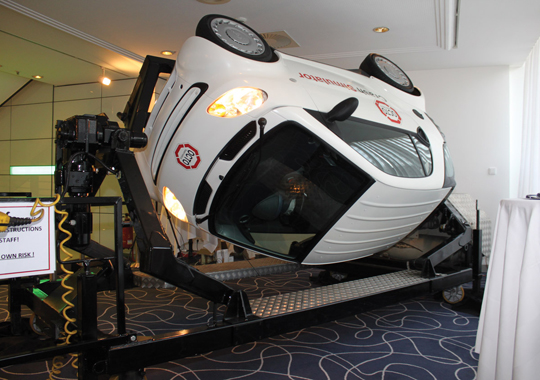
    Octo Telematics has taken a pole position in this area and had an impressive crashing-car demo that you could sit in at the show. The insurance telematics box then becomes an aftermarket product that is cross-subsidized by the insurance company. In return they receive crash data and get to monitor you to help you improve driving habits to reduce crashes.
    Malek-2 . Credit: Moni Malek
    Octo Telematics crash simulator. Show attendees were taken for a ride! The telematics box sends crash data to the insurance company to help drivers improve driving habits.

    A last word on safety: most accidents now seem to occur when people are texting while driving. Apparently when the Blackberry message service was down for three days in Dubai, there were 20 percent fewer accidents.

    Apart from eCall and insurance telematics, the other famous perennial telematic application is the connected car. As we all expected, we saw a lot of presentations on this. In simple terms, via telematics, a car is connected to the Internet. As the definition of telematics The branch of information technology that deals with long-distance transmission of computerized information, this might seem a no-brainer. But exactly how the car is connected and what value that offers constitute the two key questions for any application and market segment. Today a car buyer will almost certainly be an internet user.

    How Is It Connected? For basic telematic apps like eCall and stolen vehicle recovery, it suffices to connect to the 2G GSM/GPRS wireless network that gives worldwide coverage. Operators like Telenor offer a so called global subscriber identity module (SIM) model that supports worldwide access at a price that makes business real.

    For the so-called infotainment connectivity, the trend is 4G LTE, which offers the high data rates that the car companies dream about and flat-rate smartphone users expect. LTE is a packet mobile phone network already at Verizon and in European trial that is ideal for data. It appears that in the future, the best mobile phone network will be a combo of 4G LTE for infotainment data with 2G GSM for speech and 2G GPRS for global coverage telematic data.

    What Value Does It Offer? The blanket answer is, unless it offers a useful service, it won’t really be used. Today most connected car services drop to a poor 10–20 percent retention after the free trial period. The key is really to look for helpful services. For instance, the connected heater or rather the ability to switch your car heater remotely on in cold winters of Sweden increased Volvo connected usage 50 percent. Saving fuel in this energy conscious low CO2 emission days would seem a useful application. Couple that with a connected car, traffic information, best routes, good driving-habit rewards, social network to let you post your good driving score, and ….

    Fiat showed its eco:Drive solution, helping people save 6 percent on fuel consumption on average. That’s a start.

    At the end of the day, more efficient cars are the answer to that. Getting people to use more efficient small cars for short trips is one of the ideas behind the BMW car-sharing model. Based on the BMW One series and the Minis made by BMW, it offers a service in Munich and Berlin (I have to admit I live in Munich and haven’t tried it yet). When you register, you present your driving license and the service add an RFID. You can use this RFID as a keyless entry into a car share. Of course the cars are connected, and a smartphone app helps you find the next free car. You can pick it up and drop it off where you want. Because they are new, more efficient small cars than your average old gas guzzler, they have done a deal to get free parking in town. It costs a flat 29 cents (Euro cents) per minute to drive, which includes the fuel price. I can remember when a mobile phone call cost that much before!


    Moni Malek is CEO of ML-C MobileLocation-Company GmbH, based in Munich, Germany.