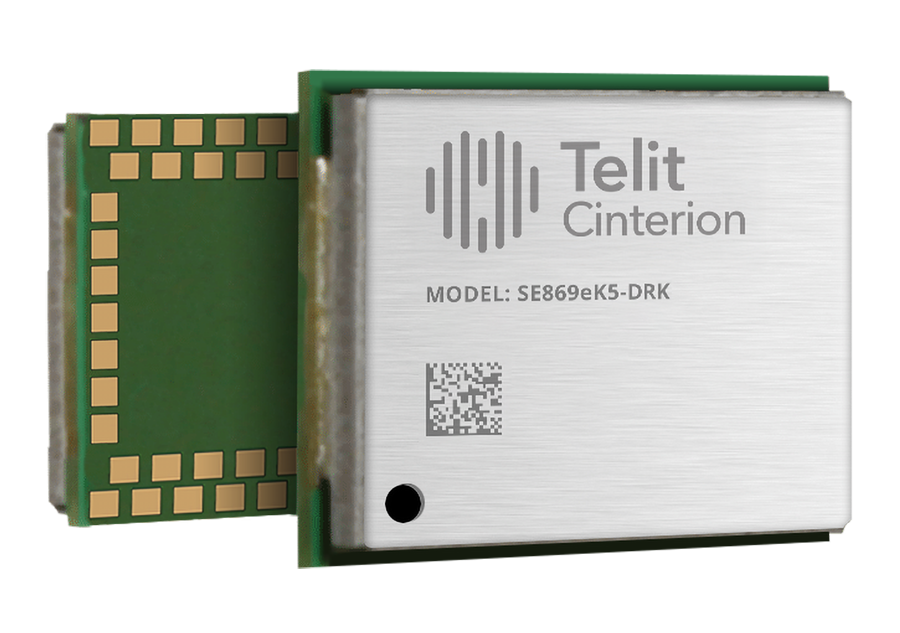
Telit Cinterion, an end-to-end IoT solutions enabler, has expaned its GNSS portfolio with two dual-band positioning modules: the ultracompact SE873K5-D and the high-end SE869eK5-DRK.
Built on the AG3335 chipset series from long-time partner Airoha, the new modules support space- and power-constrained internet of things (IoT) devices and use cases that require continuous, ultraprecise positioning.
The SE873K5-D and SE869eK5-DRK provide a scalable path to adopt dual-band L1 + L5 GNSS. Device manufacturers can add advanced correction technologies and resilient positioning architectures without redesigning hardware.
When combined with Telit Cinterion cellular connectivity solutions, the modules support the injection of RTCM corrections worldwide. This feature enables higher accuracy across connected IoT deployments.
SE873K5-D
The SE873K5-D expands the established SE873K5 family with a dual-band L1 + L5 variant. It is designed for size- and power-constrained applications.
This new module maintains the same 7 x 7 mm footprint and pin-to-pin compatibility as the single-frequency SE873K5. OEMs can scale performance without changing hardware designs.
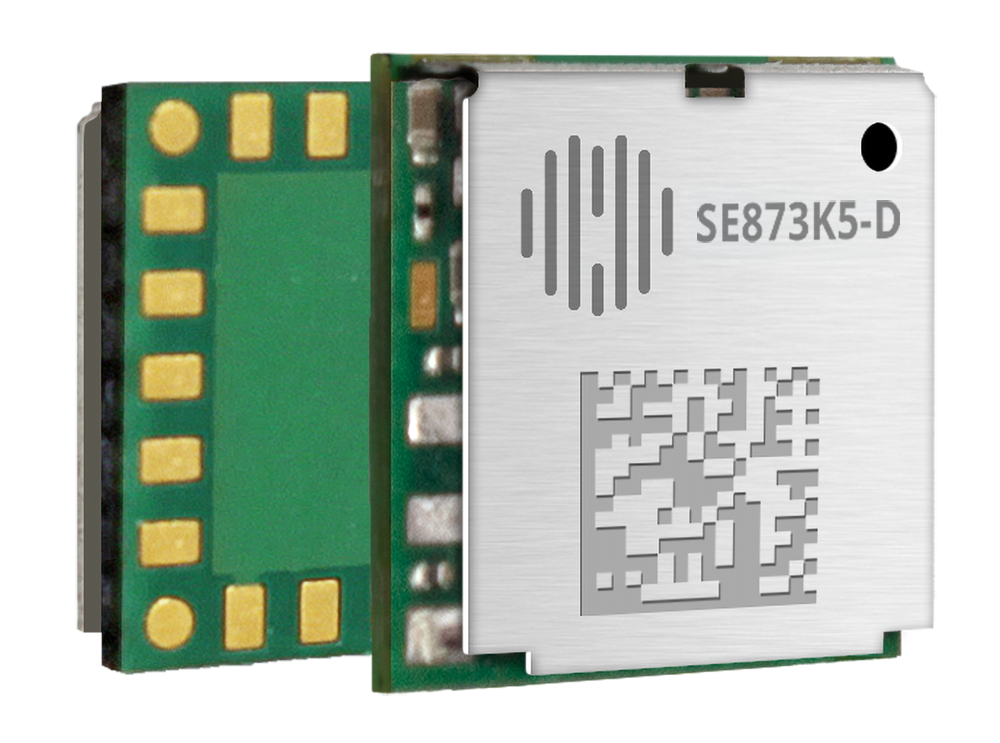
The SE873K5-D supports multiconstellation GNSS across the L1 and L5 bands. Compared to single-frequency solutions, it improves accuracy and robustness against interference and multipath effects.
With DGNSS support via RTCM corrections, the module enables submeter accuracy. It is ideal for myriad use cases, from wearables to fleet management.
Two power supply variants enable designers to optimize for either minimal size or ultralow power consumption in battery-operated devices. Multiple configurable usage profiles, such as tracking and drone modes, provide added flexibility across IoT verticals.
SE869eK5-DRK
The SE869eK5-DRK is the next evolution of Telit Cinterion’s high-end GNSS offering. Based on the upper tier of the AG3335 chipset family, this module builds on the previously announced SE869eK5-DR. It adds support for RTK positioning with untethered dead reckoning.
This powerful combination enables uninterrupted, centimeter-level positioning. It maintains performance even when GNSS signals are degraded or unavailable due to interference or signal blockage.
The SE869eK5-DRK has an embedded inertial measurement unit. This feature helps maintain accurate position fixes in environments like tunnels and dense urban areas. The module supports DGNSS for submeter accuracy when RTK corrections are unavailable or when centimeter-level precision is not needed.
The SE869eK5-DRK is designed in an industry-standard 16 x 12.2 mm form factor. It introduces a proprietary extended pinout while remaining backward-compatible with existing designs. The added pins enable future-proof implementations and customization. OEMs can expand capabilities over time without redesigning their products.
Engineering validation testing samples of the SE873K5-D are available now. Design validation testing samples are expected soon. Mass production is planned for Q2 2026.
Design validation testing samples for the SE869eK5-DRK are available now. Mass production is planned for Q2 2026.
For more information about the SE873K5-D and the SE869eK5-DRK, visit Telit Cinterion at Embedded World at Booth #3-620. The event runs March 10-12 at the Exhibition Centre Nüremberg.