Tag: iPhone

  • Eight Inches or Less: On the Road to High Accuracy for Automated Driving

    Eight Inches or Less: On the Road to High Accuracy for Automated Driving

    Janice Partyka
    Janice Partyka

    From CES to the Detroit Auto Show, it has been a big month for in-car connectivity that enables vehicle diagnostics, streaming entertainment, telematics and navigation. Ford, GM, Google and Audi unveiled new connected vehicle platforms and features, and AT&T stole the carrier limelight with LTE Connected Services.

    Plus, two industry giants announced that they are working to enable vehicles to continuously record road position at accuracies of eight inches or less. Shoppers are becoming more open to sharing their personal location with retailers. And the U.S. GAO issued a report on location privacy related to vehicle technology and applications. It has been a busy month.

    The first mass-marketed connected vehicle system was Ford Sync, which now boasts one million users and seems poised to grow rapidly with the release of an updated version. The Mustang will be the first of the company’s models with the new Ford Sync, which lets drivers use voice to activate iPhone and Android apps. New voice activated apps include Parkmobile, a parking space finder, and the Domino app, which lets me command my car to order a pizza, just the way I like it. GM announced its first LTE-enabled vehicles for about 10 of its models. Fast connectivity in vehicles will transform in-car experiences and hopefully not kill us.

    Carrier Ringmaster. AT&T wrangled itself into the center ring of car connectivity announcements. The carrier has won a multi-year exclusive agreement to enable Telsa with high speed connectivity. Despite Audi’s collaborative relationship with T-Mobile, AT&T was able to steal some work away from T-Mobile by getting a deal to supply connectivity for some Audi models. AT&T has also teamed up with Ericsson, Amdocs, Jasper Wireless and others to create AT&T Drive, a mobile platform for developing LTE connected vehicle services.

    Pathway to a Jetson Car. Two industry biggies, Continental and Here, are working together to create an end-to-end connected high-precision mapping and vehicle system offering for OEMs. The system will serve as the basis of highly automated driving functionality with the first objective of continuously determining road position to within three to eight inches. That’s quite a task. The maps will include road information that will feed vehicles with information to allow them to react to changing road conditions or speed limit changes, automatically. Continental was the first automotive supplier to be granted a test license for automated driving on public roads in Nevada.

    See Me Now. The percentage of consumers willing to share their current location via GPS with retailers nearly doubled year-over-year to 36 percent, according to a new IBM study of more than 300,000 global consumers. The study distinguished four distinct groups of consumers, differentiated by their interest in and use of social, location and mobile technologies while shopping. The largest group, 40 percent of shoppers, use social, location and mobile technologies, but don’t utilize them for buying products. The second largest group, almost 30 percent of shoppers, will use these technologies for making purchases. The rest of the shoppers sit on either pole of being tech laggards or hyper technology users.

    In-Car Privacy under the Microscope.  The U.S. Government Accountability Office (GAO) has looked into privacy issues for in-car location-based services. The GAO examined how 10 companies are using location data and if they share it, and how the policies and practices of these companies align with industry recommended privacy practices. Each of the companies stated that they do not share personally identifiable location data with marketing companies or data brokers. The GAO found that not all of the companies were following industry recommended privacy policies. The report was prepared for the Senate Subcommittee on Privacy, Technology and the Law of the Judiciary Committee. The companies that the GAO chose to examine included TeleNav (ScoutGPS Navigation), Google Maps (Navigation), TomTom (LIVE Services), Garmin Traffic, Ford Sync, Chrysler UConnect, Honda AcuraLink, GM OnStar, Toyota (Lexus Enform and Toyota Entune), and Nissan Infiniti Connection and CARWINGS.

    Retailers are Getting Closer. Qualcomm has made its Gimbal proximity beacons commercially available, which are reportedly accurate to one foot and work indoors and outdoors. Gimbal is a proximity platform for brands to engage customers’ mobile devices with contextual communication, using a combination of physical location, activity, time and personal interests. The intent is to increase the relevance of content delivered to end users’ devices to allow retailers, content providers and developers to send personalized high-value content to mobile devices.
  • Geneq Introduces Sub-Meter GNSS Receiver for iPad, iPhone

    Geneq Introduces Sub-Meter GNSS Receiver for iPad, iPhone

    iSXBlueIIGNSS_ensemble_apple.jpg
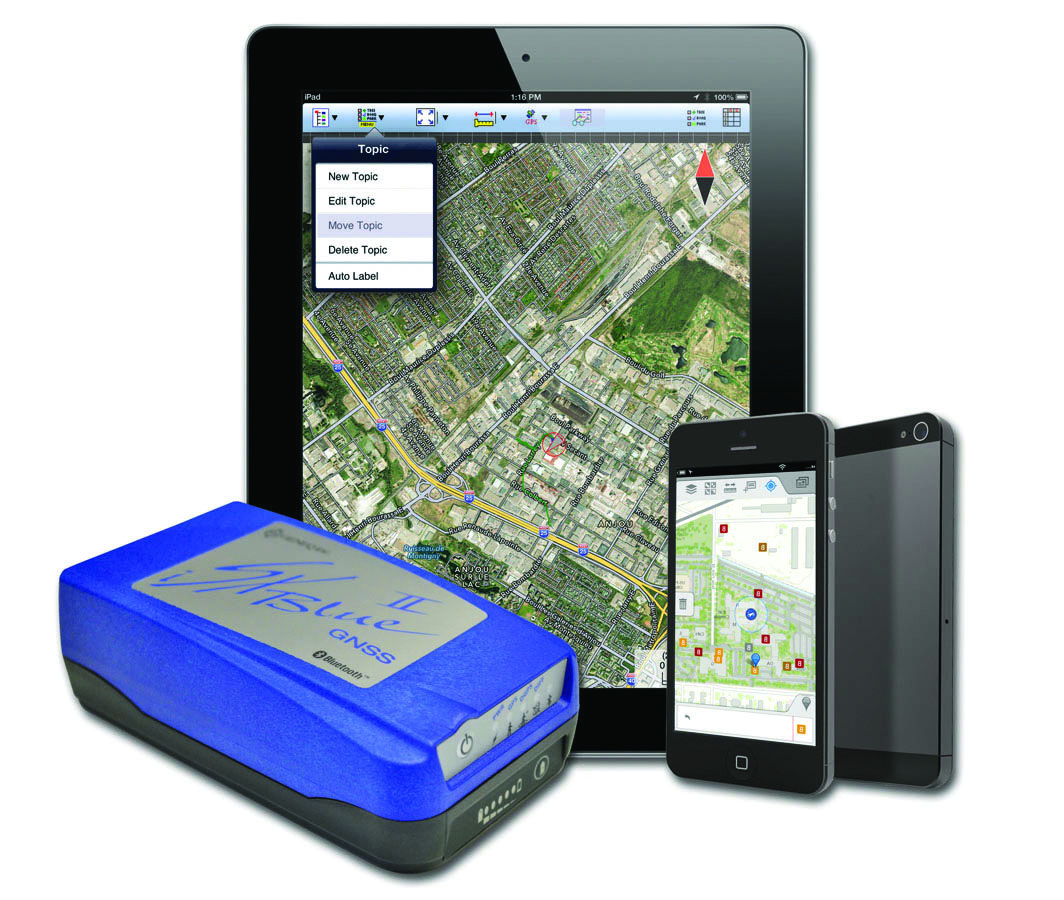
    The iSXBlue II from Geneq works with the Apple iPad and iPhone.

    Geneq Inc. announces the iSXBlue II GNSS, a sub-meter GNSS receiver that is Bluetooth-compatible with Apple iPads and iPhones.

    Fully authorized and approved by Apple, the iSXBlue II GNSS implements an Apple proprietary Bluetooth authentication feature allowing the NMEA GNSS data to replace the internal GPS location of the iPad or iPhone. A free SDK (software development kit) is available from Geneq to further utilize all the features of the iSXBlue II GNSS.

    The iSXBlue II GNSS uses both GPS and GLONASS with SBAS (WAAS/EGNOS/MSAS/GAGAN) to attain 30-cm/1-foot (RMS) accuracy in real time using free SBAS corrections. In addition to Apple iPads and iPhones, it connects wirelessly to any smartphone, handheld, tablet computer or notebook computer that is Bluetooth- compliant.

    “The iSXBlue II GNSS is the first high-accuracy GNSS receiver in the world for the Apple iPad and iPhone,” said Jean-Yves Lauture, product engineer, “and by implementing both GPS and GLONASS with SBAS, it provides iPad and iPhone users real-time, sub-meter accuracy around the world.”

    The iSXBlue II GNSS builds on the success of the proven SXBlue II GNSS that was designed to optimize SBAS performance under tree canopy and in rugged terrain. With the ability to track 55 satellites (31 operational GPS, 24 operational GLONASS), the SXBlue II GNSS uses between 12 and 19 satellites in view at any time, providing superior performance when working under and around tree canopy, buildings and rugged terrain.

    The next-generation iSXBlue II GNSS is the same, small, palm-sized unit as the SXBlue II GNSS and utilizes a small 2.7” diameter GNSS antenna. The unit is waterproof (submersible), dustproof and ruggedized, with an IP-67 rating. Its Class 2 Bluetooth 2.0 has a typical range of 15 meters, and is Apple-approved. The internal, rechargeable, field replaceable Li-Ion battery has on-board LEDs let the user know how much battery life is left. The operating temperature range of the iSXBlue II GNSS is -40°C (-40°F) to 85°C (185°F).

    In addition to the built-in long-range Bluetooth transceiver, the iSXBlue II GNSS also has a standard DE-9 RS-232 port and a USB Type B port whose outputs are fully programmable up to 10-Hz standard, and a 20-Hz option. Other optional features are L1 RTK for <2-cm real-time accuracy and base-station RTCM output.

    There is no need for post-processing or other sources of differential corrections as the iSXBlue II GNSS uses WAAS (North America), EGNOS (Europe), MSAS (Japan) and GAGAN (India) satellite corrections. Users receive real-time, 30-cm/1-foot positioning all day long.

    The iSXBlue II GNSS is targeted at GPS/GIS mapping professionals in industries such as forestry, utility, agriculture, environmental and other natural resource industries in addition to local, state and federal government users.

  • GPS Plotter iPhone App Enables Quick Plotting

    GPS Plotter makes it easy to plot longitude and latitude coordinates using iPhone, according to app developer Make It Digital. Using the mobile phone’s in-built GPS system, users can plot their current location at the touch of a button. Multiple sessions can be used to create maps plotting anything, and easy export of longitude and latitude coordinates is made possible by utilizing the universal CSV data format.

    GPS Plotter is designed for:

    • Orienteering
    • Outdoor wayfinding
    • Tracking unmarked trails
    • Detailing longitude and latitude on the move

    The app is available for 69p ($0.99 US) in the App Store and is compatible with iPhone 4, 4S and 5 running iOS 5 or later.

  • iOnRoad Steers iPhone Navigation Towards Safer Driving

    iOnRoad,  the maker of the iOnRoad app that improves driving in real-time using the power of modern computer vision algorithms and smart-phone cameras, has released its award-winning app on iOS 6 operating systems. iOnRoad, now available for immediate download in the App Store, is taking advantage of the leap in processing power of the iPhone 5 and  new navigation integration offered on iOS 6, the company said.

    iOnRoad’s new iOS 6 features bring about a whole new depth to driving assistance applications. The iOnRoad application’s advanced fusion with iOS 6 navigation allows the driver the benefit of turn-by-turn navigation along with iOnRoad’s augmented driving UI. Furthermore, iOnRoad’s new “black-box” like video recording feature acts as a virtual driving log, archiving users’ driving history. Should an accident occur, drivers may now be given a greater understanding of the events leading up to it.

    “We have serviced hundreds of thousands of mobile users over the past year and are excited to provide iPhone users an enhanced version of iOnRoad,” said Alon Atsmon, CEO of iOnRoad. “In addition, the new in-phone analytics dashboard tells a driver how safe and ‘green’ the drive was and can even estimate gas prices, which is quite useful given the fluctuation in gas prices today.”

    iOnRoad uses the iPhone camera and sensors to detect lanes and vehicles in front of the vehicle, alerting drivers when they are in danger. The app provides a range of personal driving assistance functions including augmented driving, collision warning, speeding alert and safety scoring.

    “We are witnessing a trend in which  systems and features that we used to find in jet-planes such as navigation, collision warnings, HUD and night vision are increasingly finding their way into the driving environment,” says Atsmon. iOnRoad’s innovation and market leadership has been validated by numerous industry awards including the 2012 CTIA E-Tech Award, CES 2012 showcase award, and one of Gartner’s cool vendors in automotive for 2012.

    View a video of iOnRoad in action.

  • Apple CEO Apologizes for Faulty Maps App

    After the September 12 launch of the Apple iPhone 5, which comes equipped with Apple’s own Maps application, users soon found their efforts to navigate thwarted by mislabeled cities, misplaced landmarks, lack of’ transit directions, and strange satellite imagery.

    Today, Apple Inc. Chief Executive Tim Cook apologized to customers for the flaws in the Maps app in a letter posted on Apple’s website. The Maps app replaced Google Maps as the standard iPhone mapping application, but Cook is now suggesting customers use the online Google Maps or download other mapping applications while Apple works to fix its application. Google Maps was standard on previous versions of the iPhone. Apple’s newest mobile operating system, iOS 6 doesn’t support Google Maps, so users would have to use that application through the Internet.

    Here is the text of Cook’s letter:

    To our customers,

    At Apple, we strive to make world-class products that deliver the best experience possible to our customers. With the launch of our new Maps last week, we fell short on this commitment. We are extremely sorry for the frustration this has caused our customers and we are doing everything we can to make Maps better.

    We launched Maps initially with the first version of iOS. As time progressed, we wanted to provide our customers with even better Maps including features such as turn-by-turn directions, voice integration, Flyover and vector-based maps. In order to do this, we had to create a new version of Maps from the ground up.

    There are already more than 100 million iOS devices using the new Apple Maps, with more and more joining us every day. In just over a week, iOS users with the new Maps have already searched for nearly half a billion locations. The more our customers use our Maps the better it will get and we greatly appreciate all of the feedback we have received from you.

    While we’re improving Maps, you can try alternatives by downloading map apps from the App Store like Bing, MapQuest and Waze, or use Google or Nokia maps by going to their websites and creating an icon on your home screen to their web app.

    Everything we do at Apple is aimed at making our products the best in the world. We know that you expect that from us, and we will keep working non-stop until Maps lives up to the same incredibly high standard.

    Tim Cook
    Apple’s CEO

  • CMT Announces iGPSGIS II App for iPhone

    Corvallis Microtechnology, Inc. announces the release of the iGPSGIS II application software for use on the Apple iPhone. The GPS/GIS data collection and mapping application can be used in a  range of applications such as resource management, agriculture, forestry, archaeology, and the utilities industry.


    According to the announcement, in addition to displaying the GPS coordinates of geographic locations, iGPSGIS II provides user-friendly interface to facilitate the following tasks:
    • Create Feature Lists for data collection
    • Create sampling grids
    • Display Google Map as the background map
    • Import and Export Shapefiles
    • Collect multi-layer GPS/GIS data
    • Update the coordinates for Point Features
    • Create new points using angles and distances
    • Digitize points, lines and areas
    • Assign symbols and attributes to Features and Topics
    • View/Edit the collected data
    • View the area of an enclosed region
    • Measure distances on the displayed map
    • Send and receive job files via email
    • Store job data on the Cloud
    • Get and send job data via ftp

    iGPSGIS II can be downloaded from the App Store by clicking here.

  • Survey GPS Maps Routes on iPhone

    allows users to record, export, and import routes and landmarks together with information such as photos, videos, audios, or text directly to an iPhone. The product is intended both for professional survey teams and outdoor adventurers. Key features include:

    • Enjoy recording your trip routes and pinning impressive landmarks, with multimedia files and descriptions.
    • Advanced functions; export/import, geotag/geocode, along with Multiple Recording Filters.
    • Versatilely edit the saved track/point; crop, move, copy, merge, or change properties.
    • Share and develop your trips with friends easily via iTunes or email.
    • Available in two versions: The Basic (TMX) and The In-App (TMX, GPX, MID/MIF, or Shapefiles.)
  • FCC’s Future Location Requirements, Apple iPhone 4S

    Update:

    Many press reports recently said that the Federal Communications Commission plans to require GPS in all mobiles by 2018, including LBS Insider (October 12, 2011). However, the FCC said that isn’t quite so, saying that “not before 2019, on a date still to be determined, carriers will have to meet the more stringent location accuracy standards that now apply to those carriers using a handset solution for [enhanced 911], and they may choose which solution to use.”

    FCC spokeswoman Lauren Kravetz said that these technology solutions may be GPS chipsets, network-based, or a hybrid. The FCC said, after the conclusion of an eight-year period that ends in early 2019, it will sunset the existing network-based rule and require all wireless carriers to meet “the more stringent location accuracy standards in the handset-based rule. The FCC will then set a specific sunset date for a network-based standard — after further notice and comments.”


    An announcement completely overshadowed by the Apple iPhone 4S rollout may have a major impact on the location-based services industry. The FCC has said that all wireless carriers, including voice-over-IP service and landline providers, are required to integrate GPS into phones by 2018. In other news, Intel bought Telmap, which has made inroads into the LBS market with its partnerships with carriers.

    In a move designed to allow first responders to locate 911 emergency calls, the Federal Communications Commission will require all wireless operators, including voice-over-IP service and landline providers, to integrate GPS in phones by 2018.

    The FCC says the majority of mobile phone users will have GPS-installed devices by the 2018 deadline. The FCC did not set a deadline for phones that do not use GPS-based technology. In addition, VoIP is going toward more mobile applications, rather than its original substitute for landline service.

    Most industry experts agree that the rise of location-based services occurred when the FCC mandated that carriers have location capability during its enhanced 911 rulemaking. Wireless carriers chafed at the deadlines and accuracy requirements. However, the rulemaking did bring market awareness to the carriers to the benefits, and potential new markets, coming from this mandated location requirement.

    While it is too early to tell how much this will help drive LBS markets, the FCC said the decision, which was overshadowed as it was announced the same week as the rollout of the Apple iPhone 4S, was spurred by the desire to modernize 911. This means locating emergency callers quickly, particularly from smartphones and other mobile devices.

    But have the wireless carriers lost their grip on LBS? In 2009, the surge in the number of GPS-enabled smartphones, proliferation of handset and mobile OS application stores, and increased availability and consumer demand for free or low-priced LBS applications has had a huge impact on the traditionally carrier-controlled LBS market, said Dan Gilmartin, Where vice president of marketing.

    “The decreased costs and barriers to entry into the market place and ability to reach consumers through low- or no-cost viral social marketing channels is enabling small application developers to compete with the established LBS developers. The result is a highly competitive landscape that beforehand was dominated by only a few major players,” he said.

    Gilmartin said that Google’s decision to offer free turn-by-turn navigation and acquisition of ADMob for $750 million reinforced the expectation that the viable business models for LBS in 2010 and beyond will include offering free or “freemium” services to consumers through ad-supported and other non-traditional funding models. “That said, the carriers’ subscription model still appears viable, at least for the short term, and consumers are proving to be willing to pay for what they perceive to be high-quality applications both on- and off-deck, navigation being the most prominent category,” he said.

    Go Ask Apple? 

    The rollout of the Apple iPhone 4S may not be the biggest thing for the LBS market, but it does open it further to another tier-one carrier in Sprint. Like other iPhone models, the 4S has GPS embedded, but offers Siri voice-recognition that integrates with its navigation capability.

    When LBS Insider contacted Sprint for comments on the new iPhone 4S and the FCC decision that GPS be installed in all smartphones, we got the public relations brush off to “Go ask Apple.” Ask Apple about GPS and LBS? This is an interesting response, as Sprint was one of the first major LBS market players, particularly their Nextel folks who were very innovative with location technology in the early days.

    Intel Buys Telmap

    At least one company in the LBS market is doing something right when a big company like Intel buys it. As GPS World reported, Intel bought Telmap, the Israel-based LBS company. The deal was announced at the recent Intel AppUp Elements developer conference in Seattle.

    Motti Kushnir, Telmap chief marketing officer, said that since Telmap is a private company, financial details cannot be disclosed. He said the deal will take effect by the end of the year. “Telmap will be a wholly owned subsidiary and will maintain its independence as well as its brand,” Kushnir said in a prepared statement.

    Kushnir said no layoffs are expected, nor will facilities close or be moved by Intel. “On the contrary, we are expected to grow in order to support the growth of our business both in existing and new territories,” he said.

    One of the reasons Intel bought the company is that it is sees mobility as one of its growth engines — and location is a key component, Kushnir said.

    Telmap says it has 6 million users for its IP portfolio that includes mapping, local search, and navigation. This includes a new restaurant LBS initiative in Israel. The company is working with Rest, a large Israel restaurant guide to provide location-based coupons to customers.

    In other LBS industry news:

    • Fierce Wireless made an admittedly subjective list of the worst cell phones of all time. Garmin’s ill-fated Nuvifone G60 made the list. The phone, a partnership between Garmin and Asustek Computer, featured LBS — and had a $5.95 monthly charge for premium service. Fierce Wireless says that it was a failure in part because of Google’s free location services.
    • Nokia will be closing down its operations in Bonn, Germany, and Malvern, Pennsylvania, with an expected loss of more than 1,300 jobs in the Location and Commerce divisions. According to published reports, operations will consolidate in the Berlin, Boston, and Chicago offices. Another 2,200 layoffs will come from its European manufacturing operations.
    • This column has admittedly neglected traffic markets lately, but will be running more stories and interviews soon. With that, some big news has come out of that market, namely Google’s recent deal with INRIX to power its navigation and mapping applications. INRIX traffic information will be integrated in Google’s online products and services and on mobile phones.

    Meanwhile, INRIX competitor TomTom is launching a Traffic Foundation that brings together stakeholders from academia, industry, and policy-making to help reduce traffic congestions. The company also rolled out its Custom Probe Counts at the ITS World Congress, that allows government and business markets to assess traffic density. The company also expanded its coverage from 14 to 18 countries.

  • Alabama Tornadoes: This Editor’s Personal Experience

    Wall cloud approaching.
    Wall cloud approaching.

    Four years ago my wife and I moved to Lake Guntersville as our ultimate retirement location because it seemed to have ideal factors we were looking for — mountains, lakes, great fishing, mild weather, low taxes, low cost of living and genuinely nice people. This inland location had navigable water to the Gulf of Mexico and even to the Great Lakes. We liked the small town atmosphere away from coastal hurricanes, panicky road clogging evacuations, blizzard, earthquakes or big tornadoes. Well, so much for that plan as we had a front row seat to one of the biggest tornado events of the decade with one of the tornadoes passing 500 yards in front of our windows.

    Just like in the movies, on Wednesday morning, April 27, the winds started to pick up, tornado alarms sounded, and debris started flying, including outdoor furniture. The boathouse next to us had the shingles stripped off the roof like a deck of cards, and then big oak trees started toppling over. The lake looked like it was boiling violently as winds in Guntersville reached 130 mph. We could see countless power lines and transformers arcing green and then going dead. Many buildings and trees were okay while others were totally demolished.

    Downed trees caused much of the damage.
    Downed trees caused much of the damage.

    My visual estimate was that at least 10 percent of the power poles and lines were damaged or toppled. It’s now six days after the storm. Although utility crews have been busy putting in new poles and lines, much remains to be done and I’m doing this article on battery power from my car charger.

    This tornado event was unusual in that Alabama rarely gets more than one tornado at a time with most being the smaller F-1/F-2 storms. Tuscaloosa got the worst of it with an F-4 that stayed on the ground for 70 miles.

    Concrete block walls were no match for the 130 MPH winds.
    Concrete block walls were no match for the 130 MPH winds.
    This was a TV repair shop in downtown Guntersville.
    This was a TV repair shop in downtown Guntersville.

    Our county, Marshall County, was lucky with only 10 tornadoes during the 8 hour period. I don’t think any were over an F-2 but Marshall County still had 5 fatalities. Alabama had over 200 tornadoes that day with fatalities nearing 300.

    One thing that really impressed me about the people in Alabama is their resilience and willingness to help their neighbors. There was no hand wringing waiting for the government to help. Almost immediately after the first tornado you could hear the sound of chainsaws as neighbor helped neighbor dig out and clear the roads. This helped the city and county get most roads passable within a day.

    People helping people.
    People helping people.

    Local businesses helped also. Within 12 hours T.L.’s Barbeque and our favorite seafood restaurant, Crawmama’s, had a catering service set up in downtown Guntersville providing free meals for the National Guard, emergency workers and anyone who needed a hot meal. Crawmama’s is one of those hidden gems that serve seafood comparable to the best restaurants in New Orleans.

    After the tornadoes, NOAA captured ortho imagery of the affected areas using a King Air at 5000 ft. The imagery can be seen at the NOAA website. Pictometry is providing low altitude high resolution ortho and oblique imagery and there are stunning video clips of the Tuscaloosa tornado on youTube.

    The first tornado came and went so fast that I really didn’t have much time to ponder the event. However the unexpected surprise was news media reports that we could expect numerous tornadoes during the 8 hours following the initial tornado. The tornado alarms sounded again and again throughout the day and I can tell you from first-hand experience that getting through this was much easier thanks to the location based GIS services of my iPhone. Here is why.

    When the power was still on we had the luxury of watching the television news with Doppler radar and all the detailed graphics. Once the power went out all we had were tornado alarms, a portable radio and my lowly cell phone.  The tornado alarms were nerve racking since they went off so often. I later learned that the alarms are linked county-wide so a tornado threat anywhere in the county will cause all the alarms to sound. Radio stations were helpful but it was difficult to form a clear picture of the moving storms.

    IMG_1482The iPhone proved to be wonderful. It continued working even after power was lost so we could communicate with family members. From the first power outage until now the cell phone service continued un-interrupted. The service did slow and show weaker cell tower signals as the system switched to battery power and standby generators.  But it did continue to work.

    Most important, the iPhone radar mapping application from the Weather Channel provided us with a video loop of weather bands and their path on a Google map so we could see for ourselves how the storms were moving and if we would be affected. This really put our minds at ease most of the time despite numerous tornado alarms.  Throughout the day as we dodged other tornadoes, I thought about all the man-hours I and my colleagues spent in the early ’90s digitizing street centerline data and addresses ranges to build the digital street databases and other maps that are now the backbone of location based services.

    I never could get really excited about the tiny screens of smart phones but this tornado event and even more mundane applications such as navigation are making me appreciate these little devices. My iPhone has replaced my cell phone, camera, calculator, notepad, and now my GPS. I liked the navigation and Google maps of my iPhone but many times, such as in DC traffic, it was hazardous looking at the screen. So I was very pleasantly surprised with an application that turns the iPhone into a full featured car navigation system including voice navigation and real time traffic. The MotionX GPS Drive  is one of the hottest selling applications for the iPhone and I’m a convert. I bought a mounting bracket that lets me mount the iPhone on the AC vent of any rental car and I now don’t bother packing my old GPS. The only downside is that it uses up the iPhone battery so I have a 12v adapter to keep it charged when using navigation.


    That little iPhone and GIS keep making my life better. So for all the hand wringers nearly panicked that their iPhone tracks their location and worried about their privacy, my vote is for more and better location-based services.

    Photos: Art Kalinski

  • The Business: Location-Driven Coupons on iPhone

    >> LOCATION-BASED SERVICES

    Location-Driven Coupons on iPhone

    By Gwen Cameron

    Yowza!!, an application designed for the latest GPS-enabled iPhone 3G and 3GS models and iPod Touch, brings relevant coupon offers to customers based on their location.

    “Any time you insert a concept such as location into a marketing program, you end up with a far more compelling value proposition,” states Mike Wehrs, president of the Mobile Marketing Association.

    Sales and discount offers via Yowza!! can be updated in real-time and targeted by region or store location. “The phone will deliver a list of stores within one mile that have offers on Yowza!!,” said August Trometer, co-founder of the recent startup. Users show the barcode and digital mobile coupon on their handset at checkout to redeem the discount on their purchase.Bus-2

    “We work directly with merchants; they provide us with their latitude and longitude, we get the GPS coordinates, do a database search with a proprietary algorithm,” said Trometer. “The phone constantly goes back and forth between our app, touching data from our database. When the person touches their location, it touches a new set of data in the database. The phone will work with them to keep delivering the closest store. There’s a lot of work on the database end of things.”

    One drawback of the app is that it has to be turned on to work — it does not sit in the background, waiting to be activated by incoming offers. “Users have to give the application access to their GPS coordinates,” explained Trometer. “But the power of the device and all the applications it brings make it silly to turn off the location capability.”

    Retailers that have signed with Yowza!! include Sears, McDonald’s, The Container Store, and more. Unlike traditional forms of couponing such as newspaper ads, Yowza!! offers can be updated in real time and targeted by region or store location.

    Trometer expects to announce Yowza!! capability through other GPS-equipped phones: Blackberry Storm, Google’s Android-based phone, and the Palm Pre. “All three makers allow developer access to the GPS and this is very important, it’s crucial, obviously. They also have a high-res screen, which is a requirement for our scannable barcode that the user shows to the merchant.”

    Referring to GPS handsets that lack a high-res screen, he claims “The other phone manufacturers really have an uphill battle right now.”

    Whose GPS? The source of the GPS chip within Apple’s iPhone remains a mystery. “Even people who have done teardowns of the devices, the chips are completely blank,” says Trometer.

    “There are so many possibilities, we’re just scratching the surface right now with what can be done,” Trometer said. “The mind reels with the things that can be done with that.”

    >> SURVEY & CONSTRUCTION

    Hemisphere, Juniper Jointly Offer DGPS Receiver for Demanding Environments

    Juniper Systems and Hemisphere GPS offer the XF101 DGPS receiver for the Archer Field PC, designed to deliver sub-meter DGPS to location-based applications in demanding environments.

    According to the companies, the Hemisphere GPS XF101 DGPS receiver provides: Crescent GPS technology for sub-meter accuracy; COAST technology to maintain accuracy during temporary loss of differential signal; optional external antenna for centimeter-level accuracy; low power consumption; modular connection for rapid field use; real-time or post-processed DGPS data collection; and multipath minimization.

    The XF101 with the Archer is priced at less than $2,500. It fully supports mobile GIS applications such as ESRI ArcPad and OnPoz GNSS Driver.

    >> AVIONICS

    NovAtel Receiver for Next-Gen WAAS

    NovAtel announced receipt of a contract from the U.S. Federal Aviation Administration (FAA) to develop the next generation Wide Area Augmentation System (WAAS) reference receiver, the GIII. Total contract value can go up to $9.7 million.

    NovAtel has worked with the FAA WAAS program since 1995, providing and supporting two previous generations of reference receivers for the WAAS ground network. The technology refresh will add support for new L1C, L2C, and L5 signal capabilities, on a qualified RTCA DO-178B software and DO-254 hardware platform. The WAAS GIII receiver program is scheduled to be completed over the next three years, and will include growth provision for further signal capability such as Galileo. As many as 14 receivers will be produced in the GIII development and qualification program.

    >> FLEET TRACKING

    AT&T, Trimble Fleet Management

    AT&T has broadened its fleet and mobile asset management portfolio with the latest version of Trimble’s GeoManager solution, which helps reduce fuel and maintenance costs by enabling operators to manage their vehicle assets more efficiently.

    Trimble GeoManager enables transportation and field-service fleet operators to track their mobile workers and assets through software and GPS modems running on AT&T’s wireless network. GeoManager integrates GPS, wireless data communications, and a browser interface to help manage mobile workers, the mobile worker’s work, and the mobile worker’s assets.

    AT&T and Trimble have jointly offered fleet-tracking solutions for several years. The GeoManager update features improved map and status, new landmark uploads, WLAN usage, schedule report enhancements, driver logs, and organizational hierarchy modifications.

    >> TIMING

    Timing Vulnerability Concern Grows

    Industrial and enterprise users in telecommunications and utilities privately express concern over revelations from the April Government Accounting Office (GAO) report, “Global Positioning System: Significant Challenges in Sustaining and Upgrading Widely Used Capabilities.” The GPS signal is used for synchronizing almost all global computer networks belonging to the military, utilities, banks, telecomms, television companies, and many more.

    Backup? What Backup? These same companies point to a continued lack of commitment on the part of the U.S. government to stable and reliable backup for GPS. As long ago as 2007, in comments before the Department of Transportation, wireless carrier Sprint Nextel stated: “Sprint Nextel Corporation respectfully requests that the U.S. government continue to operate and invest in the LORAN-C and eLORAN systems. Should the DOT and DHS decide to decommission the LORAN-C system, Sprint Nextel recommends that the agencies delay doing so until the eLORAN system is fully operational. Sprint Nextel and other communications providers use the frequency signals of the Global Positioning System, LORAN, and atomic clocks for multiple levels of redundancy and diversity in their networks. Therefore, Sprint Nextel urges the DOT and DHS to carefully weigh decisions which might impact LORAN’s availability to the nation’s voice and data communications networks.

    “The loss of a primary reference source (PRS) can negatively impact a telecommunications network, and those impacts can vary from minor short-term noise impairments to long-term network-wide outages. Both traditional wireline services and newer wireless services require a precise frequency reference for basic service delivery . . . . The continental U.S. portion of the Sprint Nextel network requires a PRS at thousands of switch sites, interconnection sites
    , and cell tower sites to ensure reliable service delivery.”

    Deadlock on Capitol Hill. Competing resolutions to either discontinue or adequately fund LORAN and eLORAN continue fencing in Congressional subcommittees in both chambers. Nothing has changed since Sprint commented two years ago — aside from a potential rise in the susceptibility of GPS to jamming, unintentional interference, and decreased availability.

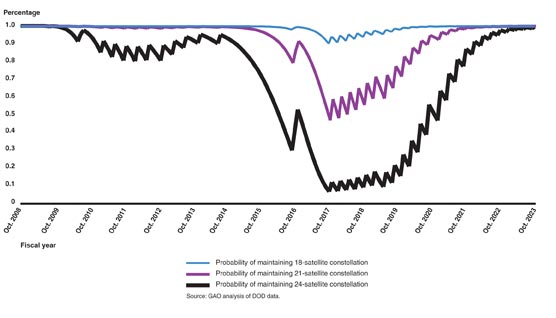
    GAO REPORT, FIGURE 5. Probability of maintaining constellation of at least 18, 21, and 24 GPS satellites based on reliability data as of March 2009 and a two-year GPS III launch delay.
    GAO REPORT, FIGURE 5. Probability of maintaining constellation of at least 18, 21, and 24 GPS satellites based on reliability data as of March 2009 and a two-year GPS III launch delay.

    >> TIMING

    Telecom Clock from EndRun

    EndRun Technologies announced a Telecom Clock Option for its Meridian Precision GPS Timebase, which provides accurate and stable GPS-synchronized outputs for military communications, aerospace, broadcast, engineering and calibration laboratories, telecommunications, and more.

    The option was designed as a plug-and-play module that can supply any combination of E1, T1, J1 and/or composite clock outputs. An alarm output is also available and single-satellite mode (SSM) is supported. The Telecom Clock Option can be installed in EndRun’s GPS or CDMA-based Meridian and Tycho product lines.