Tag: IS-GPS-200

  • 2022 Public Interface Control forum set for Sept. 28

    2022 Public Interface Control forum set for Sept. 28

    CGSIC logo

    The 2022 Public Interface Control Working Group and Open Public Forum will take place virtually on Sept. 28, the U.S. Air Force has announced. It is hosted by Space Systems Command, Military Communications and Positioning, Navigation, Timing Directorate.

    The following NAVSTAR GPS public documents will be discussed:

    • IS-GPS-200 (Navigation User Interfaces)
    • IS-GPS-705 (User Segment L5 Interfaces)
    • IS-GPS-800 (User Segment L1C Interface)
    • ICD-GPS-870 (Control Segment [OCX] to User Support Interface).

    The virtual meeting can be accessed via the following dial-in numbers and links:

    The Air Force requests that those who would like to attend register no later than Aug. 25.

    Additional logistical details can be found in the Federal Register Notice.

  • DHS offers resources to protect critical infrastructure from GPS vulnerabilities

    DHS offers resources to protect critical infrastructure from GPS vulnerabilities

    DHS logoThe U.S. Department of Homeland Security (DHS) Science and Technology Directorate (S&T) has published a GPS Receiver Whitelist Development Guide and a new release of the Positioning, Navigation, and Timing (PNT) Integrity Library to protect against GPS spoofing.

    The free resources are intended to advance the design of PNT systems and increase resilience of critical infrastructure to PNT disruptions.

    The GPS Whitelist Development Guide presents a software assurance approach to addressing potential vulnerabilities and increasing reliability of GPS receivers. The guide addresses data-related requirements in the Resilient PNT Conformance Framework, which provides guidance for defining expected behaviors in resilient PNT equipment.

    “We hope this guide and related resources will help industry advance towards a cybersecurity-based approach to PNT resilience,” said S&T Technical Manager Ernest Wong.

    Originally released in March 2021 as open source on GitHub, the PNT Integrity Library provides users with a method to verify the integrity of the received GPS data. The update includes:

    • A compliance check on Interface Control Document (ICD) IS-GPS-200, which is a formal means of establishing, defining and controlling communication between the GPS space and other user systems; and
    • A Do-It-Yourself (DIY) Toolkit, which describes how a perspective end-user of the PNT Integrity Library can assemble a demonstrational toolkit with commercial-off-the-shelf (COTS) hardware.

    “Since GPS signals can be jammed or spoofed, critical infrastructure systems should not be designed with the assumption that GPS data will always be available or will always be accurate,” said S&T Project Manager Brannan Villee. “Application of these tools will provide increased security against GPS disruptions. However, DHS also recommends a holistic defense strategy that considers the integrity of the PNT data from its reception through its use in the supported system.”

  • Happy Pi Day

    Happy Pi Day

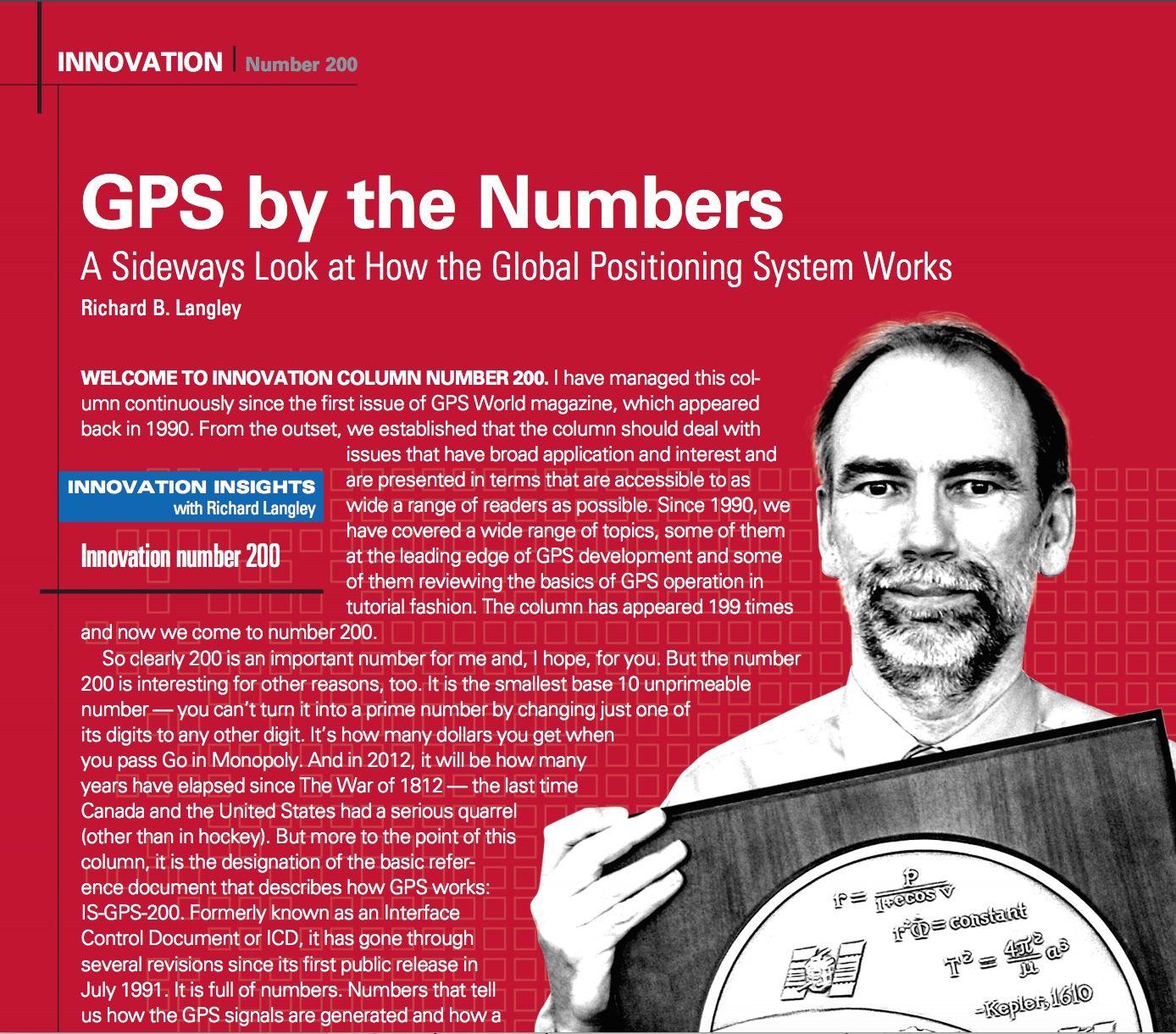
    In honor of 3.14.2019, here is what GPS World’s Innovation column editor Richard Langley wrote about π in an article (“A Sideways Look at How the Global Positioning System Works“) nine years ago.


    3.1415926…. π. Every nerd’s favorite number. It is the ratio of a circle’s circumference to its diameter in conventional or Euclidean space. We use it, for example, to convert angles measured in radians to degrees (π radians = 180 degrees). π is an irrational number, which means that its value cannot be expressed exactly as a fraction m/n, where m and n are integers. Consequently, its decimal representation never ends or repeats. But we sometimes use an easily remembered fraction, such as 22/7, to get an approximate value. In this case, 3.14. But, if we compute more digits with this fraction, we get 3.1428571…, clearly an incorrect result. A better way to remember π to eight digits is to count the number of letters in each word of the mnemonic “May I have a large container of coffee?”

    In computations related to GPS, how many digits of π should be used? It depends. If you are developing your own algorithms and software for modeling GPS observations or determining precise orbits for the satellites, you’ll likely need π to 16 digits for double-precision floating-point calculations. But it would be a mistake to use π to this precision in computing the position of a satellite from the broadcast ephemeris. The GPS interface specification document, IS-GPS-200, specifies a 14-digit value for π (3.1415926535898) in the satellite coordinate computation. Use fewer or more digits, and the resulting satellite coordinates will not be as accurate.


    Full article here.

    Thank you, Dr. Langley.

  • Schriever Air Force Base releases GPS Week Number Rollover guidelines

    Schriever Air Force Base releases GPS Week Number Rollover guidelines

    CGSIC logo

    The 50th Space Wing Public Affairs office of Schriever Air Force Base has established and posted guidelines, known as Interface Specification GPS-200 (IS-GPS-200), for receiver manufacturers to ensure continued capability during the April 6 GPS Week Number Rollover on Coordinated Universal Time derived from GPS devices.

    According to the 50th Space Wing, users should be aware of the upcoming GPS Week Number Rollover as it may impact receivers that are not manufactured in compliance with IS-GPS-200 specifications.

    The GPS Week Number count began around midnight on Jan. 5, 1980. Since then, the count has been incremented by one each week and years later broadcast as part of the GPS message. One of the GPS week number fields in the legacy navigation message counts from zero to 1,023 weeks. At the completion of every 1,024 GPS weeks, the field rolls from 1,023 to zero and starts counting again.

    The first occurrence took place the evening of Aug. 21, 1999, and the message field rolled to zero at midnight GPS time.

    The next similar GPS Week Number Rollover is set to take place April 6.

    “We appreciate the four billion people around the world who use GPS signals on a daily basis, which is why we are transparent in providing detailed guidance on use for compatibility,” said Lt. Col. Stephen Toth, 2nd Space Operations Squadron commander.

    Civil GPS users are encouraged to submit reports of GPS problems to the Coast Guard Navigation Center; civil aviation users are encouraged to report GPS anomalies to the Federal Aviation Administration; and military users should contact the GPS Operations Center.


    >Read more: GPS Week Number Rollover coming April 6

  • 2 SOPS continues GPS modifications this summer

    2 SOPS continues GPS modifications this summer

    Capt. Adam Moody, 2SOPS GPS Operations Support flight commander, and Staff Sgt. Carl Ellinger, 2 SOPS GPS mission chief, review a checklist of procedures for a transfer operation at Schriever Air Force Base. (U.S. Air Force photo/Dennis Rogers)
    Capt. Adam Moody, 2 SOPS GPS Operations Support flight commander, and Staff Sgt. Carl Ellinger, 2 SOPS GPS mission chief, review a checklist of procedures for a transfer operation at Schriever Air Force Base. (Photo: U.S. Air Force photo/Dennis Rogers)

    The 2nd Space Operations Squadron (2 SOPS), based at Schriever Air Force Base, will implement the GPS Issue of Data, Clock software modification this summer in accordance with established guidance, according to Rick Hamilton, CGSIC Executive Secretariat, U.S. Coast Guard Navigation Center.

    The modification is in compliance with GPS Interface Specifications IS-GPS-200, which is published for manufacturers to ensure continued device compatibility.

    As the largest Department of Defense spacecraft constellation, operators must modify processes, software and operations to meet the ever-growing demand for GPS signals. The squadron conducts software modifications regularly to support the constellation.

    The modifications are primarily transparent to users, specifically those with IS-GPS-200 compliant devices. Users who experience issues with their devices or receivers should contact the manufacturer to troubleshoot the problem.

    The U.S. Coast Guard Navigation Center provides information and services to civil GPS users. They can be contacted at 703-313-5900 or online.