Tag: Jackson Labs

  • Jackson Labs enters GNSS simulation market with CLAW

    Jackson Labs enters GNSS simulation market with CLAW

    Jackson Labs Technologies Inc. (JLT) has entered the GNSS simulation and synthesis market with the small size, weight and power (SWAP) CLAW GPS/GNSS simulator. The CLAW is only slightly larger than a standard deck of cards.

    CLAW targets applications that require small, low-power and low-cost GNSS synthesis with repeatable and highly accurate GNSS RF signals such as production testing of GNSS receivers, simulating GNSS anomalies such as leap-second events, 1023 GPS Week roll-overs, simulated operation in inaccessible locations around the world, real-time transcoding of different GNSS systems, and testing using dynamically user-configured RF signal levels.

    jackson_labs-claw-wWith nanosecond-accurate encoding, CLAW is particularly suited to allow easy stress-testing of GPSDO Frequency and Timing Reference products such as JLT’s GNSDOs under various different mission scenarios, the company said.

    The CLAW GNSS simulator is a no-frills solution that contains real-time processing hardware to simulate GPS constellations without the need to connect any external equipment other than a USB power source or power supply.

    Providing a real-time computed RF output signal rather than an offline file-playback differentiates CLAW from competitive solutions that are only capable of recording and playback operation in non-real-time, or require offline computation of data files using external computers that are played back on the simulation device.

    CLAW is a completely self-contained, ruggedized, miniature, real-time hardware GPS simulator.

    Navigation coordinates and 1PPS timing pulses can be provided in real-time through the NMEA and SCPI compatible USB interface or via the built-in RS-232 interface, and are encoded in the CLAW into RF GPS signals in real-time with nanosecond-level accuracy and minimal delay.

    Position, velocity and timing (PVT) information may be provided as a simple NMEA stream from an external source such as an inertial navigation system (INS), Galileo/GLONASS/BeiDou/SAASM GNSS receiver, and CLAW will encode this PVT data into standard L1 C/A GPS RF signals in real-time with minimal phase/position shifts. This allows real-time GNSS transcoding of any other GNSS standard simply by connecting an external GNSS receiver, INS system or PVT source to the RS-232 inputs of the CLAW, allowing retrofit of existing legacy equipment with the latest GNSS systems.

    CLAW includes glueless drivers for Rockwell Collins Remote Secure Receiver (RSR Puck) among others, allowing transcoding of assured, secure L2 P(Y) code into legacy L1 C/A code in real time to retrofit commercial receivers with military P(Y) capability. CLAW also allows user-entry of ephemeris and almanac information, providing a means to simulate any past or future GPS constellation and time/date event.

    CLAW was designed with a particular emphasis to encoding the optional externally-provided 1PPS GPS system time with nanosecond-level accuracy targets, allowing accuracy testing of GPS timing and frequency devices on top of simply providing a positioning/velocity reference. CLAW initially will support GPS L1 C/A code encoding with up to 12 satellites, and later versions will support additional GNSS systems such as L2 GPS, GLONASS, BeiDou and Galileo.

    A comprehensive cost-free optional user application for Windows will be offered that allows control and monitoring of the unit, creation of simulation scenarios using Google Earth and manual waypoint entry, among other options. The unit also can be controlled via simple serial terminal commands, or various other available public-domain freeware programs.

    Once position information is stored in the units’ NVRAM, the unit will generate GPS RF constellations within seconds upon power-up and thus does not require any user interaction other than plugging in the power supply.

    CLAW contains a highly accurate and stable internal 10-MHz reference oscillator that may optionally be synchronized by an external 1PPS reference, 10-MHz reference, or both. CLAW supports a user-selectable RF signal attenuation range of 63 dB in 0.5-dB steps, allowing a wide range of RF signal levels to be generated with high accuracy and power-level resolution. Antenna DC power consumption also can be controlled via software command.

    CLAW can be powered by its USB interface, or by a 6.5V to 28V DC power feed, and consumes less than 1.7W allowing extended operation of 24 hours or more from low-cost ubiquitous USB consumer battery packs.

    CLAW pre-production GPS simulator evaluation units are shipping to select customers, and are priced at $2,995 each.

  • Jackson Labs releases Galileo-enabled oscillators

    Jackson Labs releases Galileo-enabled oscillators

    Jackson Labs Technologies Inc., a designer and manufacturer of GNSS, timing and frequency equipment, is releasing several new products with full support for the new and emerging Galileo satellite navigation system, as well as a free software retrofit to existing products that adds Galileo functionality.

    Jackson Labs' low-phase noise Rubidium GNSDO.
    Jackson Labs’ low-phase-noise Rubidium GNSS disciplined oscillators (GNSDO).

    The European Galileo satellite navigation system has now become a reality with recent launches and commissioning of Galileo satellites. Three to four Galileo satellites can now typically be tracked on average in the continental U.S., and additional space vehicle launches are planned for later this year and next year that will significantly improve Galileo availability.

    Jackson Labs has upgraded its Mini-JLT GPSDO with an eighth-generation GNSS NEO-M8T timing receiver from u-blox that allows receiving Galileo signals as well as concurrent GPS, GLONASS, BeiDou and QZSS signals.

    Users can choose to operate a single GNSS system, or multiple concurrent GNSS systems for redundancy. Concurrent operation aids performance by allowing reception of up to 72 GNSS satellites in challenged reception areas such as in urban canyons, under foliage, indoors, or close to the Earth’s poles.

    “A new era of global navigation system performance has arrived with the advent of enough usable Galileo space vehicles that are now allowing first positioning and timing operations,” said Jackson Labs President Said Jackson. “Galileo promises new technology and performance levels over the many decades-old GPS and GLONASS systems, and we are excited to lead the way with our new Galileo product line.”

    The Galileo GNSS promises significant improvements in timing and frequency performance due to improved on-board hydrogen maser atomic references (Cesium and Rubidium references are used in GPS and GLONASS satellites) and other system improvements.

    In stationary timing mode, the new Galileo-capable GNSS disciplined oscillator (GNSDO) products will operate with as little as one single satellite in-view, and can use additional satellites to improve timing stability and accuracy via an over-determined timing solution for oscillator disciplining. Indoor tracking is possible with a GNSS performance of down to -167 dBm.

    These new Galileo GNSDO’s provide 1 PPS timing, position and navigation (PNT) data, as well as highly stable and accurate 10-MHz reference outputs. The M12M replacement receiver also provides a user-adjustable timing/frequency output with 1 Hz to > 10 MHz adjustment range, while the low-noise rubidium GNSDO can provide a typical holdover performance of up to, and better than 500 nanoseconds over 24 hours.

    Besides introducing the new Mini-JLT GNSS module, JLT also makes available concurrent Galileo reception via a free software update to existing customers of the JLT M12M replacement receiver, and the low-noise Rubidium product line.

  • Jackson Labs provides GNSS PNT replacement module for legacy receivers

    Jackson Labs provides GNSS PNT replacement module for legacy receivers

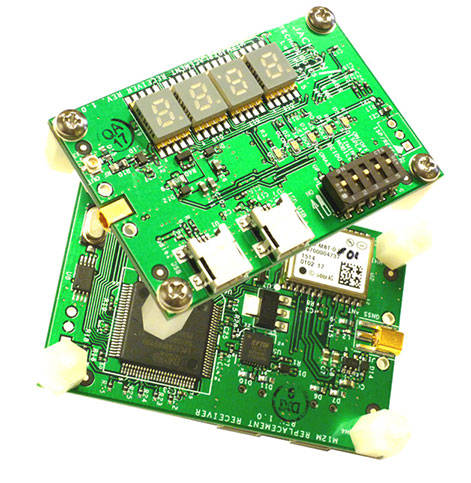
    M12M Replacement Receiver GNSS module.
    M12M Replacement Receiver GNSS module.

    Jackson Labs Technologies Inc. has made available the M12M Replacement Receiver GNSS module that is form-fit-function compatible to the legacy Motorola M12M and M12+ timing and navigation receivers. It uses an eighth-generation GNSS timing-enabled receiver allowing 72 GNSS-channel reception with any two GNSS systems being received simultaneously.

    The M12M adds configurability via USB ports as well as dual in-line package (DIP) switches and various status displays. GPS, GLONASS, BeiDou, QZSS and SBAS (WAAS/EGNOS/MSAS/GAGAN) signals can be received.

    The module supports NMEA, Motorola binary and u-blox binary, as well as SCPI (GPIB) communication protocols for easy configuration and monitoring, and is designed to allow plug-and-play retrofit of equipment designed for the legacy Motorola receivers, as well as provide an easy design-in for new customer applications, the company said.

    The M12M is certified to operate as a plug-and-play upgrade to legacy equipment such as the Symmetricom/Microsemi XLI server, as well as the Jackson Labs Technologies Fury GPSDO, requiring no setup or configuration to operate in those products, and can thus be used to retrofit products for GLONASS/BeiDou compatibility. In the process, the module enhances all performance parameters such as time to first fix; position, velocity and timing accuracy; tracking sensitivity; the addition of SBAS (differential compensation) capability; and the addition of external interfaces such as USB and a synthesized frequency output.

    The module supports a satellite tracking sensitivity of down to -167 dBm, allowing indoor reception in typical environments, a 1PPS output with better than 5-nanosecond real-mean-squared (rms) stability (quantization corrected), and a positioning accuracy of typically better than 0.3 meters rms (survey-in) or better than 0.7-meter rms horizontal even in high-dynamic environments such as aircraft missions.

    Dynamic auto Kalman filter configuration software allows using changing Kalman filter parameters in real time for improved accuracy, with filter parameters being automatically set dependent on actual mission dynamics. The GNSS timing receiver also supports Auto Survey (Survey-in) operation with Position Hold mode and TRAIM, allowing single-satellite timing reception in challenged or denied stationary environments.

    The module integrates a UTC (GNSS)-synchronized NCO synthesizer with buffered output that can generate a user-adjustable frequency from 0.25 Hz to over 10 MHz with extreme frequency accuracy when locked to the satellites. Additional features include operation from various power sources such as USB, or 3V via the M12M compatible connector, as well as a 7-segment LED status display, and numerous DIP switches for easy software-less configuration of the operating modes and desired GNSS systems to be enabled, Jackson Labs said. The module displays Satellite Status information including signal strengths and systems received, and can thus be used as a handheld antenna- and satellite signal distribution-system monitor.

    Various optional programs can be used to configure, control and monitor the unit such as GPSD/NTP, GPSCon, Z38xx, u-blox uCenter, TimeKepper, TeraTerm Pro, WinOncore-12 and others. The industry-standard SCPI software interface supports easy-to-use English-language commands such as GPS?, HELP?, and others to monitor and configure the unit, while all advanced GNSS receiver functions such as capturing carrier phase data, assisted start, satellite setup and gating, and health monitoring features are also supported.

    M12M Replacement Receiver module samples ship from stock, and are priced at $220 each.

  • As June 30 Nears, Leap Second Looms

    Leap-Second-O

    The world’s clocks will be adjusted by one second on June 30, when a leap second will be inserted into Coordinated Universal Time (UTC), the standard international time scale.

    In theory, all UTC clocks should insert a second labeled 23h 59m 60s (the leap second) following one labeled 23h 59m 59s UTC. This is equivalent to having all of the clocks in the world stop for one second at that time, as explained in May’s Expert Advice column.

    Several legacy GPS receivers immediately and incorrectly applied a leap second correction as early as January, or showed incorrect leap-second-pending data when queried due to an incorrect interpretation of the GPS specification by the firmware programmers of those GPS receivers, according to Jackson Labs Technologies.

    To help affected industries prepare, the DHS National Coordinating Center for Communications issued guidance with a paper titled “Best Practices for Leap Second Event Occurring on 30 June 2015.”

    The financial market has prepared for potential disruptions. The adjustment could present technical difficulties for traders and exchanges, as some computers might not be programmed to account for the adjustment.

    One company preparing is Racelogicwho makes the LabSat simulator. Racelogic will be recording the leap second as it happens and will then have the scenarios available for customers to replay. A variety of recordings will be taken: GPS, GLONASS, and BeiDou constellations will each be captured as a single channel, and also as a simultaneous triple-constellation recording. These will then be available to use with the LabSat.

    Jackson Labs has released new firmware versions for various products that address any potential issues for the pending and future leap second events, and that add a number of additional commands to query and handle leap second events.

    Precise Time and Frequency, Inc., has published a paper, “Phase Error Correction — Precision versus Speed,” which describes a technique for rapidly eliminating very large phase offsets (up to 0.5 seconds) between two 1 pulse per second pulses. The change is achieved without a sudden step change (which can be unwelcome in numerous applications) while retaining the ability to tune the phase with high precision (resolution of 0.006 pico seconds) once the large error is eliminated.

    “Like many novel ideas, the simplicity of this technique belies its effectiveness,” according to the paper. “With hindsight it seems like an obvious solution; however, the engineering mind is trained to know that to generate a one-second pulse from a reference frequency (in this case 10 MHz), it must be divided by the frequency itself, and the concept of an ‘incorrect’ divisor is not necessarily so obvious. In this case, however, the technique provides an ideal solution that reduces the phase-lock capture time from something that would be intolerable to a very acceptable time period.”

    Download the paper at this link.

  • Spirent’s SimSAFE Fights Signal Vulnerability

    Spirent’s SimSAFE Fights Signal Vulnerability.
    Spirent’s SimSAFE Fights Signal Vulnerability.

    By Tracy Cozzens

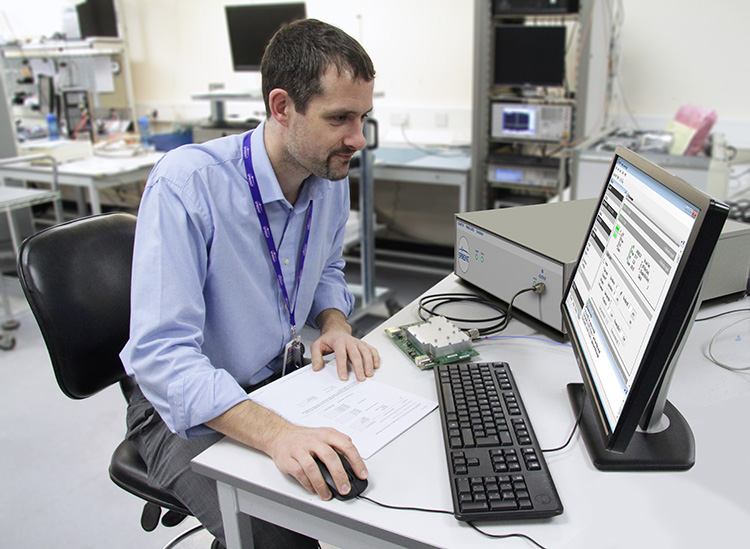
    Spirent Communications now offers SimSAFE, a software solution that simulates legitimate GNSS constellations along with spoofed or hoax signals to evaluate receiver resilience and help develop counter measures.

    Hoax or spoofing attacks work by mimicking genuine GNSS signals, which mislead GNSS receivers.  The military and critical infrastructure — such as wireless networks, banking, and utilities — are especially interested in being able to detect and reject spoofing attacks.

    “GNSS signal vulnerability is becoming a significant issue,” said John Pottle, marketing director of Spirent’s Positioning Division.  “The industry is beginning to talk more about vulnerability and how we actually think about categorizing the threat — what approaches are there to evaluate performance in the presence of interference signals? If you’re a developer, what approaches are there to clean up your performance? You’ll see us at Spirent being quite a bit more vocal about these areas in the coming months.”

    SimSAFE was developed in conjunction with Qascom, a small organization of half a dozen GNSS signal security and authentication experts headed by Oscar Pozzobon, who served as the chief solutions architect for SimSAFE. Pozzobon contributed his knowledge of GNSS security and vulnerabilities, which were then integrated into the SimSAFE system.

    SimSAFE provides a means of emulating a spoofing attack, and then monitoring a receiver under attack to evaluate mitigation strategies and countermeasures.

    “SimSAFE really gets into details on how a receiver reacts in the presence of the hoax signals,” Pottle said. “By really understanding that, really getting into how is the receiver is acting and reacting, you can understand better how your receiver is likely to behave, and tune it up.”

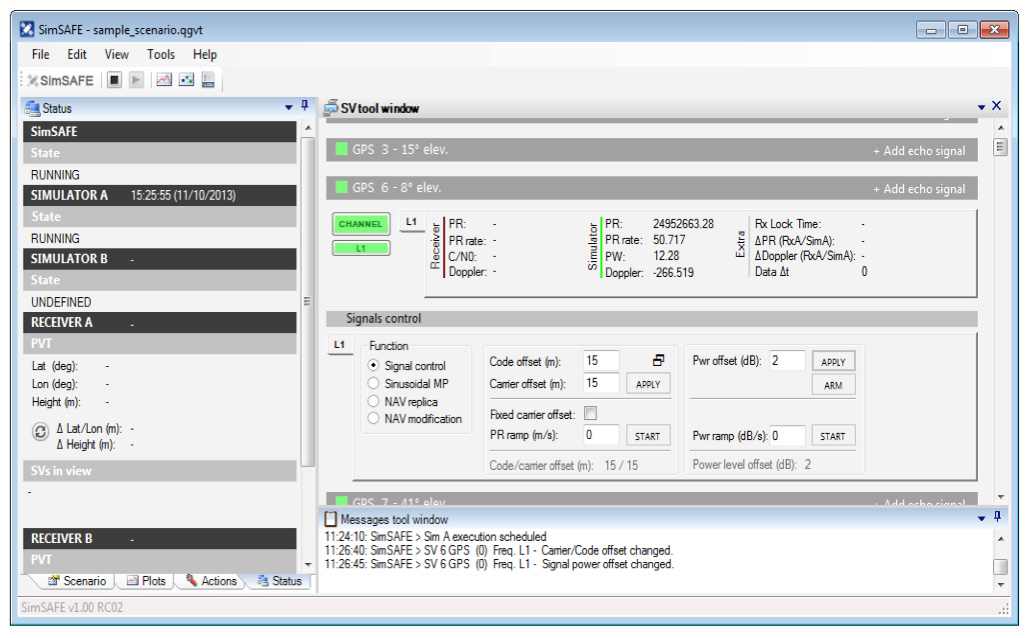
    The SimSAFE laboratory-based test solution is fully controllable, so that users can evaluate a receiver’s response to a wide range of spoofing attacks. As Pottle put it, when fed both authentic and spoofed signals, “What’s the receiver going to see? It’s going to see the authentic signals, it’s going to see a couple of spoofed signals. And you can play around with the spoofed signals — that’s the controllable bit. While this is happening, the detector module within SimSAFE monitors and reports the receiver’s response to the attacks. At its most simple, that’s the power of SimSAFE.”

    SimSAFE is aimed not only at receiver developers, a core audience of Spirent’s, but at anyone trying to build a system that may be subject to intentional interference, such as in the military or critical infrastructure. “Those people are starting to ask questions about what should I be worried about? What kind of an attack might I be open to? How can I be sure, if I’ve got a choice of three or four receivers, that I’m going to choose one that meets my needs in terms of resilience to intentional interference?” Pottle said. “Our belief is that SimSAFE will allow people to evaluate different receivers and strategies for mitigating spoofing attacks, and therefore help them to build the right level of resilience in their systems.”

    SimSAFE is available in two variants. SimSAFE Simulated uses the simulator for all signals, both satellite and spoofed, using one or more channels for the spoofed signal.

    Instead of a simulator, SimSAFE Live pulls authentic signals from sky with an antenna, so the user has the full power of the simulator to generate a much broader range of spoofing attacks. “The clever bit is aligning the spoofed signal with the real signal, getting the timing and frequency synced up,” Pottle said.

    Spirent is also working on other technologies to mitigate spoofing, including work with interference signals from ground-based transmitters, adaptive antenna lab-based tests, and integration with inertial sensors, such as in military jets.

    SimSAFE’s signal control capabilities.
    SimSAFE’s signal control capabilities.