Tag: LoRaWAN

  • Move-X offers LoRa/GNSS board with u-blox module for tracking

    Move-X offers LoRa/GNSS board with u-blox module for tracking

    Photo: Move-X
    Photo: Move-X

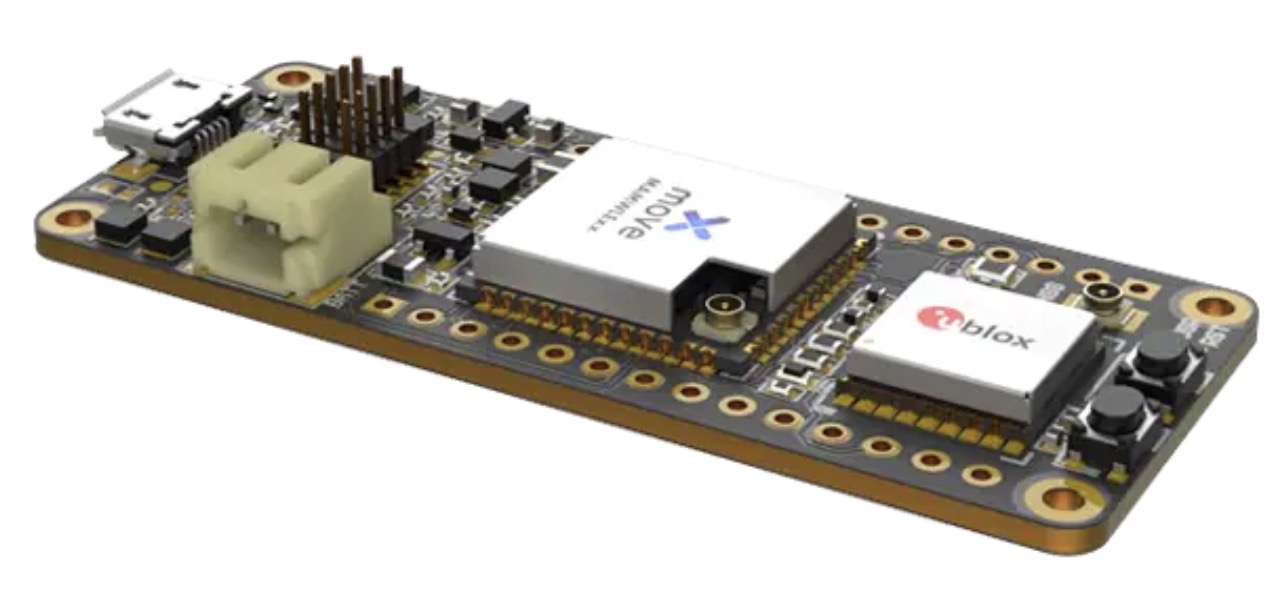
    Telecommunication electronics company Move-X is offering a new LoRa/GNSS board. The Cicerone LoRa/GNSS board is a high-performance, low-power, Arduino MKR-compatible development board based on the u-blox MAX-M10S GNSS module and the MAMWLE LoRa module.

    The Cicerone board delivers high-performance GNSS, long-range wireless connection, and high-performance MCU processing in a low-power solution for optimal battery life.

    The board allows users to build tracking applications worldwide with meter-level accuracy and to communicate long-range, low-power data via LoRaWAN. The integrated Li-Po charging circuit enables the Cicerone board to manage battery charging through the USB port.

    The Move-X Cicerone LoRa/GNSS board has a compact 63 x 25 mm form factor and is compatible with all Arduino MKR shield boards. These boards all share a common pinout to enable developers to easily add expansions with minimal software changes.

  • GNSS + Wi-Fi evaluation kit offered for IoT by Semtech, Actility

    GNSS + Wi-Fi evaluation kit offered for IoT by Semtech, Actility

    Photo: Actility
    Photo: Actility

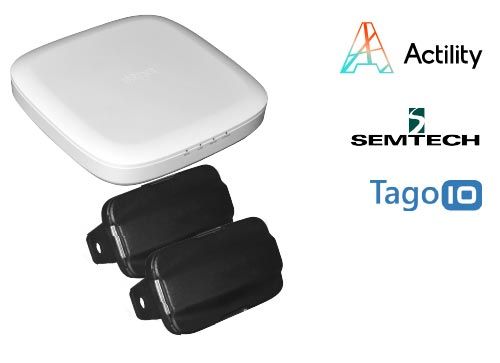
    Actility and Semtech are offering the LR1110 LoRa Edge Evaluation Kit with a tracking device based on Semtech’s LR1110 chipset and Actility’s LoRaWAN network management expertise.

    The solution delivers ultra-low power meter-accurate positioning both indoors and outdoors.

    The kit allows solution providers and integrators to quickly evaluate this new technology and to experience how it reduces the cost and complexity of building a solution for locating and monitoring internet-0f-things (IoT) assets.

    The LR1110 chipset, integrated to LoRa Edge, uses assisted GNSS (AGNSS) and Wi-Fi AP scanning, alongside standard LoRaWAN communications. It is bundled with Actility’s LoRaWAN network server (the ThingPark platform) and with the Tago.io application server.

    ThingPark Enterprise delivers the data to Tago.io through a predefined interface. Tago.ai provides a mechanism for customers to route received location data to an actionable dashboard with the map location history, the data traffic history and other data.

    The chipset has already been adapted by multiple companies such as Abeeway for its newest geolocation module.

    Low-power geolocation

    Semtech’s LR1110 is the first product in its new LoRa Edge platform — a highly versatile, low power, software-defined LoRa-based platform designed to enable a wide portfolio of applications for indoor and outdoor asset management.

    Modular and configurable, the LR1110 can transition between outdoor and indoor activity automatically, using GPS satellite tracking for outdoor applications and Wi-Fi passive scanning for tracking indoor assets. It replaces the need to build different trackers for indoor or outdoor use or trackers that combine multiple location methods with a single chipset, reducing complexity and cost.

    It contains the ultra-low power capabilities of a LoRa transceiver. This means that it can communicate over LoRaWAN and it can be used to acquire position coordinates either through GNSS or Wi-Fi signals. Instead of changing the batteries on asset trackers every three to six months with conventional Wi-Fi technology, LoRa Edge delivers low power consumption allowing battery lifetimes up to three years.

    A crypto engine allows LoRaWAN keys to be stored inside the device for secure joining and communication. Modules can be securely activated from Semtech’s LoRa Cloud Device Activation Service.

  • LoRaWAN market projected to grow by 47 percent

    LoRaWAN market projected to grow by 47 percent

    logoThe global LoRaWAN market is projected to reach US$5557.2 million, growing at a very high compound annual growth rate (CAGR) of 47.2% during 2019 to 2027, according to market research firm InForGrowth.

    LoRaWAN is mainly designed for wide range and low-power communications in smart city applications that benefit from wireless battery-operated devices and secure bi-directional communication, mobility and localization services.

    InForGrowth’s LoRaWAN market report provides a detailed analysis of global market size, regional and country-level market size, segmentation market growth, market share, the competitive landscape, sales analysis, impact of domestic and global market players, value-chain optimization, trade regulations, recent developments, opportunities analysis, strategic market growth analysis, product launches, area marketplace expanding and technological innovations.

    Top driving factors

    The report discusses these driving factors in the LoRaWAN market.

    • Growing adoption of smart devices (IoT) in smart cities and smart home projects.
    • The growing adoption of machine-to-machine communication devices due to low cost and less power consumption.
    • Due to the use of IoT in various applications such as smart metering, smart lighting, and livestock monitoring, organizations face challenges regarding the selection of an appropriate connectivity option for specific business use cases.
    • LoRaWAN mainly the private or virtual networks, and connect different endpoints that use different applications (IoT, M2M, smart cities, sensor networks, and industrial automation) in a single data environment. This fuels the demand for LPWANs that offer requisite connectivity, provide long-range access, and extended battery life for connected devices and sensors.

    Market segmentation

    The global LoRaWAN market has been segmented on the basis of deployment, hardware, application and end-user.

    The application of LoRaWAN is based on industry verticals segmented into

    • asset tracking
    • smart metering
    • smart parking
    • smart waste management
    • smart building
    • others.

    Top-end users — those receiving benefits through the LoRaWAN market — can be segmented into

    • agriculture
    • utilities
    • consumer electronics
    • healthcare
    • manufacturing
    • others.

    Region Analysis

    The market is classified into North America, Europe, Asia Pacific, Middle East, Africa and Latin America.

    Europe dominated the market in 2018 and is anticipated to dominate the market in the coming years as well. This is mainly attributed to the rapid adoption of smart agriculture in the region. Large-scale macro-farms are being replaced by family-owned micro-farms across Europe.

    Key players involved in the LoRaWAN market included in this study are Murata Manufacturing Co., Ltd., Link Labs, Microchip Technology Inc., Laird Connectivity, Semtech Corporation, SK Telecom Co. Ltd., Orange S.A. Senet Inc., Comcast Corporation and others.

    Browse the full report.