Tag: Los Angeles

  • GIS technology plays crucial role in wildfire management and response

    GIS technology plays crucial role in wildfire management and response

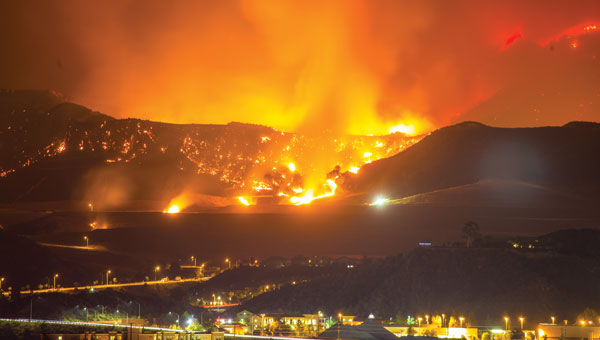
    The Palisades and Eaton fires devastated parts of Los Angeles in January 2025 and are largely contained as of Jan. 20. Fueled by extreme Santa Ana winds and dry conditions, these fires have left a mark on the region’s landscape and community.

    The Palisades Fire, which originated in the Pacific Palisades on Jan. 7, ultimately burned 23,448 acres, resulted in 12 confirmed fatalities and destroyed or damaged more than 6,800 structures, according to the California Department of Forestry and Fire Protection, known as CAL FIRE. The fire’s rapid expansion was particularly alarming, growing from a small brush fire to a massive conflagration within an hour.

    Simultaneously, the Eaton Fire, which began near Altadena and Pasadena, consumed 14,117 acres. This fire proved even more deadly, with 17 confirmed fatalities and significant damage to more than 10,000 structures, according to CAL FIRE. Both the Palisades and Eaton fires have now been classified among the most destructive wildfires in California’s history.

    During times of emergency, geographic information systems (GIS) specialists come together to create real-time mapping tools to provide critical support to first responders and keep communities well-informed. These tools have become indispensable in modern disaster management, particularly in wildfire response.

    Interactive 3D Maps 

    Firefighters and other specialists from federal, state, and local agencies work together to fight wildfires.  GIS specialists develop interactive 3D maps to display fire perimeters, evacuation zones and other critical data. The geospatial data serves as the foundation for effective communication and decision-making, allowing firefighters and incident management teams to access information in near real-time to make informed decisions. 

    Fire GIS specialists Peter Rowland, Brett Adler and Dawn Hutchinson shared insights into their teams’ strategies for wildfire management. They emphasize the crucial role of geospatial tools in disaster response by delivering actionable intelligence. GPS World interviewed them during the California wildfires. Rowland and Adler were based at the Palisades fire, while Hutchinson, who is a member of a California Interagency Incident Management Team (CIIMT), was located near the Eaton fire. 


    Interagency GIS teams use the Fire Integrated Real-Time Intelligence System (FIRIS) to watch for fire starts and then receive alerts from dispatch centers and satellite imagery. After locating the point of ignition, they create fire behavior models using a program called WIFIRE from UC San Diego. This tool allows them to predict the fire’s probable trajectory and size. 
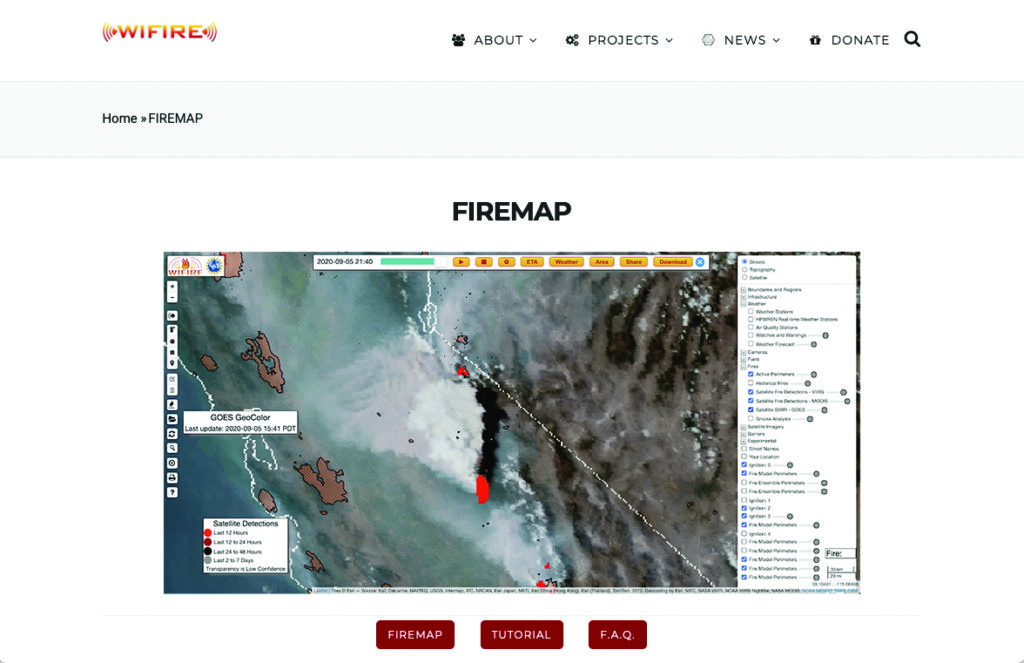
    Photo: CAL FIRE
    Photo: CAL FIRE


    The team will alert the state if the data shows the fire is likely to spread. Hutchinson explains that, within minutes of the start of the Eaton fire, her team produced a fire behavior model that illustrated where the fire was most likely to go and how big it would likely get within the next three hours.
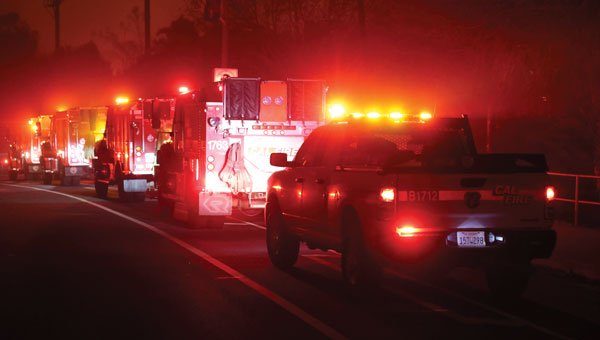
    Photo: CAL FIRE
    Photo: CAL FIRE

    The frequency of IR flights depends on the fire’s size and intensity. Occurring anywhere from once to three times daily, including nighttime, these flights comprehensively map the landscape based on the fire’s specific traits. The decision on how often to fly the planes and collect the IR data depends on the fire’s behavior and potential threat level.

    Field observers are also deployed daily to collect data down to the debris. They walk the fire’s edge and move along specific paths created for wildfire management and containment. Once a fire is contained, GIS specialists try to verify ground truth for the perimeter of the entire fire.

    GIS specialists constantly update fire perimeters as they get data from the field and the planes. Once a fire is contained, they create final maps to hand over to the local agencies or the Forest Service.

    Photo:
    Photo: CAL FIRE


    Most of the data that GIS specialists use to map fires comes from field observers and infrared (IR) thermal imagery. The data is collected by third-party contractors, by CAL FIRE’s Intel shift team, or by the FIRIS program by flying manned aircraft. 

    IR data and information collected by field observers are then uploaded into the National Incident Feature Service (NIFS) for GIS specialists to use to map fires.  

    Field observers download the maps onto their devices, go out into the field, and ground truth — physically walking the perimeter of the fire and using GPS on their devices to map the fire boundaries accurately. 
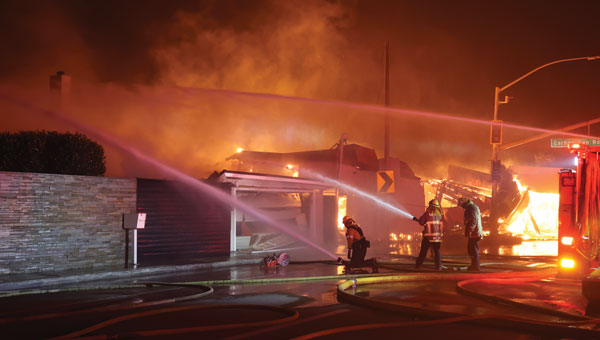
    Photo: CAL FIRE
    Photo: CAL FIRE


    Paper maps are good to have “just to get everybody on the same page without having to worry about battery life or the glare while you’re working out in the field,” said Rowland.


    Along with online maps, the Interagency GIS teams print PDF maps for fire personnel in the field. The field observers use Esri ArcGIS Field Maps to record their tracks. They pair their mobile devices with Avenza or other geolocating applications.  


    Using ArcGIS Pro, GIS specialists create online maps and dashboards, which are then distributed in print and/or digitally to the agencies that need them, such as sheriff and police departments and departments of public works. The Interagency GIS teams create different map products for different end users. For example, it works with law enforcement to create evacuation maps and zones. Local public information officers also can distribute these maps or post them on their websites. 
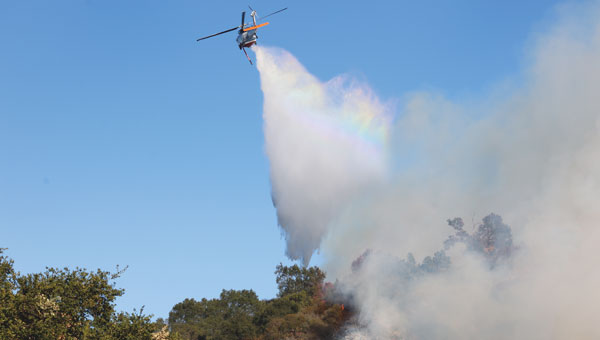
    Photo: CAL FIRE
    Photo: CAL FIRE


    Crews also have online access to the maps through wildfire FTP (ftp.wildfire.gov). Crews load data and maps there that contain public information. Many agencies plug into the National Interagency Fire Center (NIFC), where the CAL FIRE team edits and analyzes mobile data.
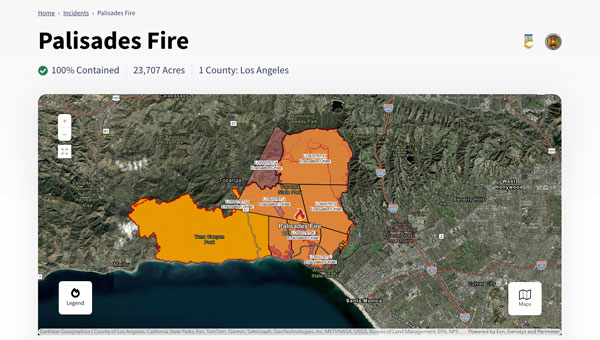

    Photo: fire.ca.gov
    Photo: fire.ca.gov
  • Los Angeles Geospatial Summit is quickly approaching

    Los Angeles Geospatial Summit is quickly approaching

    The 2025 Los Angeles Geospatial Summit will be held Feb. 28 at the USC Hotel in Los Angeles.

    Each year, leading organizations in geospatial science — including Esri, Eclipse Mapping and GIS, NV5 Geospatial, HRL Laboratories — gather to explore innovative ways geospatial science can address urgent challenges in urban planning, environmental sustainability and public health through advanced spatial data and analysis.

    Event highlights

    The summit will commence with a keynote address by Daniel Gall, FACHE, deputy chief strategy officer of the Veterans Health Administration, titled “Geospatializing the Veterans Health Administration.” Following the keynote, John P. Wilson, Professor and Founding Director of the USC Spatial Sciences Institute, will moderate a discussion with Gall and Courtney Fassett from Deloitte Consulting, focusing on emerging trends in the geospatial industry.

    Afternoon sessions will feature expert presentations and panel discussions exploring decision-making processes using geospatial data. Researchers and professionals from HRL Laboratories, Placer.ai, and other organizations will share insights into emerging geospatial technologies and methodologies. The University of Redlands Dean Thomas Horan will moderate a closing session on “Empowering the Geospatial Workforce of the Future,” featuring panelists from the Open Geospatial Consortium and Esri.

    A highlight of the event will be the annual ArcGIS StoryMaps Competition, sponsored by Esri. Students from Southern California universities will compete for prizes in categories including innovative technology use, compelling map communication, and methodological analysis. Three selected students will also present research in a lightning talk session, with expert feedback from industry professionals.

    GIS and geospatial sciences students from any college or university, as well as industry professionals, can register for the Summit and learn more here.

  • Research Roundup: GPS reveals volcanic activity under Europe

    Research Roundup: GPS reveals volcanic activity under Europe

    Scientists have discovered new evidence for active volcanism next door to some of the most densely populated areas of Europe. The study crowdsourced GPS monitoring data from antennae across western Europe to track subtle movements in the Earth’s surface, thought to be caused by a rising subsurface mantle plume.

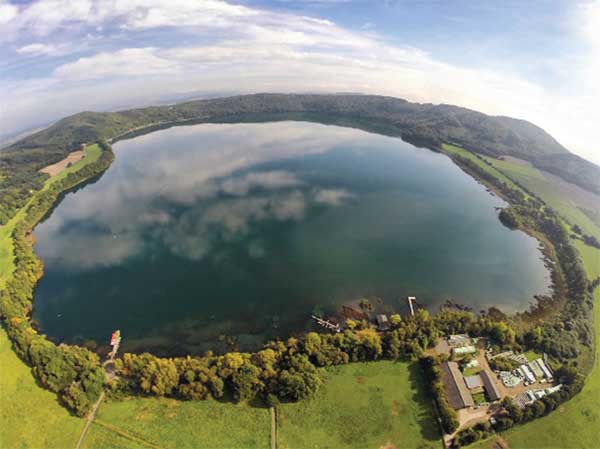
    The Eifel region lies roughly between the cities of Aachen, Trier and Koblenz, in west-central Germany. It is home to many ancient volcanic features, including the circular lakes known as maars. Maars are the remnants of violent volcanic eruptions, such as the one that created Laacher See, the largest lake in the area. The explosion that created the lake is thought to have occurred around 13,000 years ago.

    The mantle plume that fed this ancient activity is thought to still be present, extending up to 400 kilometers (km) into the earth. However, whether or not it is still active is unknown. “Most scientists had assumed that volcanic activity in the Eifel was a thing of the past,” said Corné Kreemer, lead author of the new study. “But connecting the dots, it seems clear that something is brewing underneath the heart of northwest Europe.”

    An aerial view of Laacher See, a volcanic caldera lake with a diameter of 2 km in Rhineland-Palatinate, Germany. Created by volcanic activity, maars like this are also found in other parts of Europe and on other continents, but Eifel-Maars are the classic example worldwide. (Photo: bbsferrari/iStock / Getty Images Plus/Getty Images)
    An aerial view of Laacher See, a volcanic caldera lake with a diameter of 2 km in Rhineland-Palatinate, Germany. Created by volcanic activity, maars like this are also found in other parts of Europe and on other continents, but Eifel-Maars are the classic example worldwide. (Photo: bbsferrari/iStock / Getty Images Plus/Getty Images)

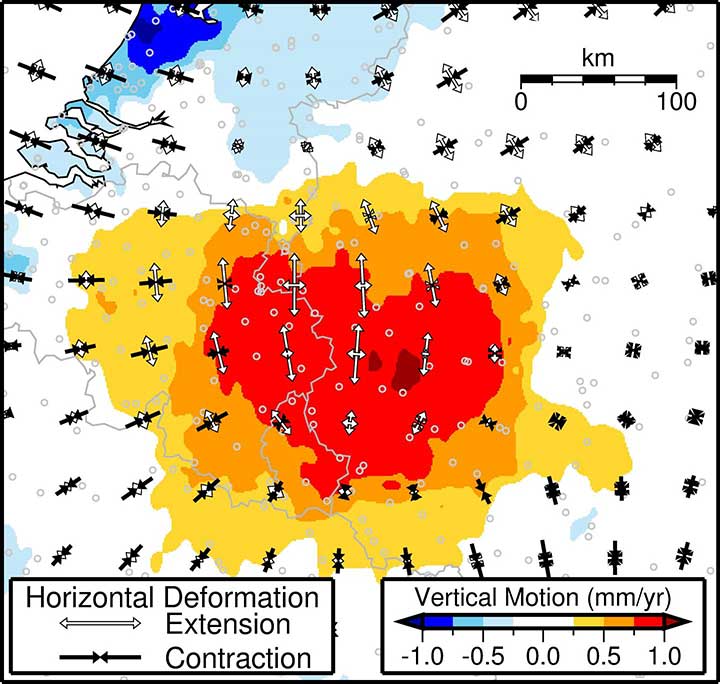
    In the new study, the team — based at the University of Nevada, Reno and the University of California, Los Angeles — used data from thousands of commercial and state-owned GPS stations all over western Europe. The research revealed that the region’s land surface is moving upward and outward over a large area centered on the Eifel, and including Luxembourg, eastern Belgium and the southernmost province of the Netherlands, Limburg.

    “The Eifel area is the only region in the study where the ground motion appeared significantly greater than expected,” said Kreemer. “The results indicate that a rising plume could explain the observed patterns and rate of ground movement.”

    The new results complement those of a previous study in Geophysical Journal International that found seismic evidence of magma moving underneath the Laacher See. Both studies point towards the Eifel being an active volcanic system.

    The implication of this study is that there may not only be an increased volcanic risk, but also a long-term seismic risk in this part of Europe. The researchers urge caution, however. “This does not mean that an explosion or earthquake is imminent, or even possible again in this area. We and other scientists plan to continue monitoring the area using a variety of geophysical and geochemical techniques, to better understand and quantify any potential risks.”

    GPS observations of ground movement under the Eifel area. Colors represent contoured vertical motion inferred from GPS station data, and white and black arrows indicate the direction in which the crust is horizontally stretching or compressing, respectively. The highest upward motion of ~1 mm per year is found near the Eifel volcanic field. (Image: Study authors)
    GPS observations of ground movement under the Eifel area. Colors represent contoured vertical motion inferred from GPS station data, and white and black arrows indicate the direction in which the crust is horizontally stretching or compressing, respectively. The highest upward motion of ~1 mm per year is found near the Eifel volcanic field. (Image: Study authors)

    Citation: “Geodetic evidence for a buoyant mantle plume beneath the Eifel volcanic area, NW Europe” by Corné Kreemer, Geoffrey Blewitt, Paul M. Davis. Geophysical Journal International, Volume 222, Issue 2, Aug. 1, 2020, pp. 1316–1332, https://doi.org/10.1093/gji/ggaa227

  • Los Angeles Geospatial Summit Coming Feb. 27

    The Fifth Annual Los Angeles Geospatial Summit will take place at the Japanese American National Museum on Feb. 27, 9 a.m. – 6 p.m. The event will feature addresses and discussions from leading innovators in the world of geographic information science (GIS) and technology. The summit also will feature presentations from students representing more than a dozen different Southern California colleges and universities.

    Registration is available here. A detailed program breakdown can be found here.

    “At the USC Spatial Sciences Institute, we collaborate with a cross-cutting array of researchers, businesses, non-profits, NGOs, and other entities from a wide range of disciplines and industries to analyze, model, and visualize location-based data,” said John P. Wilson, USC Spatial Sciences Institute and summit program committee member. “Although there are many geospatial conferences across the country and around the world, our summit has the distinctive mission to connect current leaders in the spatial sciences with students from numerous different academic institutions who are the next generation of innovators.”

    At the summit, students will be able to learn about emerging trends in geospatial science, technology, and applications; present papers and posters about their own research; network with industry professionals; and introduce themselves to geospatial company representatives at the closing Industry and job fair.

    Industry professionals will have the opportunity to learn what leaders in their field see as emerging geospatial trends, create greater awareness for their company by sharing materials at the industry fair, network with other geospatial professionals, and have a chance to influence what academic programs are teaching to the next generation of GIS professionals.

    Plenary speakers will be Gil Elbaz, CEO, Factual Inc., presenting “Location-Based Data and GIS: Changing the Future;” Keith Masback, CEO, United States Geospatial Intelligence Foundation; and Chris Mattmann, Ph.D., chief architect, Instrument and Data Systems Section, presenting the case study “Data Science from the Trenches: NASA, Academia, and Open Source Trial by Fire.”

    Moderators and panelists for the day’s panel discussions and concurrent presentations will include:

    • Estella M. Geraghty, M.D., Chief Medical Officer and Health Solutions, Esri
    • Chris B. Dunbar, Principal Director, Guidance & Control Subdivision, The Aerospace Corporation
    • Mark Sarojak, Vice President, PIXIA Corp.
    • Bingcai Zhang, Technical Fellow, BAE Systems
    • Robert Fassett, M.D., Director, Care Delivery Transformation, PricewaterhouseCoopers
    • David DiBiase, Team Lead – Education Industry, Esri
    • Isaiah Mack, Manager, California Surveying and Drafting Supply, Inc.
    • Thomas A. Horan, Professor and Dean, Claremont Graduate University
    • Myles G. Cockburn, Associate Professor of Preventive Medicine and Spatial Sciences, USC
    • Andre Doumitt, CEO, Digital Adopxion
    • R. Maxwell Baber, Director of Academic Programs, United States Geospatial Intelligence Foundation

    The summit is sponsored by California Surveying and Drafting Supply, California Geographic Information Association, Esri, PIXIA Corporation, United States Geospatial Intelligence Foundation, and the USC Spatial Sciences Institute.

  • Los Angeles Geospatial Summit Coming Feb. 27

    The Fifth Annual Los Angeles Geospatial Summit will take place at the Japanese American National Museum on Feb. 27, 9 a.m. – 6 p.m. The event will feature addresses and discussions from leading innovators in the world of geographic information science (GIS) and technology. The summit also will feature presentations from students representing more than a dozen different Southern California colleges and universities.

    Registration is available here. A detailed program breakdown can be found here.

    “At the USC Spatial Sciences Institute, we collaborate with a cross-cutting array of researchers, businesses, non-profits, NGOs, and other entities from a wide range of disciplines and industries to analyze, model, and visualize location-based data,” said John P. Wilson, USC Spatial Sciences Institute and summit program committee member. “Although there are many geospatial conferences across the country and around the world, our summit has the distinctive mission to connect current leaders in the spatial sciences with students from numerous different academic institutions who are the next generation of innovators.”

    At the summit, students will be able to learn about emerging trends in geospatial science, technology, and applications; present papers and posters about their own research; network with industry professionals; and introduce themselves to geospatial company representatives at the closing Industry and job fair.

    Industry professionals will have the opportunity to learn what leaders in their field see as emerging geospatial trends, create greater awareness for their company by sharing materials at the industry fair, network with other geospatial professionals, and have a chance to influence what academic programs are teaching to the next generation of GIS professionals.

    Plenary speakers will be Gil Elbaz, CEO, Factual Inc., presenting “Location-Based Data and GIS: Changing the Future;” Keith Masback, CEO, United States Geospatial Intelligence Foundation; and Chris Mattmann, Ph.D., chief architect, Instrument and Data Systems Section, presenting the case study “Data Science from the Trenches: NASA, Academia, and Open Source Trial by Fire.”

    Moderators and panelists for the day’s panel discussions and concurrent presentations will include:

    • Estella M. Geraghty, M.D., Chief Medical Officer and Health Solutions, Esri
    • Chris B. Dunbar, Principal Director, Guidance & Control Subdivision, The Aerospace Corporation
    • Mark Sarojak, Vice President, PIXIA Corp.
    • Bingcai Zhang, Technical Fellow, BAE Systems
    • Robert Fassett, M.D., Director, Care Delivery Transformation, PricewaterhouseCoopers
    • David DiBiase, Team Lead – Education Industry, Esri
    • Isaiah Mack, Manager, California Surveying and Drafting Supply, Inc.
    • Thomas A. Horan, Professor and Dean, Claremont Graduate University
    • Myles G. Cockburn, Associate Professor of Preventive Medicine and Spatial Sciences, USC
    • Andre Doumitt, CEO, Digital Adopxion
    • R. Maxwell Baber, Director of Academic Programs, United States Geospatial Intelligence Foundation

    The summit is sponsored by California Surveying and Drafting Supply, California Geographic Information Association, Esri, PIXIA Corporation, United States Geospatial Intelligence Foundation, and the USC Spatial Sciences Institute.