Tag: LTE

  • U-blox cellular module integrates GNSS with LTE modem for IoT

    U-blox cellular module integrates GNSS with LTE modem for IoT

    U-blox has launched the LARA-R3121, a new module comprising a single-mode LTE Category 1 modem and a GNSS positioning engine specifically designed for Internet of Things (IoT) and machine-to-machine (M2M) devices.

    The LARA-R3121 is designed for IoT applications including smart utility metering, connected health and patient monitoring, smart buildings, security and video surveillance, smart payment and point-of-sale (POS) systems, as well as wearable devices, such as action cameras.

    “Most IoT modules on the market use LTE modem technology, developed by handset-focused silicon vendors. They may not provide the best fit for IoT applications, because they focus on features targeted at Tier 1 handset makers, limited by short life cycles. The LARA-R3121 is different with features and qualifications crafted for the industrial markets,” said Andreas Thiel, u-blox co-founder and executive VP, Cellular Products and IC Design. “This is the only cellular module comprising a LTE Cat 1 modem and a GNSS engine, with complete module hardware and software all developed by a single supplier. With our focus on the IoT market, we bring an ‘IoT first’ approach to silicon design.”

    The LARA-R3121 is supplied in the small 24 x 26 mm LARA LGA form factor for compact IoT devices. This standardized package enables straightforward automated manufacturing and is pin-compatible with the u-blox LARA-R2 series, which supports multimode LTE Cat 1 with 2G/3G fallback.

    LARA-R3121 module by u-blox.
    LARA-R3121 module by u-blox.

    According to the company, it is a landmark in u-blox’s long-term strategy to create modules based on the UBX-R3 LTE modem technology platform, an internally developed, flexible, software-defined modem architecture specifically designed for IoT and M2M.

    The essential modem, positioning and module components of the LARA-R3121 are developed in-house, allowing for freedom for innovative feature development, for enabling end-to-end security and giving full control of product quality, while ensuring the long term product availability required by many IoT applications. Because modem and GNSS technologies were all developed in-house, u-blox is also able to provide unparalleled technical support for developers.

    The LARA-R3121 features FOTA, providing customers with a solution to issue firmware over the air updates. It also benefits from end-to-end security features, such as secure boot, secure transport layer, secure authentication, secure interfaces and APIs. Like other cellular modules from u-blox, it complies with a nested architecture, which allows for easy migration, and future-proof, seamless mechanical scalability across cellular technologies.

    As a single mode, LTE-only device, LARA-R3121 takes advantage of the fact that LTE networks are becoming universally available. Increasingly, products do not require fallback to 3G or 2G, which means that non-essential components can be removed, reducing cost and power consumption.

    The 10 Mbits downstream and 5 Mbits upstream maximum throughput of LTE Cat 1 provides data rates sufficient for good quality video streaming.

  • HellaPHY wireless positioning better than 50 meters for IoT

    Acorn Technologies Inc., a semiconductor and wireless technology company focused on the Internet of Things (IoT), has developed and  demonstrated new wireless long-term evolution (LTE) positioning technology for the location of things. The LTE location-based technology meets the new Enhanced 911 (E911) mandate performance requirements and performs well in very low bandwidth conditions. HellaPHY technology provides better than 50-meter accuracy for next generation location of things in the machine-type communications (MTC) and IoT markets.

    Location of devices acts as an organizing principle for anything connected to the internet, helping organize the billions of internet-connected devices based on the sensors and other location-centric elements in them. The installed base of IoT endpoints will grow to more than 25 billion in 2019, hitting 30 billion in 2020, according to a recent IoT forecast.

    “We are achieving accuracy in low bandwidth scenarios,” says Steven Caliguri, VP of wireless products at Acorn Technologies. “We believe that our advanced LTE positioning solution is the lowest complexity, lowest cost and lowest power solution available today for LTE based applications from high-end smartphones to loT.”

    Acorn has demonstrated better than 50-meter accuracy in live network testing of their user equipment (UE)-based positioning algorithms for low bandwidth CAT-M devices. (Cat-M refers to Category M, the second generation of LTE chipsets meant for IoT applications.) The network tests were conducted on a network that has not been fully optimized for LTE-based positioning.  Further gains are expected when optimizations begin to rollout.

    Acorn’s network testing has demonstrated the ability to exceed the 2021 E911 mandated performance requirements even in low-bandwidth scenarios.

    The technology has been developed from the core hellaPHY Channel Estimation algorithm that employs machine-learning techniques. The positioning algorithms are  suited for IoT applications due to their extremely low complexity, and require less then 10 kilobytes of memory and only a fraction of a low-end DSP during the maximum processing interval. It has further proven to exceed the performance of super resolution algorithms at a fraction of the complexity.

    HellaPHY RSTD is an advanced signal processing algorithm that was developed to improve LTE wireless network indoor and outdoor location accuracy. It is designed to be a drop-in replacement for existing Reference Signal Time Difference (RSTD) algorithms in UE chipsets and can be customized for any unique DSP or interface requirements. The hellaPHY RSTD IP core is designed to support advanced LTE features contemplated by operators as well as for LTE Release 14 including Positioning Reference Signals (PRS) muting, Cell-Specific Reference Signal (CRS) plus PRS transmit diversity, and fractional Ts reporting. The hellaPHY RSTD IP core is scalable and can support CAT-M through CAT-15.

    (” … the ubiquitous parameter Ts. This nameless parameter is the most basic unit of time in the LTE air interface and pretty much everything in the LTE frame structure is based on multiples of this basic time unit, capital “T”, sub small “s”. Ts is defined exactly as: Ts = 1/(15000 x 2048) seconds, a little more than 32 nano-seconds.”

    — from LTEuniversity.com)

    Acorn Technologies is a provider of performance scaling semiconductor and wireless intellectual property for the Internet of Things. With nearly 200 patents issued and pending, Acorn’s IP addresses the fundamental building blocks with algorithms for wireless and IoT. The company’s semiconductor IP portfolio includes buried silicon stressors and metal insulator silicon  technologies to significantly boost semiconductor transistor performance.

  • Taoglas offers Guardian series of combination antennas

    Taoglas offers Guardian series of combination antennas

    Taoglas, a provider of IoT (Internet of Things) and M2M (Machine to Machine) antenna solutions, has launched a new series of high-performance LTE + GNSS or Wi-Fi antennas. The announcement was made at CTIA Super Mobility, held Sept. 7-9 in Las Vegas.

    The Taoglas Guardian X 11-in-1 antenna.
    The Taoglas Guardian X 11-in-1 antenna.

    The Guardian series includes 4, 5, 6 and even 11-in-1 antenna options for 4G LTE cellular applications that also require GNSS or Wi-Fi or satellite options.

    “Drilling holes in assets and doing long coaxial cable runs is a thing of the past for many IoT applications, particularly in the transportation industry,” said Dermot O’Shea, joint CEO at Taoglas. “Most vehicles and assets are no longer made from metal, but of a carbon fiber or composite material. This means the antenna does not need to be outside the asset but can be mounted internally.”

    One example is in the trucking industry, where antennas are mounted under the roof and above the headliner, eliminating the need for holes to be drilled. “This saves huge amounts of time and cost for the installation as well as increasing device performance due to the cable runs being shorter,” O’Shea said. “It also decreases the likelihood of antenna damage due to impact or vandalism.”

    The Guardian series antennas are delivered in a gloss-finished, compact square-shaped enclosure (146 x 134 x 20 mm). In the series are these options:

    • MA931 – 6 in 1 (2 x Cellular, 3 x Wi-Fi, 1 x GNSS)
    • MA930 – 6 in 1 (2 x Cellular, 2 x Wi-Fi, 1 x GNSS, 1 x Satellite)
    • MA950 – 5 in 1 (2 x Cellular, 2 x Wi-Fi, 1 x GNSS)
    • MA961 – 4 in 1 (2 x Cellular, 2 x Wi-Fi)

    Also, an extension to the line is the Guardian X series, with the first product being MA4000, an 11-in-1 antenna (six cellular, four Wi-Fi, one GNSS).

    The Guardian X dimensions are 540 x 183.1 x 35.4 millimeters. Despite its small size, the MA4000 antenna eliminates the requirement for multiple holes to be drilled in a valuable asset. The enclosure material is flame retardant, as is the CFD-200-FR low-loss cable. This means the antenna is compliant for airline, bus and rail passenger applications and complies with UNECE regulation R 118.

  • u-blox announces its first LTE Cat M1 module

    u-blox announces its first LTE Cat M1 module

    u‑blox, a global leader in wireless and positioning modules and chips, today announced plans to launch modules supporting Category M1 (Cat M1) LTE networks, which will allow a larger number of devices to connect to the Internet of Things (IoT).

    sara_3d_transThe first SARA‑R4 module developed by u‑blox will be available in Q4 2016 targeting mobile network operators in the United States market. With the recently launched SARA‑N2, the world’s first cellular NB‑IoT module, the new LTE Cat M1 complements u‑blox’s extensive product offering for the IoT.

    Along with NB‑IoT, LTE Cat M1 is part of the new 3GPP Release 13 standard supporting low power wide area (LPWA) technologies in the licensed spectrum and is designed for IoT applications with low to medium data throughput rates, as well as devices that require long battery lifetimes.

    Additionally, M1’s vehicular handover capability delivers the technology necessary to support vehicle, asset and people tracking. It also supports lower latency applications and a data rate of 375 kbps in half duplex mode and 1 mbps in full duplex mode.

    The market focus for the LTE Cat M1 technology is extensive and will cover applications in many areas, such as the smart home, security systems, industrial monitoring and control, asset tracking, telematics, connected health, smart metering, smart cities, and wearables.

    “u‑blox is a global leader in developing cellular modules designed for IoT applications,“ said Moti Tabulo, product manager of cellular at u‑blox. “We are excited to add LTE Cat M1 modules to our LPWA product portfolio. We will now be able to offer our customers both LTE Cat M1 and NB‑IoT modules.”

    The SARA‑R4 modules follow u‑blox’s “nested design” philosophy to maintain form factor and software continuity. This allows customers to easily upgrade their products with each new generation of u‑blox wireless modules without having to change their PCB designs. Such easy migration maximizes investment return, simplifies logistics and drastically reduces time‑to‑market, u-blox said.

    The first module out of the SARA‑R4 series will be available in Q4 2016.

  • PoLTE offers indoor/outdoor positioning using LTE networks

    PoLTE Corporation has developed technology that harnesses the global long-term evolution (LTE) deployment to provide accurate and reliable location data.

    Photo: planetc1 via Foter.com / CC BY-SA
    Cell-phone tower in California. Photo: planetc1 via Foter.com / CC BY-SA

    Unlike localized solutions, such as Wi-Fi and Bluetooth, PoLTE’s technology leverages its Positioning over LTE (PoLTE) Macro software to achieve precision of 2 to 6 meters. The technology makes use of the sounding reference signals (SRS) embedded in an LTE handset user’s transmission. Using adapted radar location techniques, it converts portions of the LTE uplink signal into a probe signal.

    The technology enables mobile network operators to deliver highly accurate location data to customers in indoor and outdoor environments.

    Traditional macro cell location methods require at least three towers to see the user device to locate the device with precision. Historically, single tower deployments were limited in accuracy to the width of the sector created by the 120-degree antenna that was serving the user device. For example, at a distance of 1.5 kilometers from a base station, the cross range precision would be 4,000 meters. PoLTE Macro can improve the precision to less than 2 meters.

    The benefits to leveraging network-based positioning include speed, flexibility, accuracy and data analytics. Customers for the technology include machine-to-machine and Internet of Things technologies, mobile advertising, crowd and customer tracking, and public safety.

    Learn more about PoLTE technology in the company’s white paper.

  • NextNav supports metropolitan beacon system for mobile

    The final specification for 3GPP Release 13 will include messaging support for Terrestrial Beacon System (TBS) location technologies, including the Metropolitan Beacon System (MBS).

    NextNav is deploying the MBS positioning technology across the U.S. to allow mobile phones and other devices to reliably determine their location in indoor and urban environments where GPS signals can’t be received.

    NextNav has adopted MBS for its nationwide deployment, which it calls an innovative “terrestrial constellation” bringing GNSS-like positioning performance to indoor and urban environments where satellite-based positioning is either unavailable or significantly degraded. By standardizing the core network information flow in 3GPP, support for MBS will become available across any Release 13-compliant LTE network platforms globally, similar to previously standardized GNSS systems such as GPS, GLONASS, BeiDou and Galileo satellite signals.

    NextNav’s system is complementary to GPS and delivers high precision latitude, longitude and “floor level” altitude in GPS-challenged areas such as indoors and urban locations across an entire metropolitan area. Unlike cellular positioning in LTE, MBS does not consume expensive wireless spectrum to do so.

    “We are gratified, after an especially intensive effort, to see 3GPP add support for Terrestrial Beacon Systems generically and for supporting the NextNav implementation of it — the Metropolitan Beacon System,” said Ganesh Pattabiraman, president of NextNav. “This speaks to the urgent market requirements for ubiquitous, high-quality indoor positioning. MBS availability as an international standard ensures that our location signals can be used in widely deployed LTE (long-term evolution) networks as part of an end-to-end system. It also opens the doors for multi-vendor systems, a critical consideration for our carrier customers and users worldwide.”

    The 3rd Generation Partnership Project (3GPP) unites seven telecommunications standard development organizations (ARIB, ATIS, CCSA, ETSI, TSDSI, TTA, TTC) and provides their members with a stable environment to produce the reports and specifications that define 3GPP technologies.


  • Research Online: Positioning with LTE signals

    Research Online: Positioning with LTE signals

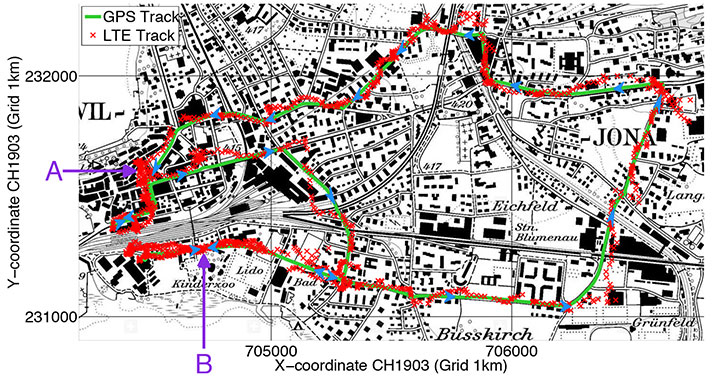
    Rover positions obtained with 2D LTE versus GPS track.
    Rover positions obtained with 2D LTE versus GPS track.

    Positioning with LTE Signals

    An alternative to GNSS in urban canyons can be provided by signals from cellular base stations, particularly new signals from long-term evolution (LTE) networks, since LTE coverage will be high in cities. Wide LTE downlink bandwidth provides good resolution of multipath components, which also assists positioning.

    A test used a universal software radio peripheral N210 synchronized to a GPS-locked Rubidium frequency standard. A personal computer stored LTE data samples together with GNSS sentences from a u-blox LEA-6T module. A Matlab-algorithm did the complete post-processing, extracting pseudoranges for the LTE base station and calculating the position solution.

    Results of a car driven on an urban route show root-mean-square value of the absolute error using LTE compared to GPS position is 43 meters.

    Positioning Using LTE Signals, by Fabian Knutti, Mischa Sabathy, Marco Driusso, Heinz Mathis, and Chris Marshall. Presented at the European Navigation Conference 2015.

    Seamless Indoors

    Sensor Augmented Indoor Navigation and Positioning, by M. Gemelli and Keith Nicholson, Bosch Sensortec. An overview of technologies that guide us indoors in a seamless and reliable manner, highlighting key requirements for motion and pressure sensing, low-power processing, efficient code design, wireless beaconing and map matching. Fusion software needs new data sources: Bluetooth low-energy, Wi-Fi fingerprinting, magnetic fingerprinting, ultrasound. Presented at ION GNSS+ 2015.

    Disturbed Ionosphere

    Mitigating satellite motion in GPS monitoring of traveling ionospheric disturbances (TIDs), by R.W. Penney and N.K. Jackson-Booth. Discusses the impact of satellite motion on the use of compact arrays of GPS receivers for estimating the velocity of travelling ionospheric disturbances (TIDs). It is shown that satellite motion has subtle effects upon standard techniques of waveform cross-correlation, or time-difference of arrival (TDOA), which can easily lead to spurious TID velocity estimates. In Radio Science, an AGU journal.

  • IZT Solutions’ over-the-air system tests GNSS receiver performance

    German research organization Fraunhofer Gesellschaft has developed and presented an over-the-air (OTA) wave-field synthesis system for test and certification of GNSS receivers. The testing platform is at its Fraunhofer IIS Facility for Over the Air Research and Testing (FORTE) in Ilmenau, Germany.

    The innovative and complex OTA test system is based on hardware and software solutions from IZT GmbH, such as powerful RF receivers and high-performance signal generators.

    The demonstrated setup to test GNSS receivers represents a new approach that — in contrast to conventional conducted and open-field tests — realistically emulates real-world scenarios under controllable and repeatable conditions, enabling the realistic comparison of receivers and algorithms. The OTA test system is cost-effective, flexible and scalable.

    The newest generations of mobile communication systems employ multiple antennas for transmission and reception, such as LTE, LTE-A, WIMAX and Wireless LAN. Multiple Input Multiple Output (MIMO) OTA test systems are typically deployed for certification, performance testing and product evaluation of broadband wireless devices. The related devices have to be tested in their related environments.

    In contrast to mobile phones, GNSS receivers are extremely susceptible to all types of interference. Hence, the goal was to develop a new testing method for interference robustness of GNSS receivers.

    The OTA Test Approach

    The OTA test laboratory comprises a satellite signal emulator (Spirent) used as signal source, several OTA channel emulators used for wave-field synthesis that are able to emulate any electromagnetic environment in an anechoic chamber, and several OTA illumination antennas. The OTA channel emulators from IZT GmbH support 8 input and 32 phase coherent output channels (up to 256 logical channels) in the frequency range of 1 to 6 GHz, and provide the output signals to the OTA illumination antennas. Note that the final extension of the system based on the IZT components will have 12 x 32 channels.

    The unique test environment developed at FORTE together with IZT GmbH excels in its great flexibility regarding possible applications in communications technology. The new OTA emulation approach enables realistic radio channel emulation taking into consideration multipath propagation, multi-frequency, and multi-user scenarios.

    The OTA system supports emulation of complex channel impulse responses of nearly unlimited length. Besides GNSS equipment, the test system can be applied for LTE and Cognitive Radio (CR), sensor networks (including energy networks and smart metering) or car-to-car and car-to-infrastructure communications.

    The Innovationszentrum für Telekommunikationstechnik GmbH IZT is a spin-off of the Fraunhofer-Gesellschaft, Germany’s leading institution for applied research. Founded in 1997 in Erlangen, the company emanated from the Fraunhofer Institute for Integrated Circuits (IIS). It specializes in advanced digital signal processing and field programmable gate array (FPGA) designs in combination with high-frequency and microwave technology.

  • Q&A at CTIA 2015 with Nick Papadopoulos, President of u-blox America

    Carrier-independent LTE modules, the autonomous vehicle and delivery drones all factor into future plans for the Swiss wireless company


    Nick Papadopoulos
    Nick Papadopoulos

    What’s new from u-blox?

    There’s a ton of new things. One is that we are now expanding our portfolio into short-range radio, meaning we have now products that are Bluetooth- and Wi-Fi-capable, which is useful especially in the automotive industries.

    And on another note, on the cellular side which we have been shipping since 2010, we have now introduced one a high-speed LTE module that is carrier independent in the United States so it can do both AT&T and Verizon at the same time so customers have the option as part of their logistics chain to build their product and not have to worry if this is an AT&T module now or a Verizon module. It simplifies logistics, simplifies the entire manufacturing chain and reduces cost.

    What are some use cases for the carrier-independent module?

    One of our customers builds devices—whether for alarm panels, tracking devices, telematics devices—where at the time of manufacture in the past they would actually have to determine for which carrier this particular device is going to made. So imagine the warehouse where they have to have one shelf for AT&T devices and another shelf for Verizon devices. It duplicates the effort. It costs money to have this kind of inventory, and you don’t know when you manufacture how many AT&T devices am I going to sell how many Verizon devices am I going to sell. That goes away. The same goes with tablets.

    This is for the automotive market as well?

    Imagine a carmaker who actually has a telematics control unit and they have an agreement say with one of the carriers—I’m not saying which—and two years down the road they have 8 million vehicles with telematics unit and then after two years decides the rates I’m getting with Carrier A, I could get better rates from Carrier B, so going forward they now sell vehicles car with telematics units with Carrier B. But everything they’ve sold in the past two years is still relying on Carrier A and, with the data buckets they have to pay still with that carrier, they don’t have any cost advantage there only moving forward. Now with our modem they can actually switch the entire base to Carrier B and save on the cost.

    Can you tell us with whom you are working on this?

    We are working with several customers on this and have a designed product, but I cannot tell you at this point until they allow us to—we’re working with them so it’s probably going to be the beginning of next year (before an announcement is made).

    What do you think it is that is giving your automotive innovations longevity?

    One of the things we have been working on is the development of our own LTE chipset and that has advantages–for one cost advantages—because LTE-only technology does not compete with our partners and so far that actually allows us to develop new products, new modules based on our own LTE chipset and expands our portfolio especially in North America where we hope in the next few years LTE will be so prevalent you won’t need any 2G or 3G, so that’s one of the things.

    We have also announced we are working very closely on the positioning side with several carmakers toward technology for autonomous vehicles. We’ve revolutionized positioning technology to the point you can identify which altitude you’re at in a parking garage. That is expanding to allow additional accuracy in very adverse environments for preparation of so called ADAS systems toward autonomous vehicles.

    What can we expect from this technology in the next few years?

    You have already today cars that park themselves. You have already today cars that are autonomous, but there are still passengers there just to monitor. A lot of the technology that already there is actually based on our dead reckoning technology. We are expanding around that in order to eventually truly allow autonomous vehicles to the point where those vehicles can actually park themselves in a valet scenario.

    Imagine driving up to a hotel and telling your car to go park yourself and it does it. It knows where to go and it eventually finds a spot and it parks itself without endangering anyone, and it can do that due to our technology, even underground. I do see in the next three-to-four years several carmakers launching vehicles that can drive autonomously on the highway. And they will need our technology for it.

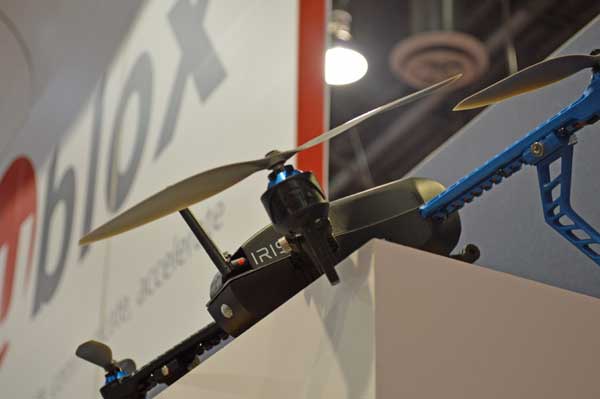
    ublox-drone-ctia-15
    The IRIS+ drone utilizes the u-blox GPS module.

    What about usage in UAVs?

    We are the leader in positioning technology for drones. We’re developing the technology to further improve position accuracy for delivery drones. So not just for recreational use but truly for professional utilization either for delivery, package delivery, agricultural delivery, pesticide/herbicide delivery. You need very, very accurate positioning technology.

    Where do you see the UAV industry going?

    I see consolidation eventually but at the same time, I see more and more proliferation of companies developing new types of drones.

    What’s the key to u-blox’s success?

    We have been phenomenally lucky that we have such good customers, who are not only loyal to us, but they spread the word and they bring more customers. I am very thankful and grateful to our customers and colleagues.