Tag: Mars mission

  • Silicon Sensing Systems to supply gyroscopes for Mars Moon rover

    Silicon Sensing Systems to supply gyroscopes for Mars Moon rover

    Silicon Sensing Systems has been contracted by the German Aerospace Centre (DLR) to supply two miniature Pinpoint (CRM200) gyroscopes for the Martian Moons eXploration (MMX) mission. This mission will travel to Mars to survey the two moons that orbit the planet.

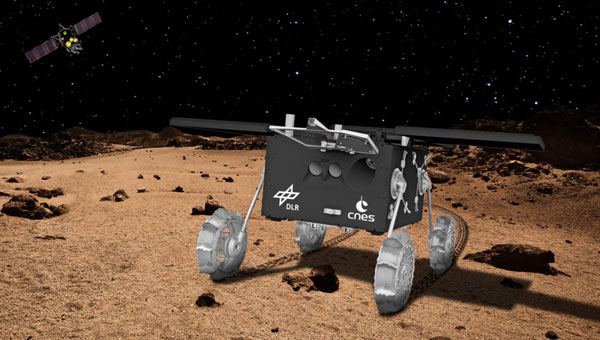
    The gyroscopes will be installed on the rover vehicle set to explore Phobos — the larger of Mars’ two moons — to collect crucial surface samples. The Pinpoint gyroscopes are designed to detect any unintended movement of the rover on unfamiliar terrain. Depending on the initial assessment of the drivetrain, which includes the gyroscopes, an optional safety module may be activated in the software. This module will automatically prevent instability during the rover’s driving sessions.

    Pinpoint completed TID testing at 17kRad Radiation and Proton tests (up to 68 MeV/proton), demonstrating the gyro’s suitability for space requirements.  

    The size of a small fingernail, at approximately 5mm by 6mm, PinPoint is the smallest gyro in Silicon Sensing’s MEMS product range. This low-drift, single-axis angular rate sensor can be used in various applications.  When integrated, these sensors can precisely measure angular rate across multiple axes — any combination of pitch, yaw and roll —while consuming little power.

    The MMX mission is conducted by the Japanese Space Agency (JAXA) to explore Mars’ two moons, with contributions from NASA, the European Space Agency (ESA), CNES and the German Aerospace Center (DLR). CNES and DLR are jointly developing a 25-kg rover for the mission. The spacecraft is expected to arrive in Martian space approximately one year after departing from Earth and will then enter orbit around Mars.

    It will then move into a quasi-satellite orbit (QSO) around the Martian moon Phobos to collect scientific data, drop the rover and gather a sample of the moon’s surface. After observation and sample collection, the spacecraft will return to Earth carrying the material gathered from Phobos. The current schedule has a launch date in 2026, followed by a Martian orbit insertion in 2027 and a return to Earth in 2031. 
  • Following Mars probe, UAE to launch two navigation satellites

    Following Mars probe, UAE to launch two navigation satellites

    The United Arab Emirates (UAE) will launch the first of two navigation satellites in 2021, according to the Emirates News Agency (WAM), spurred by the successful launch of a Mars probe on July 19.

    The satellite is designed to demonstrate the country’s technological capabilities. A second, further enhanced satellite will be launched in 2022, said Khaled Al Hashmi, director of the National Space Science and Technology Center (NSSTC) at UAE University, Al Ain.

    The satellites are the first project of Satellite Assembly, Integration and Testing Center, a collaboration formed by Tawazun Economic Council with Airbus and the NSSTC.

    Funded by the UAE Space Agency, the satellites are not intended to add a navigation system — at least not right away. “We try to select a certain technology, design and develop the satellite and payload here, and will own the intellectual property rights,” Hashmi told WAM, the state news agency.

    The UAE’s navigation satellite project is part of the Science and Technology Roadmap created by the UAE Space Agency and the NSSTC on developing new technologies. The NSSTC was jointly established by UAE University, UAE Space Agency and the Telecommunications Regulatory Authority (ICT-Fund).

    Decision on the program came following the successful launch of the Hope Probe, which opened collaboration opportunities between the UAE and global space agencies and companies. In the first Arab interplanetary mission, the probe will reach Mars in 2021 to provide a complete picture of the planet’s atmosphere.

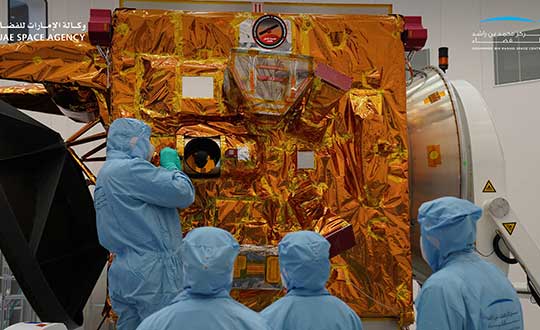
    Engineers and technicians at the Mohammed bin Rashid Space Center prepare the Hope Probe for its trip to Mars. (Photo: UAE Space Agency)
    Engineers and technicians at the Mohammed bin Rashid Space Center prepare the Hope Probe for its trip to Mars. (Photo: UAE Space Agency)