Tag: Mars

  • How we might navigate on Mars

    How we might navigate on Mars

    Images: NASA
    Images: NASA

    Researchers from NASA’s Frontier Development Lab (FDL) and Intel are proposing a way to navigate on a new planet using artificial intelligence (AI).

    The researchers presented their planetary navigation research during an Intel event on Aug. 16.

    The immense challenge of building GPS-similar constellations around every planet or moon could be avoided by using imagery, according to researchers Andrew Chung, Philippe Ludivig, Ross Potter and Benjamin Wu.
    The team developed a system for simulating the Moon’s surface so that AI could be used for navigation on the surface.

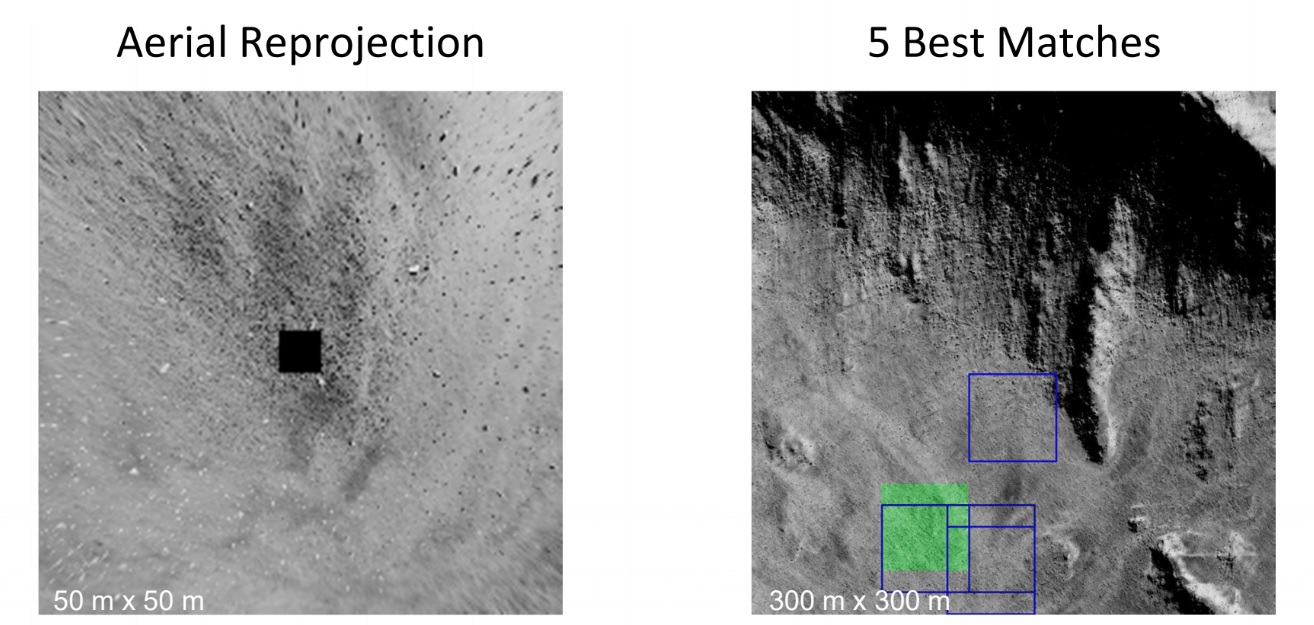
    How It Works. The researchers created a highly detailed digital model of a virtual moon using 2.4 million images of its surface. The images represent ones that might be taken by a rover.

    The AI learned what this moon looks like by being fed the millions of images, and then used its neural network to create a model of the virtual moon.

    According to the team’s presentation, this was enough to effectively enable navigation on the virtual moon’s surface.

    With the model in place, a person merely needs to take a photo of their surroundings on the surface. Based on the photo, the AI determines the person’s location and shows how to navigate to a destination. The AI would even understand the distortions of known features from the point of view of the camera.

    The team wants to try to do the same thing with a real celestial body: Mars. They think they have enough satellite images to make it work.

    If they’re right, the first Martian visitors could navigate the Red Planet by photo.

  • ION GNSS+ 2015: Plenary speech with NASA’s Jim Green

    NASA’s Jim Green presents the plenary speech at ION GNSS+ 2015, where he covers exploration on Mars and other topics.

  • Story Map: Mapping Liquid Water on Mars

    Mars-water-map-O2

    With NASA’s announcement on Monday that liquid water has been discovered on Mars, Esri has put together an interactive story map showing the craters and canyons on Mars that show evidence of water.

    Watch animations of the recurring slope lineae (water stains) across four different craters and explore satellite imagery and elevation data for the Red Planet.

    Below is an animation from the Jet Propulsion Laboratory showing seasonal flows in Hale Crater.

  • NASA’s James L. Green to Headline ION GNSS+ 2015

    NASA’s James L. Green to Headline ION GNSS+ 2015

    James L. Green, director of Planetary Science for NASA.
    James L. Green, director of Planetary Science for NASA.

    James L. Green, director of Planetary Science for NASA, will take the audience on a journey navigating through the solar system at The Institute of Navigation’s ION GNSS+ 2015 Conference.

    Green’s keynote address will show new worlds and new discoveries through the eyes of NASA’s planetary spacecraft. The conference takes place Sept. 14-18 at the Tampa Convention Center in Tampa, Florida.

    At NASA, Green is responsible for solar system exploration including astrobiology research. Under his leadership, a number of recent planetary science mission events have been successfully completed, including the New Horizons space probe which is scheduled to reach Pluto on July 14, Messenger orbit insertion at Mercury, the launch of Juno to Jupiter, the launch of Grail A and B to the Moon and subsequent orbit insertion, Dawn’s encounter with Vesta, and the landing of the Mars Science Laboratory and Curiosity rover on Mars. He has published more than 100 scientific papers on the magnetosphere of Earth and Jupiter. He has also contributed more than 50 technical articles on various aspects of data systems and networks.

    Green received his Ph.D. in physics from the University of Iowa in 1979 and has worked at NASA’s Marshall Space Flight Center and Goddard Space Flight Center before becoming the director of the Planetary Science Division at NASA Headquarters in 2006. In 1988 he received the Arthur S. Flemming award given for outstanding individual performance in the federal government and was awarded Japan’s Kotani Prize in 1996 in recognition of his international science data management activities

    Sponsored by the ION’s Satellite Division, ION GNSS+ is the world’s largest international technical meeting and showcase of GNSS technology, products and services and brings together international leaders in GNSS and related positioning, navigation and timing fields to present advances, introduce new technologies, update current policy, demonstrate products and exchange ideas.