Tag: MediaTek

  • Quectel releases 5G-advanced 3GPP R18 automotive-grade cellular module

    Quectel releases 5G-advanced 3GPP R18 automotive-grade cellular module

    Quectel Wireless Solutions has launched a 5G-advanced (5G-A) automotive-grade cellular module, the AR588MA. The module integrates dual-band GNSS supporting both L1 and L5 bands with up to 30 Hz output.

    Based on MediaTek’s latest-generation MT2739 platform, the AR588MA supports 5G-A communication technology and complies with the 3GPP R18 standard protocol. It features both NB-NTN and NR-NTN satellite communication capabilities and supports dual-SIM dual-active (DSDA) technology, offering improved stability and reliability on cellular connections. It also includes intelligent driving scenario recognition.

    Designed in compliance with the AEC-Q104 Grade 2 automotive standard, it delivers fast, stable connectivity and reliable security for in-vehicle communication and benefits on-roof applications, like smart antennas for automotive, with higher temperature support.

  • MediaTek, China Telecom and Xiaomi bring RTK positioning to urban environment

    MediaTek, China Telecom and Xiaomi bring RTK positioning to urban environment

    MediaTek, China Telecom and Xiaomi have announced an upgrade to its real-time kinematic (RTK) high-precision positioning technology. The joint development integrates 5G connectivity, advanced chip design and Xiaomi’s smart technology.

    RTK technology is usually found in professional surveying tools, but will now be available for location and positioning in smartphones, cars and city networks, according to the companies.

    The newly upgraded RTK system enables outdoor positioning with sub-meter accuracy and fast response times. Leveraging 5G network infrastructure, smart data transmission, and close chipset-mobile software coordination, the system could be widely implemented on smart city infrastructure, autonomous driving, and smart transportation.

    This partnership is part of Xiaomi’s growth beyond smartphones into urban development and smart mobility technologies under the Xiaomi HyperConnect banner.

    The improved collaboration between MediaTek’s cutting-edge chipsets, China Telecom’s network, and Xiaomi’s hardware-software ecosystem enables an optimized RTK performance model that can potentially redefine how smart devices interact in real-world environments.

  • 5G LBS features verified on R&S TS-LBS test solution

    5G LBS features verified on R&S TS-LBS test solution

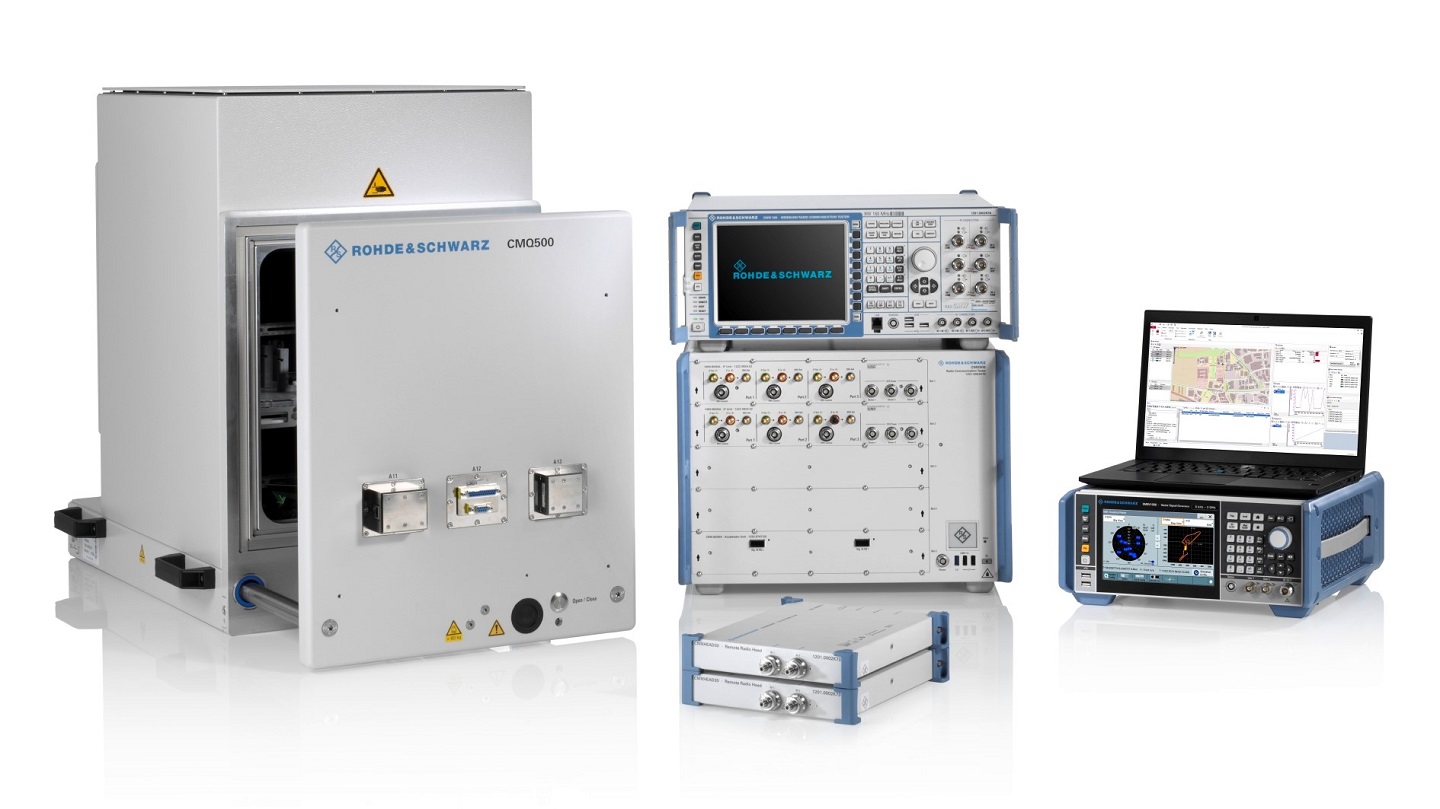
    Photo: Rohde & schwarz
    Photo: Rohde & schwarz

    Rohde & Schwarz and MediaTek have verified new location-based services (LBS) features for 5G new radio (NR), which are now available on the R&S TS-LBS test solution.

    The features will improve emergency caller location and support LBS-related use cases in challenging indoor and outdoor environments with both satellite-based and terrestrial technologies. The R&S TS-LBS now support these and other 3GPP Release 16 network-based positioning features.

    A 5G chipset from MediaTek also has been verified for Release 16, which ensures the chip’s  positioning features.

    The two companies verified the NR positioning reference signals (NR-PRS), which are central to network-based positioning features such as round-trip time (RTT), time difference of arrival in uplink and downlink (UL- TDOA and DL-TDOA), or angle of arrival and departure (AoA and AoD), and which meet the 5G requirements for indoor and outdoor positioning use cases.

    With R&S TS-LBS supporting these features, mobile device and chipset manufacturers as well as test houses and network operators can carry out verification for GCF, PTCRB and network-operator certification using a single test solution.

    About the R&S TS-LBS System

    The R&S TS-LBS is a test system for testing GNSS and network-based positioning. It consists of an R&S CMX500 OBT one-box signaling tester as the network simulator and an R&S SMBV100B GNSS simulator.

    The R&S CMX500 OBT setup provides full network simulation capabilities including the support of multiple 4G or 5G cells at a time. In addition, it provides LBS assistance data to the DUT while the R&S SMBV100B simulates the GNSS satellites.

    The R&S TS-LBS test system can be used for pre-conformance tests and to obtain GCF and PTCRB certification as well as network-operator-specific certification acceptance and validated tests.

    “Adding network-based positioning features such as DL-TDOA based on NR-PRS to the existing satellite based location signals shows the advanced level of our test solution,” said Christoph Pointner, senior vice president, Mobile Radio Testers, Rohde & Schwarz. “We are happy to continue our collaboration with MediaTek to push 5G location-based services further for 3GPP Release 16.”

  • MediaTek’s newest 5G chipset ready for mass-market 5G phones

    MediaTek’s newest 5G chipset ready for mass-market 5G phones

    Photo: MediaTek
    Photo: MediaTek

    MediaTek’s Dimensity 700 5G smartphone chipset is a system on chip (SoC) designed to bring advanced 5G capabilities and experiences to the mass market.

    The Dimensity 700 joins MediaTek’s Dimensity family of 5G chips, which is designed to give device makers a suite of options for 5G smartphone models. The chips range from flagship and premium to mid-range and mass market devices to make 5G more accessible for consumers everywhere.

    GNSS signals received include GPS L1CA and L5, BeiDou B1I and B2, GLONASS L1OF, Galileo E1 and E5, QZSS L1C and L5, and NavIC.

    “With our expanded Dimensity portfolio, we’re bringing the latest 5G capabilities to every smartphone tier so more people can enjoy 5G experiences,” said JC Hsu, corporate vice president and general manager of MediaTek’s Wireless Communications business unit. “The Dimensity 700 has an impressive mix of 5G connectivity features, advanced camera capabilities like night-shot enhancements, and multiple voice assistant support, all in a super power-efficient design.”

    Advanced connectivity features include 5G carrier aggregation (2CC 5G-CA) and 5G dual-SIM dual-standby (DSDS), giving users access to the fastest speeds and 5G-exclusive Voice over New Radio (VoNR) services from either connection, the company said.

    On the processing power side, the chip integrates two Arm Cortex-A76 big cores in its octa-core CPU and operates at up to 2.2GHz.

    MediaTek’s Dimensity 5G family of chips are designed for 5G devices across all tiers, and with the Dimensity 700 5G devices will now be accessible to even more consumers.

    For full specifications and further details on MediaTek’s Dimensity 700 series and 5G portfolio are on the MediaTek website.

  • Autotalks expands in China after C-V2X field test

    Autotalks, a V2X (vehicle-to-everything) communication company, is gaining momentum in the Chinese market following the successful completion of the C-V2X field test with a Chinese technology giant.

    The field trial evidenced Autotalks’ C-V2X capabilities on a public road, including 3GPP release 15 compliant transmit diversity, and remarkable communication range of over 2 kilometers with a nominal range of over 1.5 kilometers.

    As part of its momentum in China, Autotalks is growing its Chinese partner ecosystem and hiring for its operation in this giant market. Autotalks is a member of IMT-2020, CAICV and China ITS Industry Alliance, working on standardization and testing of C-V2X towards mass deployment. The company has also launched a Chinese website.

    China is a fast-growing region in the automotive and intelligent transportation systems (ITS) segments. LTE-V2X technology has been gaining strong momentum in China. In November 2018, Autotalks announced that it has recruited Xiaobing Yang, to lead Autotalks’ business development efforts in China out of Autotalks’ new branch in Beijing. Yang brings to Autotalks more than 25 years of experience in the Chinese telecom industry.

    In 2018, Autotalks launched a global V2X solution supporting both DSRC and LTE-V2X (also known as C-V2X) based on its second-generation mature chipset with the intention of expanding its global footprint into China. Autotalks’ LTE-V2X direct communications (PC5) solution is separated from the cellular Network Access Device (NAD), resulting in a secure and cost-effective standalone LTE-V2X solution.

    Autotalks announced in February that it has partnered with MediaTek. a global fabless semiconductor company that enables 1.5 billion connected devices a year. The two companies are cooperating on integrating V2X and telematics and have completed a joint reference design for Telematics Control Unit (TCU) integrated with a global V2X chipset.

    The reference design is based on Autotalks’ global V2X chipset and MediaTek’s newest technology, an automotive-grade cellular modem SoC, enabling a secure, robust and cost-effective global TCU architecture.

  • Rohde & Schwarz offers test system for A-BeiDou LBS

    Rohde & Schwarz and MediaTek have successfully completed the verification of location-based services (LBS) in the U-plane and C-plane for Assisted Beidou (A-BeiDou), China’s GNSS satellite positioning system.

    The R&S TS-LBS test solution allows mobile manufacturers, chipset manufacturers, test houses and network operators to verify chipsets and mobile devices in order to obtain permission to operate them in a particular network.

    The successful A-BeiDou verification of the MediaTek device under test (DUT) using the Rohde & Schwarz test system marks an important milestone in the GNSS evolution of positioning and navigation. According to Rohde & Schwarz, this was the first time that the setup could be used to validate and verify a device for A-BeiDou location-based services.

    The R&S TS LBS from Rohde & Schwarz is a test system for testing GNSS and network-based LBS. It consists of an R&S CMW500 as the base station simulator and an R&S SMBV100A GNSS simulator. The R&S CMW500 provides assistance data to the DUT and the R&S SMBV100A simulates the BeiDou satellites. The R&S TS-LBS test system can be used to obtain GCF and PTCRB certification as well as network operator-specific certification for chipsets and mobile devices.

    “We are delighted to collaborate with MediaTek and to contribute our test and measurement expertise to the development of A-BeiDou location based services,” said Alexander Pabst, vice president of Systems and Projects within the Rohde & Schwarz Test & Measurement Division. “Rohde & Schwarz already has a strong global footprint with testing solutions for A-GNSS, such as A-GPS or A-GLONASS, and for OTDOA/eCID. Thanks to our close cooperation with our partners, Rohde & Schwarz is committed to accompanying the evolution from existing to new satellite systems such as A-BeiDou with our innovative test and measurement solutions.”

    “MediaTek is committed to developing and testing the latest mobile technologies and standards to drive the industry forward,” said TL Lee, general manager of the Wireless Communications Business Unit at MediaTek. “We have worked closely with Rohde & Schwarz to develop and validate the test solution for A-BeiDou LBS, verifying the A-BeiDou proof-of-concept trial system based on the R&S TS-LBS and MediaTek DUT. This represents an exciting step forward in the evolution of LBS technology, enabling the mobile ecosystem to verify chipsets and mobile devices on the new LBS technology.”

  • ABI Research: Broadcom, Qualcomm continue to dominate GNSS IC vendor space

    ABI Research: Broadcom, Qualcomm continue to dominate GNSS IC vendor space

    The GNSS market landscape is expanding due to the rapid growth of GNSS-enabled wearables and unmanned aerial vehicles (UAVs) coupled with new innovation opportunities around low-cost precision GNSS, according to ABI Research’s latest GNSS IC vendor report.

    In its latest GNSS IC vendor competitive analysis, ABI Research determines Broadcom and Qualcomm remain the two top IC vendors for the fourth year in a row with a mere two points separating MediaTek in third from u-blox in fourth.

    New threats emerge to shake up the landscape in the years ahead, though, with CEC Huada and Samsung now companies to watch, the report said.

    abi-gnss-ic-report Source: GNSS“MediaTek and u-blox once again swapped places,” said Patrick Connolly, Principal Analyst at ABI Research. “U-blox had another stellar year financially and, along with Skytraq, led the way on low-cost precision GNSS with its NEO-M8P module. MediaTek, which showed significant success in wearables and smartphones, transitioned back to third place primarily due to growing market share.”

    Broadcom and Qualcomm remain the two top GNSS IC vendors. Within the past year, Broadcom spurred more headlines with its wearables success and its initial work on L1/L5 dual-frequency receivers. Qualcomm continues to lead in total GNSS shipments, as well as innovative new technologies like LED/VLC and LTE Direct, according to the report. Its partnership with Baidu on its IZat platform is also notable and represents the beginning of the era of “always on, ubiquitous location technologies.”

    But the incumbents are not the only players to watch in this evolving market. CEC Huada and Samsung sit poised to instill great change in the market landscape, as their innovation over the past 12 months serves to prove.

    “CEC Huada developed single frequency RTK GPS, as well as BDS receivers and INS/MEMS receivers, which the company released to select customers in 2016,” Connolly said. “And it is now developing a dual frequency BDS receiver and a receiver for IRNSS. Samsung, meanwhile, launched its first embedded GNSS solution, the Exynos CPU chipset. Given its presence across so many GPS-enabled consumer electronic devices, the company looks set to be a major disruptor in the coming years.”

    Companies Covered

    Broadcom Corporation
    CEC Huada Electronic Design Co Ltd
    Galileo Satellite Navigation
    Intel Corporation
    MediaTek Inc
    Qualcomm Inc
    Samsung
    SkyTraq Technology Inc
    STMicroelectronics
    u-blox AG

  • MediaTek offers hardware development kit for wearables

    MediaTek offers hardware development kit for wearables

    MediaTek has announced the availability of the LinkIt 2523 Hardware Development Kit (HDK) for developers looking to create advanced wearable products. Based on the MediaTek MT2523G chipset, the HDK — produced by Silicon Application Corp (SAC) — offers dual-mode Bluetooth, comprehensive GNSS standards support and industry leading performance in terms of time-to-first-fix, accuracy and power consumption.

    The HDK is designed for developers looking to create sophisticated wearables such as smartwatches, fitness trackers, health monitors, emergency locators and more.

    mt2523-hdk
    MediaTek LinkIt 2523 HDK.

    This new HDK — the second for the LinkIt Development Platform for RTOS — takes advantage of the platform’s common tool chain and set of APIs. It offers developers the ability to create a range of IoT devices using a common software development kit, the MediaTek LinkIt SDK v4. With the HDK launch, the SDK has also been updated to include a new smaller, more efficient Bluetooth stack and various improvements to support the MT2523 chipset variants.

    The goal of the LinkIt Development Platform for RTOS is to make it easy for developers to create code that powers a range of wearables and IoT devices. The new HDK puts MediaTek leading technology in the hands of professional developers to create exciting and compelling wearable products.

    The LinkIt 2523 HDK is developed by SAC, one of MediaTek’s value-added resellers of chipsets and modules, using a hardware board reference design from MediaTek. The HDK provides an easy-to-use IoT development board for the design, prototyping, evaluation and implementation of commercial wearables projects.

    The board offers developers a range of essential features to ensure devices are market ready. Key features of the board include:

    • Robust connectivity with support for dual-mode Bluetooth 2.1 + EDR and Bluetooth 4.2 Low Energy with integral antenna.
    • Fast, low-power, high-precision positioning with integral HDK antenna for GPS and SMA connector for GLONASS, Galileo and BeiDou.
    • Integrated display and versatile peripheral options, including I2C, master and slave SPI, master and slave I2S, PCM, UART, 12-bit ADC and PWM which can be used for a broad range of wearables, including smartwatches, fitness trackers and wristbands incorporating various sensors.
    • Low power consumption achieved by highly integrated SoC using 55nm ultra-low power (ULP) technology from TSMC with Power Management Integrated Circuit (PMIC), and multiple frequency and voltage modes.
    • Flexible power options for external battery and USB (5V) charger.
    • Additional onboard memory (eMMC) or the option to use a microSD card.

    Key features of the LinkIt Development Platform for RTOS include:

    • Based on the popular FreeRTOS with additional open-source modules (source code available).
    • Supports chipsets based on the ARM Cortex-M4 architecture, offering high performance, low power connectivity.
    • Supports multiple chipsets/hardware, including the MT7687F Wi-Fi SoC and the MT2523 Bluetooth/GNSS chipset family.
    • Development and debugging in ARM Keil μVision, IAR Embedded Workbench and GCC.
  • Micro module designed for UAVs, wearables

    GNSS module maker OriginGPS has launched the new Multi Micro Spider, which has a fully integrated and highly sensitive multi-GNSS module, with support for GPS, Glonass, BeiDou and Galileo.

    The Multi Micro Spider is designed for applications that require quick movement, minimal power consumption and ultra-small form factors, such as wearables and drones.

    Like its predecessor, the Multi Micro Hornet (ORG1510-MK), the Multi Micro Spider’s (ORG4033) module utilizes MediaTek’s MT3333 chip and its onboard flash memory to achieve a rapid update rate and positioning speed of up to 10 Hz.

    “With the Multi Micro Spider, we’re breaking new ground in what’s possible with GNSS footprints,” said Gal Jacobi, CEO of OriginGPS. “It’s a plug-and-play solution that will enable developers to easily improve performance of products while shortening time to market. Because of its size, low power consumption and high performance, the Multi Micro Spider is the perfect GPS and GNSS solution to power the location services for a wearable out on the go to a UAV tracking action sports.”

    Key features include:

    • Peak performance with ultra-small size — At just 5.6 mm x 5.6 mm, with a height of 2.65 mm, the Multi Micro Spider packs in a sub-one second Time To First Fix (TTFF) and sensitivity of -165 dBm for two simultaneous constellations. All of this achieved using less than 9 mW of power.
    • OriginGPS’ Noise Free Zone (NFZ) — The ORG4033 utilizes OriginGPS’ patented and proprietary NFZ technology for continued noise immunity and razor-sharp sensitivity even in poor signal conditions.
    • Onboard flash for market-leading update rate — With an onboard flash memory and an update rate of up to 10Hz, the Multi Micro Spider breaks the market’s standard update rate benchmark of 5 Hz for positioning, accurate to within 2.5 meters.
    • Intuitive design that facilitates shorter time to market — The Multi Micro Spider makes use of a developer-friendly design that allows for seamless migration from GPS to GNSS pin-to-pin compatibility. This both reduces overall development costs for new products and shortens their time to market.
    • Easy integration with OriginGPS’ miniature GNSS antenna solutions — The Multi Micro Spider can be easily integrated with the ORG12-4T-GNSS miniature patch antenna to get the best performance out of a compact form-factor.
  • u-blox joins Qualcomm and Broadcom as top three GPS/GNSS IC vendors

    ABI Research’s competitive analysis evaluates GNSS IC vendors across innovation and implementation parameters

    The GNSS market is slowly shifting in new directions, according to ABI Research. While the smartphone market continues to grow, new opportunities are also emerging in automotive, insurance, wearables, unmanned aerial vehicles (UAVs) and the Internet of Things (IoT).

    Overall, the GNSS market is forecast to continue to grow strongly, with ubiquitous location and market-specific IC design as key differentiators.

    In its latest competitive analysis of GNSS IC vendors, ABI Research evaluates a variety of innovation and implementation parameters to determine emerging competitive threats and technologies, the companies best positioned for success and those in danger of losing out.

    Unchanged for the past three years, the market’s two top IC vendors remain Qualcomm and Broadcom, soon to be acquired by Avago. Both companies continually illustrate the ability to lead the way on cutting-edge innovation, which in turn drives their dominant market-share position, ABI Research said.

    Beyond just GNSS, both companies also offer comprehensive location technology platforms in HULA (Broadcom) and Izat (Qualcomm), which will enable smartphone OEMs to begin offering ubiquitous location in 2016. Qualcomm’s work on LED/VLC and LTE Direct illustrates the gap that now exists between it and pure-play GNSS IC vendors.

    u-blox, a well-established GNSS IC company, has shown continuous growth each year by implementing  new technologies and making  acquisitions, culminating in its first ever third place ranking, ABI Research said. The company continues to lead the way in its core markets, while also expanding into the emerging IoT space.

    “The big surprise this year has been MediaTek dropping to fourth place,” said Patrick Connolly, principal analyst at ABI Research. “This is primarily due to a lack of new GNSS or indoor location products. However, this did not affect its IC market share, or its ability to win an important GNSS IC win with Fitbit in wearables. MediaTek has a history of delivering when its customers need new innovation. As a result, ABI Research expects new product announcements from the company in 2016, especially around indoor location.”

    Ranking fifth, STMicroelectronics is seeing customers migrate to its TESEO III platform. Its modular, high-performance approach should also enable it to move beyond its traditional markets of automotive and recreational/fitness, especially as it has begun to leverage the company’s expertise in sensor fusion.

    As new opportunities for GNSS continue to develop in markets such as wearables, IoT, personal tracking and UAVs, there will also be a number of new or emerging companies looking to claim a share in the stakes. Analysis findings point to the Chinese regional market as one such area that has potential to demonstrate strong growth trends in future years.

    “There’s big opportunity for emerging Chinese start-ups, such as CEC Huada, to meet new, indigenous, market demand over the next 10 years, while also working their way toward becoming major international competitors,” concluded Connolly. “Additionally, Galileo Satellite Navigation, an emerging company focused in software GPS, is reporting impressive results in trials. As consumer electronics start supporting software GPS, it will be interesting to watch whether or not it can achieve volume shipments in 2016.”

    These findings are part of ABI Research’s Location Devices Service, which includes research reports, market data, insights and competitive assessments.


  • GlobalTop Unveils Tiny Mediatek Multi-GNSS Module

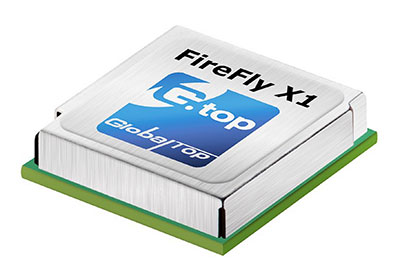
    The GlobalTop Firefly X1 GNSS module.
    The GlobalTop Firefly X1 GNSS module.

    GlobalTop Technology has launched FireFly X1, a tiny Mediatek-based multi-GNSS module. With a compact size of 9.0 x 9.5 x 2.1 millimeters, it’s one of the smallest multi-GNSS modules in the industry, the company said.

    “Compact size and low-power consumption will be the key [unique selling points] for the next generation of M2M Devices,” said Sam Khan, vice CEO of GlobalTop Technology. “After a comprehensive market study, we found that small size was one of the most important factors for companies when it came to GNSS module selection; other key factors included power consumption, TTFF, positioning accuracy, additional interfaces as well as quality and longevity of the module. I am proud to say that FireFly X1 delivers perfectly on all these criteria.”

    According to Khan, the FireFly X1 was designed with “sophisticated engineering and an entirely new set of ultra-compact quality components to reach this miniature size, while adding more features and interfaces at the same time.” It uses the latest MT3333 engine with full support for GPS, QZSS, GLONASS and BeiDou, and is Galileo ready.

    Tracking of up to two constellations simultaneously, and relying on the latest Mediatek firmware, it can provide positioning accuracy of up to 1.8 m CEP. Enabling EASY (self-generated orbit prediction), AGPS (ephermis file injection) and SBAS further enhances position accuracy.

    Despite a smaller size, FireFly X1 incorporates a complete set of high-quality components, including TCXO, RTC Crystal, SMPS, SAW Filter and an additional LNA to provide reliable performance.

    FireFly X1 combines miniature size with flexible multi-interface connectivity options such as SPI and I²C that can simplify a user’s design, and is designed for M2M devices relying on low-cost MCUs that offer limited serial interfaces.

    GlobalTop’s free customization service further expands the capability of FireFly X1 with features such as custom NMEA output sentence, distance calculation, geofencing, magnetic variation and last- position-retention. Advanced users can also customize the basic parameters of the module, including baud rate, update rate, internal logger settings, DGPS mode, 3D Fix, 1 PPS timing, and more.

    All modules are produced at GlobalTop’s in-house ISO 9001:2008 certified manufacturing facility, with 100 percent unit testing and complete quality control, allowing for a consistent annual yield rate of 99.98 percent.

    Samples and Evaluation Kits for FireFly X1 are now available. Please contact us or your local distributor for more information.

  • Qualcomm Tops ABI’s GNSS IC Vendor Assessment, MediaTek Enters Top 3

    Qualcomm Tops ABI’s GNSS IC Vendor Assessment, MediaTek Enters Top 3

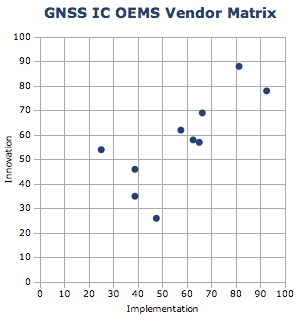
    GNSS-IC-WABI Research’s 2014 GNSS IC vendor matrix names Qualcomm as the leading GPS integrated circuit (IC) vendor, followed by Broadcom in second place. For the first time, MediaTek achieves a top three finish after another year of strong growth and robust shipments as a result of its targeted design strategy, ABI Research revealed in its “GNSS IC OEMs” report.

    The vendor matrix compares companies on 17 criteria across the broader categories of GNSS Innovation and Implementation. Qualcomm remains the dominant player with a strong ubiquitous location platform in IZat — this will be vital for success in high volume cellular handsets in 2015. It is also in a strong position to grow in other GNSS markets.

    Broadcom continues to compete aggressively through innovation, receiving the highest score for this category for yet another year. Already in 2014, Broadcom has announced its concurrent tri-band BCM 47531 IC and the BCM 4771 GNSS SoC designed for wearables, featuring a sensor hub and always-on capabilities. Finally, it has also announced its 5G Wi-Fi SoC, which supports its new proprietary FTM-based AccuLocate technology.

    u-blox has also moved up a position to fourth in this year’s assessment. It continues to grow revenue year-on-year, with little to suggest this will change in the coming year. It is also the first time u-blox has finished ahead of CSR, which was ranked fifth. CSR continues to transition and faces another arduous year in 2014. It will be 2015/16 when the effects of these tough decisions are proven out to be correct or not.

    MediaTek has now emerged as a major threat, taking third on innovation and 2012 market share rankings, following very impressive shipments of its combo ICs into local Chinese smartphone manufacturers. It is also strong on PNDs/recreational and cameras, with a growing presence in other markets. Its move to fully embedded GPS in 2013 should prove significant in driving market share in the future.

    Beyond this, STMicroelectronics also deserves a mention with its new Teseo III platform giving it significant design flexibility allowing it to compete aggressively in existing markets while expanding into new opportunities.

    Other companies discussed include:

    • Cambridge Silicon Radio (CSR)
    • Galileo Satellite Navigation
    • Intel Corporation
    • SkyTraq Technology, Inc.
    • Texas Instruments Inc.